
 Worksheets
Africa Storyline: Elephants & Plants
Total questions: 100
Worksheet time: 1hrs 19mins
What is the first phase of mitosis?
Metaphase
Anaphase
Prophase
Telophase
During which phase of mitosis do the chromosomes align at the cell's equatorial plane?
Prophase
Metaphase
Anaphase
Telophase
Explain how the chromosome number changes during mitosis.
The chromosome number doubles.
The chromosome number is halved.
The chromosome number remains the same.
The chromosome number becomes zero.
Which phase of mitosis is characterized by the separation of sister chromatids?
Prophase
Metaphase
Anaphase
Telophase
Describe the changes that occur to the nuclear envelope during mitosis.
It remains intact throughout mitosis.
It disintegrates during prophase and reforms during telophase.
It disintegrates during metaphase and reforms during anaphase.
It reforms during prophase and disintegrates during telophase.
During which phase of mitosis do the spindle fibers attach to the centromeres of the chromosomes?
Prophase
Metaphase
Anaphase
Telophase
Analyze the role of spindle fibers in the distribution of chromosomes during mitosis.
They help in the replication of DNA.
They attach to chromosomes and help in their movement.
They dissolve the nuclear envelope.
They provide energy for cell division.
What happens to the chromosome number in a cell after it completes mitosis?
It doubles.
It is halved.
It remains unchanged.
It becomes zero.
Evaluate the importance of mitosis in maintaining genetic stability in organisms.
It allows for genetic variation.
It ensures that each daughter cell receives an identical set of chromosomes.
It reduces the chromosome number by half.
It creates new genetic combinations.
During which phase of mitosis do the chromosomes de-condense and the nuclear envelope re-forms?
Prophase
Metaphase
Anaphase
Telophase
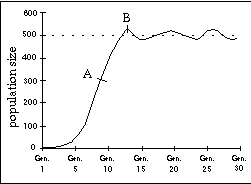
What is the carrying capacity of the graph?
around 500
more than 800
less than 300
around 700
Why don't populations grow indefinitely?
limiting factors
only biotic factors
only abiotic factors
none of the above

Natural selection explains HOW organisms change over time. What is the process in which populations are changed over time?
Digestion
Elimination
Evolution
Adaptation
What word describes a trait that helps an organism survive in its environment?
natural selection
mutation
camouflage
adaptation
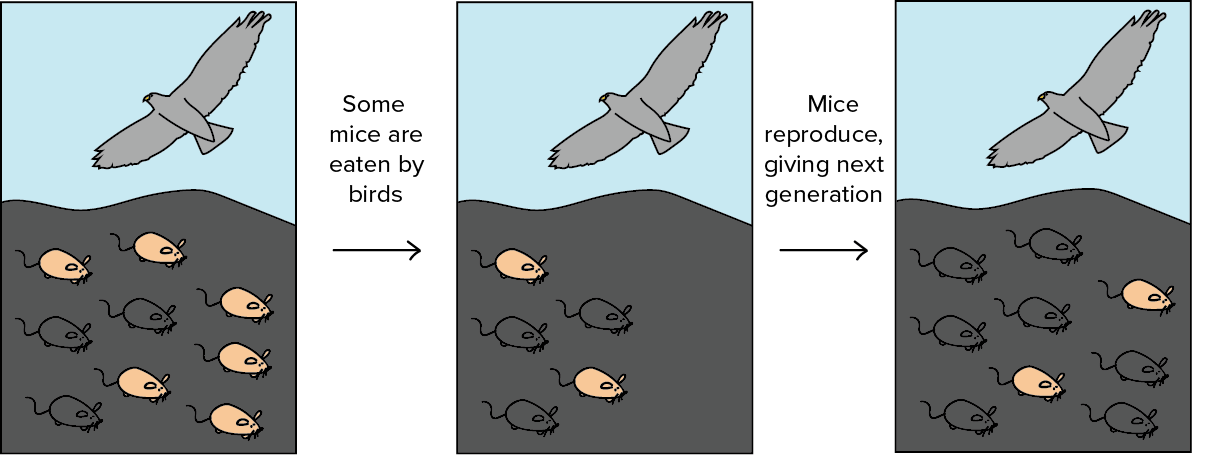
Why is the mouse population changing over time? (You can enlarge the picture by placing your cursor on it.)
The light mice can reproduce more successfully than the dark mice
The hawks eat more dark mice than light mice because the dark mice taste better
The hawks eat more light mice than dark mice because they can see the light mice more easily
The hawks eat more dark mice than light mice because they can see the dark mice more easily
Which organisms are most likely to survive?
the best adapted (best fit)
the fastest
the strongest
the most domesticated (tamed)
According to natural selection, light colored tree trunks would favor ___________________________.
light colored moths
dark colored moths
red colored moths
red and light colored moths
Why are advantageous (better fit) traits more likely to be passed onto offspring?
They are more likely to survive and reproduce.
They are more likely to die and not reproduce.
They are able to reproduce more offspring.

A slight difference in an inherited trait between individual members of the same species. (Example: Some rabbits have white fur and some have black fur.)
variations
adapatations
homologous structures
analogous structures
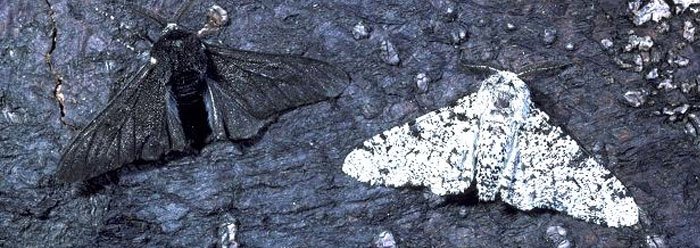
The trees these moths used to live on were white, but have been covered in soot from coal factories. Which moth will be more successful in this environment?
Dark moth
Light moth
Both will be equally successful
Neither will be successful
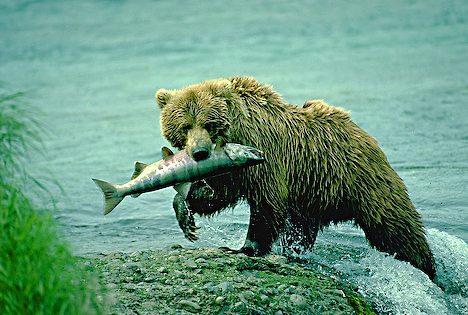
A grizzly bear survives because he is well-adapted (best fit) to his environment. When he reproduces he passes on those traits to his offspring. this process is called
Natural Selection
Selective Breeding
Random mutations
Variations in a species
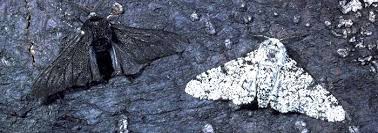
Predict which moth would increase in population over time.
light colored
dark colored
What is the correct equation for cellular respiration?
oxygen + sugar -> carbon dioxide + water + Energy
carbon dioxide + sugar + Energy -> carbon dioxide + water
carbon dioxide + water -> oxygen + sugar + Energy
carbon dioxide + water + Energy -> oxygen + sugar
What is important about cellular respiration?
It produces energy from the sun.
It forms sugar.
It transforms sugar into a usable form of energy (ATP)
Only plants perform this process.
What's the chemical formula for glucose?
6C6H12O6
C12H6O12
C6H12O6
CHO


Glucose molecules store _____________.
chemical energy
kinetic energy
gravitational potential energy
heat energy
The energy stored in glucose is transferred to ________________.
A molecule known as ATP
A molecule known as ADP
water molecules
oxygen molecules
Which of the following is a product of cellular respiration?
Radiant Energy
Oxygen
Glucose
Water
Which statement is true regarding cellular respiration?
The reactants of cellular respiration are identical to the reactants of photosynthesis.
The reactants of cellular respiration are obtained from the products of photosynthesis.
The products of cellular respiration are the same as the products of photosynthesis
Cellular respiration only occurs in autotrophs, photosynthesis occurs only in heterotrophs.
Which of the following are reactants of photosynthesis?
CO2 and H2O
O2
H2O and Glucose
None of the above
Photosynthesis produces Glucose for plants. This is a form of __________________________ for plants.
Chemical energy
Thermal energy
Light energy
Radiant energy
In which organelle does photosynthesis occur?
Cell Wall
Chlorophyll
Chloroplast
Cytoplasm
What are the end products of photosynthesis?
Carbon Dioxide and Water
Glucose and Carbon Dioxide
Oxygen and Glucose
Water and Glucose
Energy from cellular respiration is released as ATP and....
Solar Energy
Heat Energy
Potential Energy
Kinetic Energy
Cells differentiate because...
They have identical DNA, but their genes cause them to perform different functions
They have different DNA

Cytokinesis is the first stage of mitosis.
True
False


Identify letter "a" in the image.
prophase
G1
interphase
telophase
What is the primary source of energy for cells?
glucose
oxygen
water
protein
What is the process by which cells convert glucose into ATP?
fermentation
cellular respiration
mitosis
photosynthesis
Which organelle is responsible for cellular respiration?
Mitochondria
Golgi Apparatus
Lysosome
Ribosome
What is the equation for cellular respiration?
C6H12O6 + 6O2 -> 6CO2 + 6H2O
C6H12O6 + 6O2 -> 6CO2 + 6H2O + ATP
C6H12O6 + 6O2 -> 6CO2 + 6H2O + Energy
C6H12O6 + 6O2 -> 6CO2 + 6H2O + Glucose
What is the purpose of cellular respiration?
To convert glucose and oxygen into energy (ATP) and release carbon monoxide and water as waste products.
To convert glucose and oxygen into energy (ATP) and release glucose and water as waste products.
To convert glucose and oxygen into energy (ATP) and release oxygen and water as waste products.
To convert glucose and oxygen into energy (ATP) and release carbon dioxide and water as waste products.
What is the main product of cellular respiration?
ATP
Water
Carbon dioxide
Glucose
What is the waste product of cellular respiration?
Carbon dioxide
Water
Glucose
Oxygen
What is the process by which plants convert sunlight into glucose?
germination
transpiration
respiration
photosynthesis
Which organelle is responsible for photosynthesis?
Nucleus
Mitochondria
Chloroplast
Endoplasmic reticulum
What is the equation for photosynthesis?
6CO2 + 6H2O + ATP → C6H12O6 + 6O2
6CO2 + 6H2O + heat energy → C6H12O6 + 6O2
6CO2 + 6H2O + light energy → C6H12O6 + 6O2
6CO2 + 6H2O + glucose → C6H12O6 + 6O2
What is the purpose of photosynthesis?
The purpose of photosynthesis is to produce waste and release toxins.
The purpose of photosynthesis is to produce water and release carbon dioxide.
The purpose of photosynthesis is to produce food and release oxygen.
The purpose of photosynthesis is to produce energy and release nitrogen.
What is the primary pigment involved in photosynthesis?
Melanin
Chlorophyll
Hemoglobin
Carotene
What gas is released during photosynthesis?
Oxygen gas (O2)
Carbon dioxide (CO2)
Methane gas (CH4)
Nitrogen gas (N2)

The largest number of individuals that an environment can support long term is...
carrying capacity
emigration
immigration
population density

What happens if a population grows past its carrying capacity?
The population keeps growing
The population starts to die off
The entire species will go extinct
The carrying capacity just increases
This may cause a population to increase
increase of food supply
removal of predators
removal of disease
all of these

What is the carrying capacity of the graph?
1000
8000
800
600
What are factors that affect carrying capacity?
Biotic only
Biotic and abiotic
Depends on the ecosystem
Abiotic only
When humans burn fossil fuels, most of the carbon quickly enters the as carbon dioxide.
Air
Atmosphere
Sun
Water
During photosynthesis, carbon is moved from which reservoir to which reservoir?
From the atmosphere to the terrestrial biosphere.
From the troposphere to the terrestrial biosphere.
From the lithosphere to the terrestrial biosphere.
From the hydrosphere to the terrestrial biosphere
How does carbon in a grass plant get into a lion?
Carbon from grass doesn't end up in a lion.
The lion eats an antelope that ate the grass
Carbon from grass doesn't end up in a lion.
The lion breathes in carbon given out by the plant
Carbon molecules cannot be created or destroyed
True
False

Why does this picture demonstrate the Law of Conservation of Mass?
the number of atoms of each element are the same on both sides
they start out separate and end up combined
the same elements are used
it doesn't demonstrate the Law of Conservation of Mass
Biodiversity, aka biological diversity, usually refers to
the same species in a general location
the number of different species in a given area
the number of animal species in a given area
the number of plant species in a given area

Food Web B is an example of...
Low biodiversity and low sustainability. If the producer dies then all the food web will suffer.
High biodiversity and high sustainability. If an organism is removed the food web will continue with no effect.

High biodiversity is a sign of a healthy ecosystem.
True
False
What are some ways we can help in maintaining biodiversity?
Get involved with ecological restoration in your area.
Prevent invasive species from overpopulating.
Don't use chemical pesticides on crops.
All of the above
What is Cell differentiation?
The process of cell divison
The process of cells becoming specialized for specific functions
The process of cells becoming identical
The process of cells becoming mutated
What is gene regulation?
DNA Replication
The formation of new genes within the DNA
Uncontrolled cell growth with damaged DNA
The expression of genes to in order to create cell types
Which of the following best describes Specialized Cells?
They can divide rapidly
They are identical to all other cells in the organism
They have specific structures and functions
They are only found in cancerous cells
Cells differentiate to perform different functions because
all genes are turned on inside that cell
all genes are turned off inside that cell
different genes are turned on inside that cell
different genes are turned on or off inside that cell
G1, S, G2 are all part of what stage of the cell cycle?
Cytokinesis
Interphase
Mitosis
Telophase

The life of a cell is called the cell cycle. Which period of the cell cycle is where cells grow and perform their normal functions?
Interphase
Mitosis
Cytokinesis
Cell Division
A statement that answer the question.
claim
evidence
reasoning
The scientific data and details that support your claim
claim
evidence
reasoning
Explains 'how' or 'why' the evidence supports the claim.
claim
evidence
reasoning
What is niche partitioning?
The process of combining resources to increase competition among species.
The sharing of unlimited resources among different species to promote competition.
The elimination of resources to reduce competition and allow coexistence.
The division of limited resources among different species to reduce competition and allow coexistence.
What happens when two species have overlapping niches?
The two species will learn how to cooperate with each other.
Increase in population size for both species.
Competition for resources and potential decrease in population size or loss of one species in that ecosystem.
There is no effect or impact on the population size or survival of either species.
How does competition affect species diversity?
It increases species diversity.
It promotes species diversity.
It has no effect on species diversity.
It reduces species diversity.
What is biodiversity?
The number of individuals of a species in an area.

Which result is most likely to occur to the beetle population due to predation over time?
The number of light-colored beetles in the population will increase.
There will be more dark-colored beetles than light-colored beetles.
The number of light-colored beetles will decrease.
The dark-colored beetles will move to a different type of tree.
Adaptations that result from natural selection are expected to increase the fitness of an organism. In terms of natural selection, which of the following best describes fitness?
Being able to escape from predators
Being among the strongest organisms in a population
Being able to survive, find a mate, and produce offspring
Being able to survive long enough to reach the adult stage
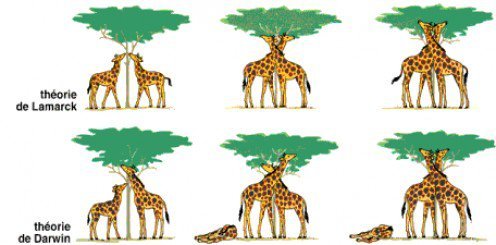

This is the "genetic material" that is inside of cells.
DNA
Ribosomes
Lysosomes
Vacuole

This is the organelle where energy is created in the form of ATP. Also known as the powerhouse of the cell.
Lysosomes
Nucleus
Chloroplasts
Mitochondria

