
 Worksheets
Bio30 Unit 5
Total questions: 133
Worksheet time: 4hrs 26mins
What is the study of why species live where they do called?
Fossil Record
Biogeography
Gene Flow
Adaptive Radiation
What term describes a species' ability to evolve into many new species, usually after a mass extinction?
Microevolution
Macroevolution
Adaptive Radiation
Genetic Drift
What is the term for genetic drift that occurs when a population becomes suddenly smaller?
Founder Effect
Bottleneck Effect
Coevolution
Gradualism
What is the term for evolution that happens over a long slow process?
Punctuated Equilibrium
Gradualism
Adaptive Radiation
Microevolution
What is the term for small changes within a population over a small amount of time?
Macroevolution
Microevolution
Adaptive Radiation
Genetic Drift
In the Hardy-Weinberg equation, what does "p" represent?
Frequency of homozygous recessive
Frequency of heterozygous
Dominant allele frequency
Recessive allele frequency
What type of selection occurs when phenotypes at both extremes are selected against?
Disruptive selection
Stabilizing selection
Directional selection
Natural selection
What is an example of directional selection mentioned in the text?
Body height differences
Beak size of finches on Galapagos
Large and small babies
Hybrid species of squirrels
What is the process by which a new species evolves called?
Natural selection
Speciation
Genetic drift
Gene flow
Which example illustrates sympatric speciation?
North American squirrels separated by states
Apple vs hawthorn bush flies
Beak size of finches
Large and small babies
What does "q^2" represent in the Hardy-Weinberg equation?
Frequency of homozygous dominant
Frequency of heterozygous
Frequency of homozygous recessive
Dominant allele frequency
Which of the following is a condition for maintaining Hardy-Weinberg equilibrium?
Natural selection
Large population size
High mutation rate
Geographic separation
What is the significance of vestigial structures in evolutionary biology?
They are fully functional in all species.
They serve no purpose in understanding evolution.
They are remnants of structures that had functions in ancestors.
They are unique to humans.
What is the concept of punctuated equilibrium in evolution?
Evolution occurs at a constant, slow pace.
Evolution happens in rapid bursts followed by long periods of stability.
Evolution is unpredictable and random.
Evolution does not occur.
What is the term for the process where two species evolve in response to changes in each other?
Coevolution
Divergent Evolution
Convergent Evolution
Parallel Evolution
Which of the following is an example of convergent evolution?
Wings of bats and birds
Beak variations in Darwin's finches
Different breeds of dogs
Color variations in peppered moths
What is the term for the random change in allele frequencies in a population?
Natural Selection
Gene Flow
Genetic Drift
Mutation
What is the term for the process by which organisms better adapted to their environment tend to survive and produce more offspring?
Natural Selection
Mutation
Gene Flow
Genetic Drift
Which of the following is an example of divergent evolution?
Wings of bats and birds
Beak variations in Darwin's finches
Different breeds of dogs
Color variations in peppered moths
What is the term for the evolutionary process where a single species evolves into several distinct species?
Adaptive Radiation
Convergent Evolution
Coevolution
Parallel Evolution

Based on the data given in the table, which two are most closely related?
Human & Gorilla
Gorilla & Orangutan
Human & Chimpanzee
Chimpanzee & Orangutan

Based on the given cladogram, which organism is the outgroup?
Human
Chimpanzee
Gorilla
Orangutan
Gibbon

Based on the figure, which organism is most closely related to the polar bear?
Black Bear
European Brown Bear
Western North American Brown Bear
Asian Brown Bear

Based on the figure, how long ago was the common ancestor of the European Brown Bear and the Asian Brown Bear?
4.5 hundreds of thousands of years ago
3.5 hundreds of thousands of years ago
2.2 hundreds of thousands of years ago
1.4 hundreds of thousands of years ago
Which evidence would be the most accurate when developing a cladogram?
Morphological
Molecular
Ecological
Fossil

Based on the figure, which three organisms are closely related?
Cat, Horse, Human
Cat, Horse, Pig
Cow, Horse, Human
Cow, Horse, Pig
Which of these is a condition that must be met for Hardy-Weinberg equilibrium?
Extremely small population size
No natural selection
Gene flow
Nonrandom mating
What does p stand for?
Dominant allele
Recessive allele
Homozygous dominant
Homozygous recessive
Heterozygous
Which of the following is the equation that you would use for Hardy-Weinberg?
p + 2q = 1
2p + 2q = 1
2p + q = 1
p + q = 1
Which of the following is the equation that you use for Hardy-Weinberg equilibrium?
p2 +2pq + q2 = 1
p2 + q2 = 1
p3 + q3 = 1
p3 + 3pq + q3 = 1
In generation 1, the recessive allele has a frequency of 0.6, and in generation 40 the recessive phenotype has a frequency of 0.36. Is the population in Hardy-Weinberg?
No, the frequency changed from one generation to another
Yes, the frequency changed from one generation to another
No, the frequency remained the same from one generation to another
Yes, the frequency remained the same from one generation to another
If there are 400 red flowers, 200 pink flowers, and 100 white flowers. Solve for the frequency of the dominant allele.
0.76
0.86
0.57
0.71
If a population is suffering from genetic drift, which of the Hardy-Weinberg conditions is not being met?
No gene flow
Random mating
Extremely large population size
No mutations
Mutations are a change in what?
DNA
tRNA
protein
rRNA
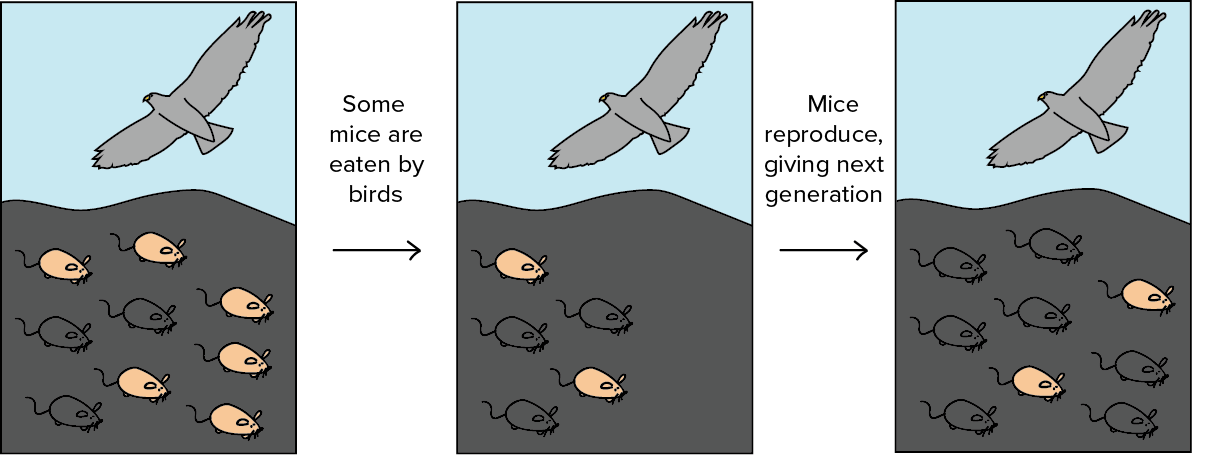

"Organisms that are better adapted to the environment survive to pass traits to their offspring" is the definition of
Natural Selection
Evolution
Selective Breeding
Artificial Selection
Which best describes the role of mutations in natural selection?
Mutations help an organism to better survive in their environment
An organism may acquire a helpful mutation by interacting with the environment
A mutation may result in a beneficial trait that makes an organism more likely to survive and reproduce
Organisms with certain traits are more likely to win competitions for mutations
Mutations are important because they bring about
death of the organism in which they develop
genetic variation needed for a population to evolve
benefits for the individual, not for the population
changes in genotype, but not phenotype
Which of the following is a situation that could cause evolutionary change that is NOT due to natural selection?
A volcano erupts and kills many individuals in a population.
A mutation produces sea stars that are less visible to predators.
An insecticide is sprayed in a community to combat mosquitoes.
Cattle are treated with antibiotics to prevent the spread of infections.
What is the movement of genes into or out of a population
(Can cause a population to evolve)
Genetic Drift
Hydrosphere
Open and close systems
Gene Flow
Do individuals evolve?
individuals evolve only if they are male
Individuals don't evolve but populations do
Individuals don't evolve because they cant fly
we do

Which of the following species is extinct?
J
A
B
C

Does the perch have jaws
yes
no

Which organisms from this cladogram are more closely related Perch and Lizard OR Salamander and Pigeon?
Perch and Lizard
Salamander and Pigeon

Because whales have a pelvis and femurs, it shows whales could be descended from an ancestor that was able to _____________________.
walk
sing
swim
polka
Humans, birds, whales, and lizards all have similar arm bones. What is a possible reason for this?
Which type of cell does NOT contain membrane-bound organelles?
plant cells
animal cells
prokaryotic cells
eukaryotic cells
Which of the following is evidence to support the endosymbiotic theory?
Mitochondria and chloroplasts have their own DNA, which is similar to prokaryotic DNA.
Fossil evidence shows that the first forms of life were prokaryotic cells.
All eukaryotic cells have a double-layered membrane composed of phosplipids and proteins.
Prokaryotes have the same number and types of enzymes as eukaryotes.

What is the main evidence for the evolution of the last universal common ancestor in the vicinity of hydrothermal vents?
Fossilized evidence of life from ancient seafloor hydrothermal vent precipitates
Fossilized evidence of life from ancient deserts
Fossilized evidence of life from ancient forests
Fossilized evidence of life from ancient oceans
What does LUCA stand for?
Last Universal Common Ancestor
Last Universal Created Animal
Lengthy Uniform Cohesive Antiparallel
Last Uniform Created Analogies
What were the conditions on early Earth that may have led to the spontaneous formation of carbon compounds?
High concentrations of oxygen and ozone
Low concentrations of carbon dioxide and methane
High concentrations of carbon dioxide and methane
Low concentrations of oxygen and ozone
What were the necessary requirements for the evolution of the first cells?
Formation of carbon compounds, self-replication of molecules, polymerization, and emergence of compartmentalization
High concentrations of oxygen and low concentrations of ozone
The formation of DNA
High concentrations of carbon dioxide and methane
Why is the formation of a membrane-bound compartment important for the origin of life?
It allows internal chemistry to be different from that outside the compartment
It allows for the replication of RNA
It allows for the formation of carbon compounds
It allows for the emergence of compartmentalization
What is RNA's role in the presumed first genetic material?
It acts as the genetic material and the enzymes of the earliest cells
It acts as the catalyst for peptide bond formation
It acts as the membrane-bound compartment
It acts as the last universal common ancestor
What is secondary endosymbiosis?
The process of eukaryote cells evolving into prokaryote cells
The process of prokaryote cells evolving into eukaryote cells
The process of eukaryote cells engulfing other eukaryote cells
The process of prokaryote cells engulfing other prokaryote cells
Punctuated Equilibrium is defined as -
slow changes over time
sudden changes followed by stasis (no change)
Gradualism is defined as -
slow changes over time
sudden changes followed by stasis (no change)
What type of evidence is found in layers of rock?
Fossil Evidence
Biogeographical Evidence
Structural Evidence
Molecular Evidence
What type of evidence came from the theory of Pangaea (a super continent)?
Fossil Evidence
Biogeographical Evidence
Structural Evidence
Molecular Evidence
DNA evidence is also known as -
Fossil Evidence
Biogeographical Evidence
Structural Evidence
Molecular Evidence
Structures that are no longer used by organisms, such as whales' pelvic bones, are known as what type of structural evidence?
Vestigial
Analogous
Fossil
Homologous
Structures that are similar in different organisms are called -
Vestigial
Analogous
Fossil
Homologous
Vestigial structures provide evidence of evolutionary history. For example, ostriches may not fly, but they do have wings indicating that they -
have an ancestor that used to fly
like to have wings for show
use their wings to float, not fly
Which taxonomic category is higher than the others?
Class
Genus
Family
Phylum

An organism identified with binomial nomenclature includes which two taxa?
class and order
family and genus
genus and species
kingdom and phylum
What is the genus name here?
Canis lupus
Canis
lupus
Canis lupus
lupus canis

What is the order of the taxonomic levels from least specific to most specific?
Kingdom, Family, Species, Order, Class, Phylum, Genus
Kingdom, Phylum, Class, Order, Family, Genus, Species
Species, Order, Kingdom, Family, Genus, Phylum, Class
Species, Genus, Family, Order, Class, Phylum, Kingdom
Name them:


Classification system in which each species is assigned a two-part scientific name
Scientific Name
Derived Character
Binomial Nomenclature
Clade
Who proposed a mechanism for how animals evolved before Charles Darwin?
Jean-Baptiste Lamarck
Alfred Russel Wallace
Gregor Mendel
Isaac Newton
How did Darwin propose changes within a species occur?
Through a gradual process over time
By individuals acquiring traits during their lifetime
By divine intervention
Through sudden mutations
Who wrote to Darwin about having developed a similar theory of evolution?
Alfred Russel Wallace
Gregor Mendel
Thomas Malthus
Jean-Baptiste Lamarck
What was Darwin's voyage that changed his life and science forever?
Journey on the HMS Challenger
Expedition on the HMS Endeavour
Voyage on the HMS Beagle
Travel on the HMS Victory
Different beak sizes indicates
same diets
different environments
similar environments
different diets
Which of the following does not show genetic drift?


Which of the following best describes what the image represents?
Natural Selection
Artificial Selection
Mutation
Genetic Drift
Which of the following is the correct definition of natural selection?
The idea that organisms less equipped for their environment tend to survive longer
The idea that organisms more well equipped for their environment tend to survive longer
The idea that organisms more well equipped for their environment tend to not survive
None.
Which of the following represents genetic drift?


Which of the following represents migration?


Which of the following represents gene flow?


the movement of genes into or out of a population
Gene Flow
Random chance; small population
Genetic Drift
A sudden change in one or more characteristics due to a change in a gene
Mutation
Occurs due to physical difference as a result of a genetic difference
Non-Random Mating
The movement of organisms from one place to another
Migration

Which of the following best describes what the image represents?
Genetic Drift
Migration
Mutation
Natural Selection

White tigers are becoming extinct, to overcome this a male and female white tiger are paired together in captivity to help their population continue to grow. This is an example of:
Natural Selection
Gene Flow
Artificial Selection
Genetic Drift

Blue catfish are going extinct. A dam in a lake full of blue catfish bursts due to poor engineering and kills some of the blue catfish. This is an example of:
Natural Selection
Gene Flow
Mutation
Genetic Drift
A type of genetic drift in which small groups of organisms separate from a larger population and form new small colonies.
Gene Flow
Founder Effect
Natural Selection
Artificial Selection
The exchange of genes between two populations.
Genetic Drift
Founder Effect
Gene Flow
Genetic Recombination
This term refers to the total genetic information found in a population; the complete collection of all the alleles found in a population
Gene library
Genome
Gene pool
Allele pool
This is one of the mechanisms of evolution; it occurs when individuals move into or out of a population, either by physically arriving or leaving, or by being born or dying
Gene flow / genetic drift
Founder effect
Natural selection
Microevolution
This is one of the mechanisms of evolution; it is a continuous process in which organisms with traits that make them better-adapted to their environment are more likely to survive and reproduce than organisms without such adaptations
Directional selection
Microevolution
Gene flow / genetic drift
Natural selection
This is a pattern of natural selection where one extreme form of a trait is more advantageous than the average or the opposite extreme; as a result, this trait in the population tends to evolve towards that one extreme
Directional selection
Disruptive selection
Stabilizing selection
Forward selection
This is the pattern of natural selection where BOTH of the extreme versions of a trait are more advantageous than the average, so a population evolves in both directions away from the average
Directional Selection
Disruptive Selection
Stabilizing Selection
Radical Selection
This occurs when a large population is drastically reduced by an event such as a natural disaster; the population's new gene pool only contains alleles from the survivors
Founder effect
Bottleneck effect
Meteor effect
Natural selection
This is the process that ultimately creates new variations and changes in DNA; leads to the creation of new alleles
Mutation
Microevolution
Natural selection
Gene flow / genetic drift
This is a pattern of natural selection in which the average (or intermediate) form of a trait is the most advantageous, and so a population evolves away from the extremes and toward the average
Disruptive selection
Directional selection
Stabilizing selection
Middle selection
The rock pocket mouse is a species of mouse that lives among the rocky outcroppings in the deserts of the Southwestern US. Researchers have observed that it is advantageous for these mice to have either a very dark or a very light fur color; this is because the very light color allows them to hide among light-colored rocks, and the very dark color allows them to hide among darker, volcanic rocks. The intermediate-colored mice cannot hide as well on either type of rock, and so are at a disadvantage. What type/pattern of natural selection would you expect to occur here?
Stabilizing selection
Disruptive selection
Directional selection
None of these are correct
What do we call a change in the genome over time?
Evolution
Adaptation
Extinction
Environmental influences


What mechanism of evolution occurs when allele frequencies change over generations due to random chance?
Genetic Drift
Mutation
Natural Selection
Gene Flow
A small group of squirrels gets separates them from the rest of the population due to a large flood. These squirrels, now confined to this new island, begin to start a new population. This is an example of which of the following?
Founder effect
Bottleneck effect
Natural Selection
Gene Flow


What type of natural selection is this?
Disruptive Selection
Directional Selection
Stabilizing Selection
Natural Selection

The formation of a new species is called
Natural selection
Struggle for existence
Speciation
Darwinism
A new river forms and splits two populations, causing ______________ speciation
Sympatric
Allopatric
Extreme
Convergent
A speciation in which new species evolve from a single ancestral species while inhabiting the SAME geographic region.
Sympatric speciation
Allopatric speciation
Complex speciation
Divergent speciation
Orcas occur in the same habitat but some are avoiding each other and do not interbreed. They have different diets, vocal behavior, and social structures. What type of speciation is this?
Allopatric
Sympatric
Complex
Covergent
when the organism develops different courtship rituals which do not attract main population this is a part of ____________ speciation.
Allopatric
Sympatric
Simple
Temporal
The emergence of a mountain range is an event that would lead to _______________ speciation
Allopatric
Sympatric
Temporal
Behavioral
The emergence of new rivers or streams is a type of ____________ isolation.
Temporal
Mechanical
Behavioral
Geographic
When the Grand Canyon in Arizona formed, two populations of one squirrel species were separated by the giant canyon. This is an example of _____________ speciation.
Allopatric
Sympatric
Simple
Divergent
Different finch populations lived on separate islands with different environments. They evolved to best adapt to those particular environments and can no longer mate. What type of speciation is this?
Allopatric
Sympatric
Temporal
Mechanical

