
 Worksheets
🚀8.28 (Climb the Mountain)
Total questions: 111
Worksheet time: 58mins

Which of the following are examples of physical properties? (Select all that apply)
Color and texture
Melting point and boiling point
Shape and size
Ability to react with acid
Ability to burn

What is the main difference between physical and chemical properties?
Physical properties can be measured, chemical properties cannot
Physical properties describe appearance, chemical properties describe the ability to undergo chemical reactions
Physical properties change with temperature, chemical properties do not
Physical properties are only found in solids, chemical properties are only found in gases

A sample has a mass of 45 grams and a volume of 15 mL. What is its density?
2.5 g/mL
3.0 g/mL
4.5 g/mL
30 g/mL

Why does a helium balloon float in air?
Helium molecules are lighter than air molecules
Helium has a lower density than air
Helium molecules move faster than air molecules
Helium takes up more space than air
A student claims that when wood burns, matter is destroyed because the wood disappears. Which scientific principle can be used to evaluate this claim?
The Law of Conservation of Energy
The Law of Conservation of Mass
The Particle Theory of Matter
The Law of Definite Proportions

An oil spill cleanup crew needs to separate oil from water. Which properties make this separation possible?
Oil and water do not mix
Oil has a different color than water
Oil and water have different boiling points
Oil floats on top of water
Oil is less dense than water

Dry ice (solid carbon dioxide) changes directly from solid to gas at room temperature. This process is called:
Melting
Evaporation
Sublimation
Condensation

Which of the following processes are examples of physical changes? (Select all that apply)
Paper burning to ash
Sugar dissolving in coffee
Ice melting into water
Water boiling to steam
Clay being molded into a pot

A student claims that when water vapor condenses into liquid water, it becomes a different substance. Which evidence would best refute this claim?
The water looks the same before and after condensation
The process can be reversed by heating
Both water vapor and liquid water have the same chemical formula (H₂O)
The temperature changes during condensation

Which method will allow a person to identify an unknown sample of matter?
Measure the temperature of the sample, and compare it to the temperatures of different samples of elements.
Compare the size of the sample to the sizes of different samples of elements.
Calculate the density of the sample, and compare it to the densities of different elements.
Compare the color of the sample to the colors of different elements.
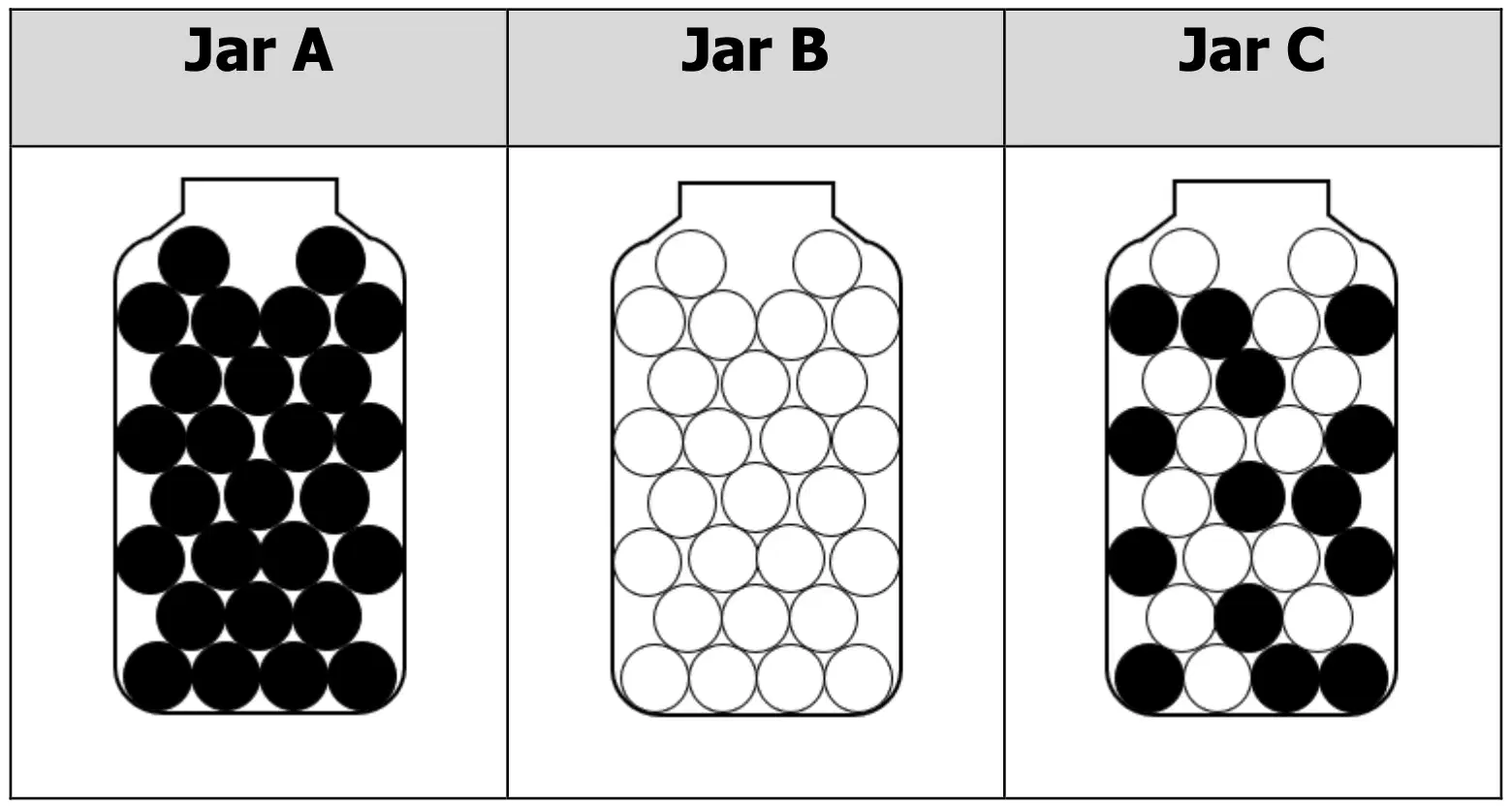
The student wants to model a chemical reaction using marbles from Jar A and Jar B. Which table shows one possible combination of the number of marbles the student can use to show a reaction that follows the Law of Conservation of Mass?
Jar A: 5, Jar B: 5, Products: 5
Jar A: 10, Jar B: 3, Products: 9
Jar A: 4, Jar B: 3, Products: 7
Jar A: 2, Jar B: 8, Products: 6

Which model represents the change in state of dry ice at room temperature? Dry ice undergoes sublimation at room temperature.
[Model showing closely packed particles changing to widely spaced particles]
[Model showing loosely packed particles changing to closely packed particles]
[Model showing widely spaced particles changing to closely packed particles]
[Model showing loosely packed particles changing to widely spaced particles]

What is density, and how does it help identify substances?
Density is the amount of space something takes up and changes based on sample size
Density is mass divided by volume and remains constant regardless of sample size
Density is the weight of an object and varies with location
Density is the color of a substance and helps with visual identification

A student has three different materials: aluminum (2.7 g/cm³), cork (0.24 g/cm³), and water (1.0 g/cm³). If all three are placed in a container together, what will happen?
All materials will float on top of each other
Aluminum will float, cork will sink, water will be in the middle
Cork will float on water, aluminum will sink to the bottom
All materials will mix together evenly
According to the Law of Conservation of Matter (LOCM), what happens to matter during physical and chemical changes?
Matter can be created but not destroyed
Matter can be destroyed but not created
Matter cannot be created or destroyed, only transformed
Matter is constantly being created and destroyed

Which of the following represents the correct arrangement of particles as matter changes from solid to liquid to gas?
Tightly packed → loosely arranged → far apart with high motion
Far apart → tightly packed → loosely arranged
Loosely arranged → far apart → tightly packed
Random arrangement in all three states

A student observes the following during an experiment: fizzing, temperature increase, and color change. Which indicators suggest a chemical change occurred?
Fizzing (gas production)
Temperature increase
Color change
All of the above are chemical change indicators

A sample of matter has a definite shape and definite volume. The particles are tightly packed and vibrate in place. This describes which state of matter?
Gas
Liquid
Solid
Plasma

When heat energy is added to matter, what happens to particle motion?
Particles slow down and get closer together
Particles speed up and spread out
Particles stop moving completely
Particle motion remains unchanged

Which of the following are examples of physical properties?
Color
Flammability
State of matter at room temperature
Density
Reactivity with acids

During sublimation, matter changes directly from:
Solid to liquid
Liquid to gas
Solid to gas
Gas to liquid

A student measures a sample and finds it has a mass of 15.6 g and a volume of 12.0 mL. What is the density of this sample and will it sink or float in water?
1.30 g/mL
Sink
0.77 g/mL
Float
3.6 g/mL
Sink
27.6 g/mL
Sink

Which of the following changes are reversible physical changes?
Melting ice
Burning wood
Dissolving salt in water
Cutting paper
Rusting iron

What happens to the kinetic energy of particles as temperature decreases?
Kinetic energy increases, particles move faster
Kinetic energy decreases, particles move slower
Kinetic energy stays the same
Kinetic energy becomes potential energy

A student wants to identify an unknown substance. Which property would be MOST reliable for identification?
Color, because it's easy to observe
Size, because it can be measured accurately
Density, because it's an intensive property that doesn't change with sample size
Mass, because it can be measured precisely

Which of the following demonstrate the particle model of matter? (Select all that apply)
Solids have tightly packed particles that vibrate in place
Liquids have particles that slide past each other
Gases have particles that are far apart and move rapidly
All matter is made of tiny particles in constant motion
Particles in different states of matter have different arrangements and energy levels

Which state of matter has particles that are closely packed together in a fixed position?
Liquid
Solid
Gas
Plasma

What is the process called when a solid changes directly into a gas?
Condensation
Sublimation
Melting
Freezing

Which state of matter takes the shape of its container but has a definite volume?
Solid
Liquid
Gas
Plasma

What is the name of the process when a liquid becomes a solid?
Melting
Freezing
Evaporation
Condensation

Which state of matter has particles that move freely and are far apart from each other?
Solid
Liquid
Gas
Plasma

What is the process called when a liquid changes into a gas?
Melting
Freezing
Evaporation
Condensation

Which state of matter has no definite shape and no definite volume?
Solid
Liquid
Gas
Plasma

What is the process called when a gas turns into a liquid?
Condensation
Melting
Freezing
Sublimation

Which diagram best represents the arrangement of particles in a solid?
Particles are far apart and move freely
Particles are closely packed in a fixed pattern
Particles are loosely packed and slide past each other
Particles are ionized and move rapidly

Given a diagram showing particles closely packed but able to slide past each other, which state of matter is represented?
Solid
Liquid
Gas
Plasma

If you see a diagram where particles are spread far apart and moving quickly, what state of matter does this represent?
Solid
Liquid
Gas
Plasma

A diagram shows particles arranged in a regular, repeating pattern. What can you infer about the temperature of this substance compared to its liquid state?
It is at a higher temperature
It is at a lower temperature
It is at the same temperature
Temperature cannot be determined

Given a diagram of water molecules moving from a fixed position to sliding past each other, what change of state is occurring?
Freezing
Melting
Condensation
Sublimation

If a diagram shows particles moving from being far apart to being close together, which change of state is most likely happening?
Melting
Freezing
Condensation
Evaporation

A diagram shows a block of ice turning into water. What is the relative temperature change during this process?
Temperature decreases
Temperature stays the same
Temperature increases
Temperature cannot be determined

Given a diagram of particles in a container, how would you identify if the substance is a liquid or a gas?
By the color of the particles
By the arrangement and movement of the particles
By the size of the container
By the number of particles

If a diagram shows particles gaining energy and moving farther apart, which process is most likely occurring?
Freezing
Condensation
Evaporation
Melting

A diagram shows a beaker of water with steam rising from it. What change of state is being shown?
Melting
Freezing
Evaporation
Condensation

If you are given a diagram of particles in a solid, liquid, and gas, how can you determine which has the highest temperature?
The one with the most closely packed particles
The one with the most spread out and fastest moving particles
The one with the largest particles
The one with the most particles

Given a diagram of a substance changing from a solid to a liquid, what must be happening to the temperature?
It is decreasing
It is increasing
It is staying the same
It is fluctuating

A diagram shows particles in a fixed, orderly arrangement suddenly moving freely and rapidly. What change of state is most likely occurring?
Melting
Freezing
Sublimation
Condensation

If a diagram shows a gas cooling and the particles coming closer together, what change of state is happening?
Melting
Condensation
Freezing
Sublimation

Given a diagram of a liquid being heated until it becomes a gas, what is the name of this process?
Freezing
Melting
Evaporation
Condensation

A diagram shows a solid being heated and turning into a gas without becoming a liquid first. What is this process called?
Melting
Sublimation
Condensation
Freezing

If you are given diagrams of three substances at different temperatures, how can you identify which is a solid, liquid, or gas?
By the color of the substances
By the arrangement and movement of the particles
By the size of the particles
By the shape of the container

A diagram shows a liquid cooling and turning into a solid. What is the relative temperature change during this process?
Temperature increases
Temperature decreases
Temperature stays the same
Temperature cannot be determined

Given a diagram of particles in a container, how would you determine if the substance is a solid?
Particles are far apart and move quickly
Particles are closely packed and vibrate in place
Particles are loosely packed and slide past each other
Particles are ionized and move rapidly

If a diagram shows a gas being cooled and turning into a liquid, what is the process called?
Melting
Condensation
Freezing
Sublimation

A diagram shows a solid being heated and turning into a liquid. What is the name of this process?
Melting
Freezing
Condensation
Sublimation


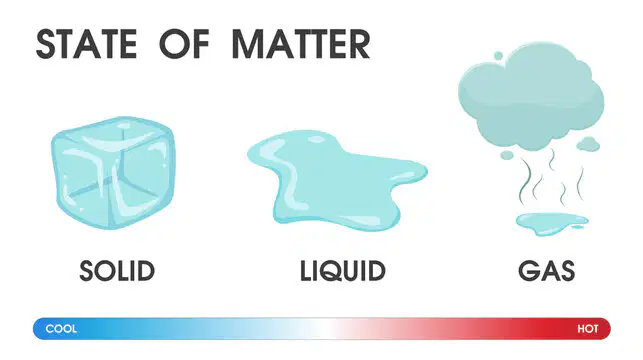
Which state of matter has the LEAST kinetic energy?

What happens to particles when heat is removed from them?
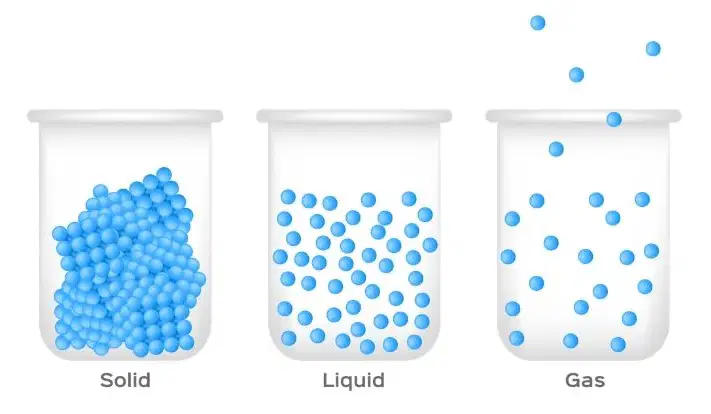

Which of the following described the properties of particles in solid? (Select all that apply).
Closely packed in orderly manner
Vibrate about fixed position
Very strong forces of attraction
Low kinetic energy
slide past each other

Which of the following described the properties of particles in liquid? (Select all that apply).
Closely packed in orderly manner
slide over each other
Vibrate about fixed position
Low kinetic energy
Closely packed in disorderly,random manner

Which of the following described the properties of particles in gas? (Select all that apply).
very far apart
move randomly at high speed in all direction
Vibrate about fixed position
high kinetic energy
Closely packed in disorderly,random manner
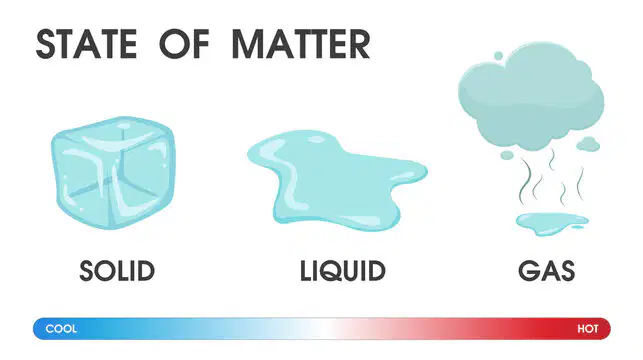

Match each of these parts with its corresponding part.
State of Matter, definite Shape, definite Volume.
Solid
State of Matter, indefinite Shape, definite Volume.
Liquid
State of Matter, indefinite Shape, indefinite Volume.
Gas
One Form of Matter.
State of Matter
Exactly Measurable.
Definite
Match each of these parts with its corresponding part.
Outline of an object.
Shape
Amount of space something takes up.
Volume
Amount of amounts in an object.
Mass
Anything with mass and volume.
Matter
Exactly Measurable.
Definite

The slower particles of a substance moves, _____ (Select all that apply).
the colder the particles are.
the warmer the particles are.
the more energy it has.
the less energy it has.

Which of these statements is TRUE of Liquids?
Molecules are tightly packed.
Takes the shape of its container.
Constantly keeps its shape.
Molecules are spread far apart.

Which states of matter will take the shape of its container (Select all that apply)?
Liquid
Gas
Solid

Particles of a Gas Movement.
No Movement
Sliding Pass
Vibrate
Zippy- Fast Bumper Cars

Match each state of matter with its particle arrangement.

Solid

Liquid

Gas

This image shows three different phases of water. In which state are the molecules moving the fastest?
A
B
C
A and C

Gas particles in a container would most likely
spread far apart, filling the container completely.
lock in place, keeping a shape unlike the container.
remain close together, resting at the bottom of the container.
None of these.

What happens to particles when heat is removed from them?

Which of the following described the properties of particles in solid? (Select all that apply).
Closely packed in orderly manner
Vibrate about fixed position
Very strong forces of attraction
Low kinetic energy
slide past each other

Which of the following described the properties of particles in liquid? (Select all that apply).
Closely packed in orderly manner
slide over each other
Vibrate about fixed position
Low kinetic energy
Closely packed in disorderly,random manner

Which of the following described the properties of particles in gas? (Select all that apply).
very far apart
move randomly at high speed in all direction
Vibrate about fixed position
high kinetic energy
Closely packed in disorderly,random manner

Who is the person MOST responsible for your academic success?🥰
(a)

Non-Verbal Cues.
Match each of these non-verbal cues with the correct meaning.

Permission to speak

Quiet Please, Classmate.

Restroom

Tissue

Water

What are the three states of matter?
solid, volume, mass
density, volume, mass
solid, liquid, gas
density, gas, volume


Atoms of a liquid have which type of movement?
jumps
slide pass
vibration
fast bumper car

Atoms of a solid have which type of movement?
jumps
slide pass
vibration
fast bumper car

Particles of a Liquid Movement.
No Movement
Sliding Pass
Vibrate
Zippy- Fast Bumper Cars

The speed of the molecules determines the _____.
Volume
Density
Pressure
Temperature

Which state of matter has the MOST energy and temperature?
Gas
Solid
Liquid

Which statement is CORRECT about matter when the temperature increase?
Speed Up and Move Closer
Speed Up and Move Farther Apart
Slow Down and Move Farther Apart
Slow Down and Move Closer

Which of these statements is NOT Correct?
They are made of atoms and molecules.
Particles are in constant motion.
Particles are always moving in the same speed.
Particles are too small to see.
Which states of matter will take the shape of its container (Select all that apply)?
Liquid
Gas
Solid

Which of these state changes result in heat (energy) being removed (Select all that apply)?
Gas to Solid
Solid to Liquid
Solid to Gas
Liquid to Gas
Liquid to Solid

Which state change is shown in BOX 1 (Hint: The arrow head points to the end state)?
Sublimation
Condensation
Melting
Freezing
Boiling

Which of these statements is TRUE of Solids?
Molecules are tightly packed.
Takes the shape of its container.
Constantly keeps its shape.
Molecules are spread far apart.

Which of these statements is TRUE of Gases (Select all that apply)?
Molecules are tightly packed.
Takes the shape of its container.
Constantly keeps its shape.
Molecules are spread far apart.
Which of the following described the properties of particles in gas? (Select all that apply).
very far apart
move randomly at high speed in all direction
Vibrate about fixed position
high kinetic energy
Closely packed in disorderly,random manner
Which of the following described the properties of particles in liquid? (Select all that apply).
Closely packed in orderly manner
slide over each other
Vibrate about fixed position
Low kinetic energy
Closely packed in disorderly,random manner
Which of the following described the properties of particles in solid? (Select all that apply).
Closely packed in orderly manner
Vibrate about fixed position
Very strong forces of attraction
Low kinetic energy
slide past each other

When thermal energy is decreased in a gas, what change in state is happening?
Melting
Freezing
Evaporation
Condensation

When thermal energy is increased in a liquid, what change in state is happening?
Melting
Evaporation
Condensation
Freezing

When thermal energy is decreased in a liquid, what change in state is happening?
Melting
Freezing
Condensation
Evaporation

When thermal energy is increased in a solid, what change in state is happening?
Melting
Evaporation
Freezing
Condensation

Brad is comparing a ceramic cup to the hot water inside the ceramic cup and the water vapor above the cup. What can she say about the motion of the particles in all of the substances?
They do not move.
They are all always moving.
They all move past each other slowly.
They all move very fast in all directions.

Match each of the states of matter with its definition.
Definite Shape and Definite Volume.
Solid
Indefinite Shape and Definite Volume.
Liquid
Indefinite Shape and Indefinite Volume.
Gas

Which of these is a physical property (Select all that apply)?
state of matter (is it solid, liquid, or gas)
size

Match each of the following with its function.
Measures Length.
Metric Ruler
Measures Volume of Liquids or Irregular-shaped Solids.
Graduated Cylinder
Measures Mass.
Triple Beam Balance
Magnifies extremely small objects, allowing for larger viewing.
Microscope
Used to carry or contain liquids and substances.
Beaker

Positively RIGHT vs. Negatively WRONG
Classify each of these items as a RIGHT choice or a WRONG choice.
Being Respectful of EVERYONE
Pushing YOUR SEAT under the Table after use.

Talking when the Teacher Talks.
Asking Ms. Hickson for Permission to Speak.



