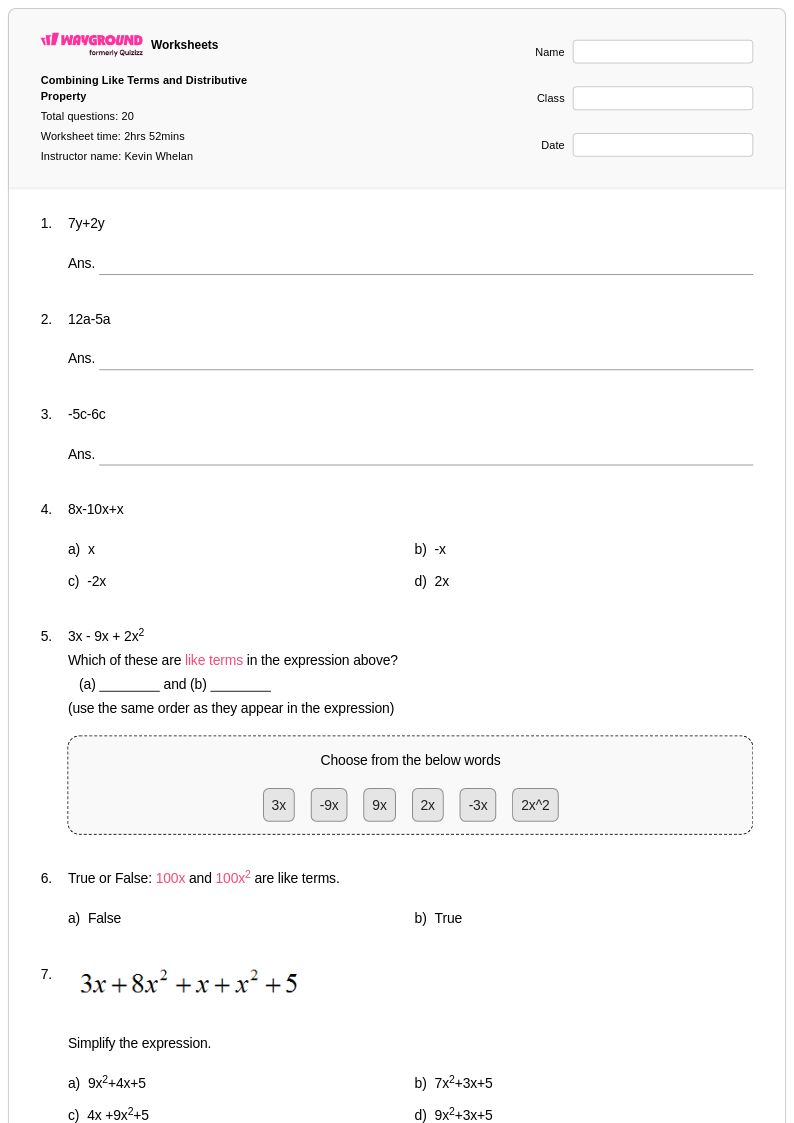
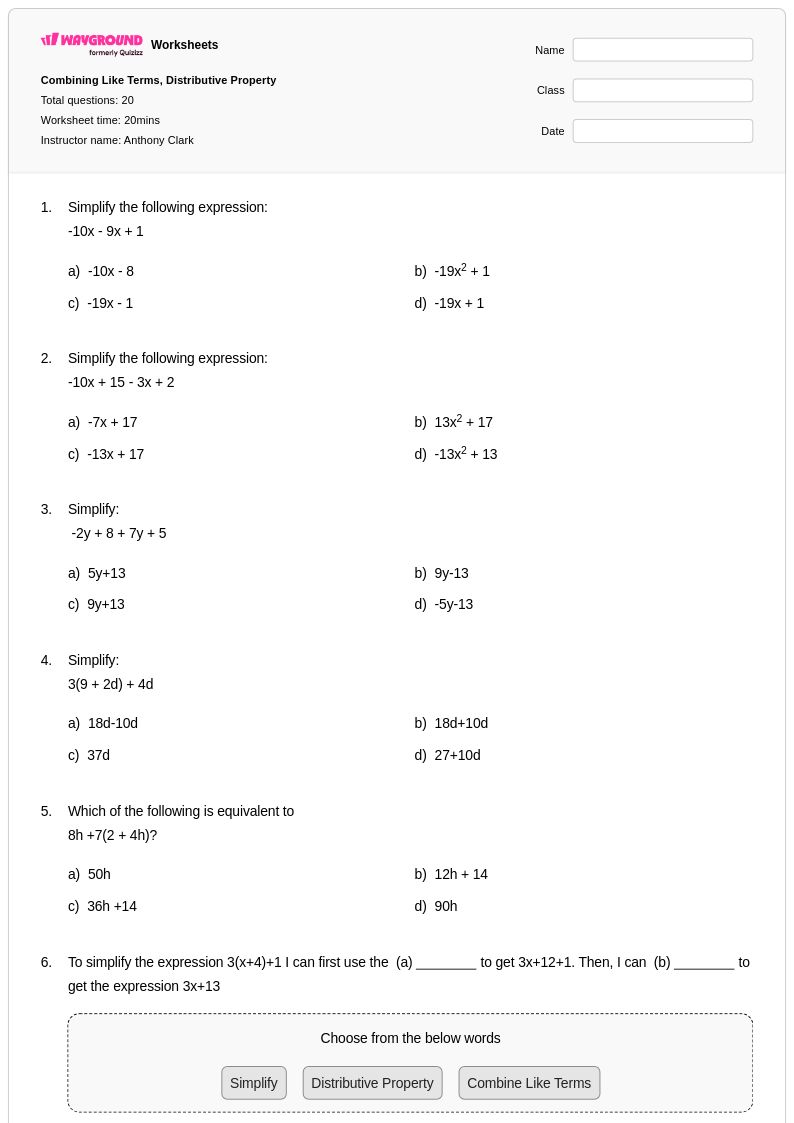
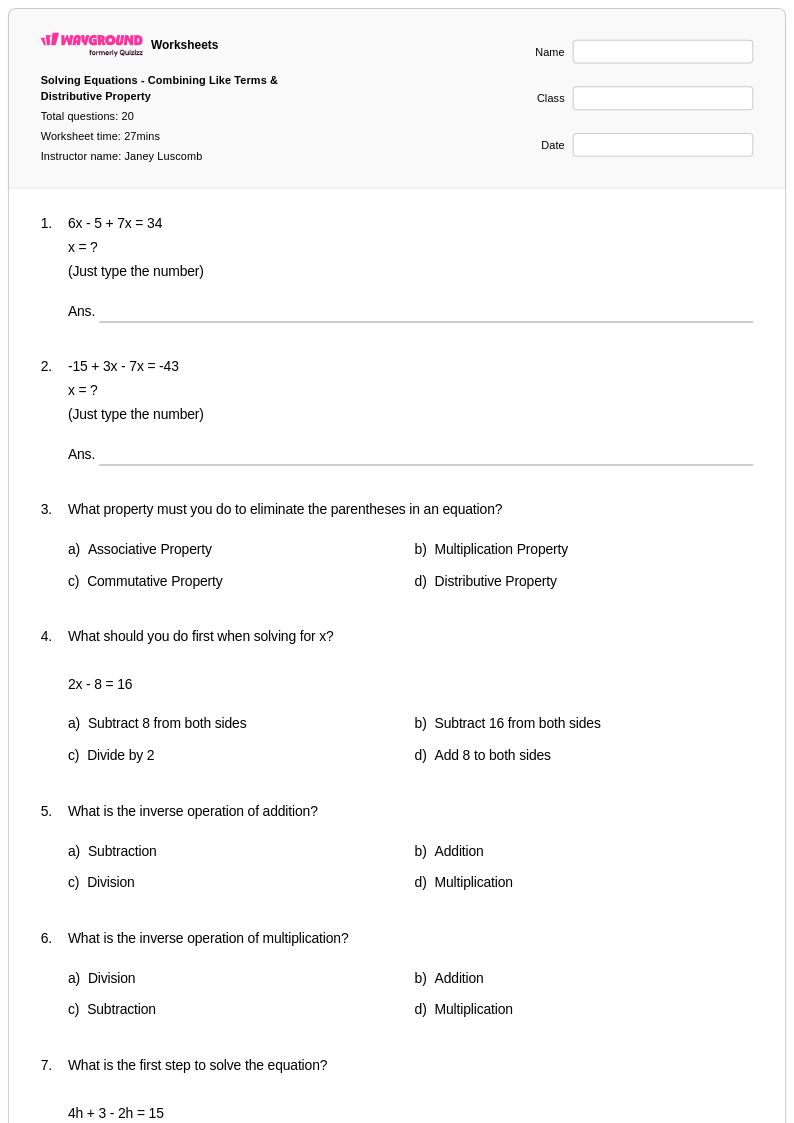
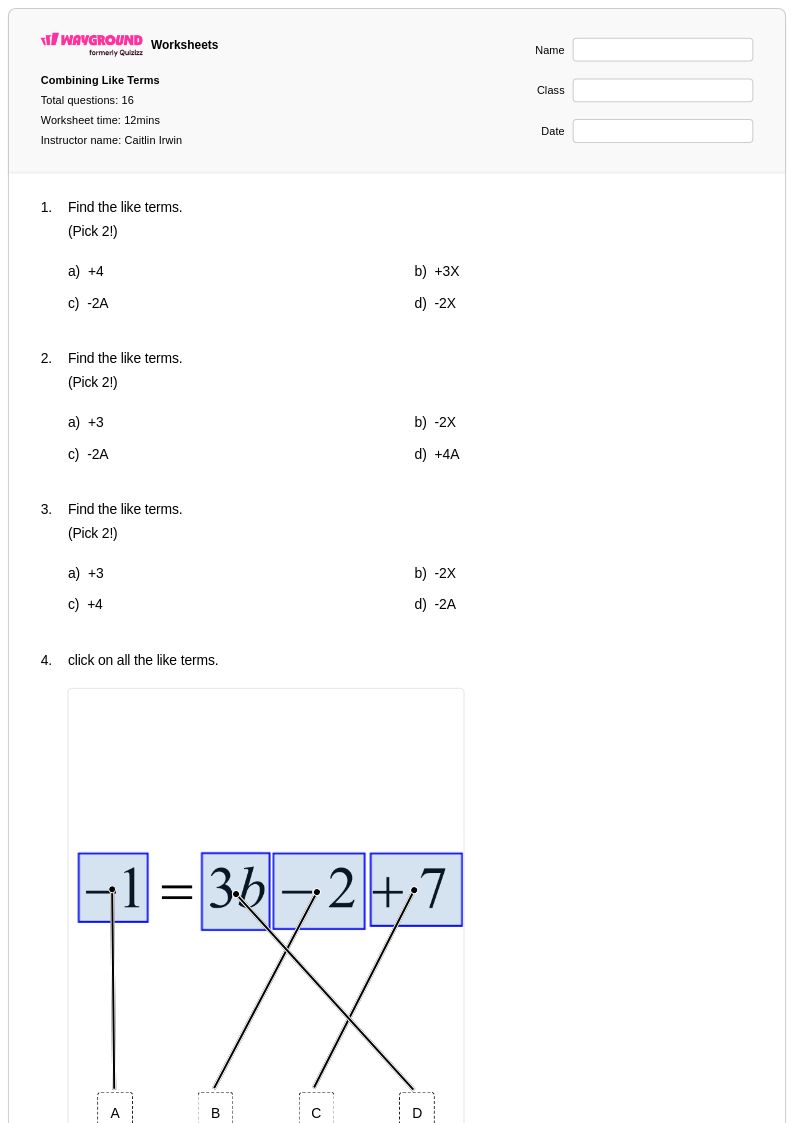
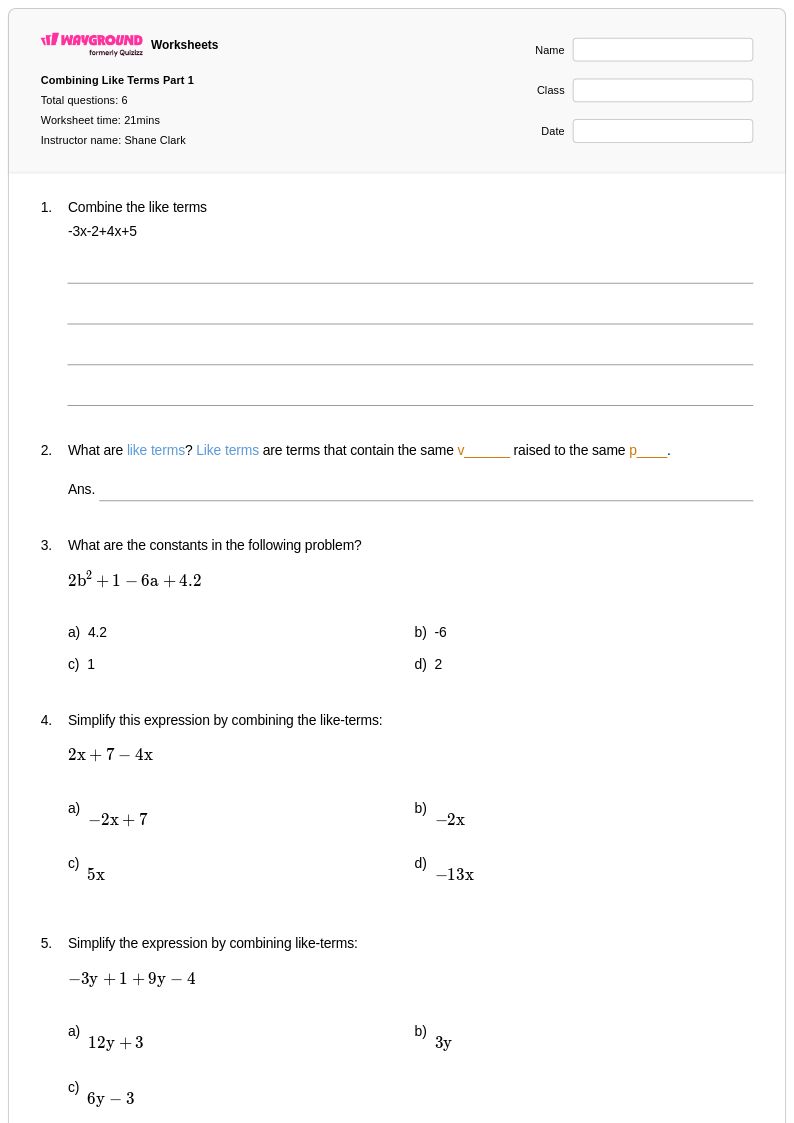
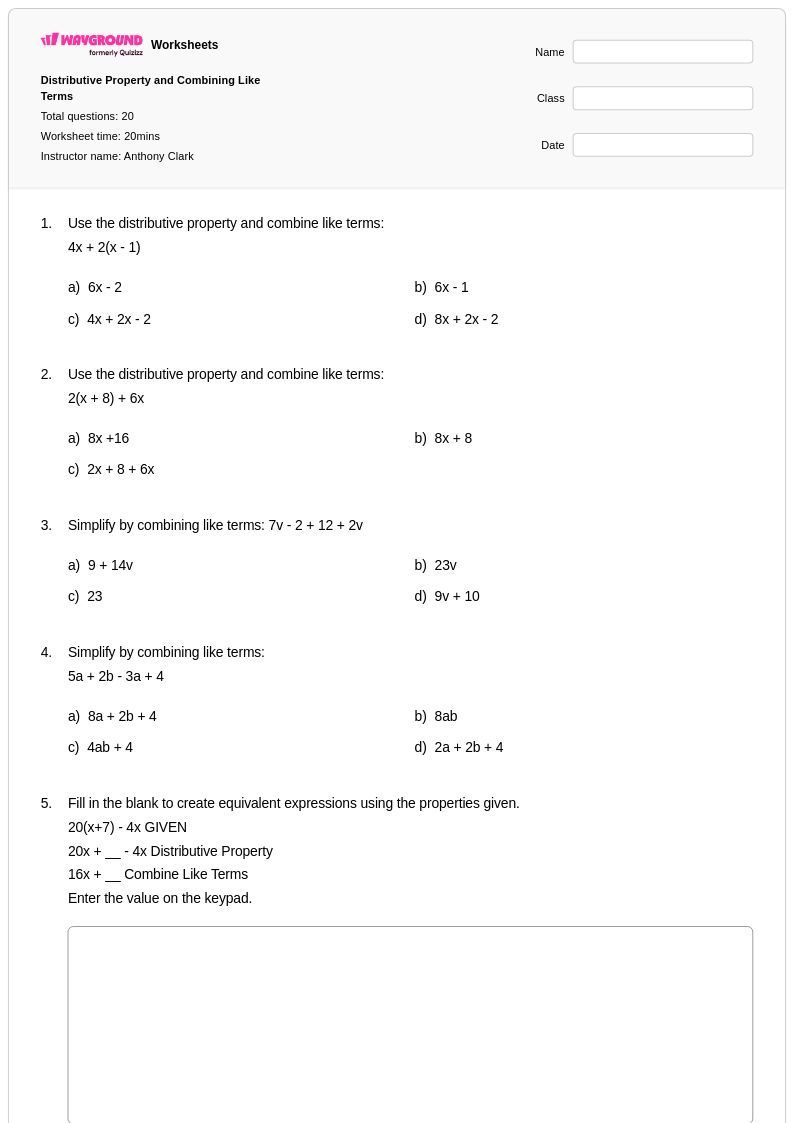
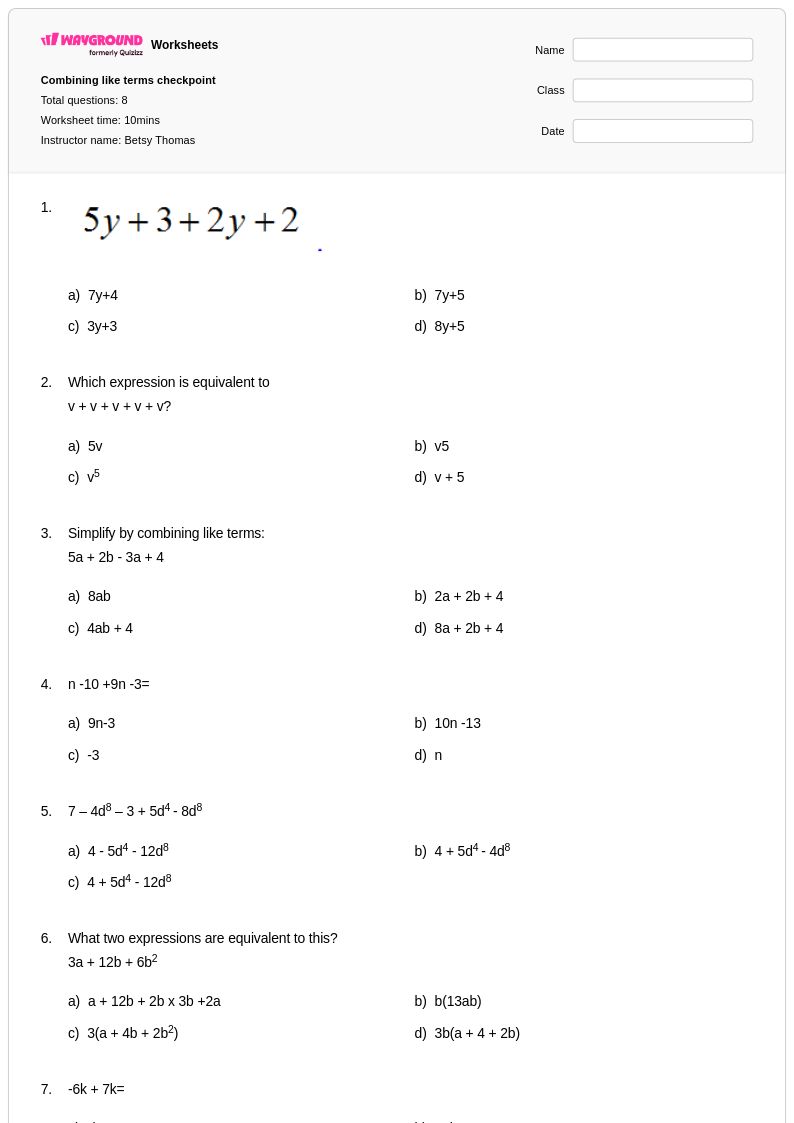
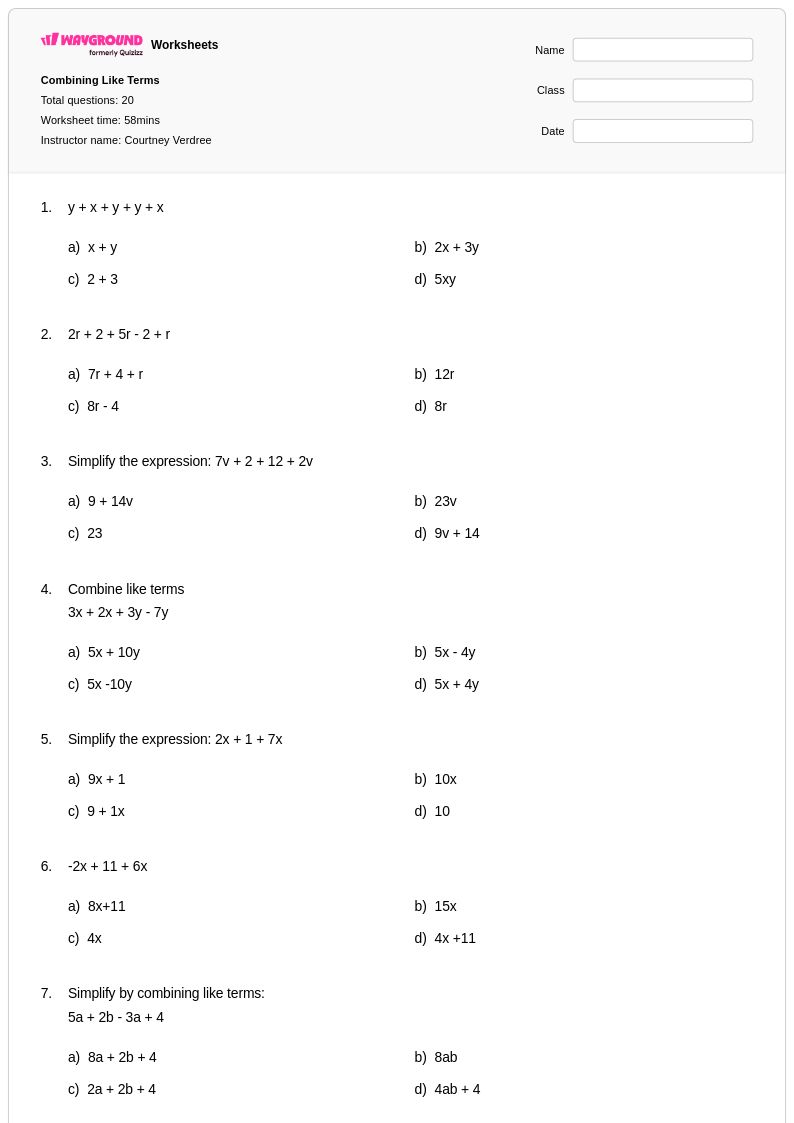
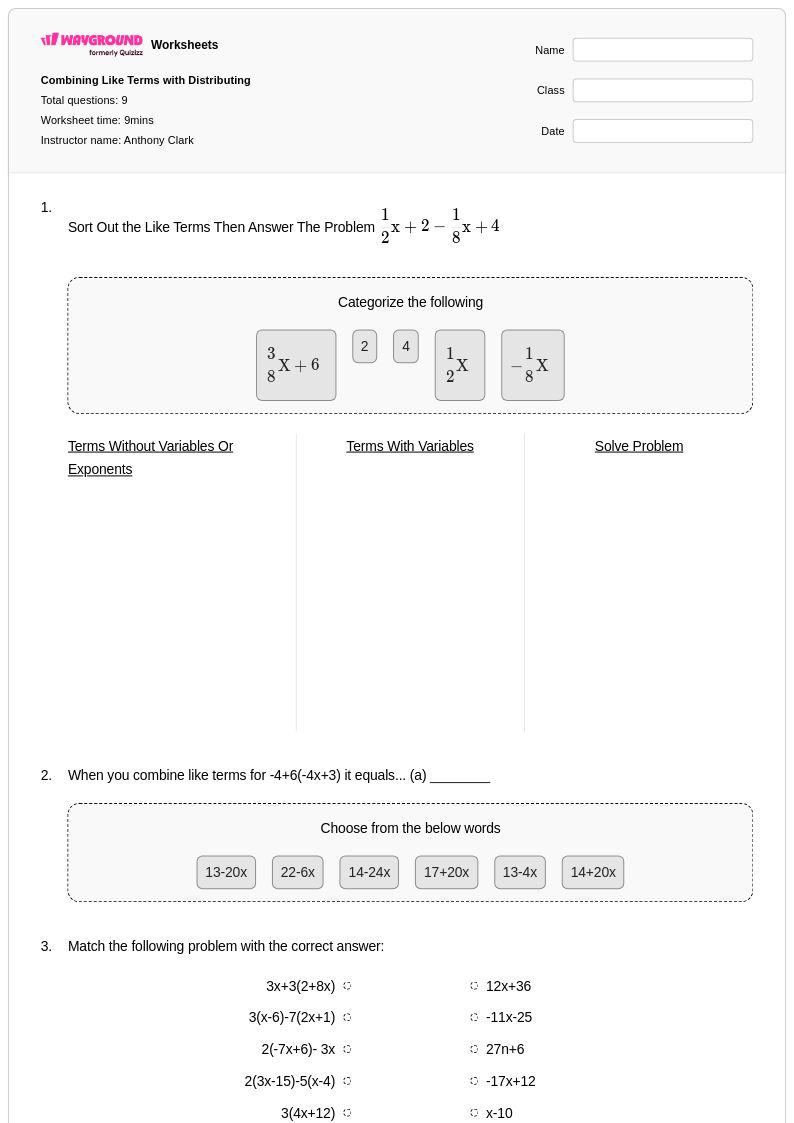
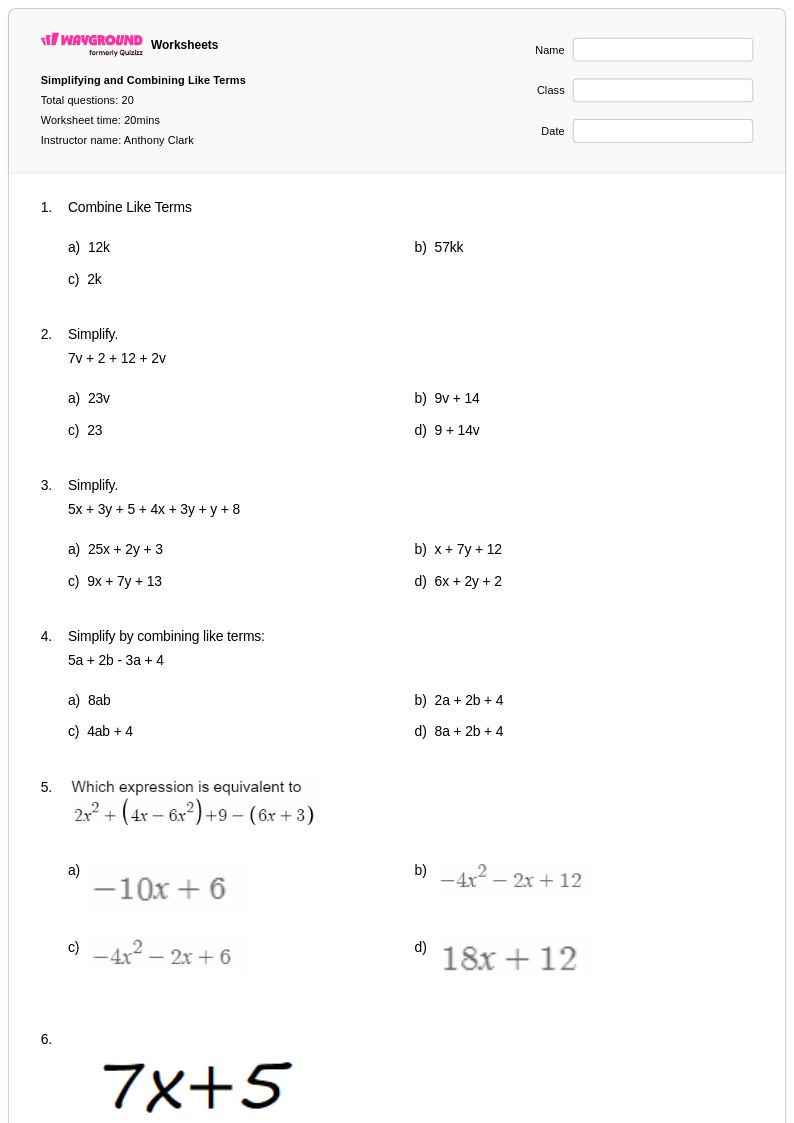
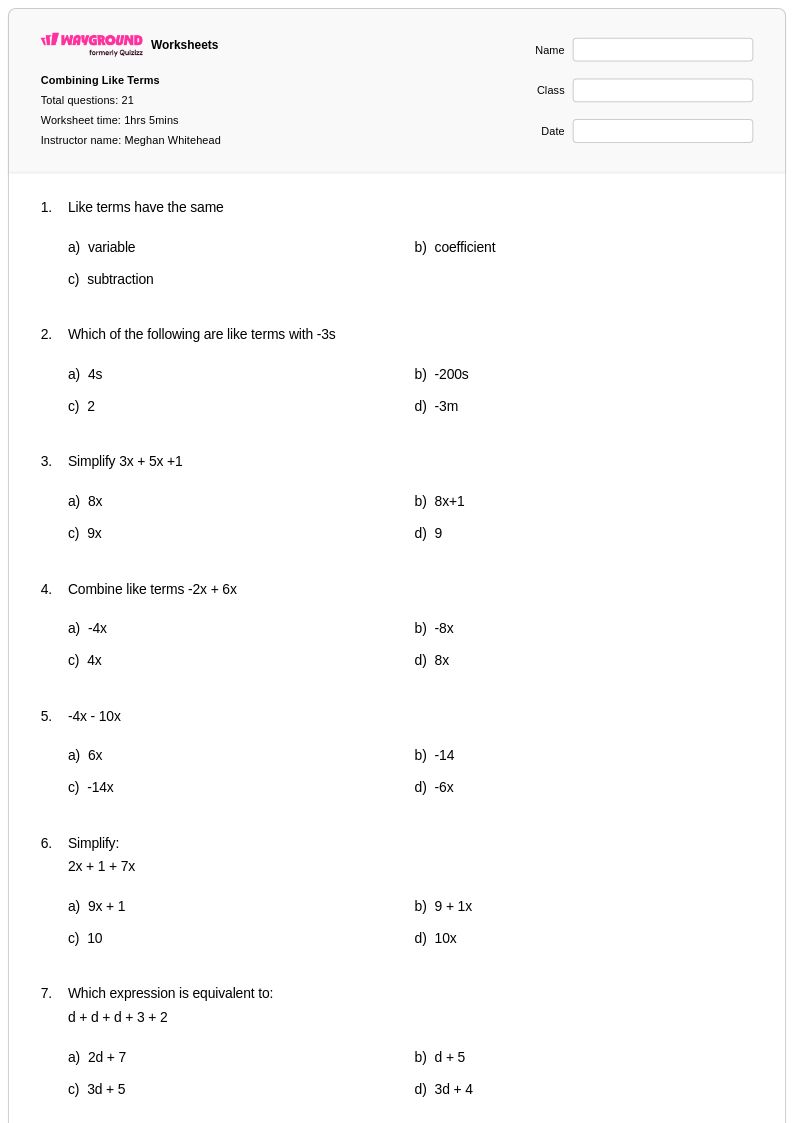
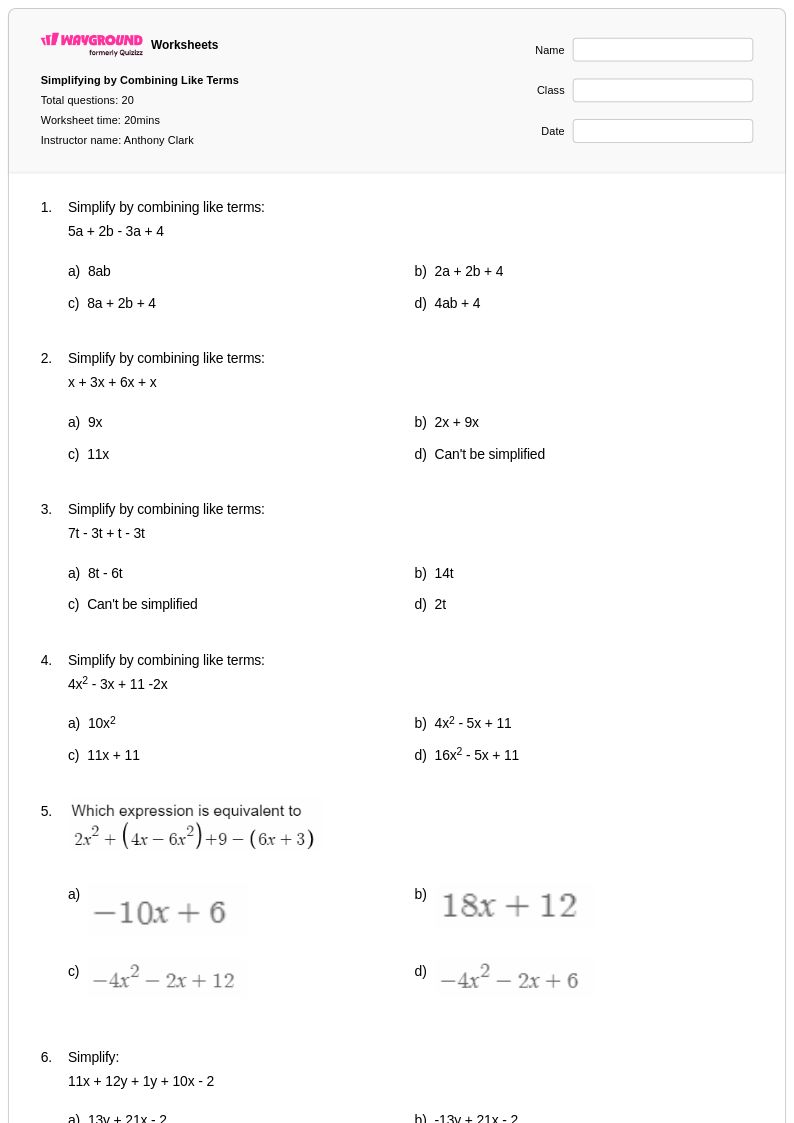
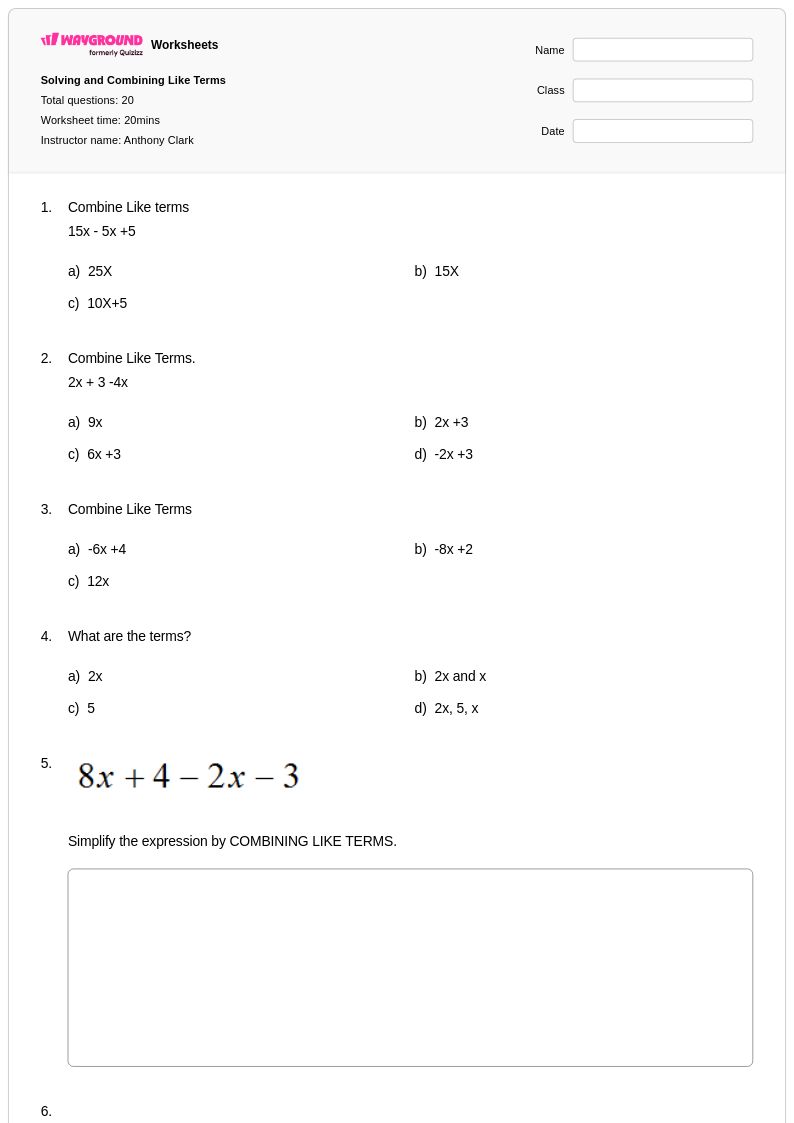
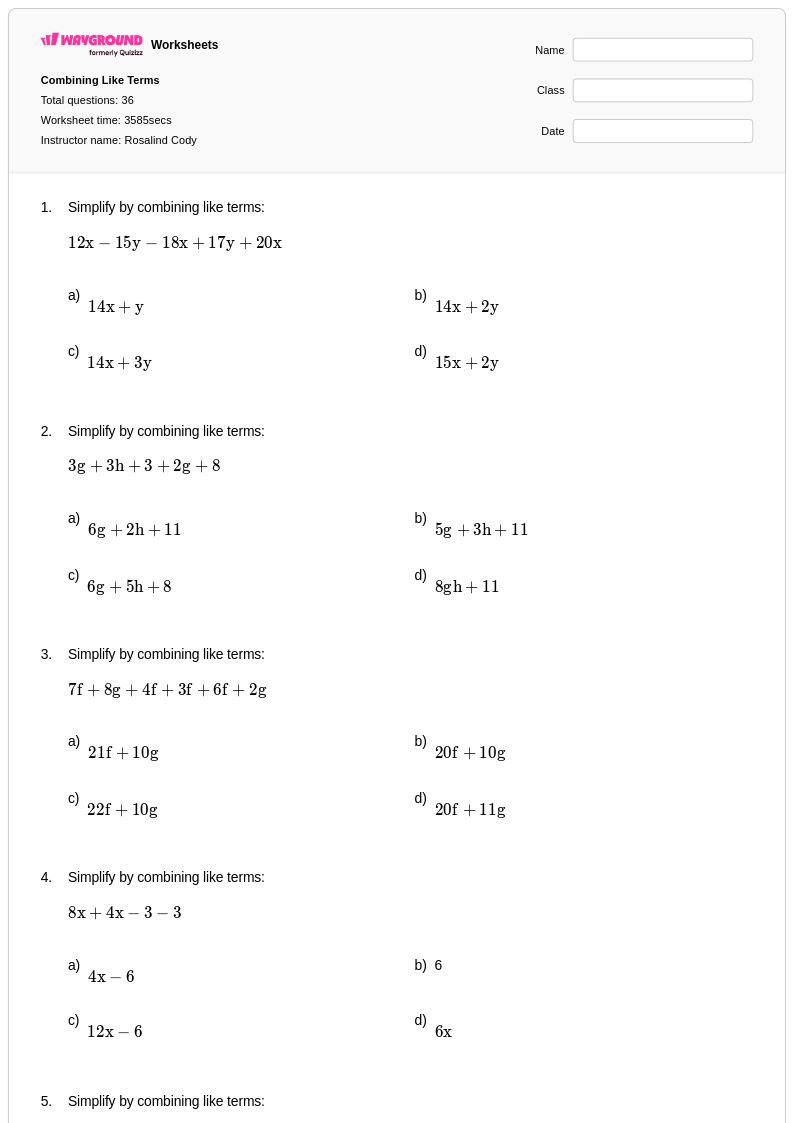
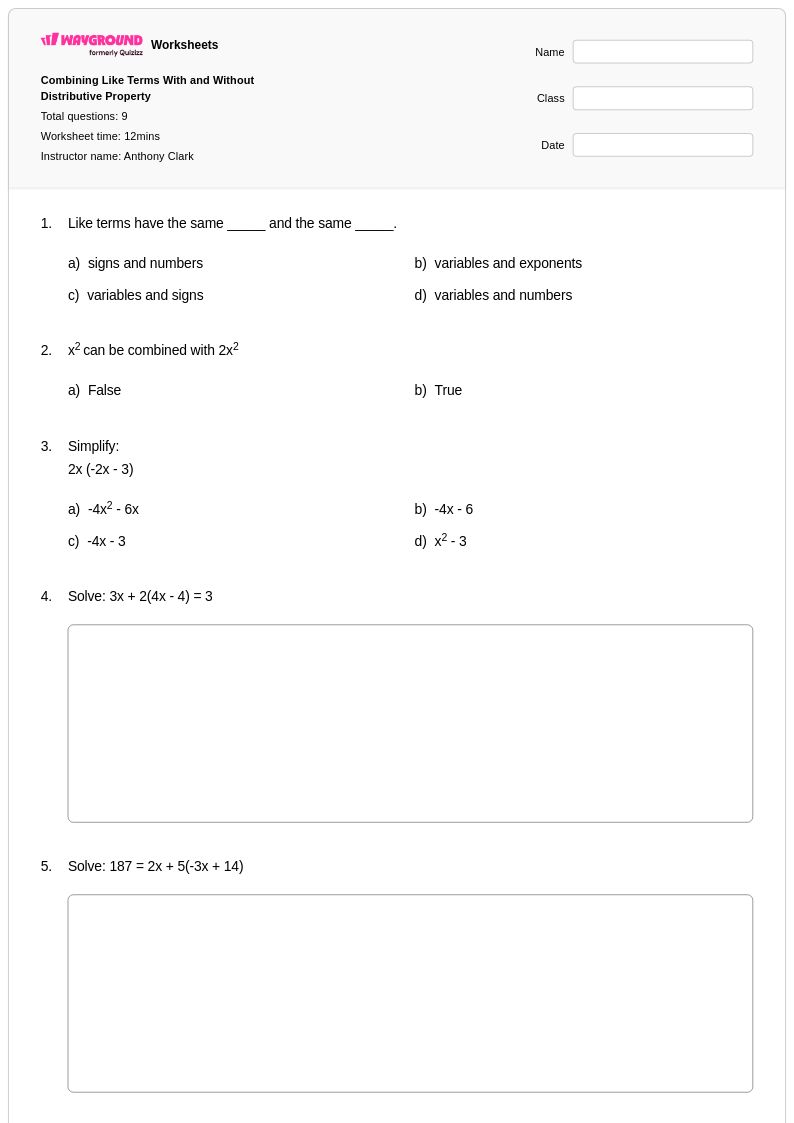
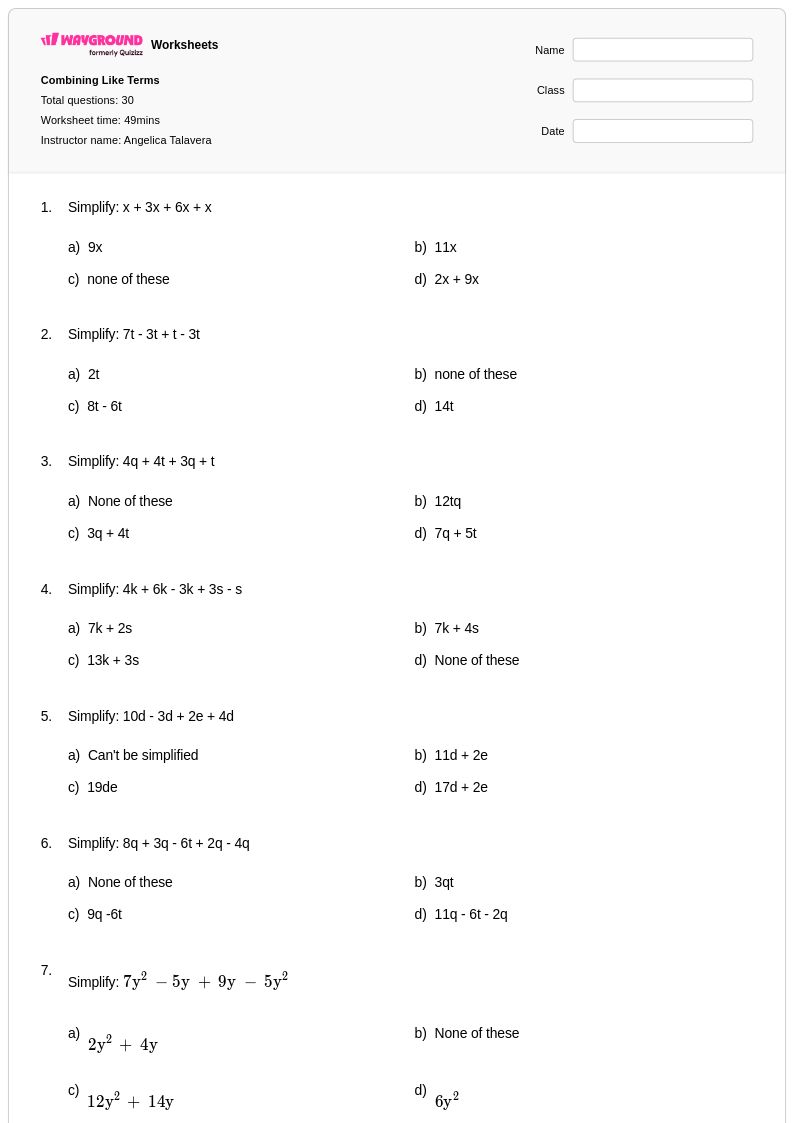
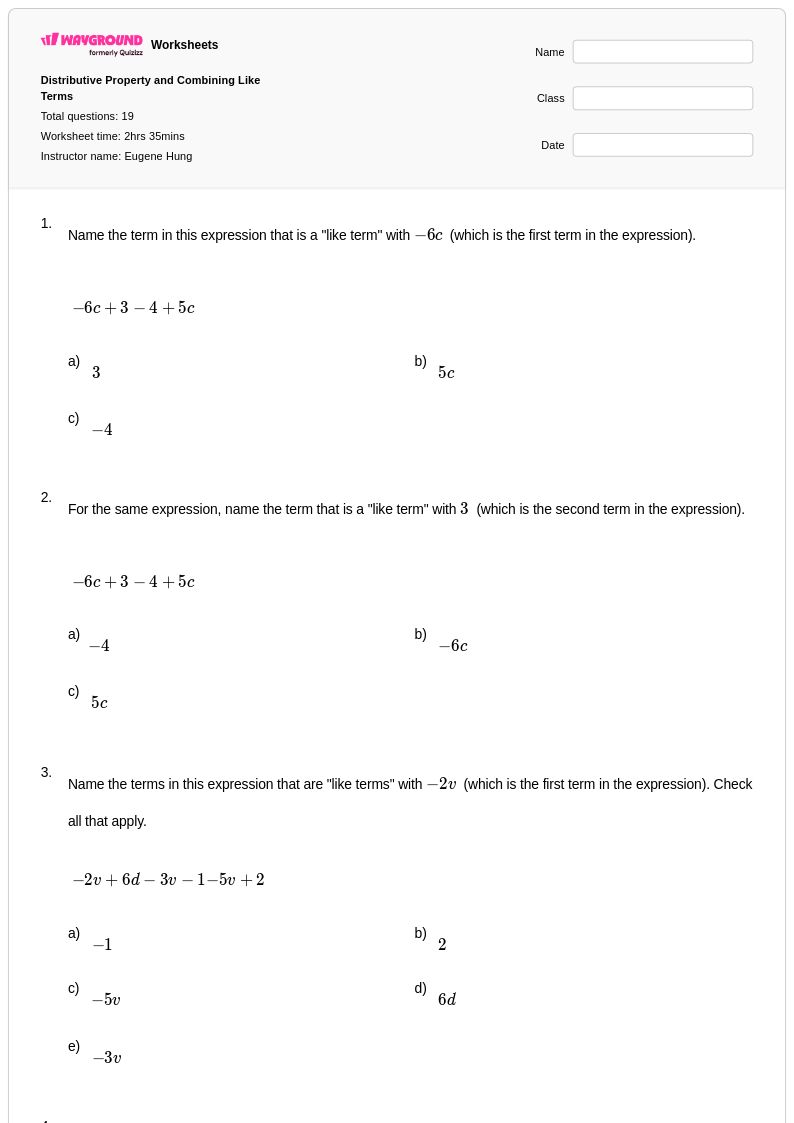
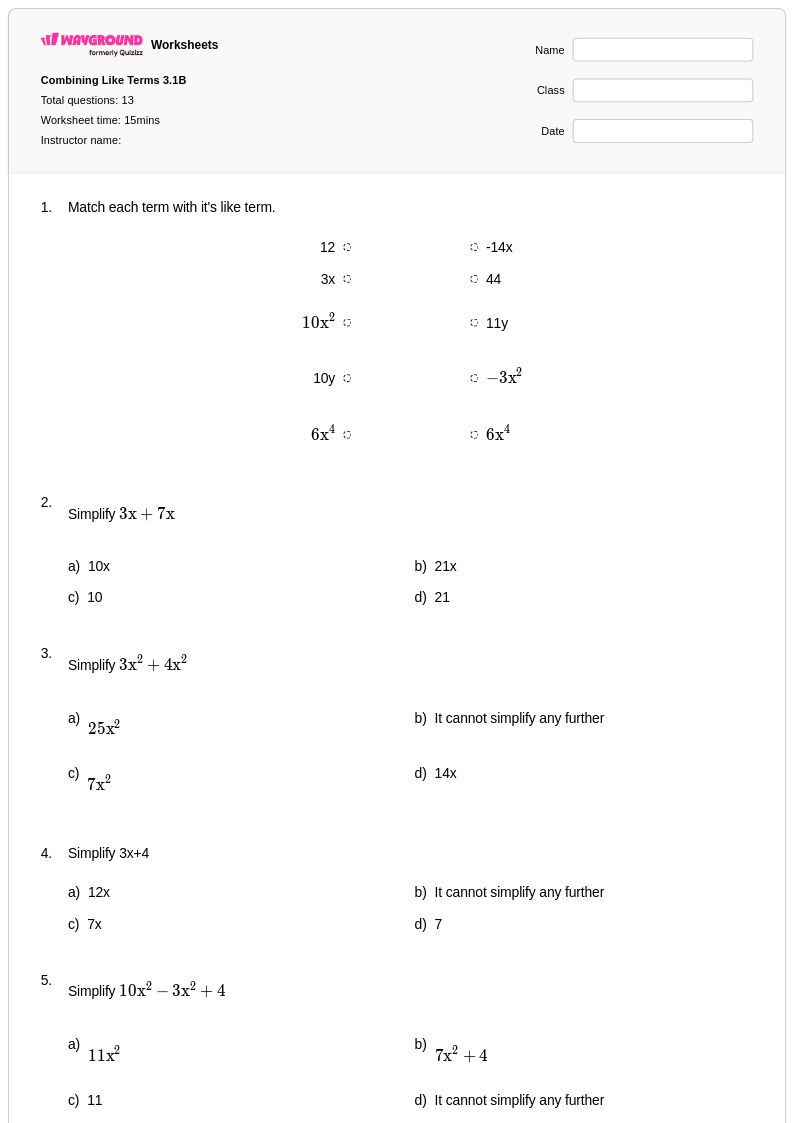
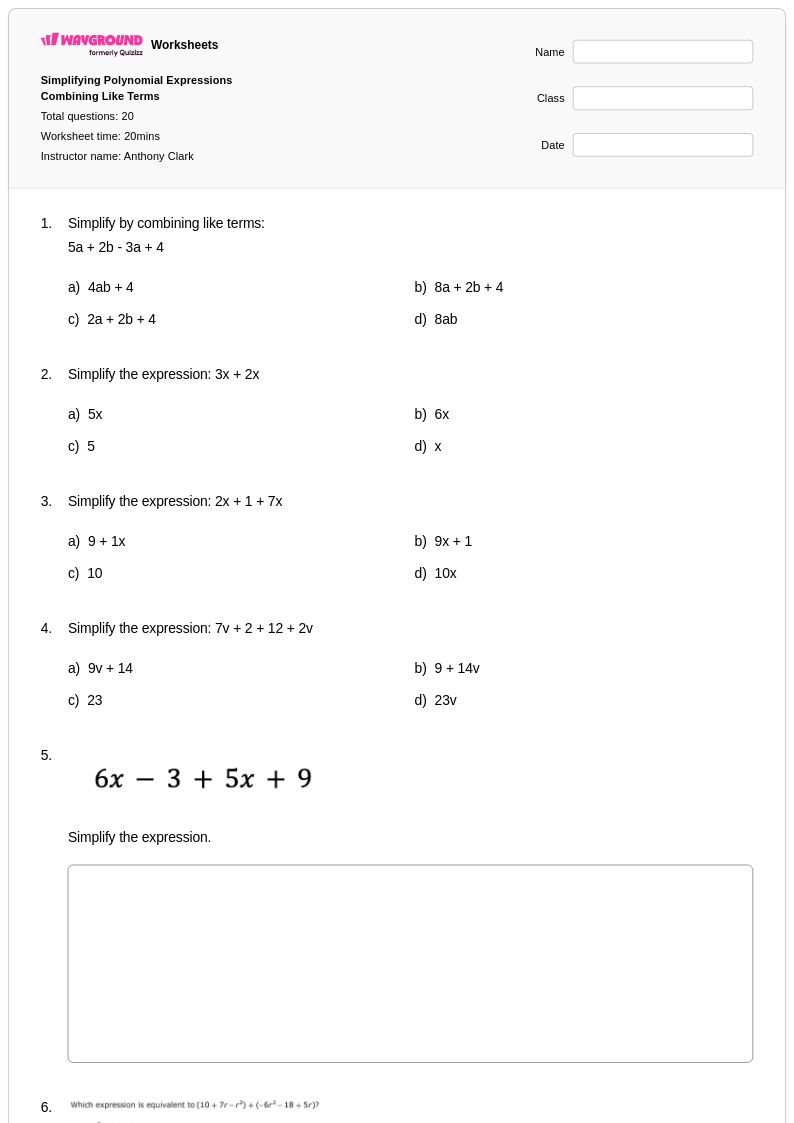
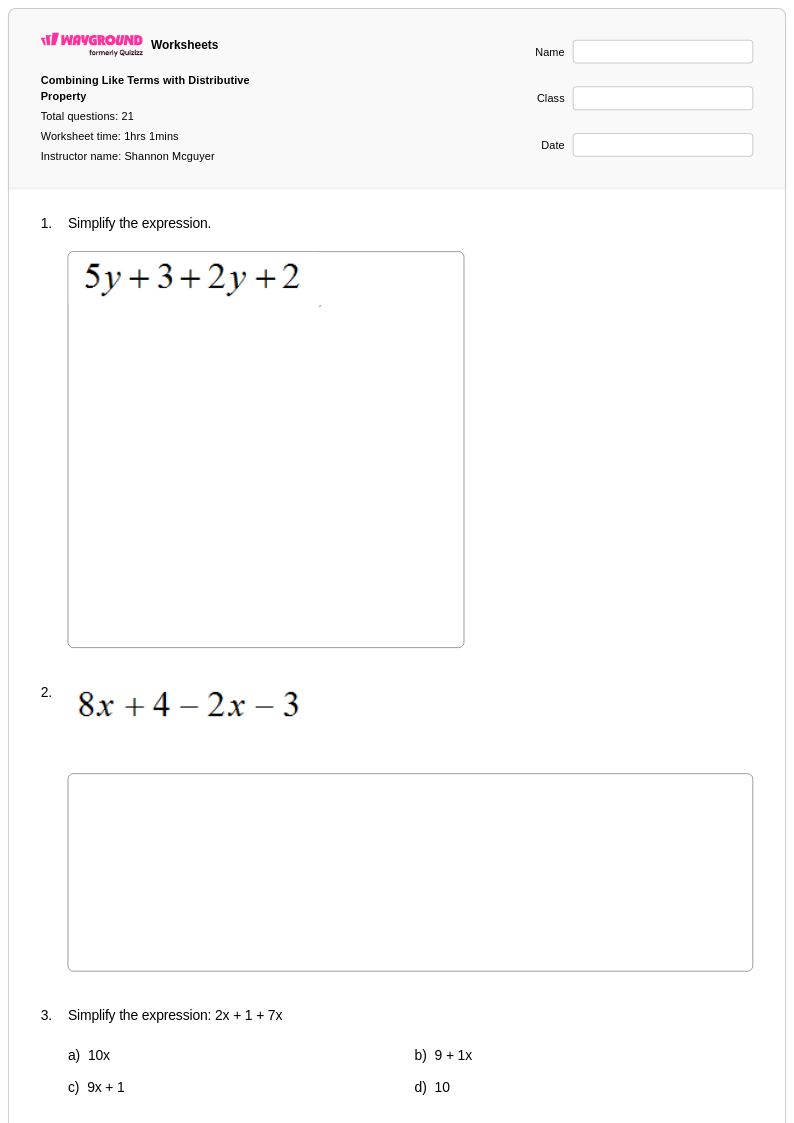
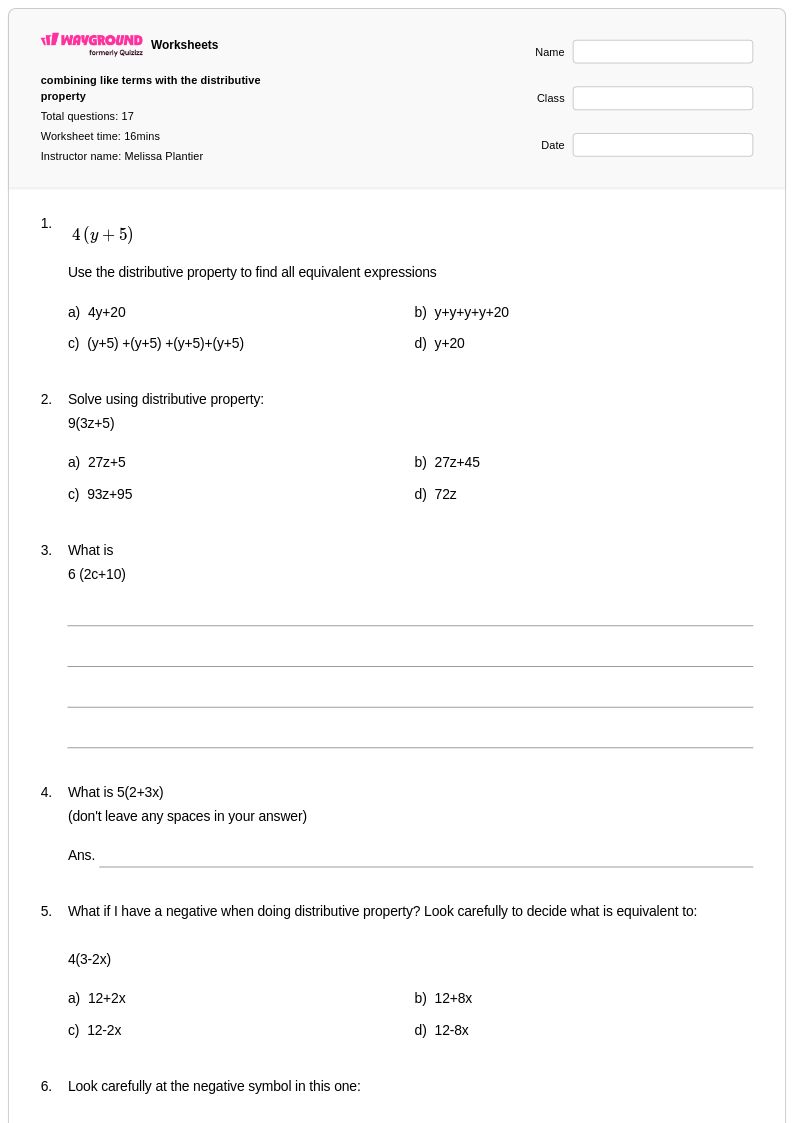
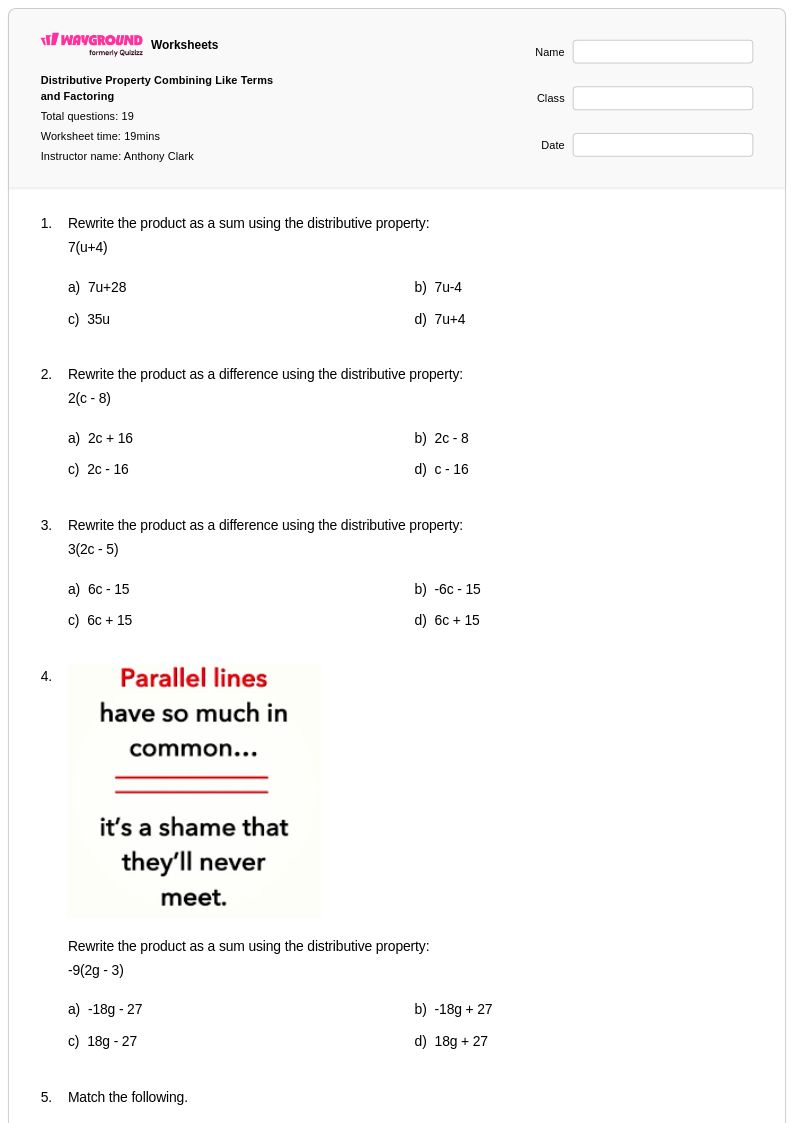
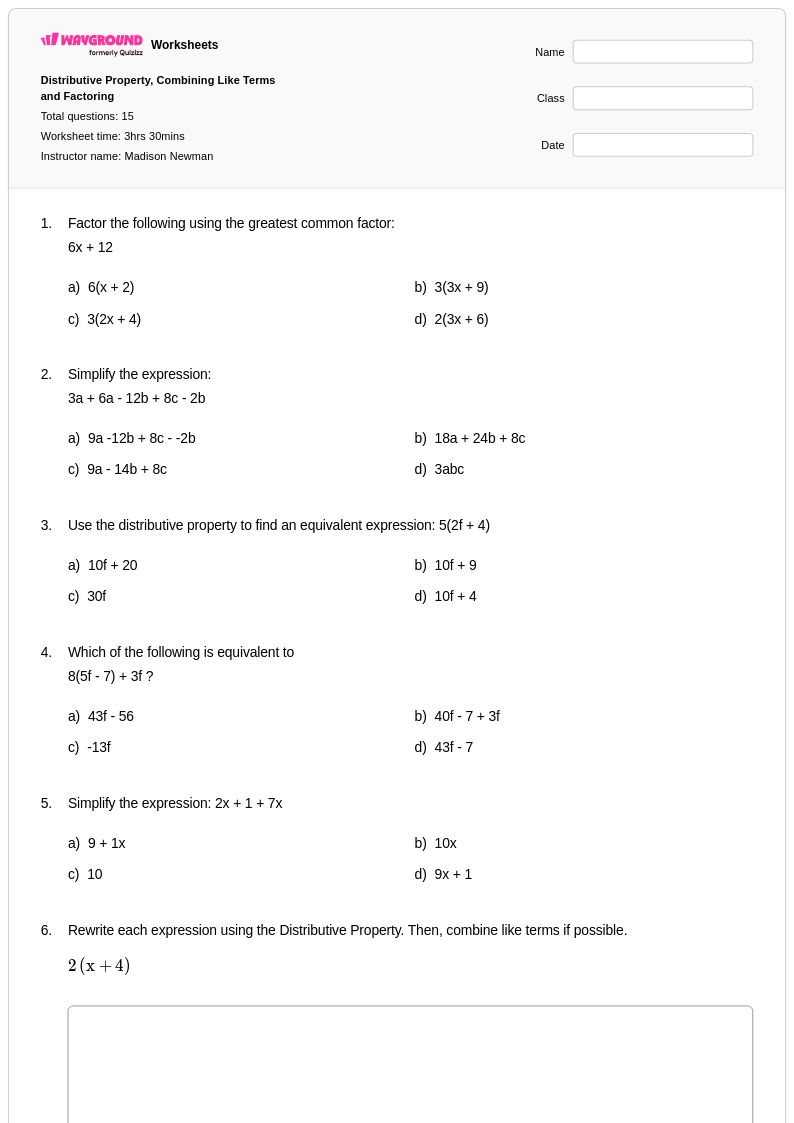
Master combining like terms with Wayground's comprehensive collection of free algebra worksheets, featuring printable PDFs with practice problems and answer keys to help students simplify expressions confidently.
Combining like terms worksheets available through Wayground (formerly Quizizz) provide students with essential practice in one of algebra's most fundamental skills. These comprehensive resources help students master the process of identifying and consolidating algebraic expressions that contain the same variables raised to identical powers, a critical foundation for solving equations and simplifying complex mathematical statements. The worksheets feature carefully structured practice problems that guide learners through combining coefficients while maintaining proper variable notation, with each printable resource including a complete answer key to support independent learning and self-assessment. These free educational materials systematically build student confidence in recognizing like terms within polynomials, distributing coefficients correctly, and applying the commutative and associative properties of addition and subtraction in algebraic contexts.
Wayground (formerly Quizizz) empowers mathematics educators with millions of teacher-created combining like terms worksheets that can be seamlessly integrated into diverse instructional approaches. The platform's robust search and filtering capabilities allow teachers to locate resources that align with specific standards and match their students' varied skill levels, while built-in differentiation tools enable customization for both remediation and enrichment purposes. These flexible worksheet collections are available in both printable pdf format and interactive digital versions, making them ideal for classroom instruction, homework assignments, or independent practice sessions. Teachers can efficiently plan comprehensive algebra units by accessing these expertly designed resources, which support systematic skill development and provide targeted practice opportunities that strengthen students' algebraic reasoning and expression manipulation abilities.
FAQs
How do I teach students to combine like terms?
Begin by having students identify each term’s variable and exponent, then group only terms with identical variable parts. Use color coding to separate like-term groups before students add or subtract the coefficients while keeping the variable notation unchanged. Connect the process to the commutative and associative properties so students understand why terms can be reordered and regrouped.
What exercises help students practice combining like terms?
Effective practice should progress from identifying like terms to simplifying polynomials with positive and negative coefficients. Students should also work with distributed coefficients and expressions whose terms must be reordered before they can be combined. Wayground worksheets provide structured problems for building these skills systematically.
What mistakes do students commonly make when combining like terms?
Students often combine terms with different variables or exponents, add exponents instead of coefficients, or lose a negative sign. They may also distribute a coefficient incorrectly before grouping terms. Require students to mark each term’s sign and variable part before simplifying, then use the answer key to analyze errors.
How can I use a combining like terms worksheet on Wayground?
Every Wayground worksheet includes a complete answer key and is available as a printable PDF or in a digital format for different teaching environments and student preferences. Teachers can host it as a digital quiz on Wayground or print and assign it on paper for offline practice; physical submissions can then be scanned or captured for grading with the Wayground for Teachers app.
How does combining like terms fit into the Common Core math progression?
Combining like terms supports the Common Core progression from applying arithmetic properties to generating equivalent algebraic expressions. Students use the distributive property and the commutative and associative properties to rewrite expressions, preparing them to solve equations and manipulate more complex polynomials.
How can I differentiate combining like terms practice?
Teachers can create scaffolded worksheet versions by adjusting font size and spacing, applying a dyslexia-friendly font, or translating the content into another language. During digital sessions, Wayground also supports extended time, Read Aloud, reduced answer choices, and an adjustable reading mode for individual students while classmates retain the default settings.