Free Printable Ionic Bonding Worksheets for Year 10
Year 10 ionic bonding worksheets from Wayground provide comprehensive printables and practice problems with answer keys to help students master chemical bonds, electron transfer, and compound formation through engaging free PDF resources.
Explore printable Ionic Bonding worksheets for Year 10
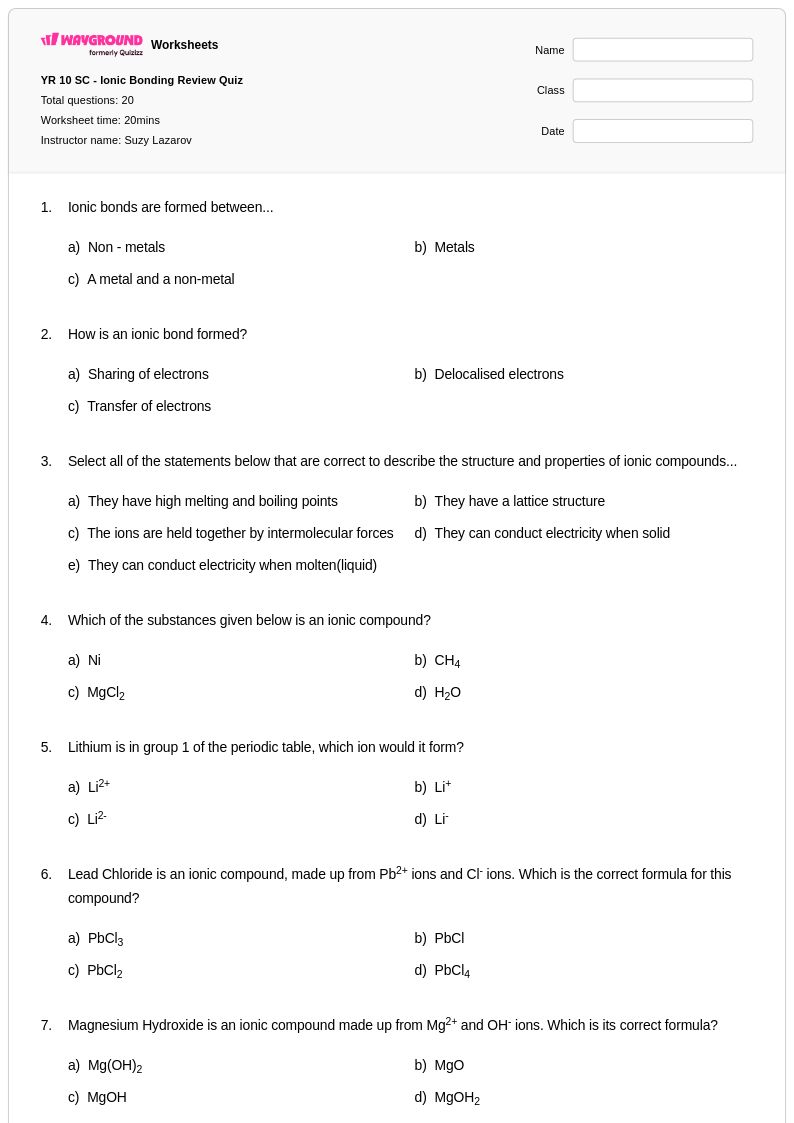
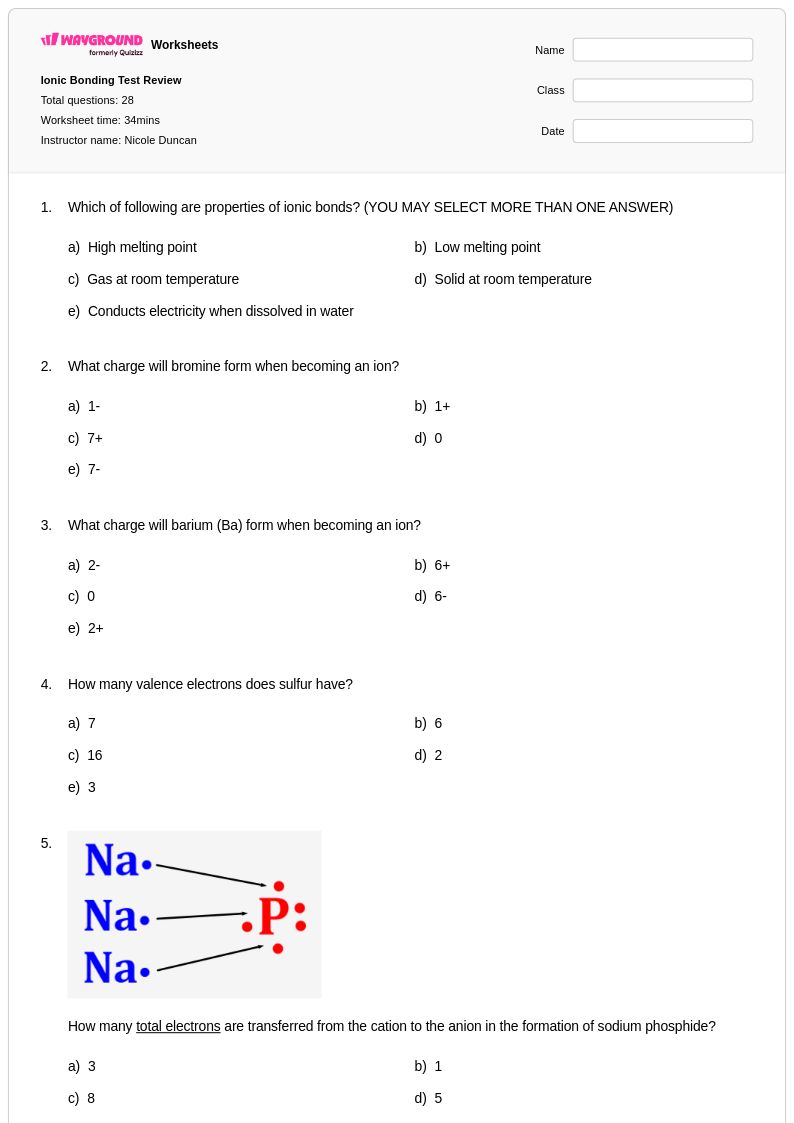
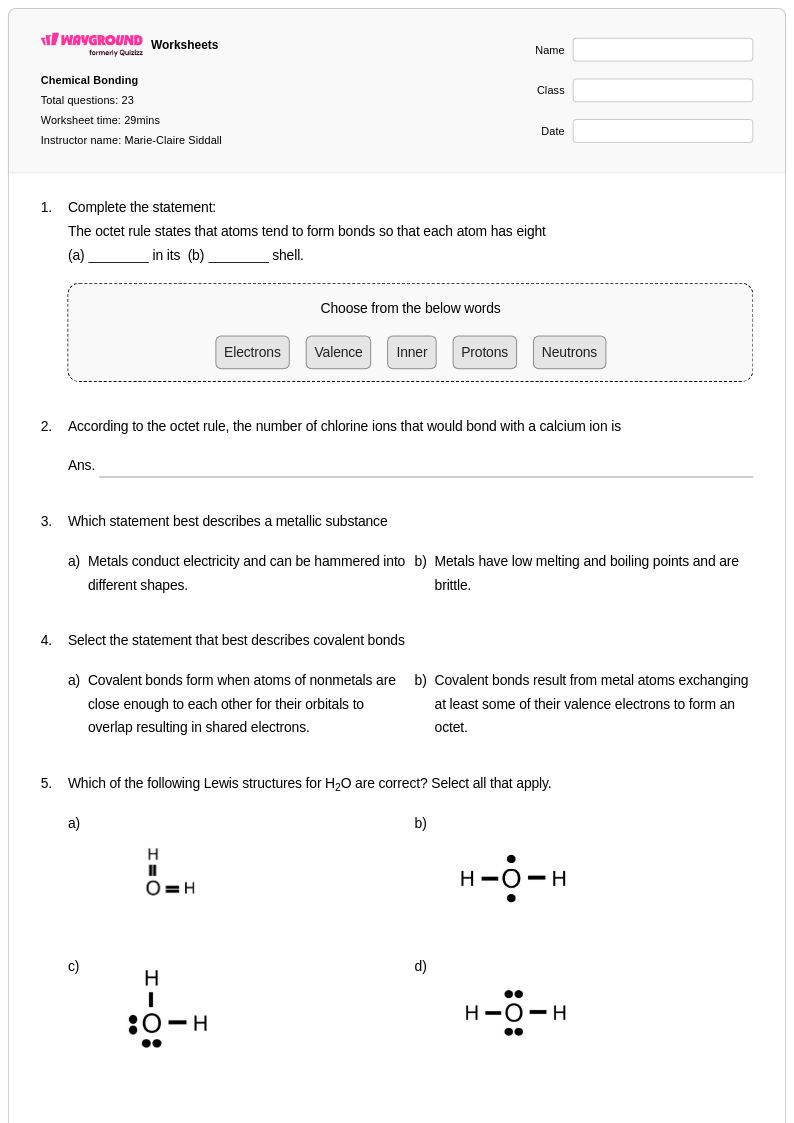
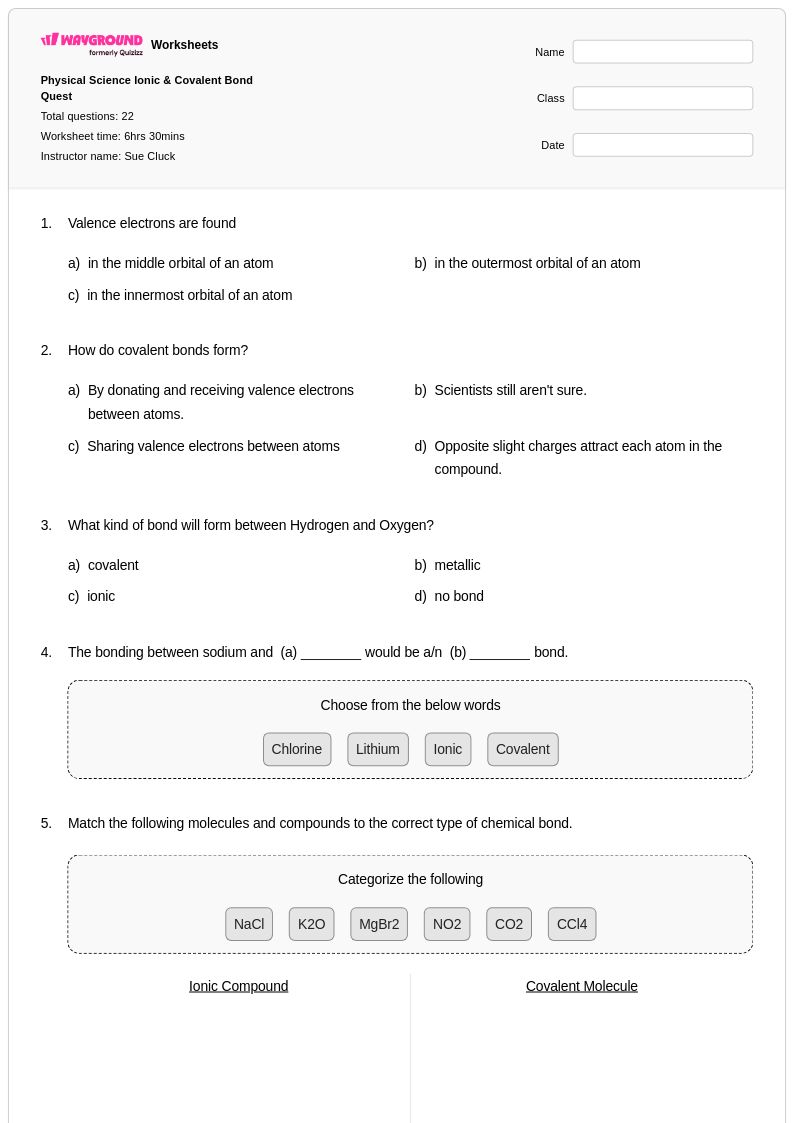
Ionic bonding worksheets for Year 10 students available through Wayground (formerly Quizizz) provide comprehensive coverage of this fundamental chemistry concept that explains how atoms transfer electrons to form charged ions and create stable compounds. These expertly designed resources strengthen essential skills including predicting ion formation based on electron configuration, writing correct chemical formulas for ionic compounds, understanding lattice energy and crystal structures, and recognizing the relationship between ionic bonding and physical properties like melting point and electrical conductivity. The collection includes varied practice problems that progress from basic ion identification to complex compound naming and formula writing, with each worksheet featuring detailed answer keys that support independent learning and self-assessment. Free printable pdf formats ensure accessibility while maintaining the rigorous academic standards necessary for high school chemistry success.
Wayground (formerly Quizizz) empowers educators with an extensive library of millions of teacher-created ionic bonding resources specifically curated for Year 10 chemistry instruction, featuring advanced search and filtering capabilities that allow quick identification of materials aligned to specific curriculum standards and learning objectives. The platform's differentiation tools enable teachers to customize worksheets based on individual student needs, whether providing remediation for struggling learners or enrichment challenges for advanced students ready to explore complex polyatomic ions and coordination compounds. Both printable and digital pdf formats offer maximum flexibility for classroom implementation, homework assignments, and laboratory preparation, while the comprehensive answer keys and detailed solutions support efficient grading and provide immediate feedback opportunities that enhance student understanding of electron transfer mechanisms, ionic radius trends, and the energetic factors that drive ionic compound formation.
FAQs
How do I teach ionic bonding to high school chemistry students?
Start by building on students' understanding of electron configuration and valence electrons before introducing the concept of electron transfer. Use visual models showing how metals lose electrons and nonmetals gain them to achieve stable octets, forming oppositely charged ions that attract one another. Connecting ionic bond formation to periodic table trends — such as ionization energy and electronegativity — helps students predict which element pairs are likely to form ionic compounds rather than covalent ones.
What exercises help students practice ionic bonding?
Effective practice exercises include writing ion charges from element symbols, predicting chemical formulas by balancing charges, and distinguishing ionic from covalent bonds based on electronegativity differences. Students also benefit from problems that require them to name ionic compounds using systematic nomenclature, including those involving polyatomic ions. Progressively challenging problem sets — starting with simple binary ionic compounds and advancing to compounds with polyatomic ions — build both procedural fluency and conceptual understanding.
What mistakes do students commonly make when learning ionic bonding?
One of the most frequent errors is confusing ionic and covalent bonding, particularly when students encounter compounds with small electronegativity differences. Students also commonly misapply charge-balancing rules when writing formulas for polyatomic ionic compounds, either ignoring parentheses or incorrectly distributing subscripts. Another persistent misconception is treating ionic bonds as directional like covalent bonds, rather than understanding that the attraction is electrostatic and non-directional within the lattice structure.
How do I help students who struggle with predicting ionic compound formulas?
Students who struggle with this concept often need explicit instruction on reading ion charges directly from the periodic table before attempting formula writing. A criss-cross method scaffold — where students swap the numerical values of each ion's charge to determine subscripts — can reduce procedural errors while students internalize the charge-balance principle. For students who need additional support, Wayground's reduced answer choices accommodation can lower cognitive load during digital practice by presenting fewer options, while extended time settings allow struggling learners to work through problems without pressure.
How can I use ionic bonding worksheets in my classroom?
Ionic bonding worksheets on Wayground are available as printable PDFs for traditional classroom use and in digital formats for technology-integrated environments, including the option to host them as a quiz directly on Wayground. Printable versions work well for guided notes, in-class practice, or homework assignments, while digital formats enable immediate feedback and allow teachers to track individual student performance. Both formats include answer keys, making it straightforward to use these materials for independent practice, peer review, or formative assessment.
How does electronegativity relate to ionic bonding, and how do I explain it to students?
Electronegativity measures an atom's tendency to attract electrons in a chemical bond, and a large difference in electronegativity between two atoms — generally greater than 1.7 on the Pauling scale — indicates that electron transfer, rather than sharing, will occur, producing an ionic bond. Teachers can make this tangible by having students calculate electronegativity differences for several compound examples and classify each as ionic or covalent, reinforcing the pattern through repetition. This approach also previews polarity concepts students will encounter later in covalent bonding units.
What topics should an ionic bonding unit cover to prepare students for advanced chemistry?
A thorough ionic bonding unit should cover ion formation from electron configuration changes, charge prediction using the periodic table, formula writing and nomenclature for binary and polyatomic ionic compounds, and the physical properties of ionic substances such as high melting points, brittleness, and electrical conductivity in solution. Students preparing for AP Chemistry or college-level coursework also benefit from exposure to lattice energy concepts and how ionic charge magnitude and ion size affect lattice stability. Building this conceptual foundation early ensures students can apply ionic bonding knowledge to solubility, electrochemistry, and acid-base chemistry in later units.