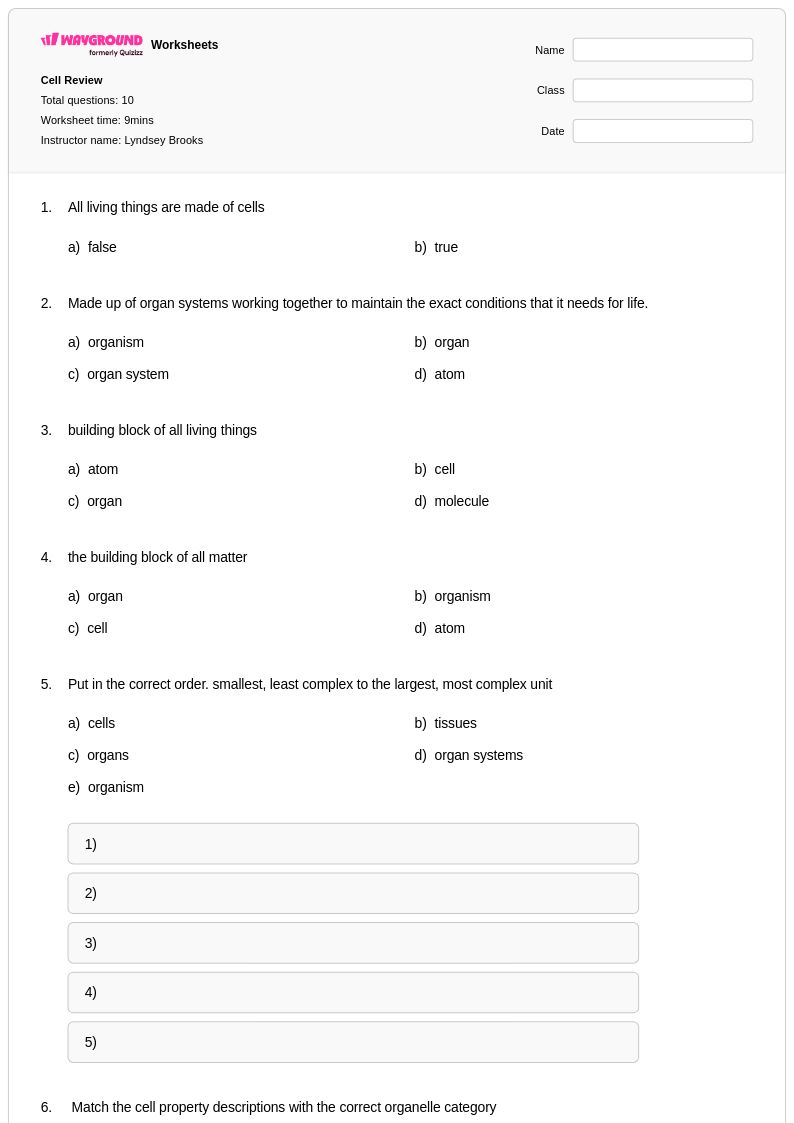
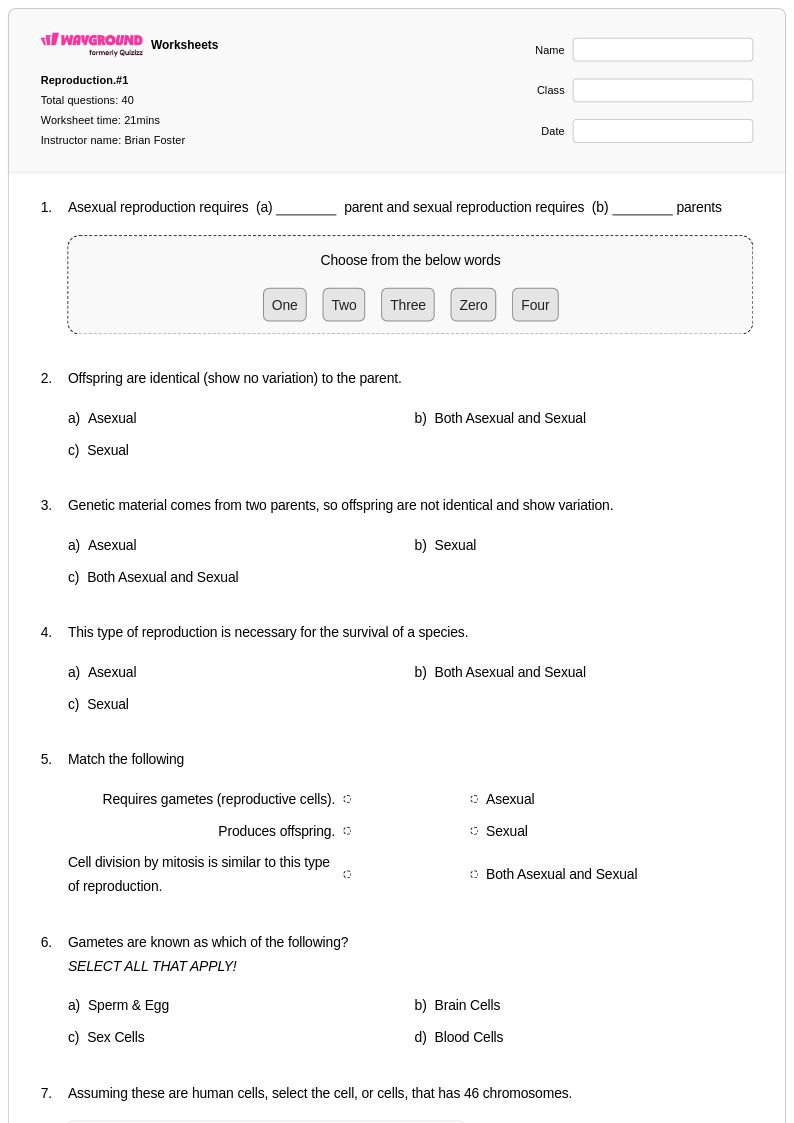
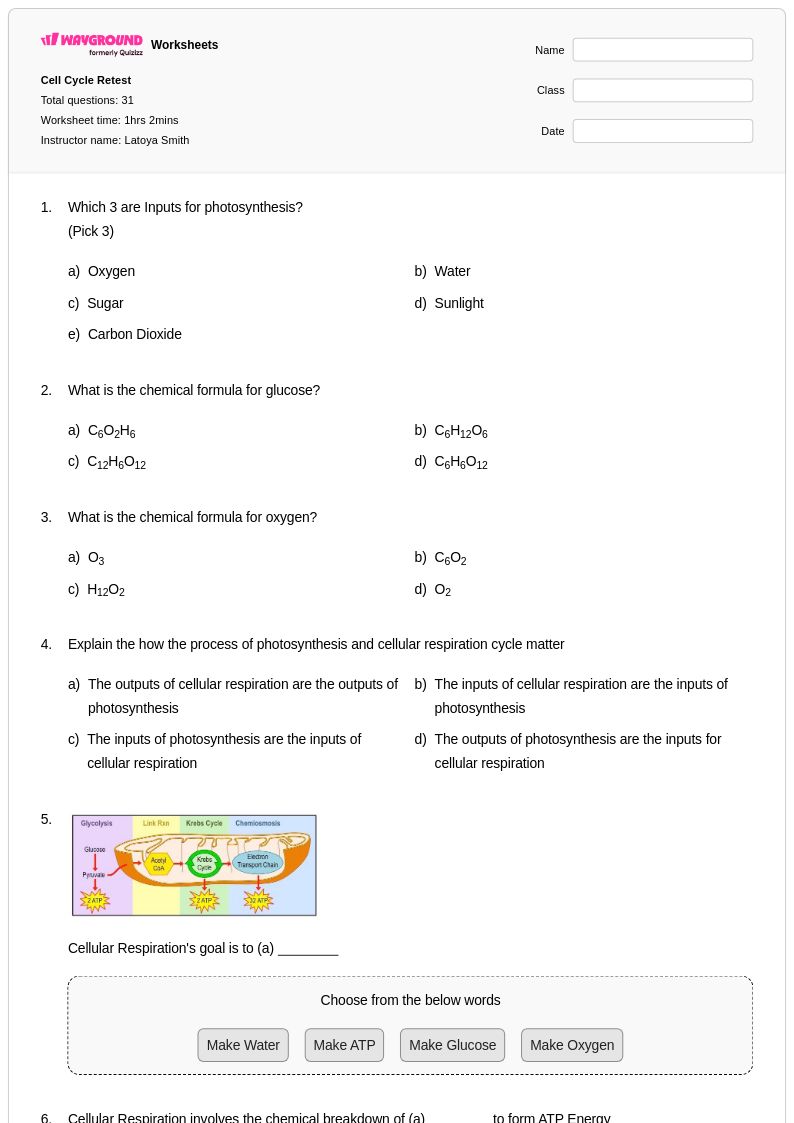
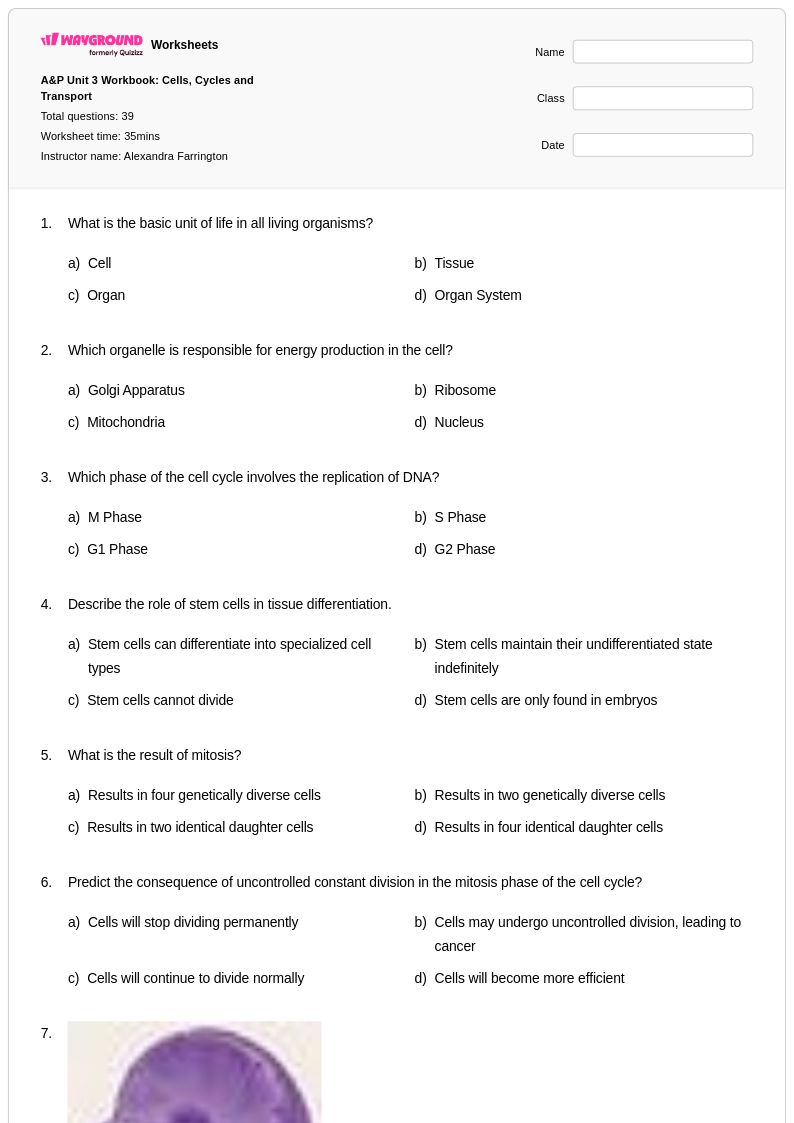
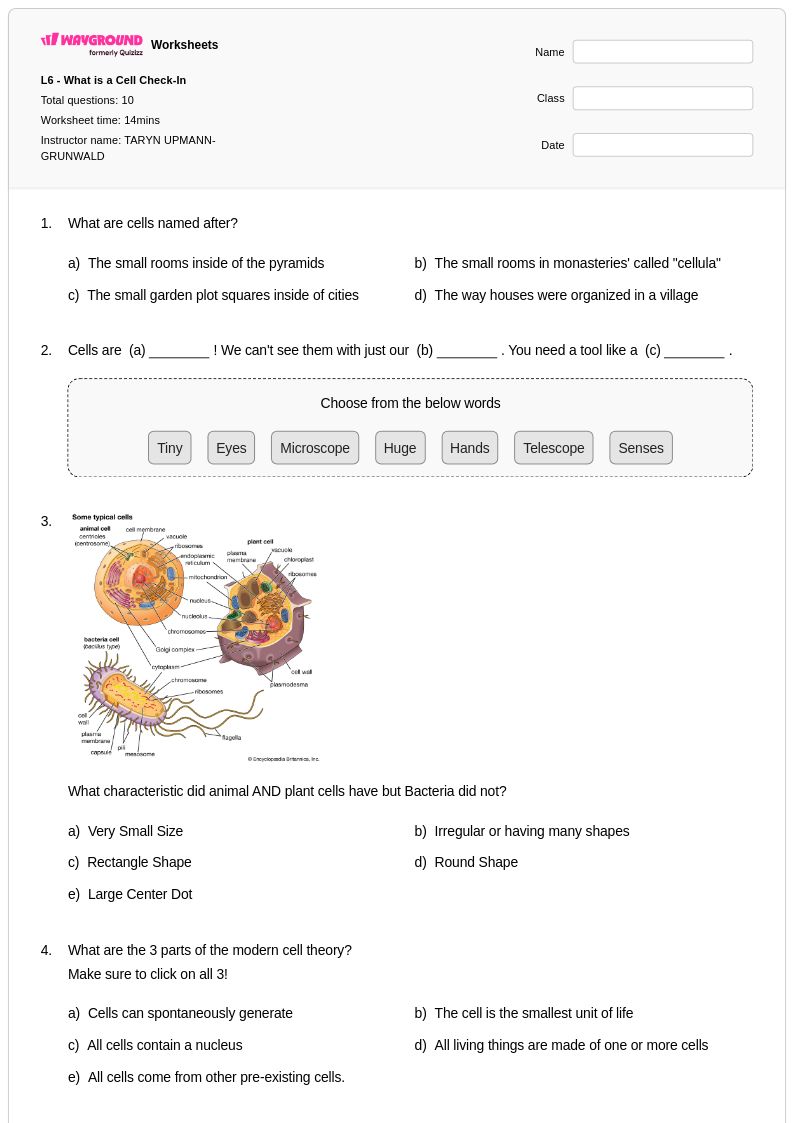
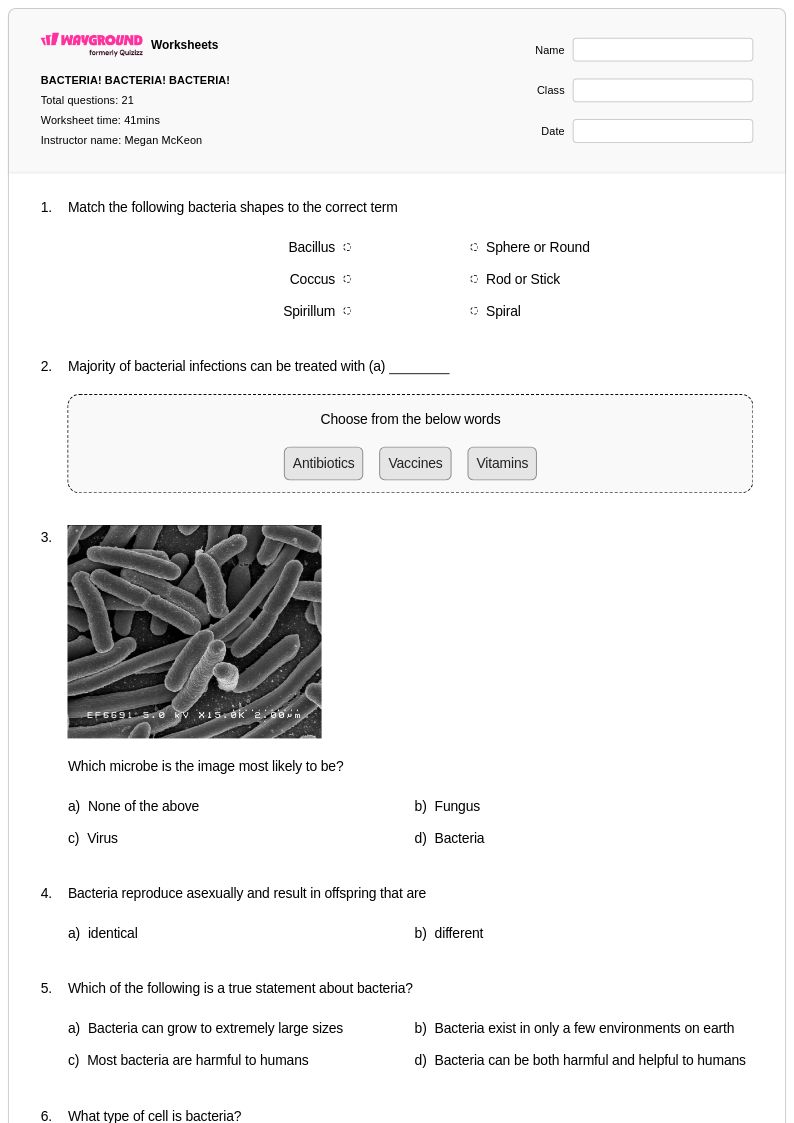
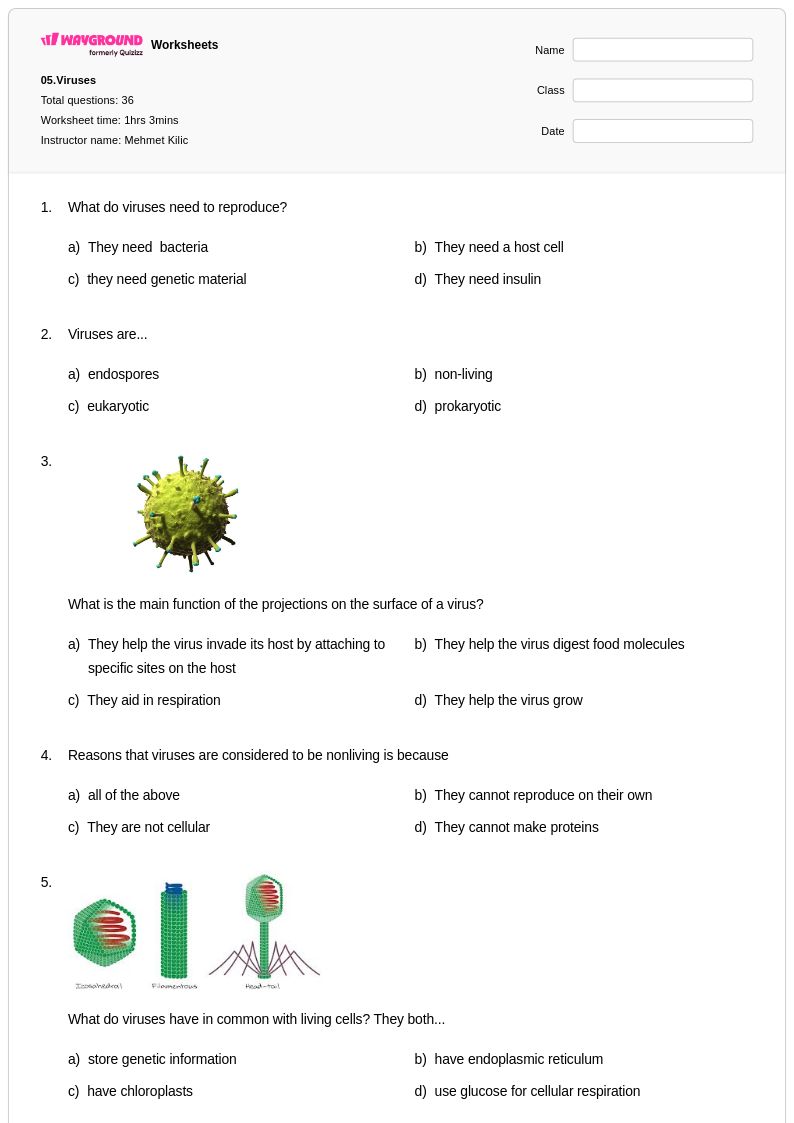
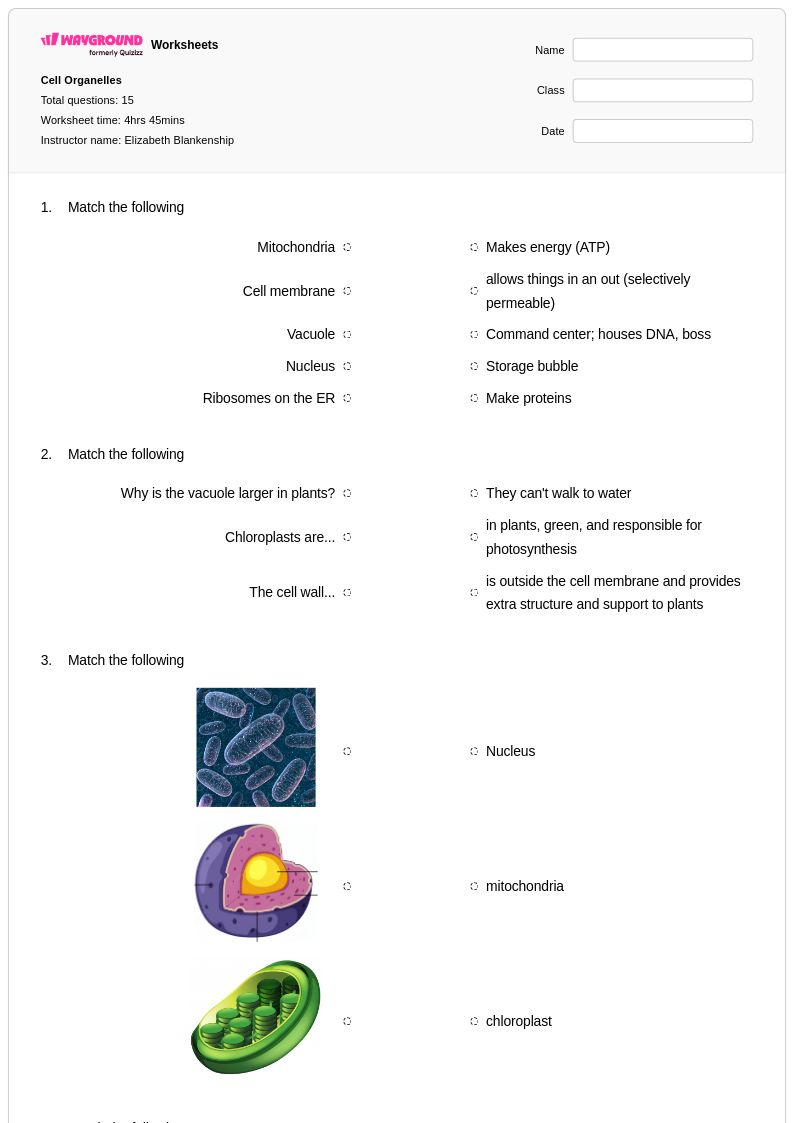
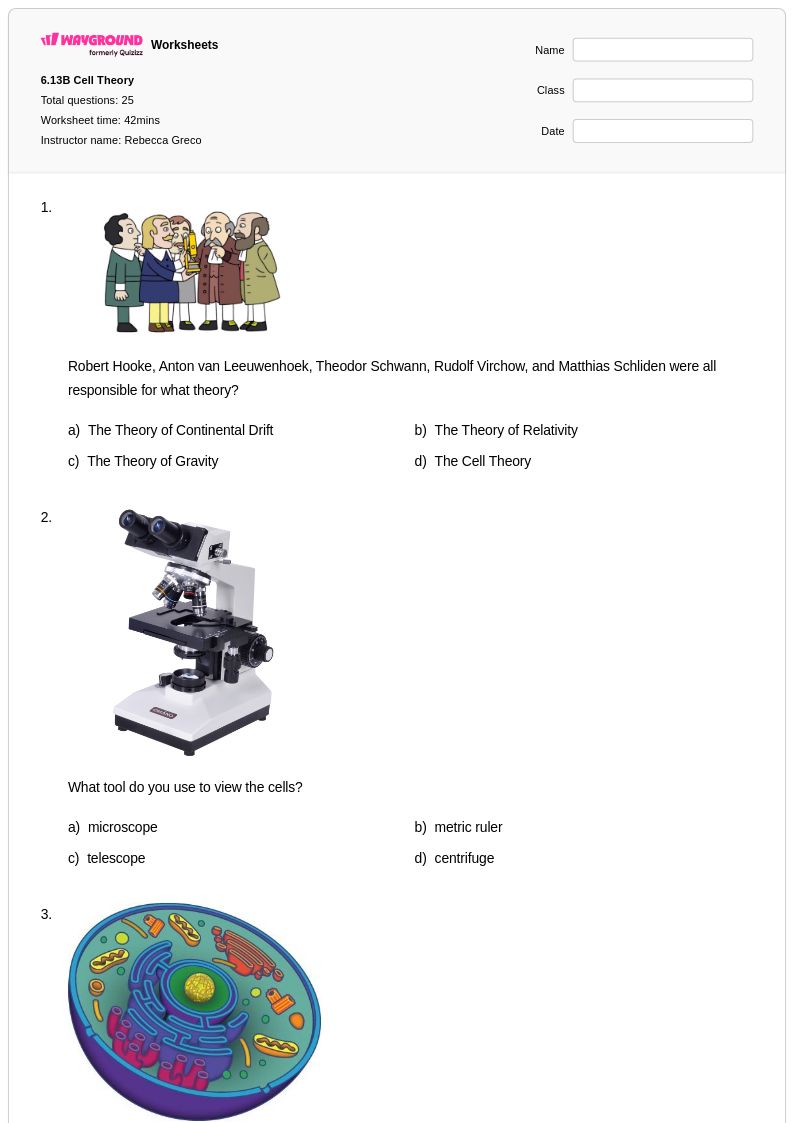
Explore Wayground's free cell environments biology worksheets and printables with answer keys to help students master how cells interact with their surroundings through engaging practice problems and comprehensive PDF resources.
Cell environments worksheets available through Wayground (formerly Quizizz) provide comprehensive resources for exploring how cellular structures interact with their surrounding conditions and maintain homeostasis. These expertly designed materials strengthen students' understanding of osmosis, diffusion, membrane permeability, and cellular transport mechanisms while developing critical thinking skills about how environmental factors affect cellular function. The collection includes detailed practice problems that challenge learners to analyze concentration gradients, predict cellular responses to various solutions, and interpret data from experiments involving cell membrane dynamics. Each worksheet comes with a complete answer key and is available as a free printable pdf, making it easy for educators to incorporate these resources into both classroom instruction and independent study sessions.
Wayground (formerly Quizizz) empowers teachers with millions of educator-created resources specifically focused on cell environments, featuring robust search and filtering capabilities that allow instructors to quickly locate materials aligned with specific learning standards and curriculum requirements. The platform's differentiation tools enable teachers to customize worksheets for varying ability levels, while the flexible format options include both printable pdf versions for traditional classroom use and digital formats for interactive learning experiences. These comprehensive features support effective lesson planning by providing ready-to-use materials for initial instruction, targeted remediation for students struggling with membrane transport concepts, and enrichment activities for advanced learners ready to explore complex cellular processes. The extensive collection ensures that educators have access to diverse practice opportunities that reinforce key biological principles while accommodating different learning styles and classroom environments.
FAQs
How do I teach students about cell environments and how cells interact with their surroundings?
Start by grounding students in the concept of homeostasis before introducing osmosis and diffusion as the primary mechanisms cells use to maintain internal balance. Use concrete analogies, such as comparing a semi-permeable membrane to a net with specific hole sizes, to make membrane permeability tangible. From there, move into concentration gradients so students can predict whether water or solutes will move into or out of a cell in a given solution. Hands-on lab simulations or data interpretation tasks reinforce these concepts more effectively than lecture alone.
What exercises help students practice osmosis, diffusion, and cellular transport?
Effective practice exercises include concentration gradient analysis problems where students predict the direction of particle movement, scenario-based questions asking students to classify solutions as hypertonic, hypotonic, or isotonic, and data interpretation tasks drawn from simulated membrane transport experiments. Worksheet problems that ask students to explain why a cell would shrink or swell in a given environment are particularly useful because they require applying multiple concepts simultaneously rather than recalling isolated definitions.
What mistakes do students commonly make when learning about cell environments and membrane transport?
One of the most common misconceptions is that water moves toward lower water concentration rather than higher solute concentration, causing confusion when students try to predict osmotic direction. Students also frequently conflate osmosis and diffusion, applying them interchangeably rather than distinguishing between water movement and general particle movement. Another common error is assuming that active transport always requires more energy than passive transport regardless of context, rather than understanding that energy use depends on whether movement goes against a concentration gradient.
How can I differentiate cell environments instruction for students at different ability levels?
For struggling students, reduce the complexity of practice problems by focusing on binary comparisons, such as hypertonic versus hypotonic, before introducing isotonic solutions or multi-step gradient problems. For advanced learners, add questions that ask students to connect membrane transport mechanisms to real biological phenomena like kidney function or plant turgor pressure. On Wayground, teachers can apply accommodations such as reduced answer choices to lower cognitive load for individual students, or enable Read Aloud for students who benefit from audio support, without alerting the rest of the class.
How do I use Wayground's cell environments worksheets in my classroom?
Wayground's cell environments worksheets are available as printable PDFs for traditional classroom use and in digital formats for technology-integrated or remote learning environments, making them adaptable to most instructional settings. Teachers can also host worksheets directly as a quiz on Wayground, which allows for real-time monitoring of student responses. Each worksheet includes a complete answer key, reducing prep time and making it straightforward to use the materials for guided practice, independent work, or review sessions.
How do I assess whether students truly understand cellular transport versus just memorizing vocabulary?
True conceptual understanding shows up when students can predict cellular behavior in novel scenarios, not just define terms like osmosis or diffusion. Effective assessment tasks include presenting students with an unfamiliar solution concentration and asking them to predict and explain what would happen to a cell placed in that environment. If students can accurately predict outcomes, justify their reasoning using concentration gradient logic, and identify whether active or passive transport applies, they have moved beyond vocabulary memorization into genuine biological reasoning.