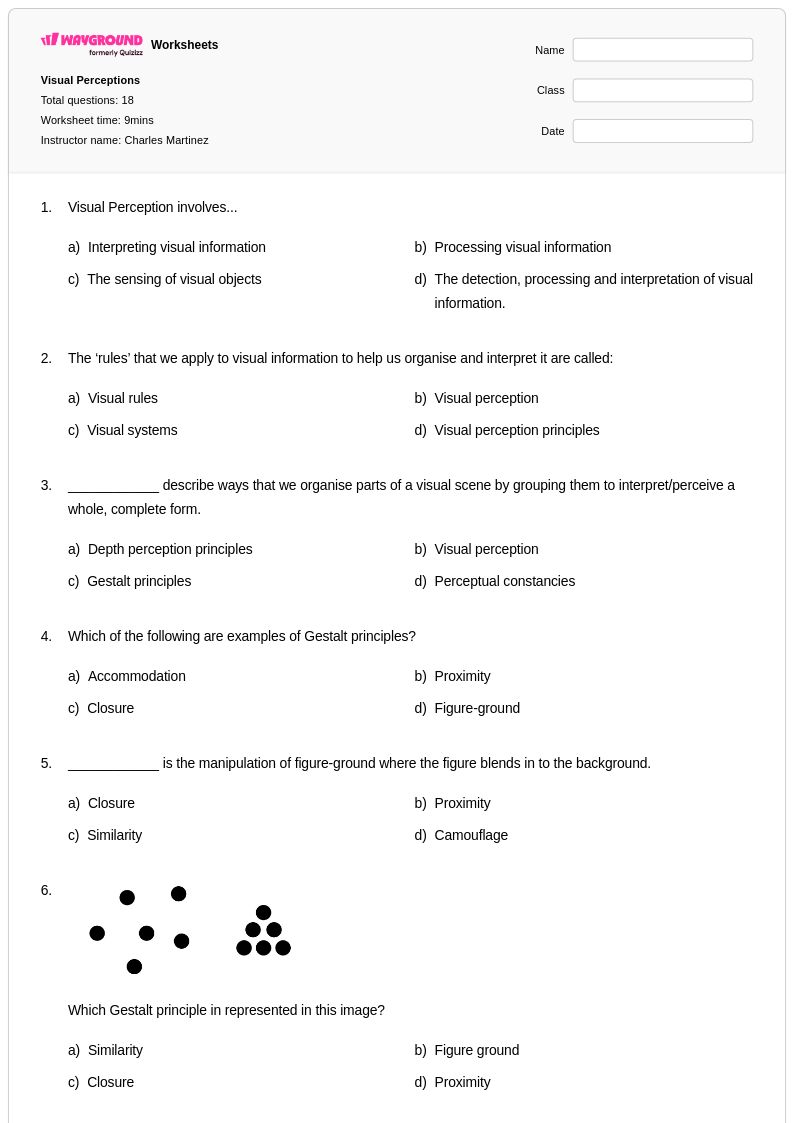
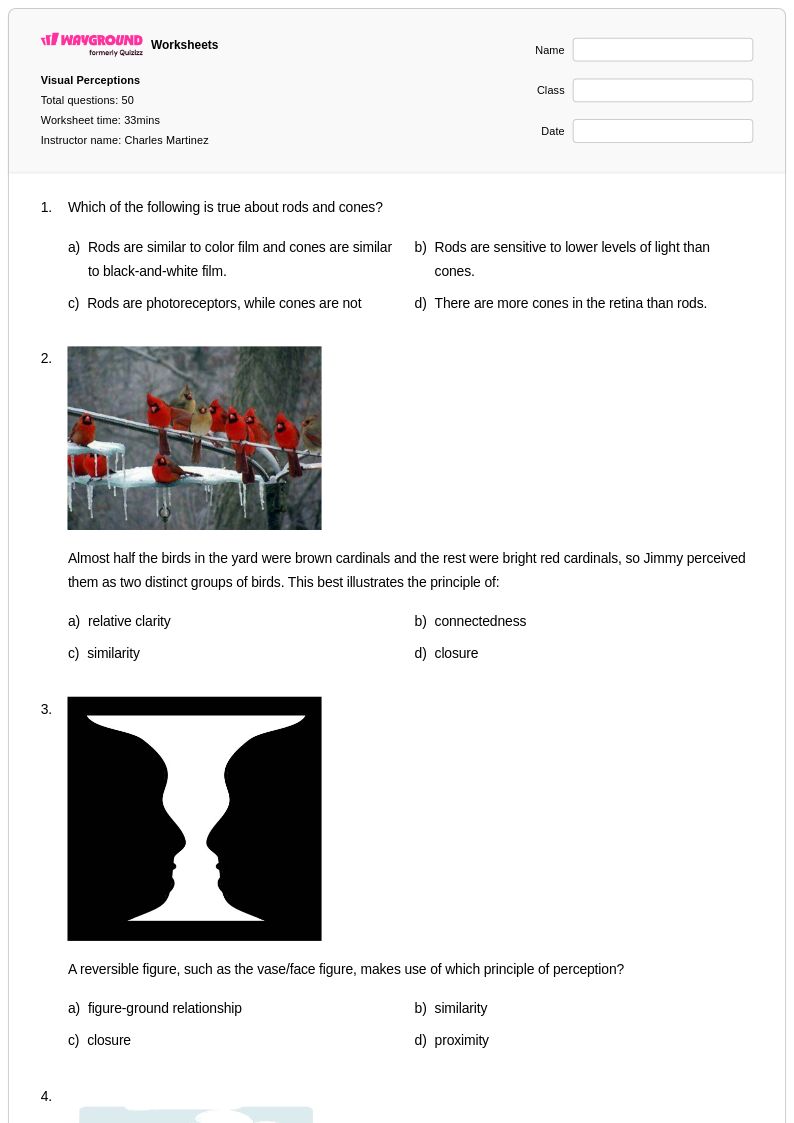
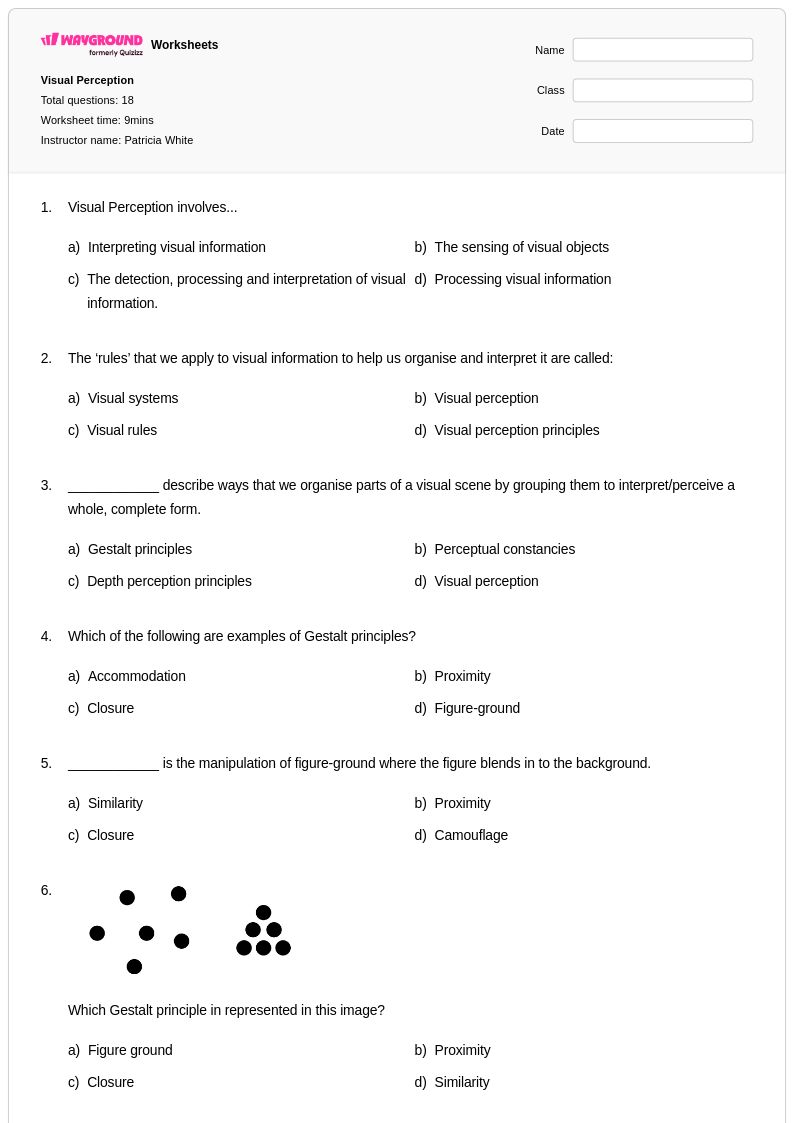
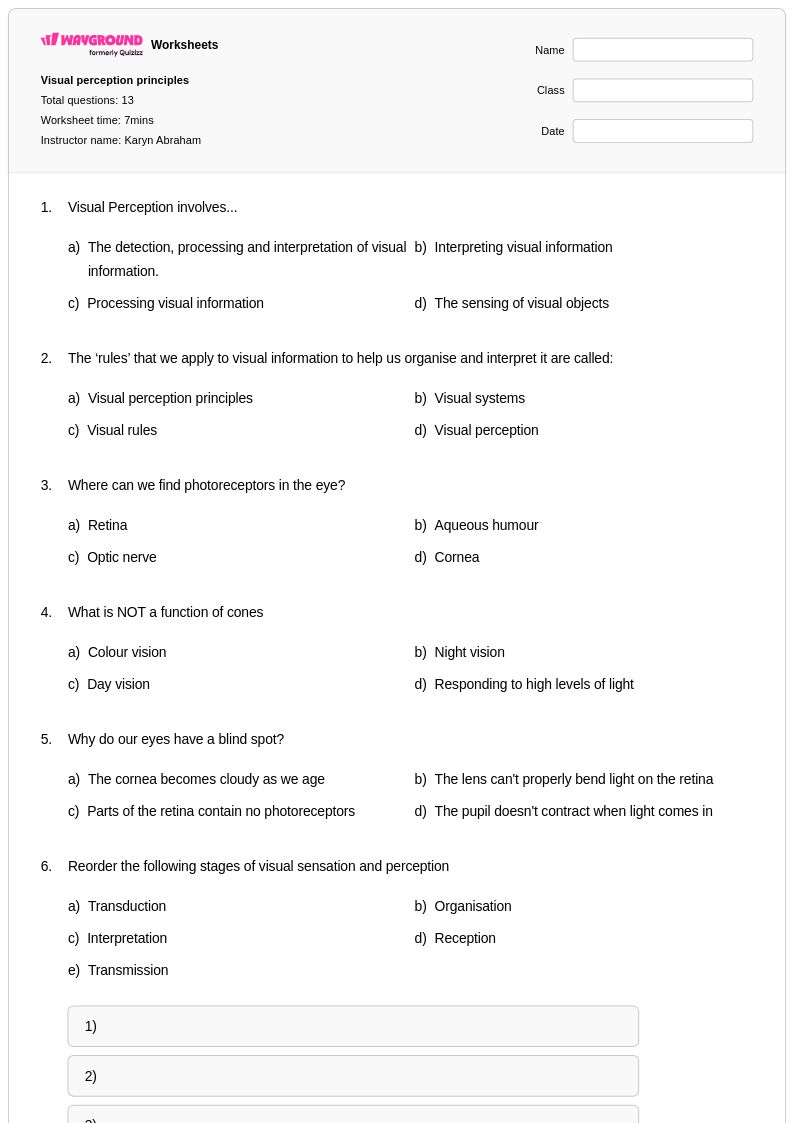
Explore Wayground's comprehensive collection of visual perception biology worksheets, featuring free printables and practice problems with answer keys to help students understand how organisms process and interpret visual information.
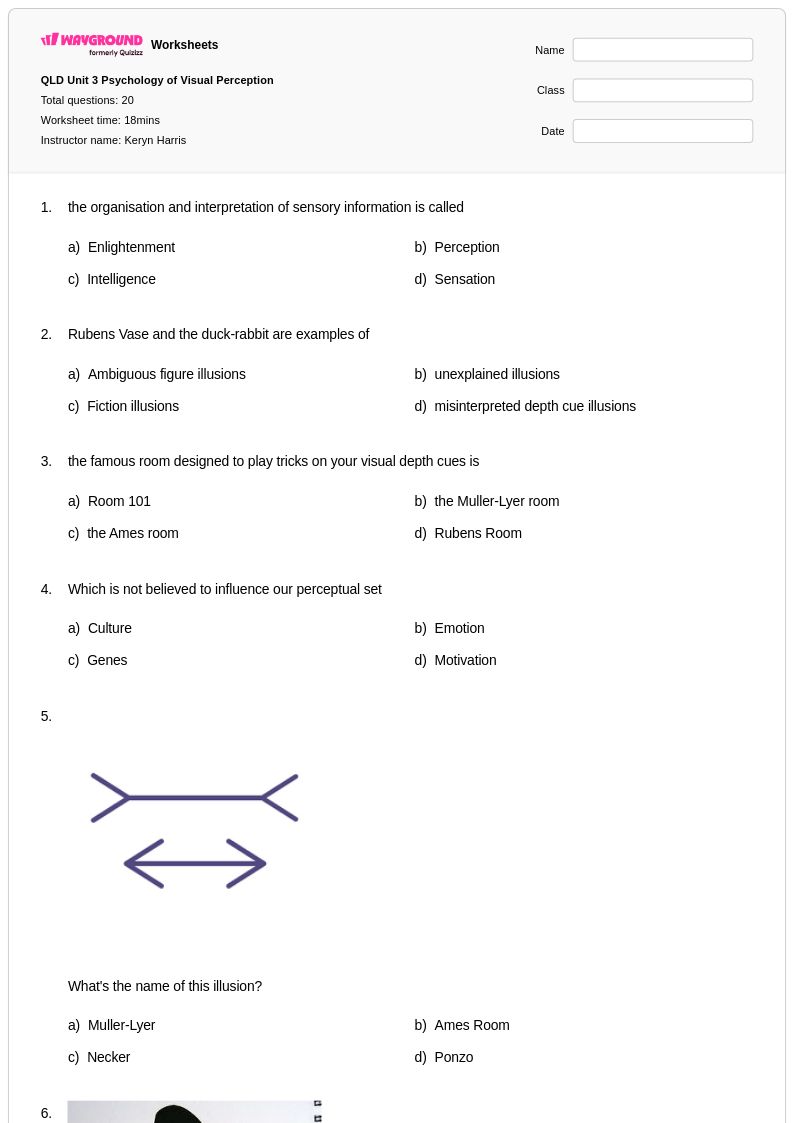
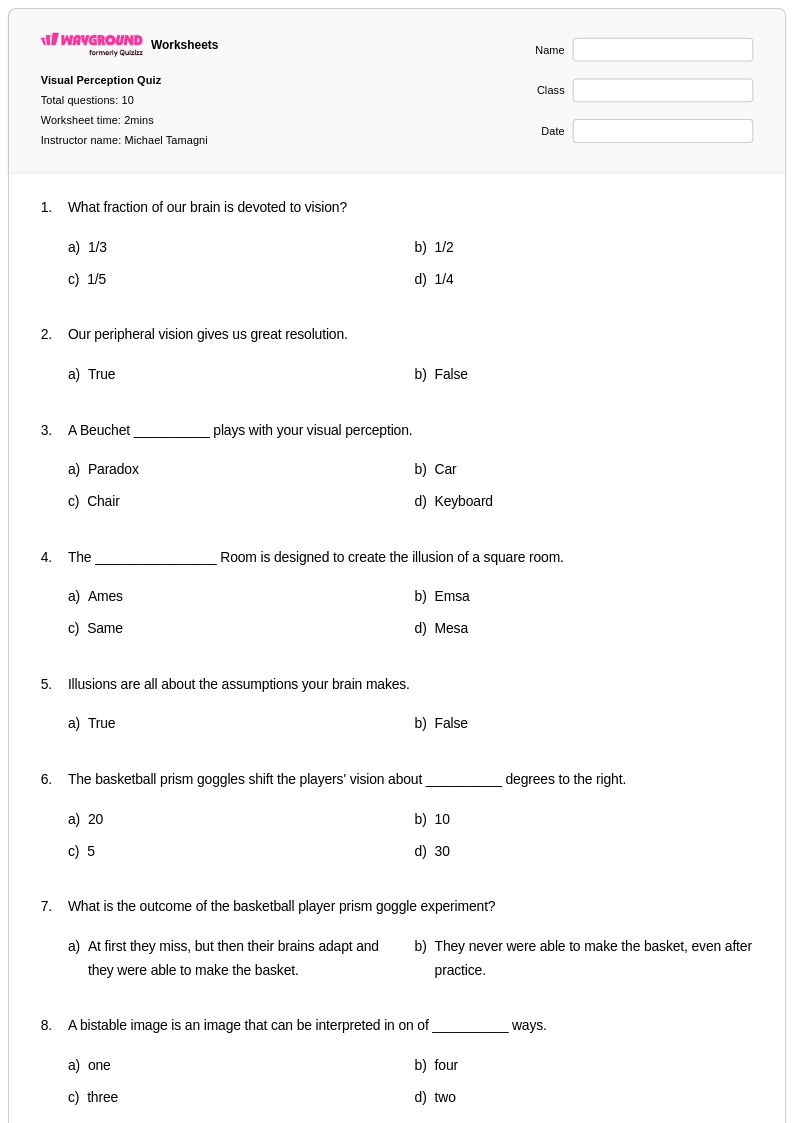
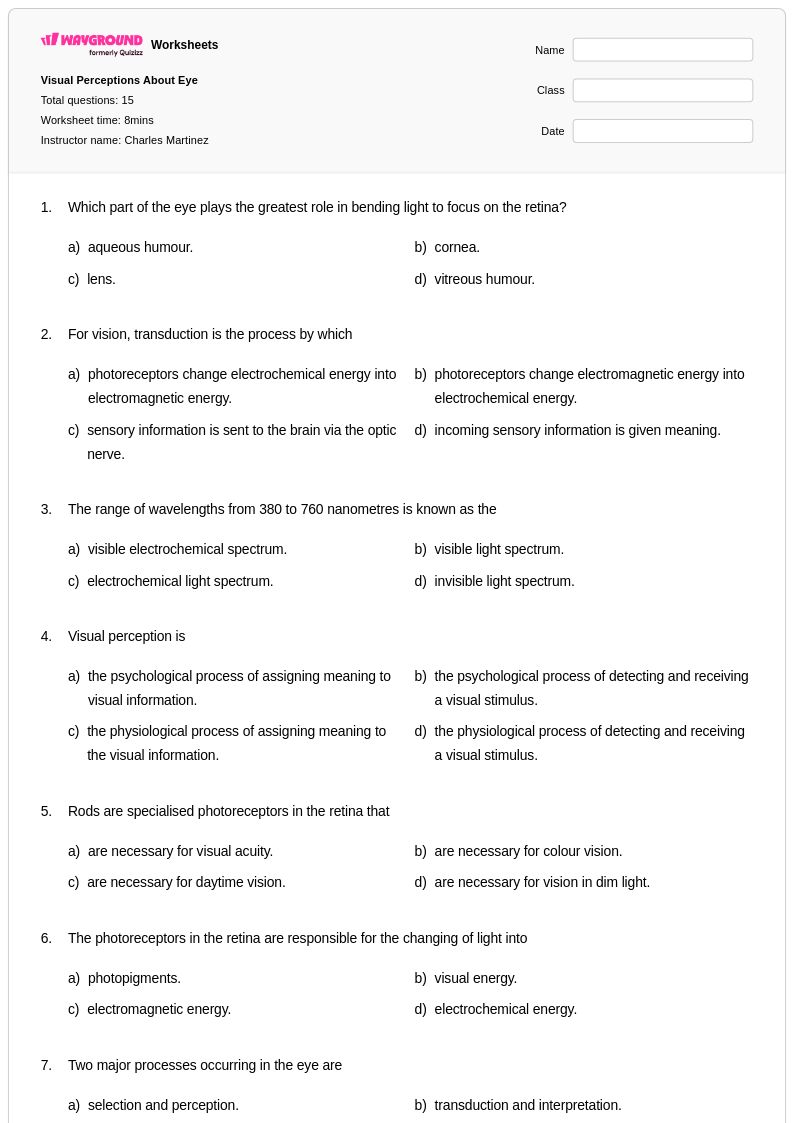
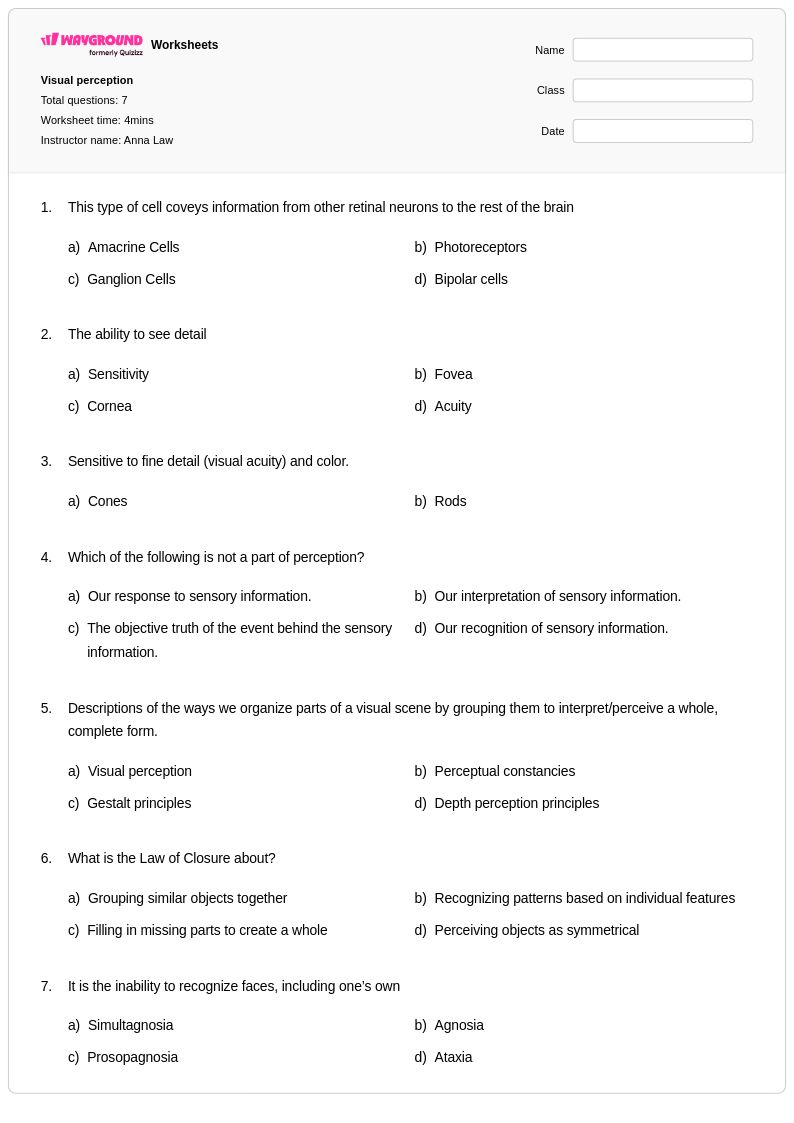
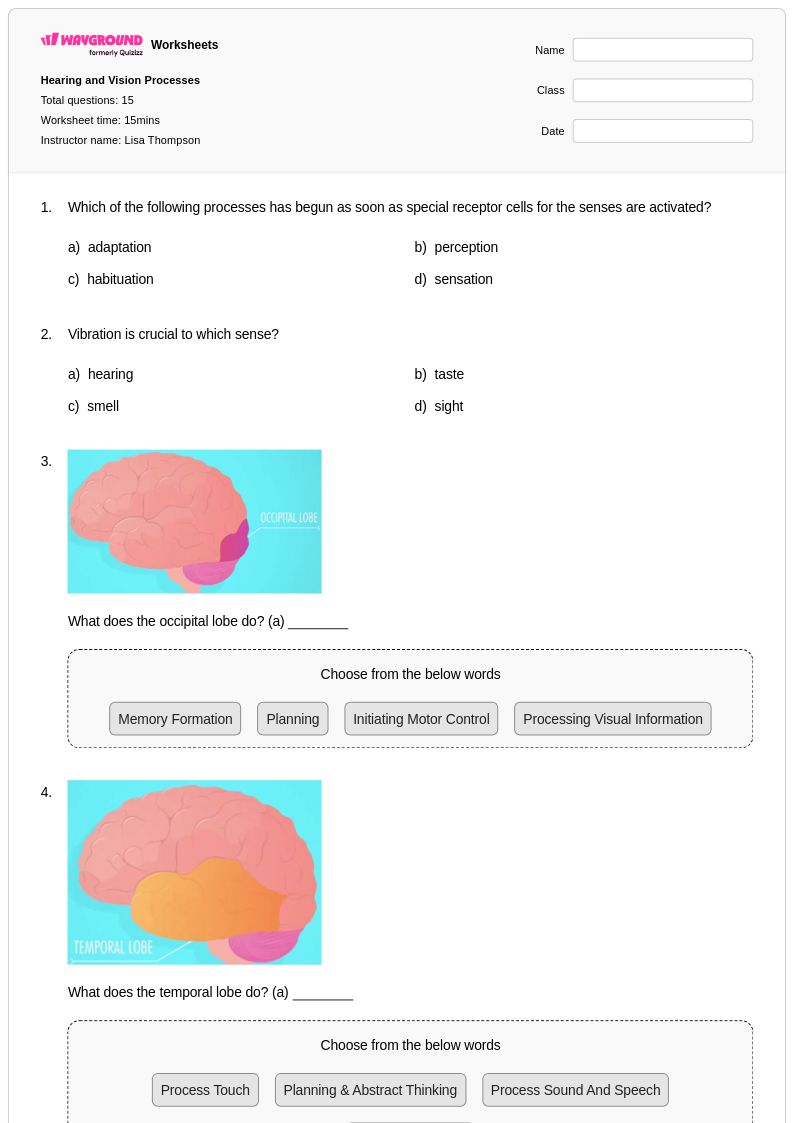
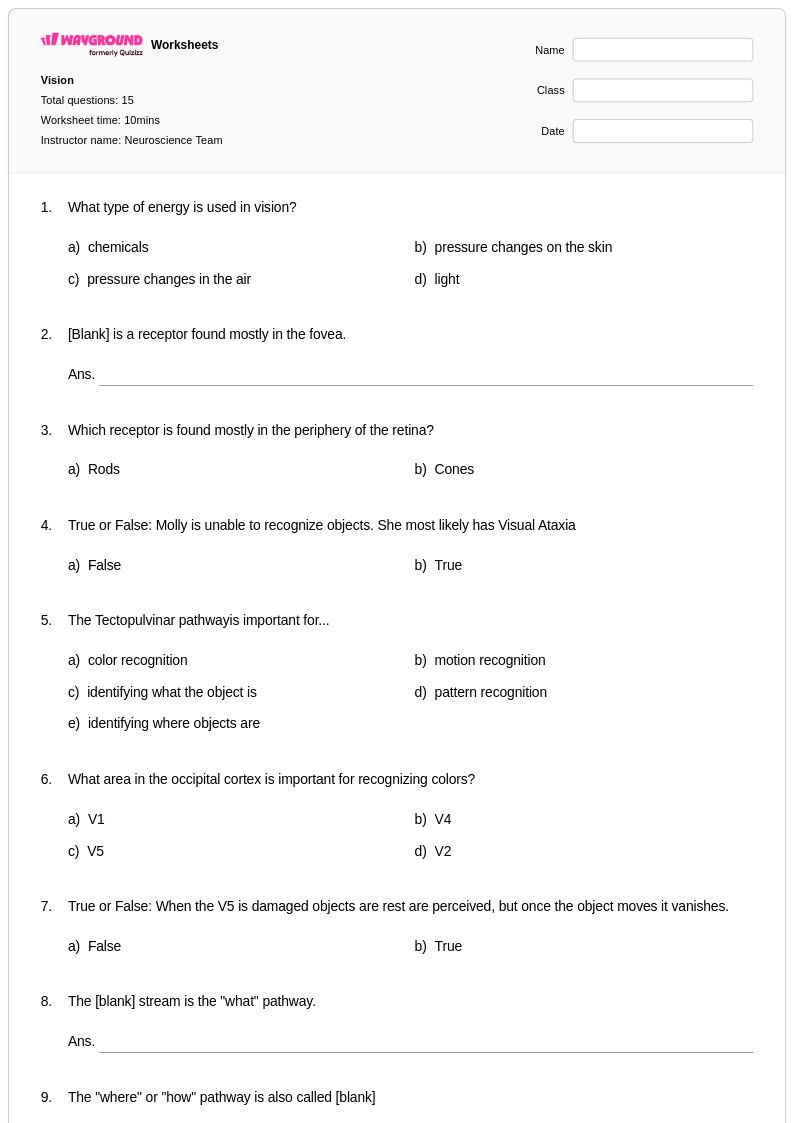
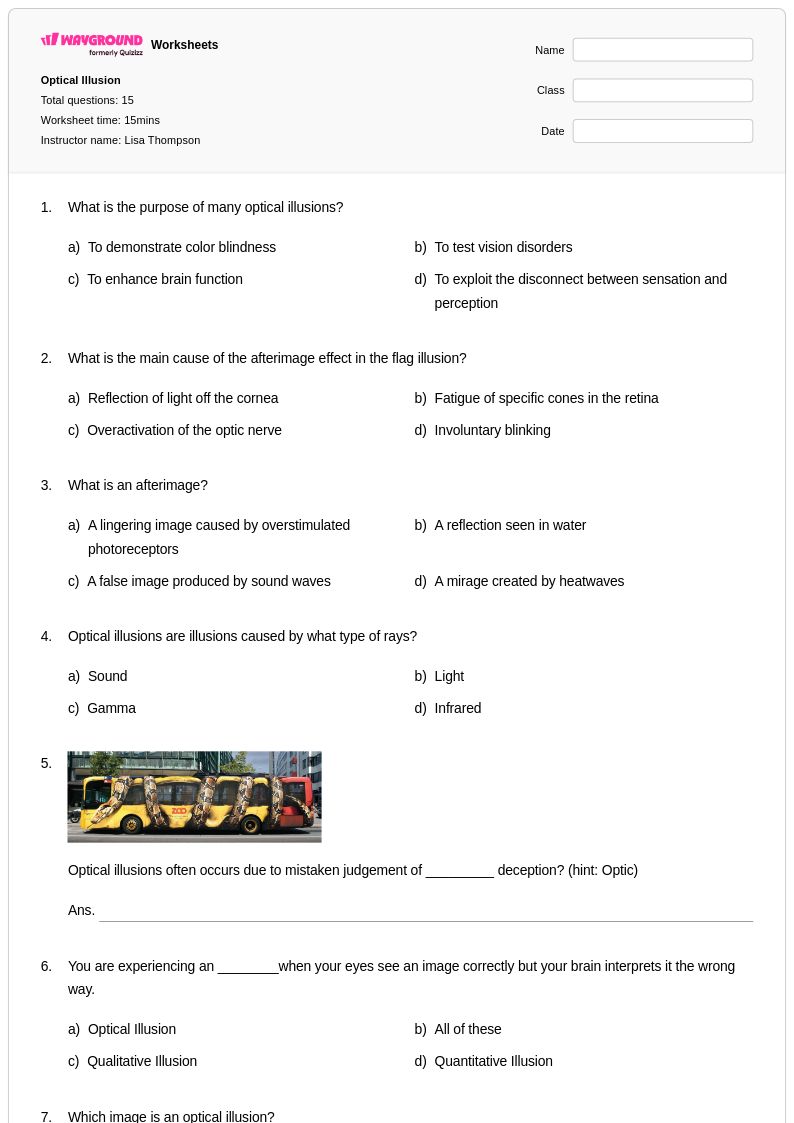
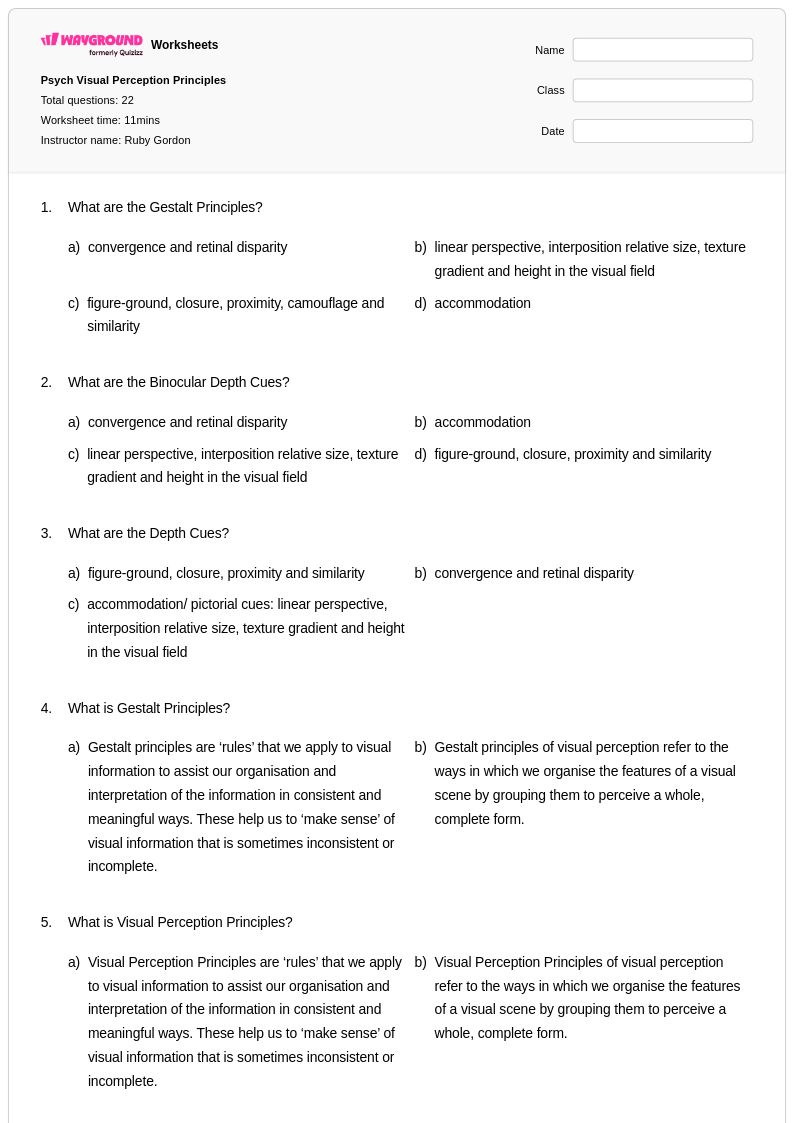
Visual perception worksheets available through Wayground (formerly Quizizz) provide comprehensive resources for exploring how organisms detect, process, and interpret visual stimuli from their environment. These science worksheets focus on the complex biological mechanisms underlying sight, including the anatomy and physiology of visual systems, light detection processes, and neural pathways that transform electromagnetic radiation into meaningful visual information. Students engage with practice problems that examine everything from photoreceptor function and retinal processing to visual cortex organization and perceptual adaptations across different species. Each worksheet includes detailed answer keys and is available as free printable pdf resources, enabling educators to strengthen students' understanding of how biological systems have evolved sophisticated mechanisms for visual information processing.
Wayground (formerly Quizizz) supports biology educators with an extensive collection of millions of teacher-created visual perception worksheets that can be easily accessed through robust search and filtering capabilities. Teachers can locate materials that align with specific educational standards while utilizing differentiation tools to accommodate diverse learning needs and skill levels. The platform's flexible customization options allow educators to modify existing worksheets or create targeted practice materials for remediation and enrichment activities. Available in both printable and digital pdf formats, these visual perception resources streamline lesson planning by providing ready-to-use materials that help students master complex concepts related to sensory biology, comparative visual systems, and the evolutionary adaptations that enable organisms to effectively navigate their visual environments.
FAQs
How do I teach visual perception in a biology class?
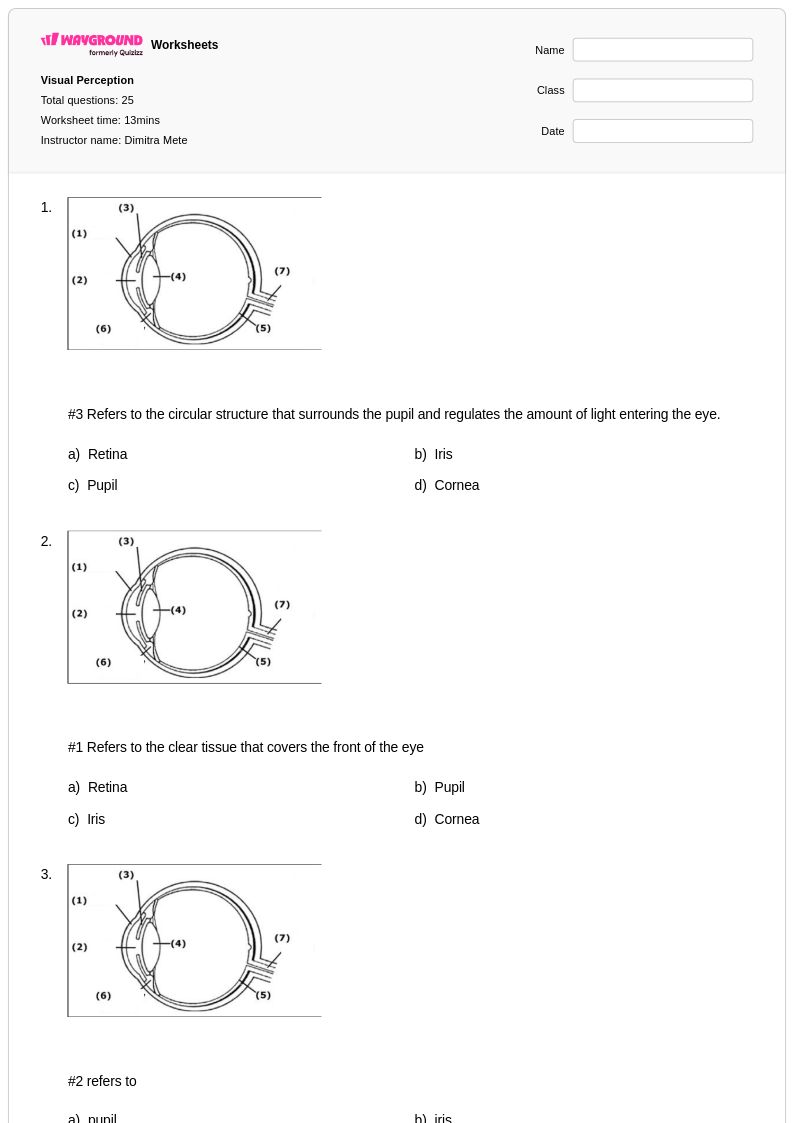
Teaching visual perception effectively starts with grounding students in the anatomy of the eye before moving into neural processing. Begin with photoreceptor function (rods vs. cones), then trace the signal pathway from the retina through the optic nerve to the visual cortex. Connecting structural anatomy to functional outcomes, such as how retinal organization determines color vision or peripheral acuity, helps students see the system as integrated rather than a list of parts. Comparative examples across species (compound eyes, tapetum lucidum) also help reinforce how visual systems are shaped by evolutionary pressures.
What exercises help students practice visual perception concepts in biology?
Practice problems that ask students to trace the visual signal pathway, label photoreceptor distribution on the retina, and explain what happens when specific components fail are especially effective. Diagram-based questions reinforcing the anatomy of the eye alongside short-answer questions about neural processing help students consolidate both structural and functional knowledge. Comparative analysis tasks, such as contrasting human and invertebrate visual systems, push students to apply core concepts rather than just recall them.
What mistakes do students commonly make when learning about visual perception?
A frequent misconception is that the eye works like a camera, with students assuming the retina simply captures a complete image that the brain then views passively. In reality, visual perception involves active neural construction, with the brain filling in gaps and interpreting signals based on context. Students also commonly confuse the roles of rods and cones, misattributing color detection to rods or assuming cones function in low-light conditions. Addressing these errors directly with targeted practice questions can prevent them from becoming entrenched.
How can I differentiate visual perception instruction for students at different skill levels?
For students who need additional support, reduce the complexity of pathway-tracing questions and focus first on core vocabulary: photoreceptor, optic nerve, visual cortex. For advanced students, push into higher-order analysis, such as explaining perceptual adaptations in non-human species or evaluating what structural damage would produce specific visual deficits. On Wayground, teachers can apply accommodations such as Read Aloud for students who need audio support, reduced answer choices to lower cognitive load, and extended time, all configurable per student without disrupting the rest of the class.
How do I use visual perception worksheets from Wayground in my classroom?
Wayground's visual perception worksheets are available as printable PDFs for traditional classroom use and in digital formats for technology-integrated learning environments. Teachers can also host worksheets as a live quiz on Wayground, making them suitable for formative assessment or independent practice. The platform's search and filtering tools allow educators to locate materials aligned to specific standards, and existing worksheets can be customized to target remediation or enrichment goals. Answer keys are included with every worksheet, reducing preparation time.
How does visual perception connect to other biology topics I'm already teaching?
Visual perception is a natural extension of nervous system units, since it directly illustrates sensory transduction, neural signal transmission, and brain processing in a tangible context. It also connects to cell biology through photoreceptor structure and to evolution through comparative visual systems across species. Teachers often find it useful to introduce visual perception after covering neuron function and sensory receptors, so students can apply their understanding of action potentials and signal pathways to a real, relatable system.