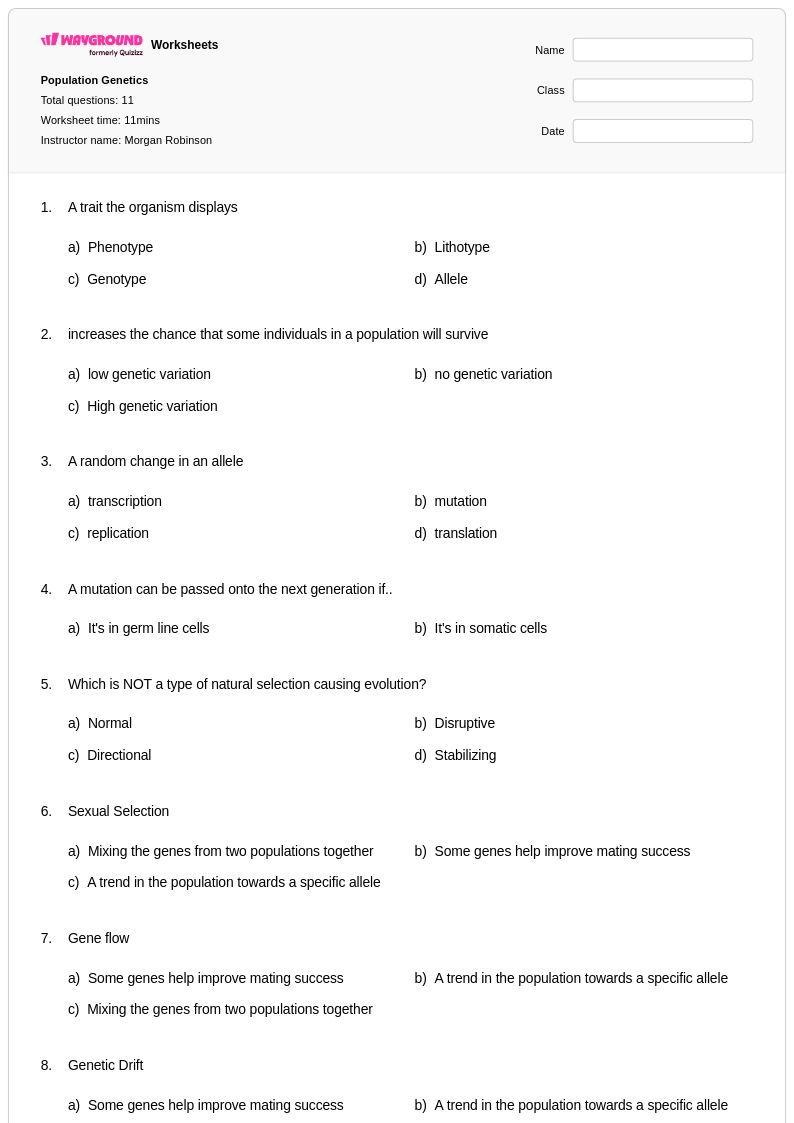
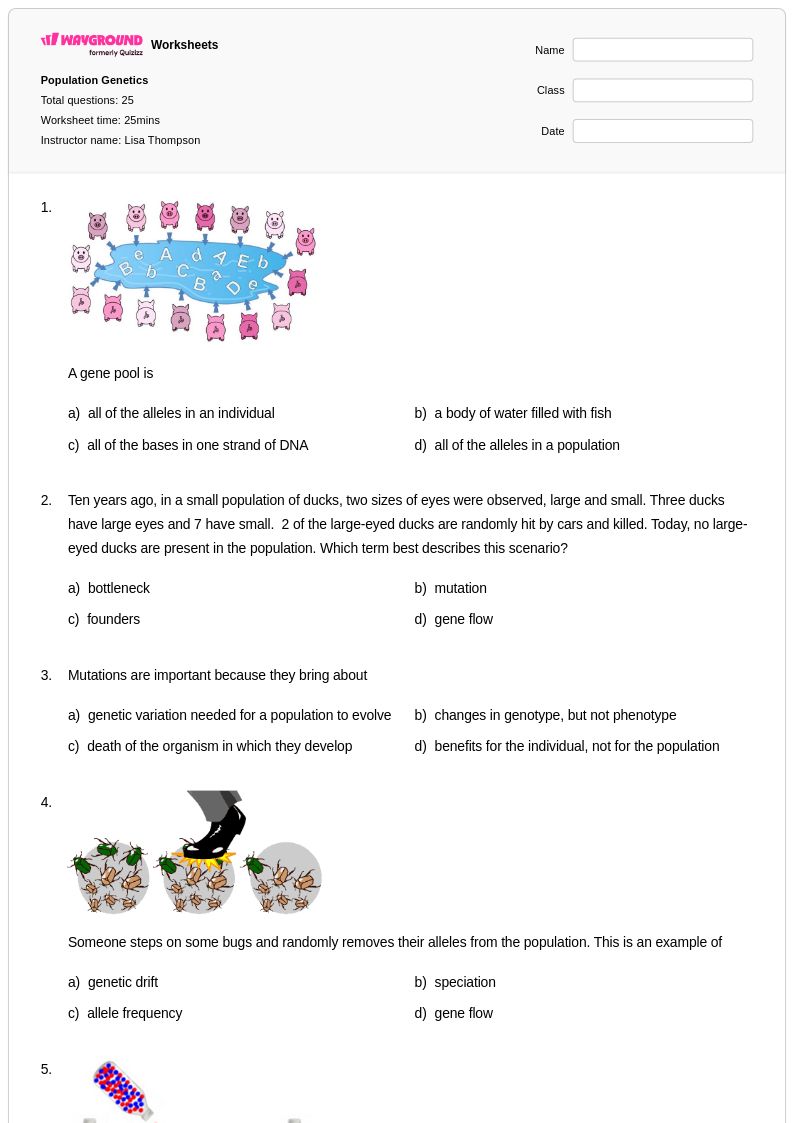
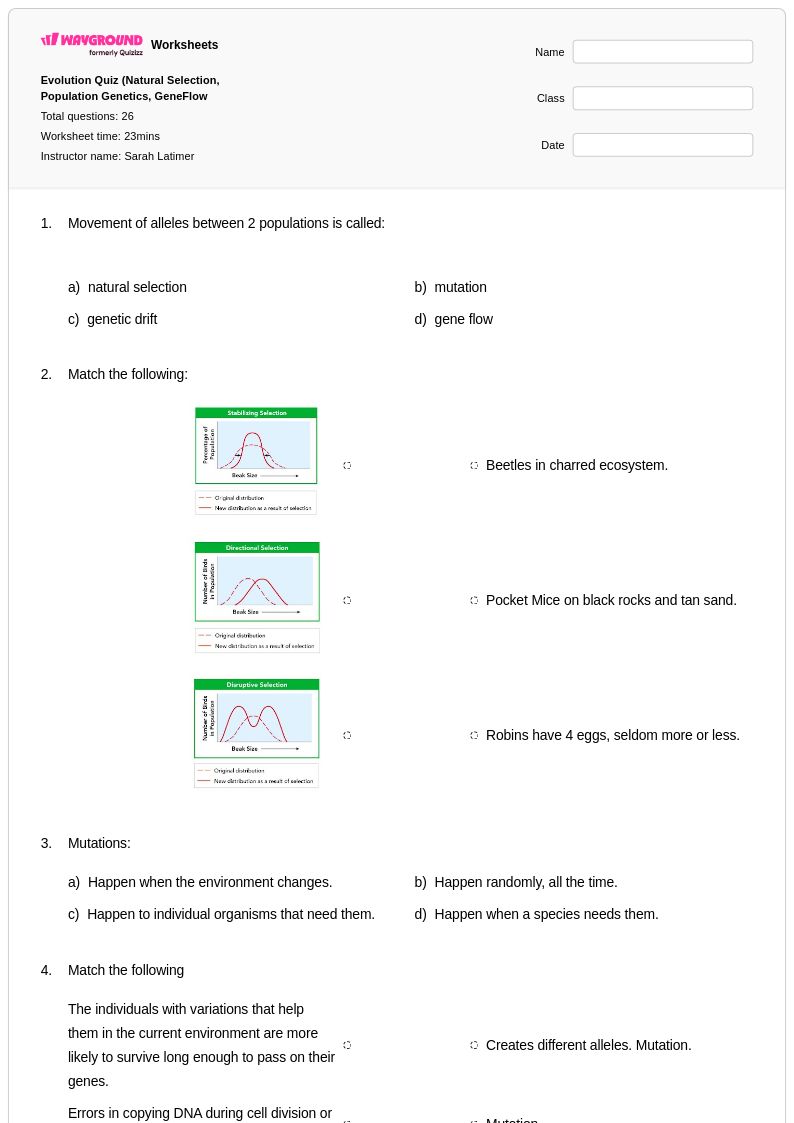
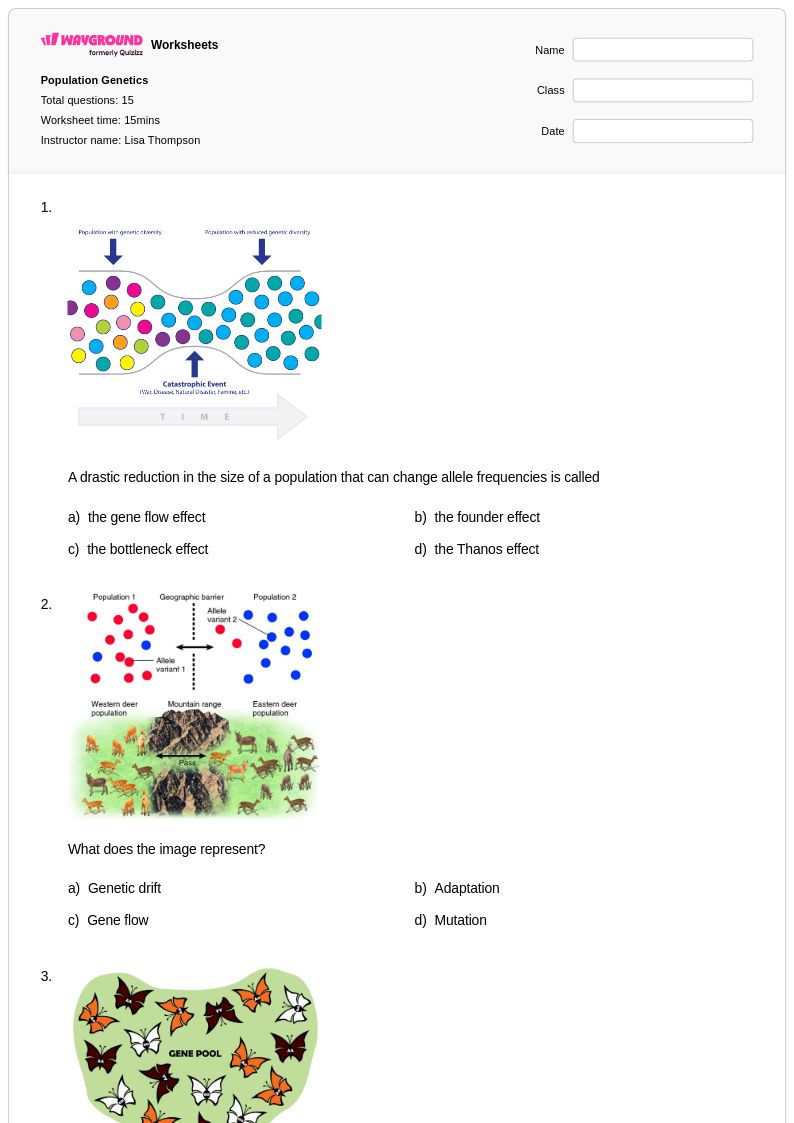
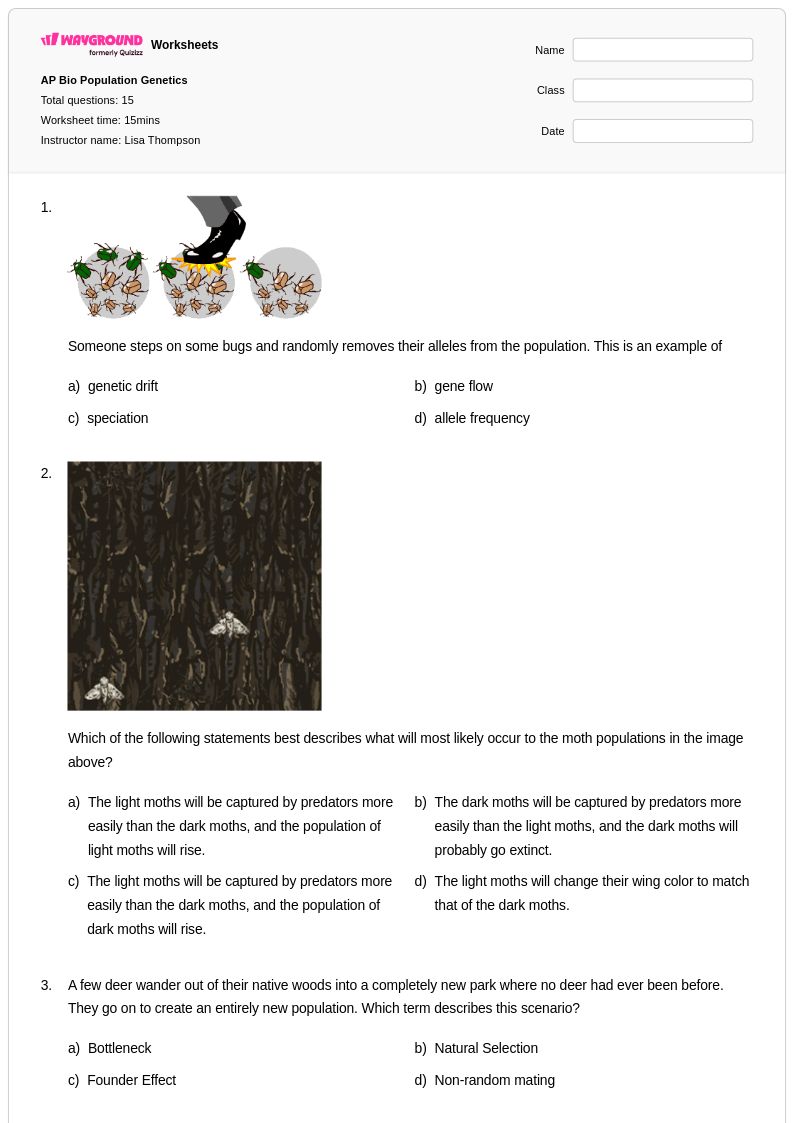
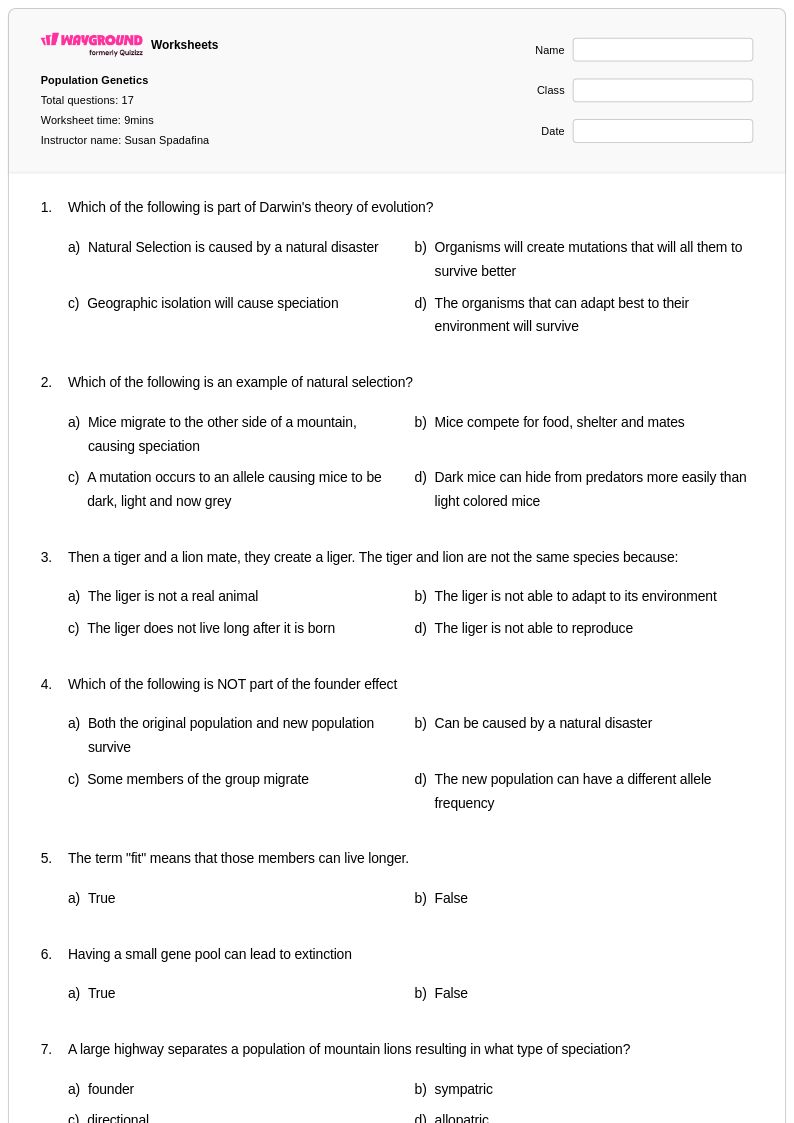
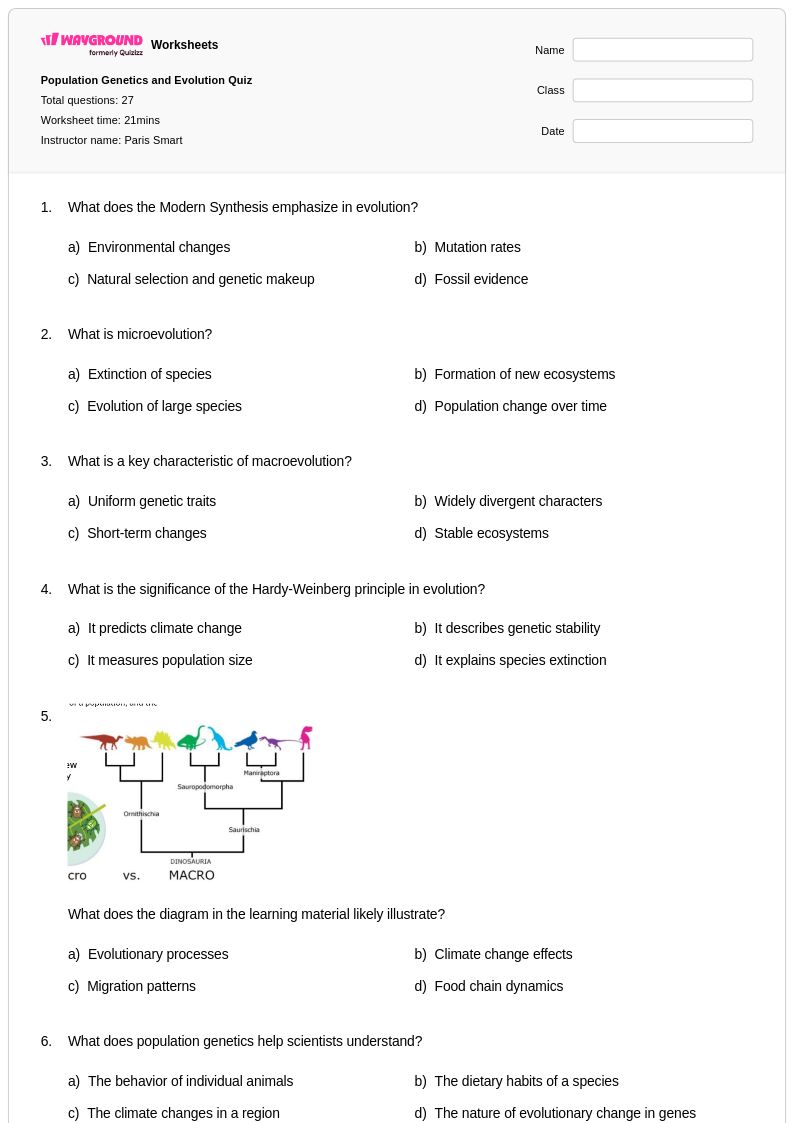
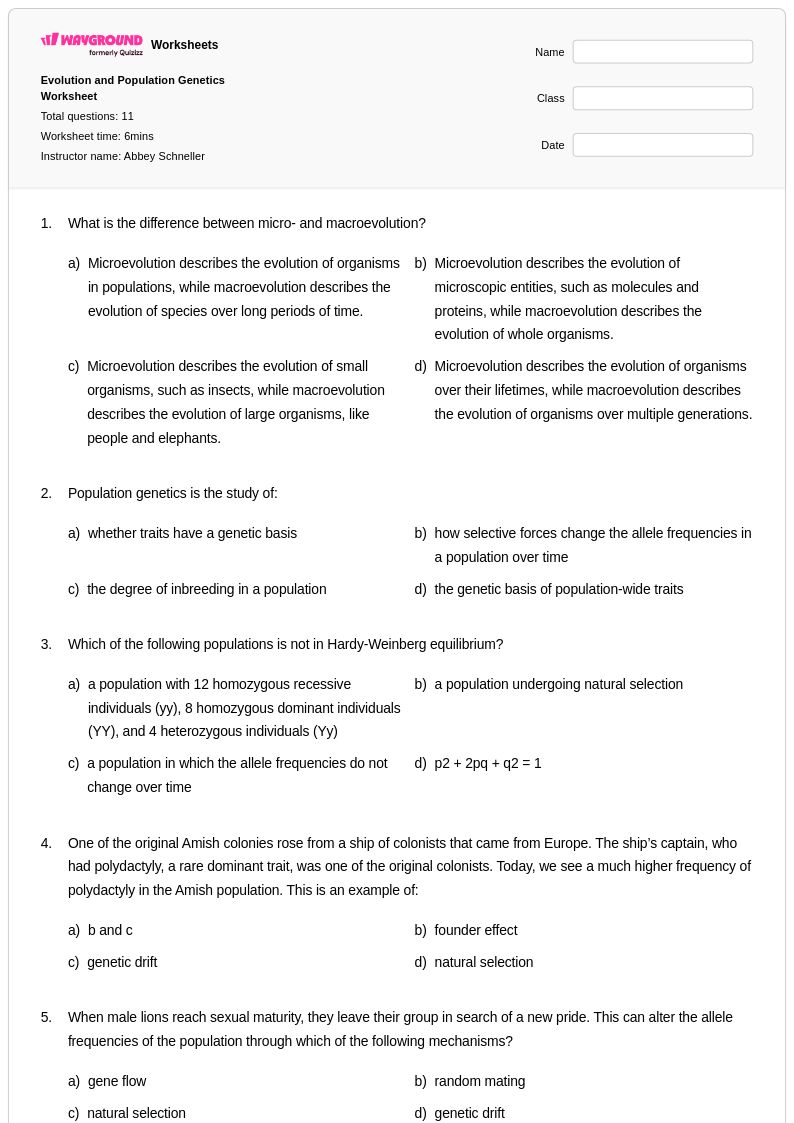
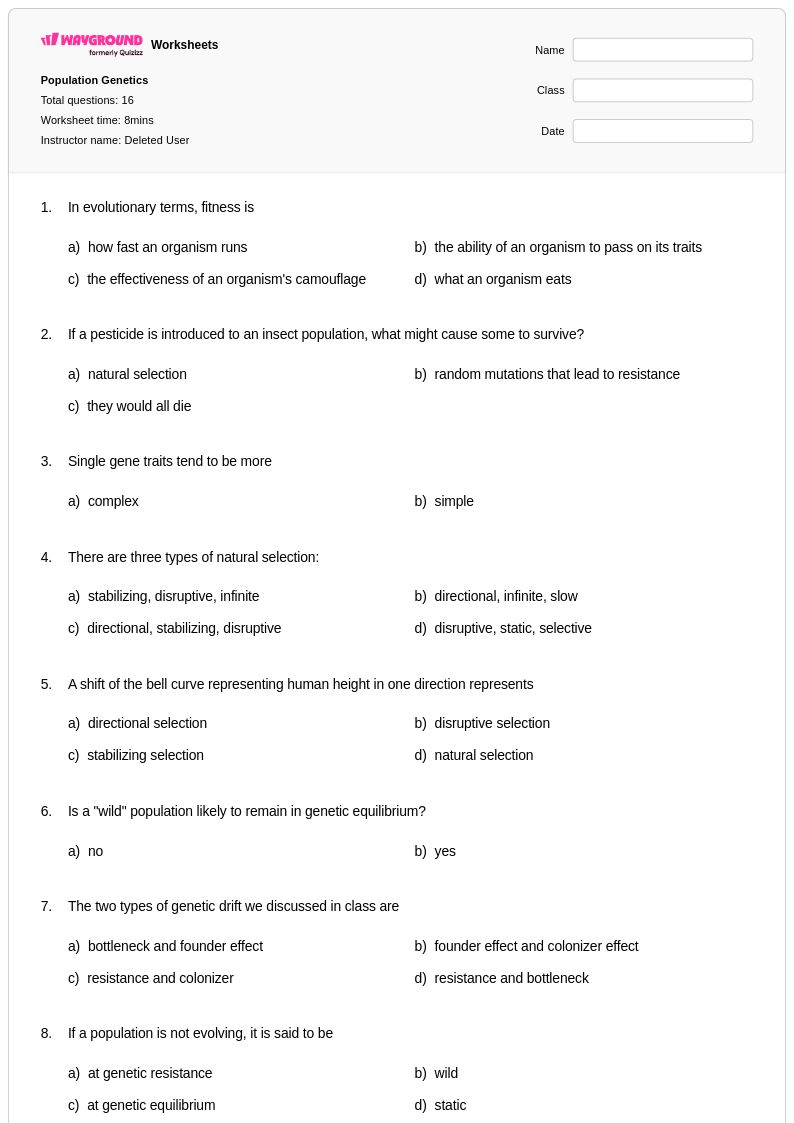
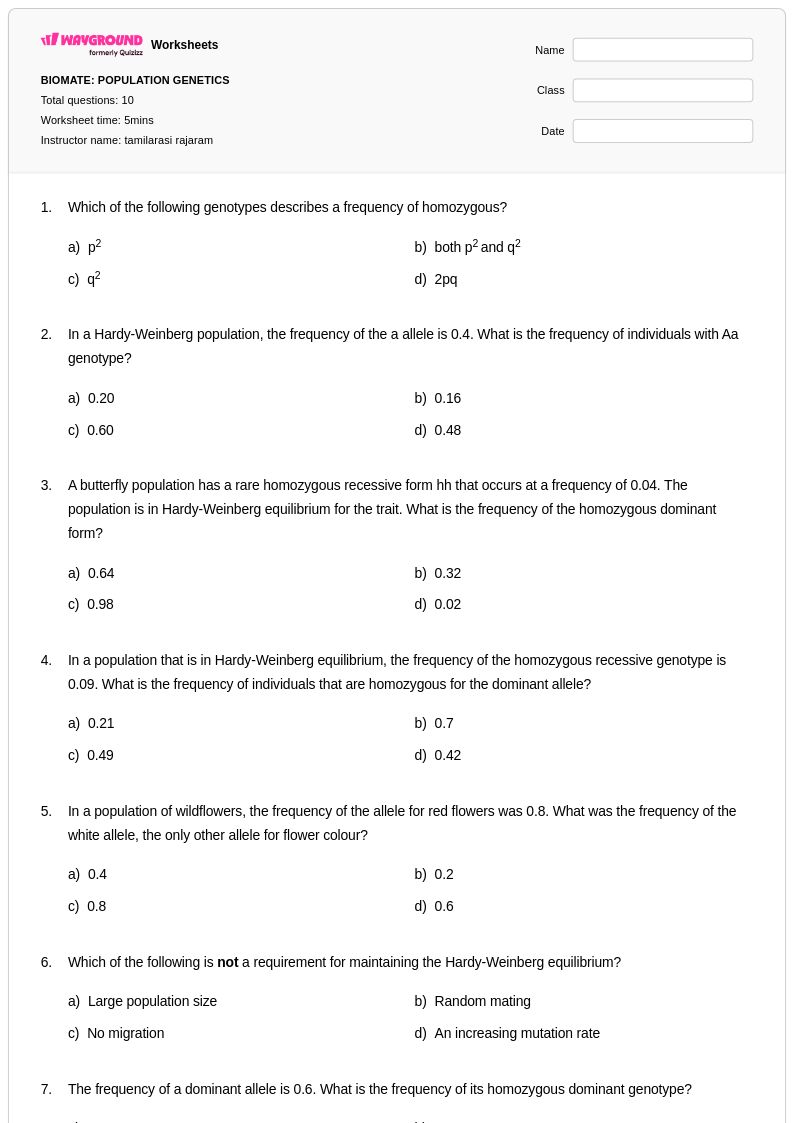
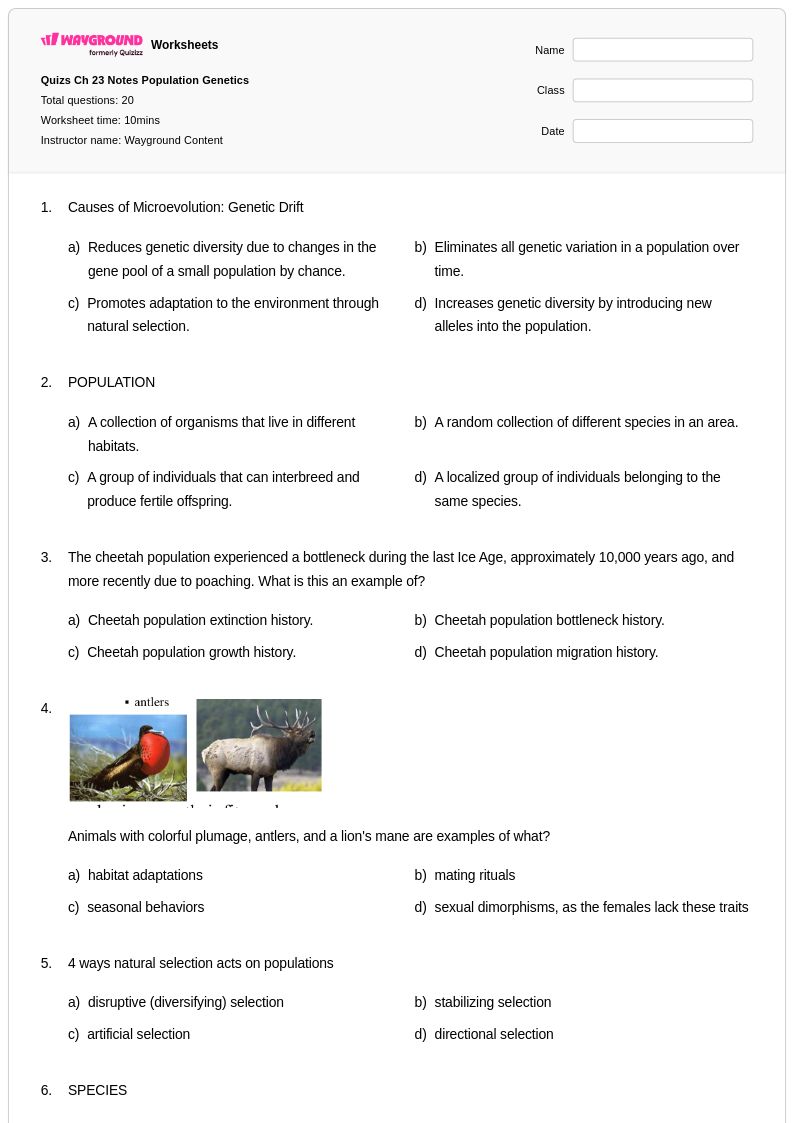
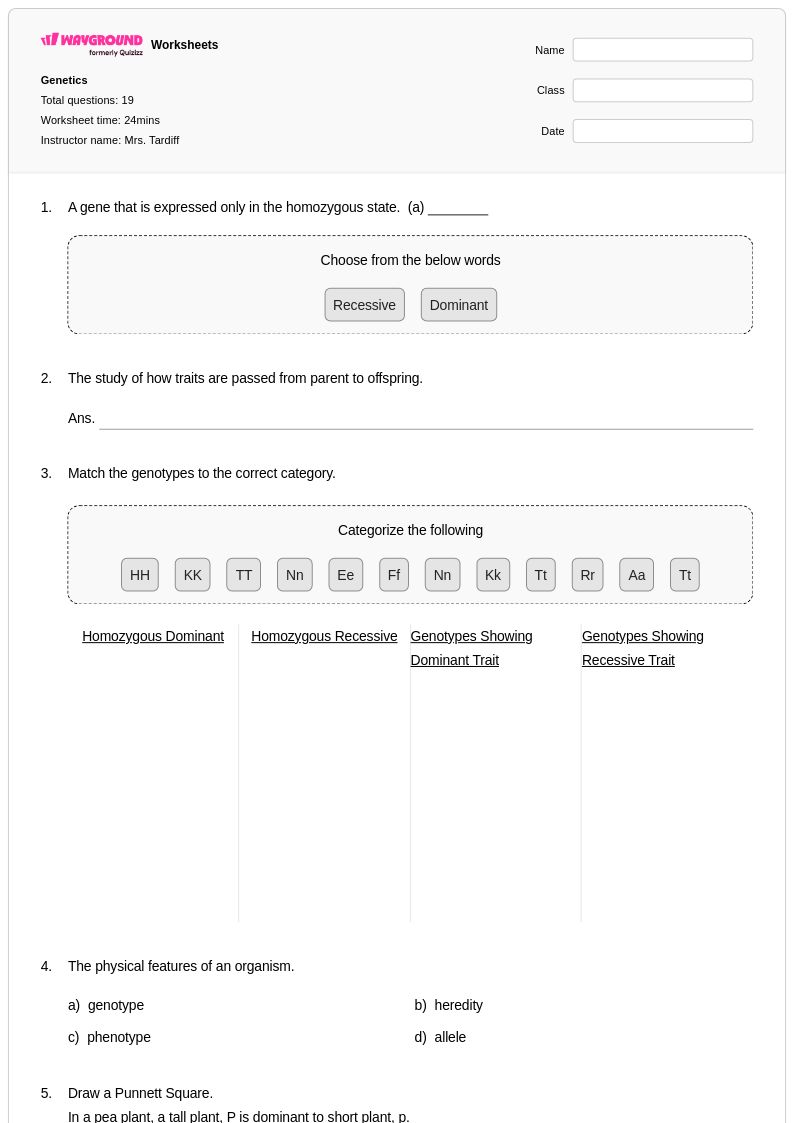
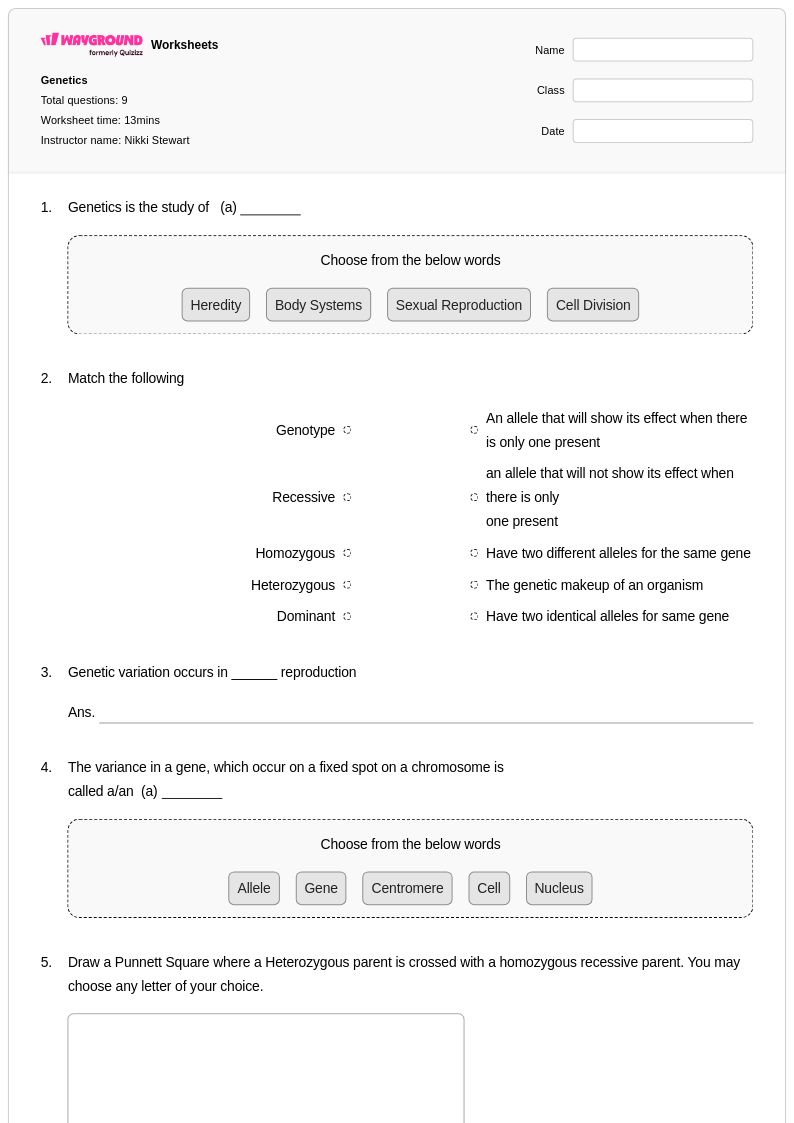
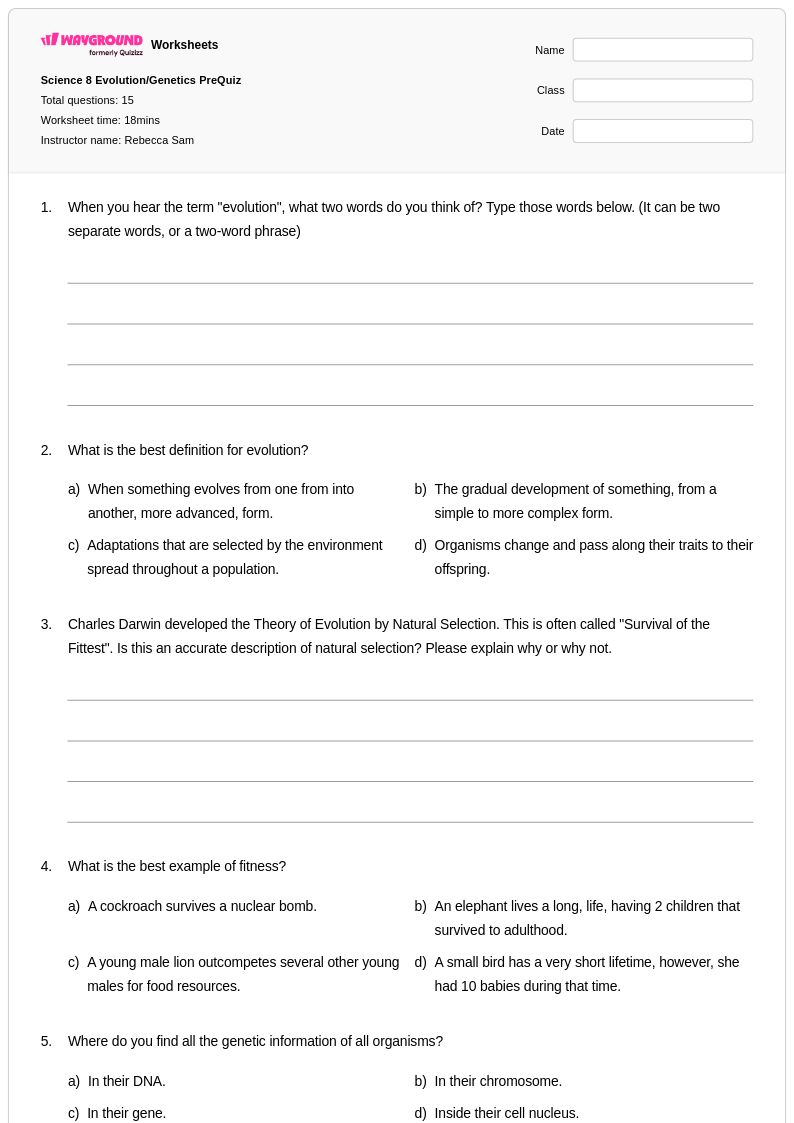
Explore Wayground's free population genetics worksheets and printables that help students master Hardy-Weinberg equilibrium, allele frequencies, and genetic drift through engaging practice problems with comprehensive answer keys.
Population genetics worksheets available through Wayground (formerly Quizizz) provide comprehensive coverage of fundamental concepts in evolutionary biology and genetic variation within populations. These expertly designed resources help students master critical skills including Hardy-Weinberg equilibrium calculations, allele frequency analysis, genetic drift modeling, and natural selection mechanisms. The worksheets feature structured practice problems that guide learners through complex population-level genetic phenomena, from basic Mendelian inheritance patterns in populations to advanced concepts like gene flow, bottleneck effects, and founder effects. Each resource includes detailed answer keys and step-by-step solutions, making these free printables invaluable for both independent study and classroom instruction. Students develop quantitative reasoning skills while exploring how evolutionary forces shape genetic diversity across generations.
Wayground (formerly Quizizz) empowers educators with an extensive collection of millions of teacher-created population genetics resources that streamline lesson planning and enhance student understanding. The platform's robust search and filtering capabilities allow teachers to quickly locate materials aligned with specific curriculum standards, whether focusing on mathematical modeling of genetic change or conceptual understanding of microevolutionary processes. Advanced differentiation tools enable instructors to customize worksheets for varying skill levels, supporting both remediation for struggling students and enrichment opportunities for advanced learners. These versatile resources are available in both printable pdf format and interactive digital versions, providing flexibility for diverse classroom environments and teaching styles. Teachers can seamlessly integrate these materials into unit plans covering population biology, evolutionary mechanisms, and quantitative genetics while ensuring students receive targeted practice with essential problem-solving techniques.
FAQs
How do I teach Hardy-Weinberg equilibrium to high school biology students?
Start by establishing the five conditions required for Hardy-Weinberg equilibrium (no mutation, no gene flow, random mating, no genetic drift, no natural selection) before introducing the equations p + q = 1 and p² + 2pq + q² = 1. Use concrete population scenarios — such as a hypothetical population of 1,000 individuals with a known recessive trait — so students can practice calculating allele and genotype frequencies before tackling more complex problems. Once students are comfortable with equilibrium conditions, introduce violations of those conditions to bridge into genetic drift, natural selection, and gene flow.
What practice problems help students get better at allele frequency calculations?
Students improve most when they work through a progression of problems: first solving for allele frequencies from genotype counts, then working backward from phenotype frequencies to estimate allele frequencies using Hardy-Weinberg assumptions. Problems that require students to determine whether a population is in equilibrium by comparing observed and expected genotype frequencies are especially effective because they reinforce both calculation skills and conceptual understanding. Including problems involving multiple generations or changing allele frequencies over time builds the quantitative reasoning needed for more advanced population genetics topics.
What mistakes do students commonly make when solving Hardy-Weinberg problems?
The most frequent error is confusing allele frequency with genotype frequency — students often assign the observed frequency of a recessive phenotype directly to q rather than to q², which throws off all downstream calculations. A second common mistake is applying Hardy-Weinberg calculations to a population that does not meet equilibrium conditions, leading to incorrect conclusions. Students also frequently forget that p and q must sum to 1, so checking that step explicitly can catch arithmetic errors before they propagate through a problem.
How do I explain genetic drift and the bottleneck effect in a way students actually understand?
Genetic drift is best introduced through simulation before formal instruction — having students draw random 'allele samples' from a bag mimics how small population size amplifies chance variation in allele frequencies. Once students have experienced the concept kinesthetically, the bottleneck effect becomes intuitive: a sudden population crash randomly eliminates alleles regardless of fitness, reducing genetic diversity in the surviving population. The founder effect can then be introduced as a related scenario where a small subgroup colonizes a new area, carrying only a subset of the original population's genetic variation.
How can I use population genetics worksheets to support students with different skill levels in the same class?
Structured worksheets that scaffold from conceptual questions to multi-step quantitative problems allow you to differentiate by assigning different sections to different students without preparing entirely separate materials. On Wayground, teachers can apply individual accommodations such as read aloud support, reduced answer choices, and extended time on a per-student basis, so advanced learners receive the full problem set while struggling students get targeted support. These settings are saved and reusable across sessions, which makes differentiation sustainable over an entire population genetics unit rather than a one-time adjustment.
How do I use Wayground's population genetics worksheets in my classroom?
Wayground's population genetics worksheets are available as printable PDFs, making them easy to distribute in a traditional classroom setting, and in digital formats for technology-integrated or hybrid environments. Teachers can also host worksheets as a quiz directly on Wayground, giving students an interactive experience while automatically handling grading. All worksheets include comprehensive answer keys, so teachers can use them for guided practice, independent work, homework, or formative assessment without additional preparation.