Free Printable Neutralization Worksheets for Class 11
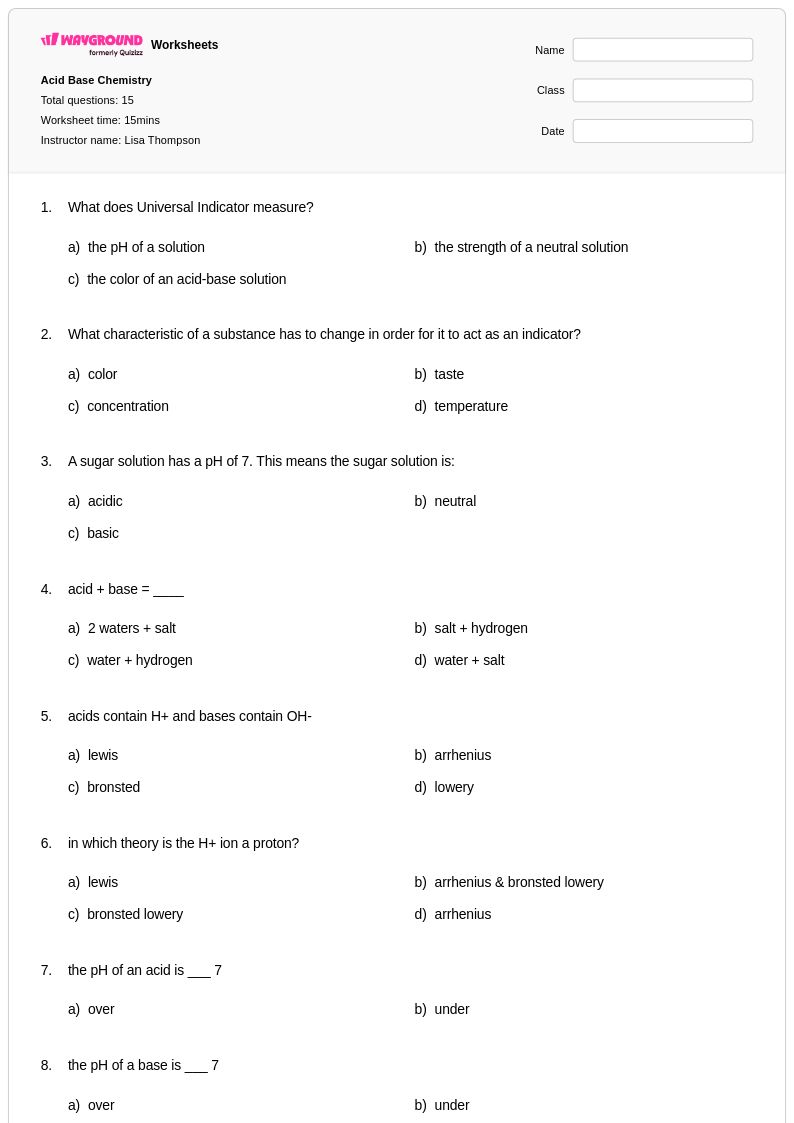
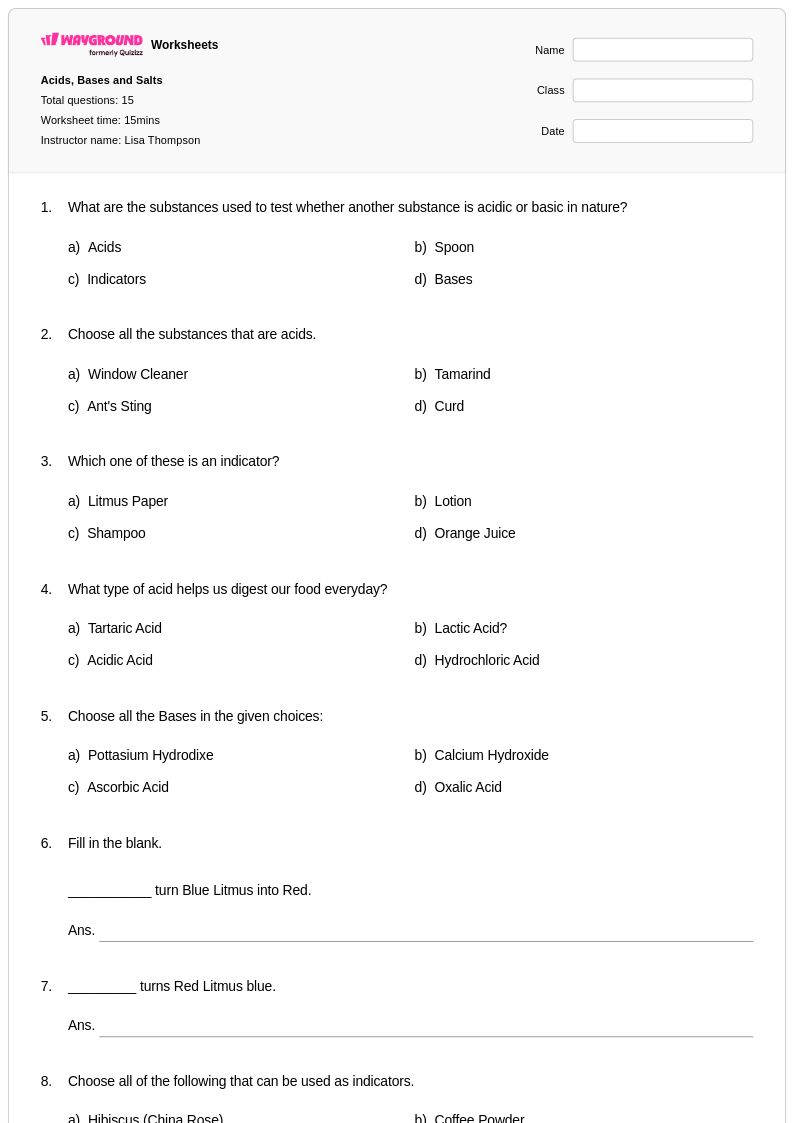
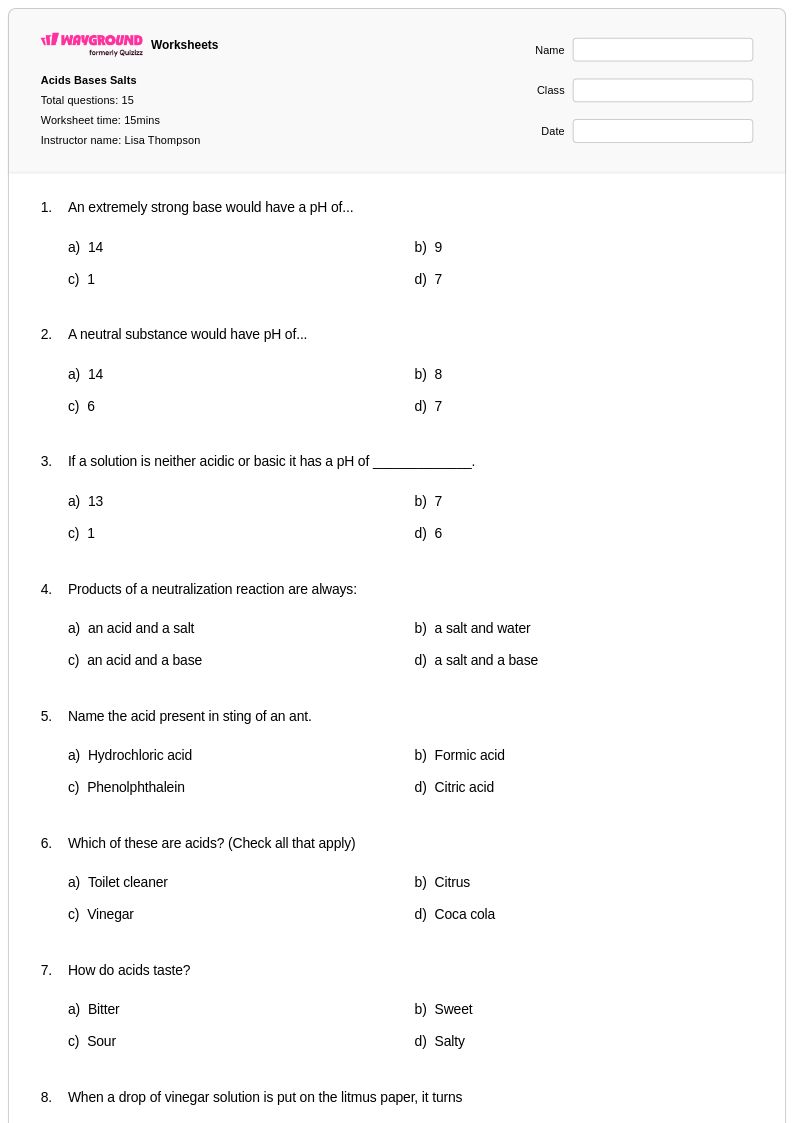
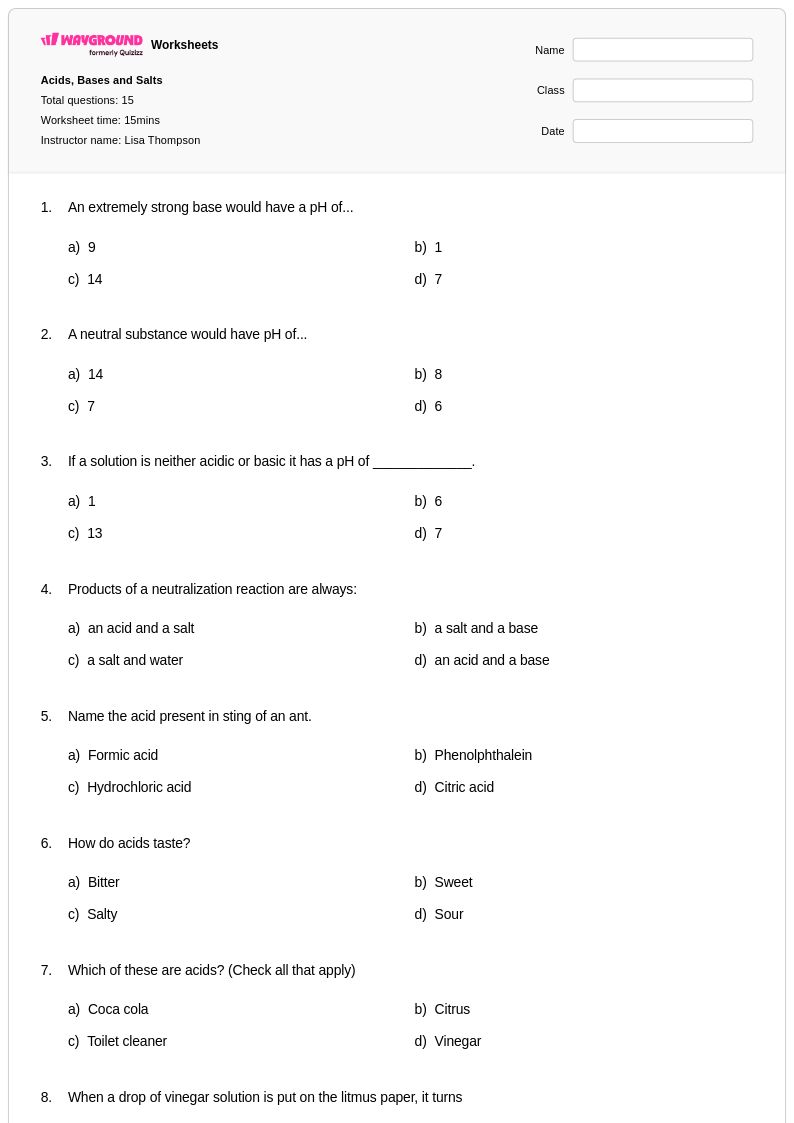
Class 11 neutralization worksheets from Wayground provide comprehensive printables and practice problems with answer keys, helping students master acid-base reactions, pH calculations, and chemical equilibrium concepts through engaging free PDF exercises.
Explore printable Neutralization worksheets for Class 11
Neutralization reactions represent a fundamental concept in Class 11 chemistry, where students explore the precise interactions between acids and bases to form salts and water. Wayground's comprehensive collection of neutralization worksheets provides students with systematic practice in balancing chemical equations, calculating pH changes, determining equivalence points, and understanding the stoichiometry involved in acid-base reactions. These expertly crafted worksheets strengthen critical analytical skills including molarity calculations, titration curve interpretation, and predicting reaction products, while offering complete answer keys that enable independent learning and self-assessment. Students can access these free printables in convenient pdf format, working through practice problems that range from simple neutralization equations to complex buffer system calculations that mirror real-world laboratory scenarios.
Wayground's extensive library draws from millions of teacher-created resources specifically designed to support Class 11 chemistry instruction in neutralization concepts. The platform's advanced search and filtering capabilities allow educators to quickly locate worksheets aligned with specific curriculum standards, whether focusing on strong acid-strong base reactions, weak acid-strong base titrations, or indicator selection principles. Teachers can seamlessly customize these materials to meet diverse classroom needs, utilizing differentiation tools to provide appropriate challenge levels for students requiring remediation or enrichment activities. Available in both printable and digital formats including downloadable pdf versions, these neutralization worksheets serve as invaluable resources for lesson planning, homework assignments, laboratory preparation, and targeted skill practice that reinforces essential chemistry concepts throughout the academic year.
FAQs
How do I teach neutralization reactions to chemistry students?
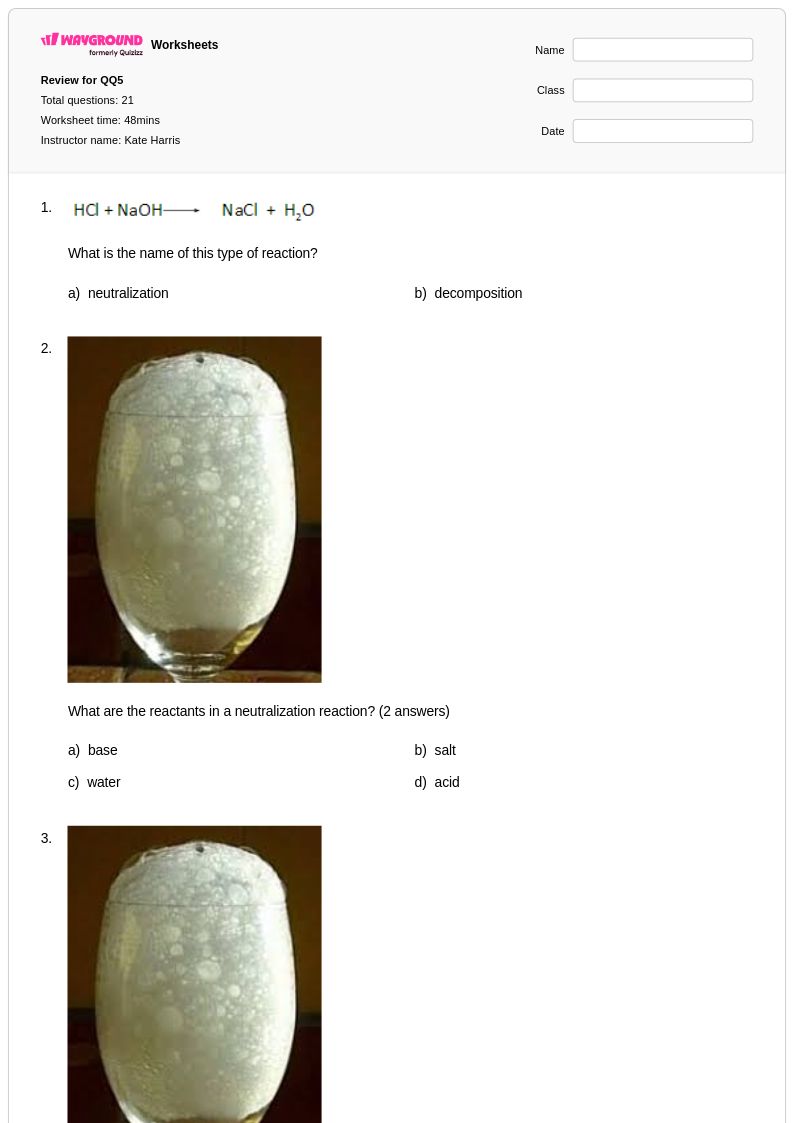
Start by grounding students in the definitions of acids and bases before introducing what happens when they interact. Use concrete examples like antacids neutralizing stomach acid to make the concept tangible, then build toward the underlying equation: acid + base → salt + water. From there, layer in pH changes and stoichiometric relationships so students can see neutralization as both a conceptual and quantitative process.
What types of practice problems help students understand neutralization?
Effective neutralization practice moves from simple to complex — beginning with identifying the acid and base in a reaction, predicting the salt and water products, then calculating pH changes. Titration problems are especially valuable because they require students to apply stoichiometric reasoning in a real analytical context. Including real-world scenarios, such as industrial wastewater treatment or antacid chemistry, helps students connect abstract equations to applied situations.
What mistakes do students commonly make when working through neutralization problems?
One of the most common errors is assuming that a neutralization reaction always produces a solution with a pH of exactly 7 — students often forget that weak acid-strong base or strong acid-weak base combinations yield a non-neutral salt solution. Another frequent mistake is misidentifying the spectator ions in a net ionic equation, which leads to errors when predicting salt formation. Students also tend to confuse equivalence point with endpoint in titration problems, so reinforcing the distinction between these terms early reduces persistent confusion.
How can I use neutralization worksheets to assess student understanding?
Neutralization worksheets work well as both formative and summative tools depending on the problem types included. Use short identification and prediction problems as quick formative checks after introducing acid-base theory, then shift to multi-step titration and pH calculation problems for unit assessments. Answer keys allow students to self-check during practice, which frees up class time for targeted reteaching based on patterns of error.
How do I use Wayground's neutralization worksheets in my classroom?
Wayground's neutralization worksheets are available as printable PDFs for traditional classroom use and in digital formats for technology-integrated environments, making them adaptable to in-person, hybrid, or remote instruction. Teachers can also host worksheets directly as a quiz on Wayground, enabling real-time student responses and built-in answer key feedback. Wayground supports student-level accommodations such as read aloud, extended time, and reduced answer choices, which can be assigned individually so that students with different learning needs receive appropriate support without disrupting the rest of the class.
How do I differentiate neutralization instruction for students at different levels?
For students who are still building foundational skills, focus on simple strong acid-strong base pairs where the products are straightforward and pH lands near 7. Advanced learners can be challenged with weak acid-strong base titrations, buffer calculations, or real-world industrial applications that require multi-step reasoning. On Wayground, teachers can apply accommodations like reduced answer choices or read aloud to specific students, ensuring that scaffolding is invisible to peers and does not require separate lesson planning.