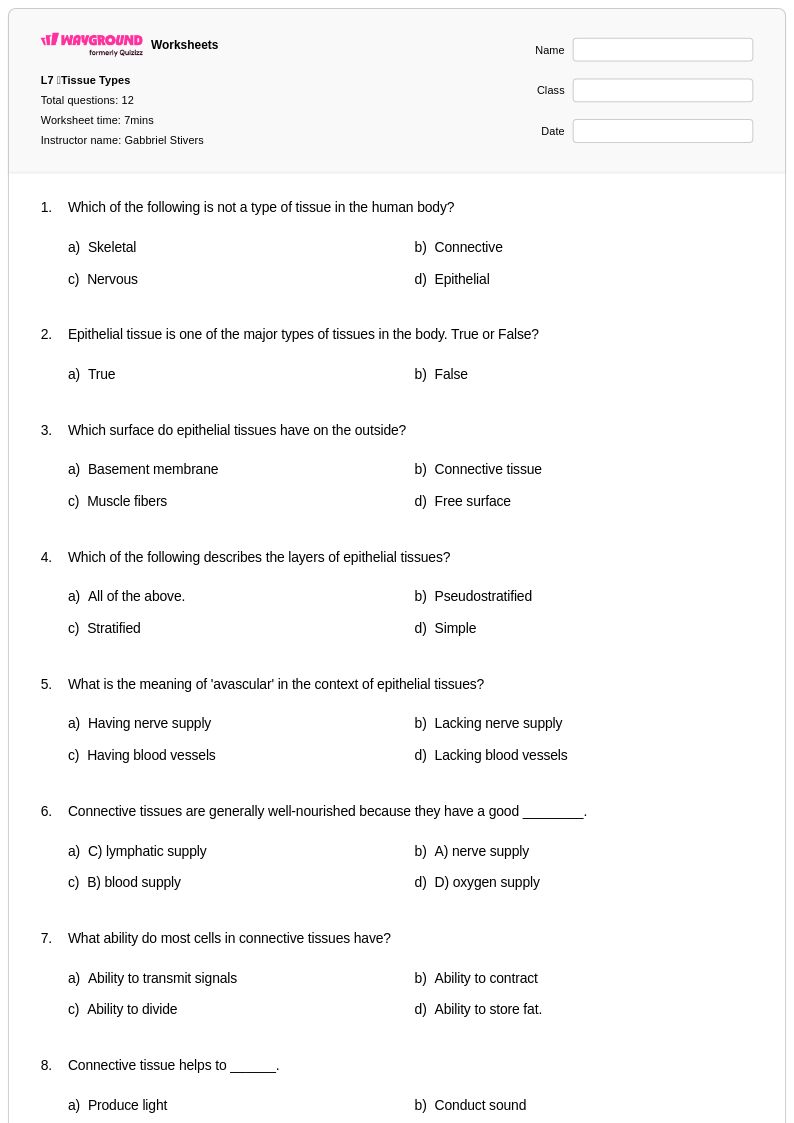
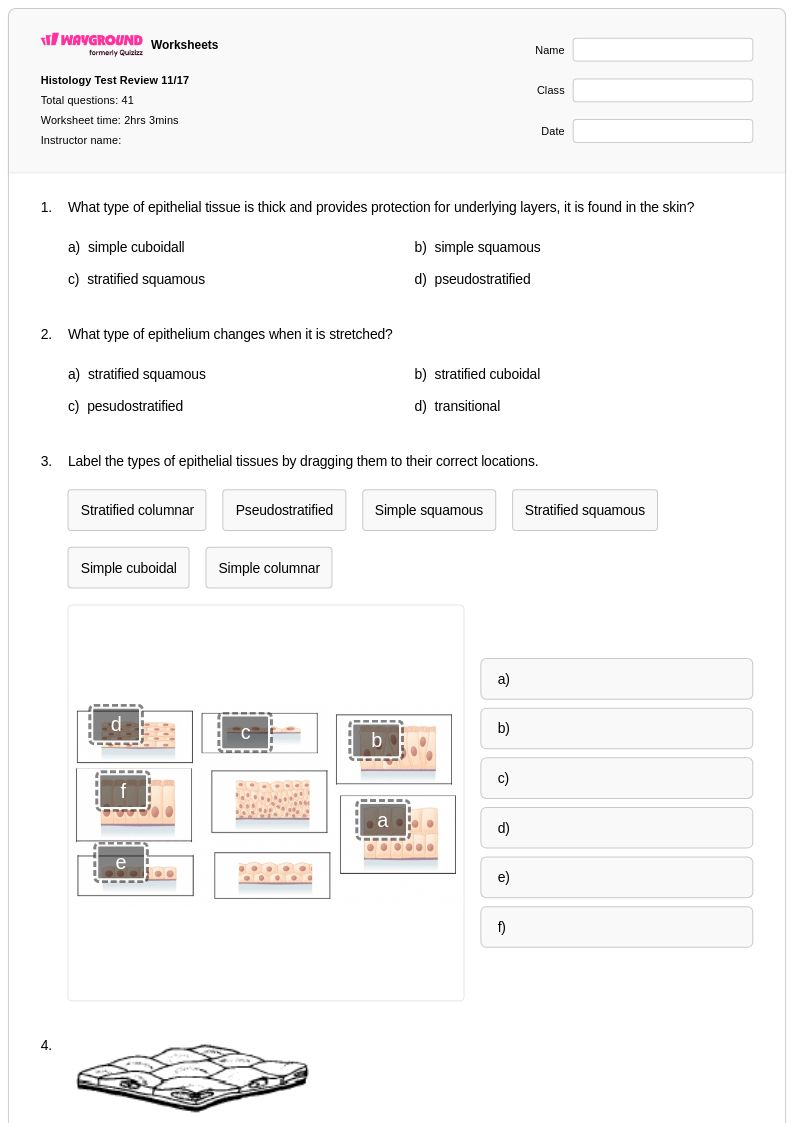
Explore Wayground's comprehensive collection of free epithelial tissues worksheets and printables with answer keys, designed to help biology students master cell structure, tissue classification, and functions through engaging practice problems and PDF resources.
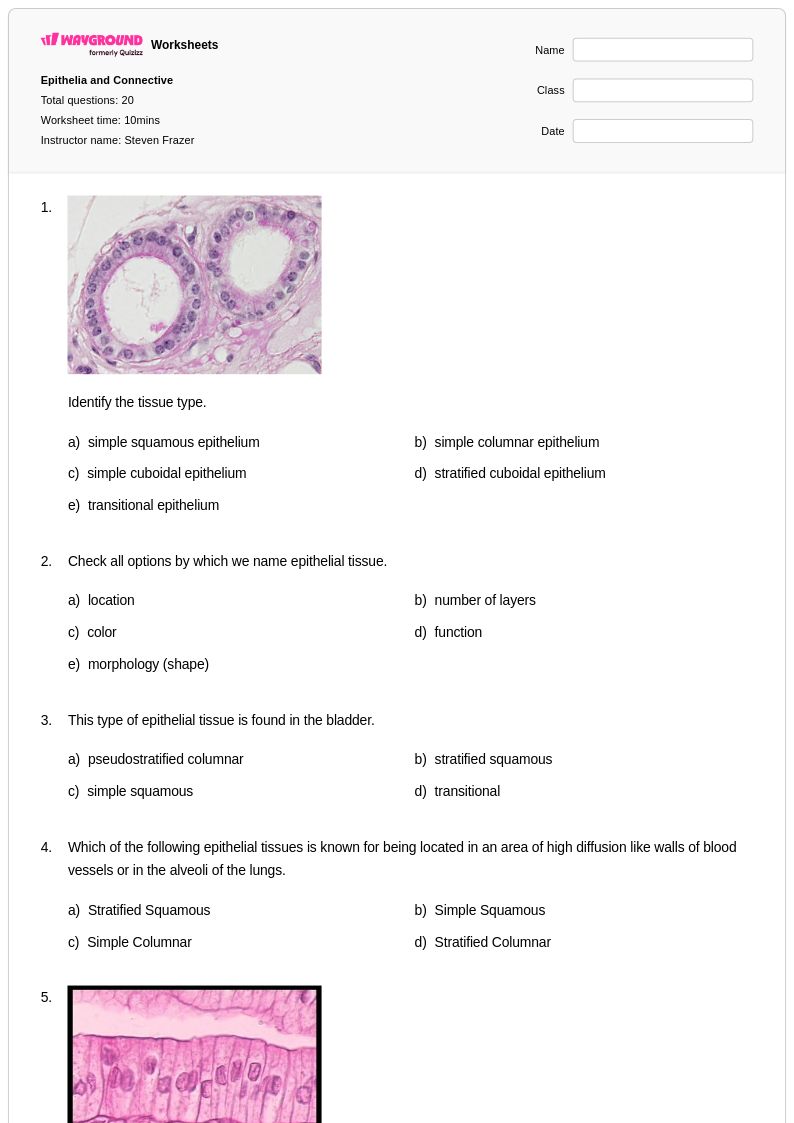
Epithelial tissues worksheets available through Wayground (formerly Quizizz) provide comprehensive coverage of one of the four fundamental tissue types in the human body. These educational resources focus on helping students master the structure, function, and classification of epithelial tissues, including simple and stratified arrangements, cell shapes from squamous to columnar, and specialized functions like protection, secretion, and absorption. The worksheets strengthen critical skills in tissue identification, microscopic analysis, and understanding the relationship between form and function in biological systems. Each resource includes detailed practice problems that guide students through the characteristics of different epithelial tissue types, complete with answer keys that facilitate self-assessment and reinforce learning objectives. These free printables and pdf resources serve as invaluable tools for both classroom instruction and independent study.
Wayground (formerly Quizizz) empowers educators with an extensive collection of millions of teacher-created epithelial tissue worksheets that support diverse instructional needs across biology curricula. The platform's robust search and filtering capabilities allow teachers to quickly locate resources aligned with specific standards and learning objectives, while differentiation tools enable customization for students with varying ability levels. Whether delivered in printable pdf format for traditional paper-based learning or accessed digitally for interactive engagement, these worksheets provide flexible options for lesson planning, targeted remediation, and enrichment activities. Teachers can modify existing materials or create entirely new assessments, ensuring that epithelial tissue concepts are reinforced through varied practice opportunities that accommodate different learning styles and classroom environments.
FAQs
How do I teach epithelial tissue classification to biology students?
Start by grounding students in the two classification axes: arrangement (simple vs. stratified) and cell shape (squamous, cuboidal, columnar). Use labeled diagrams and microscope slides to make the distinctions concrete before introducing specialized types like pseudostratified or transitional epithelium. Connecting each tissue type to its function — for example, simple squamous for diffusion, stratified squamous for protection — helps students build a logic-based framework rather than relying on rote memorization.
What exercises help students practice identifying epithelial tissue types?
Tissue identification practice works best when students move from labeled diagrams to unlabeled microscope images, requiring them to apply classification criteria independently. Matching exercises that pair tissue names with their structural features and functions reinforce the form-function relationship central to this topic. Practice problems that ask students to predict tissue type based on a described location or function — such as 'what tissue lines the alveoli?' — push for deeper conceptual understanding rather than surface-level recall.
What mistakes do students commonly make when classifying epithelial tissues?
The most frequent error is confusing pseudostratified columnar epithelium with stratified epithelium — students see multiple nuclei at different heights and assume multiple cell layers are present. Students also frequently misidentify transitional epithelium because its cell shape changes depending on whether the tissue is stretched or relaxed. Another common misconception is conflating cell shape with tissue function, rather than understanding that both arrangement and shape together determine what a tissue can do.
How can I use epithelial tissue worksheets to assess student understanding?
Worksheets that combine microscopic image analysis with short-answer questions are effective for assessing whether students can apply classification criteria rather than simply recall definitions. Including questions that ask students to justify their tissue identification — explaining which structural features led to their conclusion — reveals depth of understanding. Answer keys included with these worksheets allow for efficient self-assessment and make it easier to identify class-wide gaps before moving on to connective or muscle tissue.
How do I use Wayground's epithelial tissues worksheets in my classroom?
Wayground's epithelial tissues worksheets are available as printable PDFs for traditional classroom use and in digital formats for technology-integrated learning environments, including the option to host them as a quiz directly on Wayground. Teachers can use printable versions for lab follow-up activities or homework assignments, while digital versions support interactive engagement and immediate feedback. Wayground also allows teachers to modify existing materials or create new assessments, making it straightforward to tailor content to specific learning objectives or ability levels.
How do I differentiate epithelial tissue instruction for students at different ability levels?
For students who need additional support, reduce the number of tissue types introduced at once and use color-coded diagrams that visually separate classification criteria. Advanced students benefit from case-based questions that require them to identify tissues in pathological contexts, such as recognizing metaplasia or describing how tissue type relates to disease susceptibility. On Wayground, teachers can apply accommodations such as reduced answer choices for individual students to lower cognitive load, while read-aloud settings can support students with reading difficulties — all without notifying other students.