Explore Wayground's comprehensive collection of membrane function worksheets featuring printable PDFs and practice problems with answer keys to help students master cellular membrane processes and transport mechanisms.
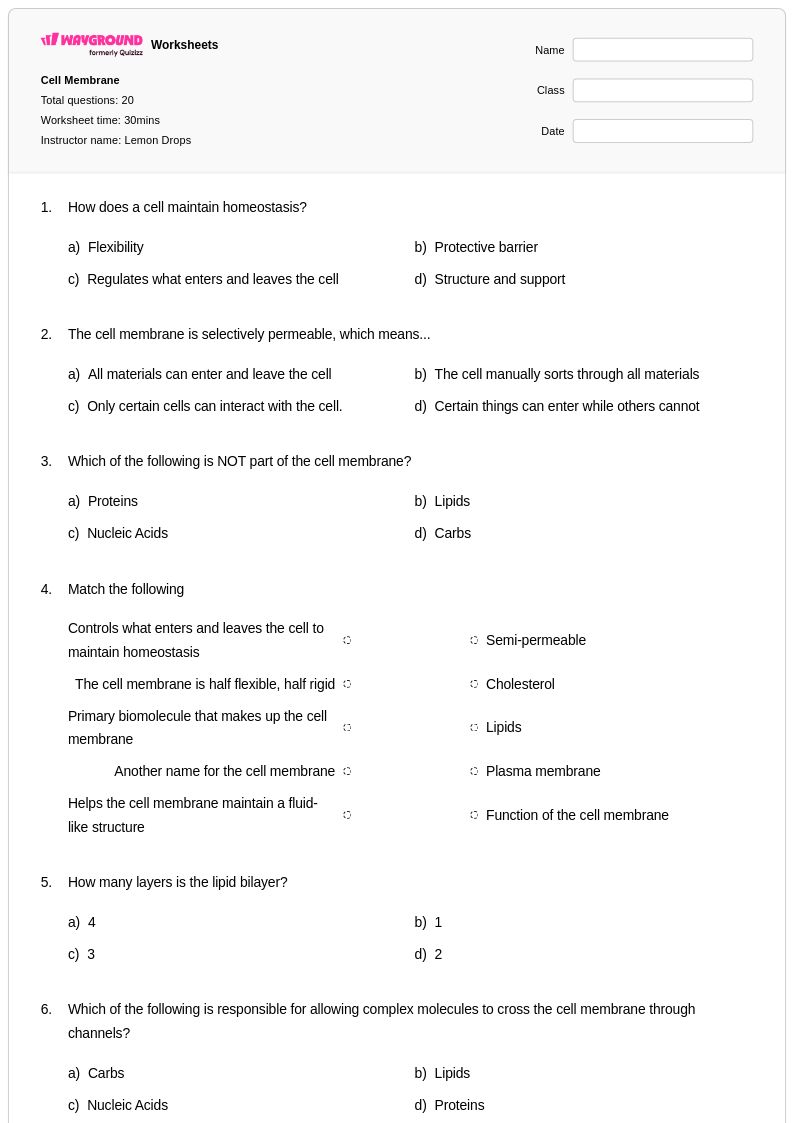
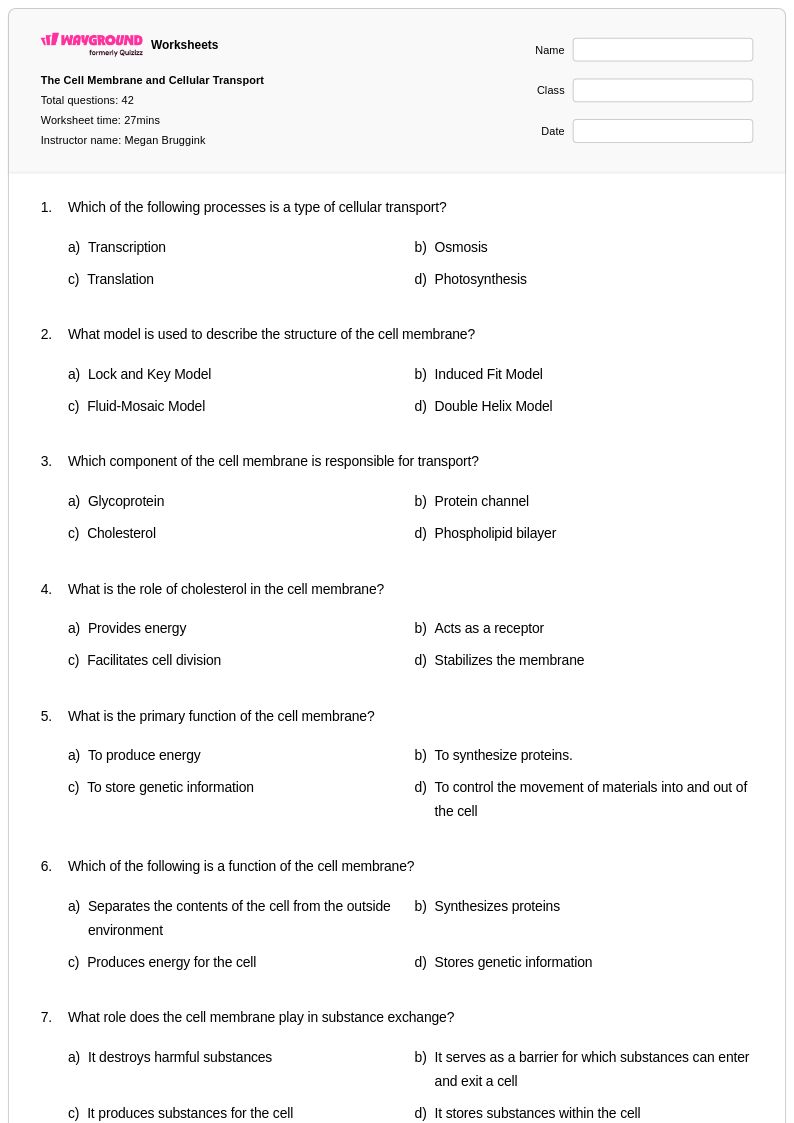
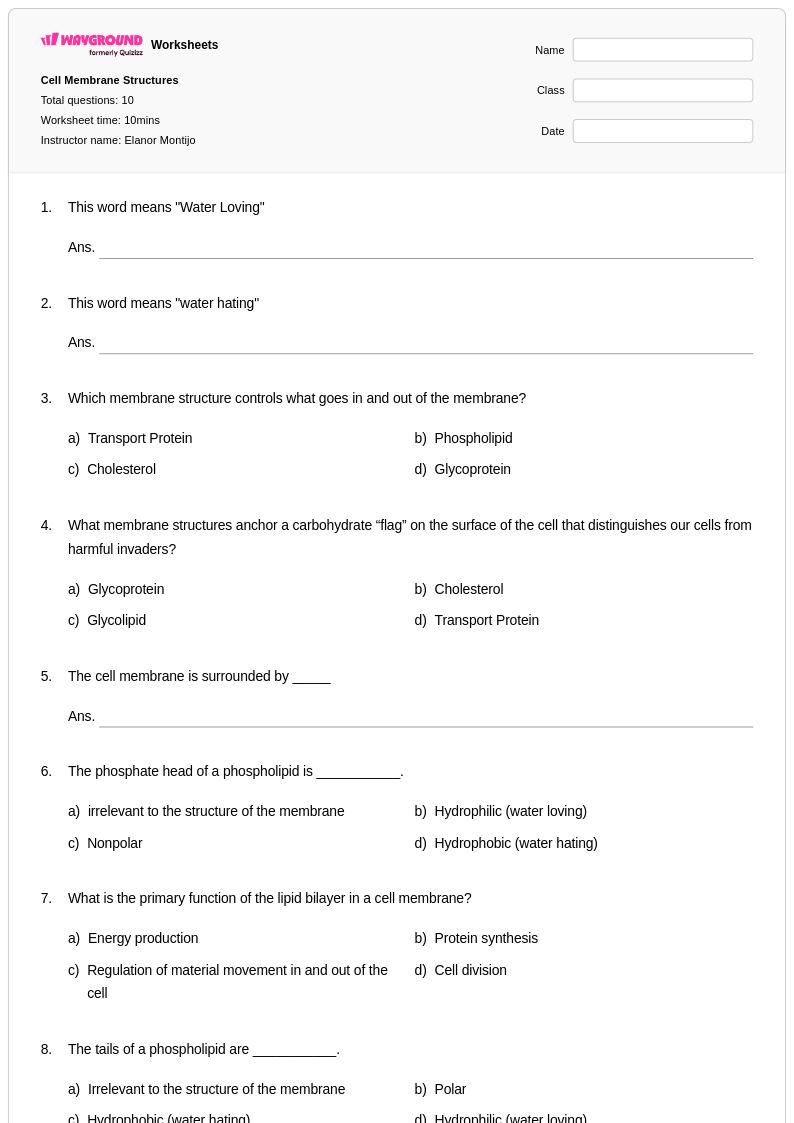
Membrane function worksheets available through Wayground (formerly Quizizz) provide comprehensive coverage of cellular membrane processes, structures, and mechanisms that are fundamental to understanding how cells maintain homeostasis and interact with their environment. These carefully designed resources strengthen students' grasp of critical concepts including selective permeability, transport mechanisms such as diffusion and active transport, membrane composition and fluidity, and the role of membrane proteins in cellular communication. Each worksheet collection includes detailed answer keys that support both independent study and classroom instruction, while the free printable format ensures accessibility for diverse learning environments. Practice problems range from basic membrane structure identification to complex scenarios involving osmotic pressure calculations and transport protein function, allowing students to build proficiency through progressively challenging exercises available in convenient pdf format.
Wayground (formerly Quizizz) supports biology educators with an extensive collection of millions of teacher-created membrane function resources that can be easily located through robust search and filtering capabilities. The platform's alignment with educational standards ensures that worksheet content meets curriculum requirements, while built-in differentiation tools allow teachers to customize materials for students with varying ability levels and learning needs. These flexible resources are available in both printable and digital formats, including downloadable pdf versions that facilitate seamless integration into lesson plans, homework assignments, and assessment strategies. Teachers can efficiently identify appropriate materials for skill practice, targeted remediation of challenging concepts like facilitated diffusion, or enrichment activities exploring advanced topics such as membrane potential and signal transduction, making instructional planning more effective and responsive to individual student needs.
FAQs
How do I teach membrane function to biology students?
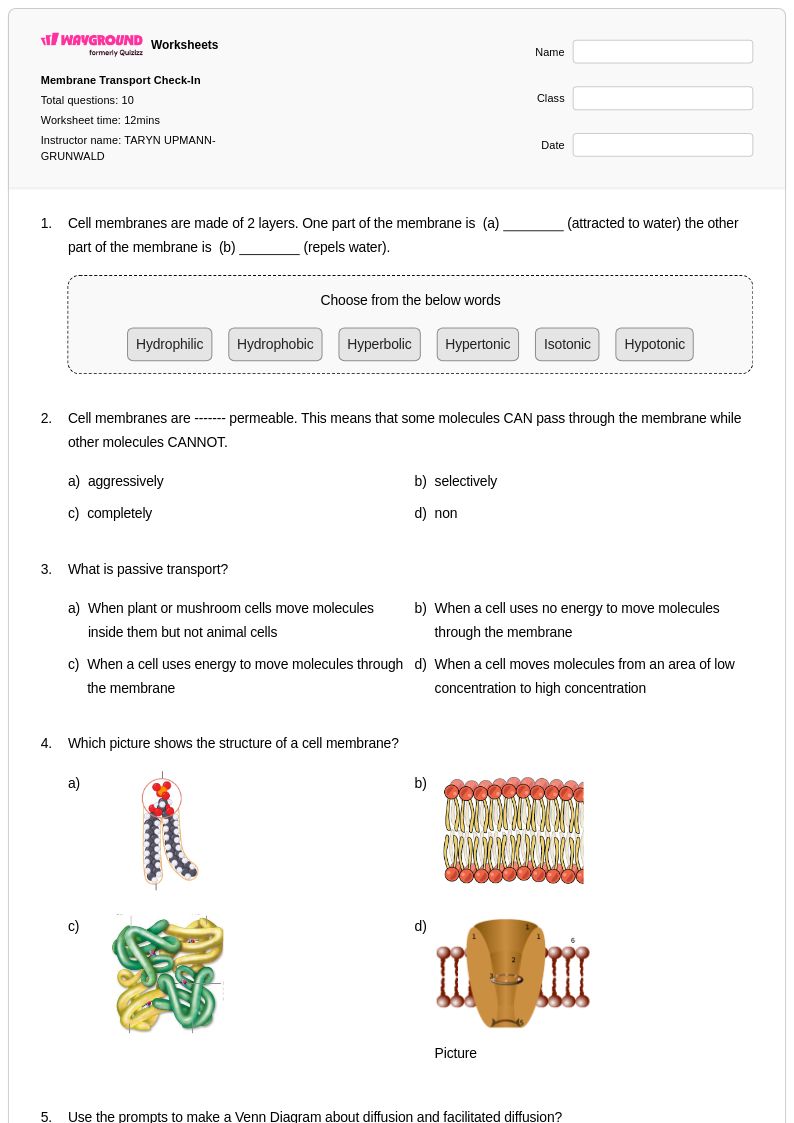
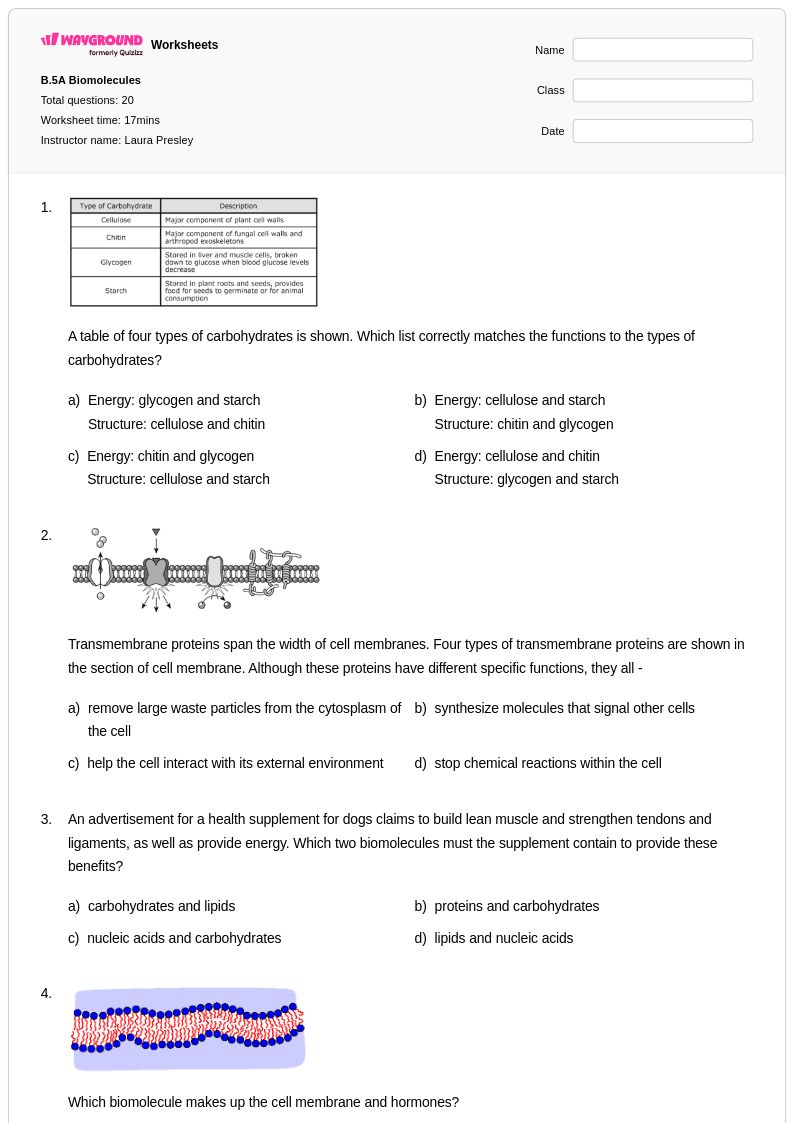
Effective membrane function instruction typically begins with membrane structure, establishing how the phospholipid bilayer creates a selectively permeable boundary before introducing transport mechanisms. Teachers often sequence lessons from passive transport (simple diffusion, facilitated diffusion) to active transport, using visual diagrams and analogies like a bouncer at a door to make selective permeability concrete. Connecting each transport type to real cellular examples, such as glucose uptake or sodium-potassium pump activity, helps students see why membrane function is central to homeostasis rather than treating it as isolated vocabulary.
What exercises help students practice passive and active transport?
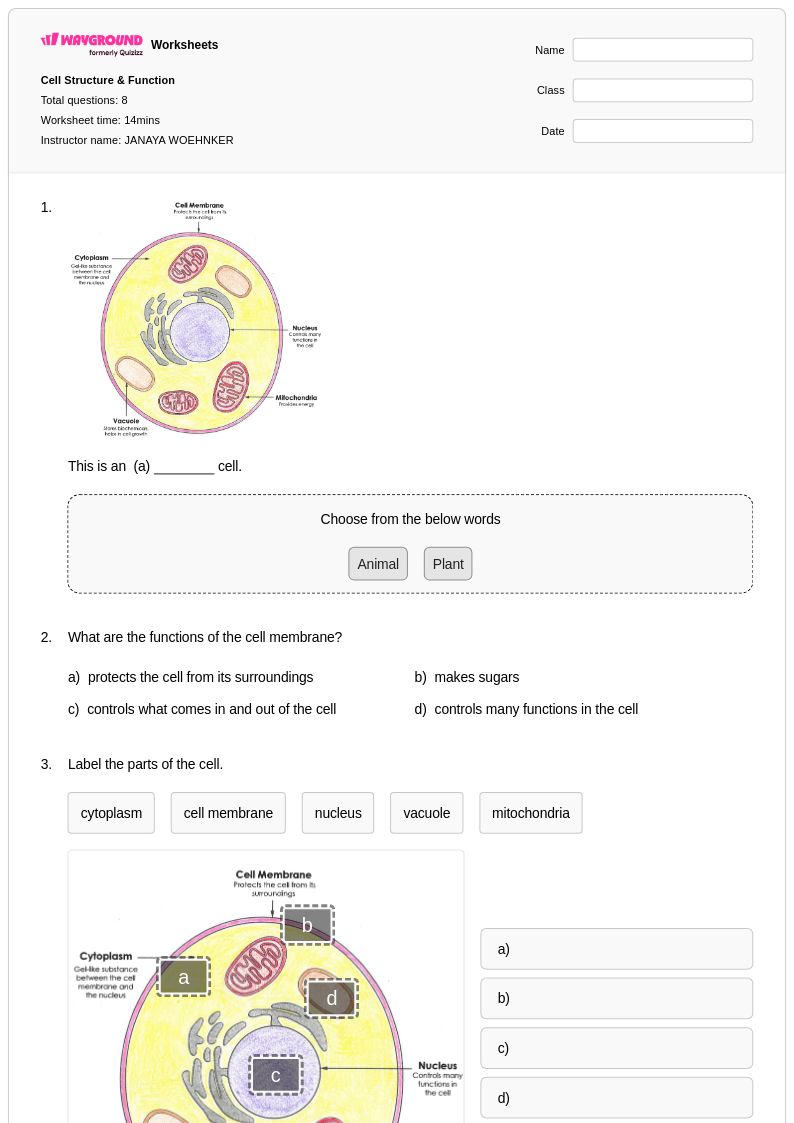
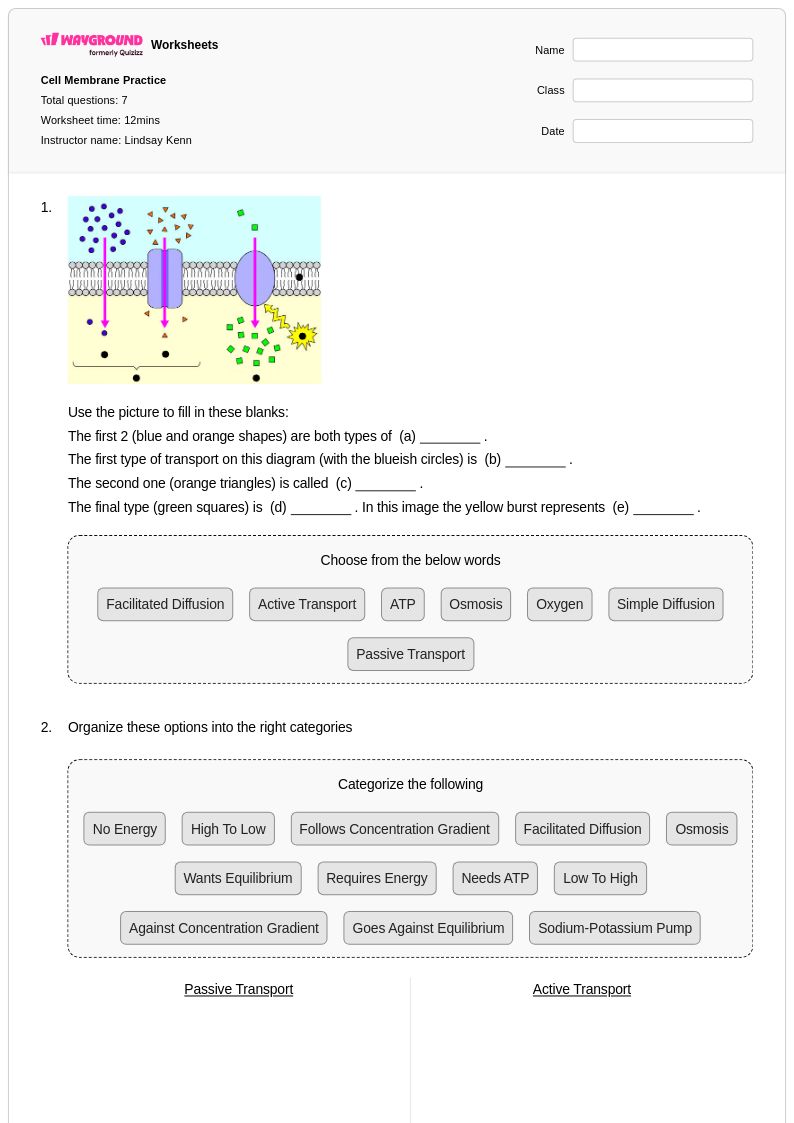
Practice exercises that work well for transport mechanisms include labeling diagrams of channel and carrier proteins, comparing energy requirements across transport types, and working through osmosis scenarios where students predict whether a cell will swell, shrink, or remain the same in a given solution. Progressively challenging problems, such as calculating osmotic pressure or identifying which transport mechanism applies to a specific scenario, build students' ability to apply concepts rather than just recall them. Membrane function worksheets that mix identification, short-answer, and scenario-based questions are especially effective for reinforcing these distinctions.
What mistakes do students commonly make when learning about membrane transport?
One of the most persistent misconceptions is that all transport requires energy, leading students to misclassify facilitated diffusion as active transport simply because proteins are involved. Students also frequently confuse the direction of movement in osmosis, particularly when comparing hypotonic and hypertonic solutions, because they focus on water concentration rather than solute concentration. Another common error is treating the cell membrane as a rigid wall rather than a fluid, dynamic structure, which makes it harder for students to understand how membrane proteins, fluidity, and composition all influence transport.
How can I use membrane function worksheets to differentiate instruction?
Membrane function worksheets can be differentiated by assigning basic structure identification tasks to students still building foundational knowledge while directing more advanced learners toward complex scenarios involving osmotic pressure calculations or membrane potential. On Wayground, teachers can apply individual accommodations such as Read Aloud for students who benefit from audio support, reduced answer choices to lower cognitive load for learners who need scaffolding, and extended time settings configurable per student. These accommodations are saved and reusable across future sessions, making it practical to maintain consistent support without rebuilding settings each time.
How do I use Wayground's membrane function worksheets in my classroom?
Wayground's membrane function worksheets are available as printable PDFs for traditional classroom use and in digital formats for technology-integrated learning environments, giving teachers flexibility to assign them as in-class practice, homework, or assessment tasks. Teachers can also host worksheets directly as a quiz on Wayground, enabling real-time student responses and automated grading. Each worksheet includes a complete answer key, which supports both teacher-led review and independent student self-checking after practice.
How do I assess whether students understand selective permeability versus general diffusion?
A reliable assessment approach is to present students with novel molecules of varying size, polarity, or charge and ask them to predict whether each would cross the membrane freely, require a protein channel, or be blocked entirely. This moves assessment beyond definition recall and into applied reasoning about membrane properties. Common errors to watch for include students assuming any small molecule passes freely regardless of charge, or failing to connect selective permeability to the phospholipid bilayer's hydrophobic interior.