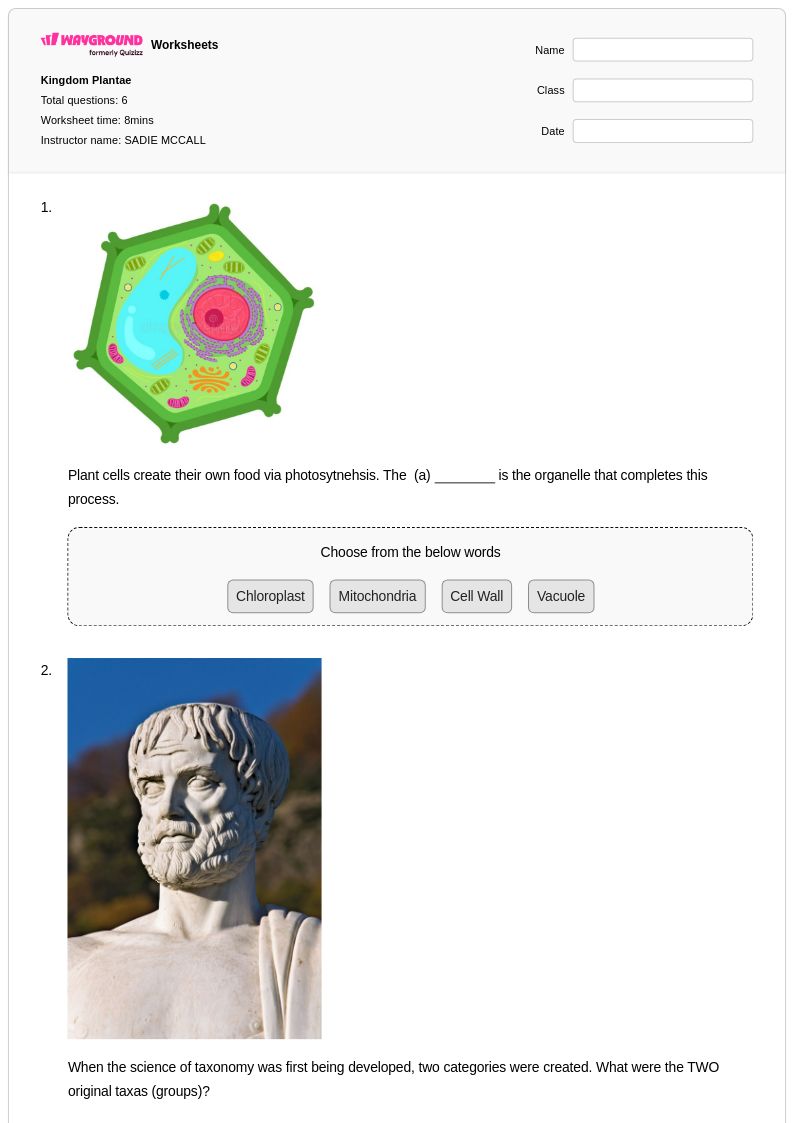
Explore Wayground's comprehensive collection of free Plant Kingdom worksheets and printables that help students master botanical classification, plant structures, and life cycles through engaging practice problems with detailed answer keys.
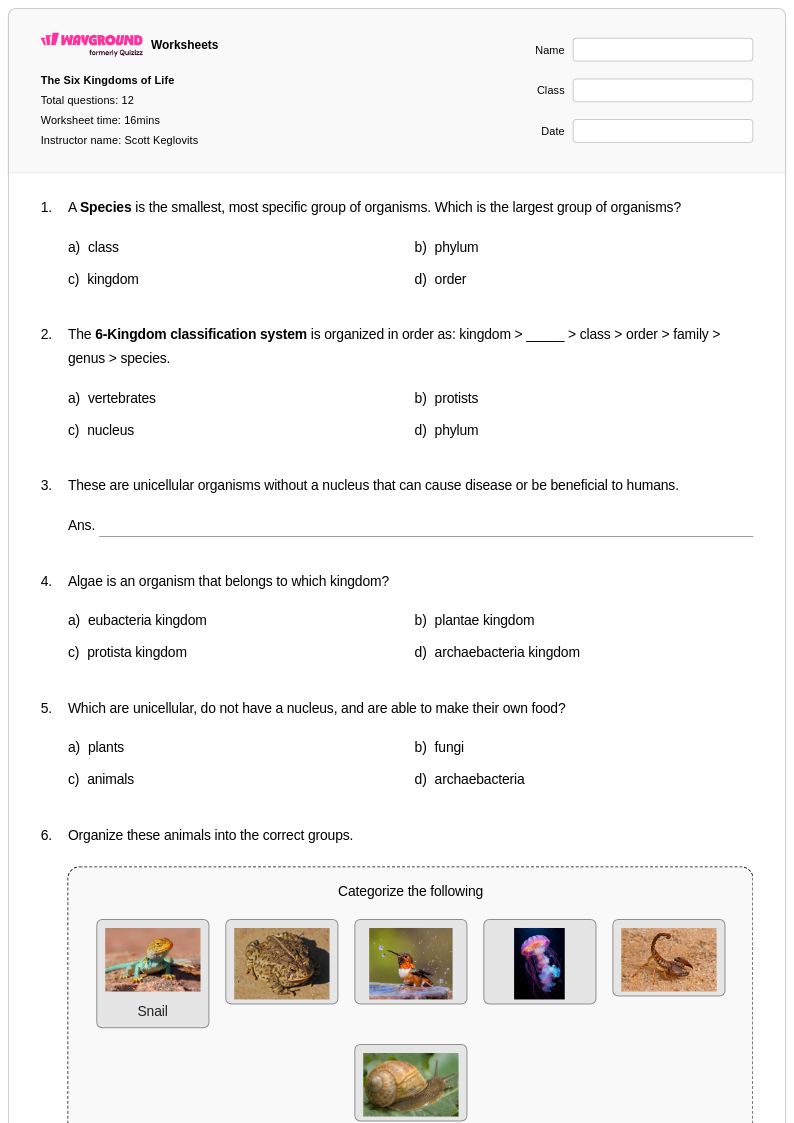
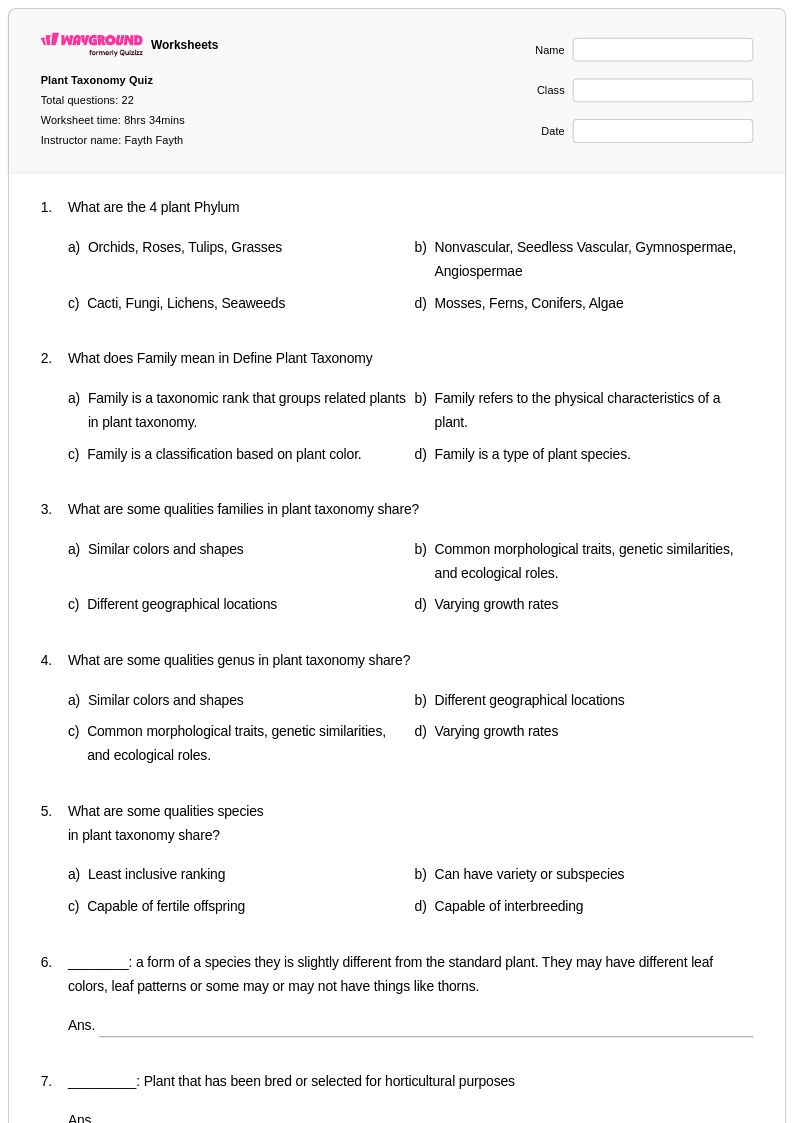
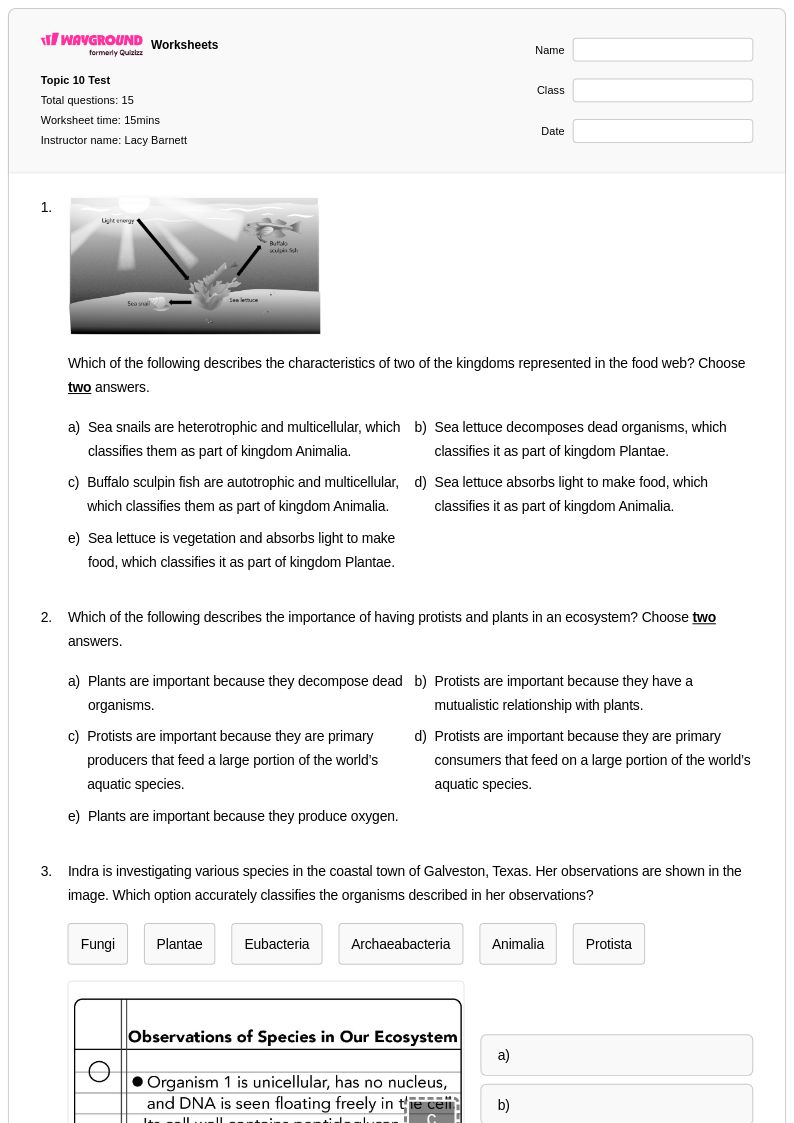
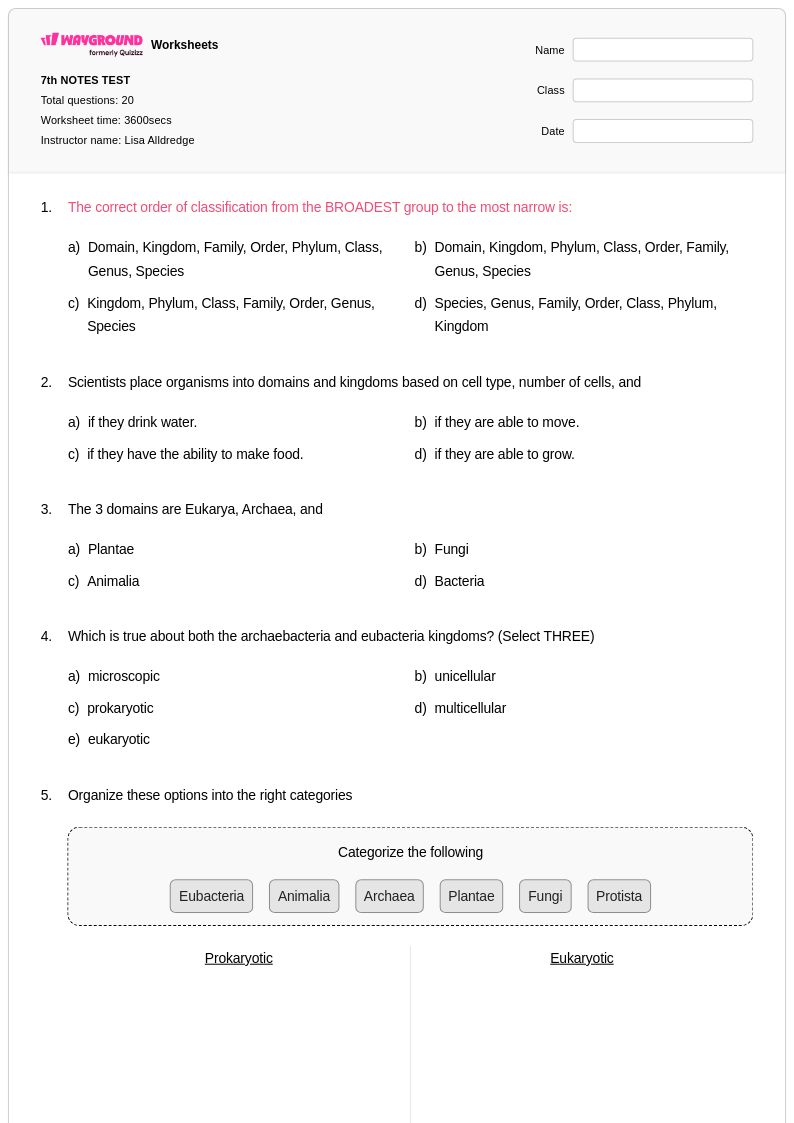
Plant Kingdom worksheets available through Wayground (formerly Quizizz) provide comprehensive coverage of botanical concepts that form the foundation of biological understanding. These expertly designed resources guide students through the classification, structure, and functions of various plant groups, from simple algae and mosses to complex flowering plants. The worksheets strengthen critical skills including taxonomy identification, plant anatomy recognition, and understanding of plant life cycles and reproductive strategies. Each resource includes detailed answer keys to support independent learning and assessment, while the free printable format ensures accessibility for diverse classroom environments. Practice problems range from basic plant structure labeling to advanced comparative analysis of different plant phyla, allowing educators to address multiple learning objectives through targeted skill development.
Wayground's extensive collection of Plant Kingdom worksheets draws from millions of teacher-created resources, offering educators unprecedented access to high-quality botanical content through intuitive search and filtering capabilities. The platform's standards alignment features ensure that worksheet selections support curriculum objectives, while built-in differentiation tools allow teachers to customize content complexity for diverse student needs. Resources are available in both printable pdf formats and interactive digital versions, providing flexibility for traditional classroom instruction and technology-enhanced learning environments. These comprehensive tools streamline lesson planning while offering targeted options for remediation of struggling students and enrichment opportunities for advanced learners, enabling educators to provide systematic skill practice that builds deep understanding of plant biology concepts across all instructional contexts.
FAQs
How do I teach the plant kingdom to middle or high school students?
Teaching the plant kingdom effectively starts with establishing a clear classification framework, moving from simple non-vascular plants like mosses and liverworts through increasingly complex vascular plants, culminating in angiosperms and gymnosperms. Use plant anatomy diagrams to ground abstract taxonomy in observable structures, and connect each plant group to its reproductive strategy so students understand why classification boundaries exist. Hands-on activities like leaf identification, seed dissection, and life cycle mapping help students retain the hierarchy rather than memorize it in isolation.
What are the best worksheet activities for practicing plant kingdom classification?
The most effective practice activities for plant kingdom classification include taxonomy sorting tasks where students group organisms by shared traits, labeled diagram exercises that reinforce plant anatomy, and comparative analysis prompts that ask students to distinguish between plant phyla. Fill-in-the-blank and matching formats work well for reinforcing vocabulary like vascular tissue, sporophyte, and gymnosperm, while short-answer questions push students to explain why a plant belongs to a given group rather than simply identifying it.
What misconceptions do students commonly have about the plant kingdom?
One of the most common misconceptions is that all green organisms are plants, which causes students to misclassify algae or cyanobacteria. Students also frequently confuse mosses and ferns because both lack seeds, not recognizing that ferns have true vascular tissue while mosses do not. Another persistent error is conflating gymnosperm and angiosperm reproduction, with many students assuming all seed-bearing plants produce flowers. Targeted classification exercises that require students to justify their reasoning are the most reliable way to surface and correct these misunderstandings.
How do I use Plant Kingdom worksheets in my classroom?
Plant Kingdom worksheets on Wayground are available as printable PDFs for traditional classroom use and in digital formats for technology-integrated environments, including the option to host them as a quiz directly on Wayground. Printable versions work well for guided note-taking, lab companions, or independent practice, while digital formats allow for self-paced review and immediate feedback. Each worksheet includes a detailed answer key, making them practical for both teacher-led instruction and independent student work.
How can I differentiate plant kingdom instruction for students with different learning needs?
For students who need additional support, reduce the complexity of classification tasks by focusing on two or three plant groups before introducing the full taxonomy, and use visual anchor charts that students can reference during practice. On Wayground, teachers can apply individual accommodations such as Read Aloud for students who need audio support, reduced answer choices to lower cognitive load, and extended time, all configurable per student without notifying the rest of the class. For advanced learners, comparative analysis tasks that ask students to evaluate evolutionary relationships between plant phyla provide meaningful enrichment beyond basic identification.
How do plant life cycles differ across major plant groups, and how do I help students keep them straight?
Plant life cycles differ primarily in the dominance of the sporophyte versus gametophyte generation and in whether reproduction requires water. Mosses have a dominant gametophyte and require water for fertilization, ferns have a dominant sporophyte but still need water for reproduction, while seed plants internalize fertilization entirely, with gymnosperms using wind pollination and angiosperms using flowers. A side-by-side comparison chart that maps each group against the same set of criteria, such as vascular tissue, seed presence, and fertilization method, is one of the most effective tools for helping students see these distinctions clearly rather than memorizing each cycle separately.