Explore Wayground's comprehensive collection of predation worksheets and printables that help students understand predator-prey relationships, food webs, and ecological interactions through engaging practice problems with answer keys.
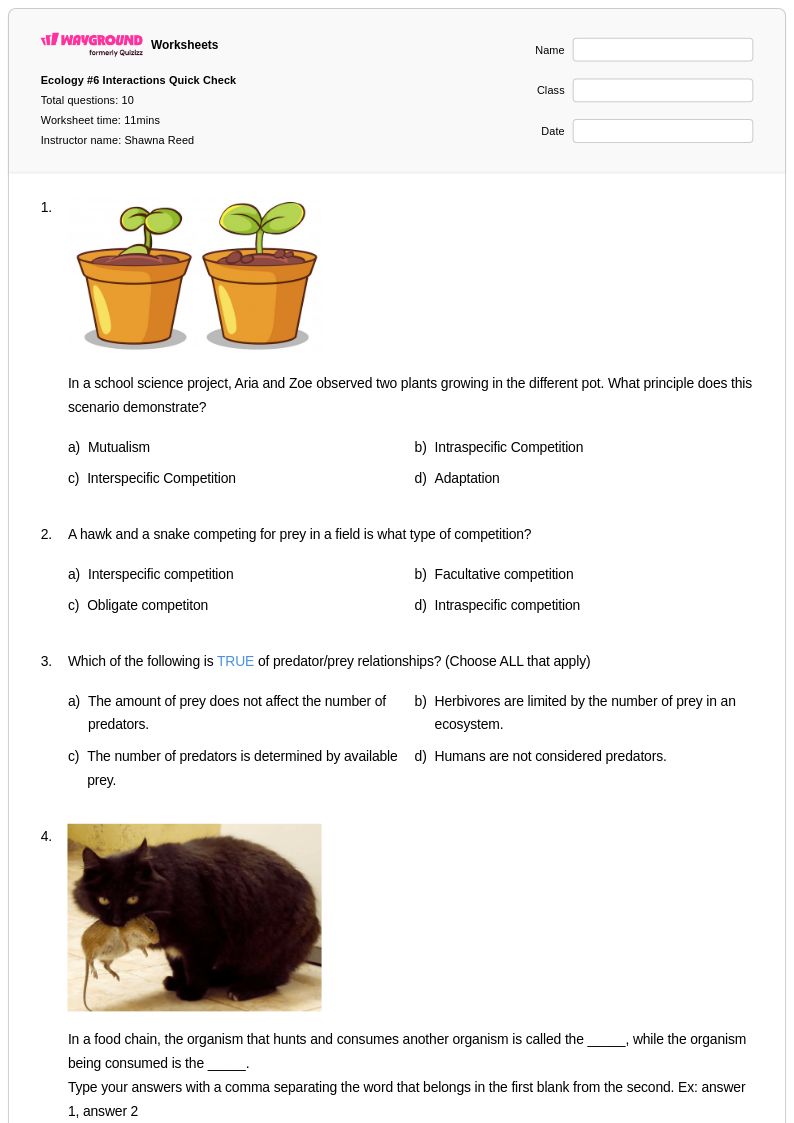
Predation worksheets available through Wayground (formerly Quizizz) provide comprehensive resources for exploring one of ecology's most fundamental interactions between organisms. These expertly crafted materials help students develop critical thinking skills about predator-prey relationships, food webs, population dynamics, and evolutionary adaptations that drive survival strategies in natural ecosystems. The worksheet collections include diverse practice problems that challenge learners to analyze hunting behaviors, defensive mechanisms, and the intricate balance between predator and prey populations across different habitats. Each resource comes with detailed answer keys and is available as free printables in convenient PDF format, making it easy for educators to incorporate hands-on learning experiences that reinforce key biological concepts about species interactions and ecosystem stability.
Wayground (formerly Quizizz) empowers educators with an extensive library of millions of teacher-created predation worksheets that streamline lesson planning and enhance student engagement. The platform's robust search and filtering capabilities allow teachers to quickly locate materials aligned with specific curriculum standards while offering powerful differentiation tools to accommodate diverse learning needs and skill levels. These customizable resources are available in both printable PDF formats and interactive digital versions, providing flexibility for classroom instruction, homework assignments, and independent study sessions. Teachers can effectively use these predation worksheets for targeted remediation of struggling students, enrichment activities for advanced learners, and regular skill practice that builds mastery of ecological principles, population biology, and evolutionary concepts essential for understanding how organisms interact within complex biological communities.
FAQs
How do I teach predation and predator-prey relationships in a biology class?
Start by grounding students in the definition of predation as a direct ecological interaction where one organism hunts and consumes another, then build outward to food webs and population dynamics. Use real-world examples like wolves and elk or lynx and snowshoe hares to illustrate how predator and prey populations cycle in response to one another. From there, introduce concepts like defensive adaptations, hunting behaviors, and the evolutionary arms race between predators and prey. Connecting these ideas to broader ecosystem stability helps students see predation not as an isolated event but as a regulating force in nature.
What kinds of practice problems help students understand predator-prey population dynamics?
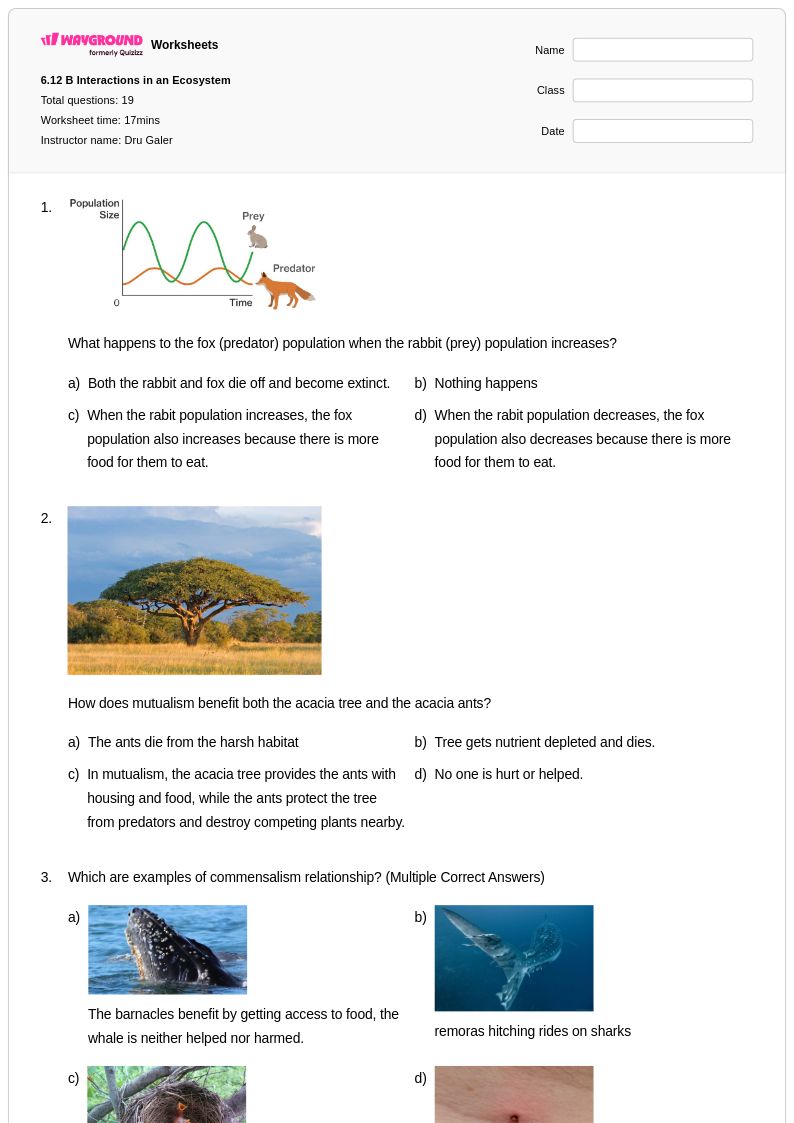
Graph interpretation exercises using Lotka-Volterra population curves are highly effective, as they require students to read data and explain why predator and prey populations oscillate in predictable patterns. Scenario-based questions that ask students to predict what happens when a top predator is removed from an ecosystem reinforce cause-and-effect reasoning. Food web diagrams where students trace energy flow and identify trophic levels also build analytical skills. These exercise types push students beyond memorization and toward genuine ecological thinking.
What misconceptions do students commonly have about predator-prey relationships?
A frequent misconception is that predators drive prey populations to extinction, when in reality prey scarcity limits predator populations too, creating a self-regulating cycle. Students also tend to view predation as purely harmful to ecosystems, overlooking its role in maintaining population balance and preventing overgrazing or habitat degradation. Another common error is confusing predation with competition or parasitism, particularly when the distinction between interaction types is not explicitly taught. Addressing these gaps with targeted scenario analysis and population graph work can correct the confusion efficiently.
How can I use predation worksheets to differentiate instruction for students at different skill levels?
For struggling students, start with visual food web diagrams and simplified scenario questions before introducing population graphs or multi-variable analysis. Advanced learners benefit from open-ended problems that ask them to design an experiment, predict population outcomes under changed conditions, or evaluate real field data. On Wayground, teachers can apply accommodations such as reduced answer choices or read-aloud support to individual students while the rest of the class works with default settings, keeping differentiation seamless and unobtrusive.
How do I use Wayground's predation worksheets in my classroom?
Wayground's predation worksheets are available as printable PDFs, making them straightforward to distribute in traditional classroom settings, and in digital formats suited for blended or fully online instruction. Teachers can also host worksheets directly as a quiz on Wayground, enabling real-time progress tracking. Each worksheet includes a complete answer key, reducing prep time and supporting quick formative feedback. The platform's filtering tools let teachers sort by topic and skill level so they can locate the most relevant materials without searching manually through a large library.
How does predation connect to evolutionary adaptations, and how do I help students make that link?
Predation is one of the primary selective pressures driving evolutionary adaptation, meaning the traits that improve hunting success in predators and survival in prey are favored by natural selection over generations. Help students make this connection by pairing examples of adaptations, such as camouflage, venom, speed, or mimicry, with the specific predator-prey relationships that drove them. Ask students to classify adaptations as offensive or defensive and then explain the evolutionary pressure behind each. This approach reinforces both ecology and natural selection simultaneously, making predation a productive bridge between two major biology units.