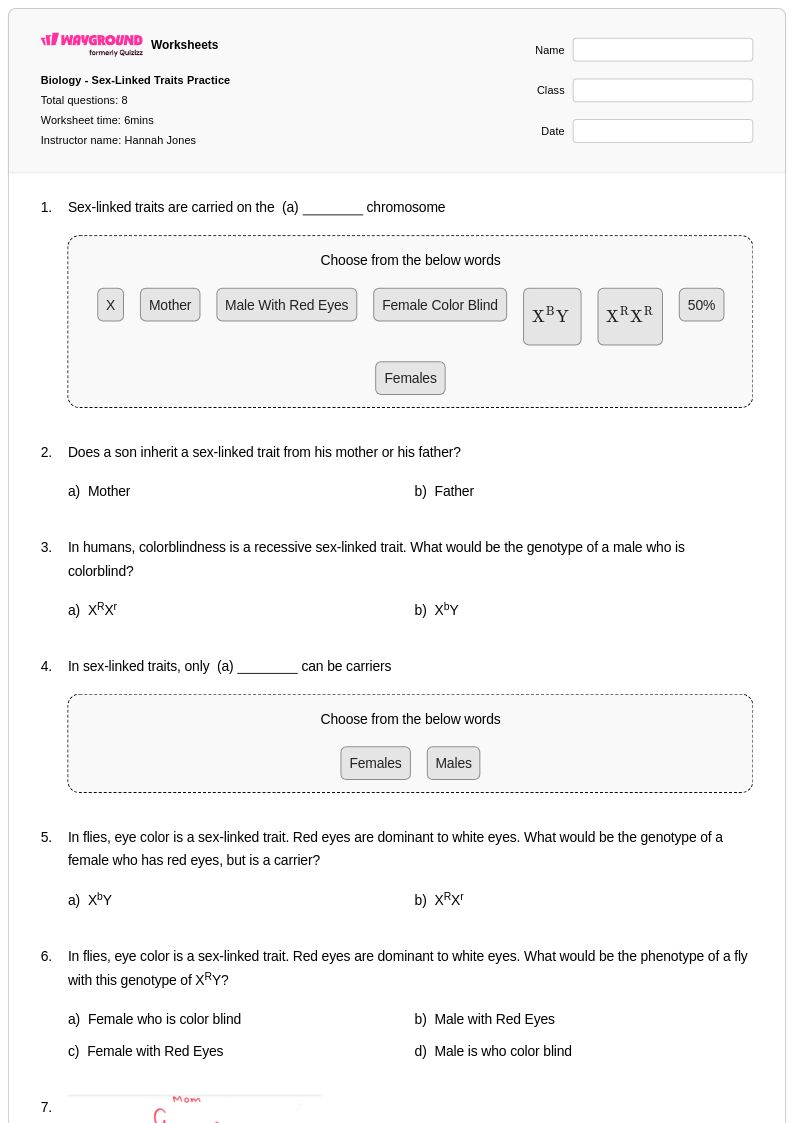
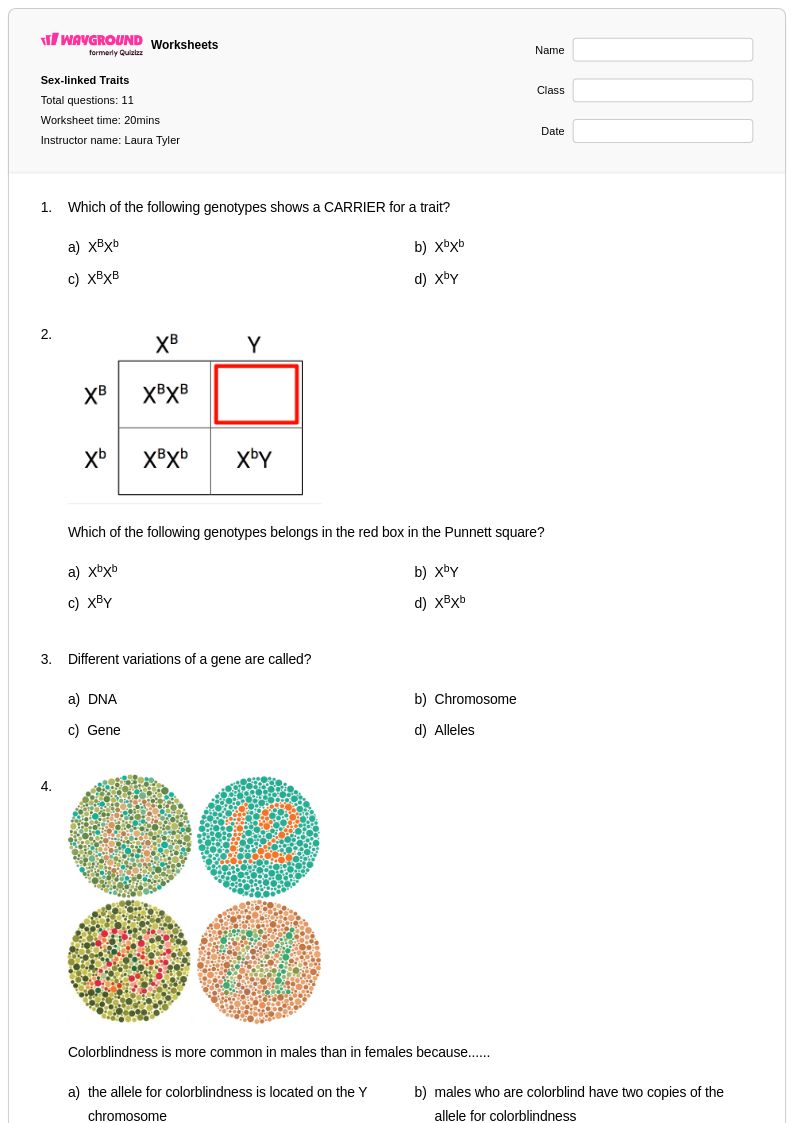
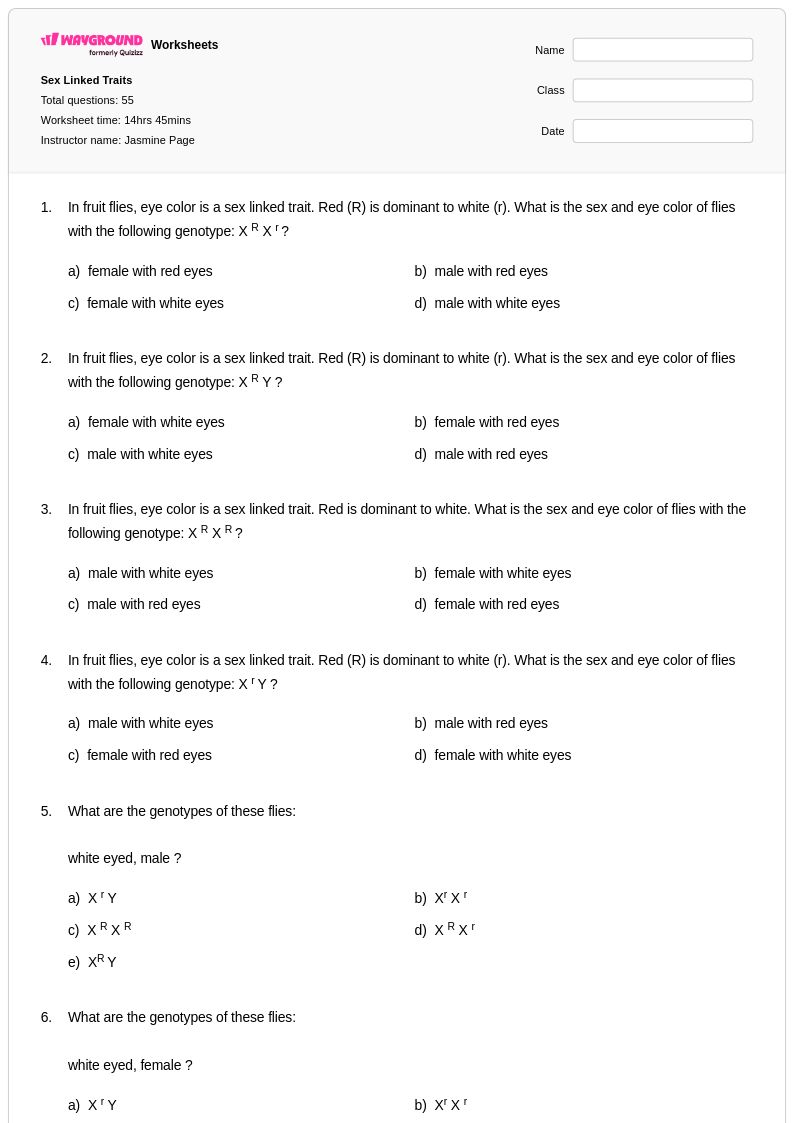
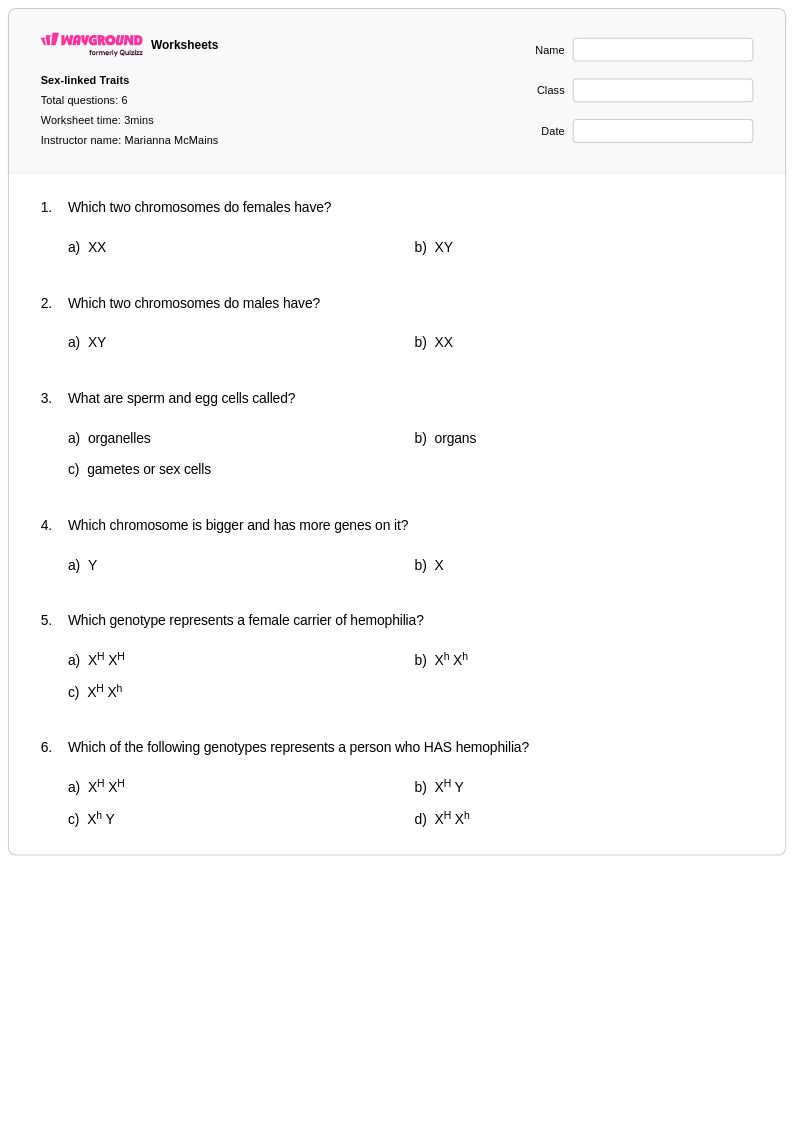
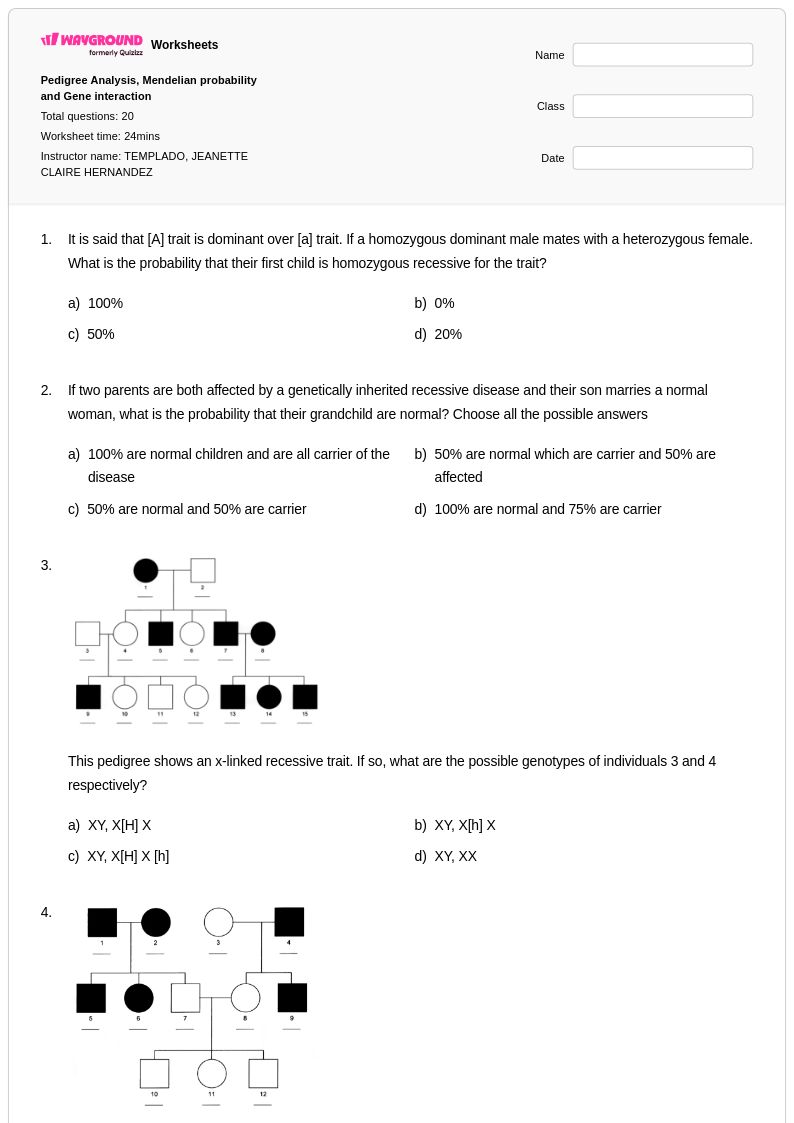
Explore Wayground's comprehensive collection of free sex linked traits worksheets and printables that help students master inheritance patterns, genetic crosses, and chromosome-linked characteristics through engaging practice problems with answer keys.
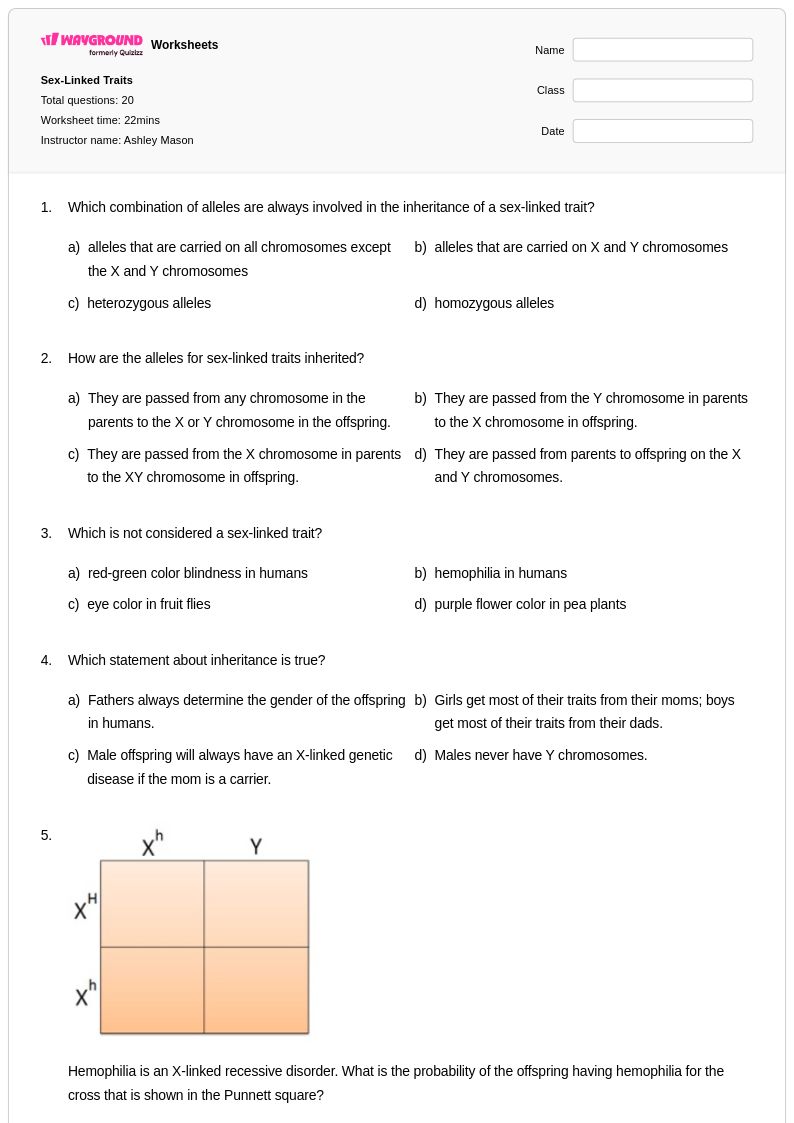
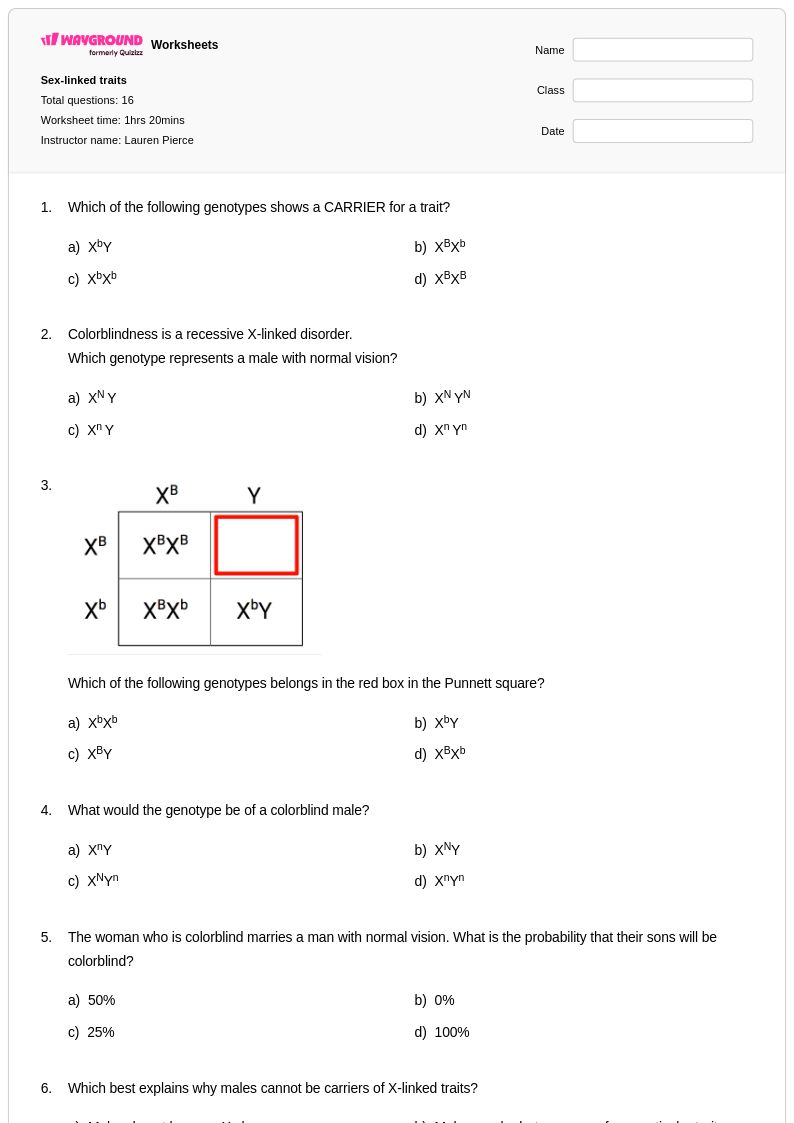
Sex linked traits worksheets available through Wayground (formerly Quizizz) provide comprehensive coverage of inheritance patterns for genes located on the X and Y chromosomes, offering students essential practice with pedigree analysis, probability calculations, and genetic cross interpretations. These carefully designed worksheets strengthen critical thinking skills by challenging students to analyze real-world examples of sex linked disorders such as color blindness, hemophilia, and Duchenne muscular dystrophy, while reinforcing fundamental concepts of carrier status, affected individuals, and inheritance probability. Each worksheet collection includes detailed answer keys that guide students through complex problem-solving processes, with free printables available in convenient pdf format to support both classroom instruction and independent study of these intricate genetic principles.
Wayground (formerly Quizizz) empowers educators with millions of teacher-created resources specifically focused on sex linked traits, featuring robust search and filtering capabilities that allow instructors to quickly locate materials aligned with specific learning standards and curriculum requirements. The platform's sophisticated differentiation tools enable teachers to customize worksheet difficulty levels and content focus, ensuring appropriate challenge levels for diverse learners while maintaining rigorous academic expectations. Available in both printable and digital formats, including downloadable pdf versions, these resources seamlessly integrate into lesson planning workflows and provide flexible options for remediation, enrichment, and targeted skill practice, allowing educators to address individual student needs while reinforcing mastery of complex genetic inheritance patterns through systematic, evidence-based instruction.
FAQs
How do I teach sex-linked traits to high school biology students?
Start by ensuring students have a solid understanding of meiosis and basic Mendelian inheritance before introducing sex linkage. Explain that sex-linked genes are located on the X or Y chromosome, and use familiar examples like color blindness and hemophilia to ground abstract concepts in real-world context. Pedigree analysis is the most effective tool for helping students visualize inheritance patterns across generations, so walk through at least one family pedigree together before assigning independent practice. Emphasize the asymmetry between males (XY) and females (XX) early, since this is the foundation for understanding why certain conditions appear more frequently in males.
What are common mistakes students make when solving sex-linked trait problems?
The most frequent error is forgetting to attach the allele notation to the X chromosome (e.g., writing 'X^B' rather than treating the trait as autosomal). Students also confuse carriers with affected individuals, particularly when analyzing females, since females need two copies of a recessive X-linked allele to express the trait. Another common mistake is assuming Y-linked traits follow the same probability rules as X-linked traits — students need explicit instruction that Y-linked traits pass exclusively from father to all sons. In pedigree problems, students often misread whether an unaffected female is homozygous dominant or a carrier, so teach them to work backward from affected offspring to determine parental genotypes.
What practice problems help students understand X-linked recessive inheritance?
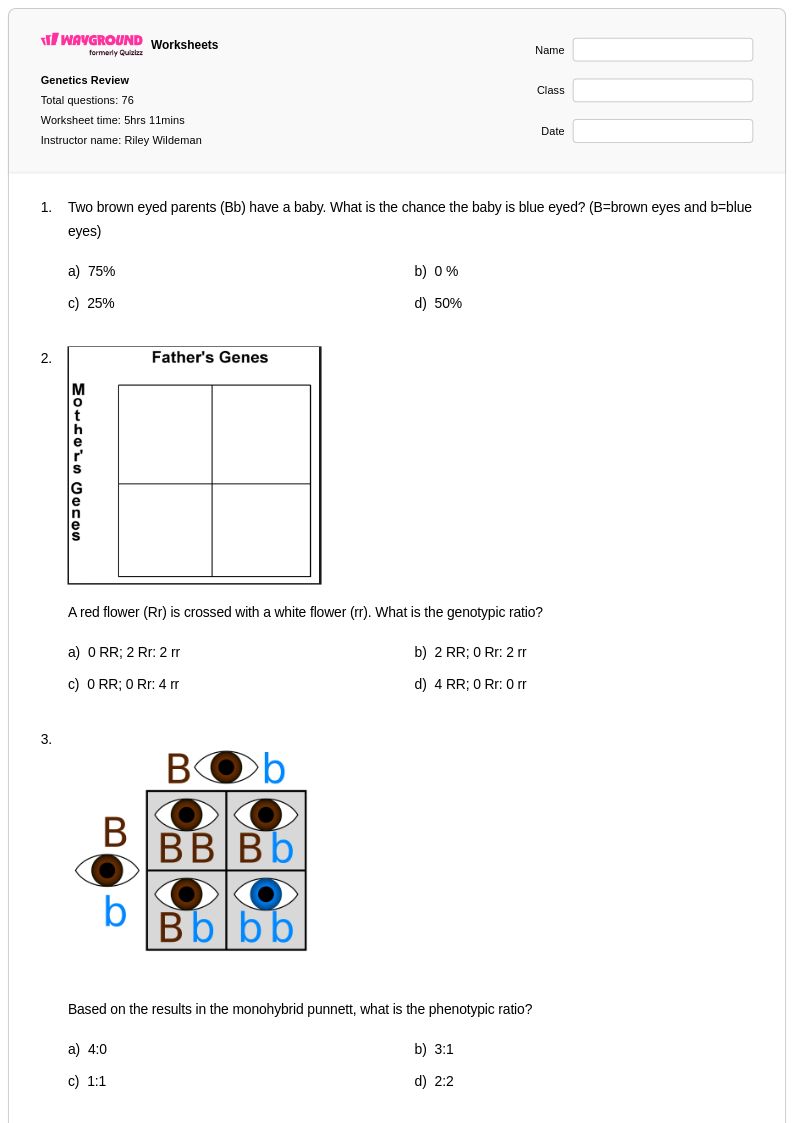
Genetic cross problems using Punnett squares are the foundational exercise, particularly crosses involving a carrier mother and unaffected father, since these produce the 1:1:1:1 genotype ratio that illustrates carrier daughters and affected sons. Pedigree interpretation problems add complexity by requiring students to identify genotypes from phenotypic data across multiple generations. Probability calculation problems — such as determining the likelihood that a child of a carrier mother will be an affected male — build quantitative reasoning alongside conceptual understanding. Real-world case studies involving color blindness or hemophilia increase engagement and give students a concrete frame of reference for why these inheritance patterns matter clinically.
How do I differentiate sex-linked traits instruction for students at different skill levels?
For students who are still building foundational skills, begin with straightforward X-linked recessive crosses involving known parental genotypes before introducing pedigree analysis or probability calculations. More advanced students can be challenged with incomplete pedigrees where they must determine possible genotypes for ambiguous individuals, or with problems involving co-dominant or incompletely dominant X-linked alleles. On Wayground, teachers can apply accommodations such as reduced answer choices for students who need additional support, or enable the Read Aloud feature for students who benefit from auditory processing of complex genetics problems. These settings can be assigned to individual students without affecting the experience of the rest of the class.
How can I use sex-linked traits worksheets from Wayground in my classroom?
Sex-linked traits worksheets on Wayground are available as printable PDFs for traditional classroom use and in digital formats for technology-integrated environments, giving teachers flexibility to assign them as in-class work, homework, or lab follow-ups. Digital worksheets can also be hosted as a quiz directly on Wayground, allowing teachers to track student responses and identify gaps in understanding in real time. Each worksheet includes a complete answer key, so teachers can use them for guided practice, peer review, or self-correction exercises. The platform's search and filtering tools make it straightforward to find materials aligned to specific standards or skill focuses within the sex-linked traits topic.
How do I explain the difference between sex-linked and autosomal inheritance to students?
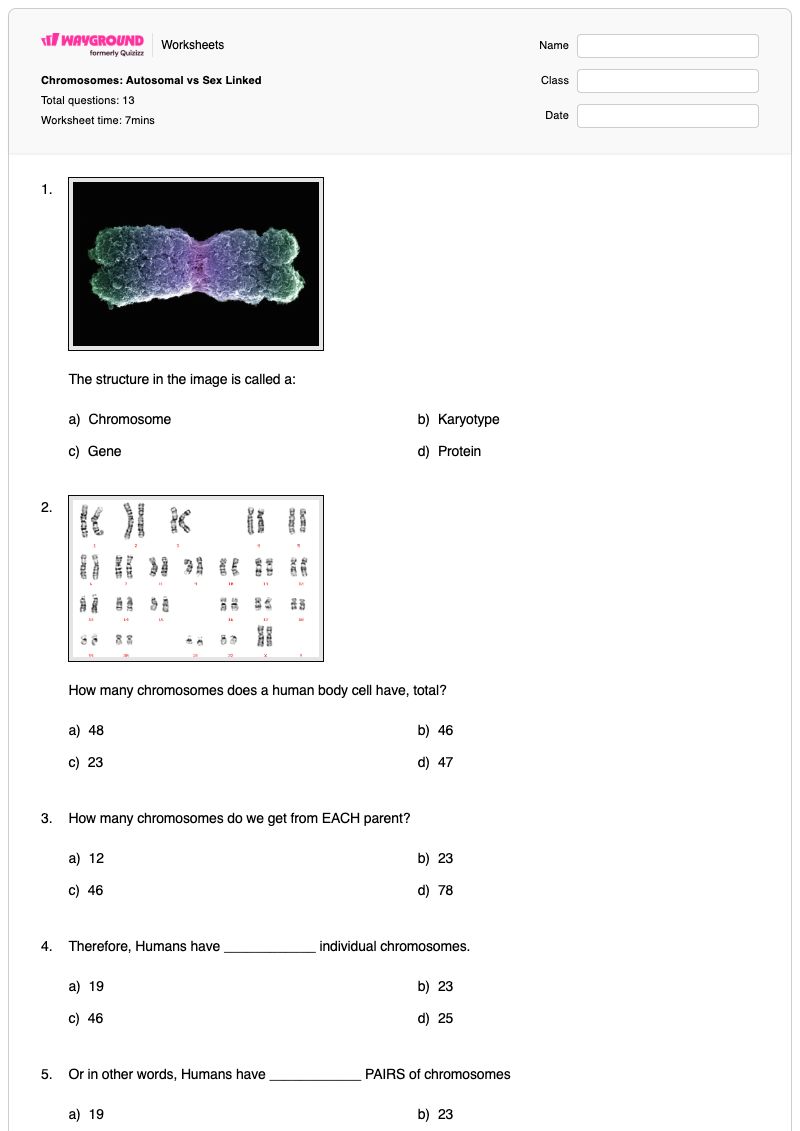
The key distinction is chromosomal location: autosomal traits are carried on chromosomes 1 through 22 and affect males and females with equal probability, while sex-linked traits are carried on the X or Y chromosome and show different inheritance patterns depending on the sex of the offspring. A practical way to make this concrete is to compare the inheritance of a typical autosomal recessive trait — where both sexes have equal carrier and affected rates — with an X-linked recessive trait, where males are far more likely to be affected because they only have one X chromosome and therefore cannot be carriers. Using side-by-side pedigree examples of each inheritance type is one of the most effective ways to help students see and internalize the difference.