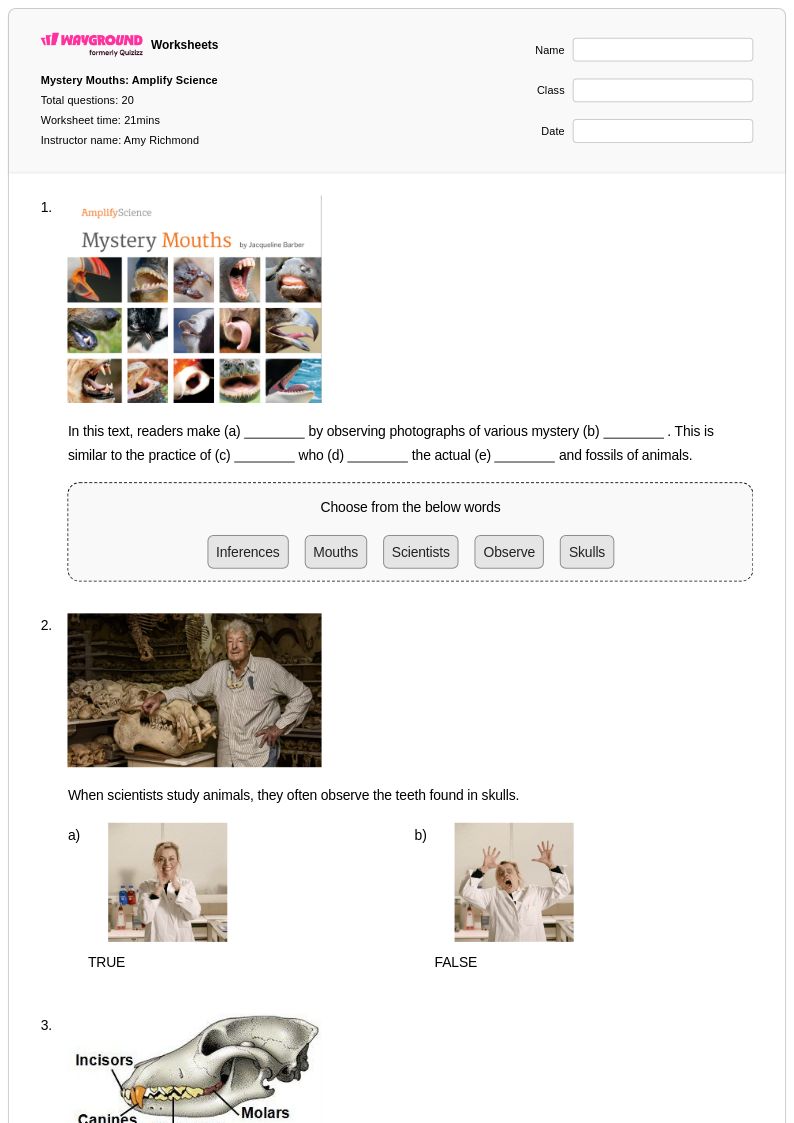
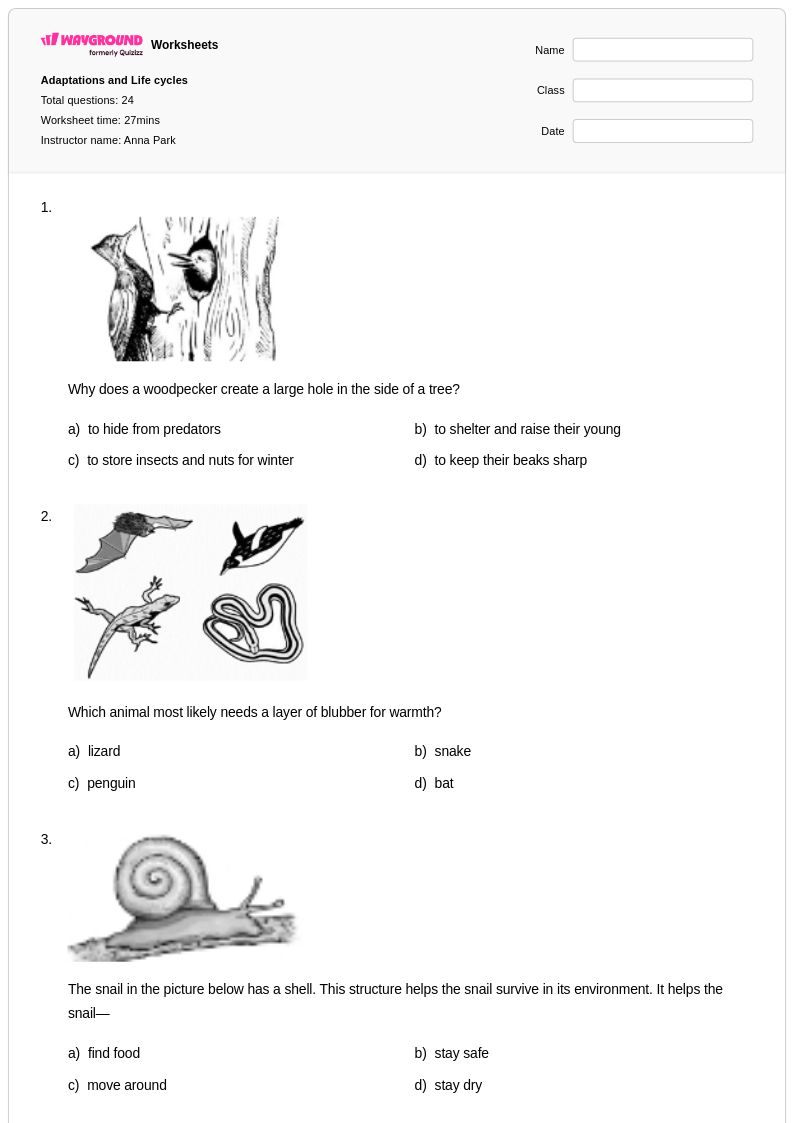
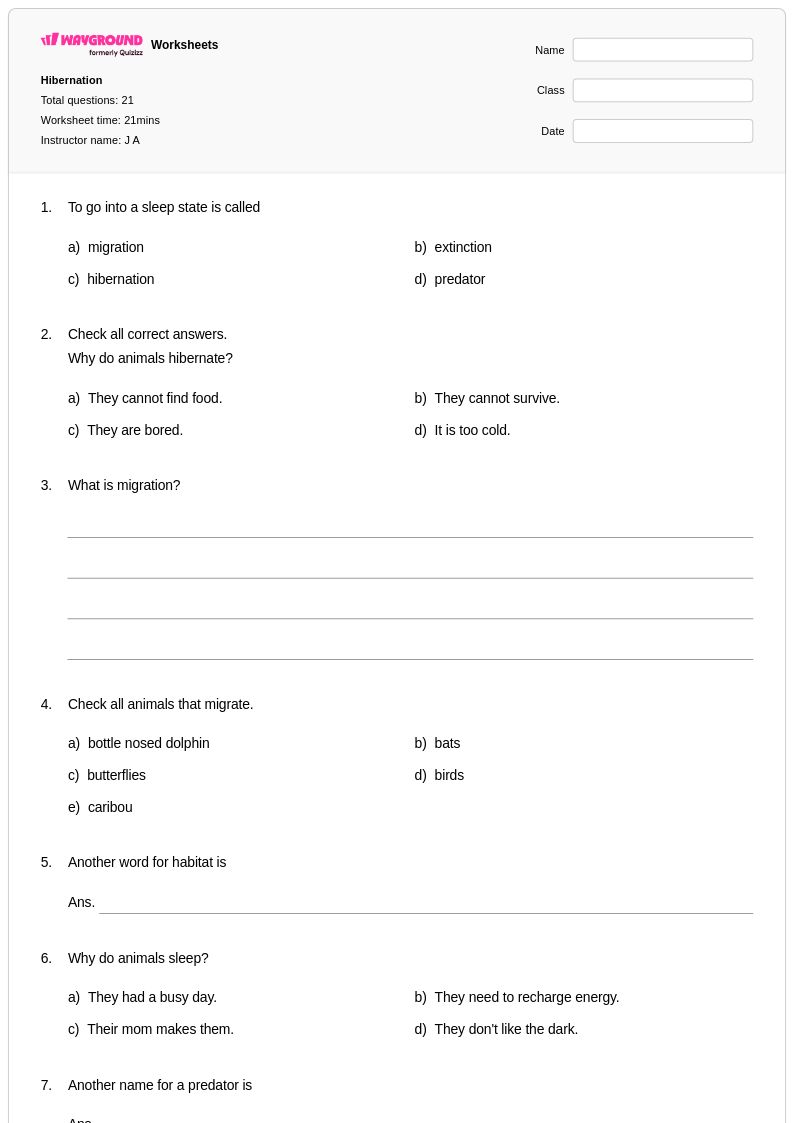
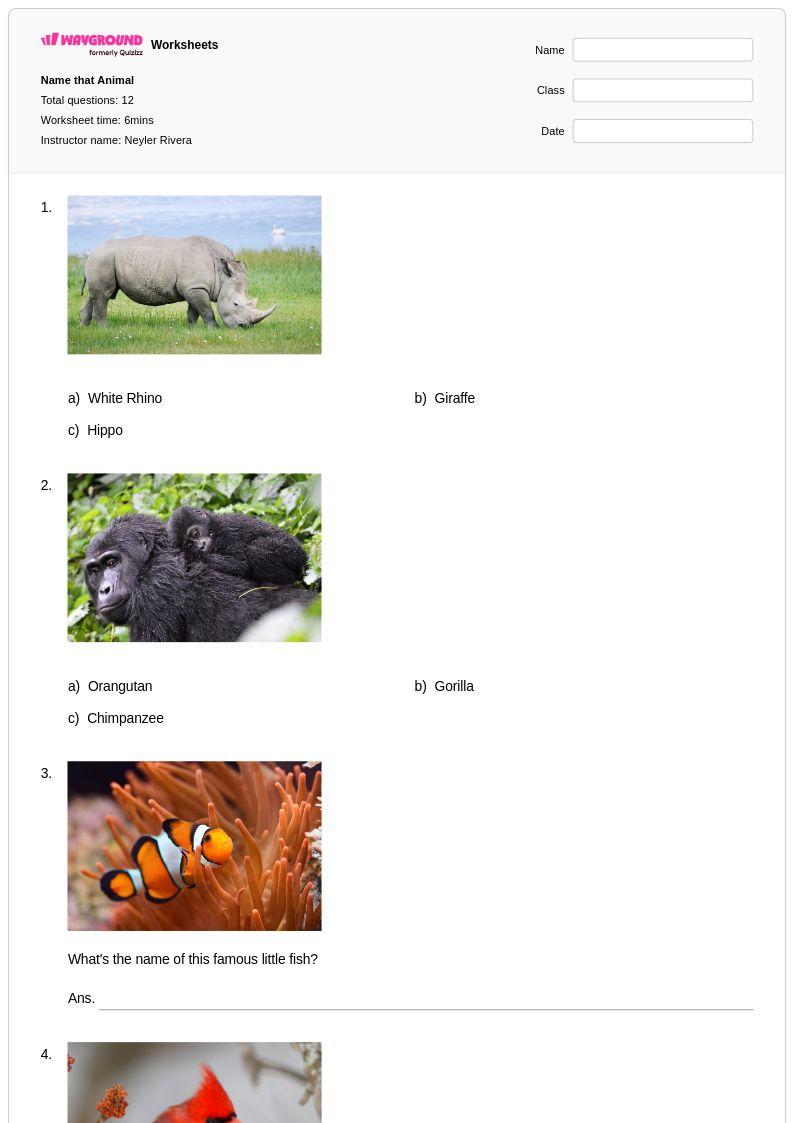
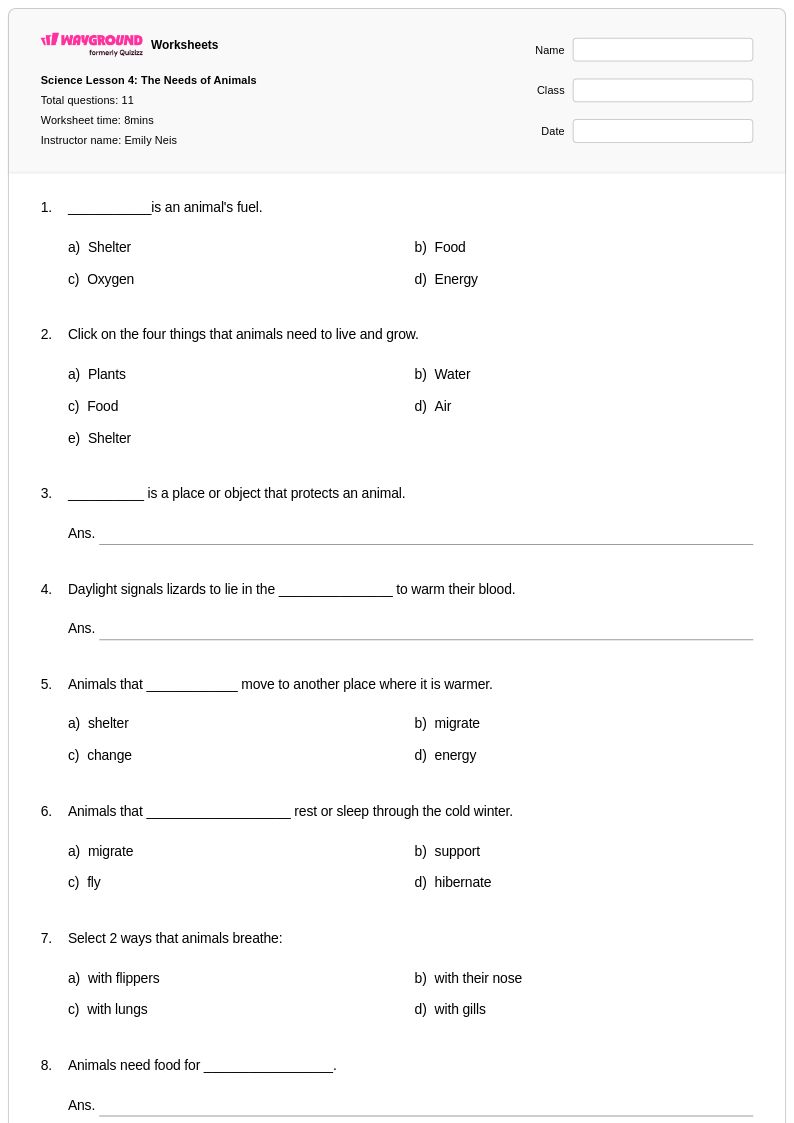
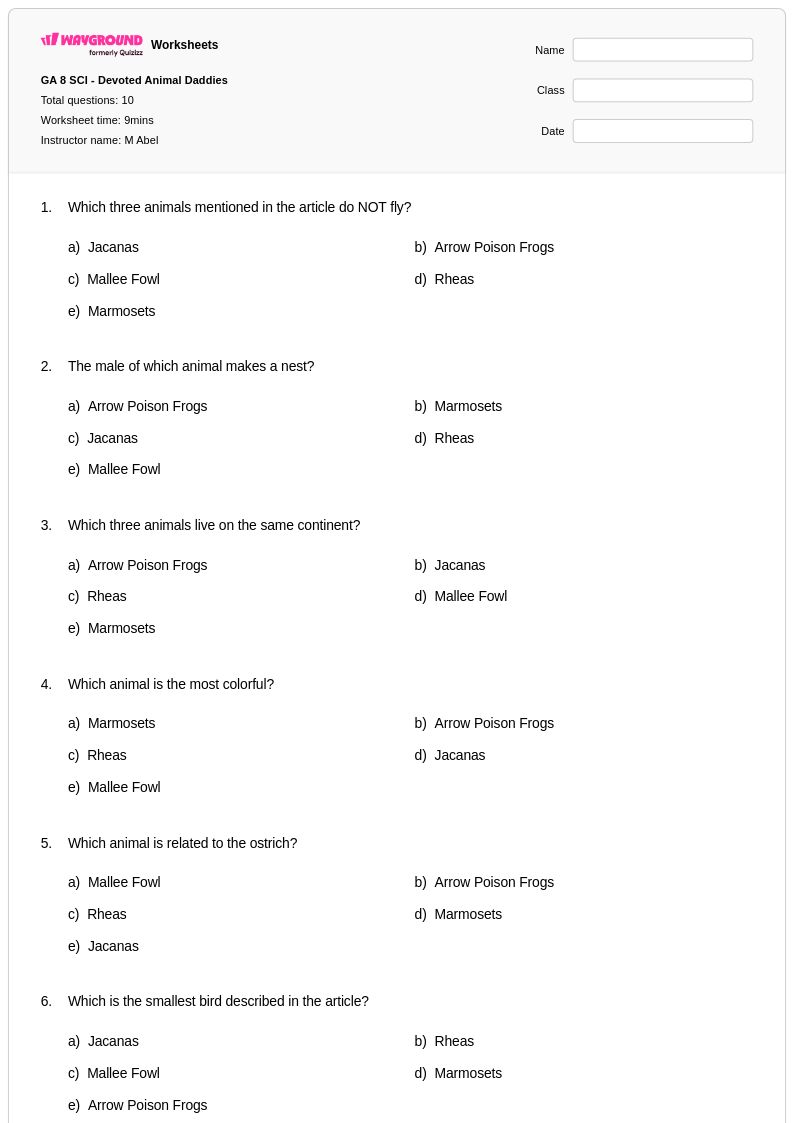
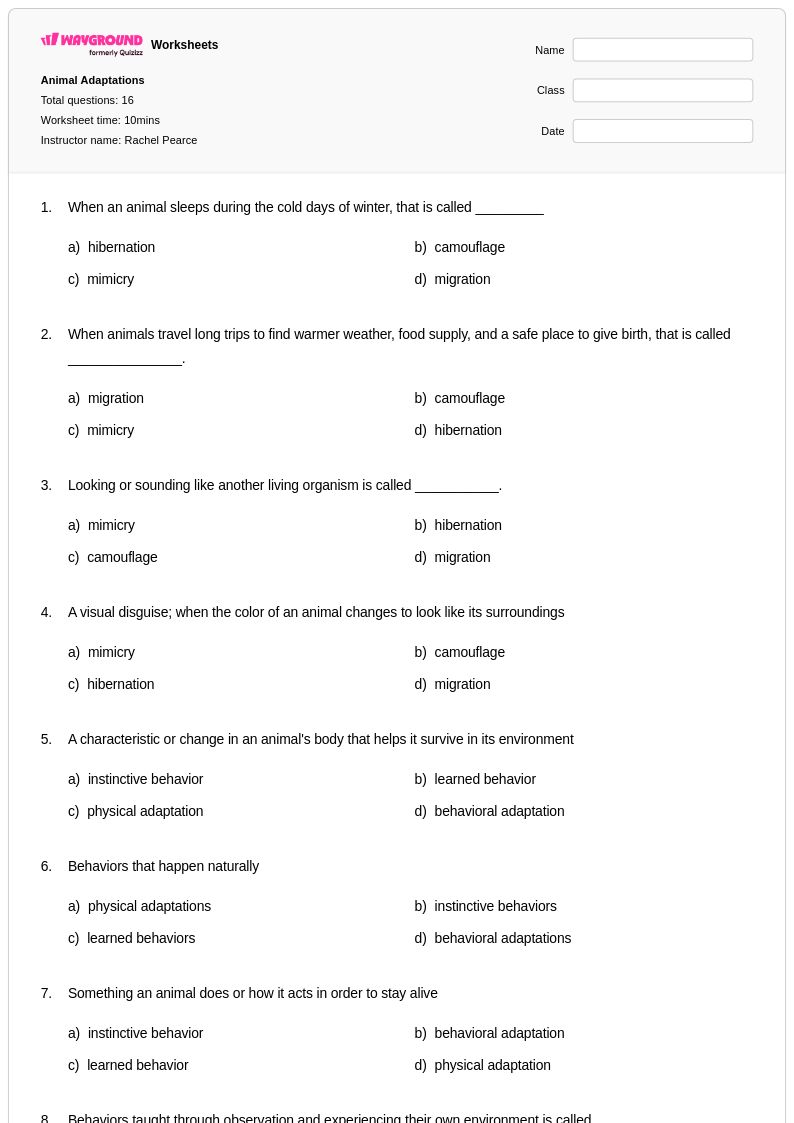
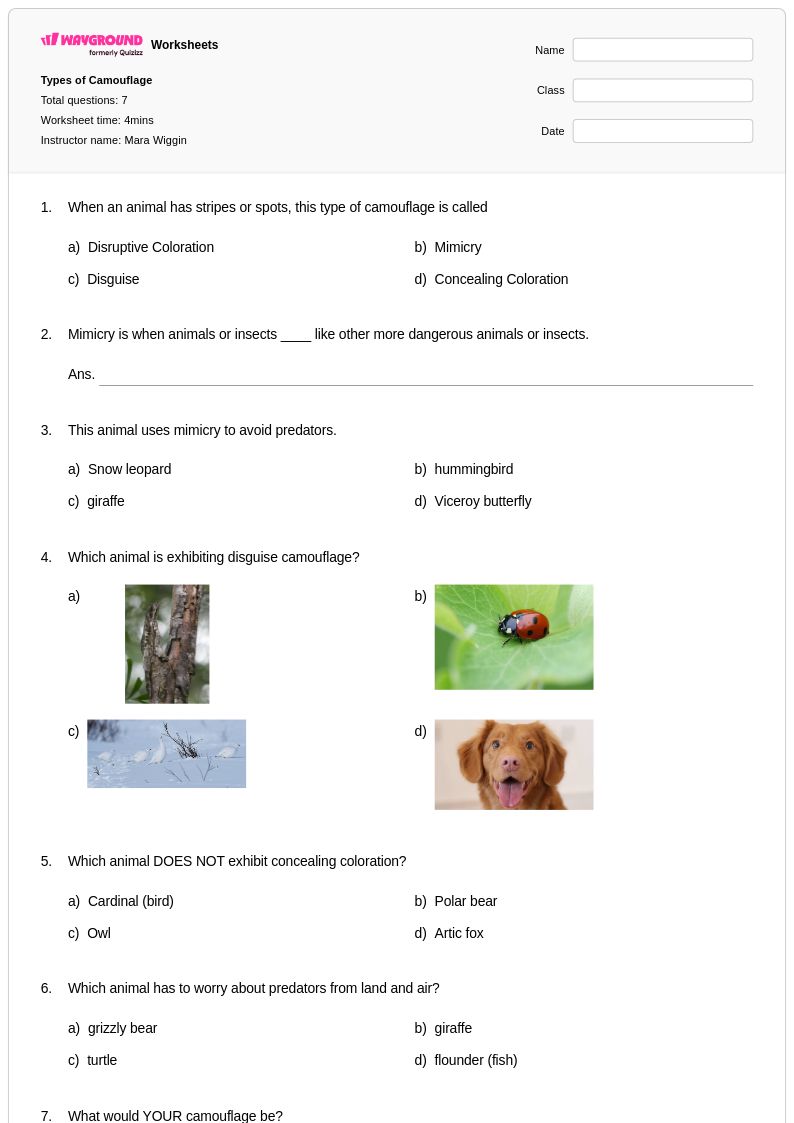
Free Printable Animal Communication Worksheets for Class 3
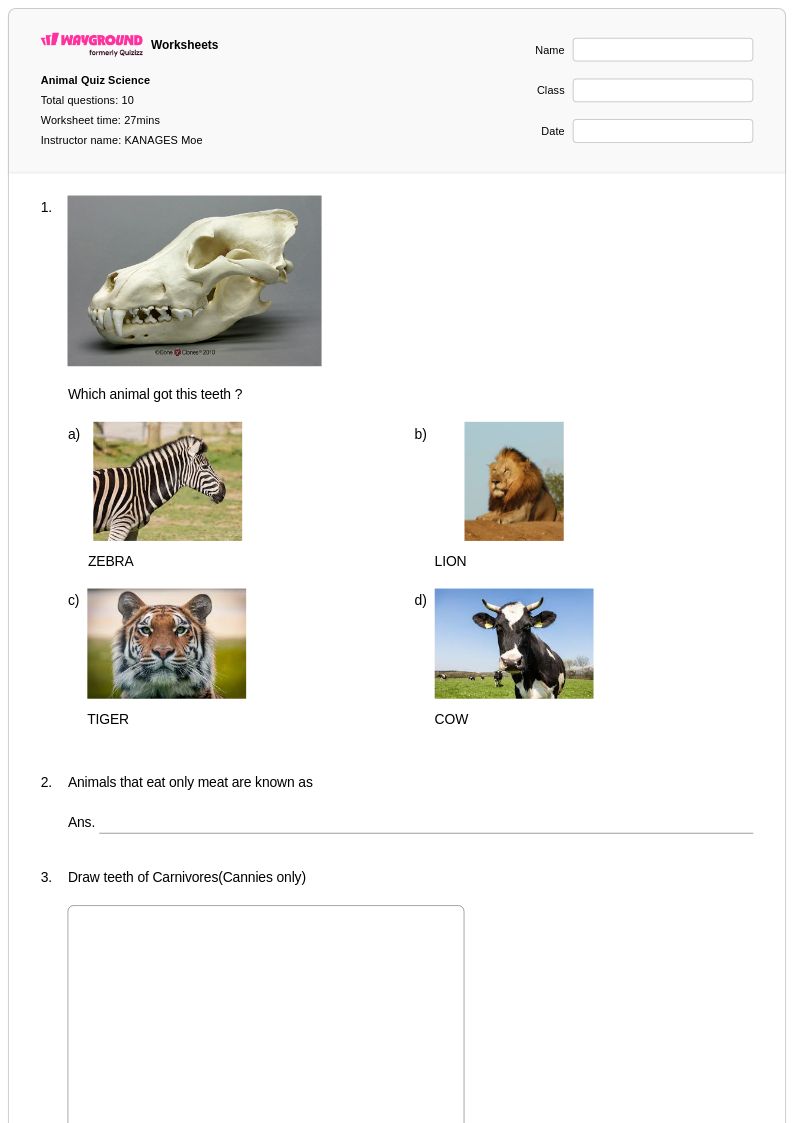
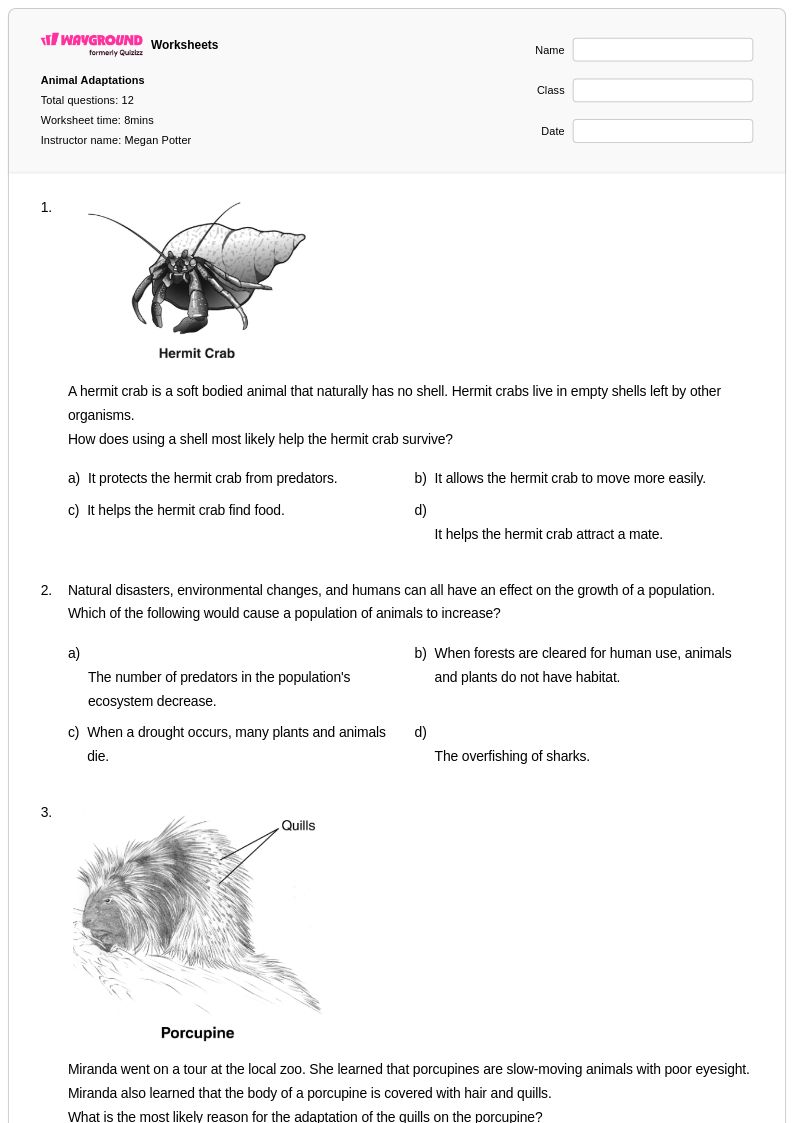
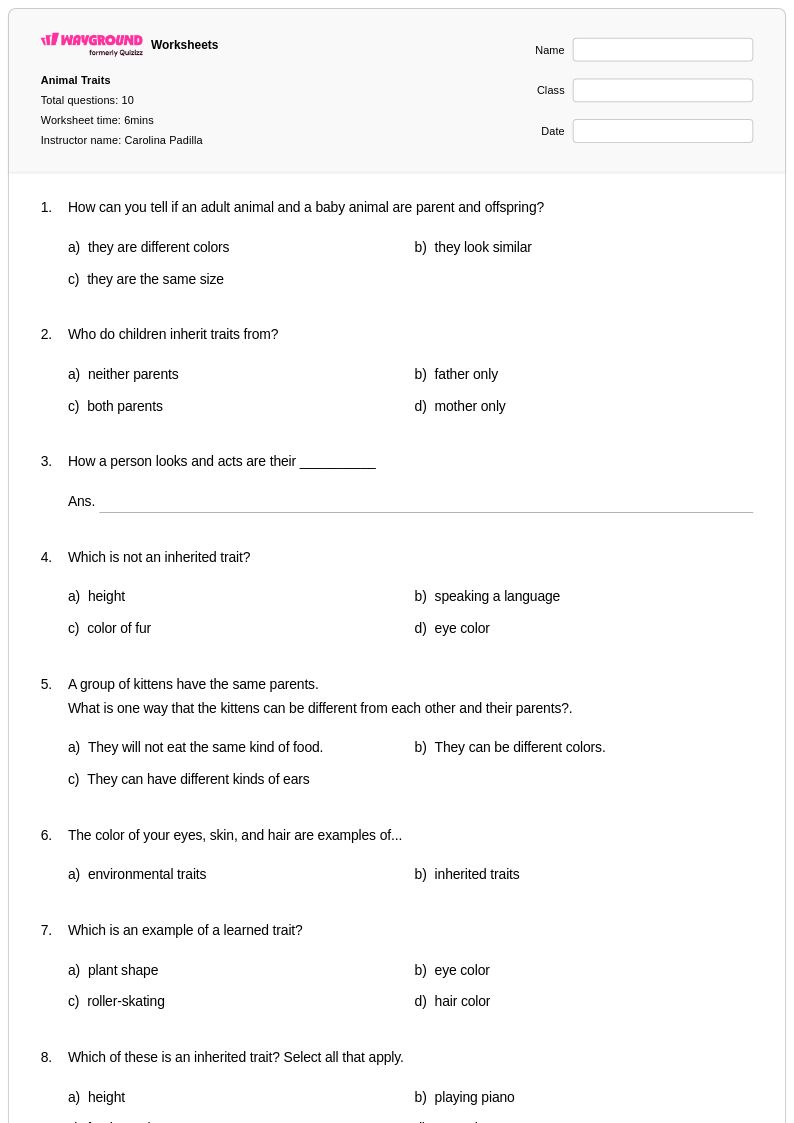
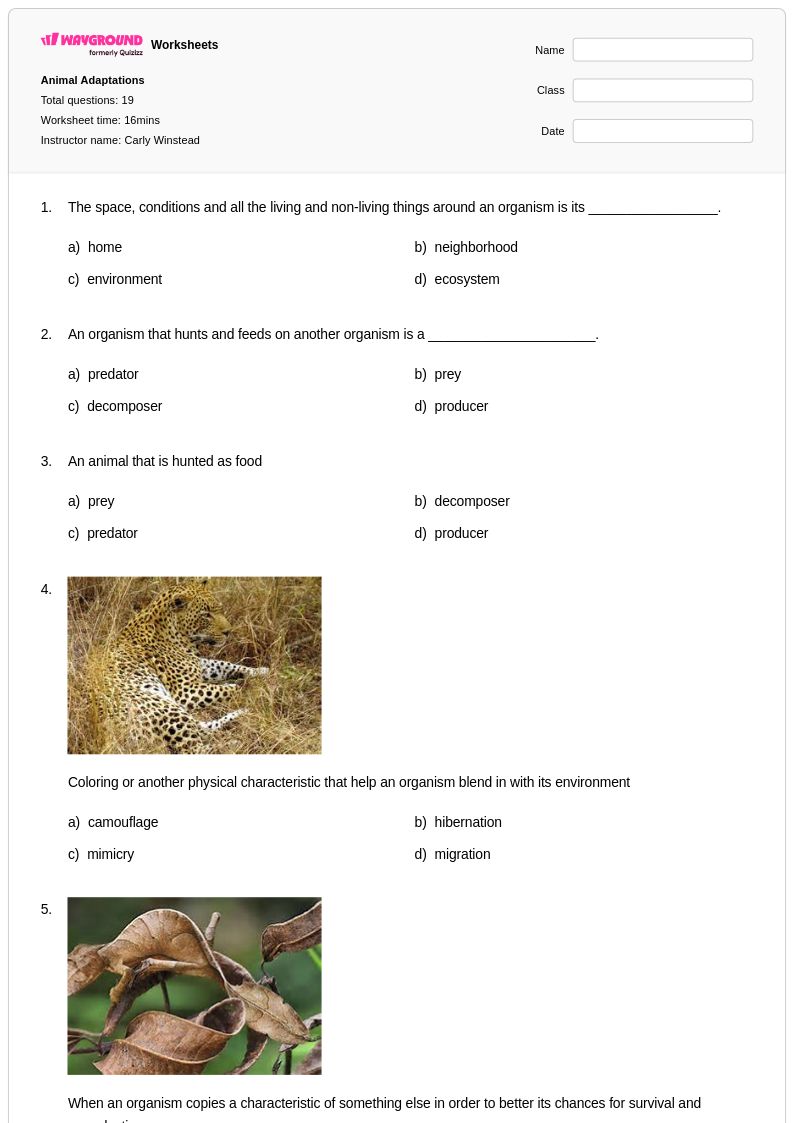
Discover free Class 3 animal communication worksheets and printables that help students explore how animals send messages, with engaging practice problems and complete answer keys available as downloadable PDFs through Wayground.
Explore printable Animal Communication worksheets for Class 3
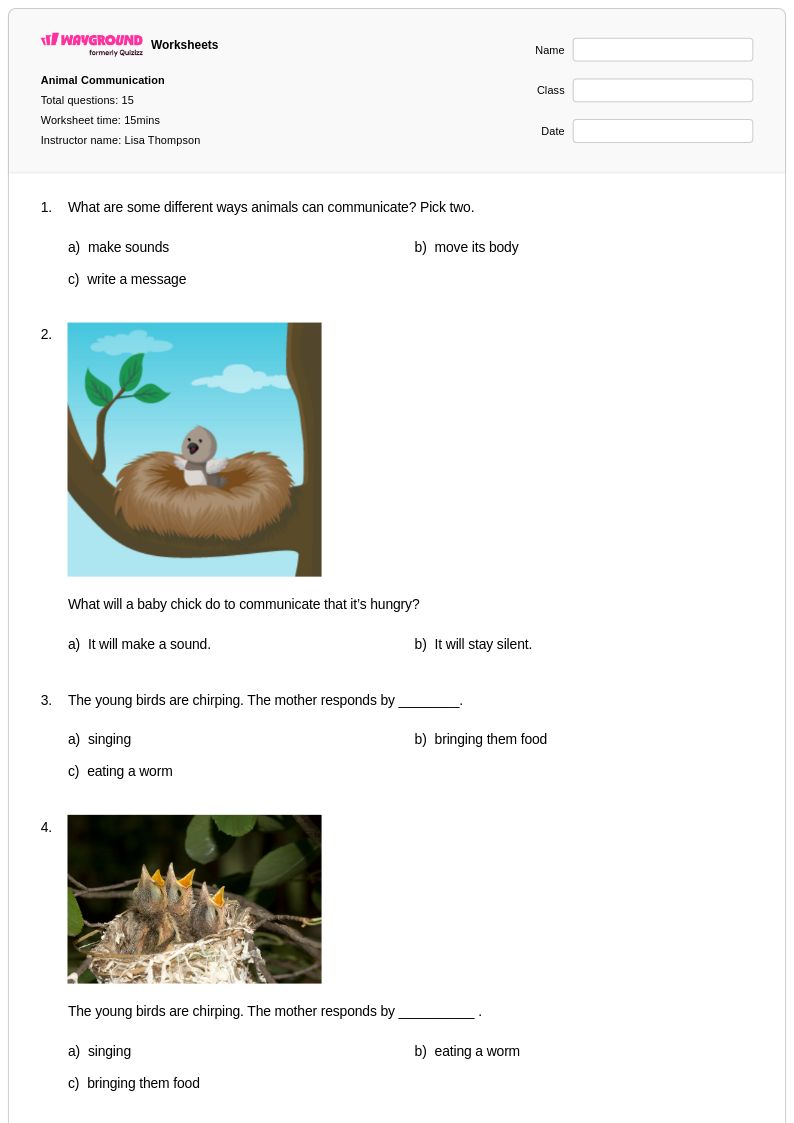
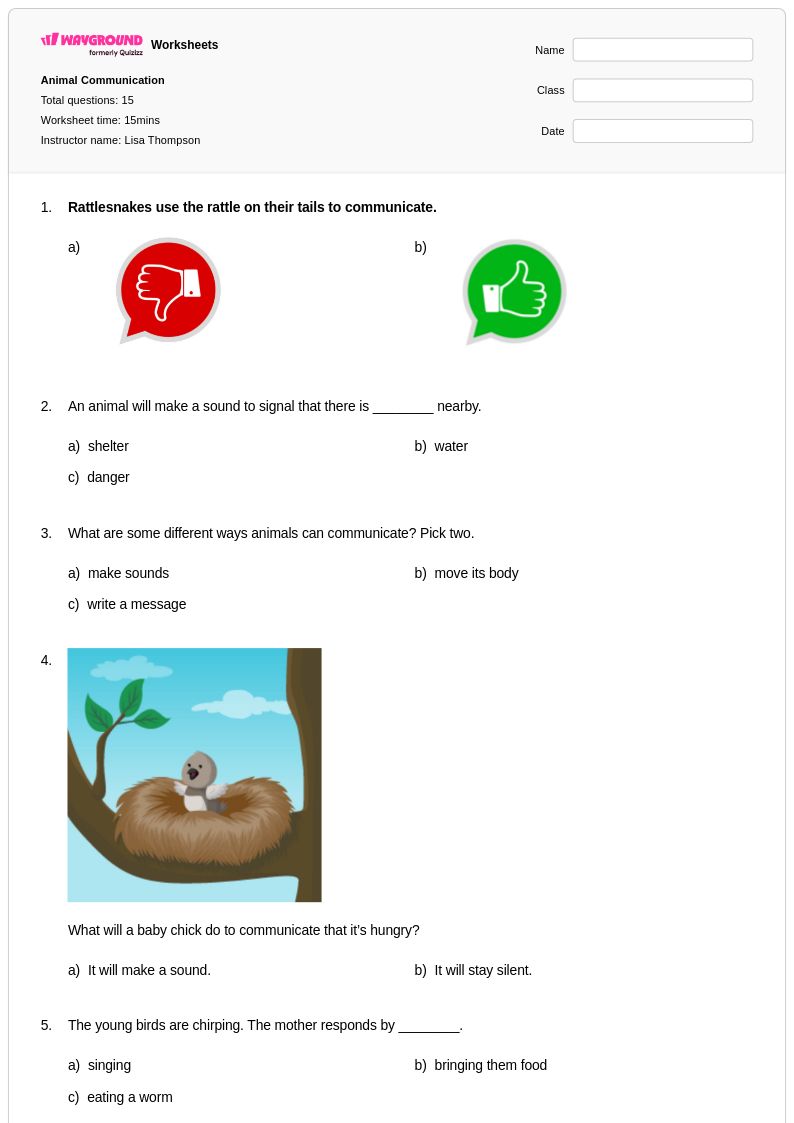
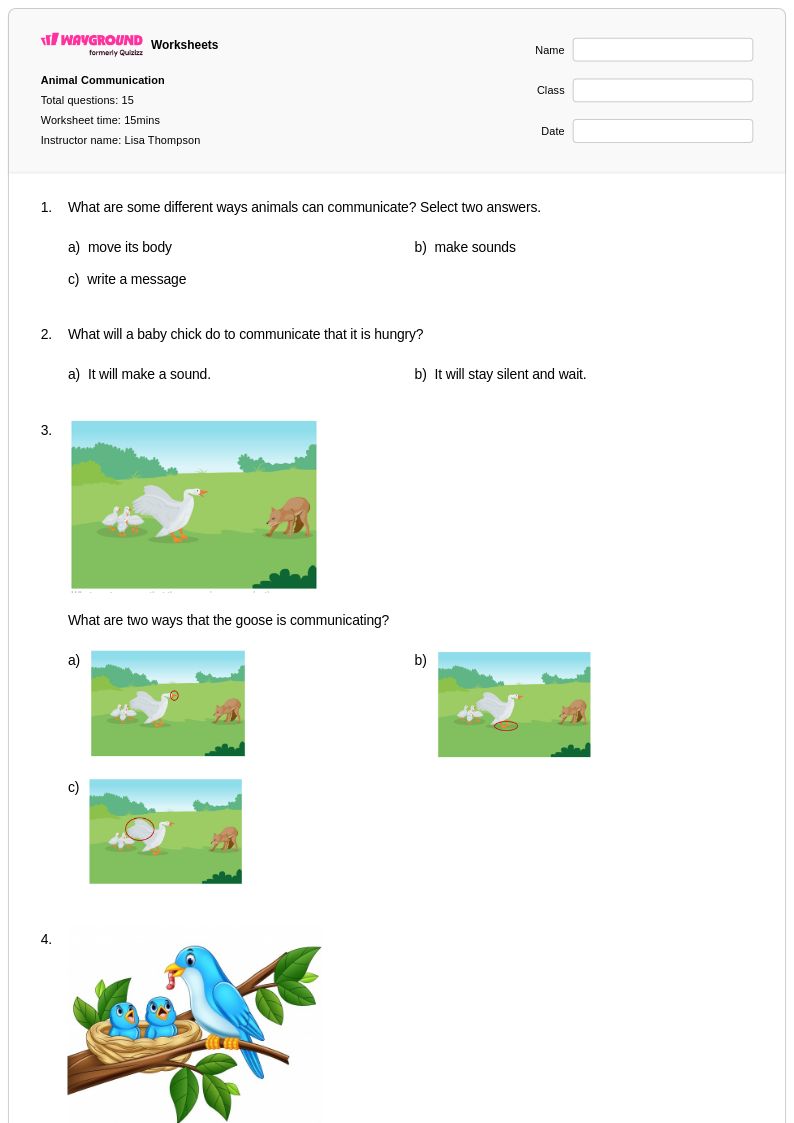
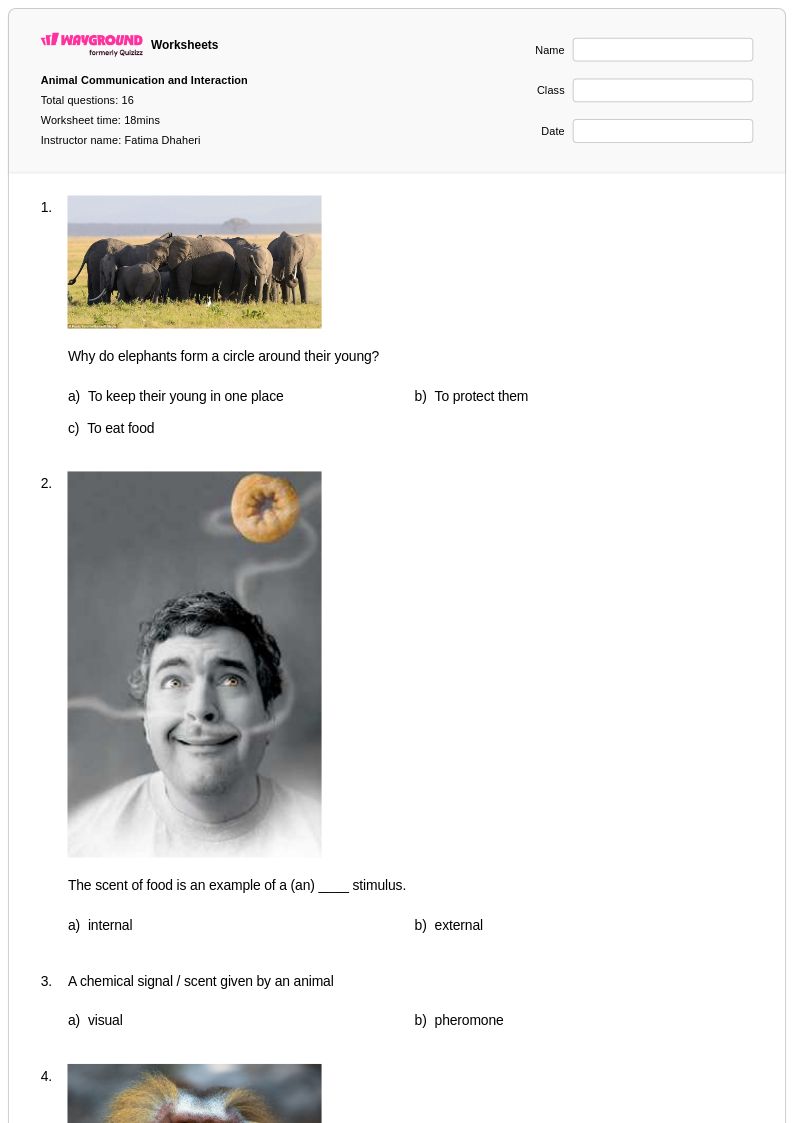
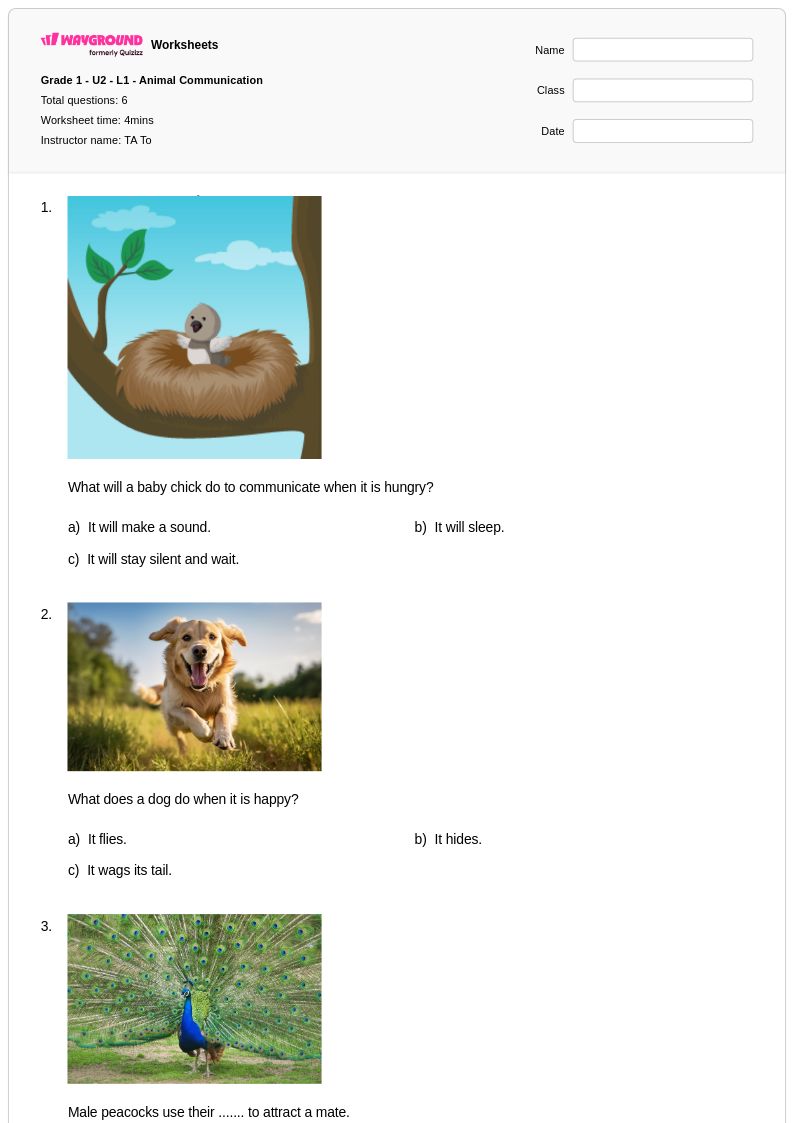
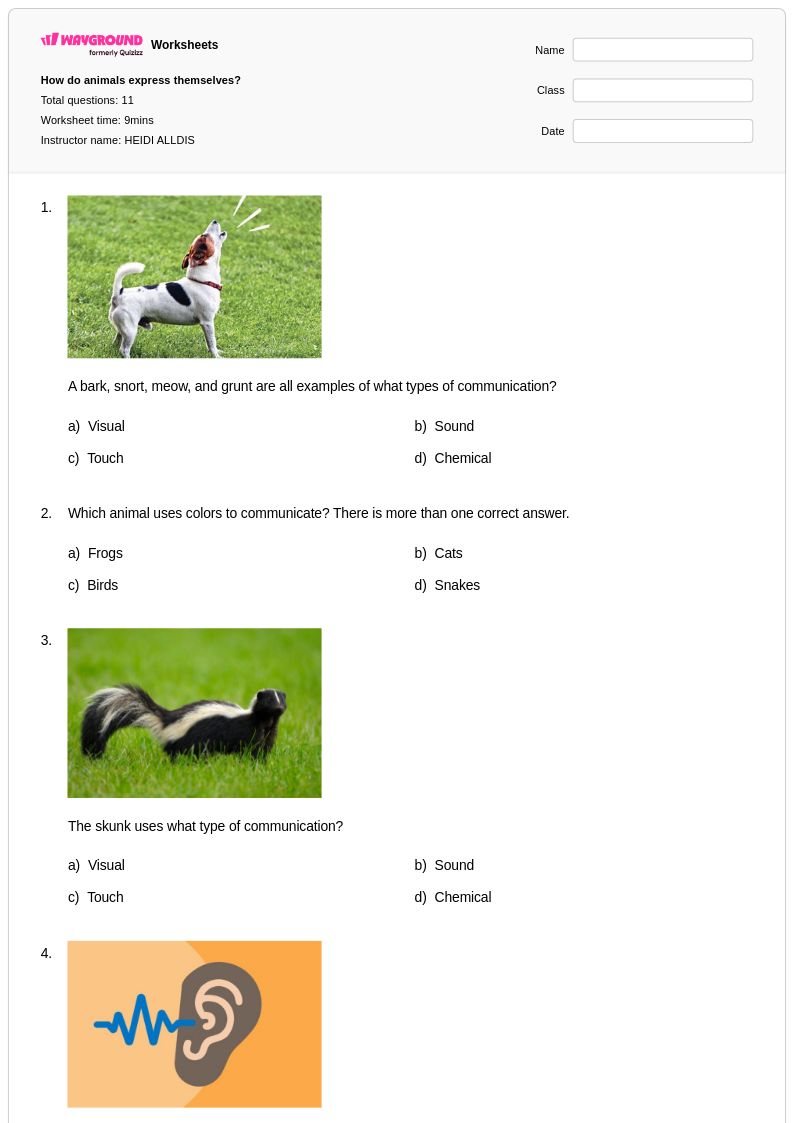
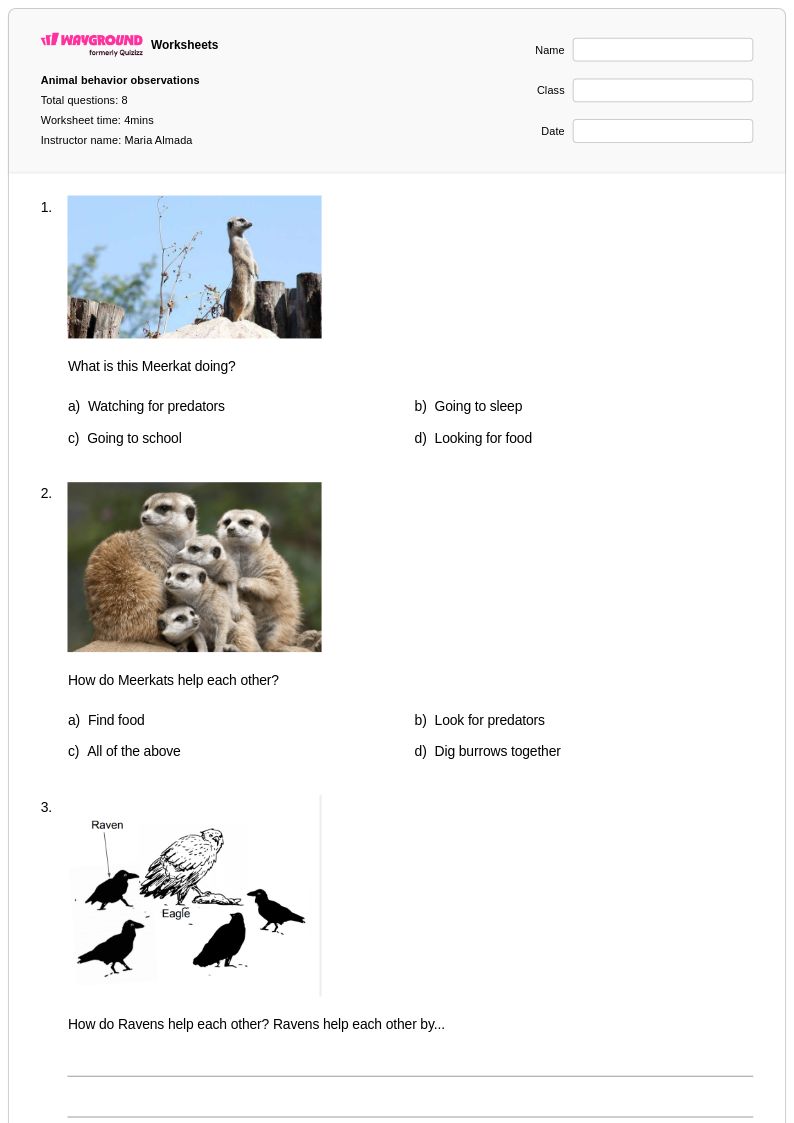
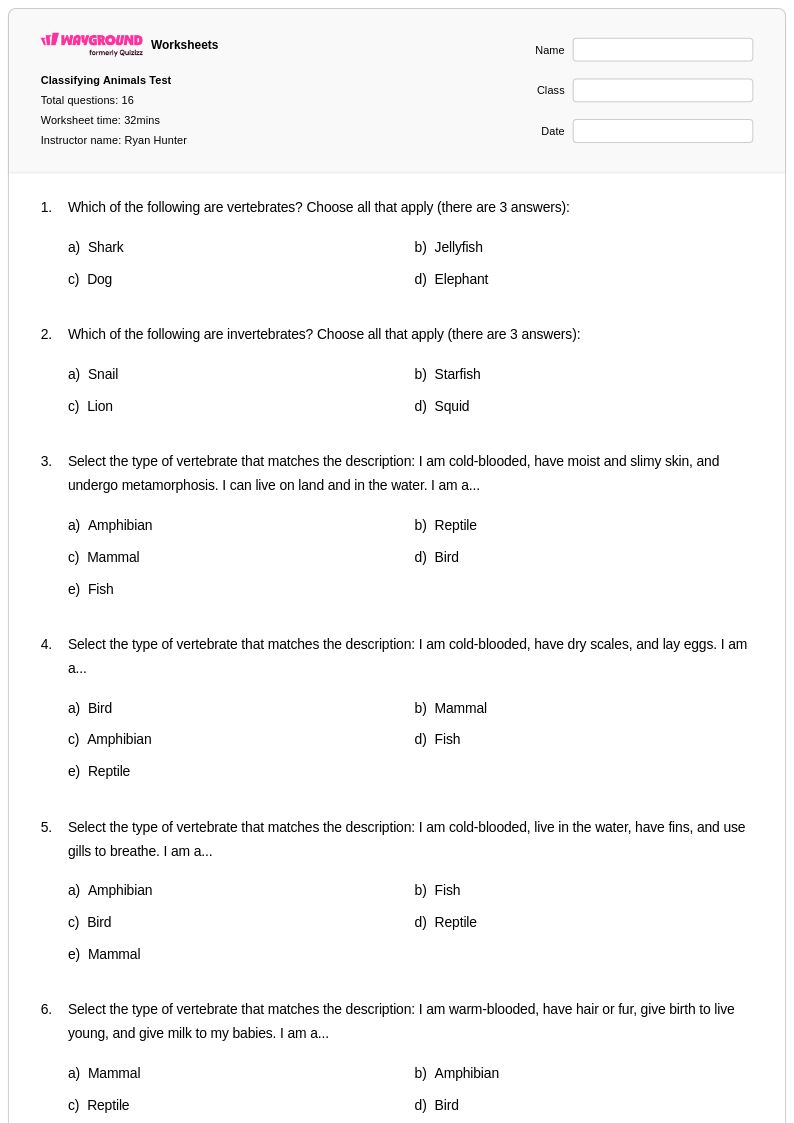
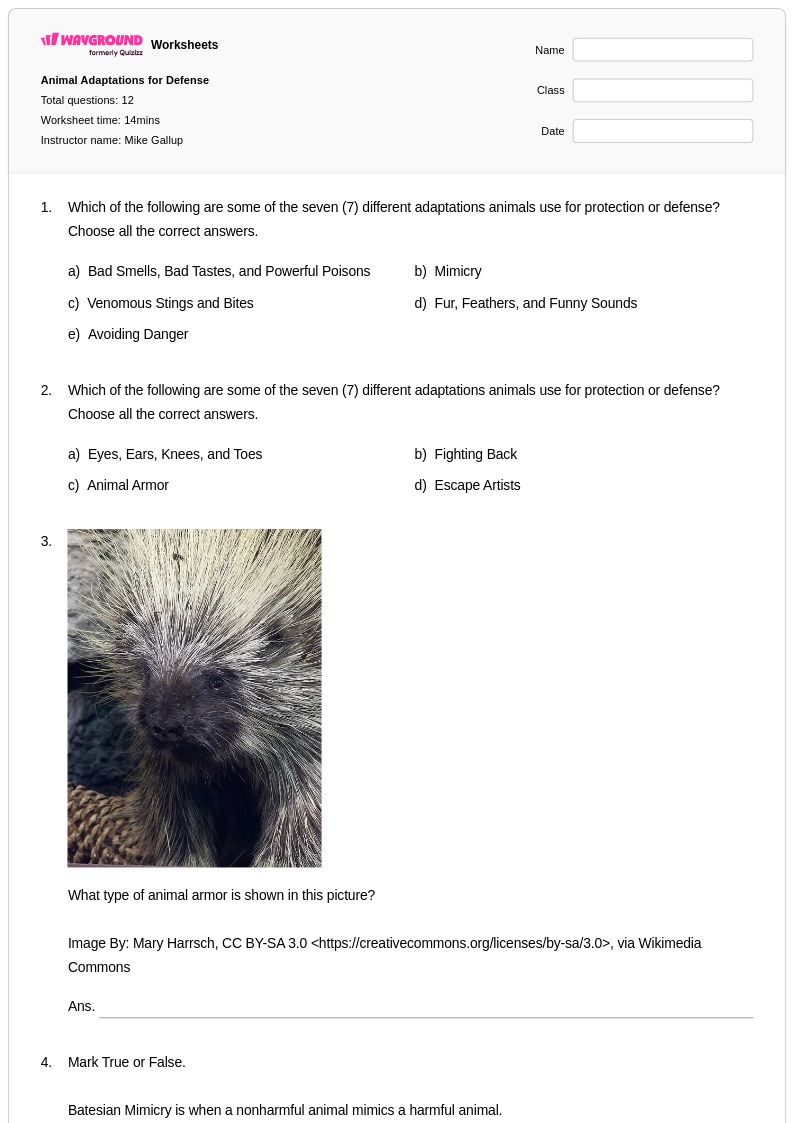
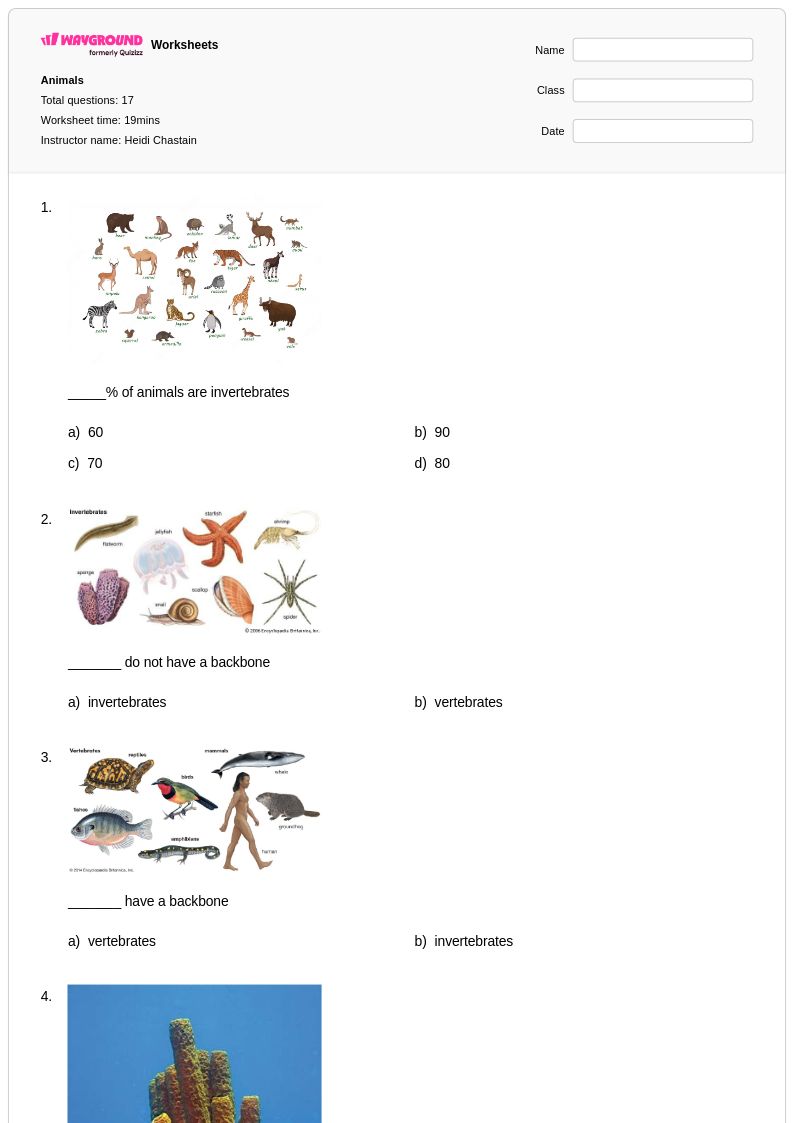
Animal communication worksheets for Class 3 students available through Wayground (formerly Quizizz) provide comprehensive exploration of how different species share information and interact with one another. These educational resources strengthen critical observation skills as young learners discover the fascinating ways animals use sounds, visual signals, body language, and chemical cues to survive and thrive in their environments. Students engage with practice problems that challenge them to identify various communication methods, from a bird's warning call to a bee's waggle dance, while developing scientific vocabulary and analytical thinking abilities. Each worksheet collection includes detailed answer keys and is available as free printables in convenient pdf format, making it simple for educators to incorporate hands-on learning activities that connect students with the natural world around them.
Wayground (formerly Quizizz) empowers teachers with access to millions of educator-created resources specifically designed to support Class 3 animal communication instruction across diverse classroom settings. The platform's robust search and filtering capabilities enable quick discovery of materials aligned with science standards, while built-in differentiation tools allow seamless customization for varying skill levels within the same classroom. Teachers can easily adapt worksheets for remediation support, enrichment challenges, or targeted skill practice, with flexible options available in both printable pdf formats for traditional learning and digital versions for technology-integrated instruction. These comprehensive planning resources streamline lesson preparation while ensuring students receive engaging, scientifically accurate content that builds foundational understanding of biological concepts and strengthens essential scientific inquiry skills.
FAQs
How do I teach animal communication in a biology class?
Start by grounding students in the four main channels of animal communication: chemical, visual, acoustic, and tactile. Use concrete examples like honeybee waggle dances for spatial signaling or dolphin echolocation for acoustic communication to make abstract mechanisms tangible. From there, connect each type to its evolutionary function, asking students why natural selection would favor one signal type over another in a given environment. This approach builds both content knowledge and scientific reasoning.
What exercises help students practice identifying types of animal communication?
Worksheet exercises that present real-world examples and ask students to classify the communication channel, identify the sender and receiver, and infer the adaptive purpose are highly effective. Practice problems that include data interpretation, such as analyzing a graph of bird call frequencies or reading a diagram of pheromone signaling pathways, push students beyond recall into evidence-based reasoning. These tasks mirror the analytical thinking required in AP Biology and advanced ecology coursework.
What mistakes do students commonly make when learning about animal communication?
A frequent misconception is that animal communication is intentional or conscious in the same way human language is. Students also tend to conflate signal with meaning, assuming every behavior is communicative rather than recognizing that true communication requires an evolved sender-receiver system with reliable information transfer. Another common error is treating animal communication as a single category rather than recognizing the distinct mechanisms, costs, and evolutionary pressures behind chemical, visual, acoustic, and tactile signals.
How can I differentiate animal communication worksheets for students with different learning needs?
On Wayground, teachers can apply individual accommodations directly to students, including Read Aloud for students who need text read to them, reduced answer choices to lower cognitive load for struggling learners, and extended time per question for students who need additional processing time. These settings can be configured per student and applied across multiple sessions, so differentiation does not require rebuilding assignments each time. Advanced students can be given the same content with full answer choices and higher-complexity analysis prompts, while the rest of the class works with default settings.
How do I use Wayground's animal communication worksheets in my classroom?
Wayground's animal communication worksheets are available as printable PDFs for traditional classroom use and in digital formats for technology-integrated environments, giving teachers flexibility based on their setup. Digital worksheets can also be hosted as a quiz directly on Wayground, enabling real-time student responses and instant feedback. All worksheets include complete answer keys, which reduces grading time and makes them practical for both in-class assignments and homework. Teachers can use Wayground's search and filtering tools to quickly find materials aligned to specific learning standards or biological concepts.
At what grade level should animal communication be taught in biology?
Animal communication is typically introduced in middle school life science and revisited in high school biology, particularly within units on animal behavior, ecology, and evolutionary adaptations. At the middle school level, instruction focuses on identifying types of signals and their purposes, while high school courses engage students in analyzing the evolutionary origins and fitness consequences of communication systems. The topic also appears in AP Biology and introductory college-level ecology courses, where students examine communication in the context of natural selection and population dynamics.