Explore Class 3 plankton worksheets and free printables from Wayground that help students discover microscopic marine life through engaging practice problems and activities with complete answer keys.
Class 3 plankton worksheets available through Wayground (formerly Quizizz) introduce young learners to the fascinating microscopic world that forms the foundation of aquatic ecosystems. These educational resources help students understand what plankton are, distinguish between phytoplankton and zooplankton, and explore how these tiny organisms serve as crucial food sources for larger marine animals. The worksheets strengthen essential scientific observation skills, vocabulary development, and basic ecological understanding through engaging activities that make abstract concepts accessible to elementary students. Teachers can access comprehensive materials including detailed answer keys, free printable resources in convenient pdf format, and carefully designed practice problems that reinforce key learning objectives about these vital microscopic life forms.
Wayground's extensive collection draws from millions of teacher-created resources specifically designed to support Class 3 biology instruction focused on plankton and marine ecosystems. The platform's robust search and filtering capabilities enable educators to quickly locate age-appropriate materials that align with elementary science standards, while built-in differentiation tools allow for seamless adaptation of content to meet diverse learning needs within the classroom. Teachers benefit from flexible customization options that support both digital instruction and traditional printable worksheets, making it effortless to incorporate plankton studies into lesson planning, targeted remediation sessions, enrichment activities, and regular skill practice. These comprehensive resources ensure that educators have immediate access to high-quality materials that effectively communicate complex biological concepts in ways that resonate with third-grade students' developmental understanding.
FAQs
How do I teach students the difference between phytoplankton and zooplankton?
Start by grounding students in the producer-consumer distinction: phytoplankton are photosynthetic organisms that convert sunlight into energy, while zooplankton are heterotrophs that consume other organisms. A useful classroom approach is to have students sort examples by whether they produce or consume energy, then connect each group to its role in the marine food web. Visual comparisons using labeled diagrams help reinforce the structural and functional differences between the two.
What exercises help students practice understanding plankton's role in aquatic food webs?
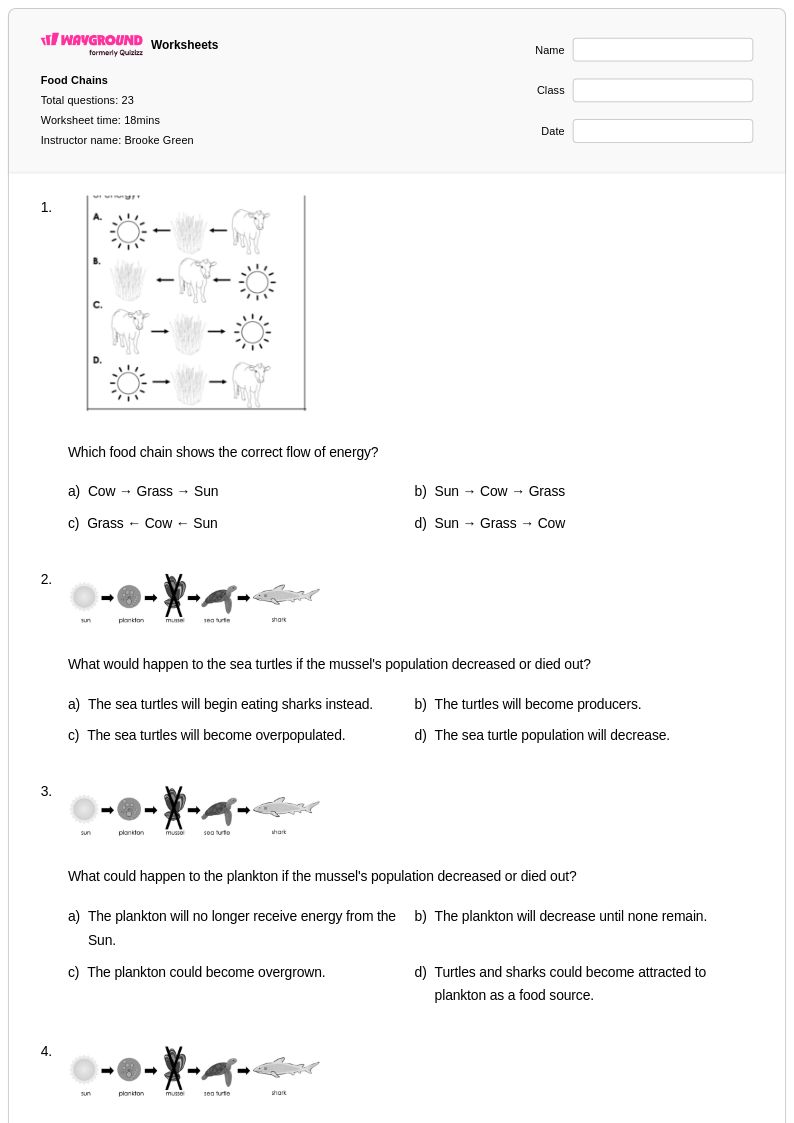
Food web mapping exercises are especially effective — students trace energy flow from phytoplankton as primary producers through zooplankton to higher consumers, identifying dependencies at each trophic level. Practice problems that ask students to predict what happens to a food web when plankton populations change help build systems-level thinking. Worksheets that pair these scenarios with written explanation prompts also strengthen scientific reasoning alongside content knowledge.
What common mistakes do students make when learning about plankton?
A frequent misconception is that plankton refers to a single type of organism rather than a functional category defined by how organisms move — drifting with currents rather than swimming independently. Students also commonly confuse phytoplankton with aquatic plants, missing the distinction that phytoplankton are primarily single-celled algae and cyanobacteria. Another error is underestimating plankton's ecological scale; students often struggle to connect microscopic organisms to global processes like oxygen production and climate regulation.
How does plankton connect to topics like photosynthesis and climate change?
Phytoplankton perform roughly half of all photosynthesis on Earth, making them a critical entry point for teaching both the carbon cycle and oxygen production at a planetary scale. When teaching climate change, plankton population data gives students a concrete, measurable indicator of ocean health and temperature shifts. Connecting these threads helps students see plankton not as an isolated biology topic but as a keystone concept that links marine ecosystems to broader Earth systems science.
How do I use Wayground's plankton worksheets in my classroom?
Wayground's plankton worksheets are available as printable PDFs for traditional classroom use and in digital formats for technology-integrated or remote learning environments. Teachers can also host them as a quiz directly on Wayground, which allows for real-time progress tracking and immediate student feedback. All worksheets include complete answer keys, making them practical for independent practice, formative assessment, or guided review sessions.
How can I differentiate plankton instruction for students at different levels?
For students who need additional support, Wayground's platform offers accommodations including Read Aloud for audio delivery of questions, reduced answer choices to lower cognitive load, and extended time settings that can be configured per student. Advanced learners can be challenged with open-ended problems that ask them to analyze relationships between plankton adaptations and environmental pressures such as nutrient availability or water temperature. These accommodations can be assigned individually so that each student's experience is tailored without disrupting the rest of the class.