Free Printable Directional Concepts Worksheets for Kindergarten
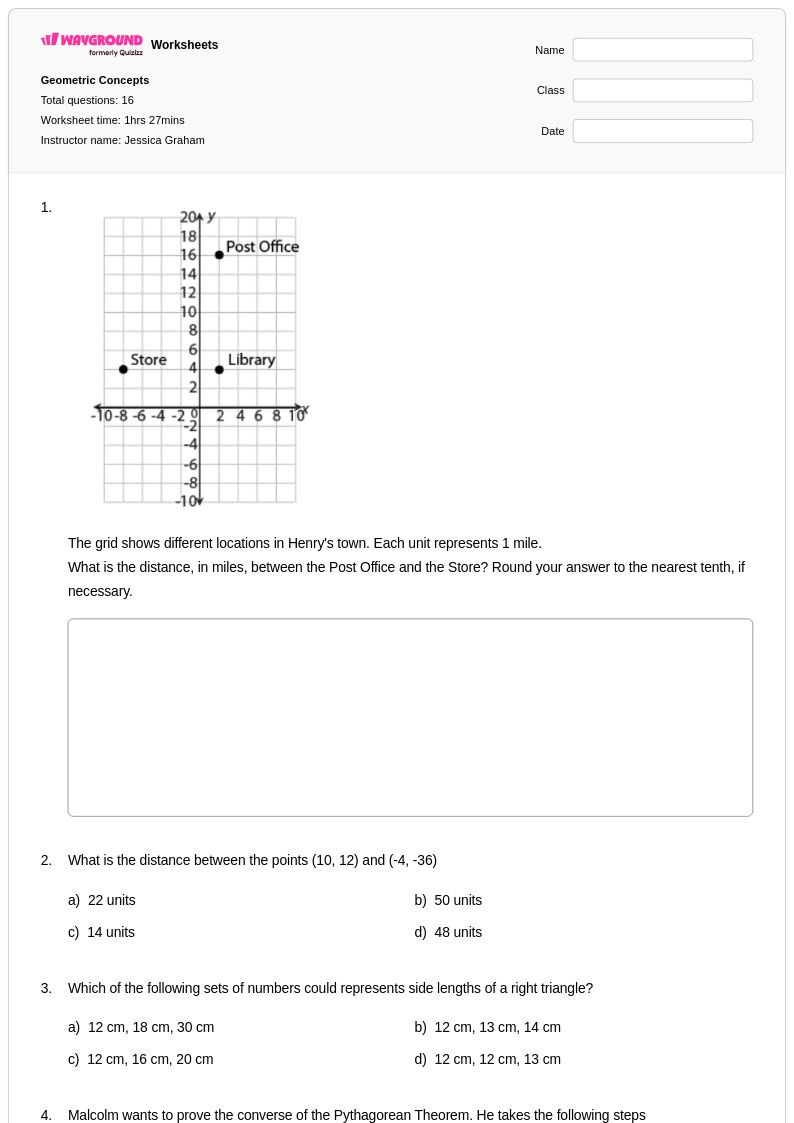
Wayground's free kindergarten directional concepts worksheets provide printable PDF practice problems with answer keys to help young students master spatial vocabulary like up, down, left, right, and positional relationships through engaging activities.
Explore printable Directional Concepts worksheets for Kindergarten
Directional concepts worksheets for kindergarten students through Wayground (formerly Quizizz) provide foundational geometry skills that help young learners understand spatial relationships and positional vocabulary. These carefully designed practice problems introduce essential directional terms such as up, down, left, right, above, below, in front of, and behind through engaging visual activities and age-appropriate exercises. Students strengthen their spatial reasoning abilities while developing critical mathematical vocabulary that serves as building blocks for more advanced geometry concepts. Each worksheet collection includes comprehensive answer keys and is available as free printables in convenient pdf format, making it simple for educators to incorporate directional concept practice into daily math instruction.
Wayground (formerly Quizizz) supports kindergarten teachers with an extensive library of millions of teacher-created directional concepts resources that can be easily searched and filtered to match specific classroom needs and learning objectives. The platform's robust differentiation tools allow educators to customize worksheets for various skill levels, ensuring that both struggling learners and advanced students receive appropriate challenges in mastering spatial relationships. Standards alignment features help teachers connect directional concept activities to curriculum requirements, while the flexible availability of materials in both printable and digital pdf formats accommodates diverse teaching preferences and classroom technology setups. These comprehensive resources streamline lesson planning while providing targeted options for remediation, enrichment, and systematic skill practice that builds kindergarten students' geometric understanding.
FAQs
How do I teach directional concepts to kindergarteners?
Kindergarteners learn directional language best through movement before paper. Have students physically act out up/down and left/right, then connect those actions to objects in the room ('put the block above the box'). Visual activities with familiar characters or animals work well for introducing above, below, in front of, and behind — young learners anchor abstract terms to pictures far more readily than to definitions.
What exercises help kindergarten students practice directional concepts?
Picture-based activities are the right format at this age: show a scene and ask where the dog is relative to the fence, or which animal is behind the tree. Simple follow-the-direction tasks — draw a circle above the star — build both vocabulary and fine motor skills at once. Avoid text-heavy problems; the spatial reasoning is the target, not reading.
What mistakes do kindergarteners commonly make with directional concepts?
Left and right are the hardest pair at this age — many kindergarteners won't reliably distinguish them until mid-to-late first grade, so don't treat persistent confusion there as a red flag. More addressable errors include mixing up 'above' and 'in front of' when a picture has depth, and reversing 'behind' depending on which way a character faces. Using consistent, simple scenes (no perspective shifts) reduces these errors significantly.
How do I use Wayground's kindergarten directional concepts worksheets?
The worksheets are available as printable PDFs with a complete answer key included — print and go for morning work, centers, or homework. For schools managing screen time, paper practice is a natural fit at the kindergarten level. If you do want a digital option, you can host the same worksheet as an interactive quiz on Wayground for whole-class or small-group use on devices.
Are kindergarten directional concepts worksheets aligned to Common Core?
Common Core introduces geometry in kindergarten with a focus on describing the positions and locations of shapes and objects using positional words. Directional concepts — above, below, beside, in front of, behind — are the vocabulary layer that makes that description possible. Mastering these terms in kindergarten sets students up for Grade 1 work on defining and composing shapes, where spatial language becomes essential for explaining relationships between figures.
How can I support kindergarteners with different learning needs on directional concepts?
For students who are still developing print awareness, the Read Aloud feature reads questions aloud so the task stays focused on spatial reasoning rather than decoding. For students who need visual simplicity, Wayground lets you increase font size or apply wider spacing to reduce clutter on the page. These adjustments can be made per student, so the rest of the class works from the standard version without any disruption.