Free Printable Elastic Collisions and Conservation of Momentum worksheets
Explore Wayground's free elastic collisions and conservation of momentum worksheets featuring practice problems and answer keys to help students master physics concepts through comprehensive printable PDFs and interactive exercises.
Explore printable Elastic Collisions and Conservation of Momentum worksheets
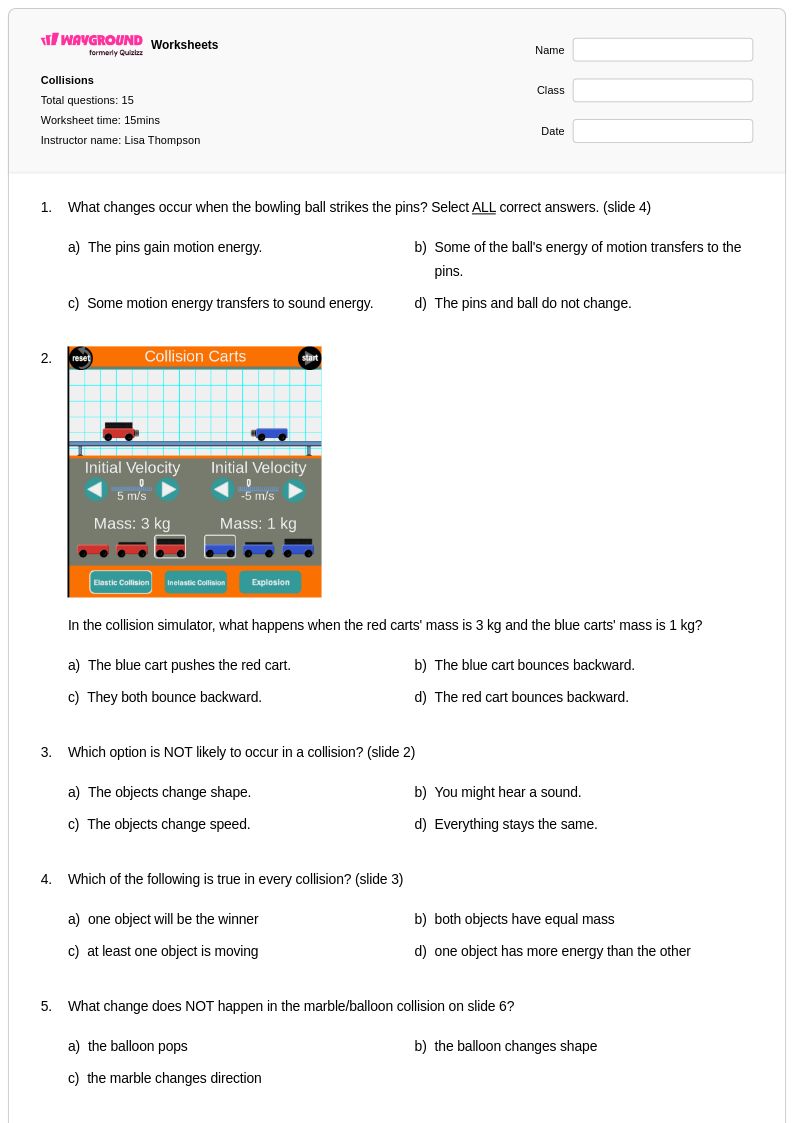
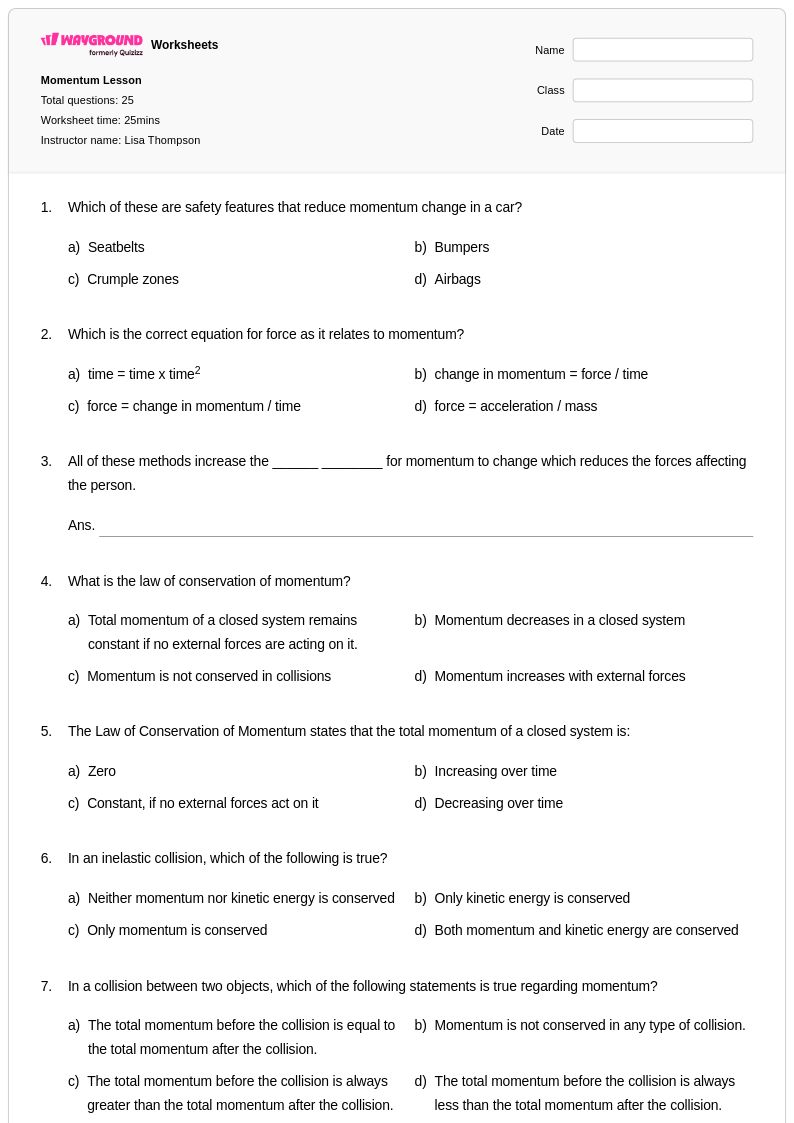
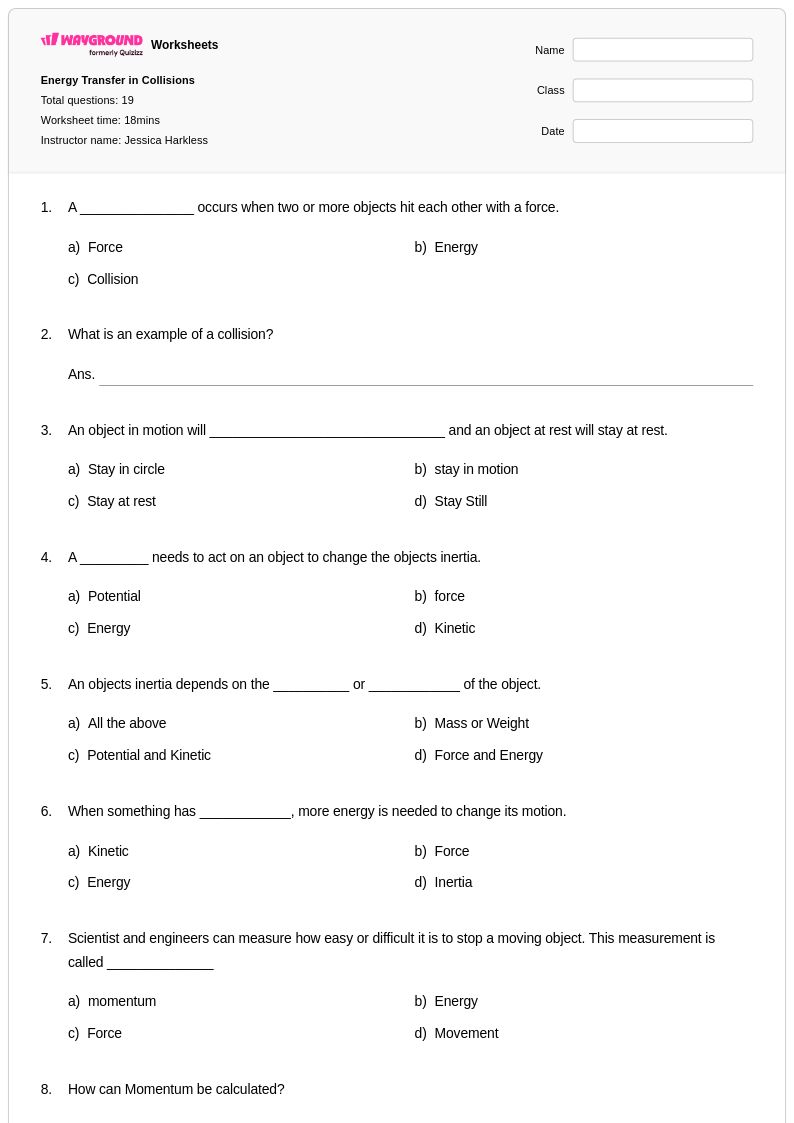
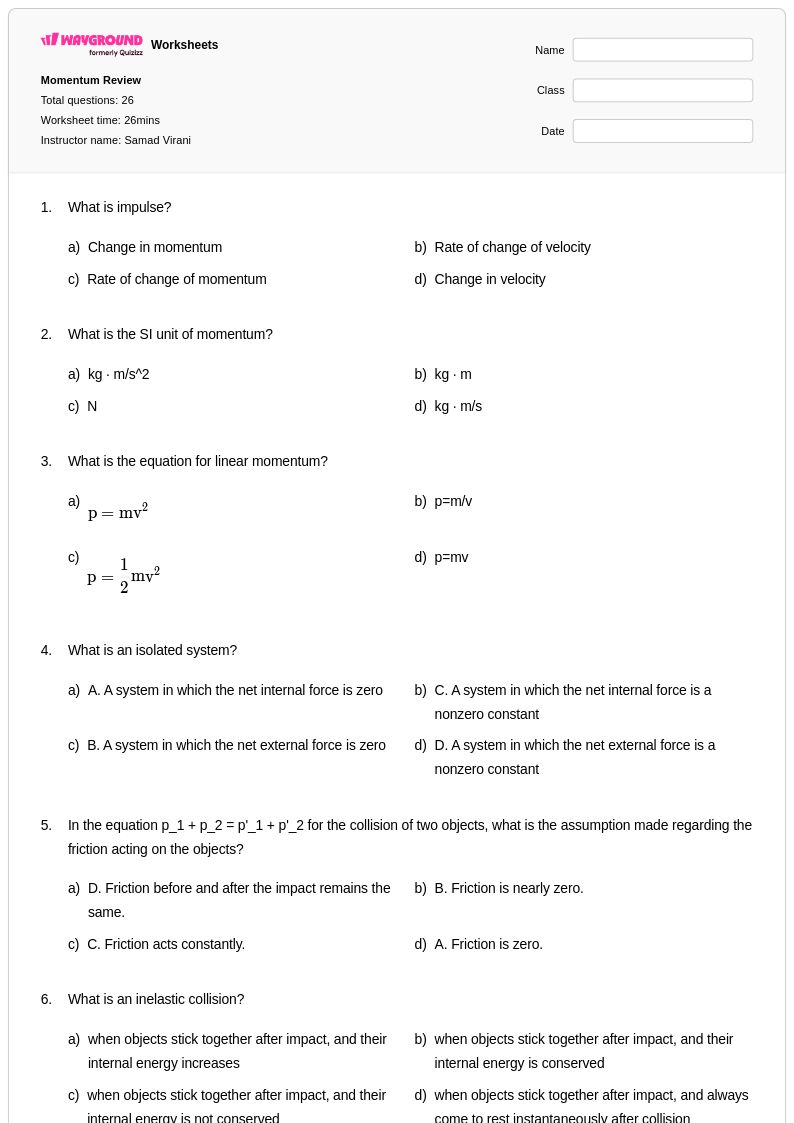
Elastic collisions and conservation of momentum worksheets available through Wayground (formerly Quizizz) provide comprehensive practice materials that help students master the fundamental principles governing collision dynamics in physics. These carefully crafted resources focus on developing students' ability to analyze perfectly elastic collisions where both kinetic energy and momentum are conserved, enabling learners to solve complex problems involving velocity calculations, mass relationships, and energy transfers. The worksheets strengthen critical problem-solving skills through systematic practice problems that range from simple two-object collisions to more sophisticated scenarios involving multiple particles and vector components. Each worksheet comes with a detailed answer key that guides students through step-by-step solutions, while the free printable pdf format ensures accessibility for both classroom instruction and independent study sessions.
Wayground (formerly Quizizz) supports physics educators with an extensive collection of millions of teacher-created resources specifically designed for elastic collision and momentum conservation instruction. The platform's robust search and filtering capabilities allow teachers to quickly locate worksheets that align with specific learning standards and match their students' proficiency levels, while built-in differentiation tools enable seamless customization for diverse learning needs. These flexible resources are available in both printable and digital formats, including downloadable pdf versions that facilitate easy distribution and implementation across various teaching environments. The comprehensive worksheet collections serve multiple instructional purposes, from initial concept introduction and guided practice to targeted remediation for struggling students and enrichment activities for advanced learners, making lesson planning more efficient and effective for physics educators at all levels.
FAQs
How do I teach elastic collisions and conservation of momentum in physics?
Start by establishing the two conditions that define an elastic collision: total momentum is conserved and total kinetic energy is conserved. Use concrete, low-friction demonstrations such as air track carts or Newton's cradle to give students a physical intuition before introducing the algebraic equations. From there, scaffold problem-solving by beginning with equal-mass collisions before moving to unequal masses and multi-object scenarios.
What practice problems help students master elastic collisions and momentum conservation?
Effective practice problems for elastic collisions should progress from straightforward two-object, one-dimensional scenarios to problems that require students to apply both the conservation of momentum equation and the conservation of kinetic energy equation simultaneously. Including problems that vary mass ratios and initial velocities builds flexibility in student thinking. Problems that require students to verify energy conservation after solving for final velocities are especially useful for reinforcing the distinction between elastic and inelastic collisions.
What mistakes do students commonly make when solving elastic collision problems?
The most frequent error is applying only the conservation of momentum equation and ignoring the conservation of kinetic energy condition, which is what distinguishes elastic collisions from inelastic ones. Students also commonly mishandle signs when dealing with objects moving in opposite directions, leading to incorrect velocity values. Another frequent mistake is assuming that objects must come to rest or exchange velocities in all elastic collisions, which only holds true when the two objects have equal masses.
How is elastic collision different from inelastic collision, and how do I explain this to students?
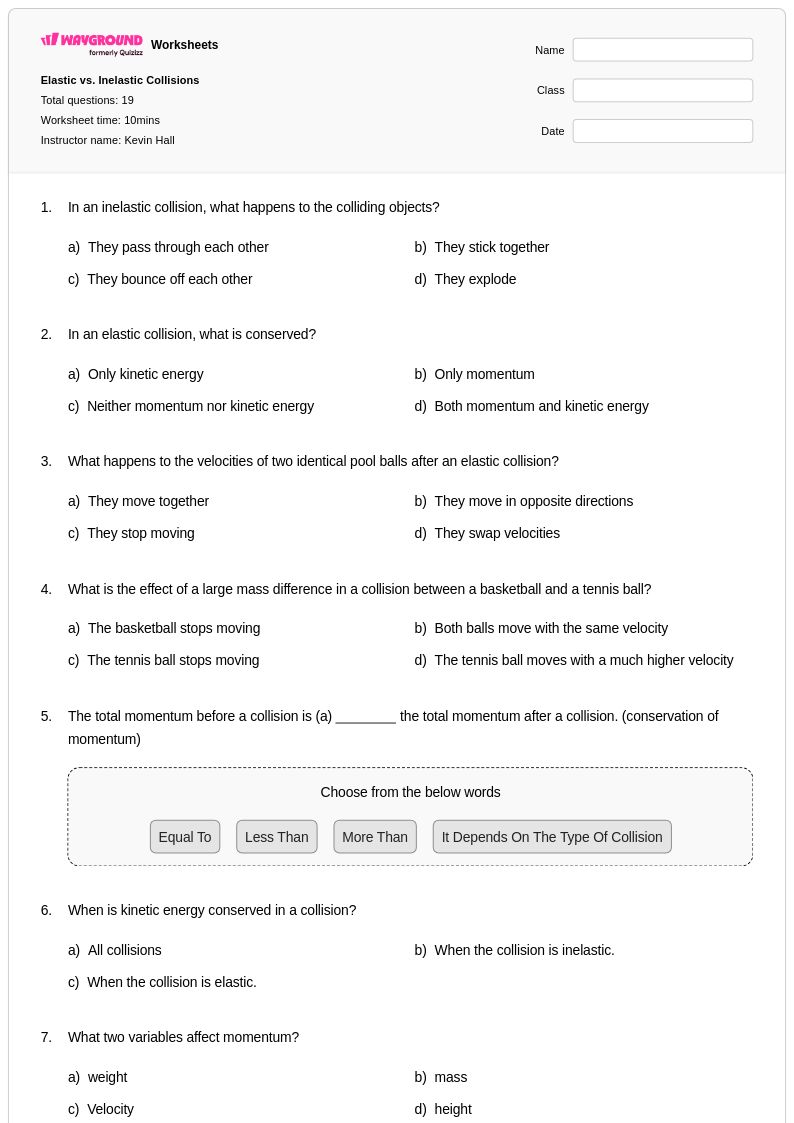
In an elastic collision, both momentum and kinetic energy are conserved, meaning no energy is lost to heat, sound, or deformation. In an inelastic collision, momentum is still conserved but kinetic energy is not — some energy is converted into other forms. A helpful classroom framing is to tell students that perfectly elastic collisions are idealized models: real-world collisions between billiard balls or gas molecules come close, but true elastic collisions are a theoretical construct used to build problem-solving foundations in physics.
How can I differentiate elastic collision worksheets for students at different skill levels?
For students who are still building fluency, start with problems where one object is initially at rest, which simplifies the algebra considerably. More advanced students can work through two-dimensional collision problems that require vector decomposition. On Wayground, teachers can apply individual accommodations such as reduced answer choices or read-aloud support to specific students, while the rest of the class receives standard settings, making it straightforward to run differentiated practice within a single session.
How do I use Wayground's elastic collision worksheets in my physics class?
Wayground's elastic collision and conservation of momentum worksheets are available as printable PDFs for traditional classroom use and in digital formats for technology-integrated environments, including the option to host them as a quiz directly on Wayground. Each worksheet includes a complete answer key, so teachers can use them for guided practice, independent work, or remediation without additional preparation. The platform's filtering tools allow teachers to find worksheets matched to specific learning standards and student proficiency levels.