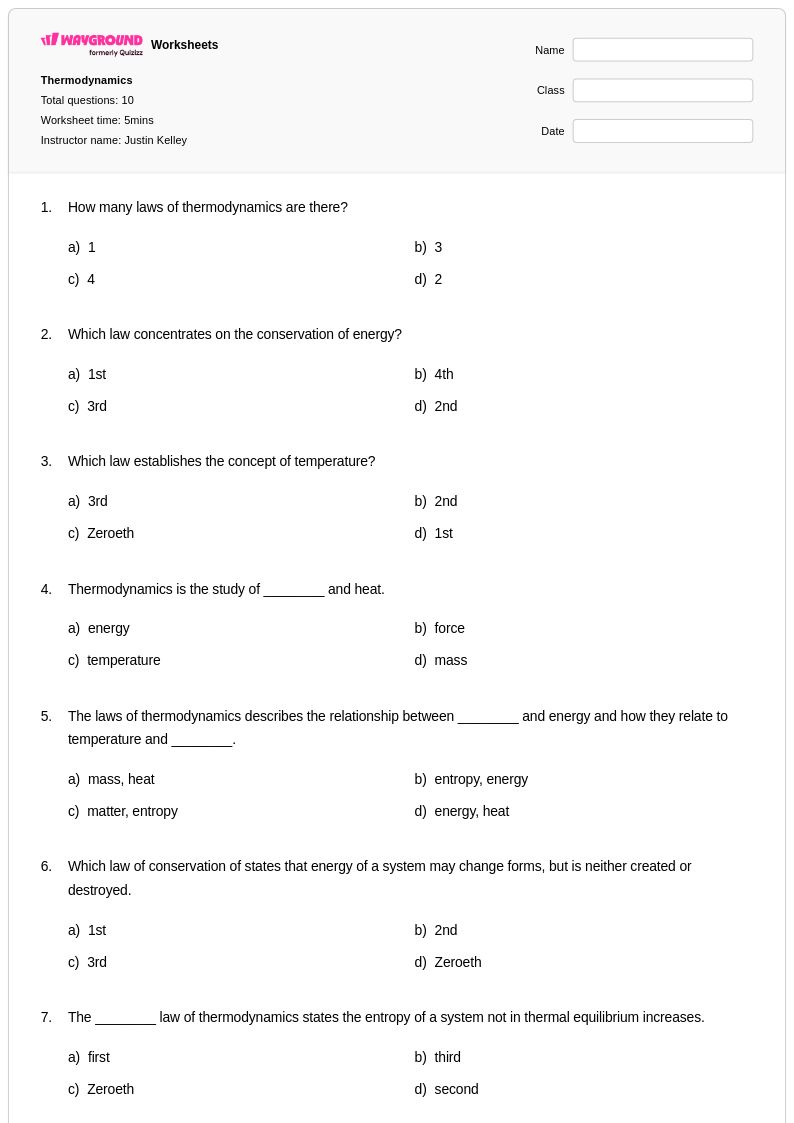
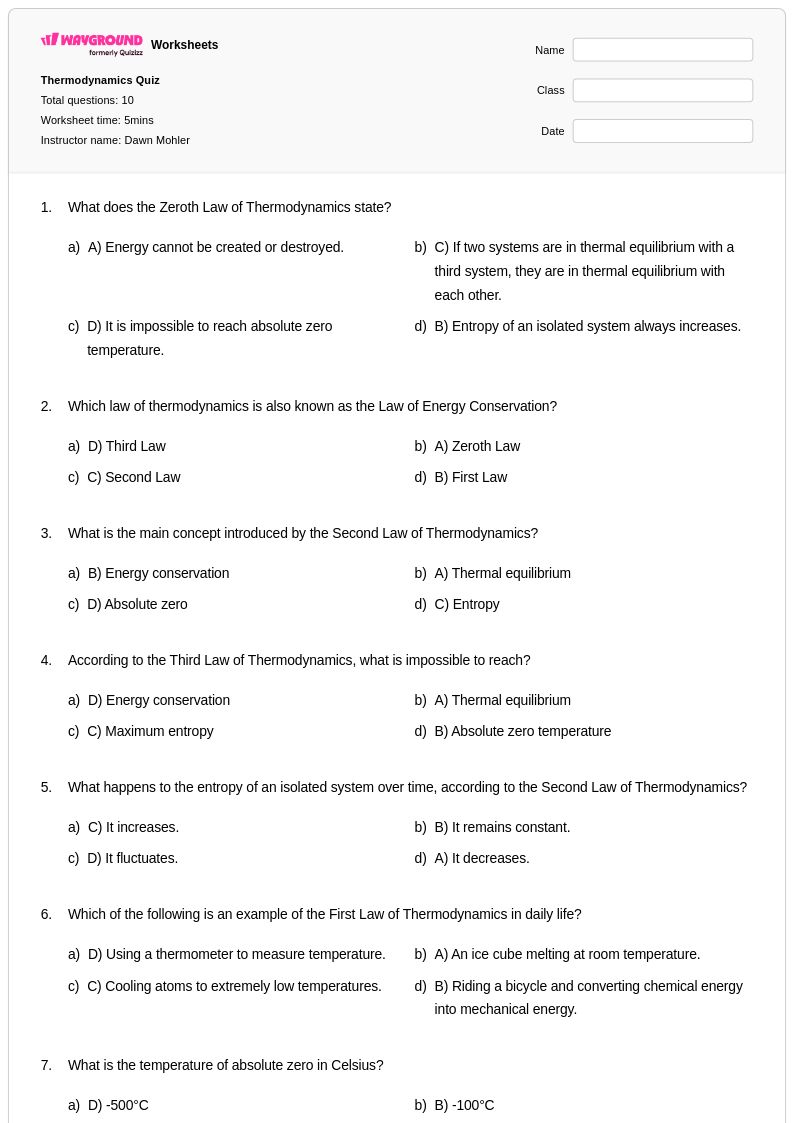
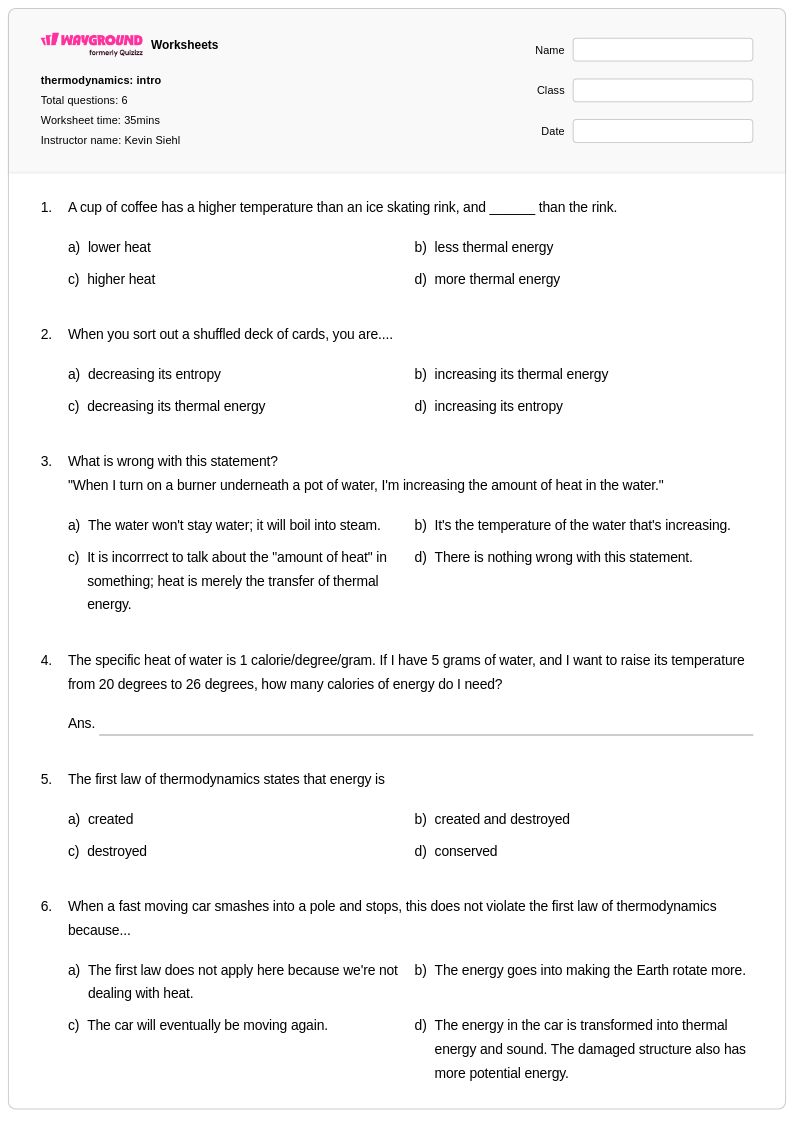
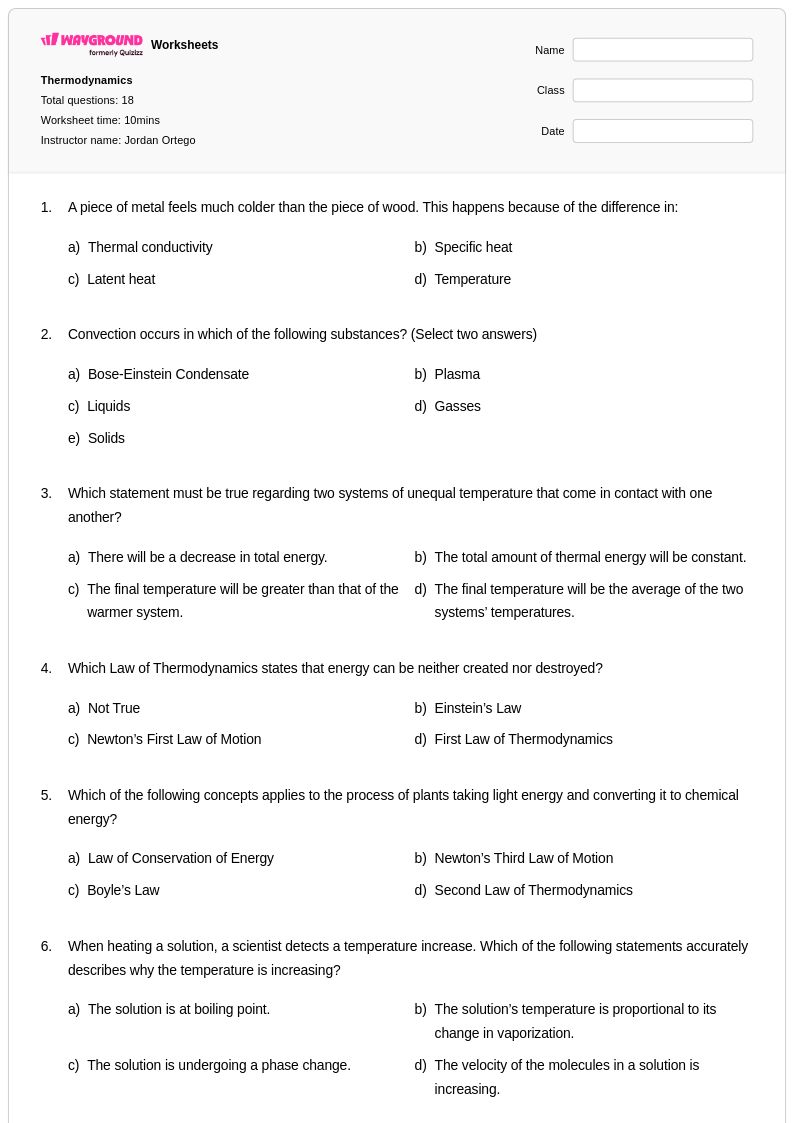
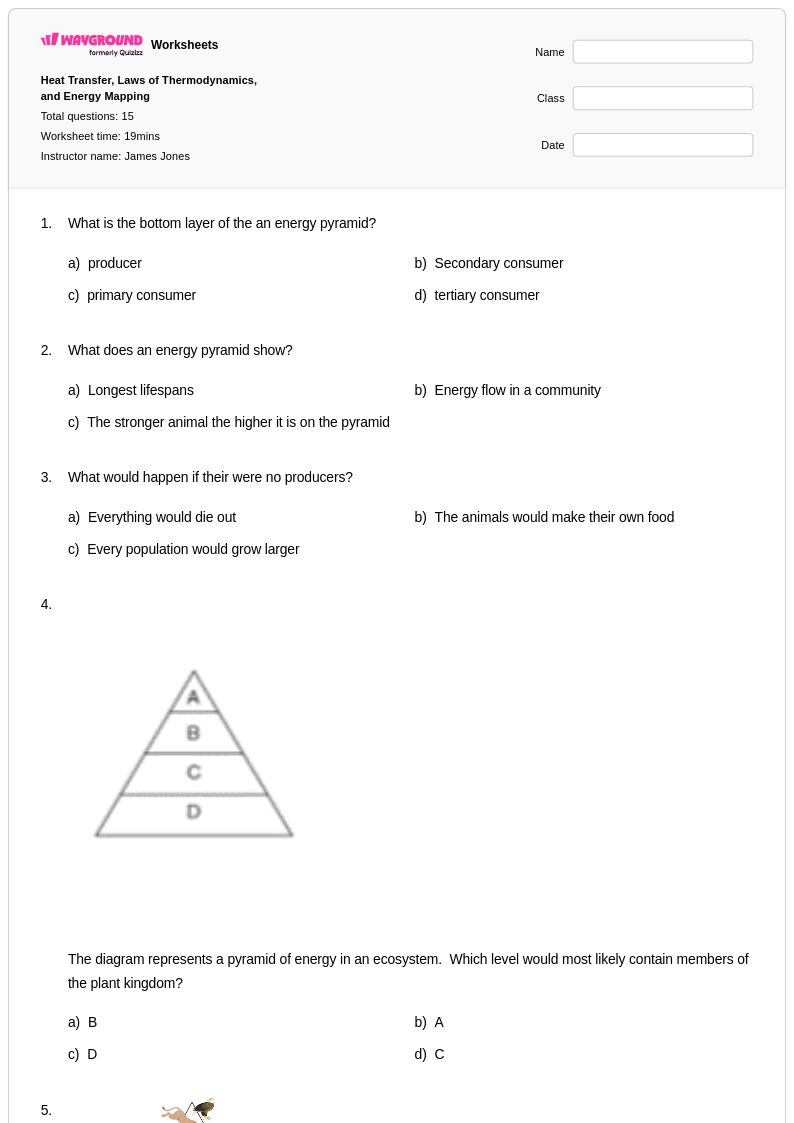
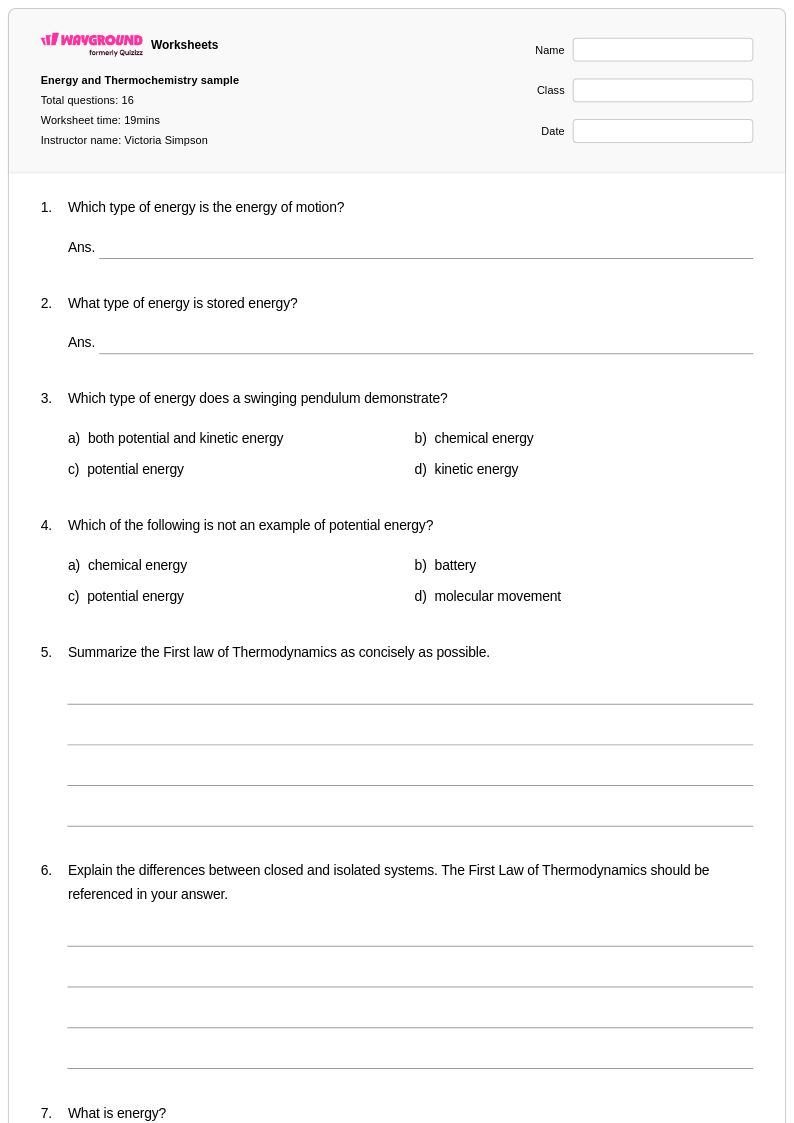
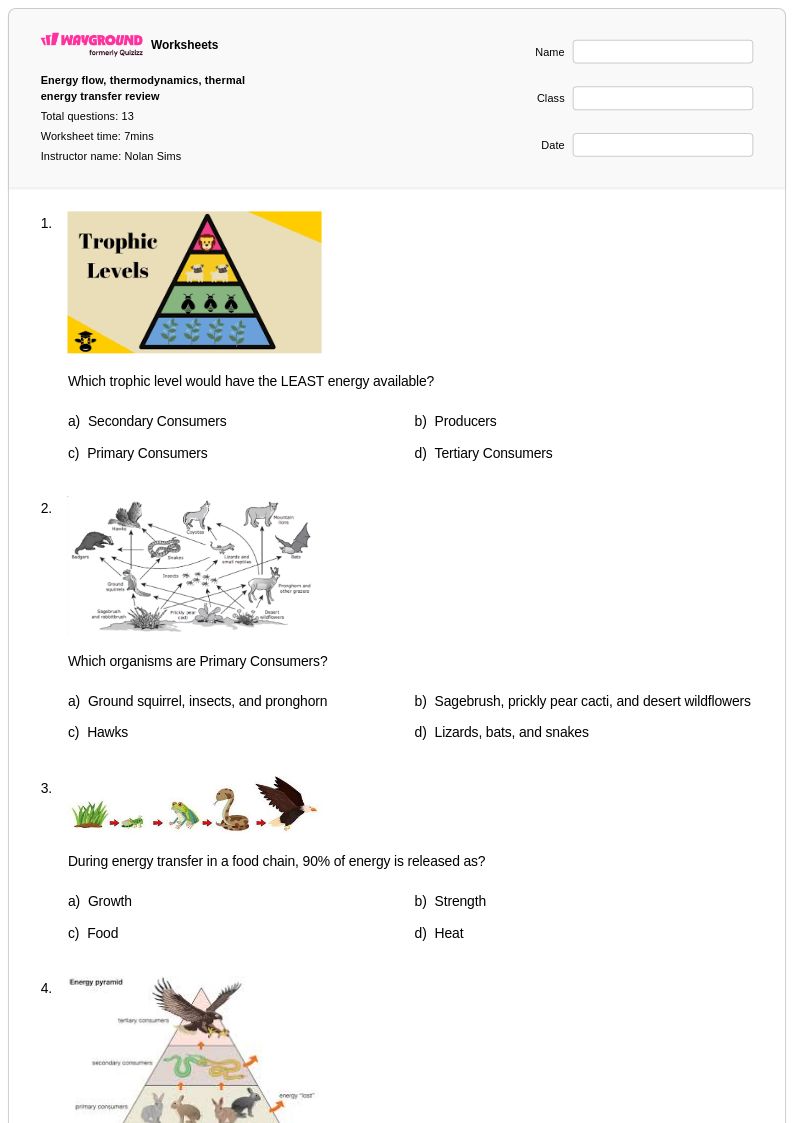
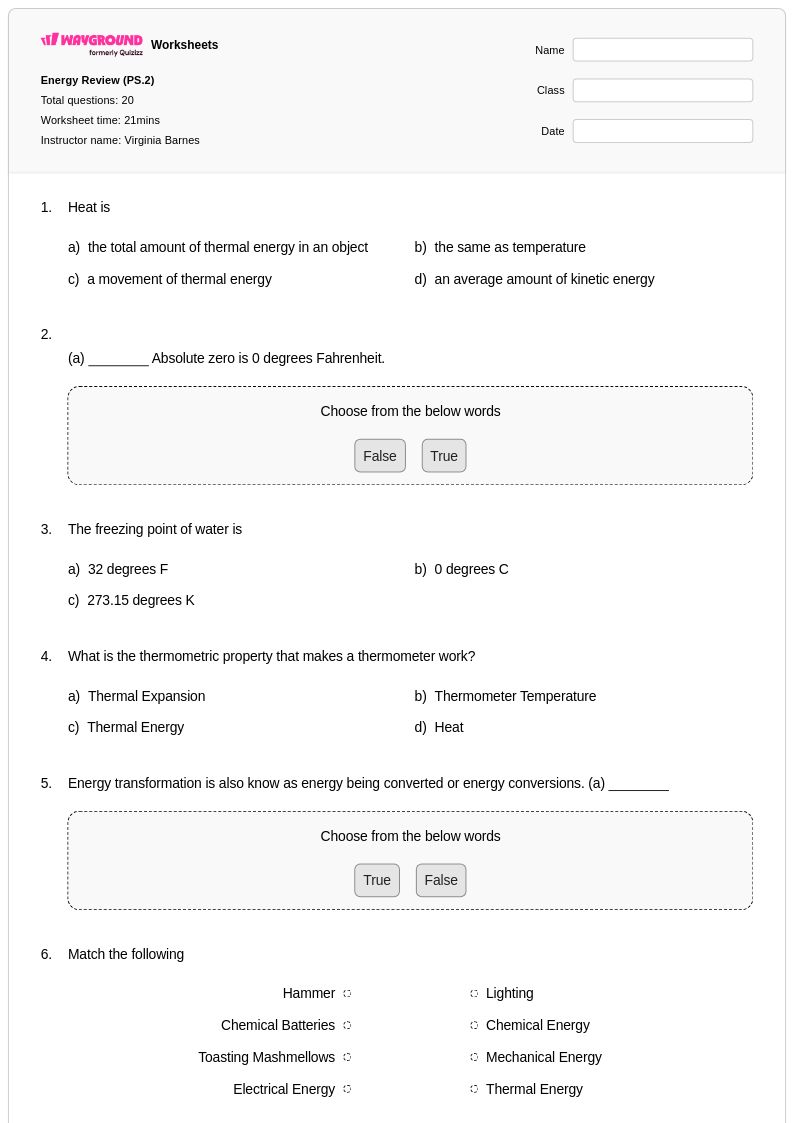
Explore Wayground's comprehensive collection of thermodynamics worksheets featuring free printables, practice problems, and answer keys to help students master heat transfer, energy conversion, and thermal processes in physics.
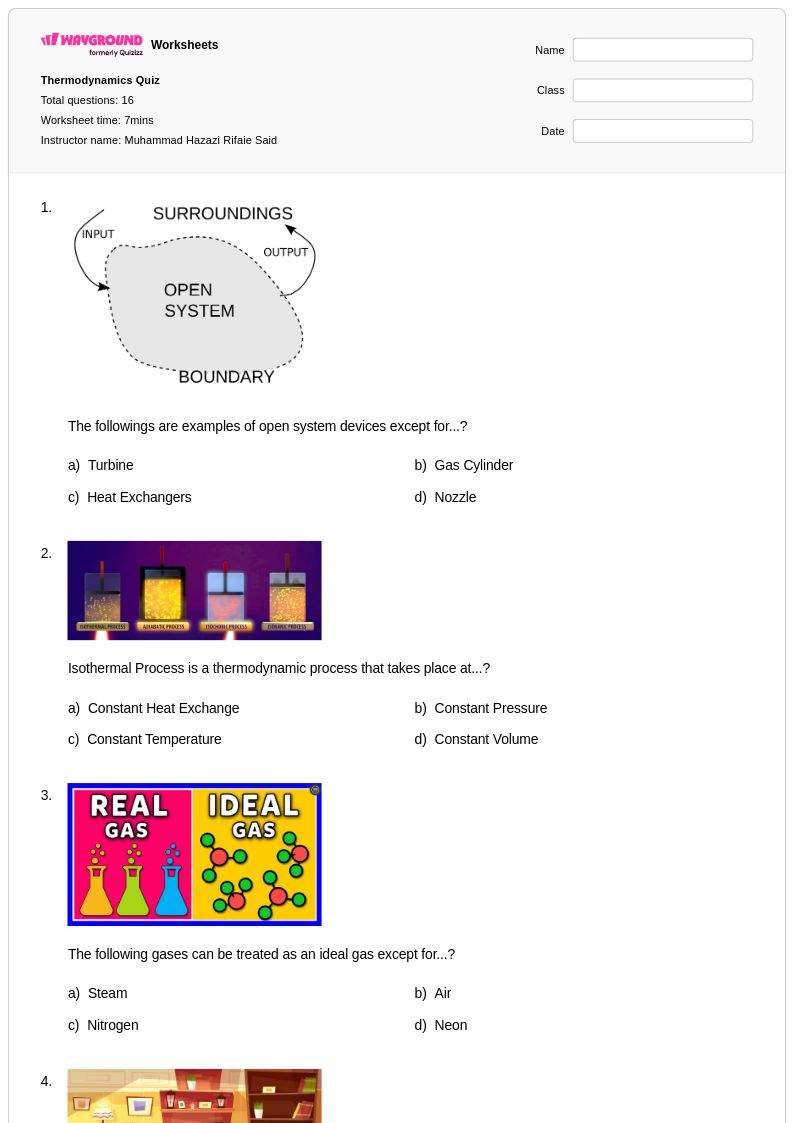
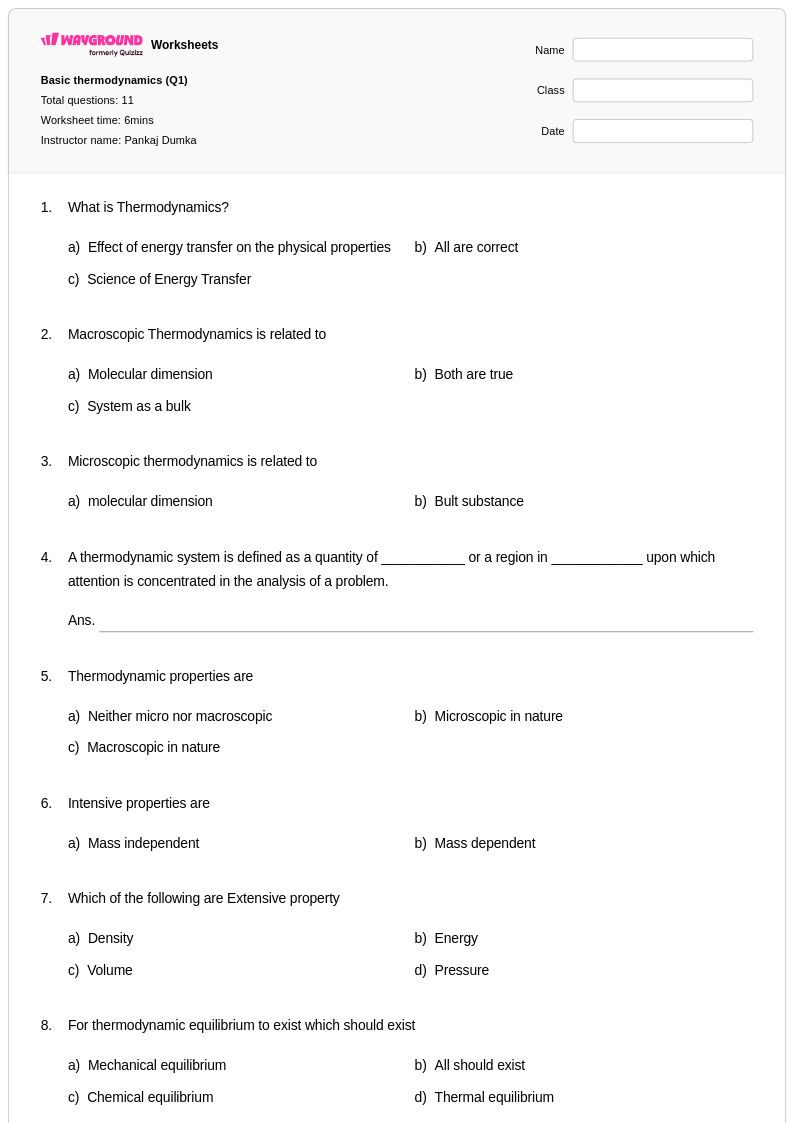
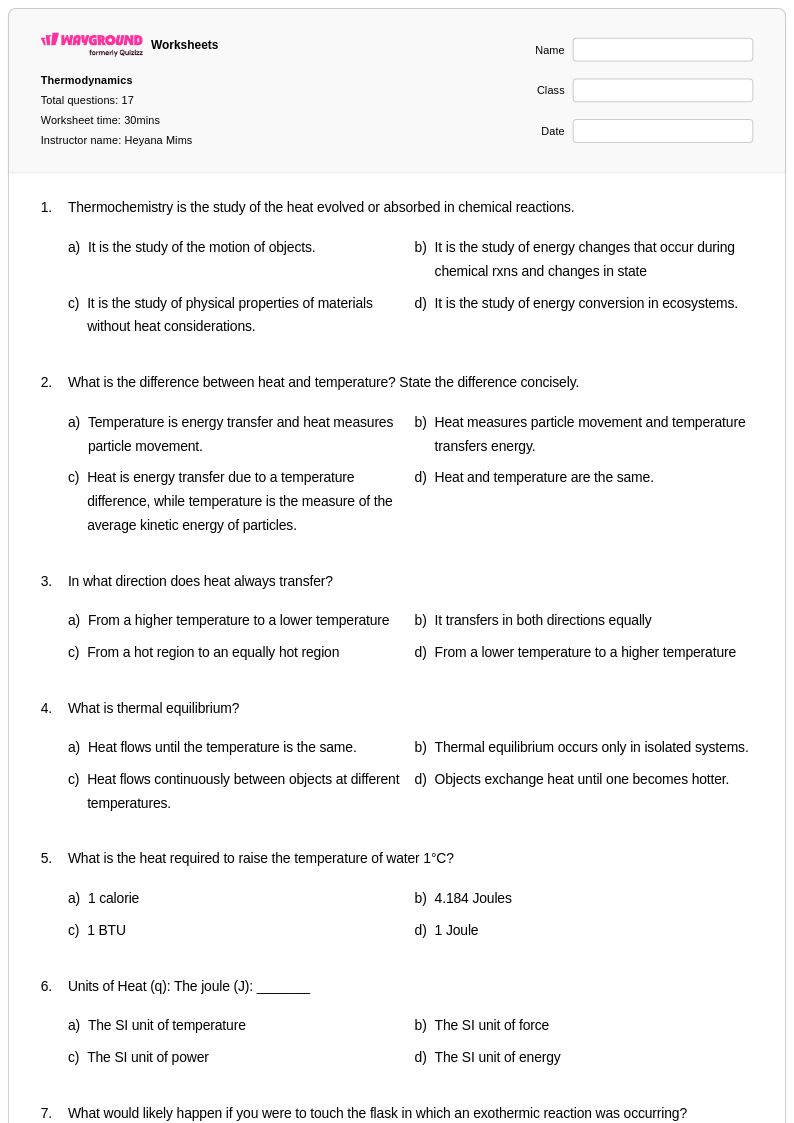
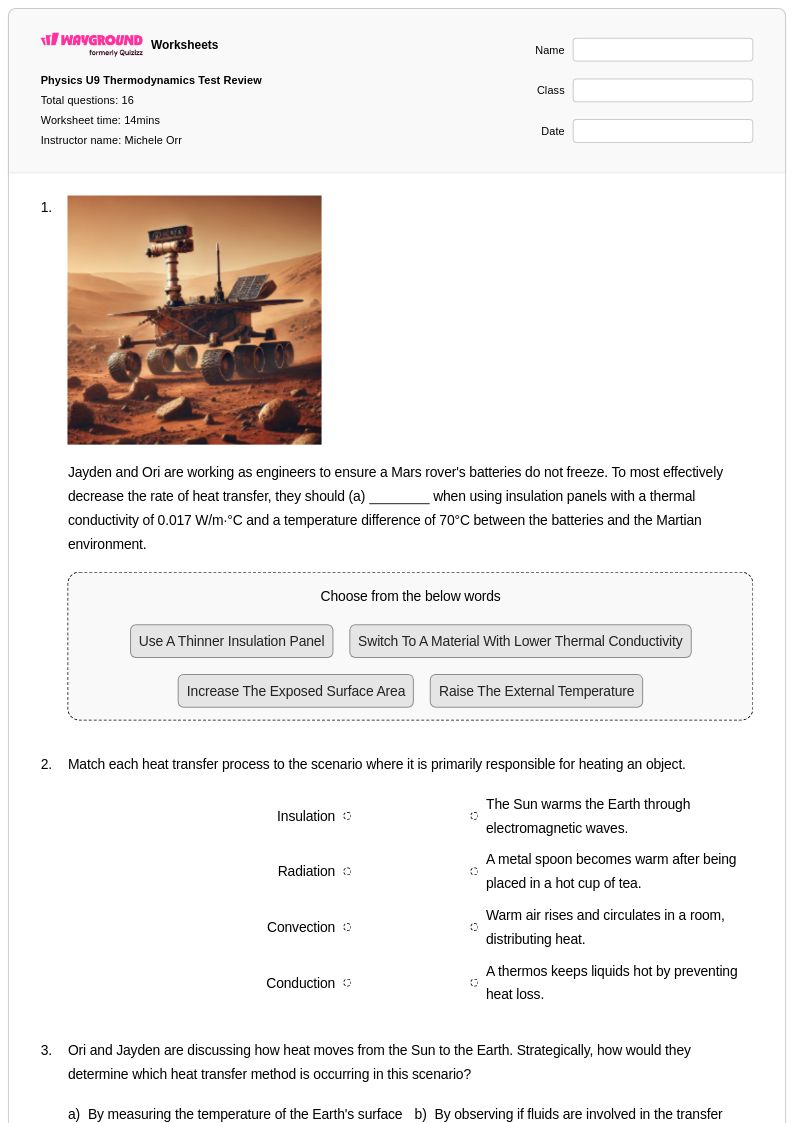
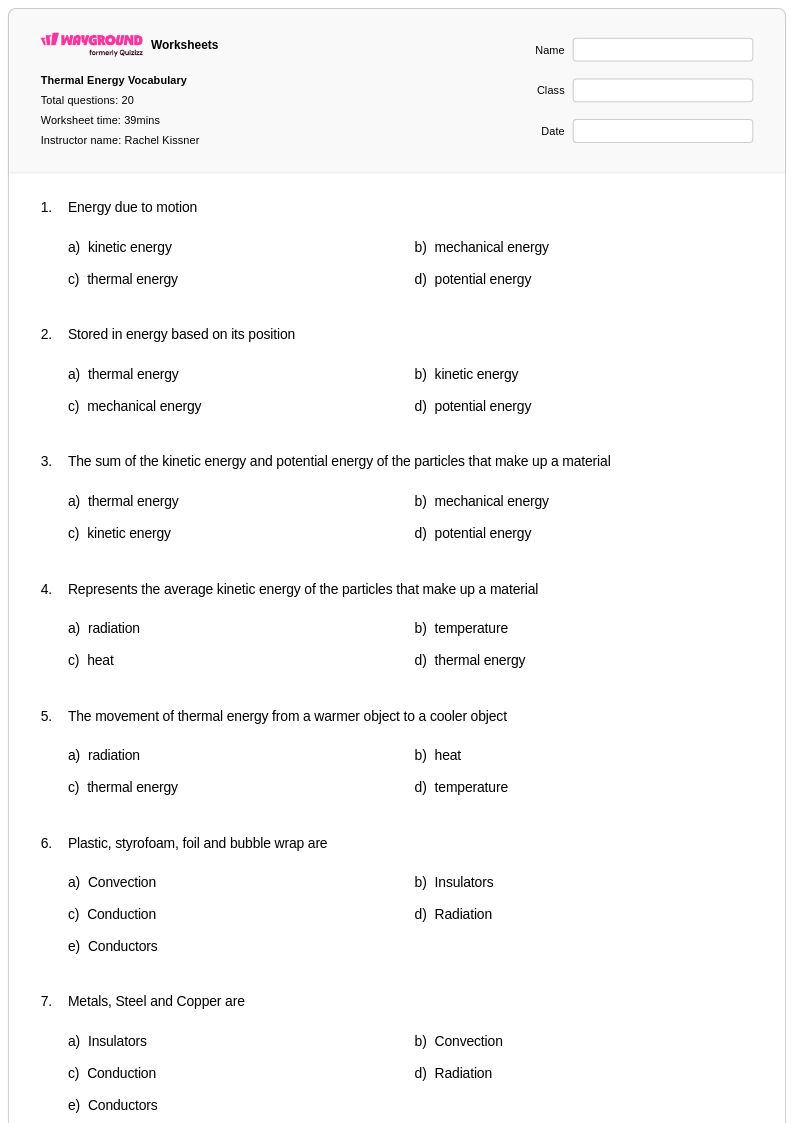
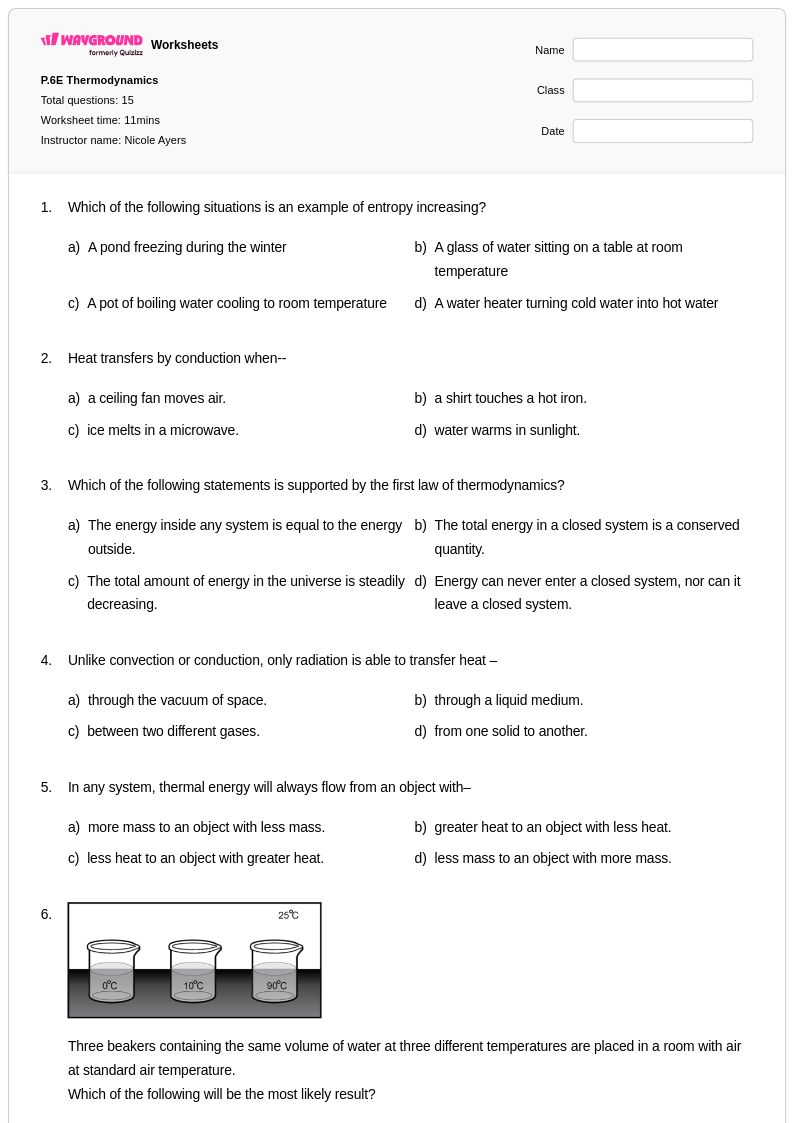
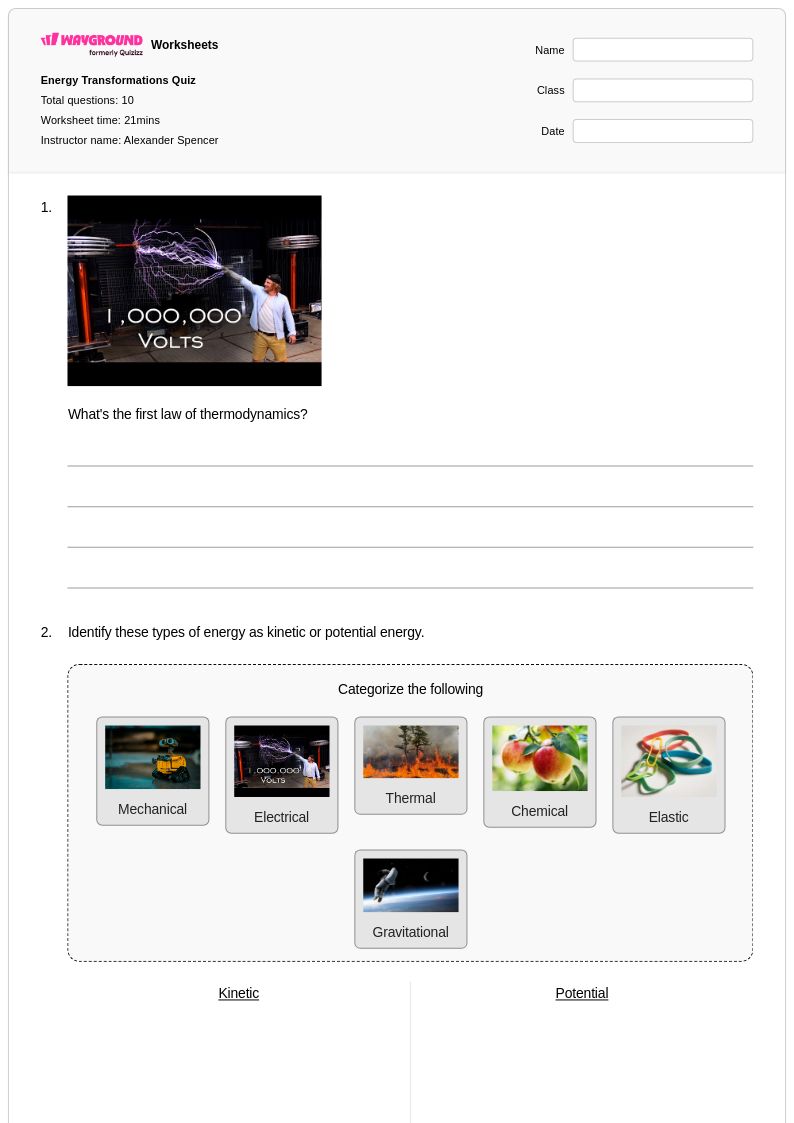
Thermodynamics worksheets available through Wayground (formerly Quizizz) provide comprehensive coverage of heat transfer, energy transformations, and the fundamental laws governing thermal systems. These expertly crafted resources strengthen students' understanding of critical concepts including entropy, enthalpy, specific heat capacity, and the relationships between temperature, pressure, and volume in various thermodynamic processes. The collection encompasses practice problems that challenge learners to apply the first and second laws of thermodynamics, analyze heat engines and refrigeration cycles, and calculate energy changes in both closed and open systems. Each worksheet includes detailed answer keys that facilitate self-assessment and guided learning, while the free printable format ensures accessibility for diverse classroom environments and individual study sessions.
Wayground's extensive thermodynamics worksheet collection draws from millions of teacher-created resources, offering educators powerful search and filtering capabilities to locate materials precisely aligned with their curriculum standards and learning objectives. The platform's robust differentiation tools enable teachers to customize worksheets based on student ability levels, while flexible formatting options provide both printable PDF versions for traditional classroom use and digital formats for interactive learning experiences. These comprehensive resources support effective lesson planning by offering varied problem types for initial instruction, targeted practice for skill reinforcement, and advanced applications for enrichment activities. Teachers can seamlessly integrate these materials into their remediation strategies, using the diverse question formats and difficulty levels to address individual learning gaps and accelerate student mastery of complex thermodynamic principles.
FAQs
How do I teach the laws of thermodynamics to high school physics students?
Start with the zeroth and first laws before introducing entropy and the second law, since students need a concrete understanding of energy conservation before grappling with disorder. Use real-world examples like heat engines, refrigerators, and metabolic processes to ground abstract principles. Structured practice problems that move from single-step calculations to multi-step system analyses help students build procedural fluency alongside conceptual understanding.
What types of practice problems help students master thermodynamics?
Effective thermodynamics practice should span multiple problem types: calculating heat transfer using Q = mcΔT, applying the first law to closed and open systems, analyzing pressure-volume work, and interpreting PV diagrams for processes like isothermal, adiabatic, and isobaric changes. Problems that require students to connect energy changes to entropy help reinforce the second law. Scaffolded problem sets that increase in complexity give students the repetition needed to internalize formulas and reasoning strategies.
What mistakes do students commonly make when solving thermodynamics problems?
One of the most common errors is sign convention confusion — students frequently misapply the sign of work or heat, especially when distinguishing between work done on a system versus by a system. Another persistent mistake is conflating temperature and heat, treating them as interchangeable rather than understanding that heat is energy transfer and temperature is a measure of average kinetic energy. Students also struggle with entropy, often assuming any spontaneous process must release heat rather than understanding that entropy change drives spontaneity.
How do I differentiate thermodynamics instruction for students at different ability levels?
For students who need additional support, reduce problem complexity by isolating single variables before combining laws, and use visual tools like PV diagrams and energy flow charts to make abstract processes concrete. For advanced students, introduce heat engine efficiency problems, Carnot cycle analysis, and multi-step open-system calculations. On Wayground, teachers can apply accommodations such as read aloud support, reduced answer choices, and extended time on a per-student basis, so differentiated instruction can be delivered within the same assignment without singling out individual students.
How can I use Wayground's thermodynamics worksheets in my classroom?
Wayground's thermodynamics worksheets are available as printable PDFs for traditional classroom use and in digital formats for technology-integrated environments, including the option to host them as a quiz directly on Wayground. This flexibility makes them suitable for in-class problem sets, homework assignments, lab follow-ups, or self-paced review. Each worksheet includes a complete answer key, supporting both teacher-led correction and independent student self-assessment.
How do I help students understand entropy without making it overly abstract?
Entropy is best introduced through physical analogy before formal definition — mixing hot and cold water, melting ice, or expanding gas into a vacuum all illustrate irreversibility in tangible terms. Once students recognize that natural processes move toward greater disorder, connect this to the mathematical expression ΔS = Q/T and to spontaneity in chemical and physical processes. Reinforcing entropy through worked examples in both thermodynamic and chemical contexts helps students transfer the concept across disciplines.