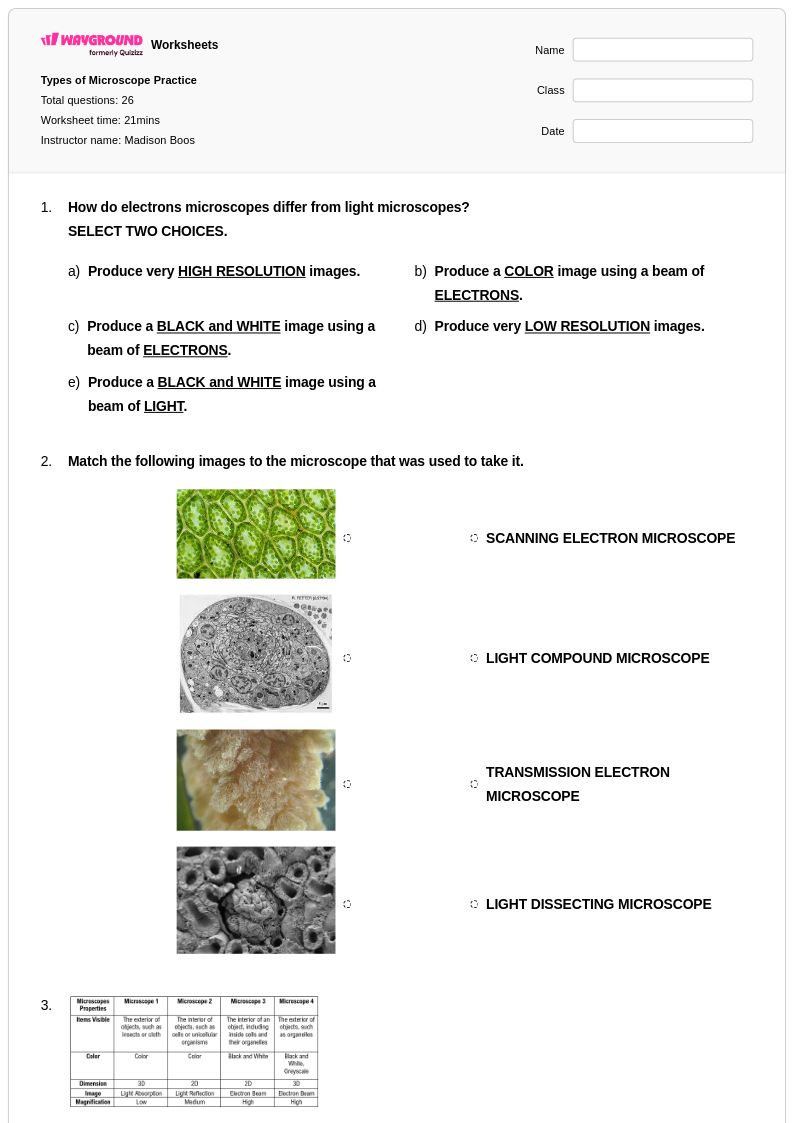
Explore Wayground's comprehensive collection of free resolution physics worksheets and printables with answer keys, designed to help students master vector components, force analysis, and problem-solving through engaging practice problems and PDF resources.
Resolution worksheets available through Wayground (formerly Quizizz) provide comprehensive practice materials that help students master the fundamental physics concept of vector resolution and its practical applications. These educational resources focus on developing critical analytical skills including breaking down vectors into their component parts, applying trigonometric relationships to solve multi-dimensional problems, and understanding how forces, velocities, and other vector quantities interact in real-world scenarios. The collection includes carefully structured practice problems that progress from basic component analysis to complex multi-vector systems, with complete answer keys and detailed solution explanations that support both independent study and classroom instruction. These free printable resources are designed as pdf downloads, making them easily accessible for teachers who need reliable materials to reinforce vector resolution concepts through systematic practice and assessment.
Wayground (formerly Quizizz) empowers educators with millions of teacher-created resolution worksheets that can be seamlessly integrated into physics instruction at multiple levels. The platform's robust search and filtering capabilities allow teachers to quickly locate materials that align with specific curriculum standards and match their students' current skill levels, whether they need introductory vector component exercises or advanced three-dimensional resolution problems. The comprehensive differentiation tools enable instructors to customize worksheet difficulty and problem types to support both remediation for struggling students and enrichment challenges for advanced learners. Available in both printable pdf format and interactive digital versions, these resources provide the flexibility teachers need for effective lesson planning, targeted skill practice, and comprehensive assessment of student understanding in vector resolution concepts.
FAQs
How do I teach vector resolution to physics students?
Start by grounding students in the idea that any vector can be broken into perpendicular components, typically horizontal and vertical, using sine and cosine functions. Use concrete examples like a force applied at an angle on a flat surface or a projectile's initial velocity before introducing multi-vector systems. Once students can reliably decompose single vectors, have them build up to summing components across multiple vectors to find a resultant. Visual aids like scaled diagrams and component triangles are essential for building conceptual understanding before moving to algebraic methods.
What exercises help students practice vector resolution?
Effective practice moves from identifying components of a single vector at a given angle, to solving equilibrium problems where multiple forces must balance, to projectile motion setups requiring simultaneous horizontal and vertical analysis. Problems that require students to first draw a free-body diagram and then resolve each force into components build both procedural fluency and conceptual understanding. Including real-world contexts like ramp forces, tension in cables, or wind velocity adds relevance and helps students see why resolution is a foundational physics skill.
What mistakes do students commonly make when resolving vectors?
The most frequent error is misassigning sine and cosine to the wrong component, which usually happens when students memorize rules without understanding the reference angle. Students also frequently forget to resolve every force in a system, leaving out components like normal force or friction when the surface is inclined. Another common mistake is adding vector magnitudes directly instead of summing x-components and y-components separately before finding the resultant. Targeted practice with problems that isolate each error pattern helps students identify and correct these habits before assessments.
How can I differentiate vector resolution instruction for students at different skill levels?
For students who are still building confidence, begin with vectors along the axes to eliminate trigonometry as a barrier, then gradually introduce angled vectors with scaffolded diagrams. Advanced students can be challenged with three-dimensional resolution problems or scenarios where the coordinate system must be rotated, such as inclined plane problems. On Wayground, teachers can apply accommodations such as reduced answer choices for students who need additional support, and extended time settings can be configured per student to ensure equitable access to the same rigorous content.
How do I use Wayground's resolution worksheets in my physics class?
Wayground's resolution worksheets are available as printable PDFs, making them straightforward to distribute for in-class work, homework, or test review. They are also available in digital formats, allowing teachers to assign them through a technology-integrated environment, and can be hosted as a quiz directly on Wayground for real-time student response and automated grading. The worksheets include complete answer keys, which support both teacher-led correction and independent student review after practice.