Free Printable Electric Charge Field and Potential worksheets
Explore Wayground's comprehensive collection of free electric charge field and potential worksheets with printables, practice problems, and answer keys to help students master fundamental electrostatics concepts in physics.
Explore printable Electric Charge Field and Potential worksheets
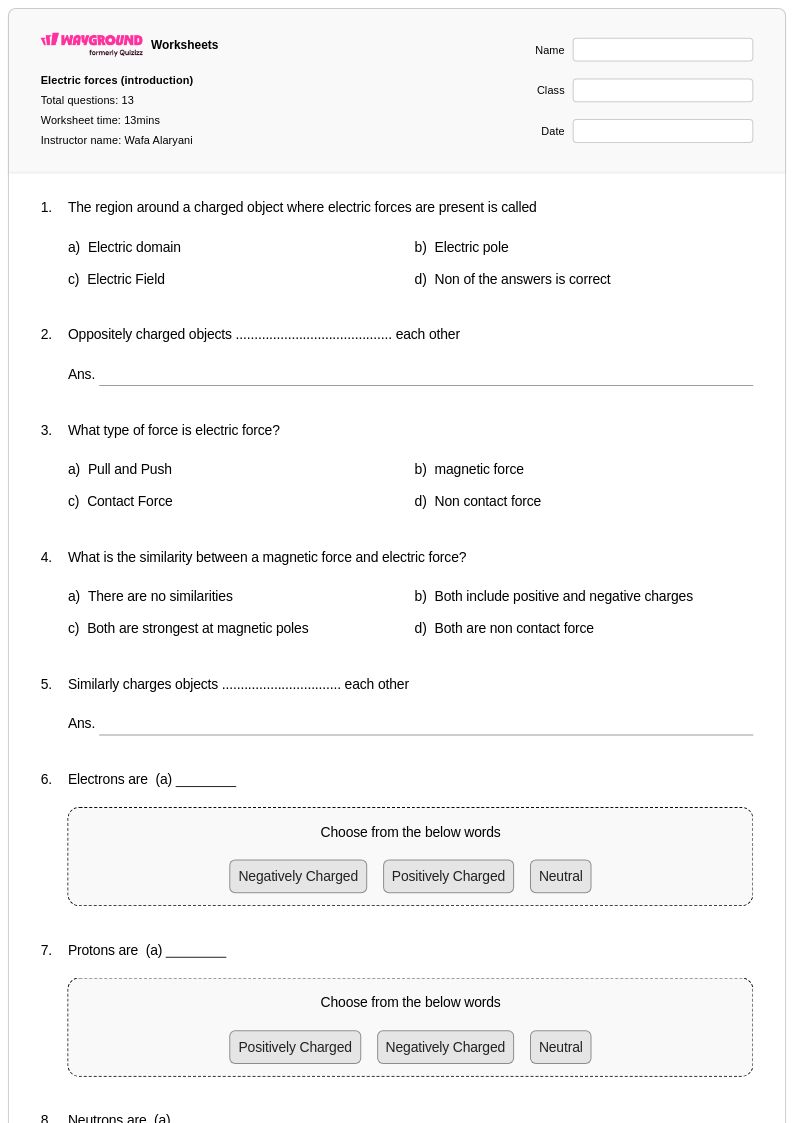
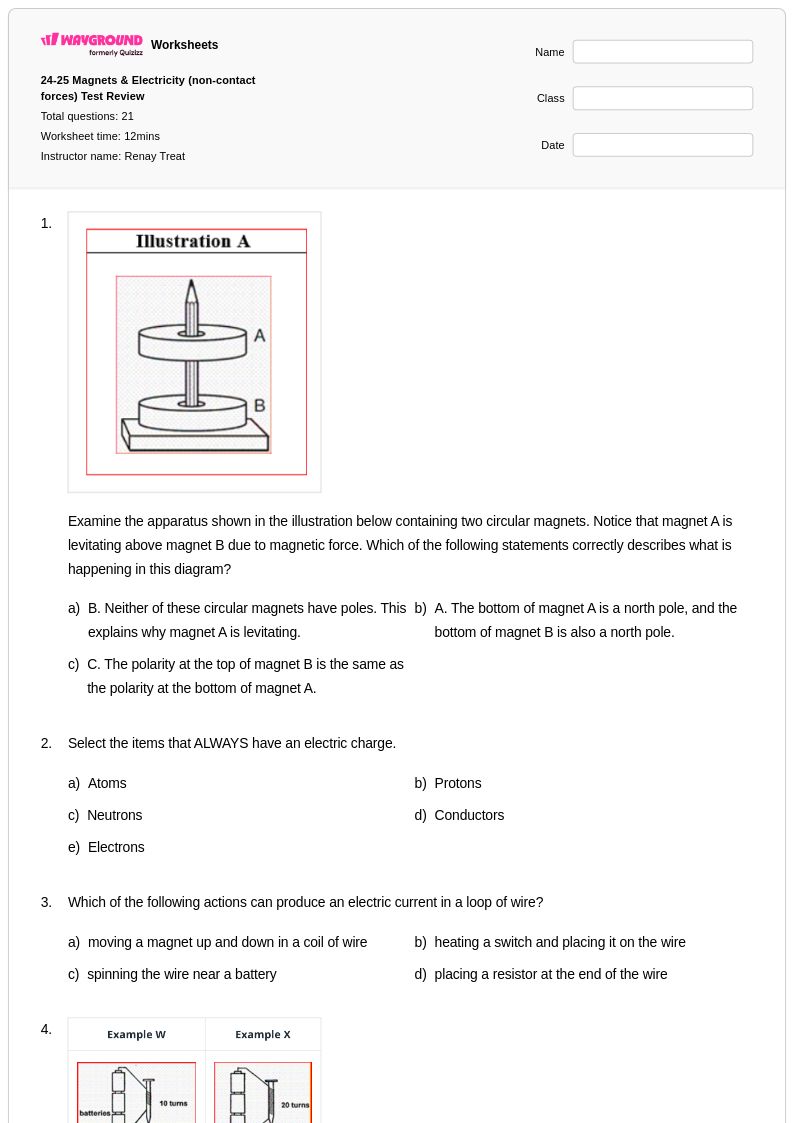
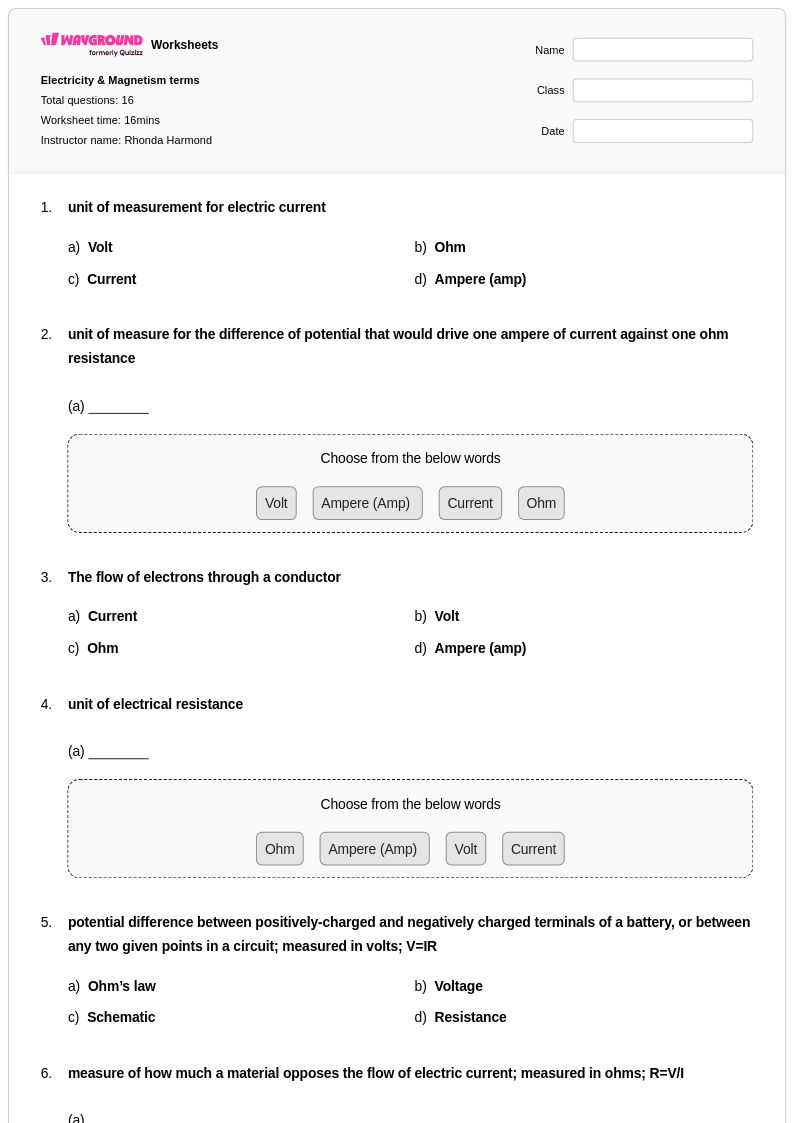
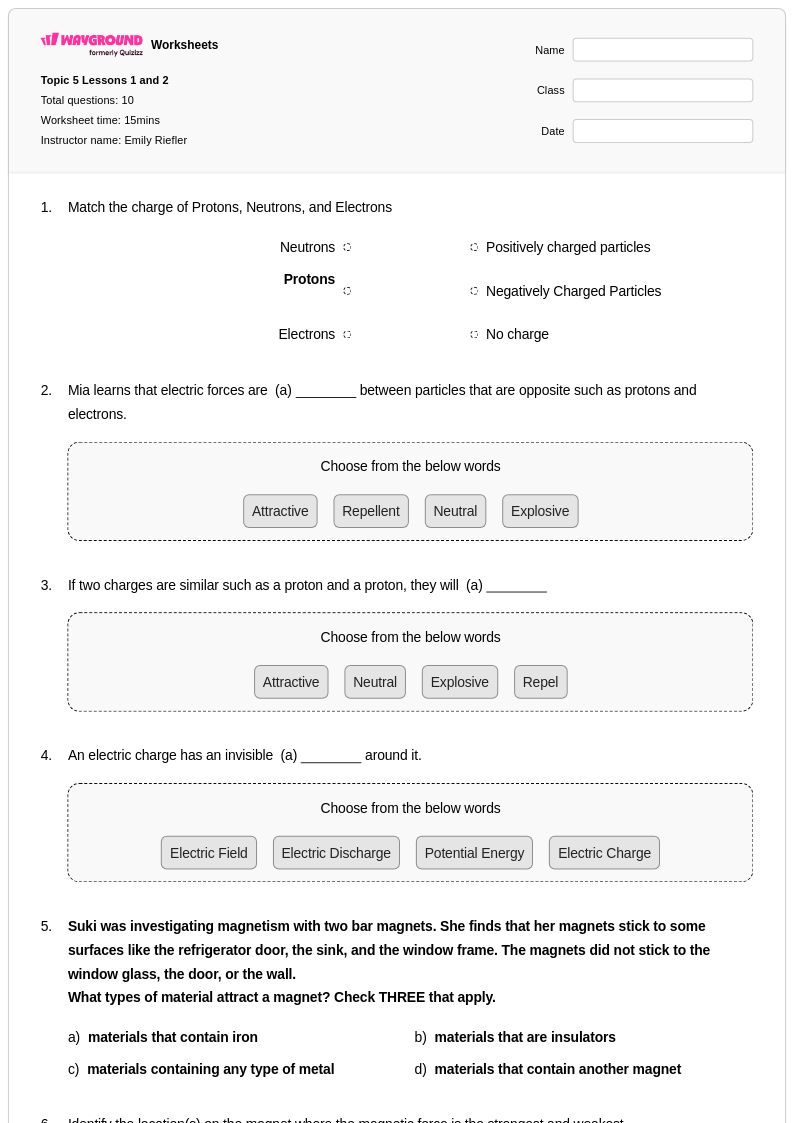
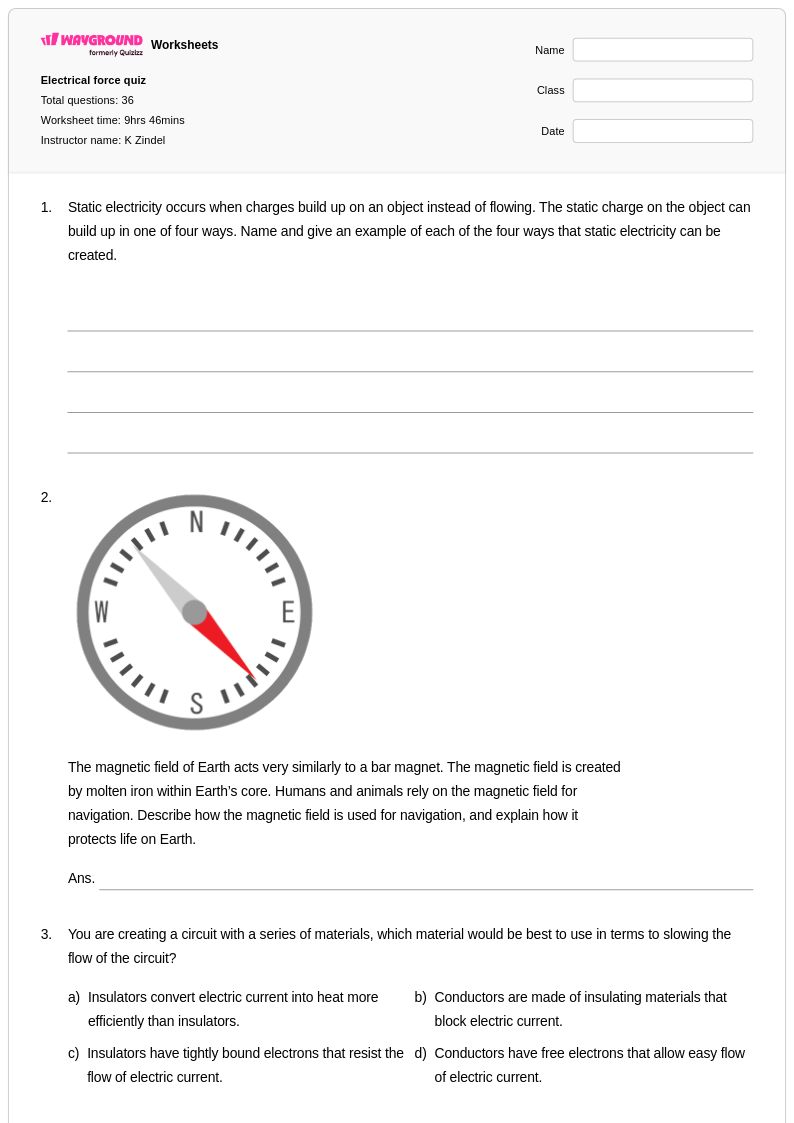
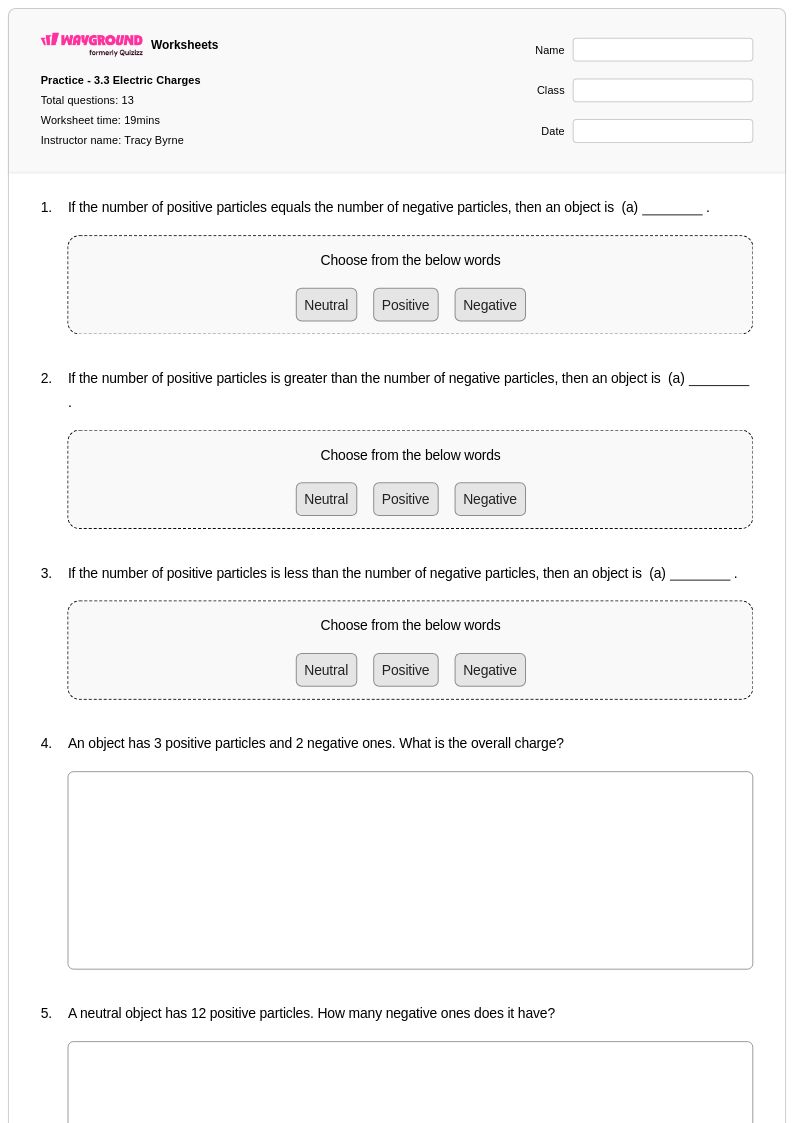
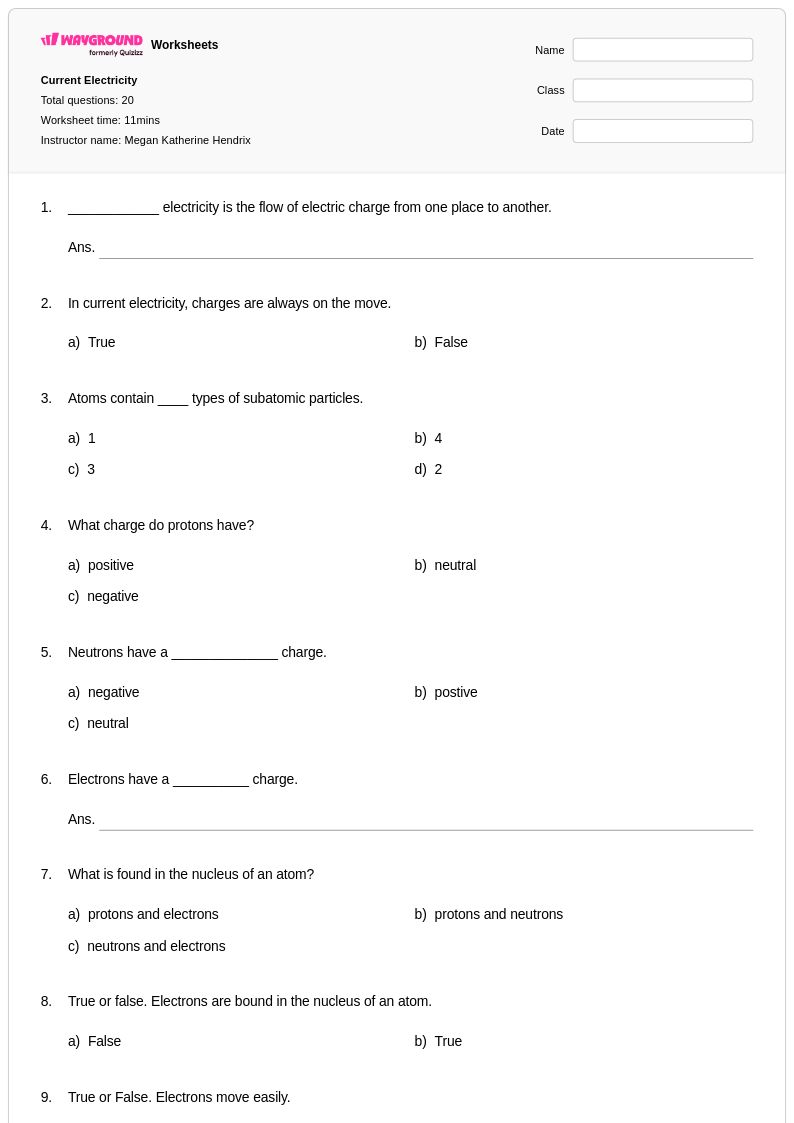
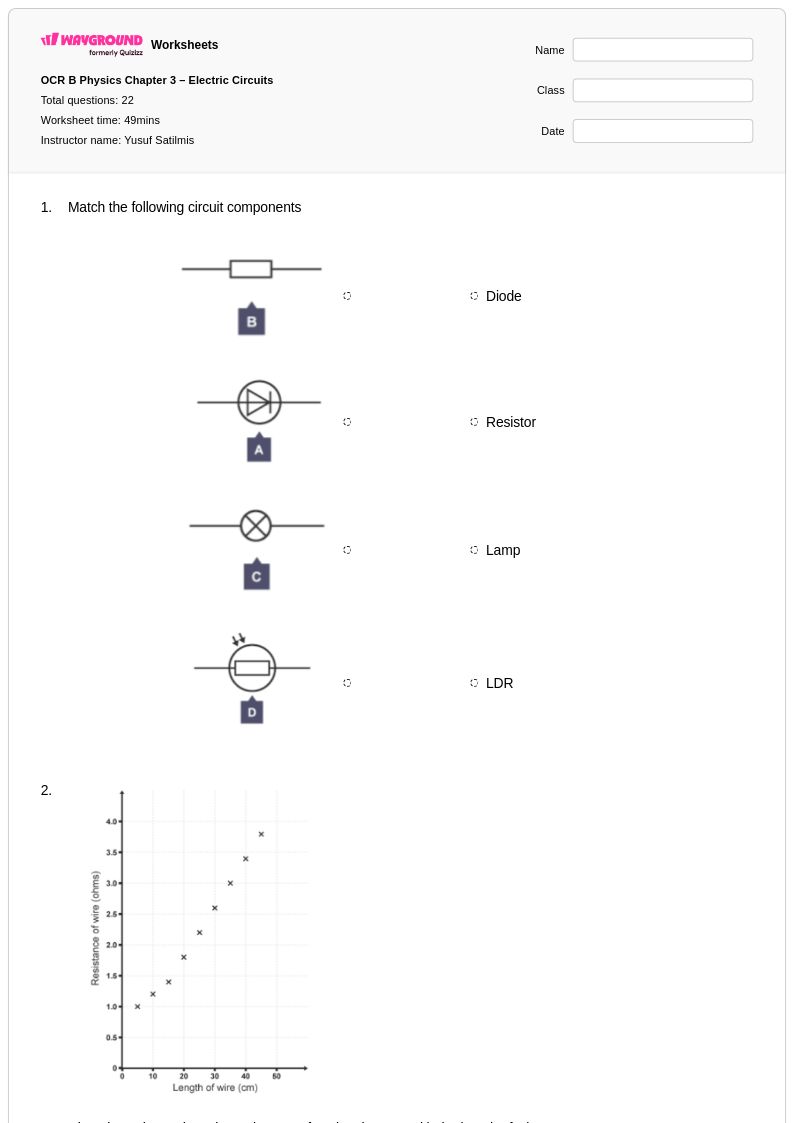
Electric charge field and potential worksheets available through Wayground (formerly Quizizz) provide comprehensive practice materials that help students master fundamental electrostatics concepts in physics. These expertly designed worksheets focus on building critical skills including calculating electric field strength, determining electric potential at various points in space, understanding the relationship between electric field and potential difference, and analyzing charge distributions and their effects. Students work through practice problems that cover point charges, continuous charge distributions, equipotential surfaces, and the application of Gauss's law, with each worksheet including detailed answer keys to support independent learning. The free printable resources offer systematic skill development through progressively challenging scenarios, from simple single-charge situations to complex multi-charge systems, ensuring students develop both conceptual understanding and computational proficiency in this essential physics topic.
Wayground (formerly Quizizz) supports physics educators with an extensive collection of teacher-created electric charge field and potential worksheets, drawn from millions of high-quality educational resources developed by experienced instructors worldwide. The platform's advanced search and filtering capabilities enable teachers to quickly locate materials that align with specific curriculum standards and match their students' learning needs, while differentiation tools allow for seamless customization of content difficulty and scope. These versatile worksheets are available in both printable PDF format for traditional classroom use and digital formats for online learning environments, making them ideal for lesson planning, targeted remediation of challenging concepts, enrichment activities for advanced learners, and regular skill practice sessions. Teachers can efficiently modify problem sets, adjust mathematical complexity, and adapt content presentation to support diverse learning styles while maintaining rigorous academic standards in electromagnetic theory instruction.
FAQs
How do I teach electric field and electric potential in a physics class?
Start by grounding students in Coulomb's law and the concept of a test charge before introducing the electric field as a vector quantity. Once students can calculate field strength from point charges, build toward electric potential as a scalar quantity and explicitly teach the relationship between potential difference and field direction. Using equipotential surface diagrams alongside field line diagrams helps students develop spatial intuition for both quantities simultaneously.
What practice problems help students master electric charge, field, and potential?
Effective practice should progress from single point charge calculations to multi-charge superposition problems, then to continuous charge distributions and Gauss's law applications. Problems that require students to both calculate electric potential at a point and determine the corresponding field vector are especially valuable because they reinforce the mathematical relationship between the two quantities. Including equipotential surface analysis problems ensures students develop conceptual understanding alongside computational fluency.
What mistakes do students commonly make when working with electric field and potential?
The most persistent misconception is treating electric potential as a vector quantity — students frequently attempt to add potentials using directional components the way they would add field vectors. Students also routinely confuse electric field direction with the direction of increasing potential, when in fact the field points from high to low potential. A third common error is misapplying Gauss's law to charge distributions that lack the necessary symmetry, leading to incorrect field calculations.
How do I use electric charge field and potential worksheets effectively in my classroom?
These worksheets work well as structured practice following direct instruction on each subtopic, allowing students to consolidate understanding of point charges before moving to more complex distributions. Because the worksheets are available as both printable PDFs and in digital formats, they can be deployed for in-class problem sets, homework, or as hosted quizzes on Wayground depending on your teaching environment. Answer keys included with each worksheet make them suitable for independent practice, peer review, or self-paced remediation sessions.
How do I differentiate electric field and potential instruction for students at different levels?
For students who are still building foundational skills, focus problem sets on single point charges with straightforward distance values before introducing superposition. More advanced learners can be challenged with continuous charge distribution problems and Gauss's law applications in non-trivial geometries. On Wayground, teachers can also enable accommodations such as read aloud support, reduced answer choices, and extended time for individual students, ensuring all learners can engage with the material without disrupting the rest of the class.
What is the difference between electric field and electric potential, and how should I explain it to students?
Electric field is a vector quantity that describes the force per unit positive charge at a point in space, while electric potential is a scalar quantity representing the work done per unit charge to move a test charge from a reference point to that location. The field and potential are mathematically related: the electric field points in the direction of steepest decrease in potential, and its magnitude equals the rate of change of potential with distance. Helping students internalize this relationship — rather than memorizing it — is essential for success in electrostatics and later topics in electromagnetism.