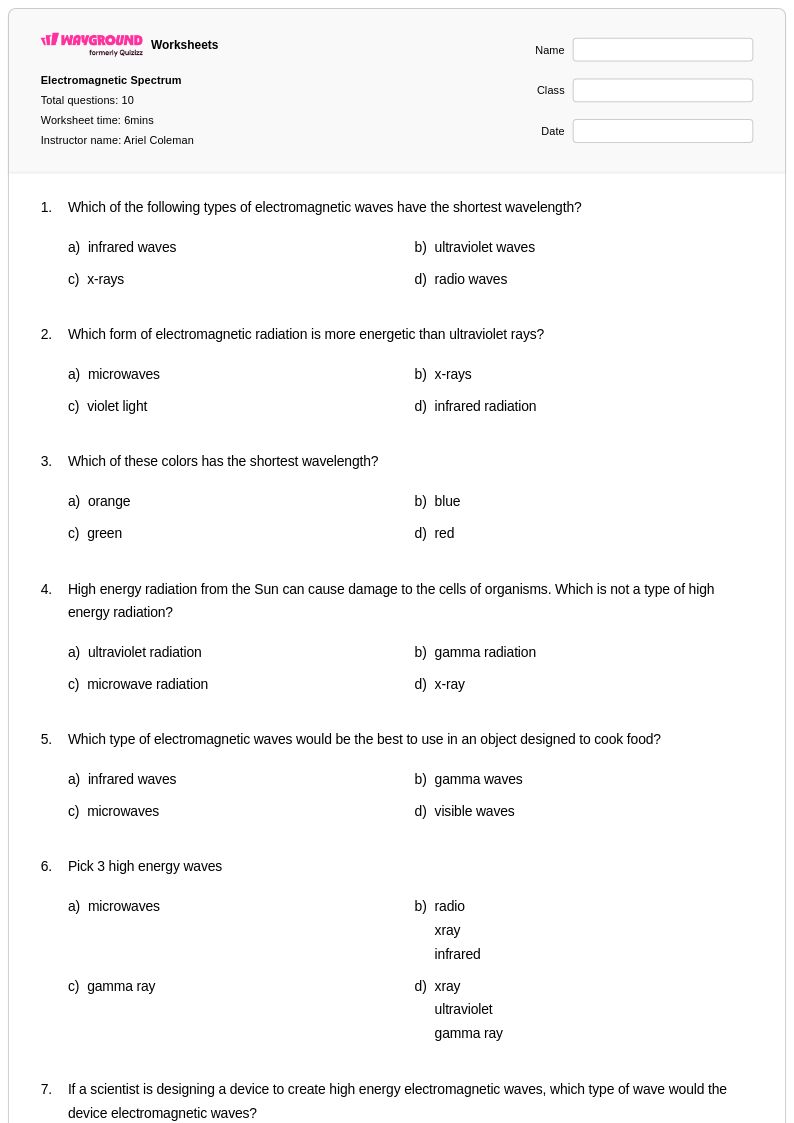
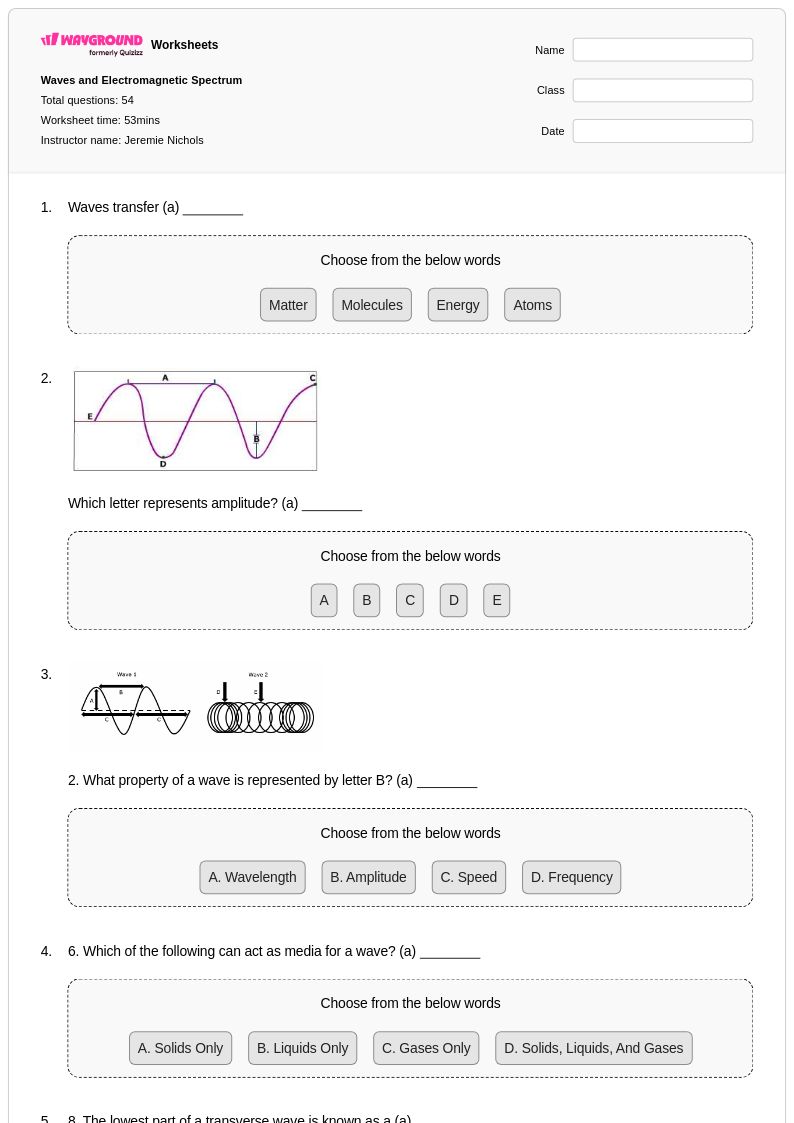
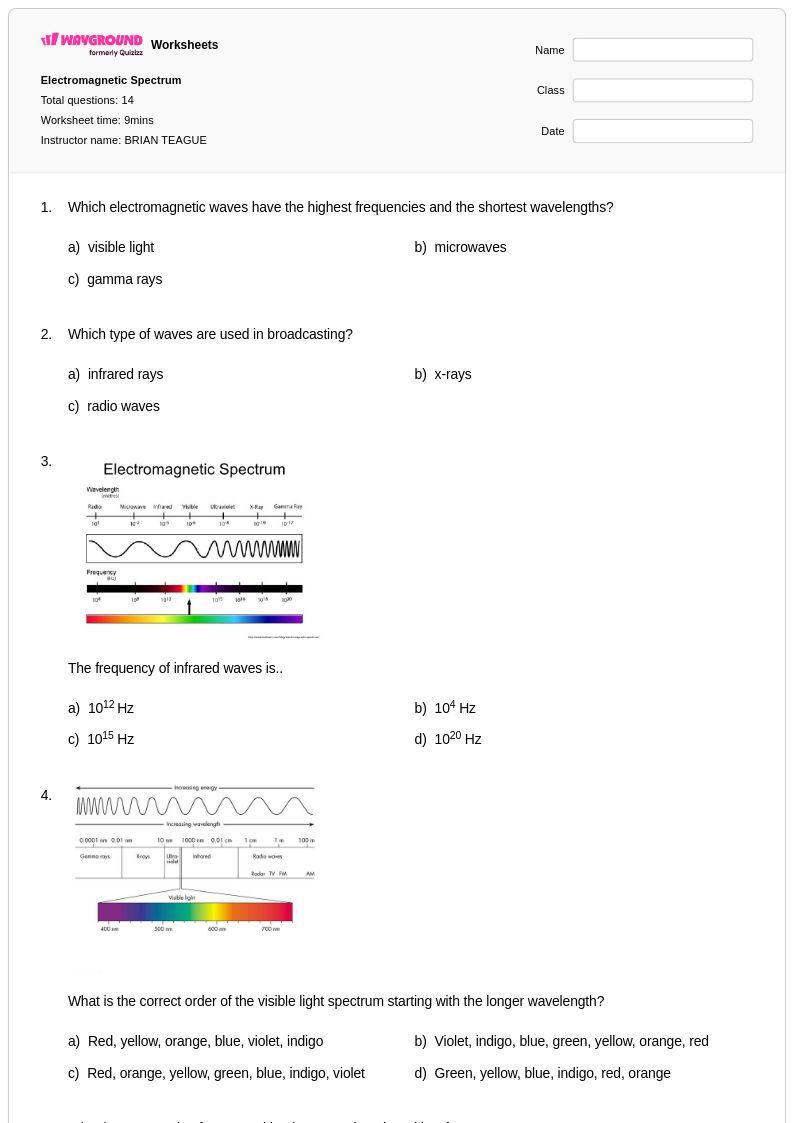
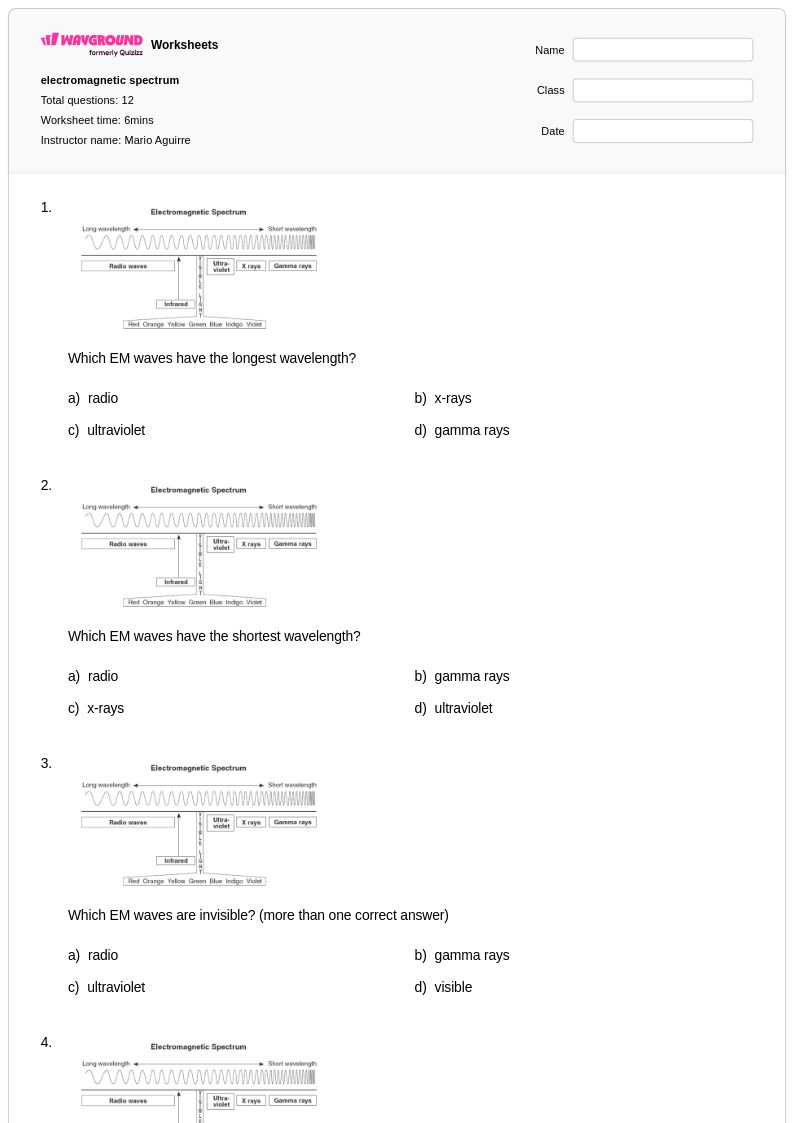
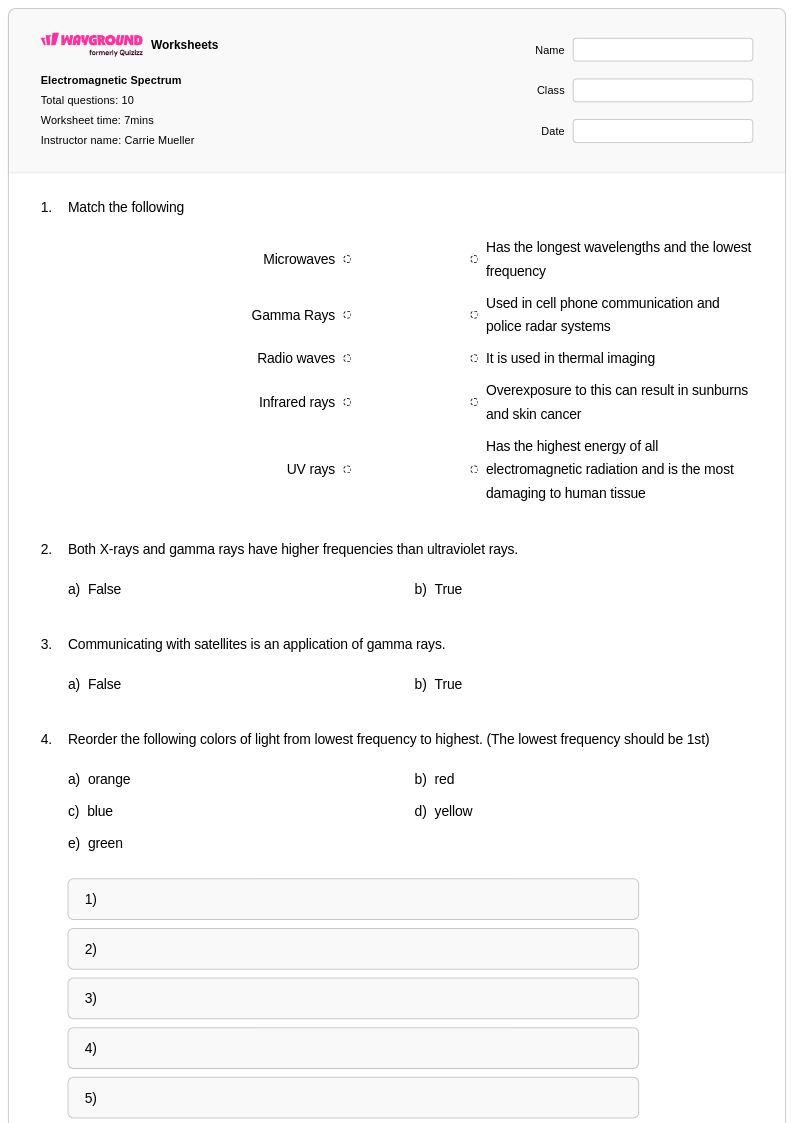
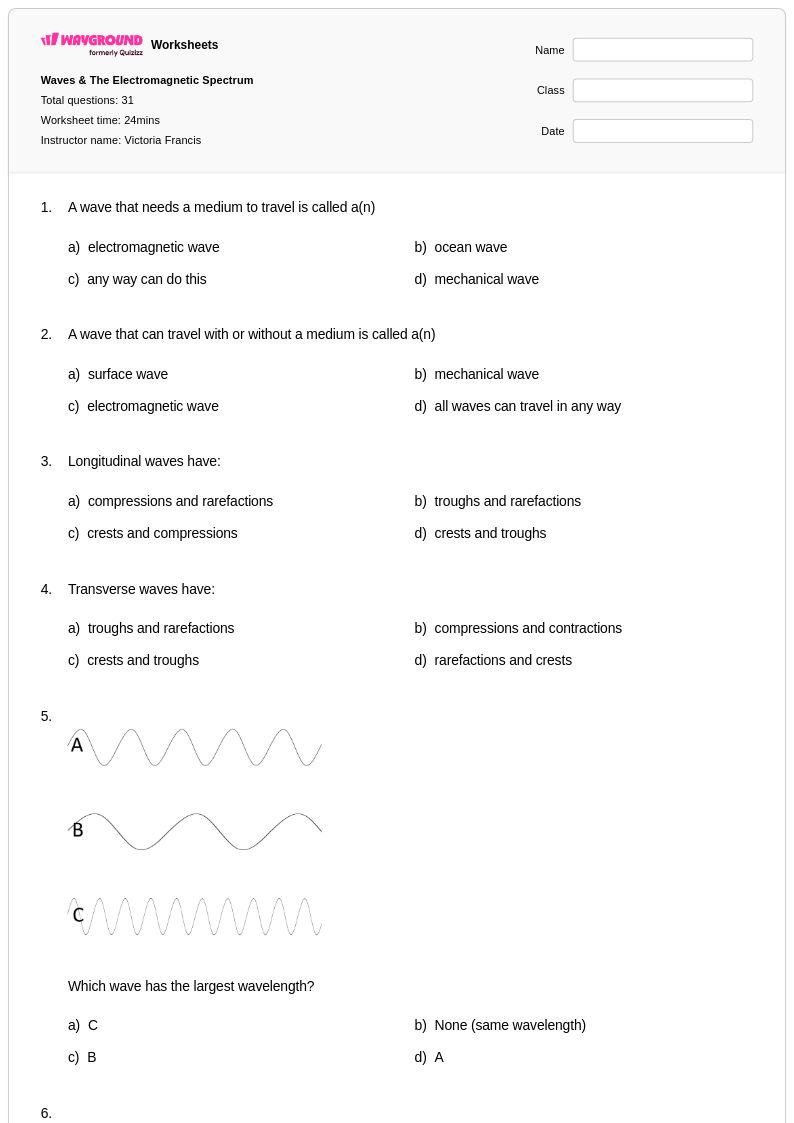
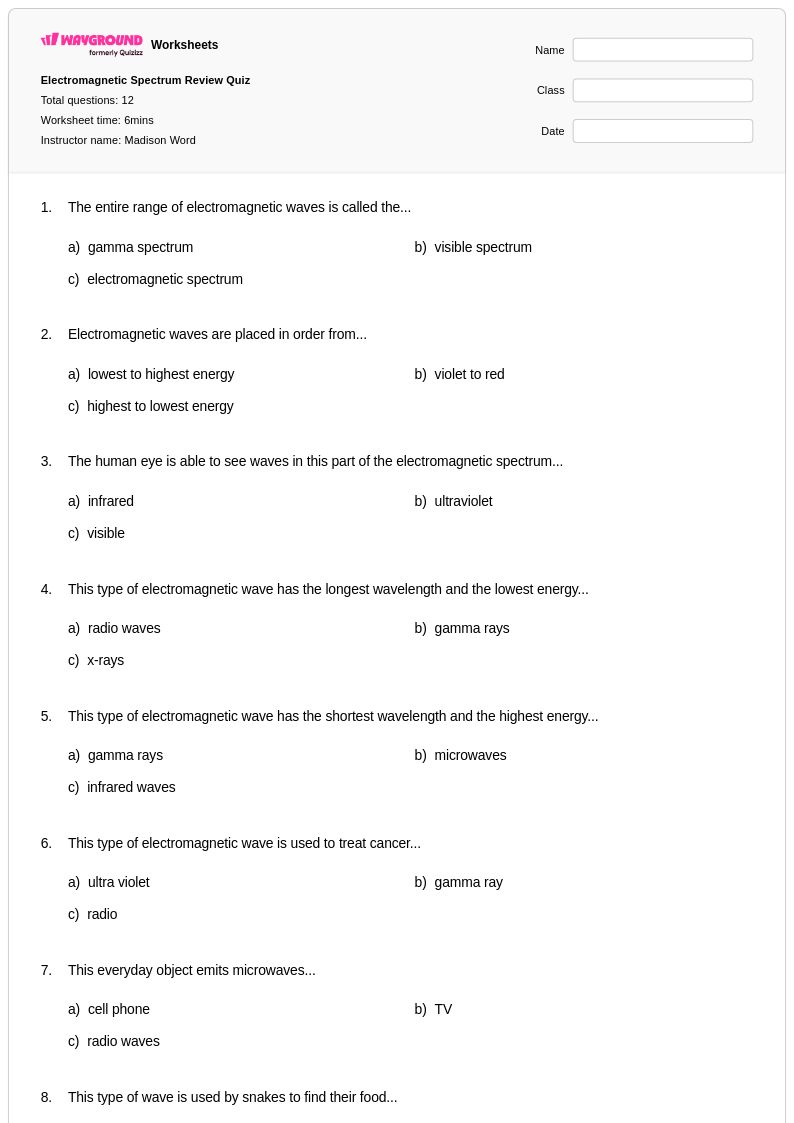
Explore Wayground's comprehensive collection of electromagnetic spectrum worksheets featuring free printables and practice problems with answer keys to help students master light waves, frequency, and radiation concepts.
Electromagnetic spectrum worksheets available through Wayground (formerly Quizizz) provide comprehensive practice materials that help students master the fundamental concepts of electromagnetic radiation and wave properties. These expertly crafted resources strengthen critical physics skills including wave frequency and wavelength calculations, identifying different regions of the electromagnetic spectrum from radio waves to gamma rays, understanding the relationship between energy and frequency, and analyzing real-world applications of electromagnetic radiation in technology and medicine. The collection includes detailed practice problems with complete answer keys, free printable pdf formats, and structured exercises that guide students through progressively complex scenarios involving electromagnetic wave behavior, photon energy calculations, and spectroscopic analysis.
Wayground (formerly Quizizz) empowers educators with an extensive library of millions of teacher-created electromagnetic spectrum resources that streamline lesson planning and enhance student comprehension. The platform's robust search and filtering capabilities allow teachers to quickly locate worksheets aligned with specific physics standards while offering powerful differentiation tools to accommodate diverse learning needs within the classroom. These customizable materials are available in both printable and digital pdf formats, enabling seamless integration into traditional and technology-enhanced learning environments. Teachers can efficiently implement targeted remediation for students struggling with wave concepts, provide enrichment activities for advanced learners exploring quantum mechanics connections, and deliver consistent skill practice that reinforces electromagnetic spectrum principles through varied problem-solving approaches and authentic scientific applications.
FAQs
How do I teach the electromagnetic spectrum to middle or high school students?
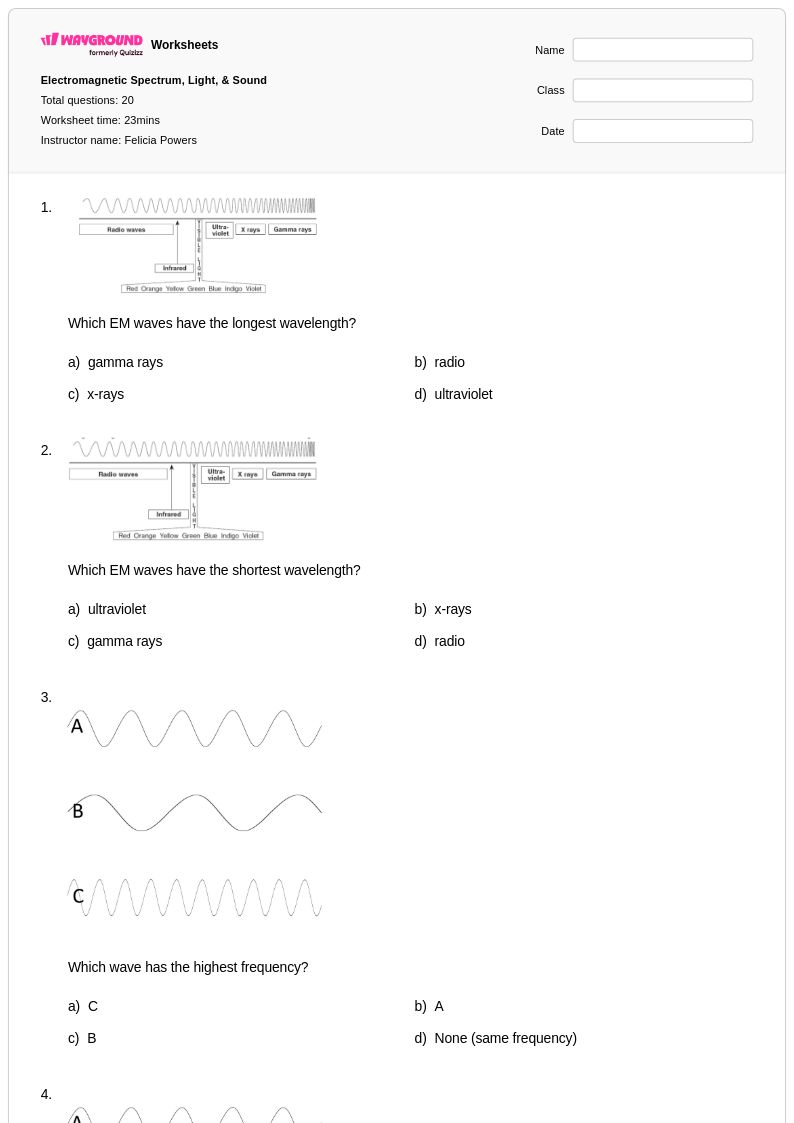
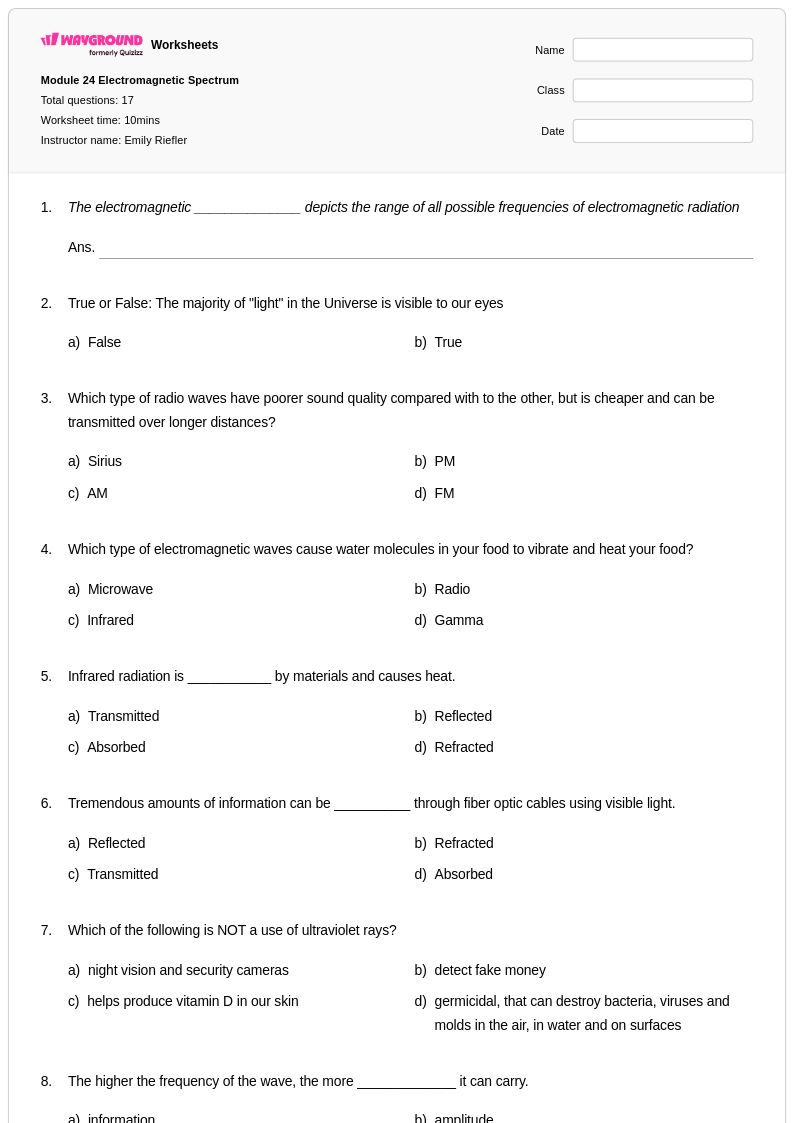
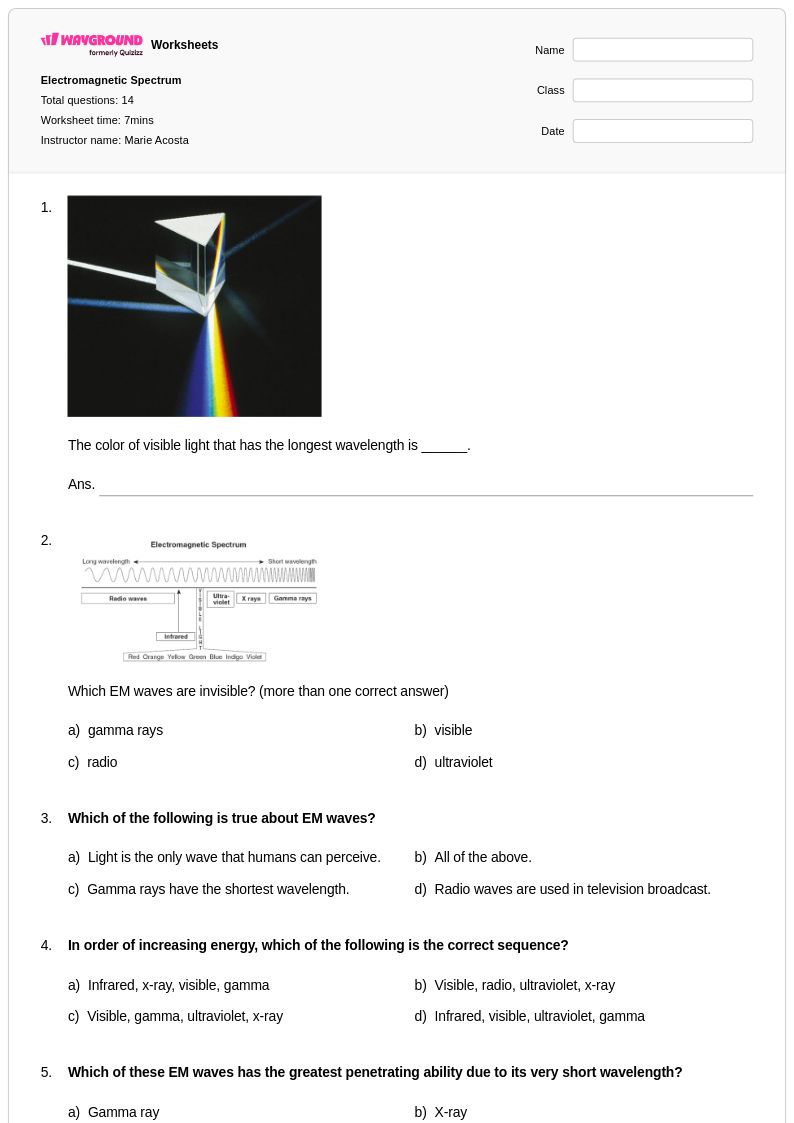
Start by anchoring instruction in the visible light spectrum, which students already have intuitive experience with, then expand outward to radio waves and gamma rays. Emphasize the inverse relationship between wavelength and frequency, and connect each region of the spectrum to a real-world application — radio waves in communication, X-rays in medicine, UV in sunscreen. Using a visual spectrum diagram alongside wave property calculations helps students build both conceptual understanding and quantitative fluency.
What are common mistakes students make when learning about the electromagnetic spectrum?
The most frequent misconception is that different types of electromagnetic radiation are fundamentally different phenomena rather than the same type of wave at different frequencies and wavelengths. Students also commonly confuse the direction of the wavelength-frequency relationship, incorrectly assuming longer wavelengths carry more energy. A third common error is conflating the speed of light with the speed of sound, particularly when comparing wave behaviors in different media.
What practice problems help students master wave frequency and wavelength calculations?
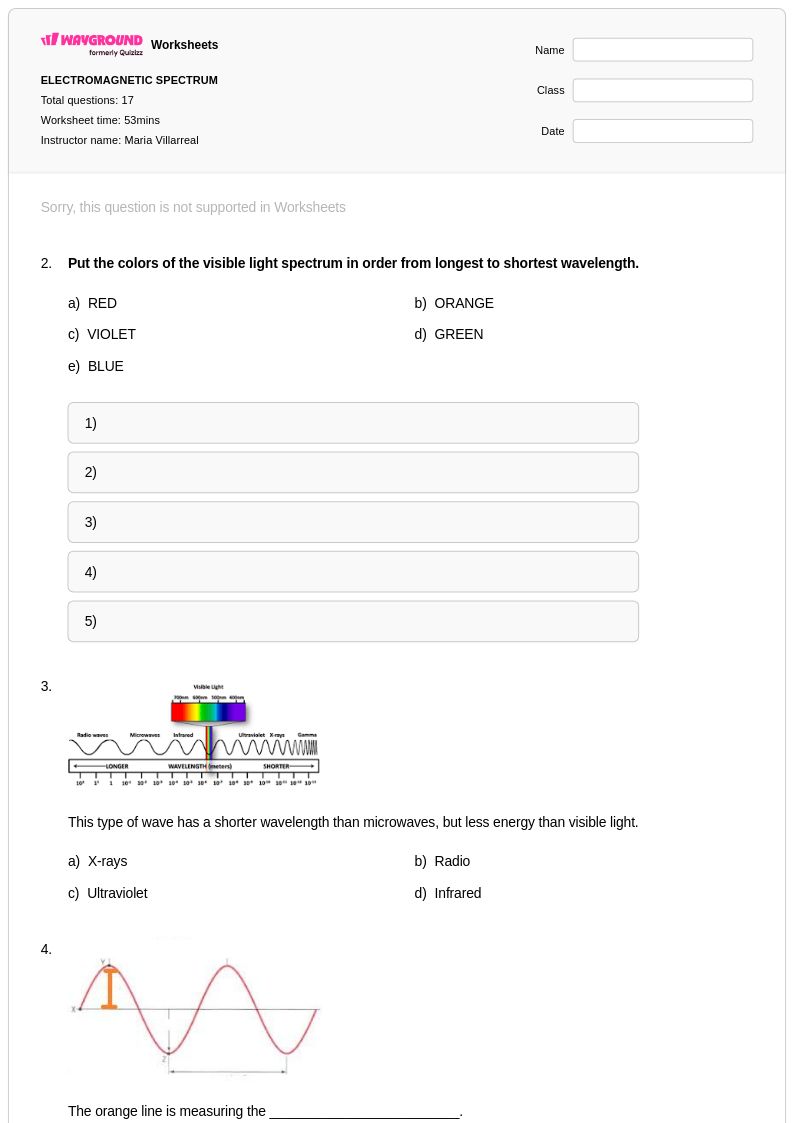
Effective practice includes problems that require students to apply the wave speed equation (c = fλ) across different regions of the electromagnetic spectrum, not just visible light. Problems that give one variable and ask students to solve for another, then interpret the result in terms of energy or spectral region, reinforce both calculation fluency and conceptual mapping. Scaffolded problem sets that move from single-step to multi-step photon energy calculations using E = hf build the skills needed for more advanced spectroscopic analysis.
How can I use electromagnetic spectrum worksheets to support differentiated instruction?
Electromagnetic spectrum worksheets work well for differentiation when structured problems are paired with accommodation tools. On Wayground, teachers can enable Read Aloud for students who need audio support, reduce answer choices for students who struggle with cognitive load on multiple-choice wave property questions, and set extended time for students working through multi-step frequency calculations. These accommodations can be assigned to individual students without affecting the rest of the class, making it practical to support diverse learners within a single assignment.
How do I use Wayground's electromagnetic spectrum worksheets in my classroom?
Wayground's electromagnetic spectrum worksheets are available as printable PDFs for traditional classroom use and in digital formats for technology-integrated environments, including the option to host them as a quiz directly on Wayground. Teachers can assign structured exercises covering wave properties, spectrum identification, and photon energy calculations, with complete answer keys included for efficient grading. The digital format supports both in-class and remote learning, and Wayground's filtering tools allow teachers to locate materials aligned to specific physics standards quickly.
What real-world applications should I include when teaching the electromagnetic spectrum?
Connecting spectrum regions to tangible technology makes abstract wave concepts more accessible and memorable. Radio waves in wireless communication, microwaves in cooking and radar, infrared in thermal imaging, UV in sterilization and skin damage, X-rays in medical imaging, and gamma rays in cancer treatment collectively span the full spectrum with clear, relatable contexts. Grounding calculations in these applications — such as determining the frequency of a WiFi signal or the energy of a dental X-ray photon — gives students a reason to care about the math.