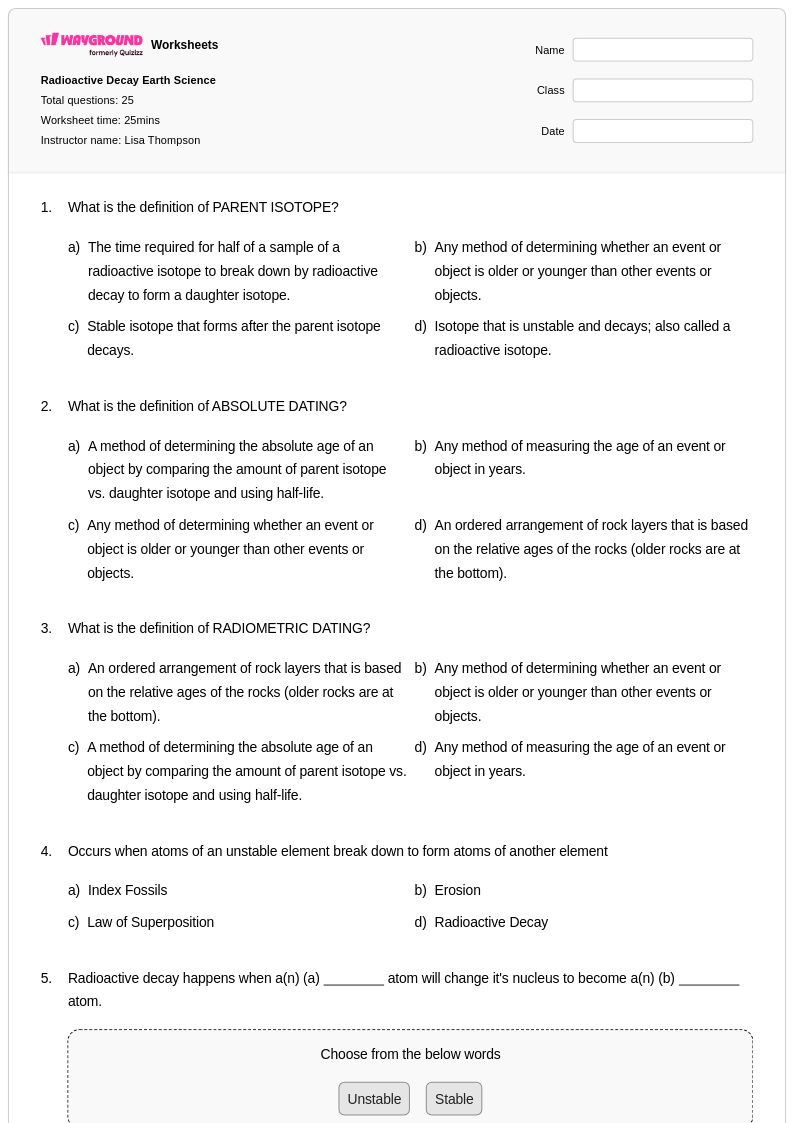
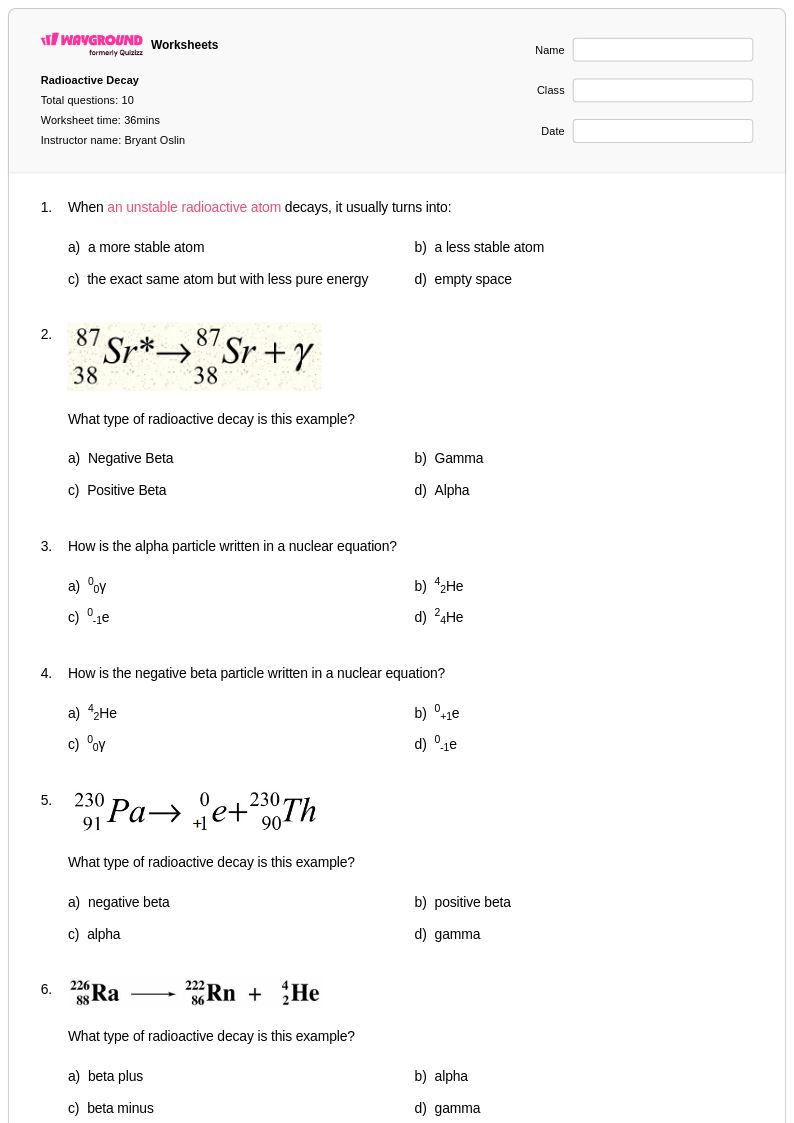
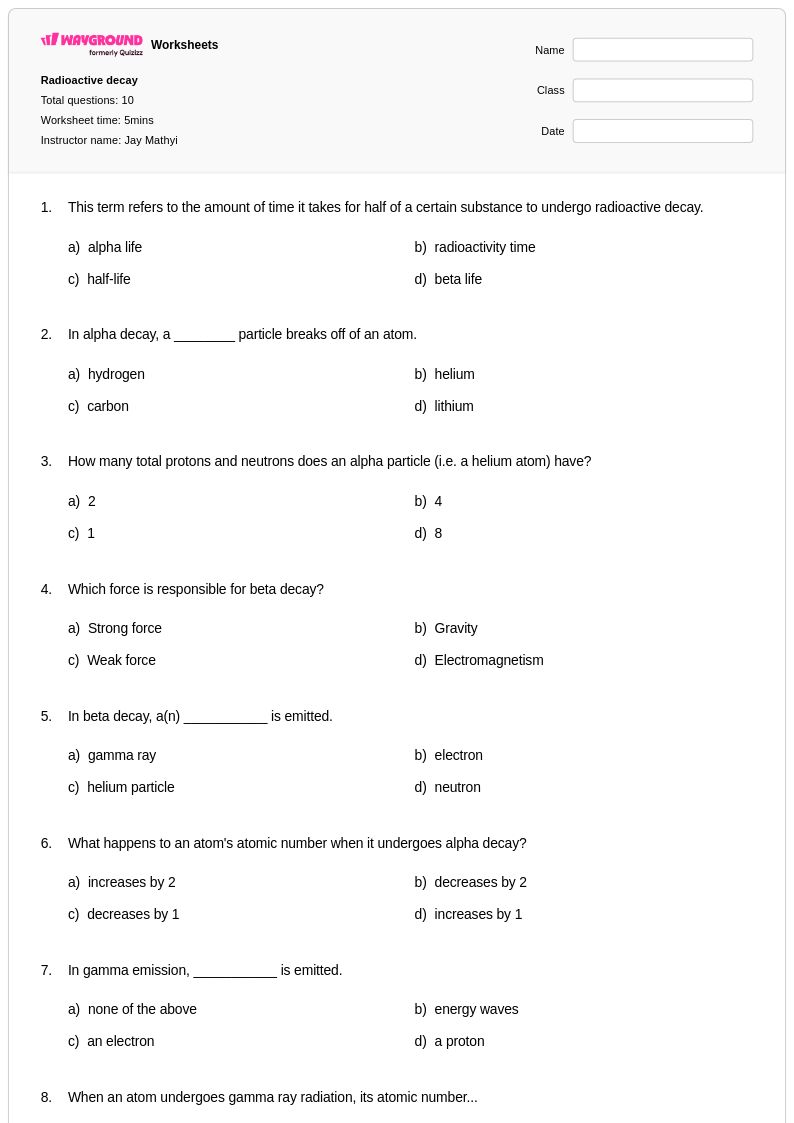
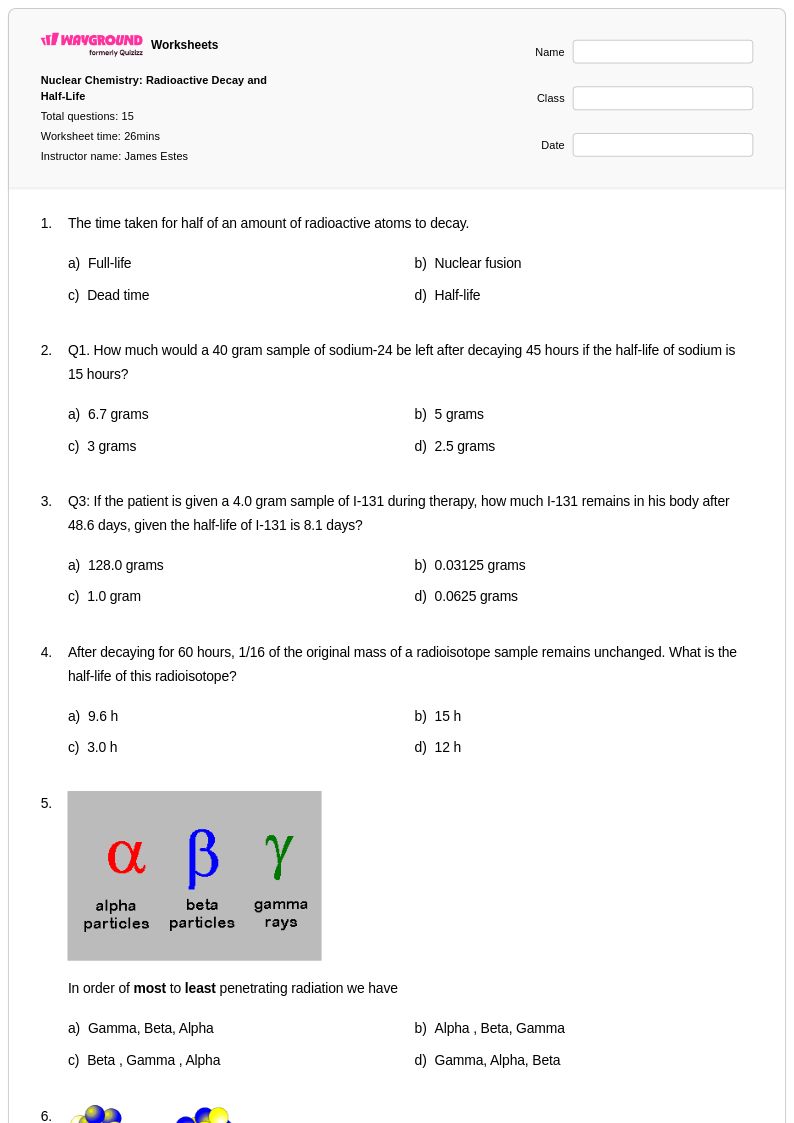
Explore Wayground's comprehensive collection of free radioactive decay worksheets and printables that help students master nuclear physics concepts through engaging practice problems and detailed answer keys in PDF format.
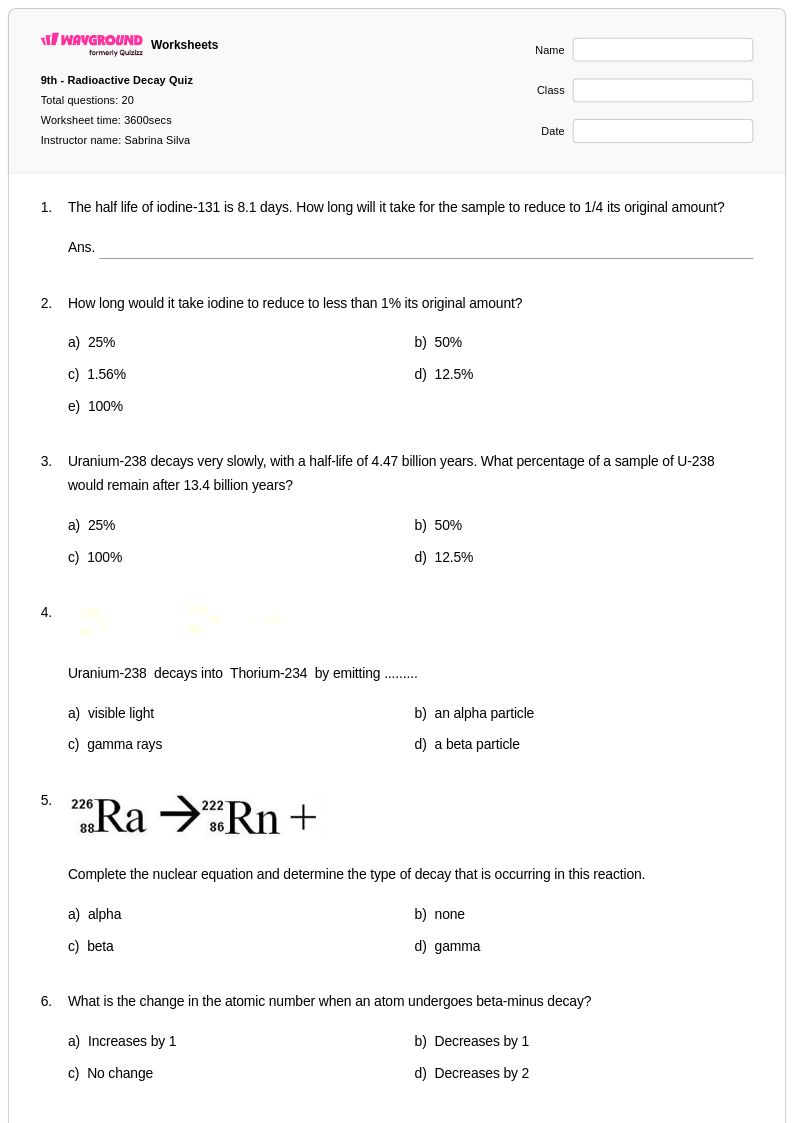
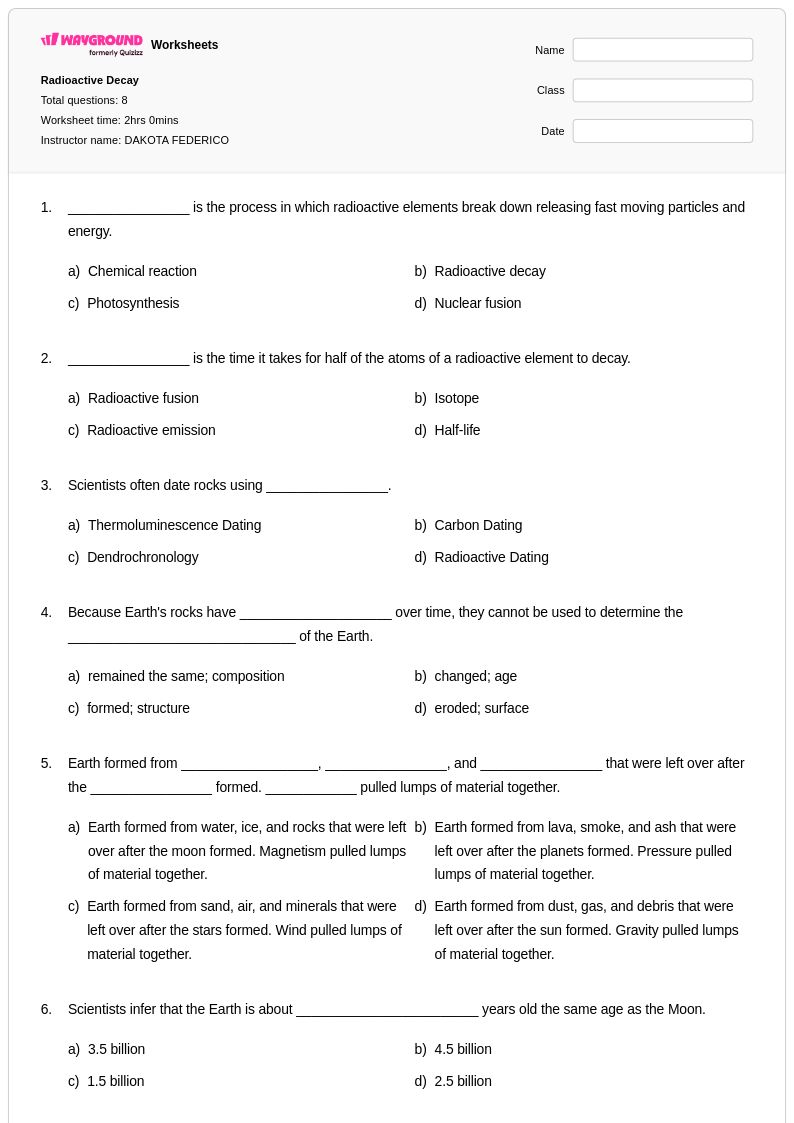
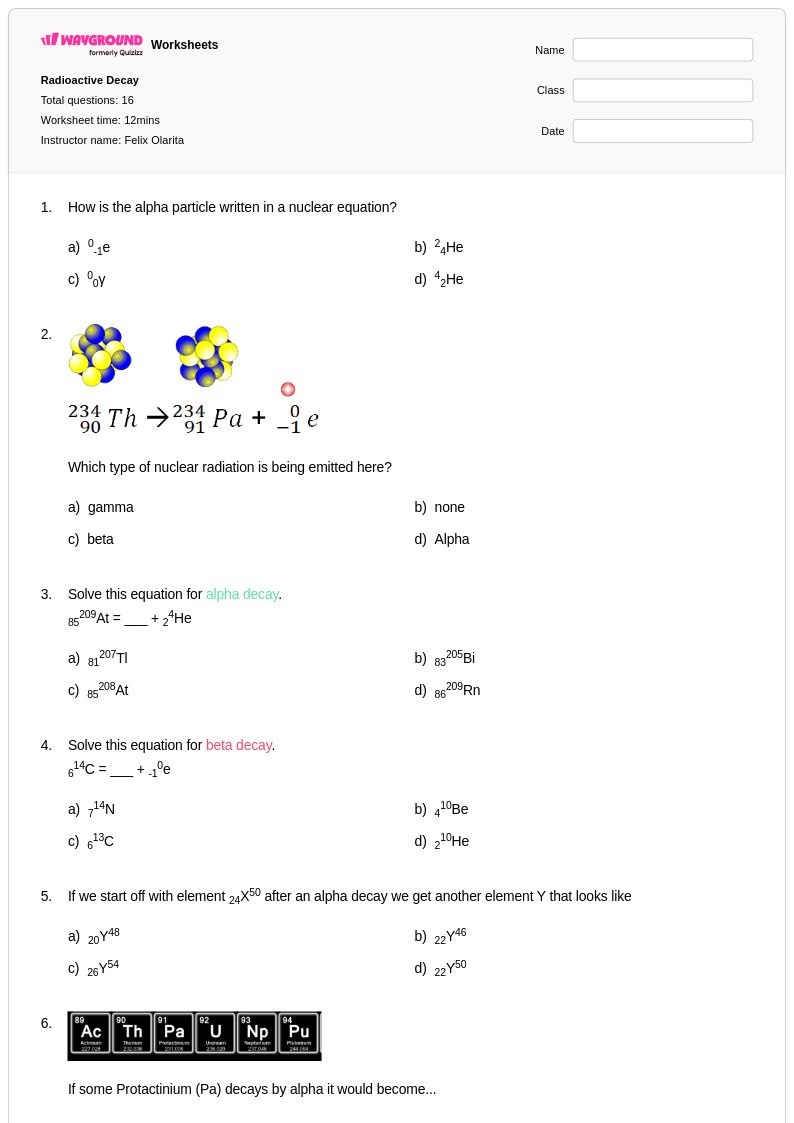
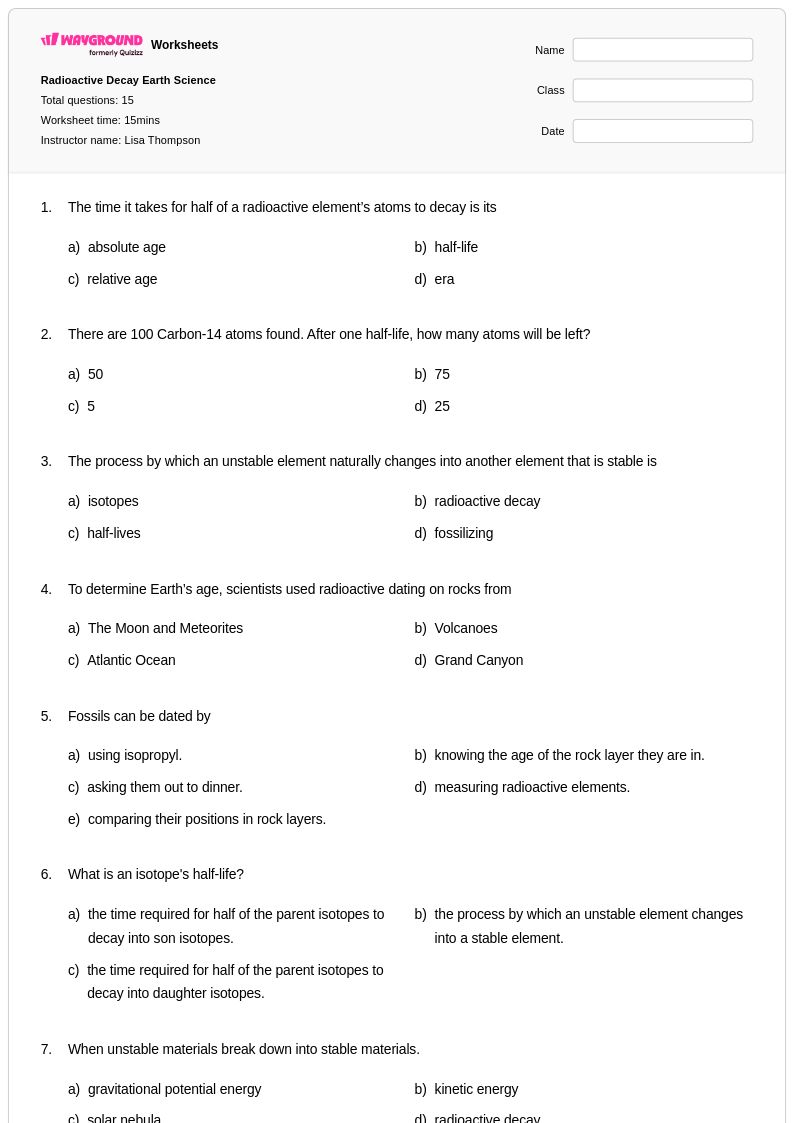
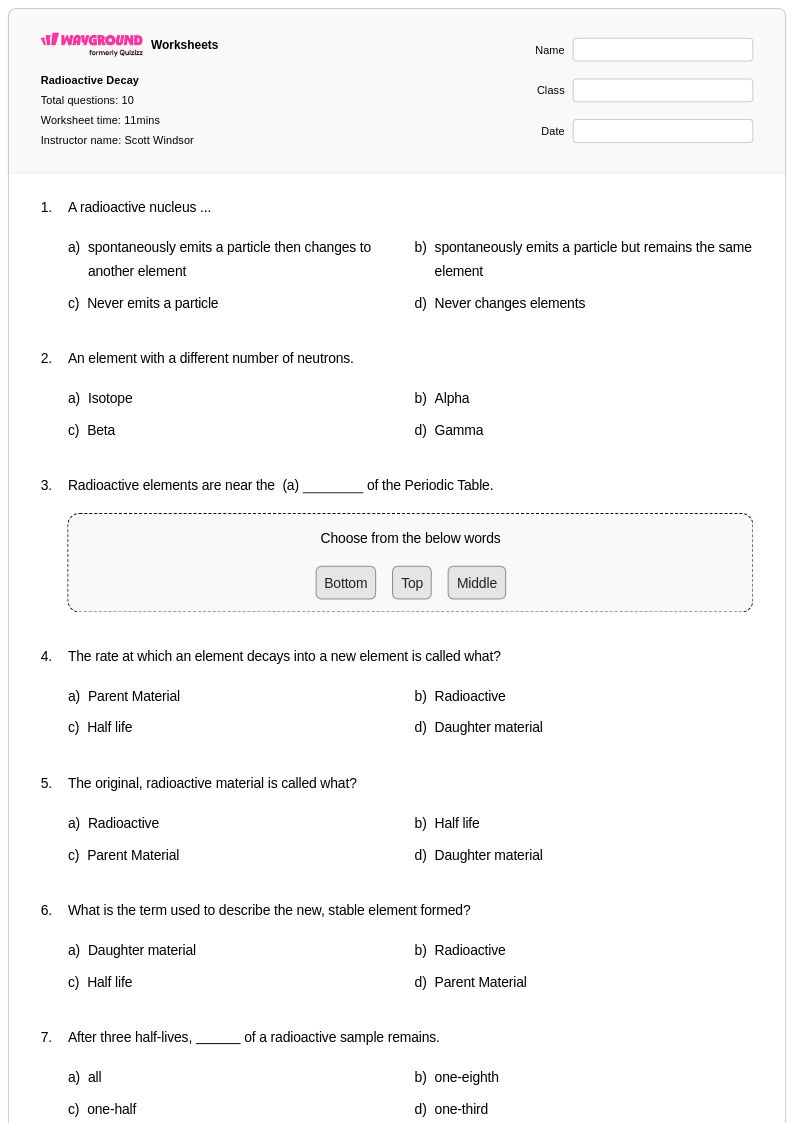
Radioactive decay worksheets available through Wayground (formerly Quizizz) provide comprehensive coverage of nuclear physics fundamentals, enabling students to master the complex concepts governing atomic instability and nuclear transformations. These expertly crafted resources strengthen critical analytical skills through practice problems that explore half-life calculations, decay equations, radioactive dating techniques, and the mathematical relationships between parent and daughter isotopes. Students develop proficiency in interpreting decay curves, applying exponential decay formulas, and understanding the probabilistic nature of nuclear disintegration processes. Each worksheet collection includes detailed answer keys and comes in convenient pdf format as free printables, allowing educators to seamlessly integrate these materials into their nuclear physics curriculum while providing students with essential practice in quantitative problem-solving.
Wayground (formerly Quizizz) supports science educators with an extensive collection of millions of teacher-created radioactive decay resources that streamline lesson planning and enhance student understanding of nuclear physics concepts. The platform's robust search and filtering capabilities enable teachers to quickly locate worksheets aligned with specific educational standards, while built-in differentiation tools allow for customized content delivery based on individual student needs and learning objectives. These versatile materials are available in both printable and digital pdf formats, providing flexibility for classroom instruction, homework assignments, and remote learning environments. Teachers can effectively utilize these resources for targeted remediation of challenging nuclear physics concepts, enrichment activities for advanced learners, and systematic skill practice that builds student confidence in mathematical applications of radioactive decay principles.
FAQs
How do I teach radioactive decay to high school students?
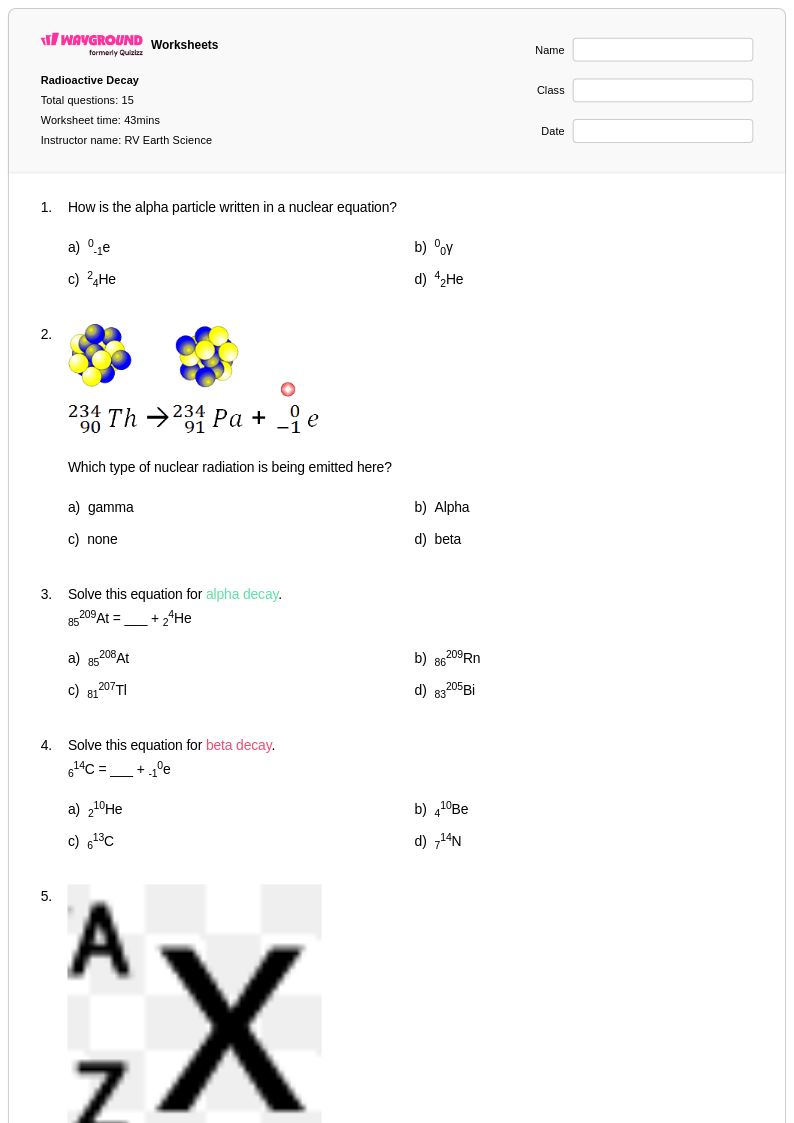
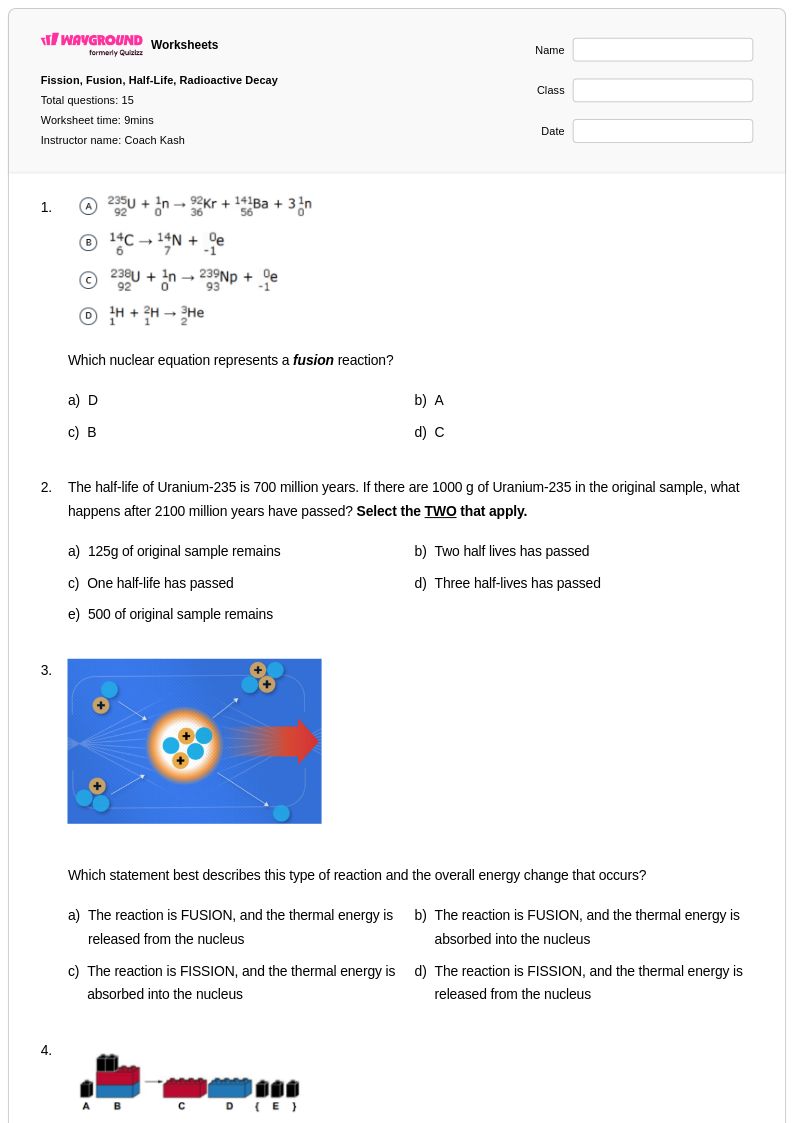
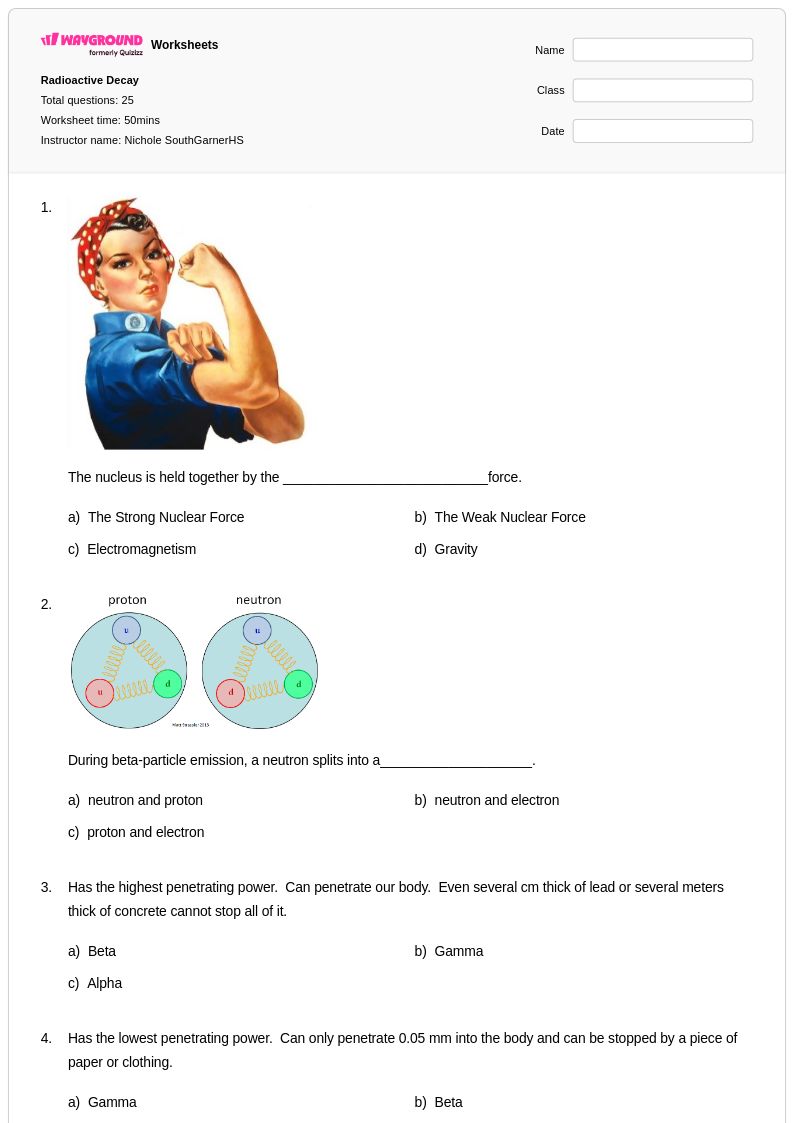
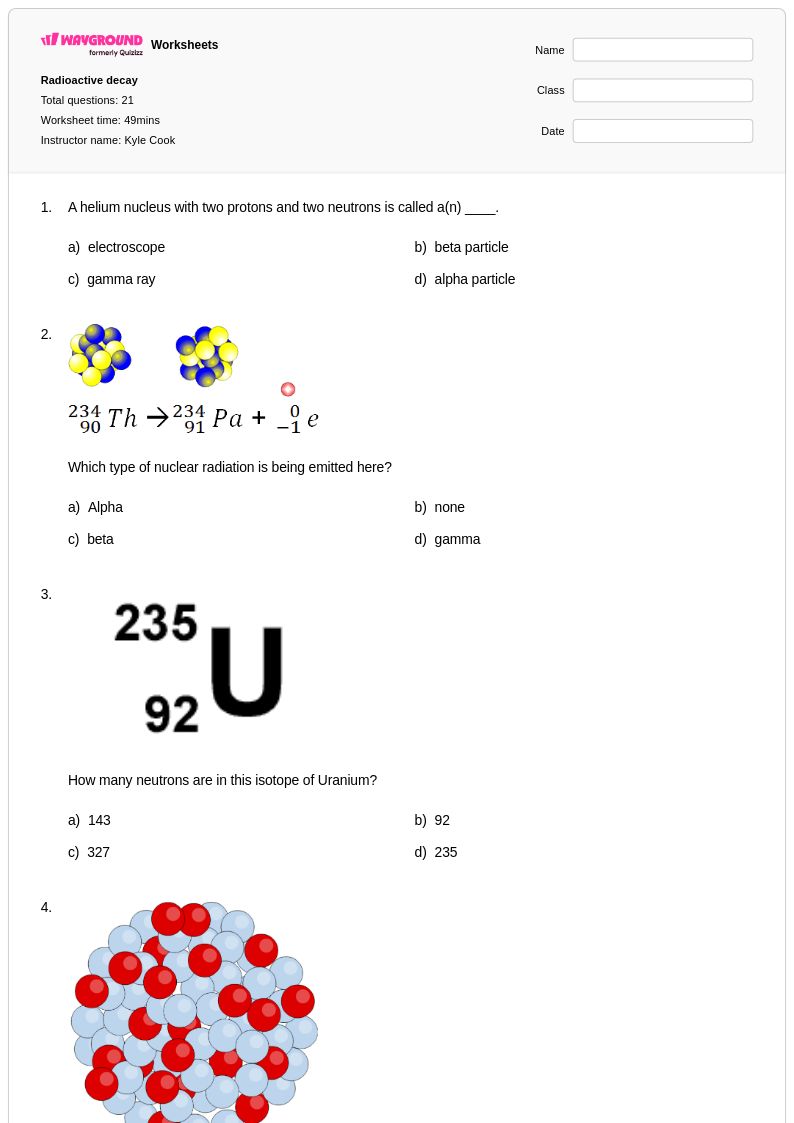
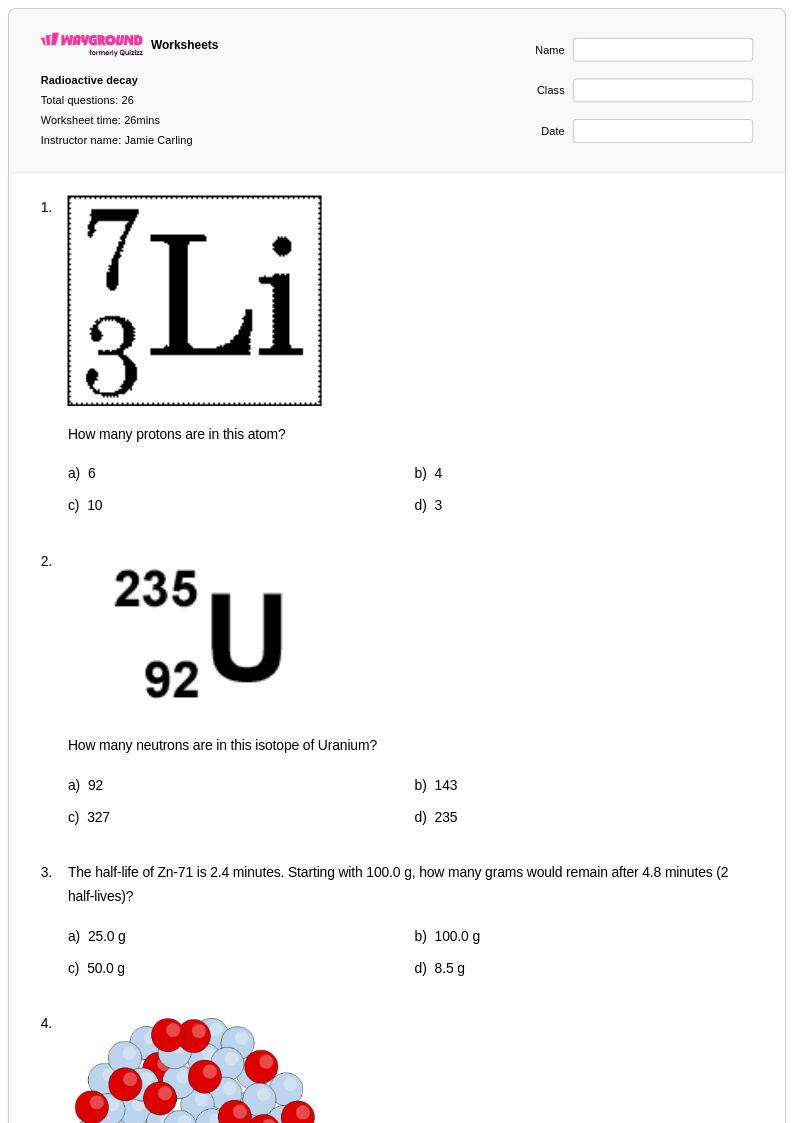
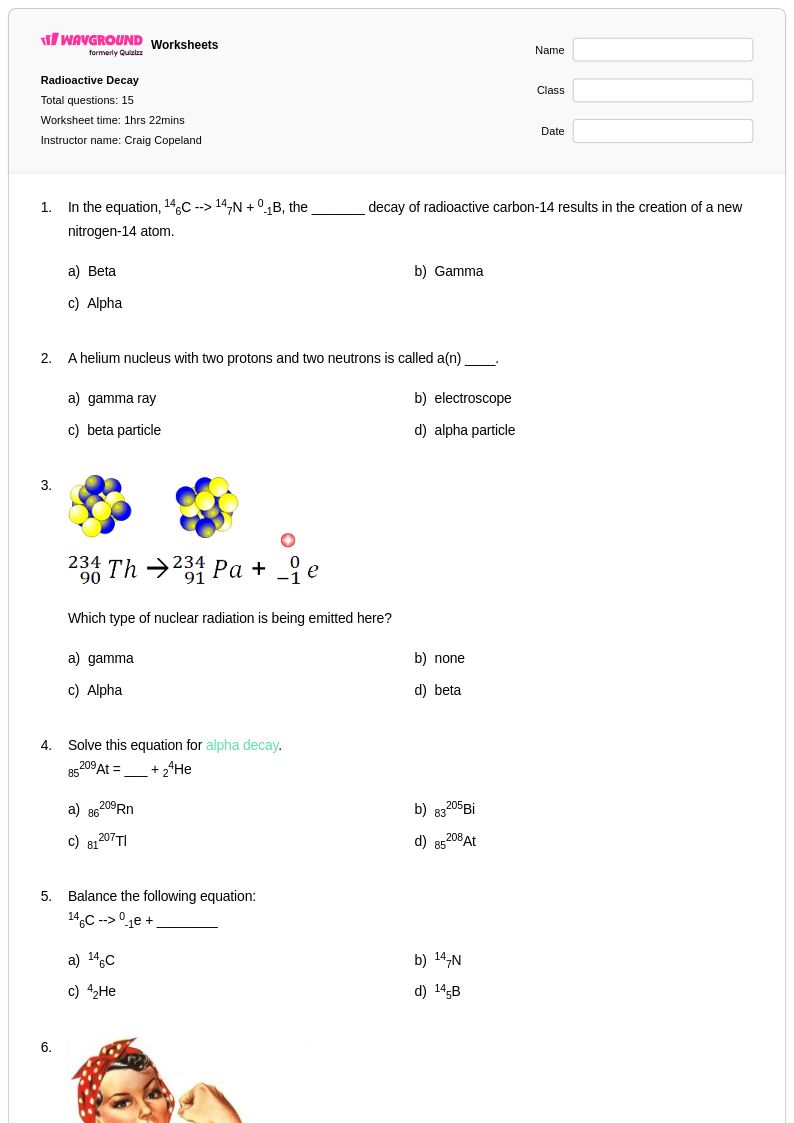
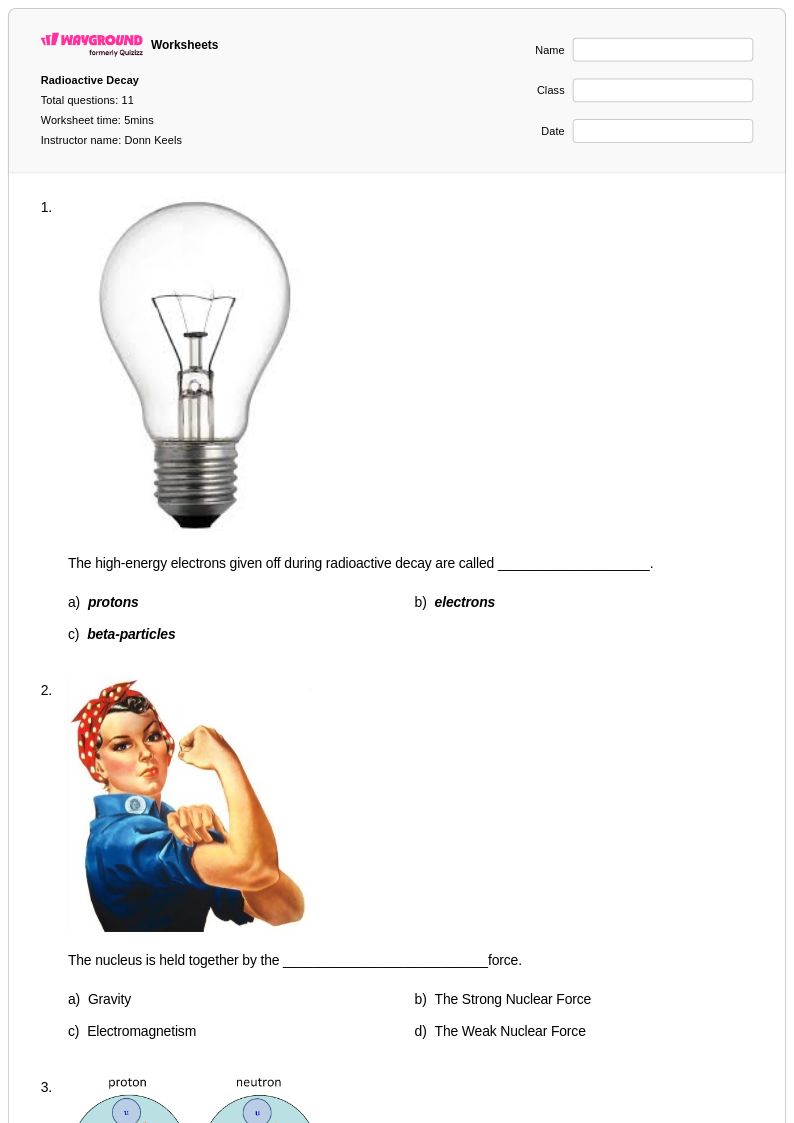
Start by grounding students in atomic structure and the concept of nuclear instability before introducing the three main decay types: alpha, beta, and gamma. Use decay equations to show how parent isotopes transform into daughter isotopes, and build toward half-life calculations using both graphical and algebraic approaches. Connecting the math to real-world applications like carbon-14 dating and medical imaging helps students see the relevance of these abstract concepts.
What practice problems help students get better at half-life calculations?
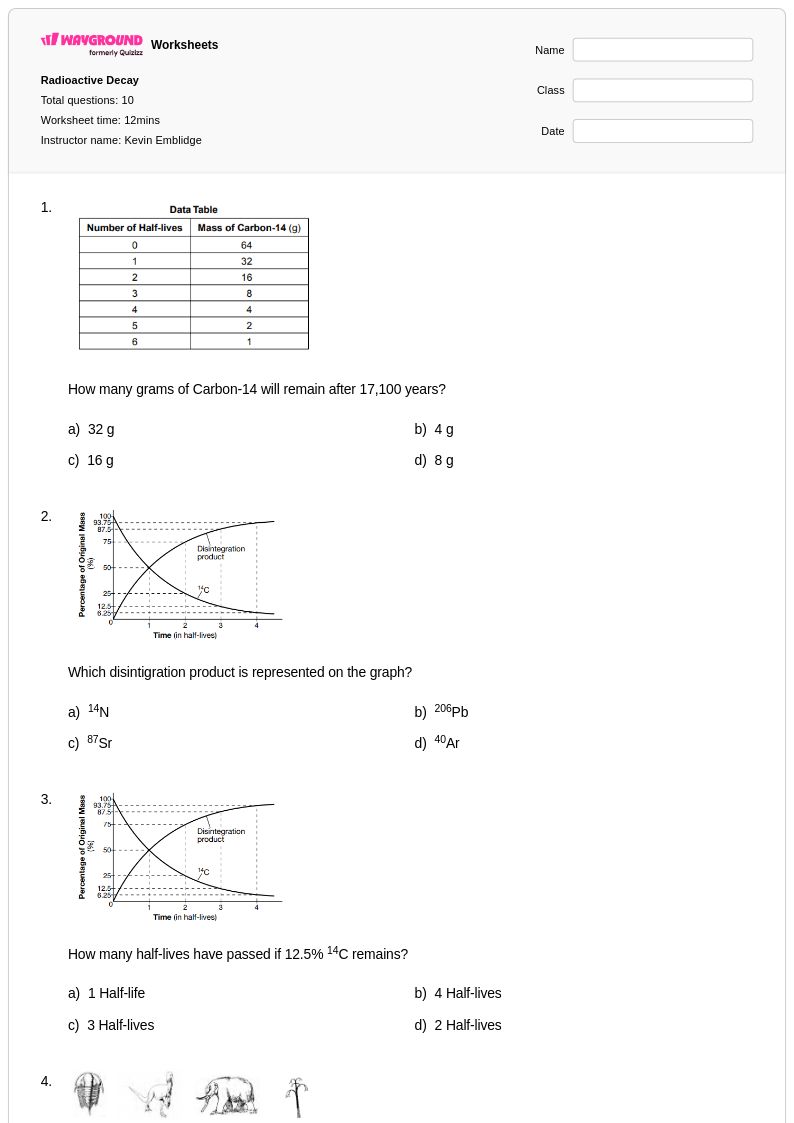
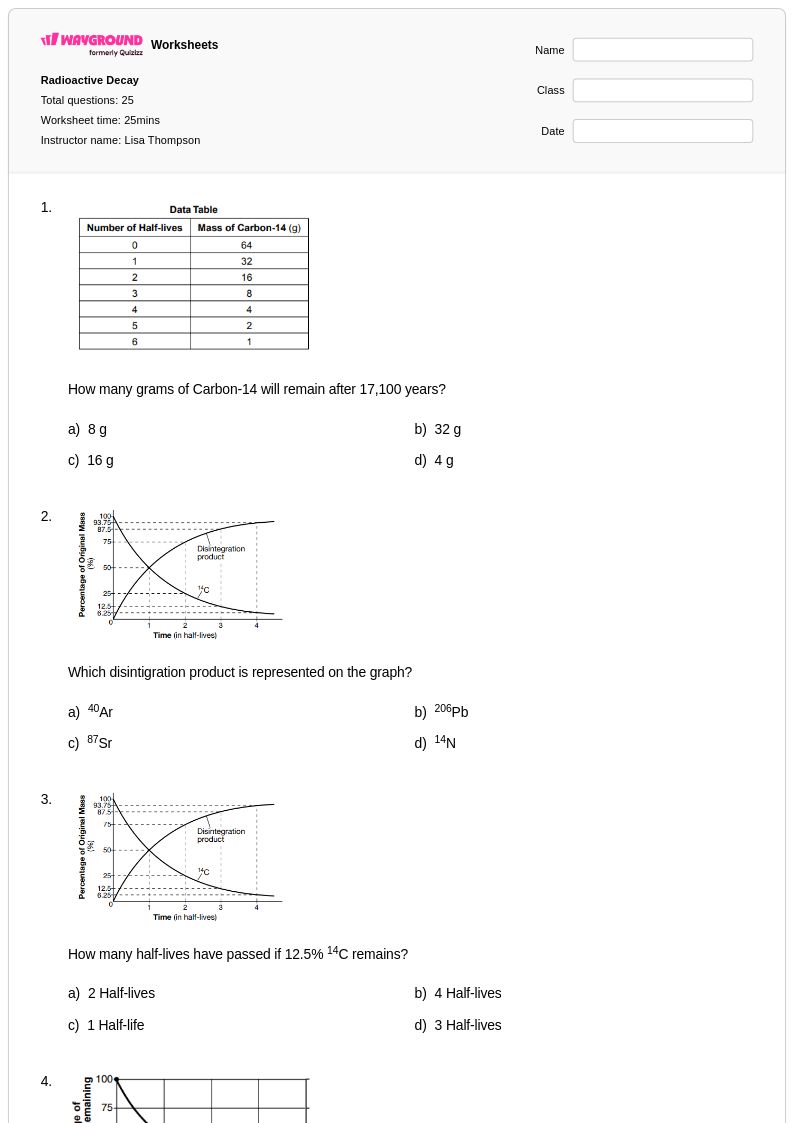
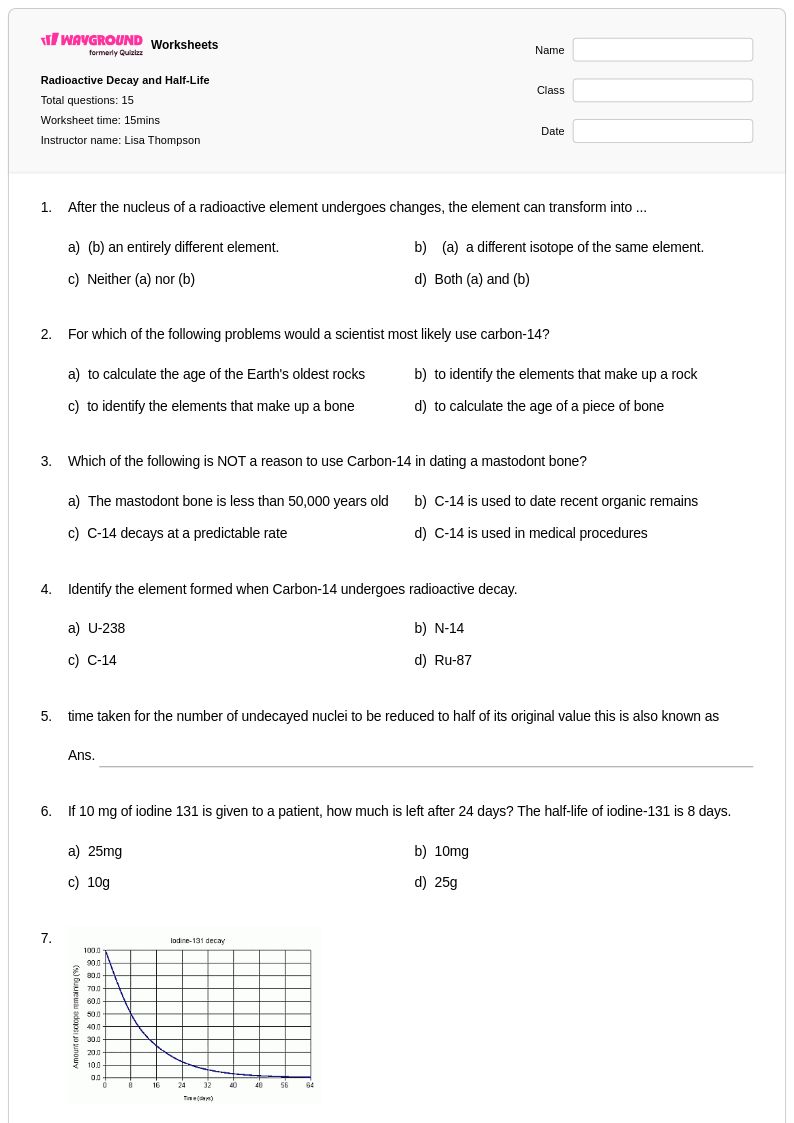
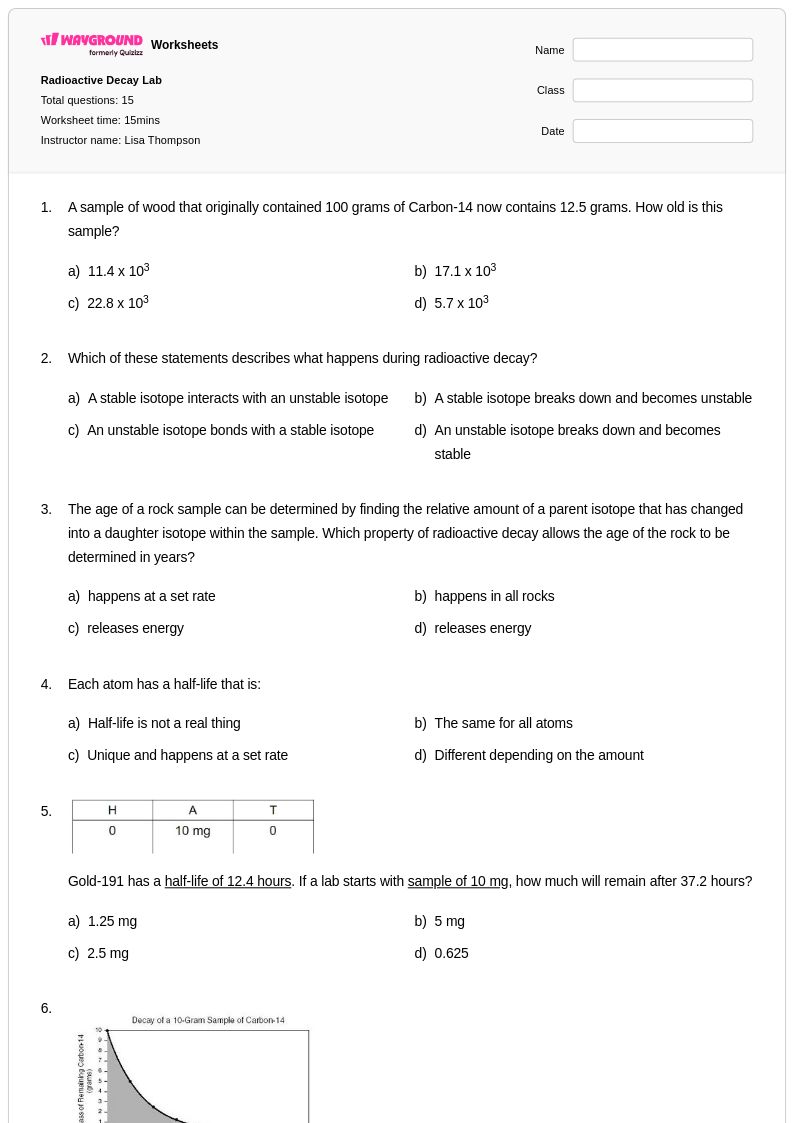
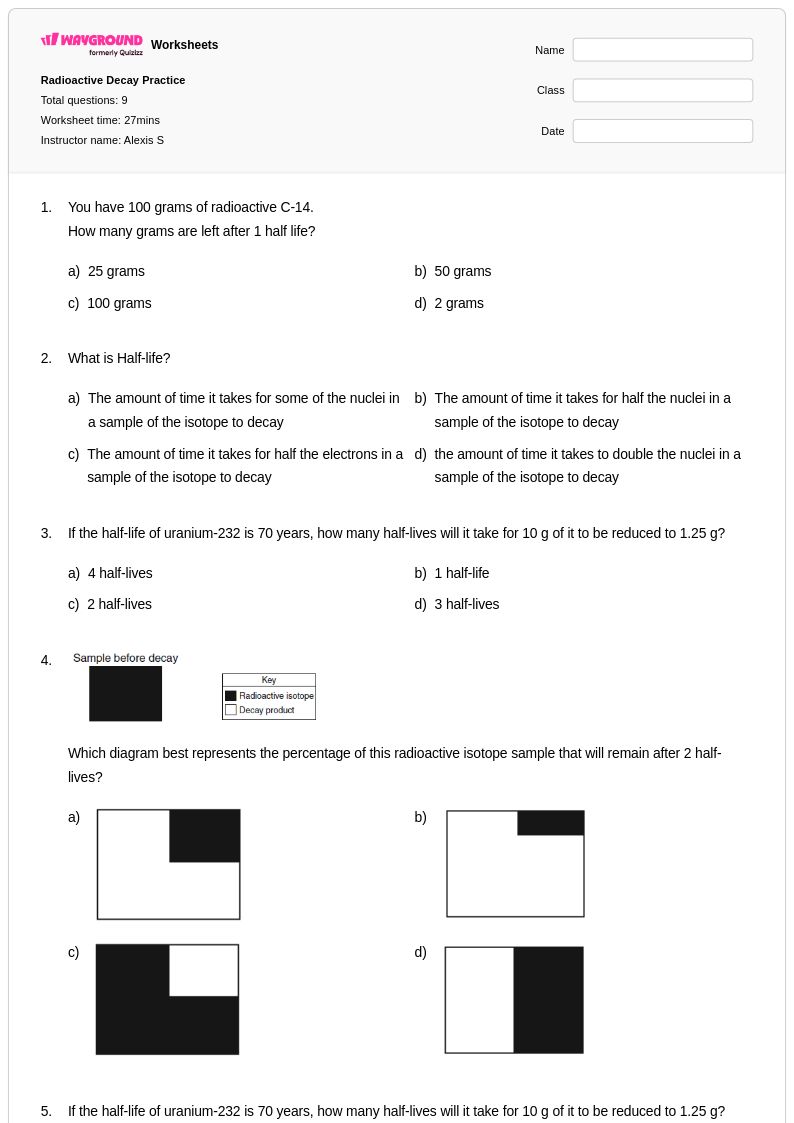
Students benefit most from a progression that starts with simple half-life tables, moves to interpreting decay curves, and then applies the exponential decay formula to solve for elapsed time or remaining quantity. Problems that ask students to work both forward and backward — given the half-life, find the remaining amount, or given the remaining amount, find the time elapsed — build the flexibility needed for assessments. Including radioactive dating scenarios adds context that reinforces why these calculations matter.
What mistakes do students commonly make when solving radioactive decay problems?
The most common error is confusing the number of half-lives elapsed with the total time elapsed, which leads to incorrect calculations when the half-life period is not one unit of time. Students also frequently misapply the exponential decay formula by using the wrong base or forgetting to convert units consistently. Another persistent misconception is treating decay as a linear process rather than an exponential one, which causes systematic errors when interpreting decay curves.
How do I use Wayground's radioactive decay worksheets in my classroom?
Wayground's radioactive decay worksheets are available as printable PDFs for traditional classroom use and in digital formats for technology-integrated or remote learning environments. Teachers can also host the worksheets as a quiz directly on Wayground, which allows for real-time student response tracking. Each worksheet includes a complete answer key, making them efficient tools for guided practice, independent work, or homework assignments.
How can I differentiate radioactive decay instruction for students at different levels?
For students who need additional support, reduce cognitive load by starting with whole-number half-life intervals and providing a reference formula sheet before moving to independent problem-solving. Advanced learners can be challenged with multi-step decay chain problems or asked to derive the exponential decay equation from first principles. On Wayground, teachers can apply accommodations such as reduced answer choices or read-aloud support to individual students without disrupting the rest of the class.
How do decay curves help students understand radioactive decay?
Decay curves provide a visual representation of the exponential relationship between time and the amount of remaining radioactive material, which helps students who struggle with the abstract formula develop intuition for how half-lives work. By reading off values at each half-life interval, students can verify their algebraic calculations and identify the characteristic shape of exponential decay. Interpreting decay curves also prepares students for data analysis questions on standardized assessments.