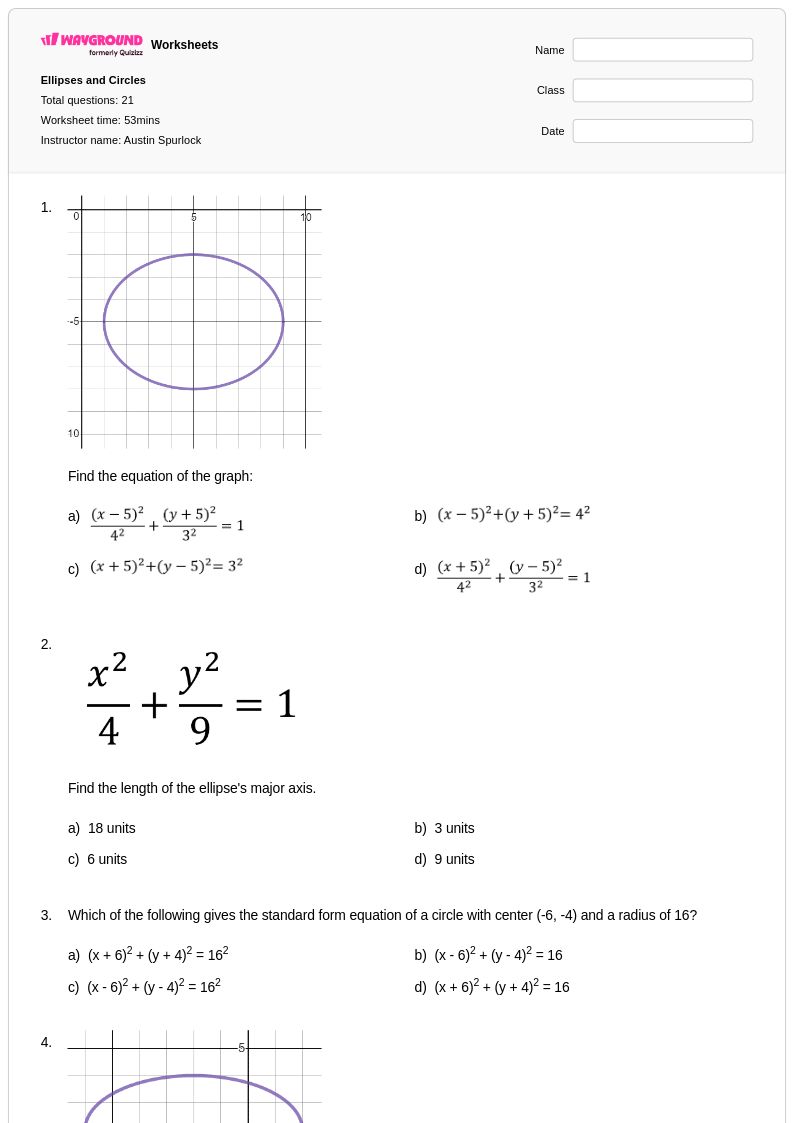
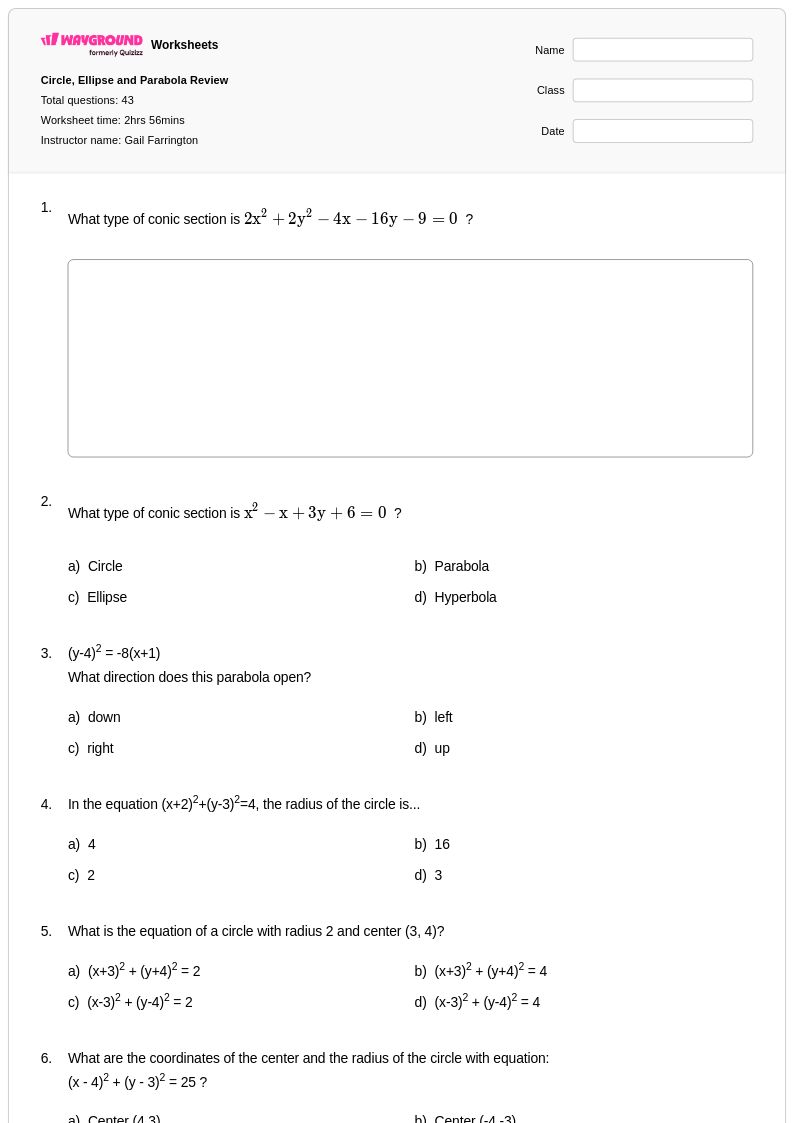
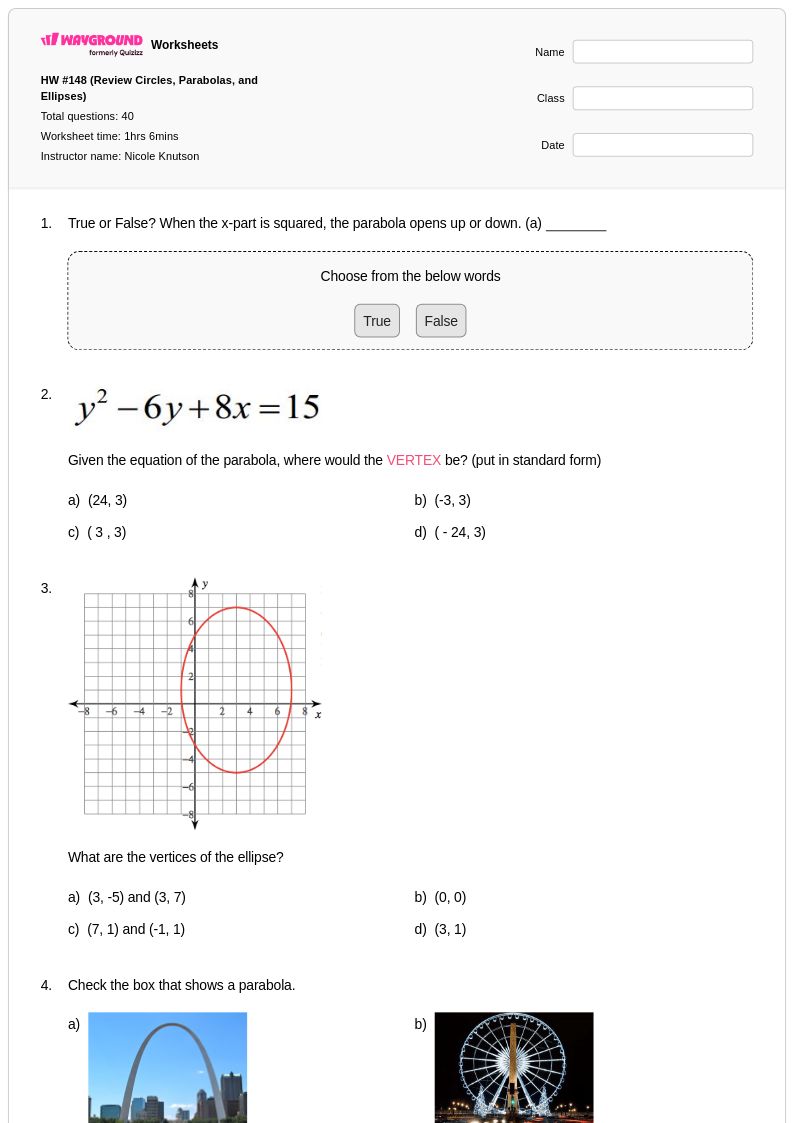
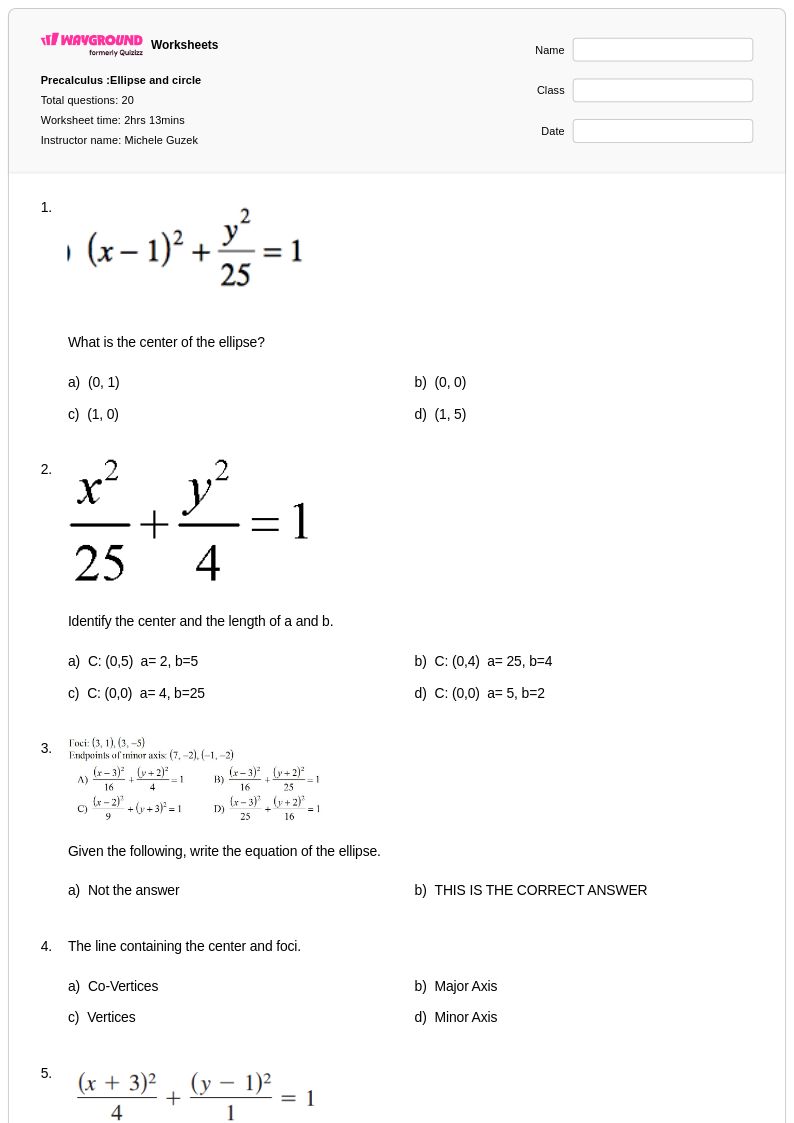
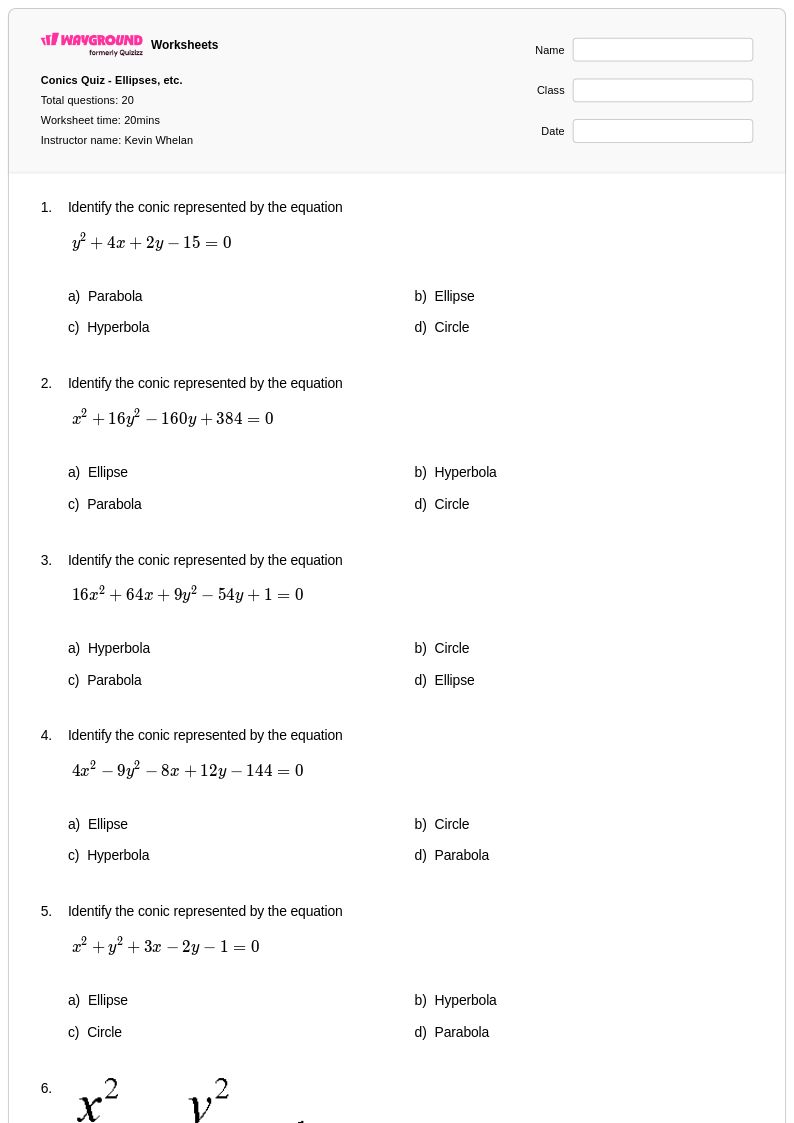
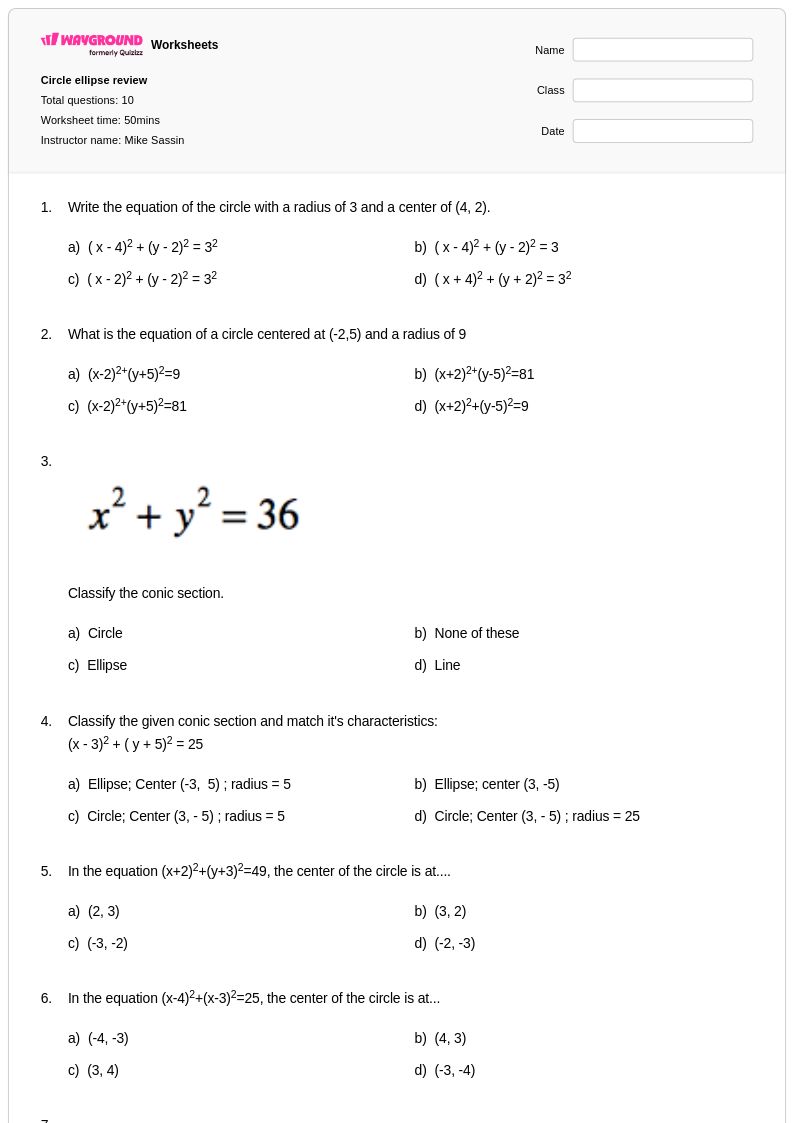
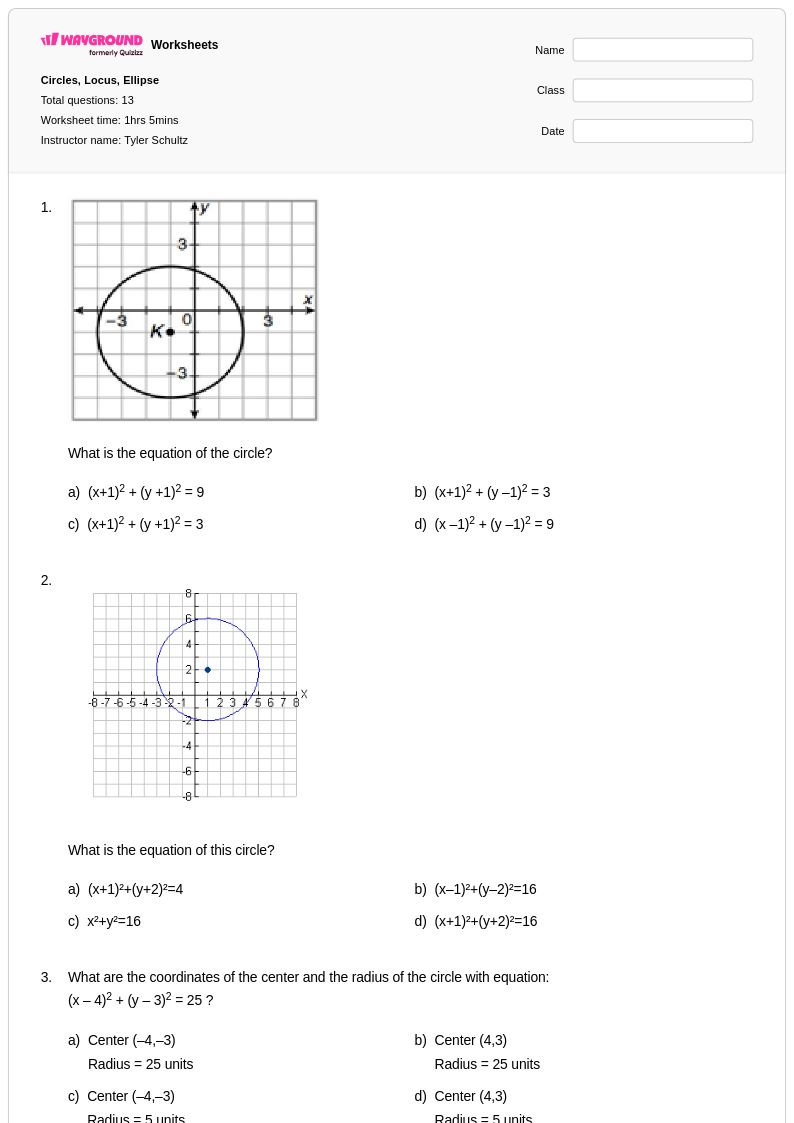
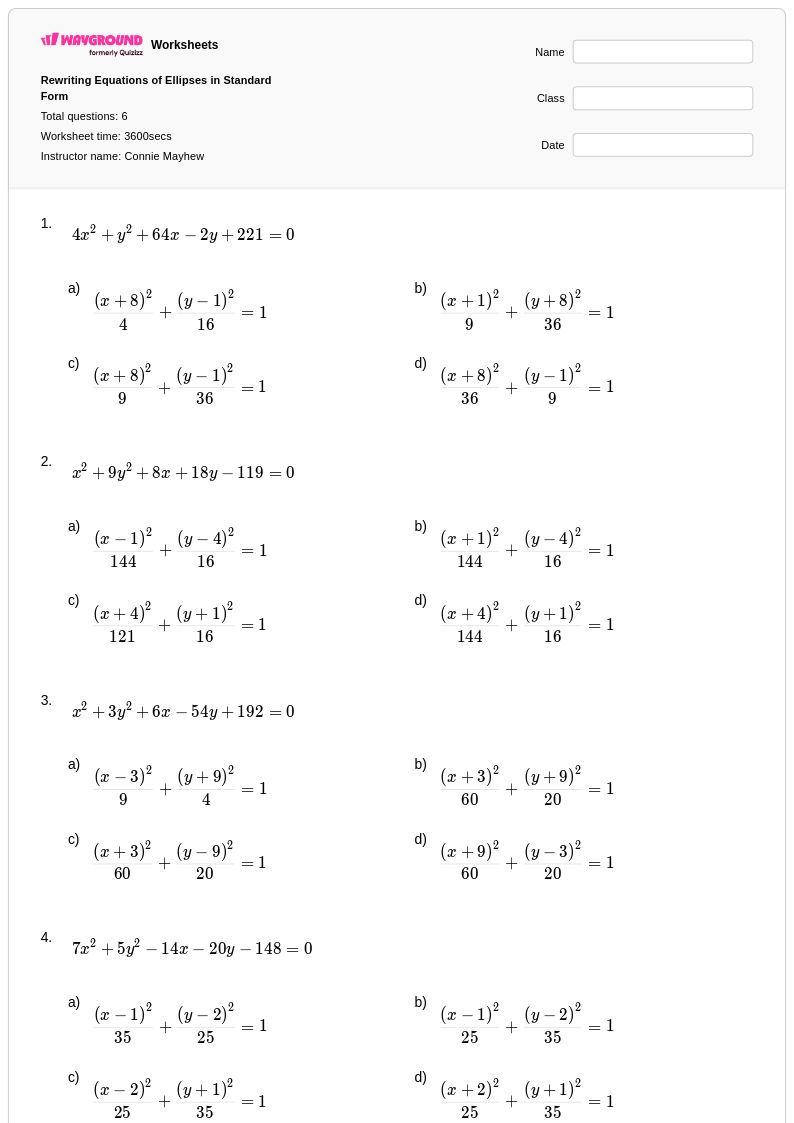
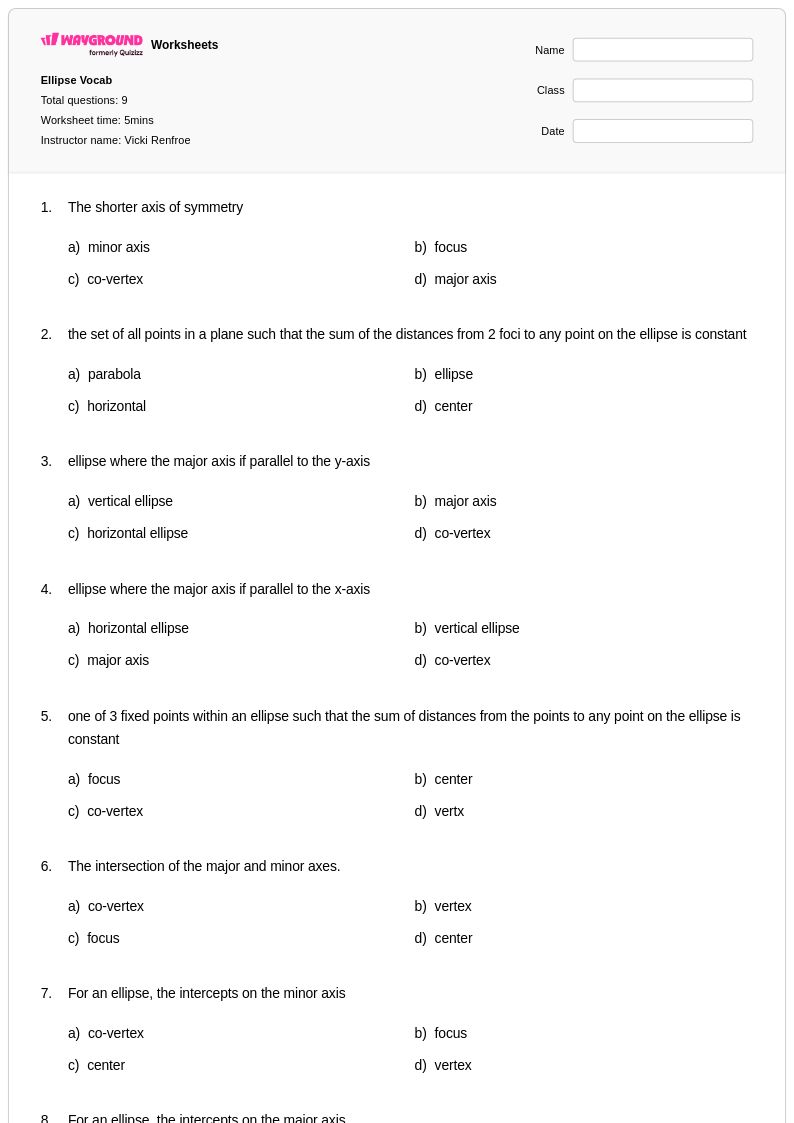
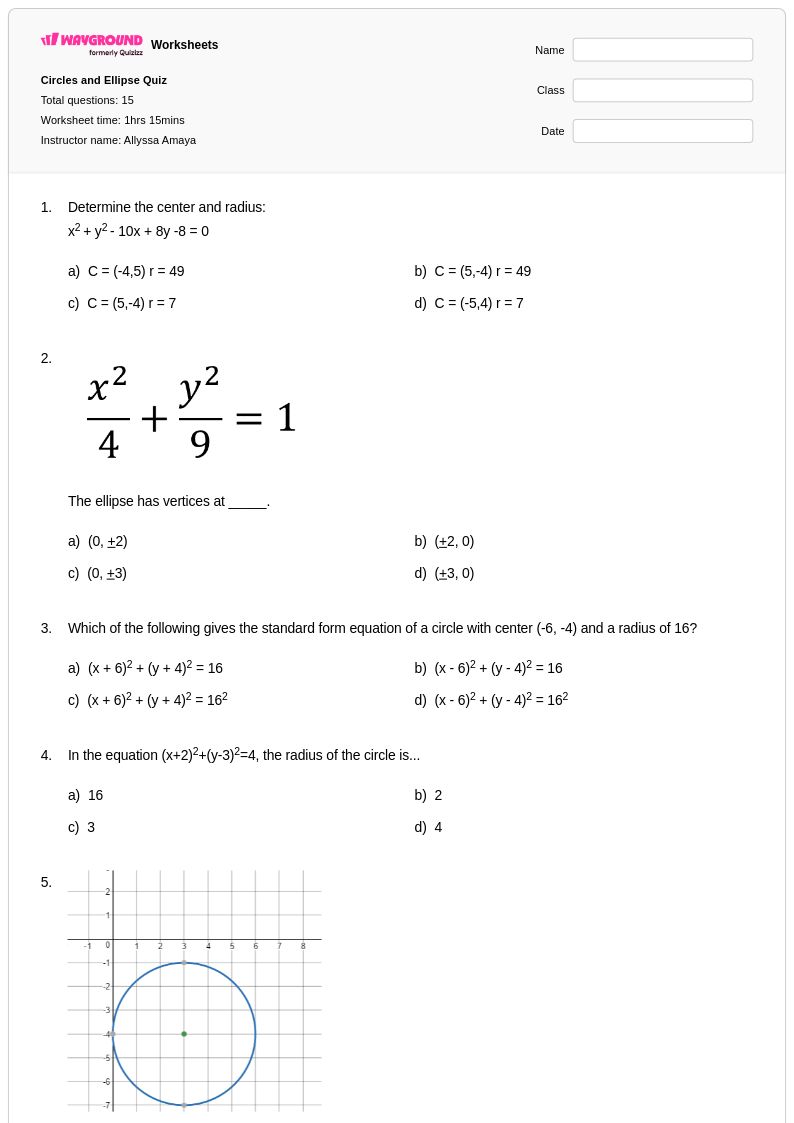
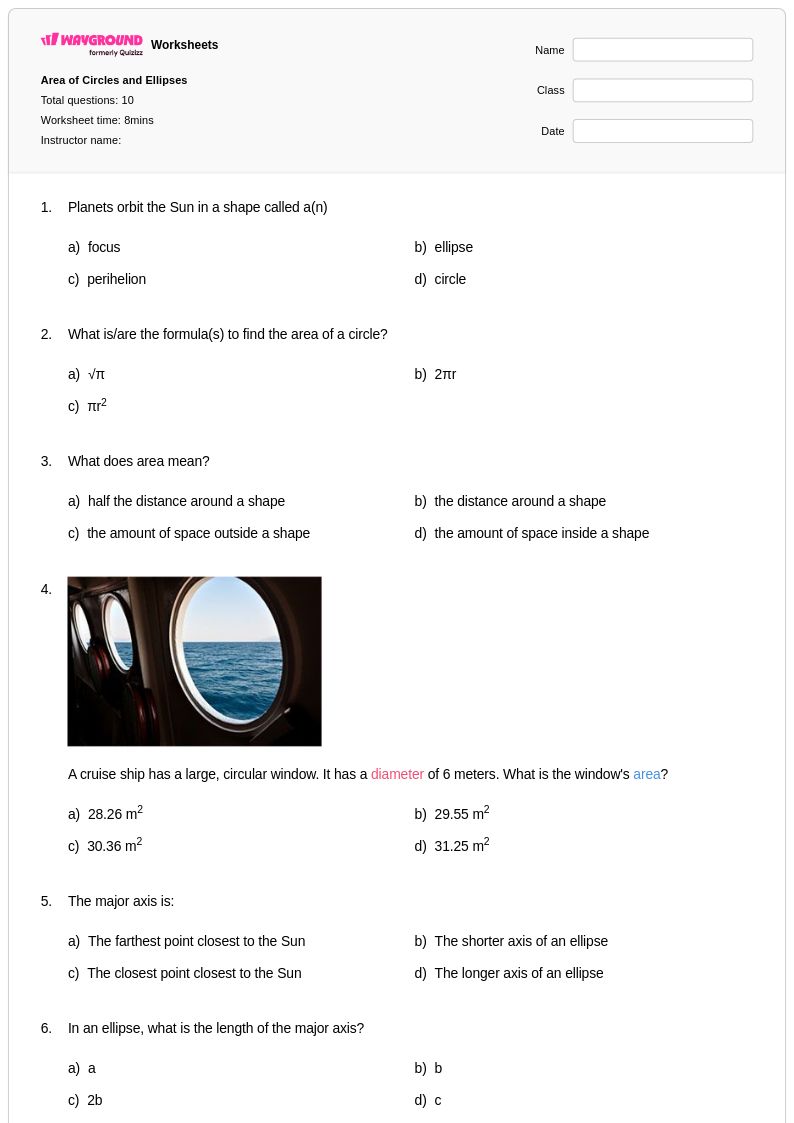
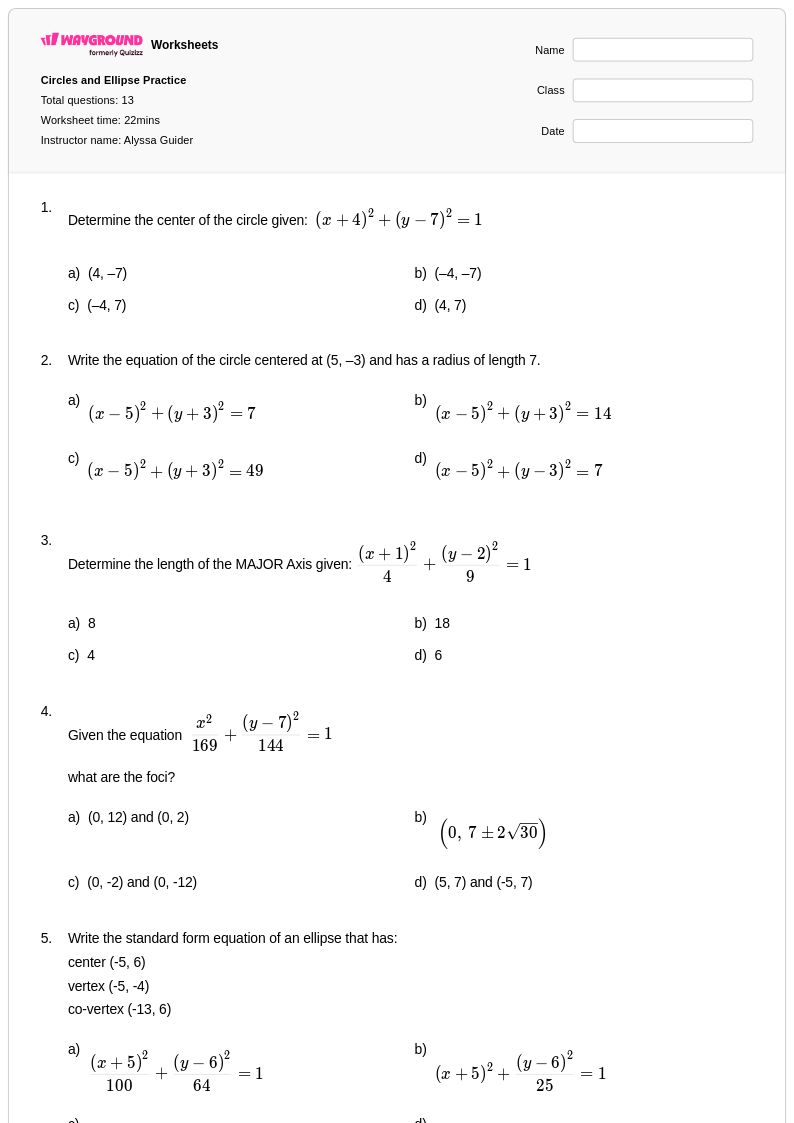
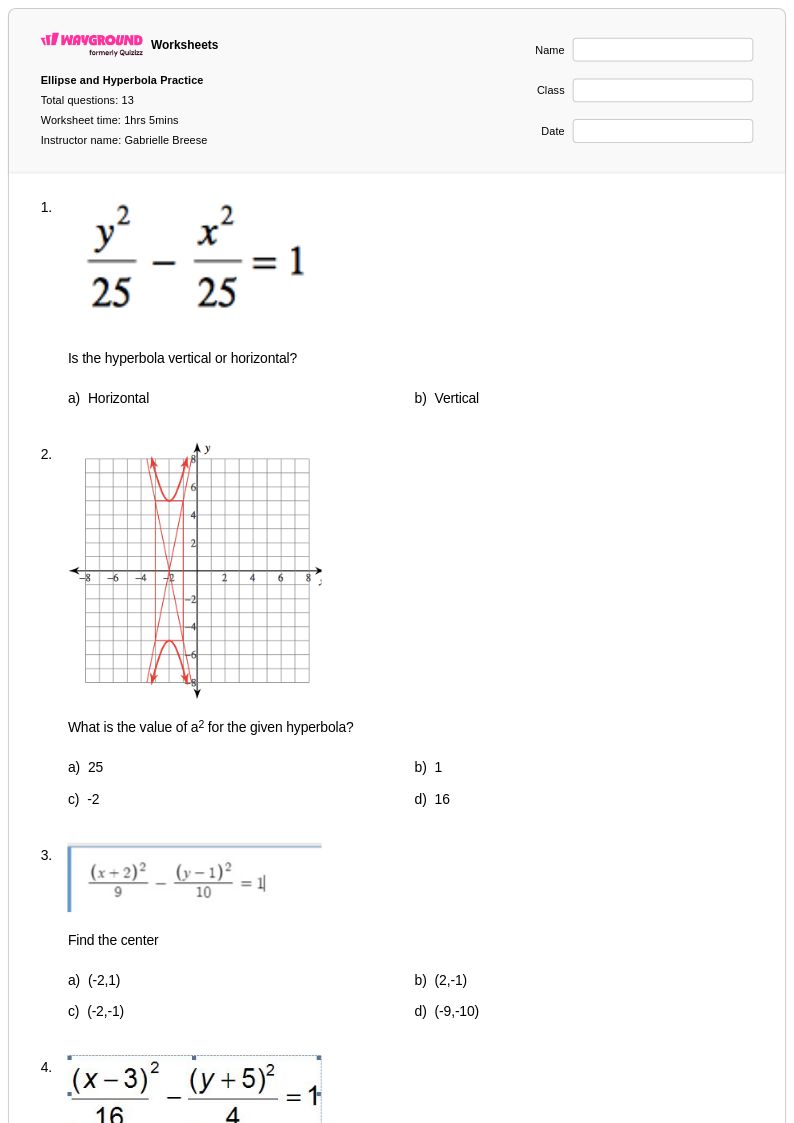
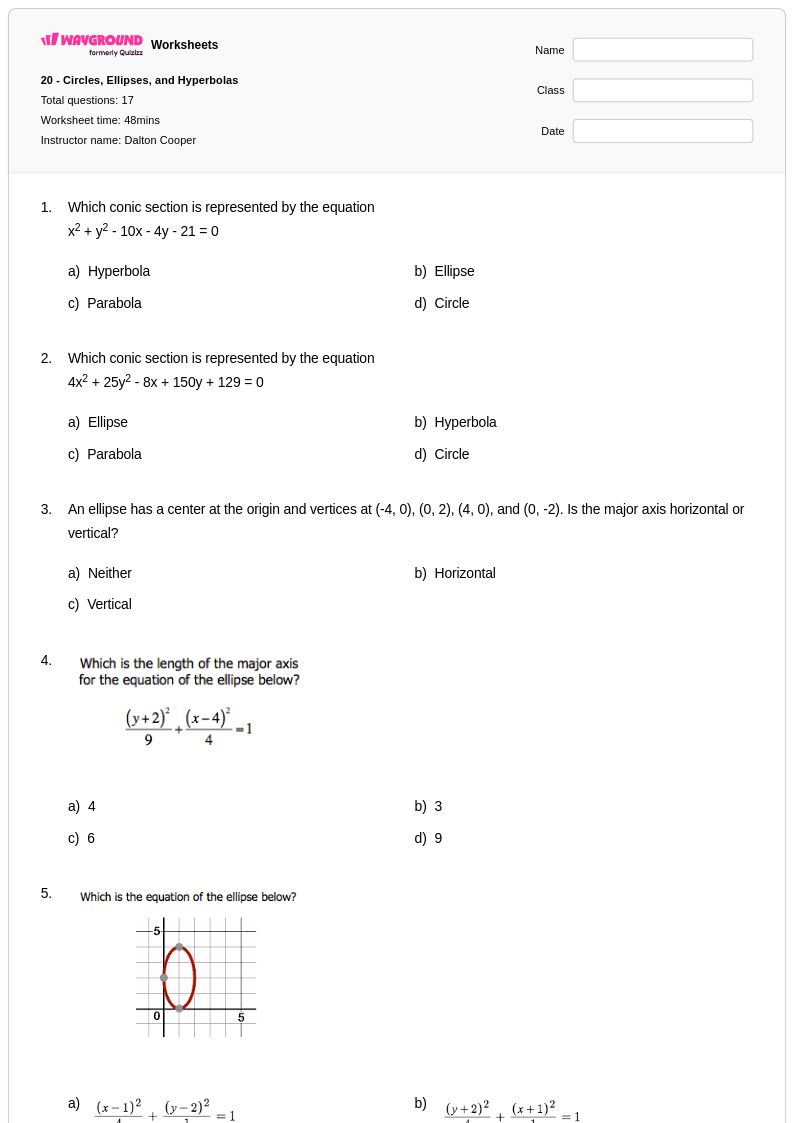
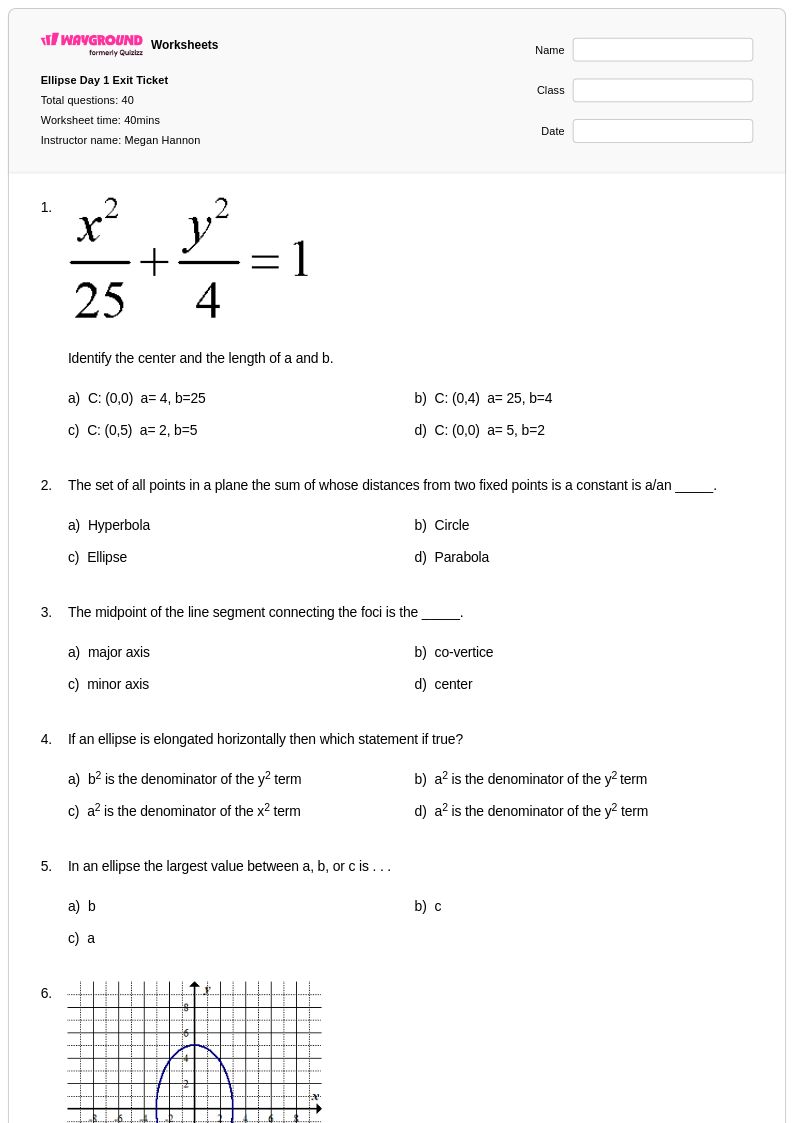
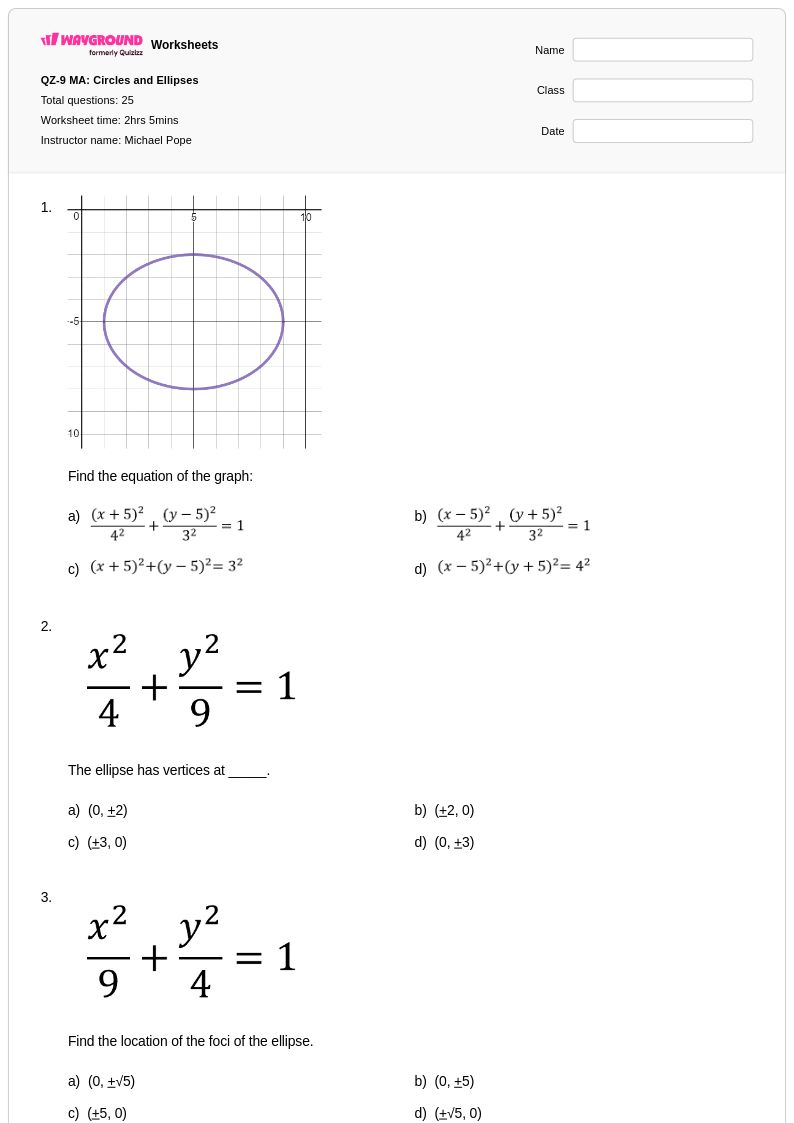
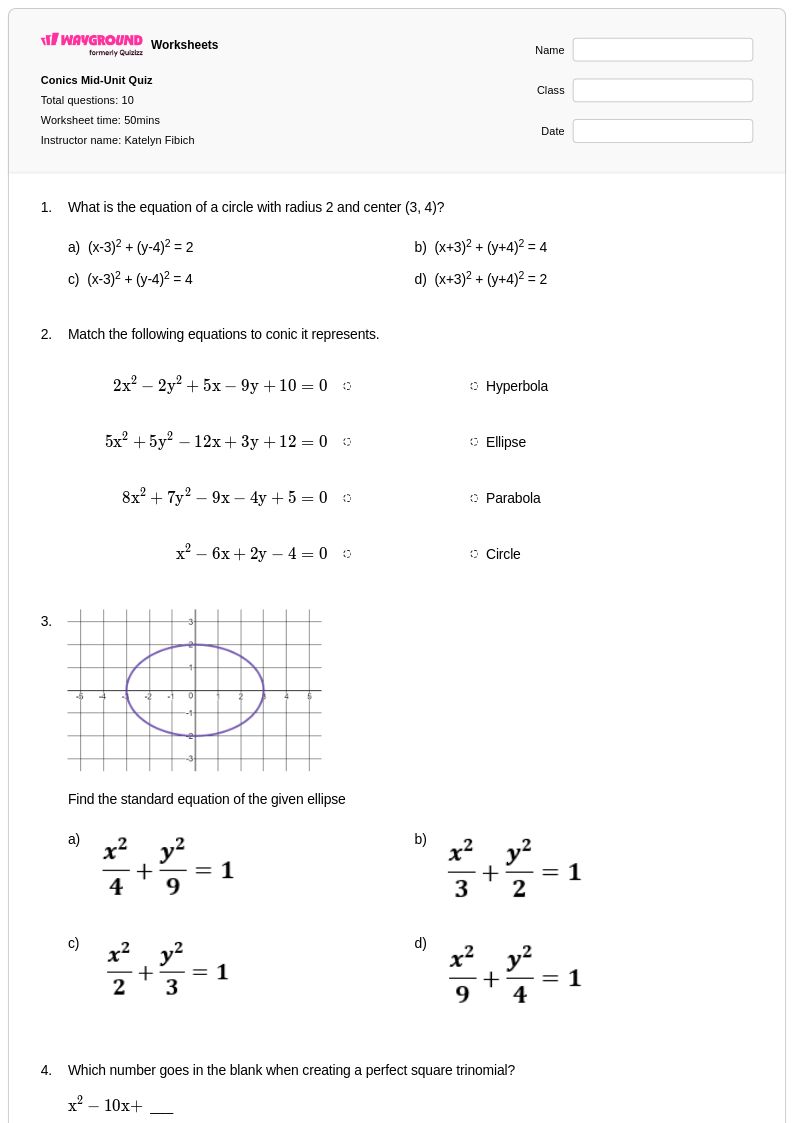
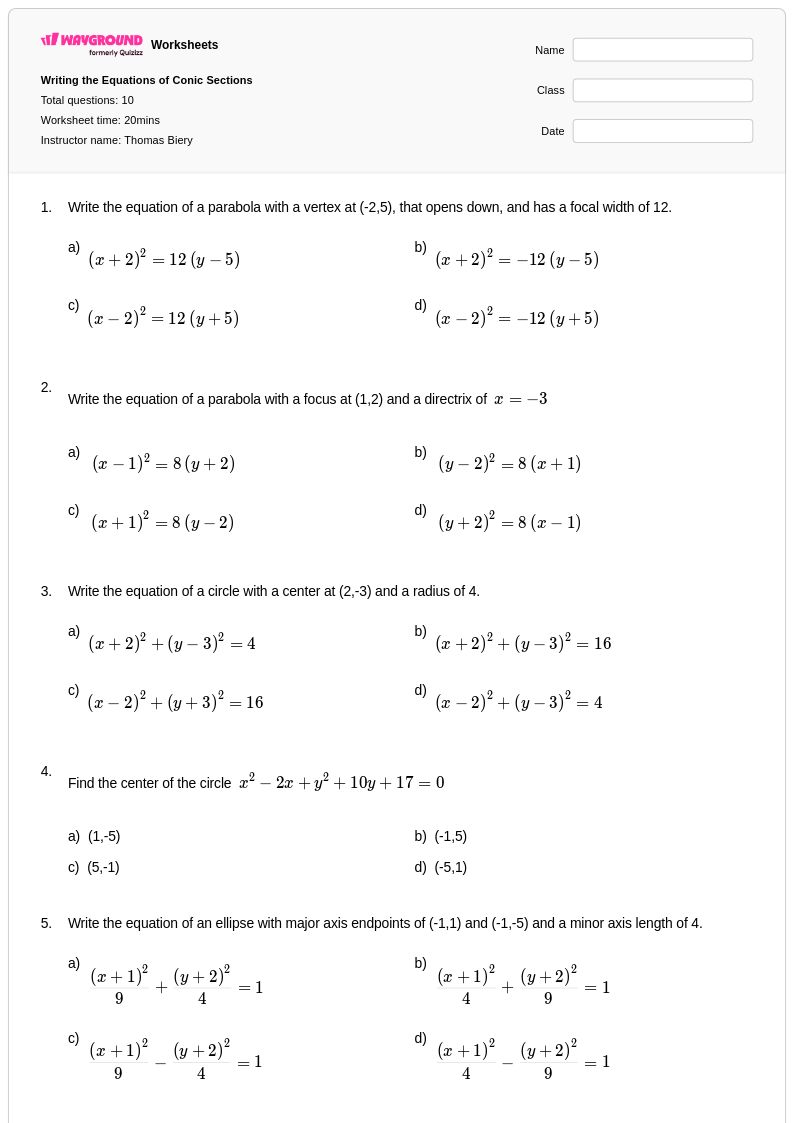
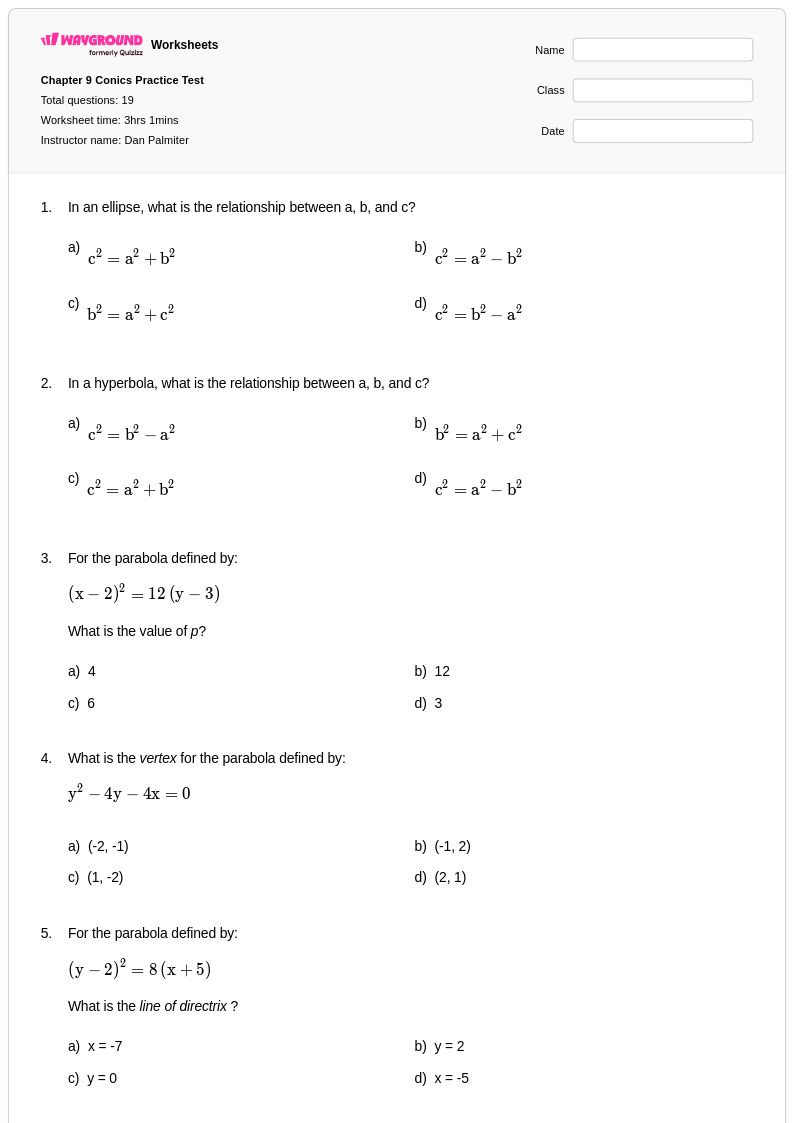
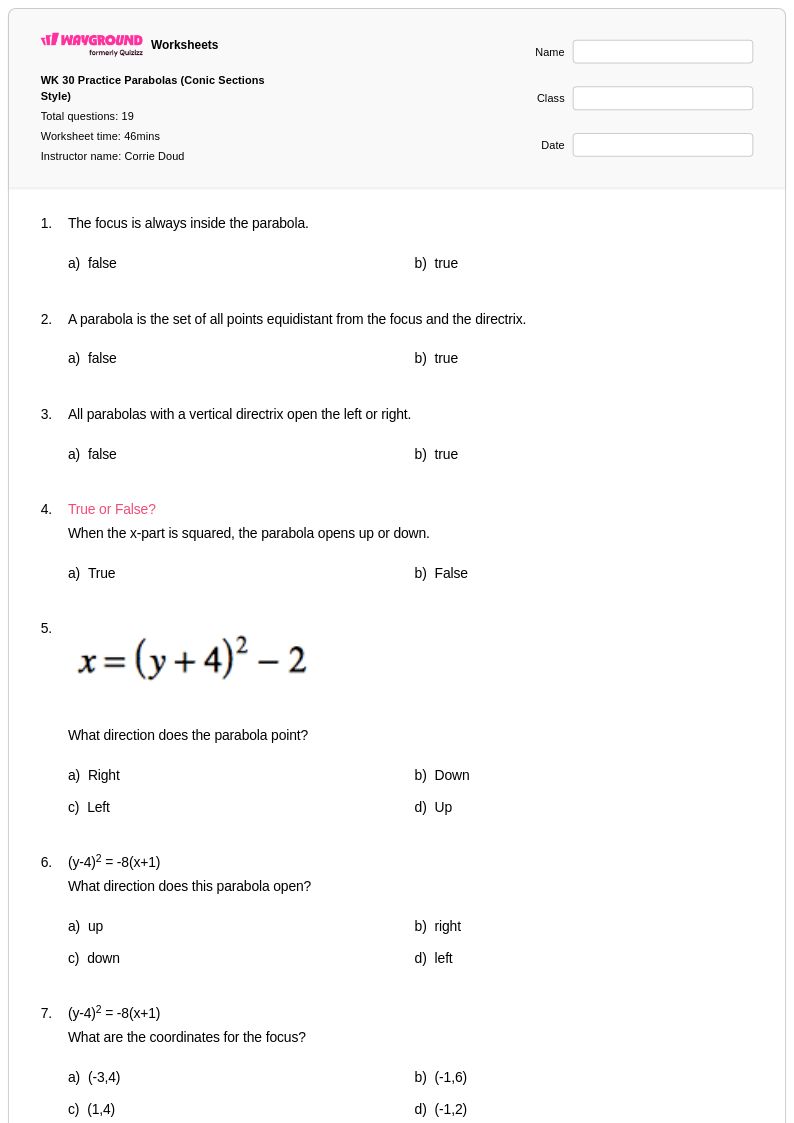
Free Class 9 ellipses worksheets and printables help students master conic sections through practice problems covering equations, graphing, and properties, complete with answer keys and PDF downloads.
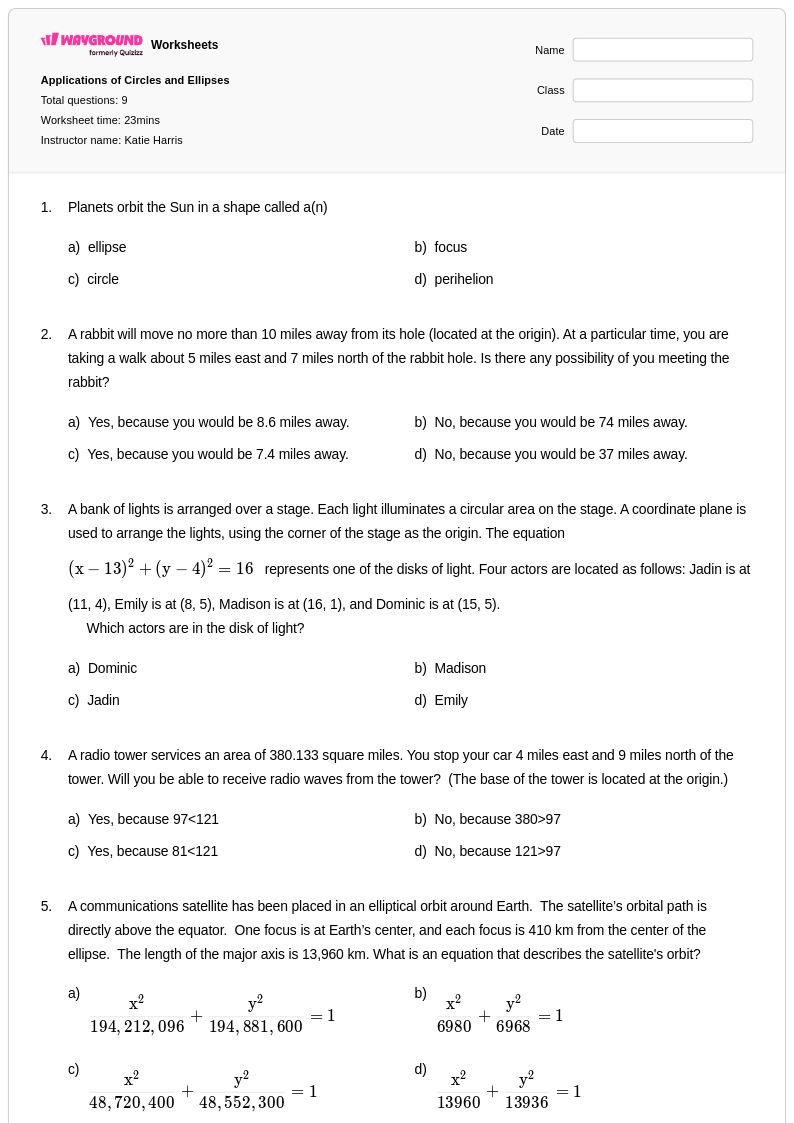
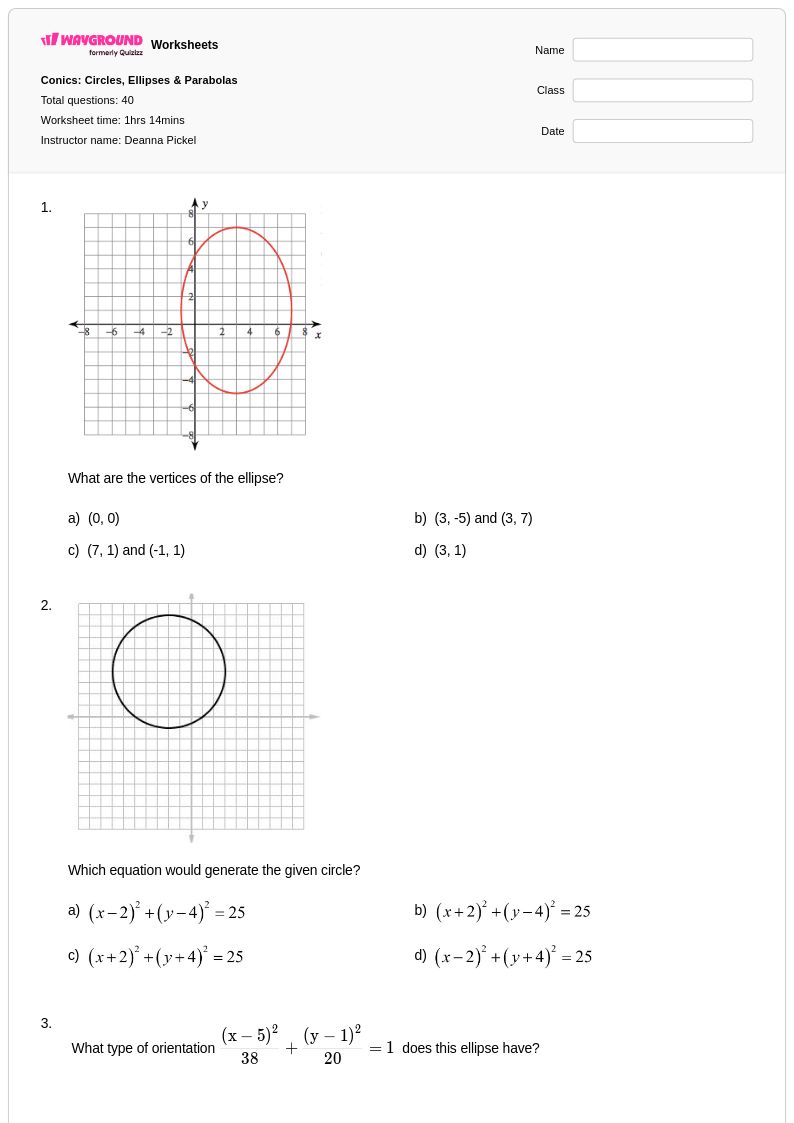
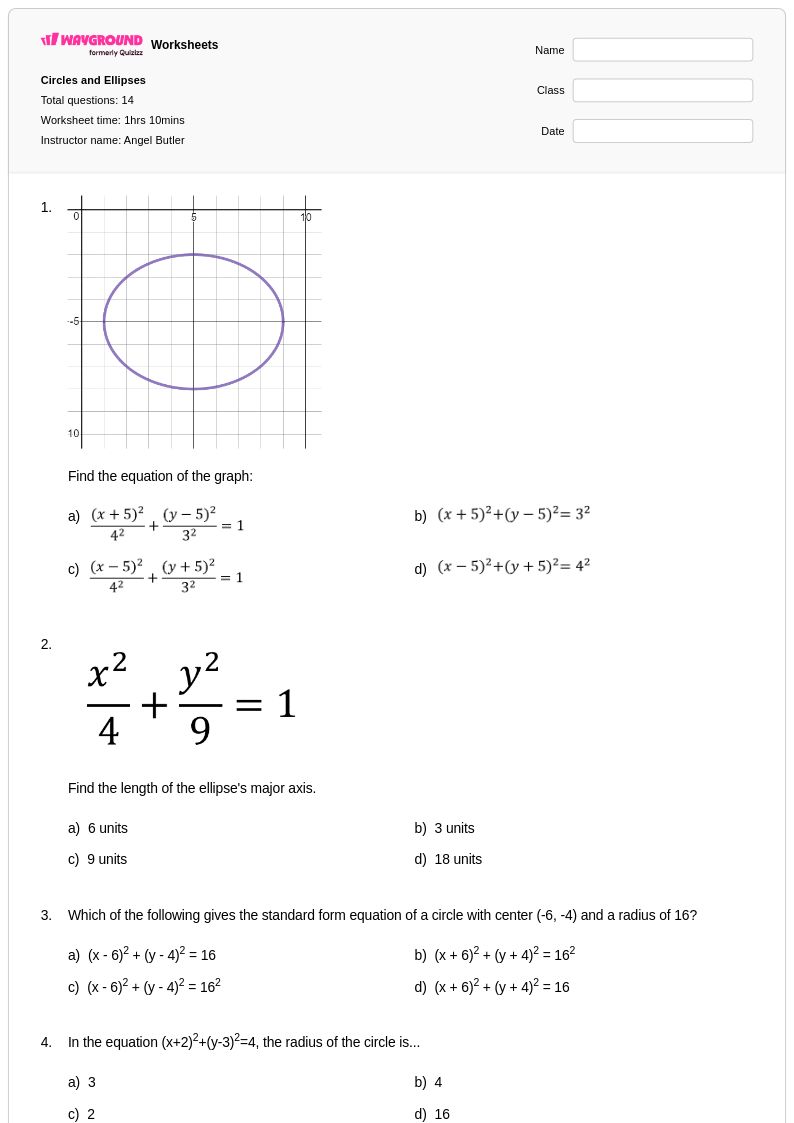
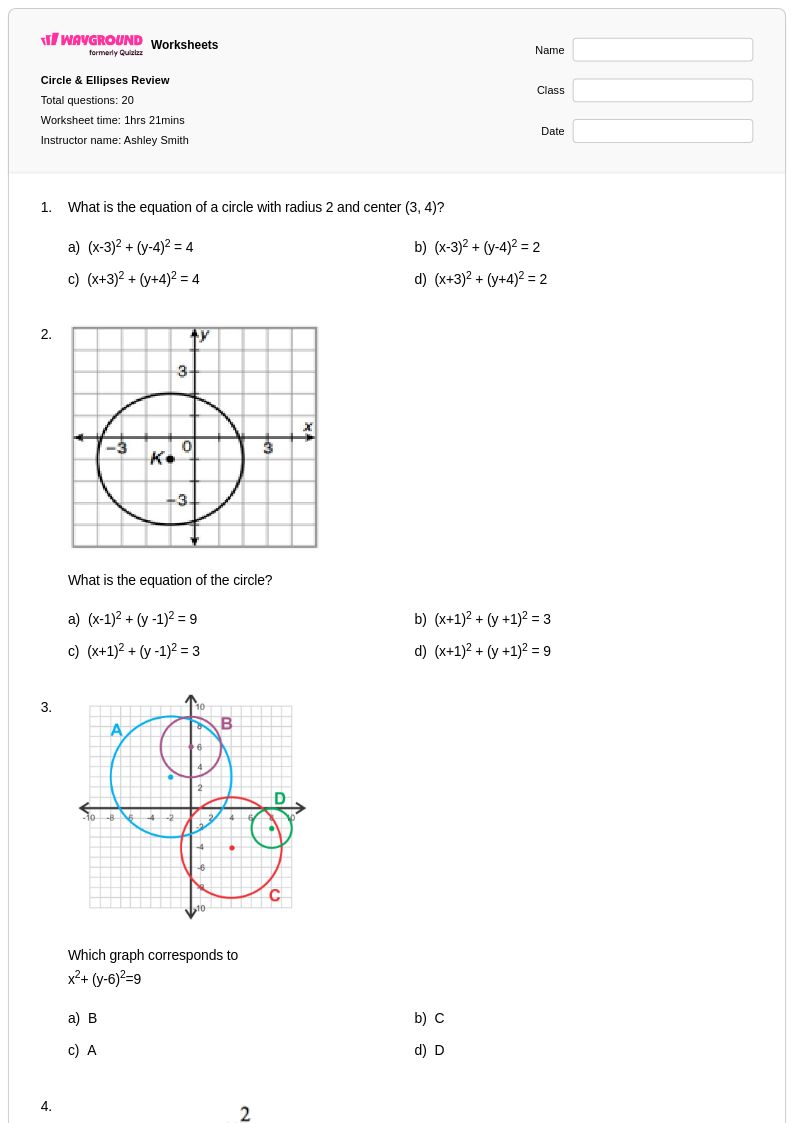
Ellipses worksheets for Class 9 students available through Wayground (formerly Quizizz) provide comprehensive coverage of this fundamental conic section in geometry. These expertly crafted resources help students master the essential skills of identifying ellipse properties, writing equations in standard form, finding vertices and foci, and calculating eccentricity values. The practice problems systematically progress from basic ellipse recognition to advanced applications involving translations and real-world contexts. Each worksheet includes detailed answer keys that enable independent learning and self-assessment, while the free printable pdf format ensures accessibility for all classroom environments. Students develop critical analytical thinking as they work through problems involving ellipse graphing, determining major and minor axes, and understanding the geometric relationships that define these curved figures.
Wayground (formerly Quizizz) empowers educators with millions of teacher-created ellipse worksheet resources that feature robust search and filtering capabilities aligned to mathematical standards. Teachers can efficiently locate materials that match their specific instructional needs, whether focusing on introductory ellipse concepts or advanced coordinate geometry applications. The platform's differentiation tools allow educators to customize worksheets for varying skill levels, supporting both remediation for struggling learners and enrichment opportunities for advanced students. Available in both printable and digital pdf formats, these resources seamlessly integrate into lesson planning while providing flexible options for homework assignments, skill practice sessions, and formative assessments. The comprehensive collection enables teachers to scaffold ellipse instruction effectively, ensuring students build strong foundational understanding before progressing to more complex conic section relationships.
FAQs
What ellipse concepts should 9th graders be learning?
Grade 9 is where ellipse study becomes fully algebraic and analytical. Students should be able to write equations in standard form, identify vertices and foci from the equation, calculate eccentricity, and graph ellipses that are not centered at the origin. Translations — shifting the center to (h, k) — are a key 9th grade skill, as is moving fluently between standard form and general form. Real-world applications, such as orbital mechanics or architectural design, are also appropriate at this level.
How do I teach ellipse translations and non-standard center positions to 9th graders?
Anchor the lesson in what students already know: an ellipse centered at the origin. Then ask what happens to the equation if you slide the entire ellipse three units right and two units up. Students who understand that (x − h) and (y − k) simply shift the reference point — rather than treating the translated form as a new formula — handle these problems much more confidently. A side-by-side comparison of the origin-centered and translated equations, with the same ellipse graphed in both positions, makes the pattern obvious.
What mistakes do 9th graders commonly make with ellipses?
Eccentricity trips up a lot of students — they calculate c correctly but then divide by the wrong value (b instead of a). Translated ellipses produce sign errors: students write (x + h) instead of (x − h) when the center is at a positive x-value. And when converting from general form to standard form, incomplete or incorrect completing-the-square steps are the most common source of wrong answers. Requiring students to check their standard form by confirming the equation equals 1 at the vertices catches most of these.
How do I use Wayground's Grade 9 ellipses worksheets?
Host the worksheet as a digital quiz on Wayground to get instant class-level data on which problems are causing the most errors — useful for deciding whether to reteach before moving to hyperbolas. Or print the PDF for a test-prep session where students work through problems by hand, which more closely mirrors exam conditions. Either format includes a complete answer key, so students can self-check after independent practice.
How do ellipses fit into the Common Core high school geometry and algebra progression?
Common Core's high school geometry strand asks students to derive the equations of conic sections from their geometric definitions and understand them as cross-sections of a double cone. Ellipses are typically the second conic section students study formally, after circles, because the standard form equation is a natural extension: a circle is simply the special case where a = b. From ellipses, the progression moves to hyperbolas (where the difference of distances replaces the sum) and parabolas, completing the conic sections family. Eccentricity — introduced with ellipses — becomes the unifying concept that connects all four curves.
How can I differentiate ellipses practice for my 9th grade class?
For students who struggle with the multi-step algebra in standard form conversions, Wayground's read-aloud feature can help those with reading difficulties focus on the math rather than parsing dense problem text. For students who need more time on complex graphing problems, per-student extended time keeps the activity equitable. If you have English language learners working through conic sections vocabulary, Wayground's worksheet translation tool lets you generate a version in their home language — same problems, accessible language — without building a separate assignment.
What real-world contexts make ellipses relevant for 9th graders?
Planetary orbits are the most mathematically rich example: Kepler's first law places the sun at one focus of an elliptical orbit, which gives eccentricity immediate physical meaning — a nearly circular orbit has eccentricity close to 0, while a highly elongated one approaches 1. For students interested in engineering, elliptical arches in bridges and the reflective properties used in lithotripsy (breaking up kidney stones with focused sound waves) show that the foci aren't just abstract points. Either context gives students a reason to care about the calculation before they start the worksheet.