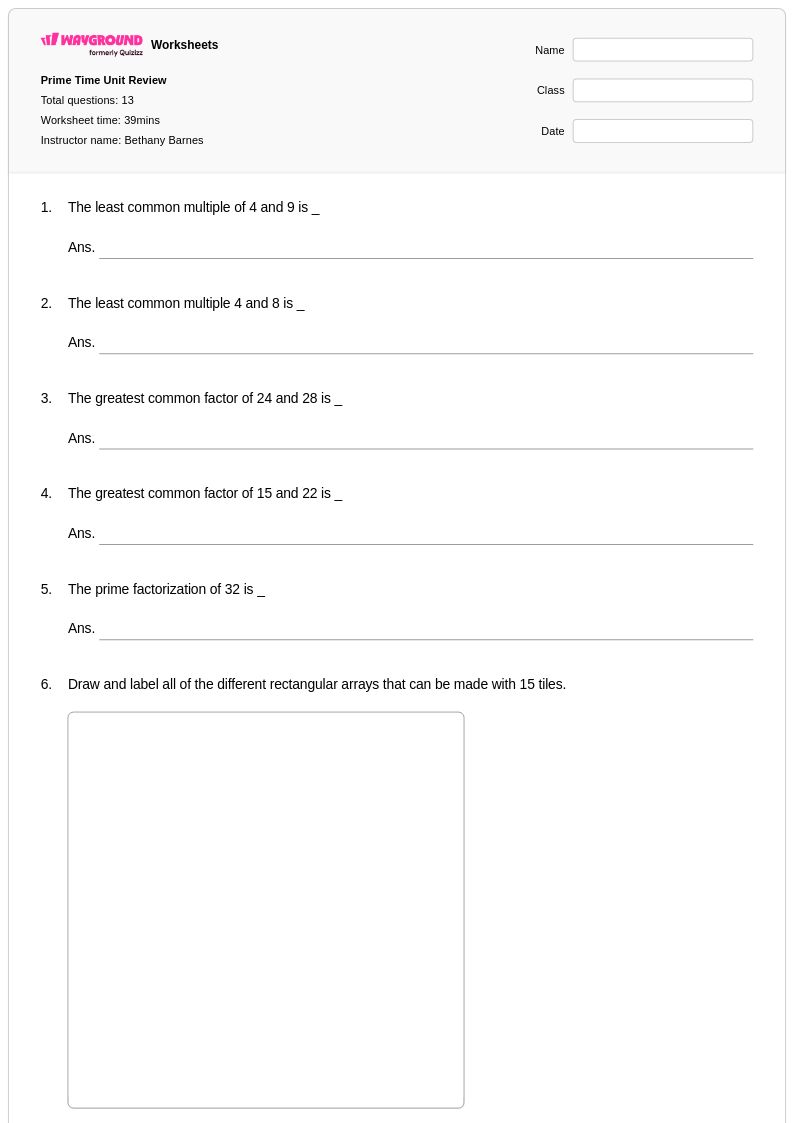
Wayground's free factor trees worksheets and printables help students master prime factorization through engaging practice problems with comprehensive answer keys and downloadable PDF formats.
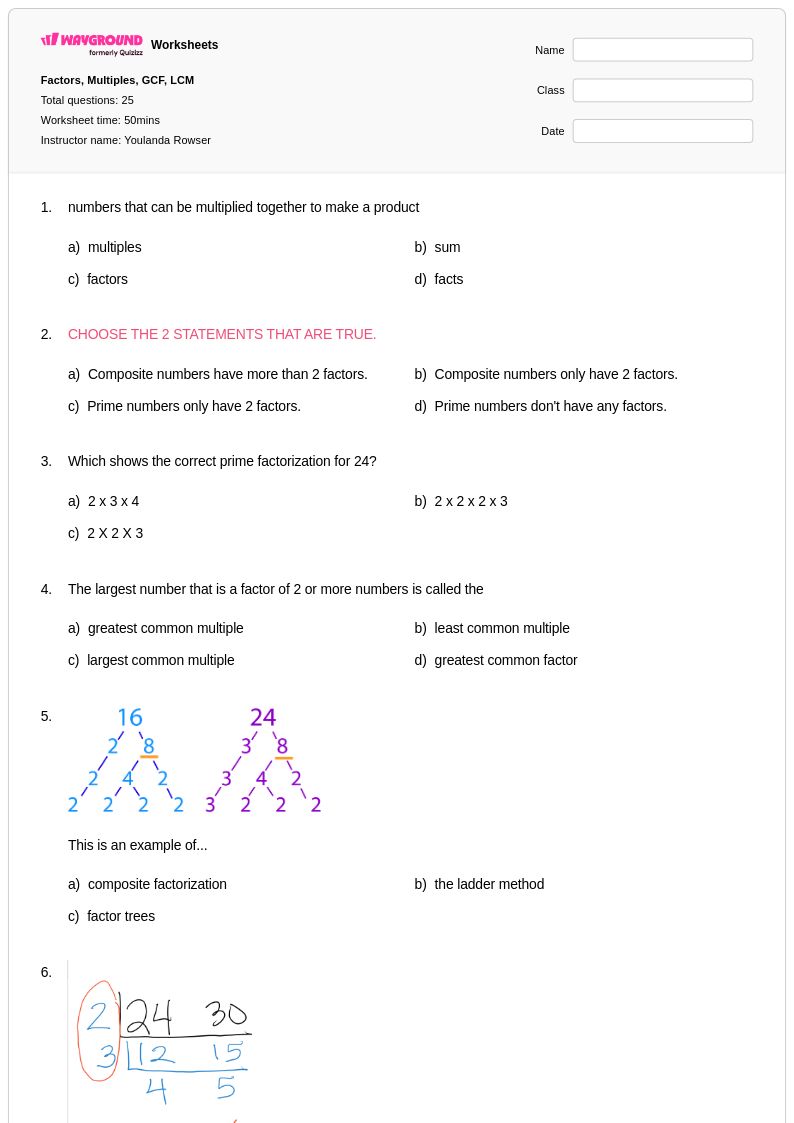
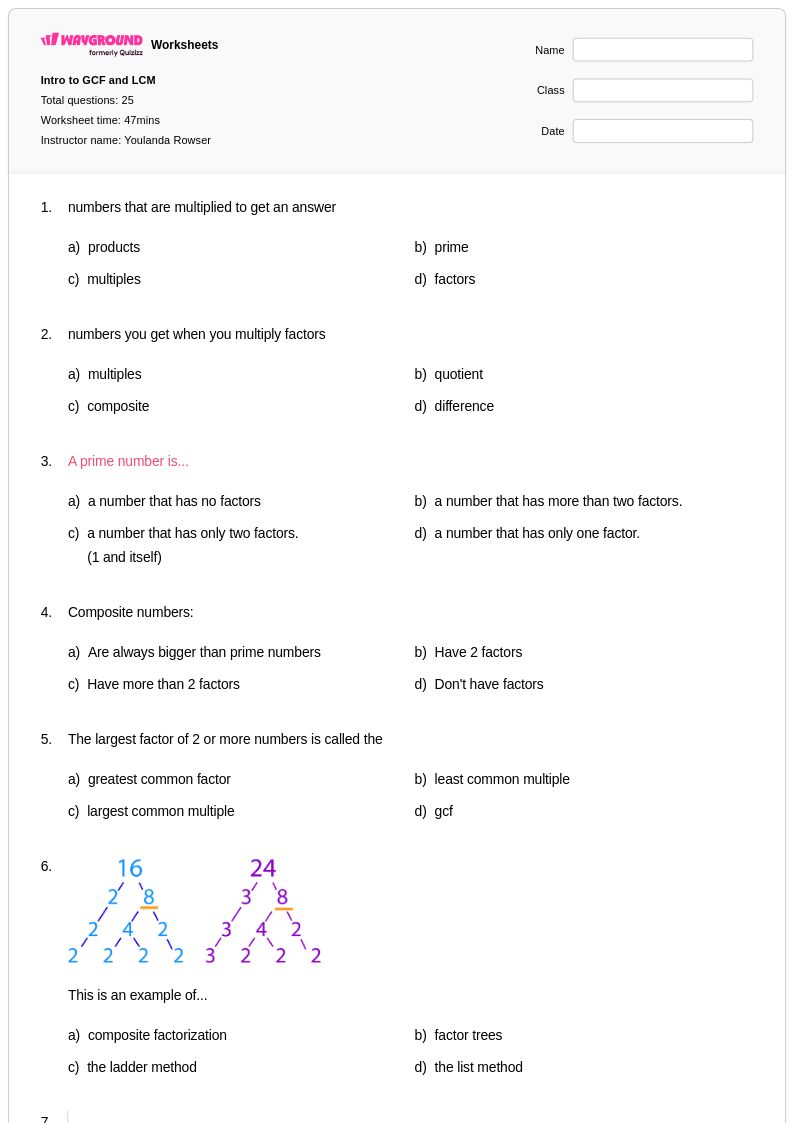
Factor trees worksheets available through Wayground (formerly Quizizz) provide students with systematic practice in decomposing composite numbers into their prime factorization using visual tree diagrams. These comprehensive worksheets strengthen fundamental number sense skills by guiding learners through the methodical process of breaking down numbers into factor pairs, continuing until only prime factors remain at the branches. Students develop critical mathematical reasoning as they determine which factors to use at each level, reinforce their understanding of prime and composite numbers, and build fluency with multiplication facts. Each worksheet collection includes detailed answer keys and free printable pdf formats, offering educators ready-to-use practice problems that progress from simple two-factor decompositions to more complex multi-step factor trees involving larger composite numbers.
Wayground (formerly Quizizz) supports mathematics educators with an extensive library of millions of teacher-created factor tree resources that can be easily discovered through robust search and filtering capabilities. Teachers can customize worksheets to match their specific instructional needs, selecting from various difficulty levels and number ranges while accessing both printable pdf versions and interactive digital formats for flexible classroom implementation. The platform's differentiation tools enable educators to provide targeted practice for struggling learners who need additional scaffolding with basic factorization concepts, while simultaneously offering enrichment opportunities for advanced students ready to tackle factor trees with three-digit numbers or multiple composite factors. These versatile resources streamline lesson planning and support effective remediation strategies, ensuring all students can master the essential skill of prime factorization through structured, visual problem-solving approaches.
FAQs
How do I teach factor trees to students?
Start with a number students can factor mentally, like 12 or 18, and model the branching process on the board: split the number into any two factors, then keep splitting each branch until every endpoint is prime. The key teaching move is showing students that different starting pairs (e.g., 2×6 vs. 3×4 for 12) always produce the same set of prime factors at the bottom — that's the insight worth dwelling on. Once students see that, they stop worrying about which pair to pick first and focus on recognizing when a branch is done.
What exercises help students practice factor trees?
The most effective practice sequence moves from small, familiar composites (12, 18, 24) to two-digit numbers with less obvious factor pairs (48, 72), and finally to three-digit numbers that require three or more levels of branching. Mixing in a few "find my number" problems — where students are given the completed prime factorization and must reconstruct a possible tree — builds the concept in both directions and catches students who are following steps without understanding them.
What mistakes do students commonly make with factor trees?
The most common error is stopping too early — students mark a composite number as a branch endpoint because they don't recognize it as composite (36 split into 4×9, then left there). A close second is forgetting to bring down prime factors that appeared at an earlier level, so the final prime factorization is incomplete. Both errors are easy to catch if you ask students to write out the full prime factorization from their tree as a final step — it forces them to account for every branch.
How do I use Wayground's factor trees worksheets in my classroom?
Each worksheet comes with a complete answer key, so it works equally well for independent practice, homework, or a quick formative check. You can host it as a digital quiz on Wayground — students submit answers online and you get instant results — or download the printable PDF and assign it on paper, which is handy for schools managing screen time. If you go the paper route, the Wayground for Teachers app lets you scan or photograph student submissions to grade them without manual data entry.
How are factor trees sequenced in the Common Core math curriculum?
Common Core introduces factor pairs and the concept of prime vs. composite numbers in Grade 4, which is where factor trees typically first appear as a visual tool. By Grade 6, students are expected to use prime factorization fluently to find the greatest common factor and least common multiple of two numbers — so factor trees serve as the bridge between early multiplication work and those ratio and fraction applications. Students who struggle with GCF and LCM in middle school almost always have a gap in prime factorization, making solid factor tree practice in Grades 4–5 a high-leverage investment.
How can I differentiate factor tree practice for mixed-ability classes?
For students who need more support, Wayground's reduced answer choices accommodation lowers the cognitive load on digital assignments, and the dyslexia-friendly font and adjustable font size options make the visual tree diagrams easier to parse on printed versions. For students ready for more challenge, the worksheet library includes problems with larger composite numbers that require four or more levels of branching — assign those versions to advanced learners while others work with two- and three-level trees, all from the same platform without drawing attention to the difference.
What grade level are factor trees taught?
Factor trees are typically introduced in Grade 4, when students begin formally distinguishing prime from composite numbers and exploring factor pairs. They're reinforced and extended through Grades 5 and 6, where prime factorization becomes a tool for solving GCF and LCM problems. Some students encounter factor trees again in Grade 7 when working with rational number operations that require common denominators.