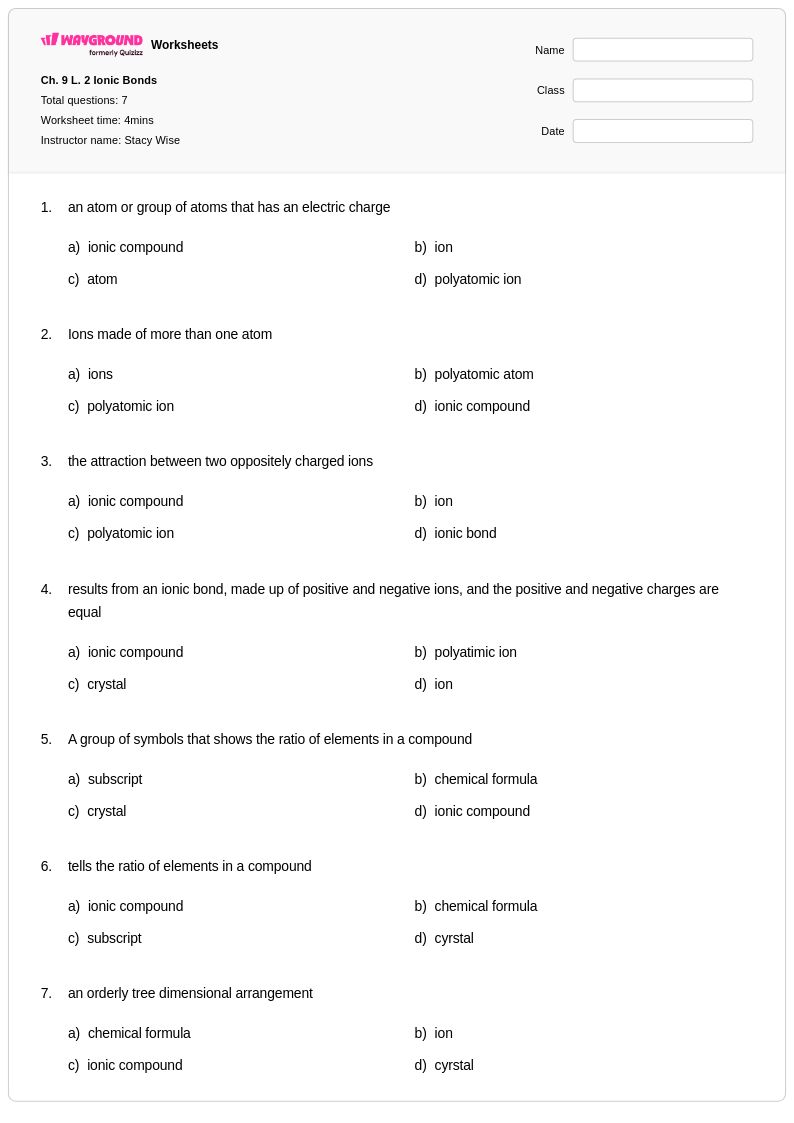
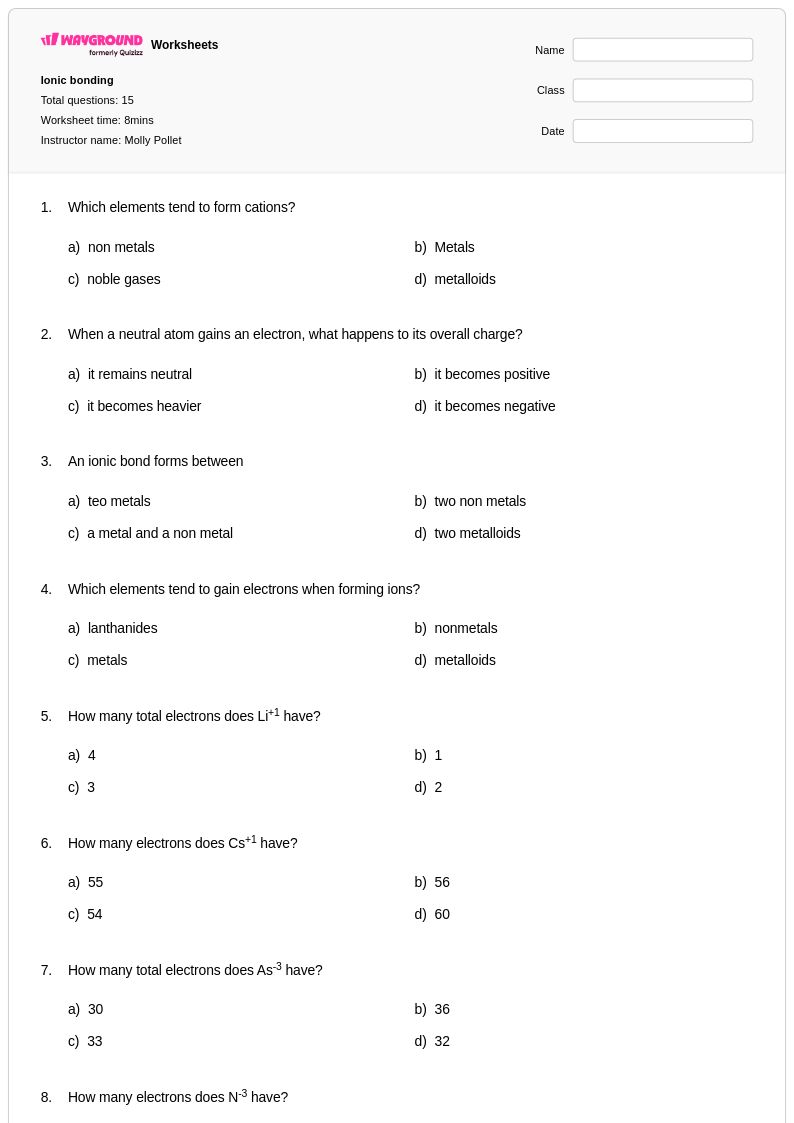
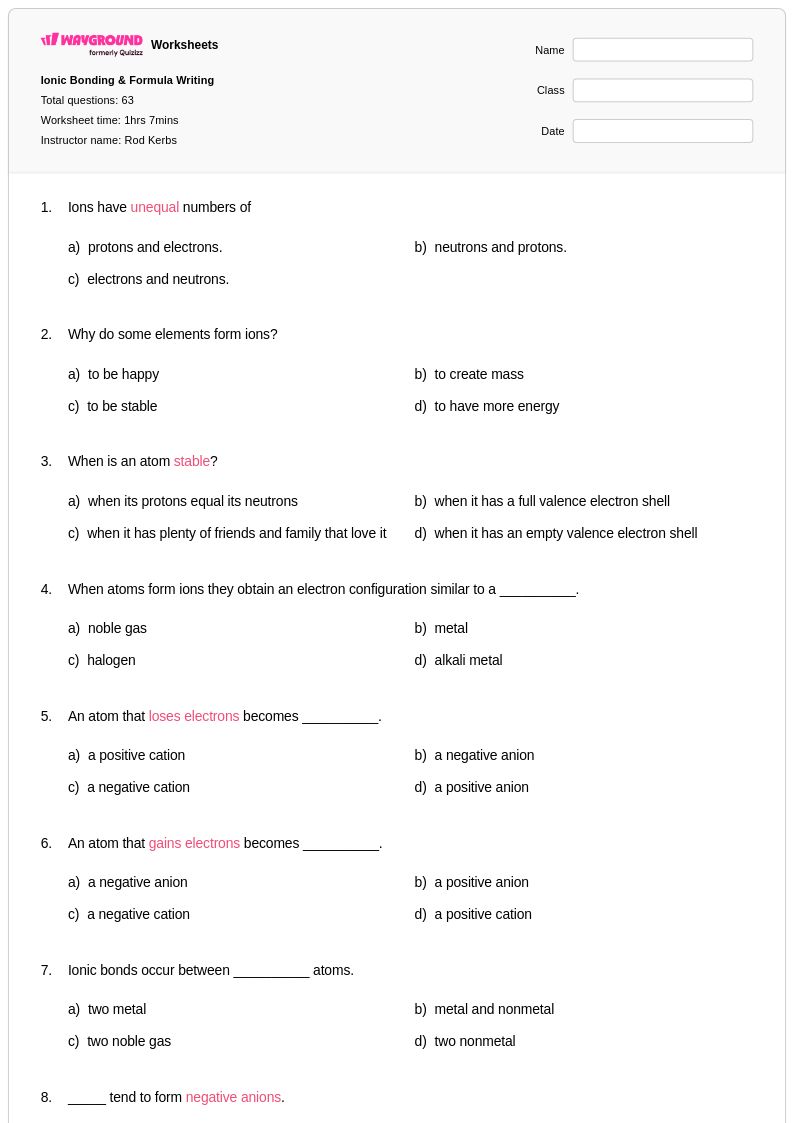
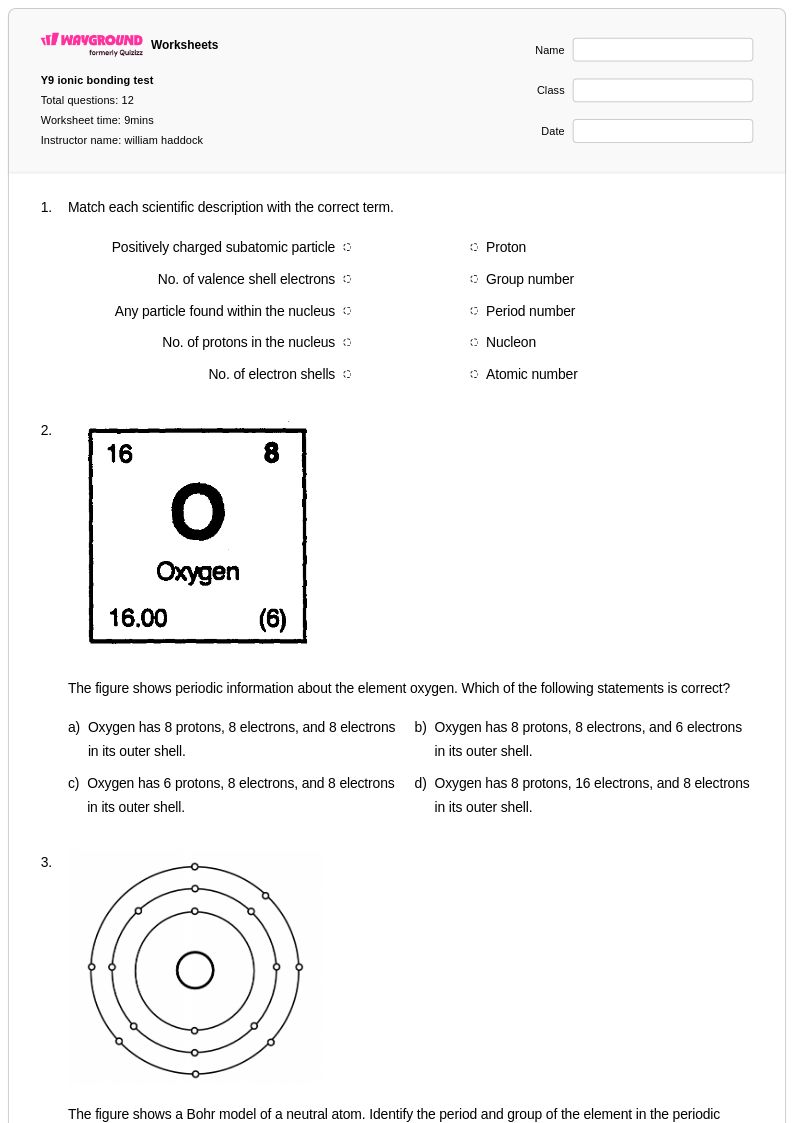
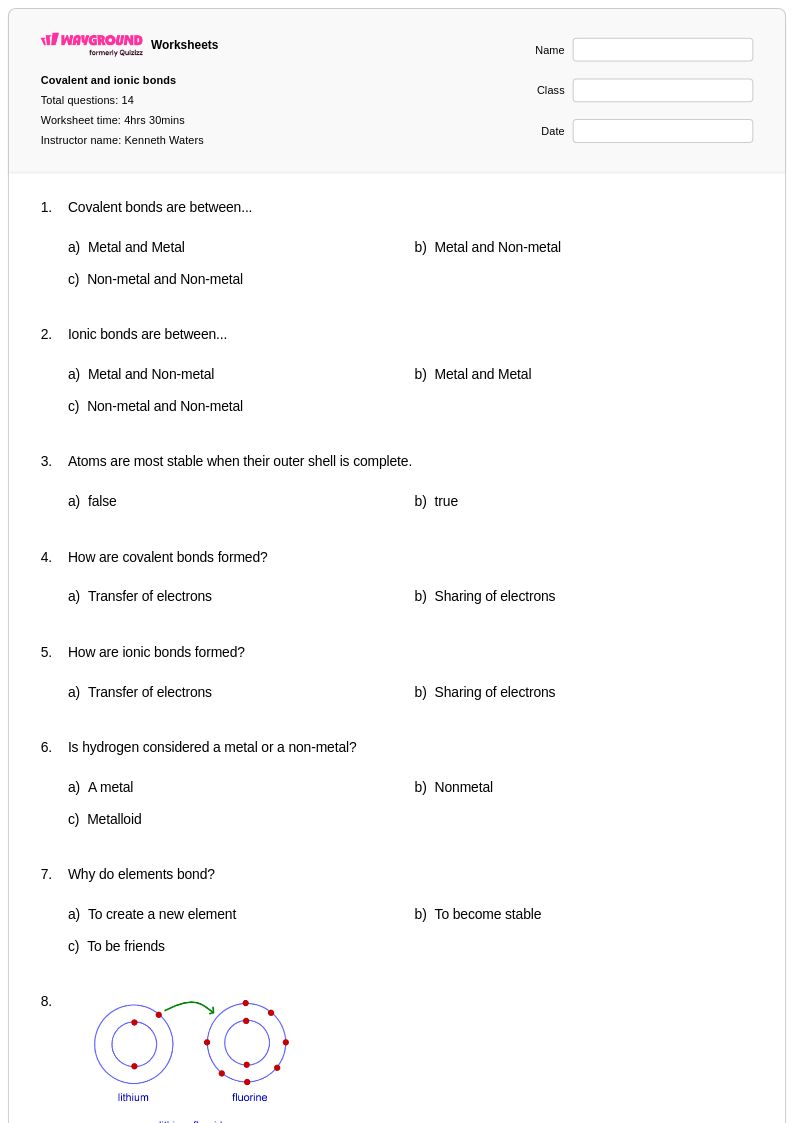
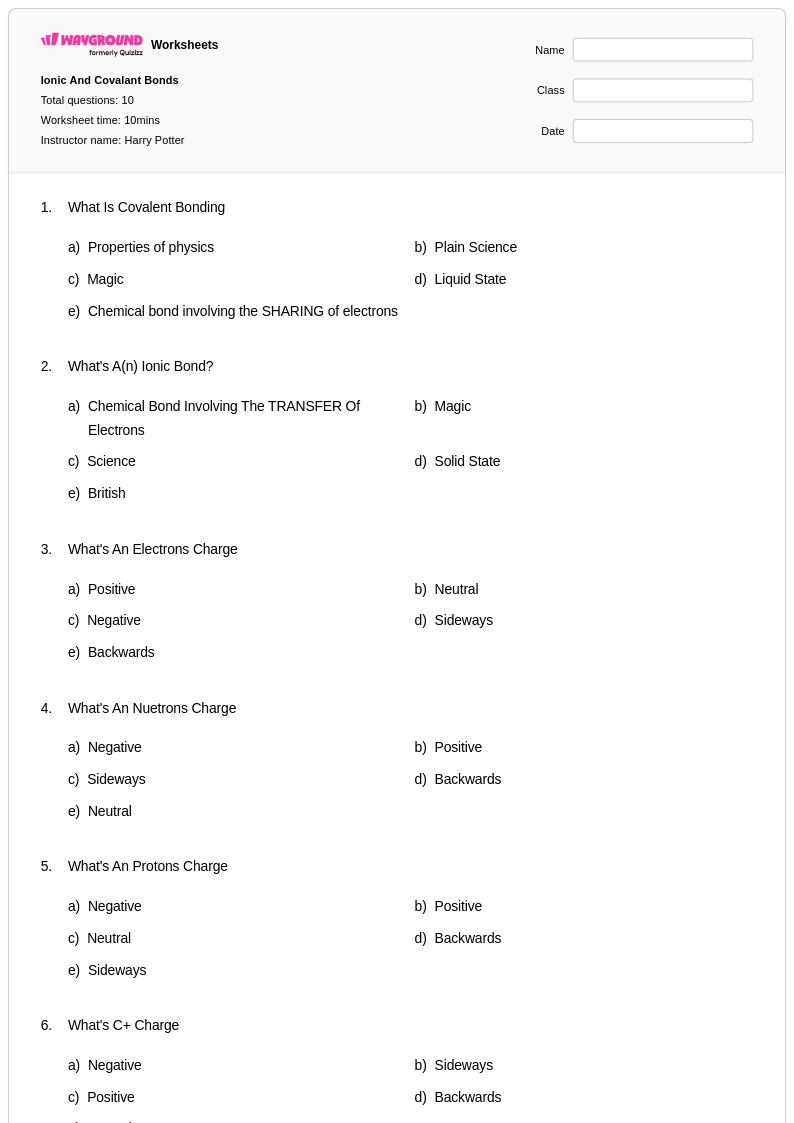
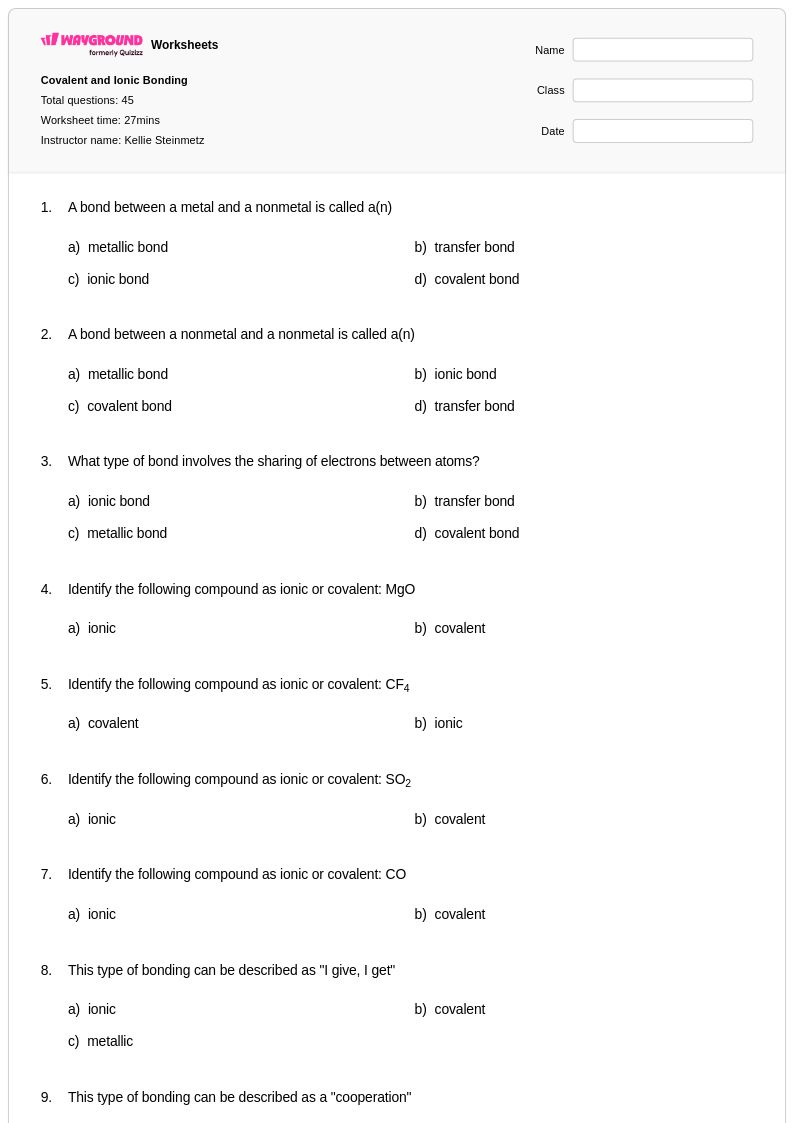
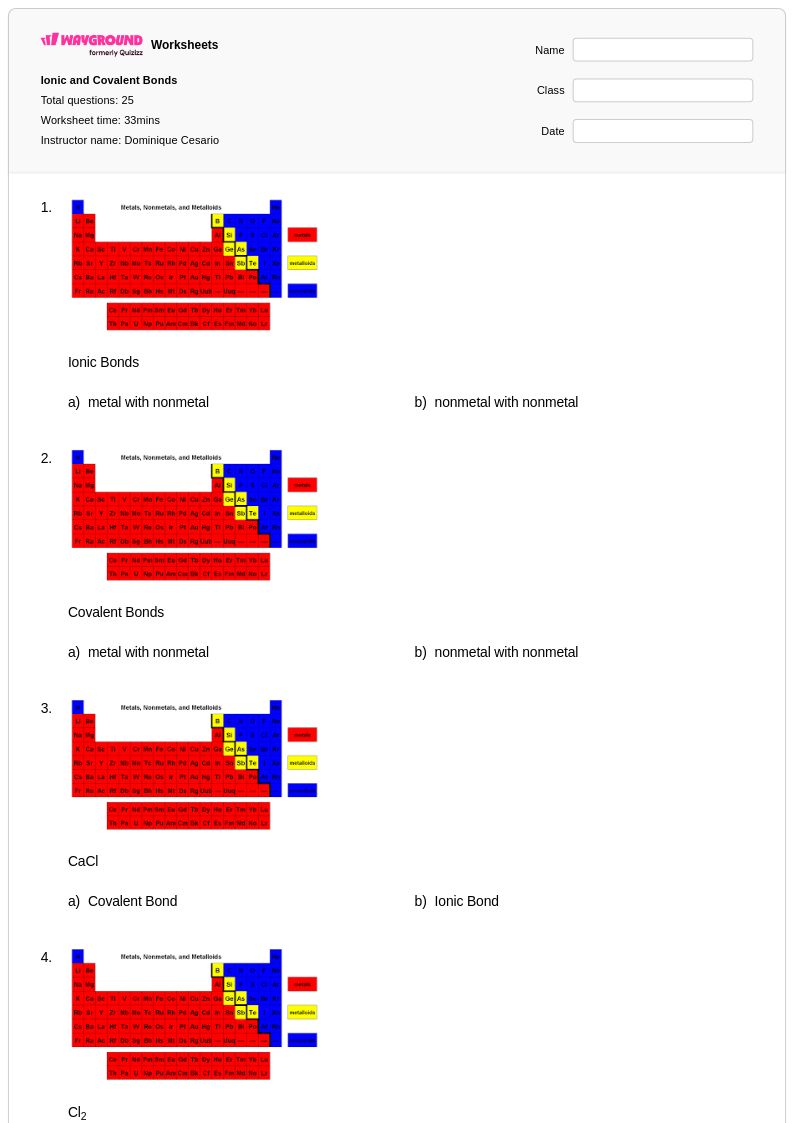
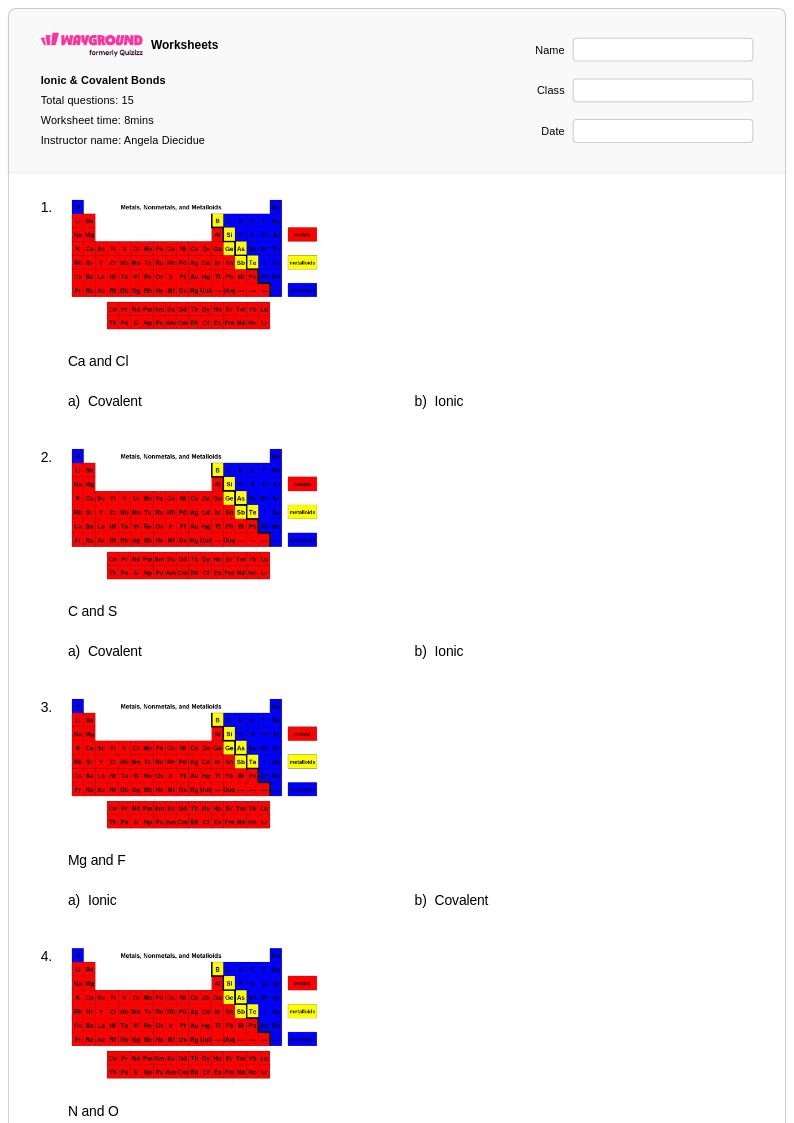
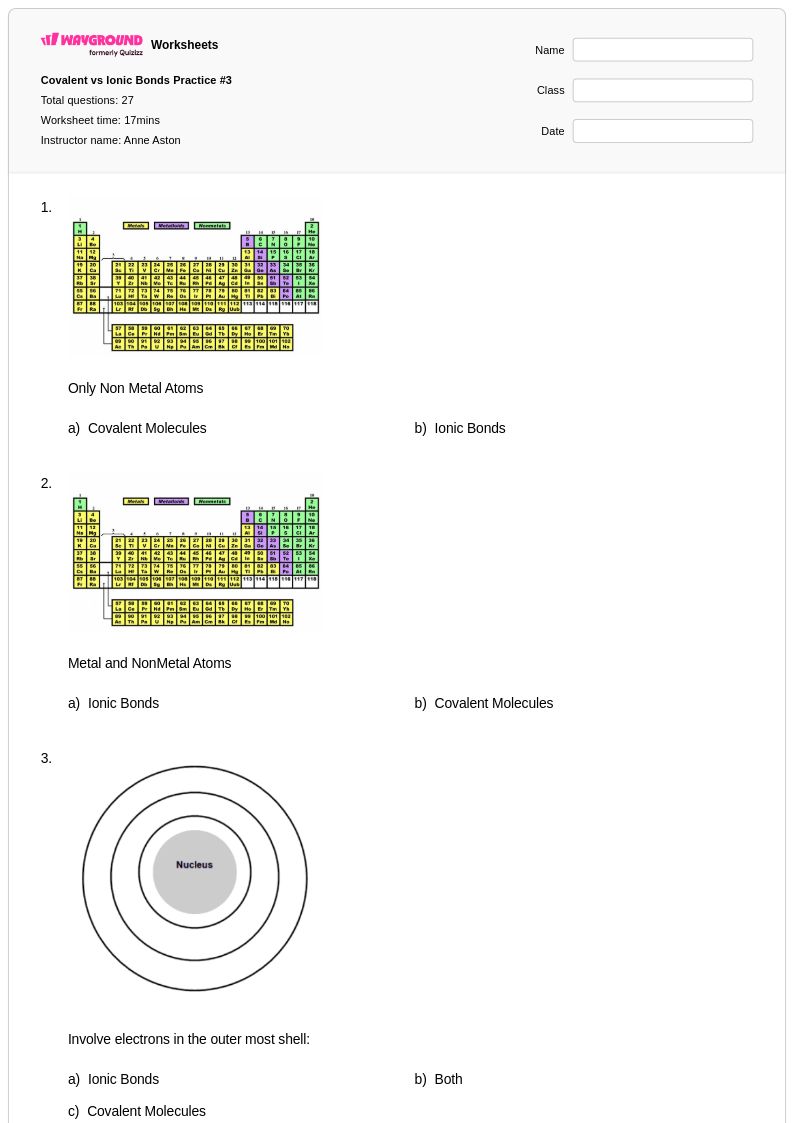
Class 6 ionic bond worksheets and printables help students master how atoms transfer electrons to form charged particles, featuring free practice problems with answer keys in PDF format.
Explore printable Ionic Bond worksheets for Class 6
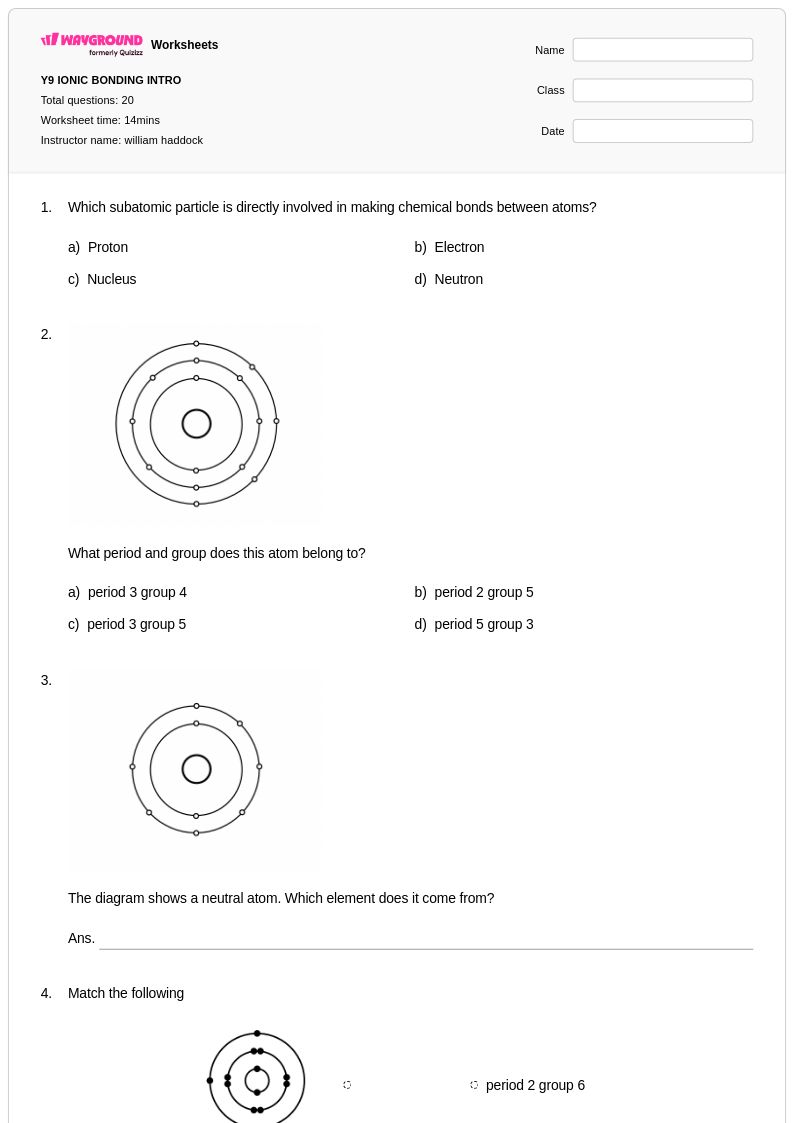
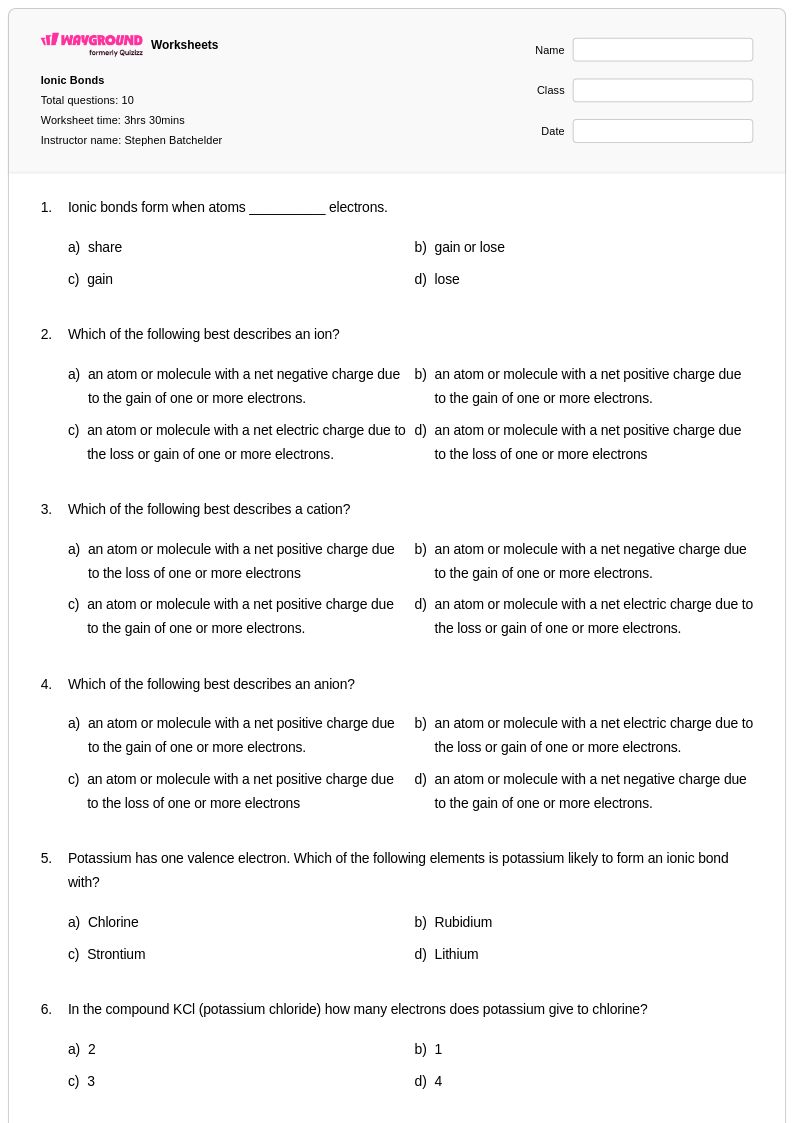
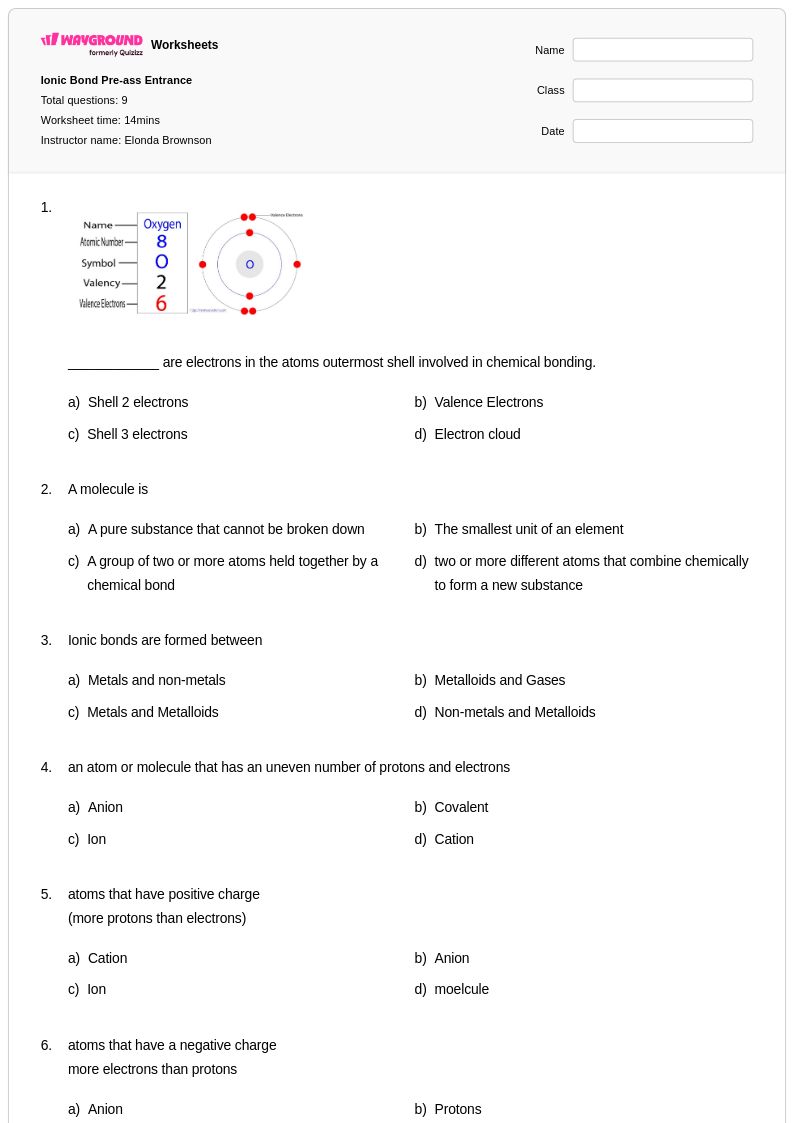
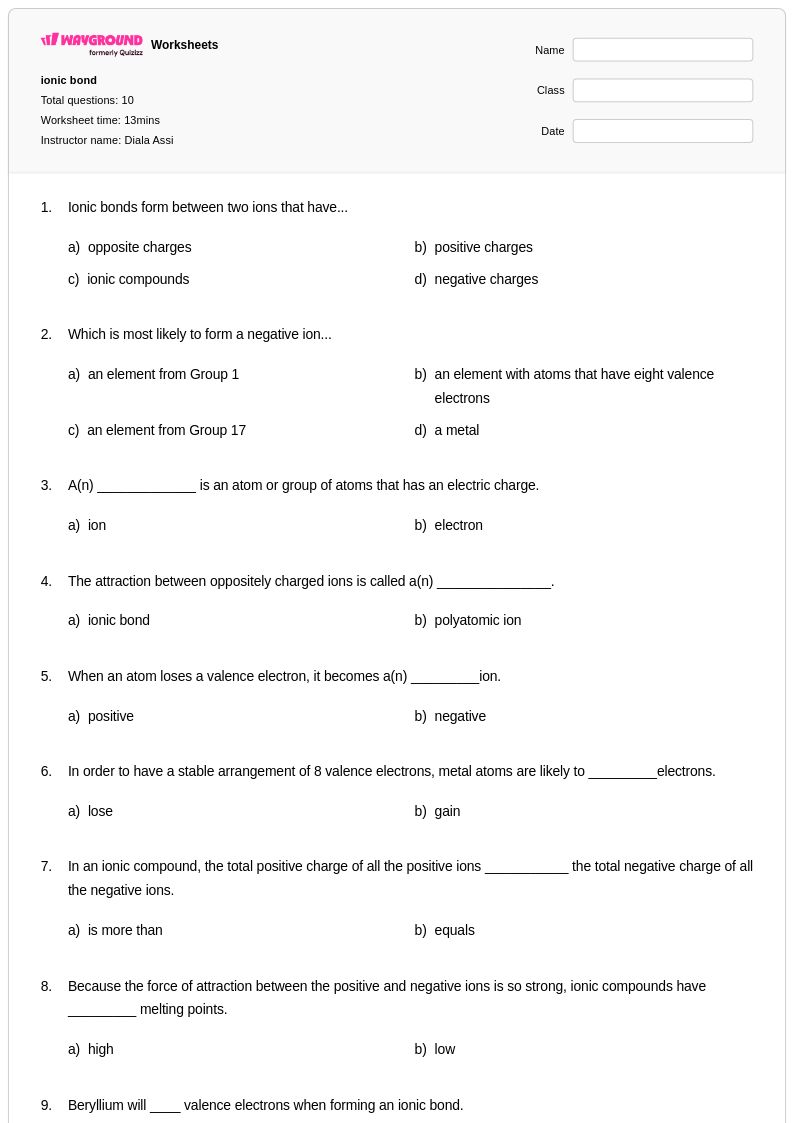
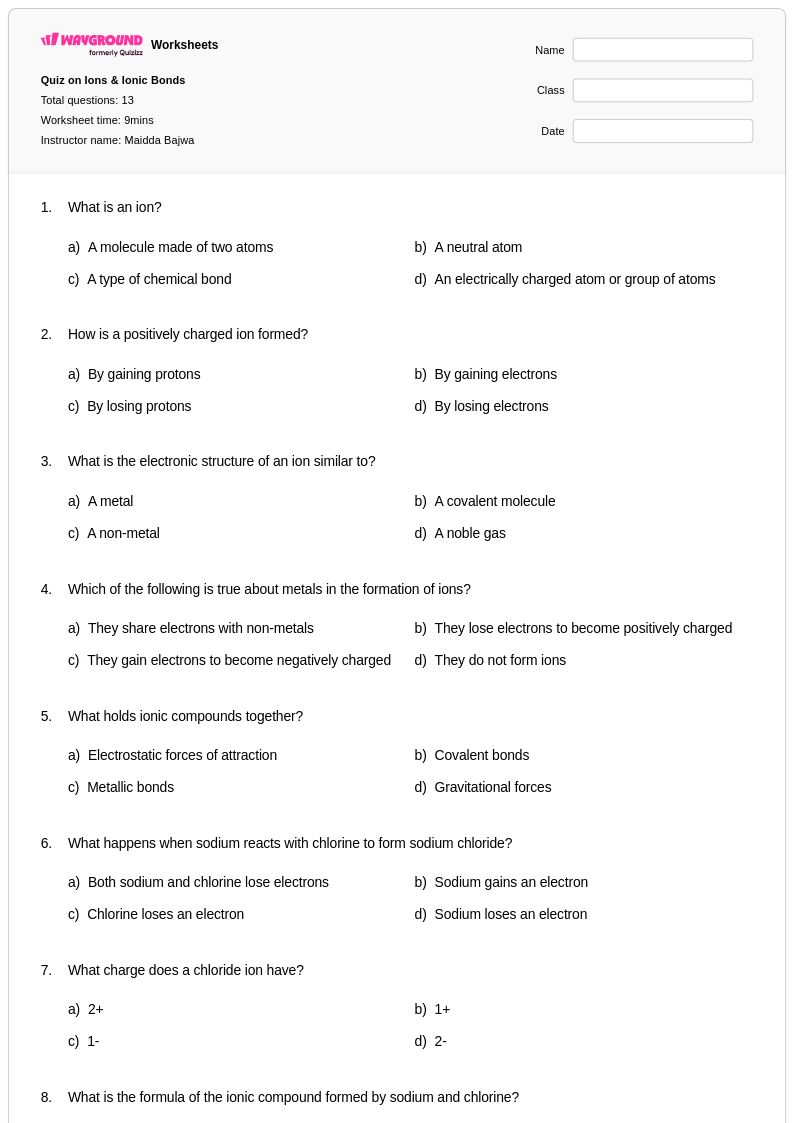
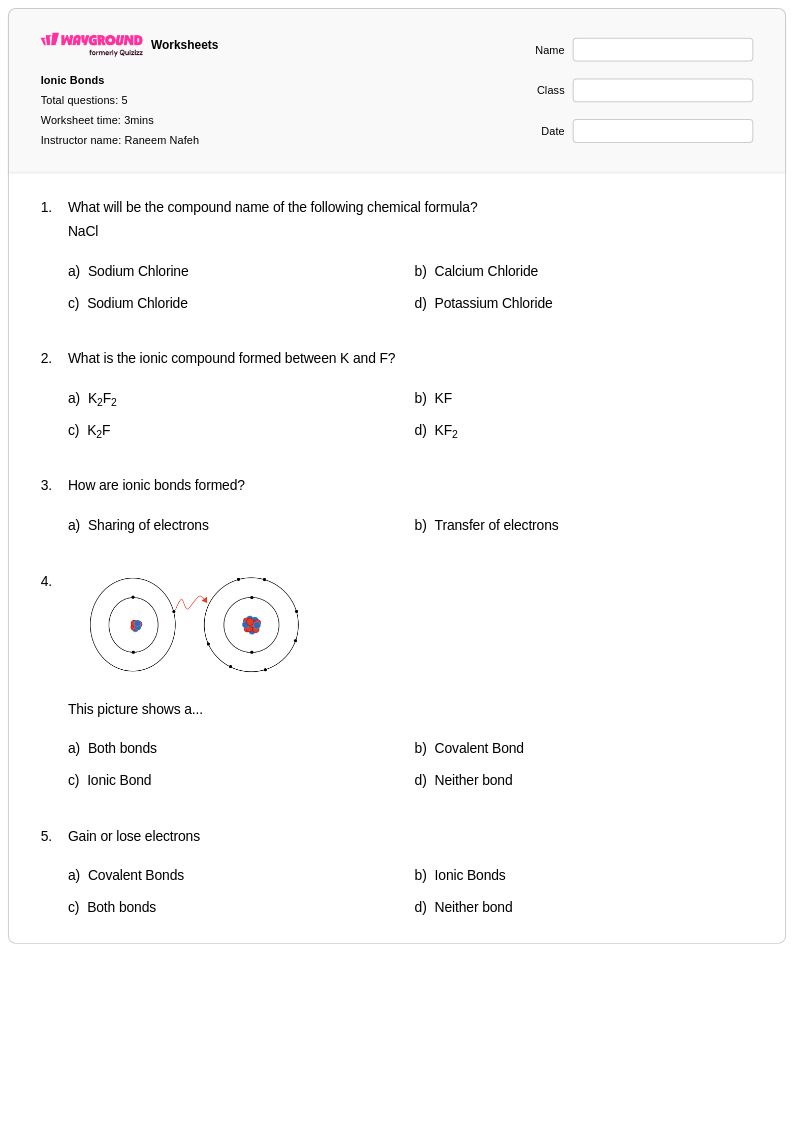
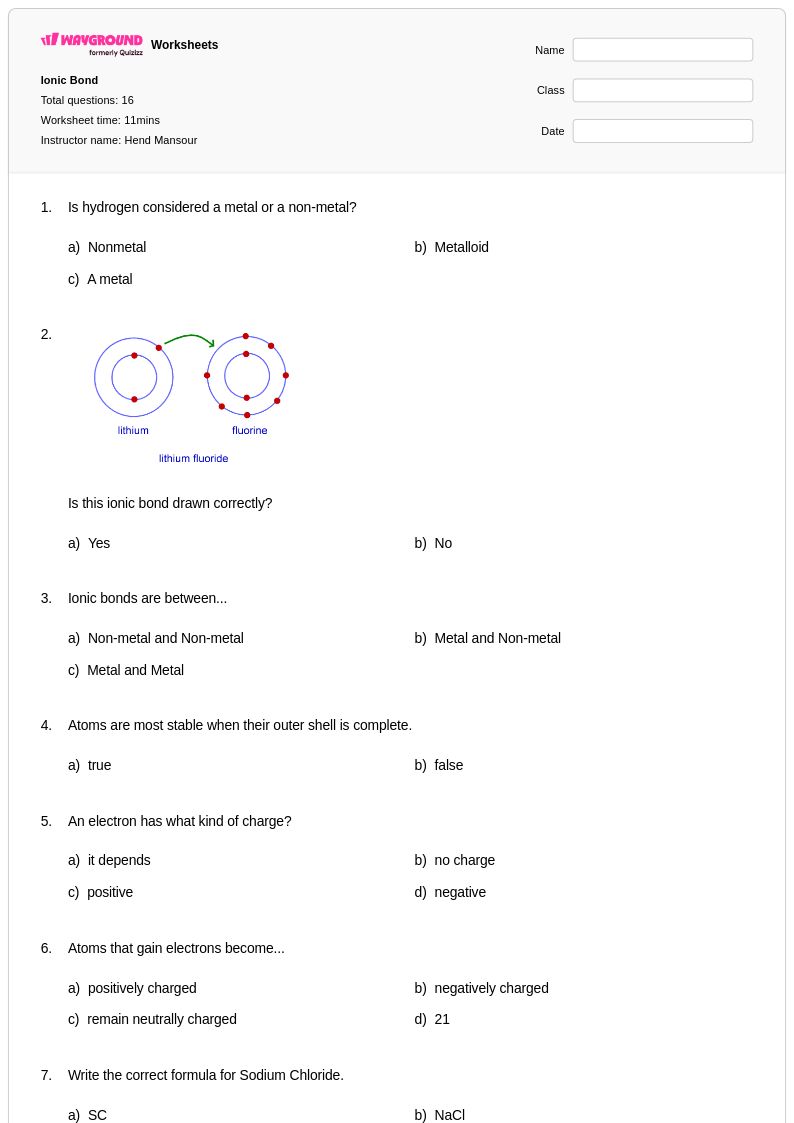
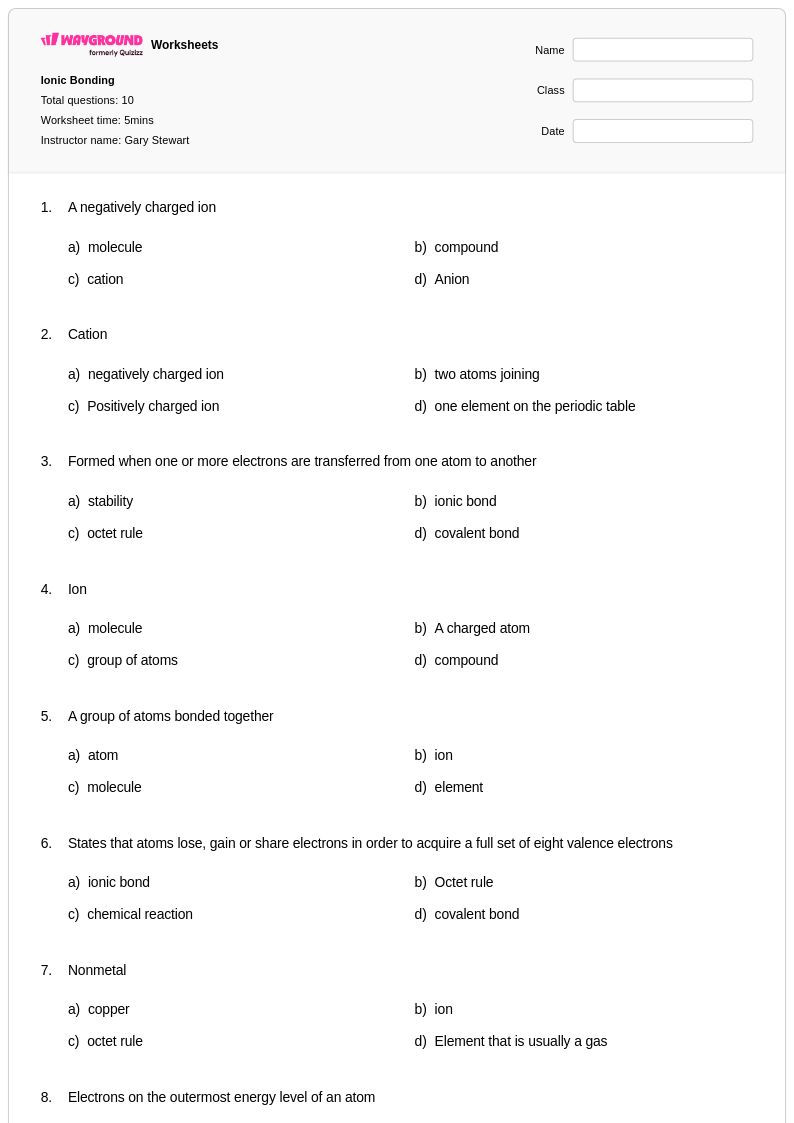
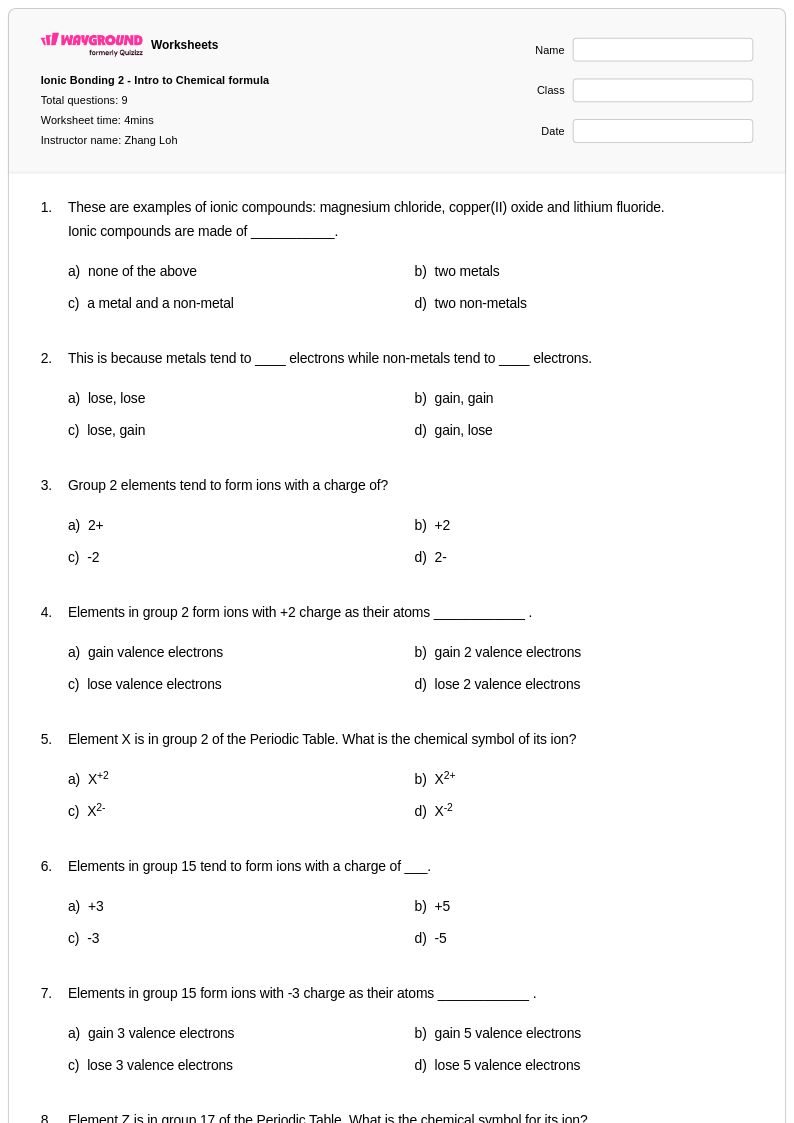
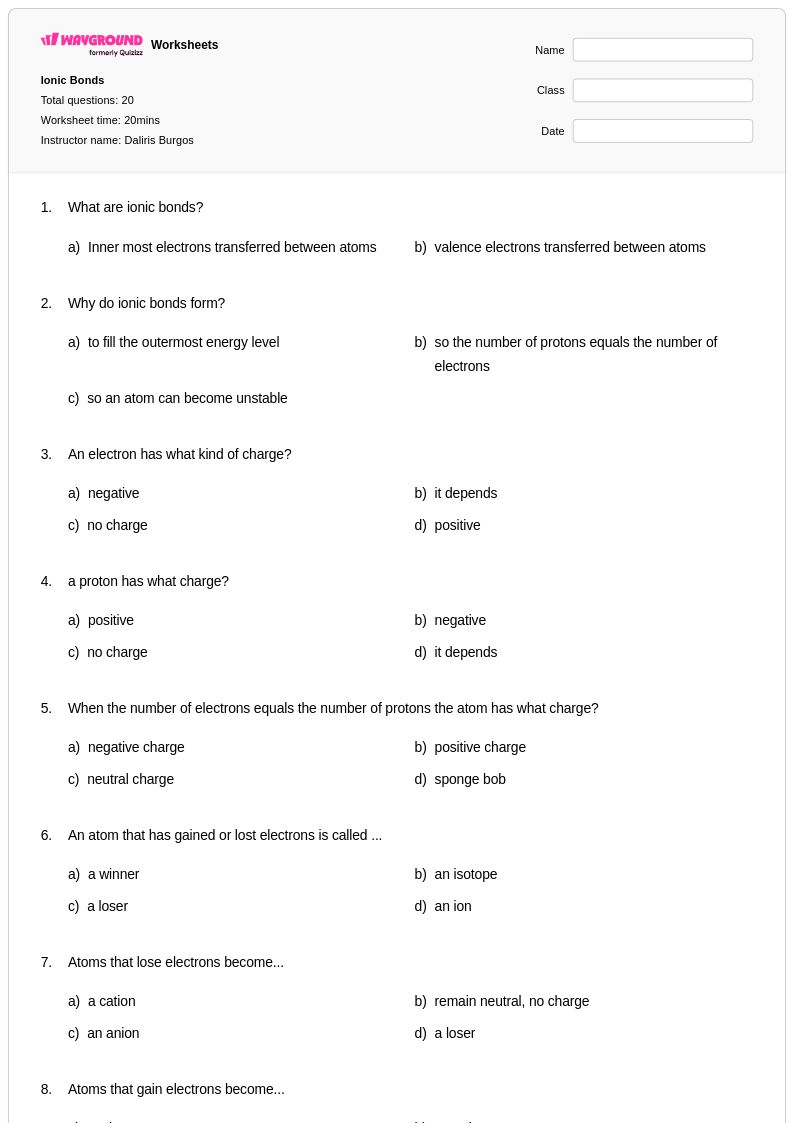
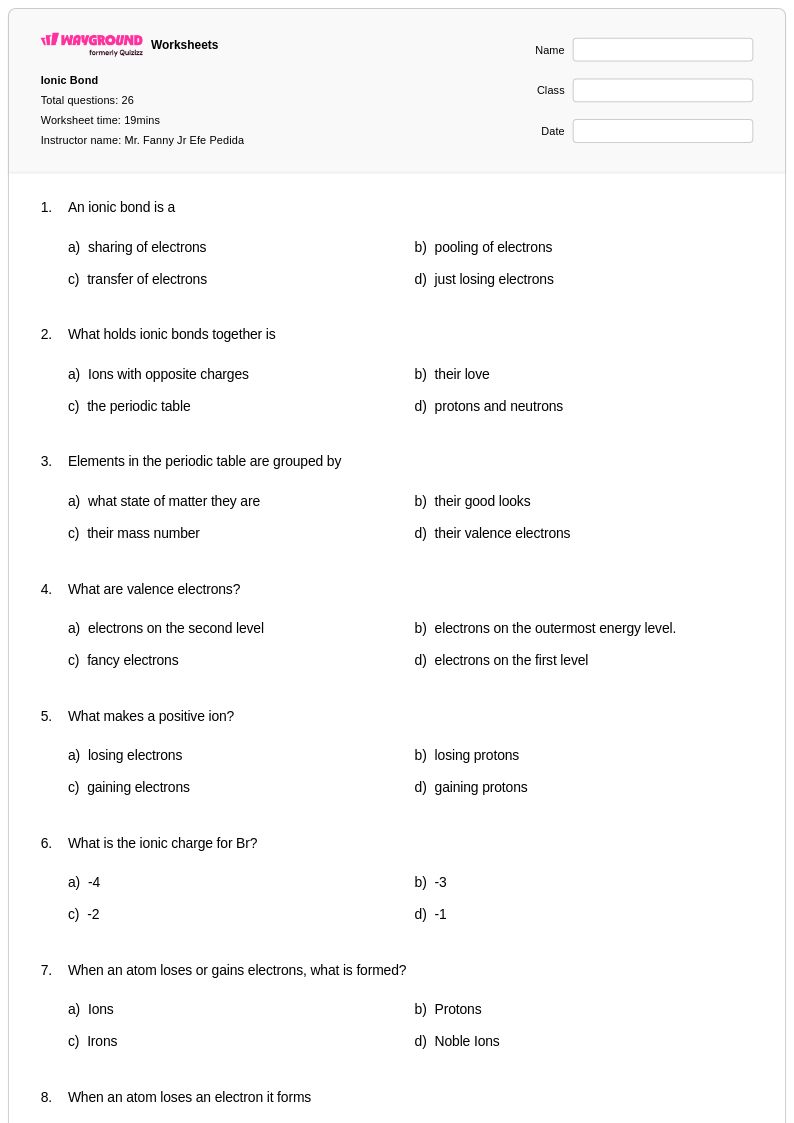
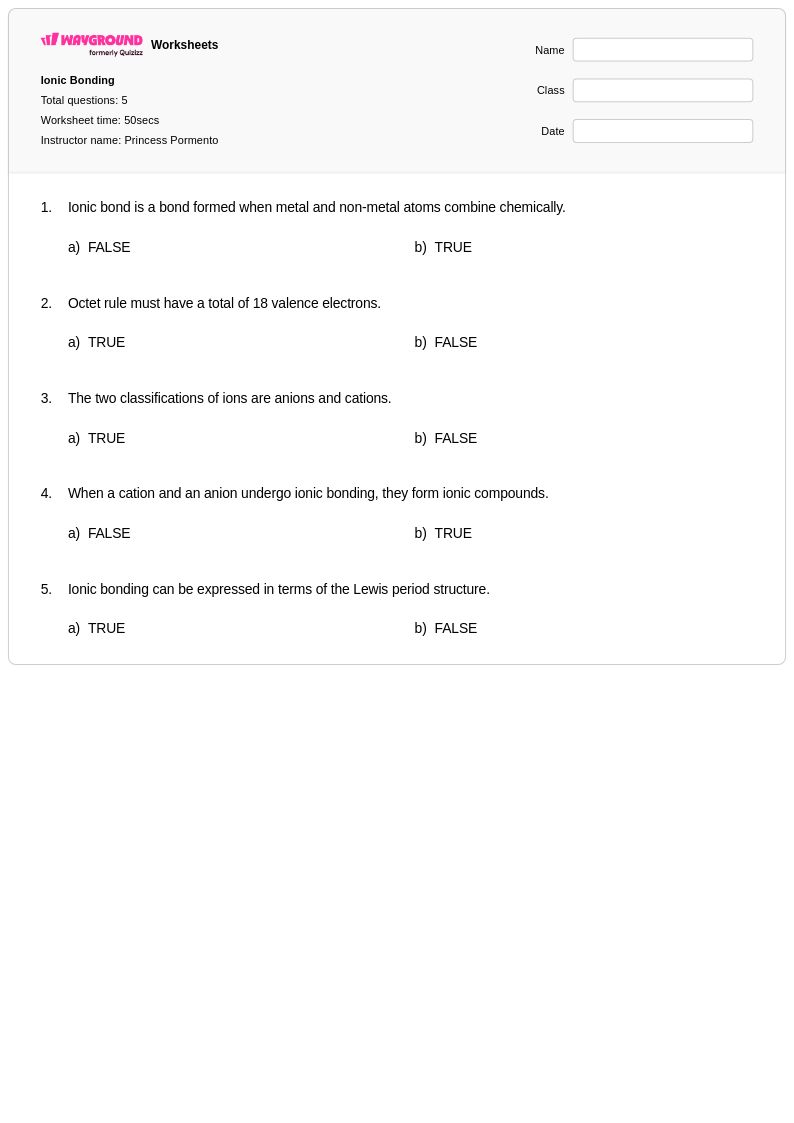
Ionic bond worksheets for Class 6 through Wayground (formerly Quizizz) provide comprehensive practice materials that help students understand how atoms transfer electrons to form charged ions and create stable chemical compounds. These carefully designed worksheets strengthen fundamental skills including identifying the formation of cations and anions, recognizing common ionic compounds like sodium chloride, and understanding the electrostatic forces that hold ionic structures together. Each worksheet collection includes detailed answer keys and is available as free printable pdf resources, featuring practice problems that range from basic ion formation exercises to more complex ionic compound naming activities that build student confidence in this essential chemistry concept.
Wayground (formerly Quizizz) supports educators with an extensive collection of ionic bond worksheet resources created by millions of teachers worldwide, offering robust search and filtering capabilities that allow instructors to quickly locate materials aligned with specific learning standards and grade-level expectations. The platform's differentiation tools enable teachers to customize worksheets for diverse learning needs, while flexible formatting options provide both printable pdf versions for traditional classroom use and digital formats for interactive learning environments. These comprehensive features streamline lesson planning by providing ready-to-use materials for skill practice, targeted remediation for students struggling with electron transfer concepts, and enrichment activities for advanced learners ready to explore more complex ionic bonding scenarios.
FAQs
How do I teach ionic bonding to chemistry students?
Start by ensuring students have a solid grasp of electron configuration and valence electrons before introducing ionic bonding. Use concrete examples like sodium chloride to show how a metal donates an electron to a nonmetal, creating oppositely charged ions that attract through electrostatic force. Visual aids such as Lewis dot diagrams and periodic table trends help students predict which elements are likely to form ions and why. Connecting ionic bond formation to observable physical properties — high melting points, brittleness, and conductivity in solution — gives students a meaningful context for the abstract concept.
What exercises help students practice ionic bonding?
Effective practice exercises include writing electron transfer diagrams for common ionic compounds, predicting ion charges using periodic trends, and constructing chemical formulas by balancing ion charges. Students also benefit from problems that ask them to distinguish ionic from covalent compounds based on electronegativity differences and to explain why ionic solids conduct electricity only when dissolved or melted. Progressing from simple binary compounds like NaCl and MgO to polyatomic ions and more complex formulas builds fluency across skill levels.
What mistakes do students commonly make with ionic bonds?
A frequent misconception is that ionic bonds involve sharing electrons rather than transferring them — students often conflate ionic and covalent bonding, especially early in a chemistry course. Many students also struggle to correctly apply charge balance when writing formulas for ionic compounds with polyatomic ions or transition metals that have variable oxidation states. Another common error is assuming that all metal-nonmetal combinations automatically produce ionic compounds, without checking electronegativity differences to confirm the bond type.
How can I use ionic bond worksheets to differentiate instruction?
Ionic bond worksheets work well for differentiation because the topic spans a wide range of complexity, from basic ion formation to lattice energy calculations. For struggling students, focus on identifying ion charges from the periodic table and writing simple binary formulas. For advanced learners, include problems involving polyatomic ions, lattice energy trends, and comparisons of ionic versus covalent properties. On Wayground, teachers can apply individual accommodations such as read-aloud support, extended time, and reduced answer choices to specific students, so each learner engages with the same material at an appropriate level of support.
How do I use Wayground's ionic bond worksheets in my classroom?
Wayground's ionic bond worksheets are available as printable PDFs for traditional classroom use and in digital formats for technology-integrated environments, including the option to host them as a graded quiz directly on the platform. Teachers can use printable versions for independent practice, homework, or in-class review, while the digital format supports remote learning, immediate feedback, and built-in accommodations for individual students. Each worksheet comes with a complete answer key, reducing prep time and making it easy to integrate into existing lesson plans.
How do ionic bond worksheets connect to broader chemistry curriculum standards?
Ionic bonding is a foundational concept in high school chemistry that connects directly to topics like periodic trends, chemical nomenclature, stoichiometry, and solution chemistry. Worksheets that address electron transfer, formula writing, and physical properties of ionic compounds align with Next Generation Science Standards and most state chemistry frameworks. By practicing these skills through structured worksheets, students build the conceptual vocabulary they need to engage with more advanced topics such as electrochemistry and reaction types.