Free Printable Standard Heats of Formation Worksheets for Class 10
Enhance Class 10 students' understanding of standard heats of formation with Wayground's comprehensive collection of free chemistry worksheets, featuring printable PDFs, practice problems, and detailed answer keys.
Explore printable Standard Heats of Formation worksheets for Class 10
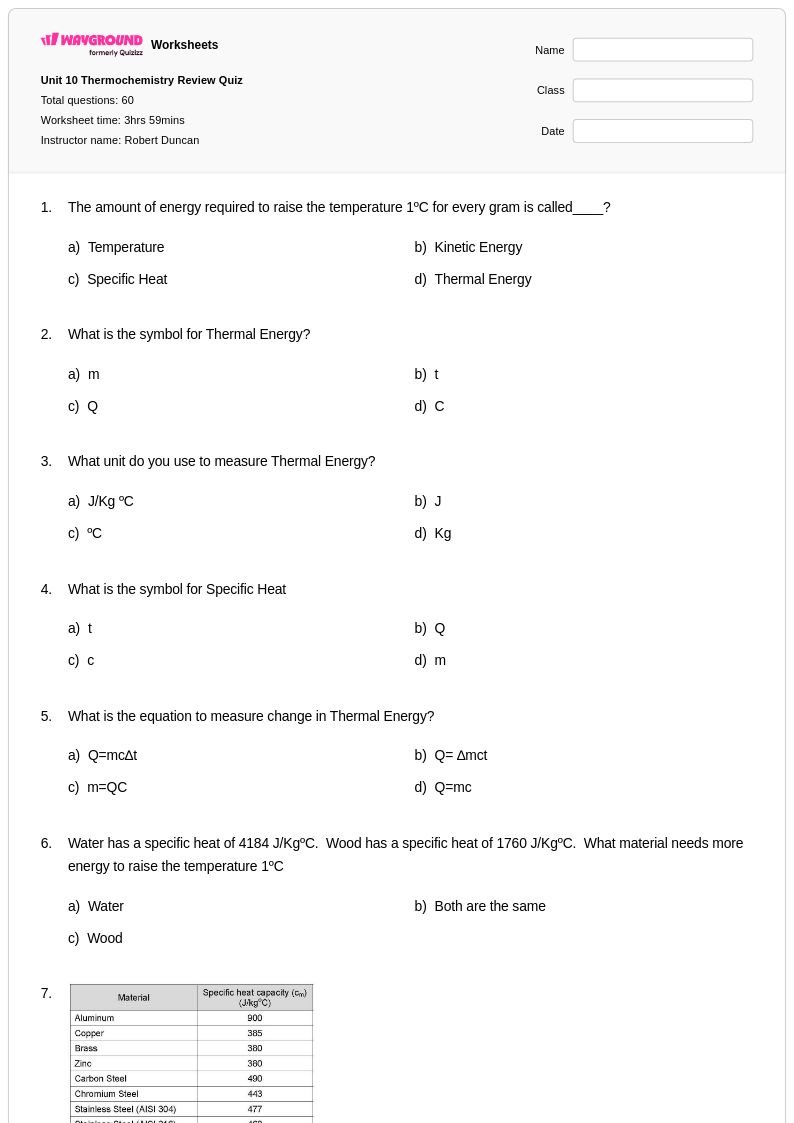
Standard heats of formation worksheets for Class 10 chemistry students available through Wayground (formerly Quizizz) provide comprehensive practice with thermochemical calculations and energy change concepts fundamental to understanding chemical reactions. These carefully designed educational resources strengthen students' abilities to calculate enthalpy changes using standard formation data, interpret thermochemical equations, and apply Hess's law to determine reaction energetics. The collection includes practice problems ranging from basic heat of formation lookups to complex multi-step calculations, with each worksheet featuring detailed answer keys that guide students through proper problem-solving methodologies. These free printable resources offer structured approaches to mastering the quantitative aspects of thermochemistry, helping students develop proficiency in using standard enthalpy tables and understanding the relationship between bond formation, bond breaking, and overall energy changes in chemical processes.
Wayground (formerly Quizizz) empowers chemistry educators with millions of teacher-created worksheet resources specifically designed for standard heats of formation instruction, featuring robust search and filtering capabilities that enable quick location of materials aligned with specific curriculum standards and learning objectives. The platform's differentiation tools allow teachers to customize worksheets based on individual student needs, offering both remediation support for struggling learners and enrichment opportunities for advanced students ready to tackle more challenging thermochemical problems. These versatile resources are available in both printable PDF formats for traditional classroom use and digital formats for technology-integrated learning environments, facilitating seamless lesson planning whether teachers need quick skill practice exercises, comprehensive review materials, or targeted intervention worksheets that address specific misconceptions in thermochemistry concepts.
FAQs
How do I teach standard heats of formation in chemistry class?
Start by grounding students in the reference point: the standard heat of formation (ΔHf°) of any pure element in its standard state is defined as zero. From there, build toward compound formation reactions, ensuring students can write balanced equations where exactly one mole of product forms from its elements. Connecting formation enthalpies to Hess's law early helps students see how individual ΔHf° values combine to calculate the overall enthalpy change of any reaction.
What practice problems help students get better at standard heats of formation calculations?
The most effective practice sequence moves from identifying standard states and writing formation reactions, to using tabulated ΔHf° values to calculate ΔH°rxn using the products-minus-reactants formula. Students should then progress to multi-step problems involving combustion reactions and phase changes. Repeated exposure to thermodynamic data tables is critical so students become fluent in extracting and applying values accurately under timed conditions.
What mistakes do students commonly make with standard heats of formation?
The most frequent error is applying ΔHf° values without accounting for stoichiometric coefficients, treating them as fixed quantities regardless of moles. Students also frequently forget that the ΔHf° of elemental substances in their standard states is zero, inadvertently including them in calculations. A third common mistake is confusing the sign convention, particularly when reversing a reaction as part of a Hess's law pathway.
How does Hess's law connect to standard heats of formation?
Hess's law states that enthalpy is a state function, meaning the total enthalpy change of a reaction is independent of the pathway taken. Standard heats of formation are the practical application of this principle: since every compound can be conceptually formed from its elements, ΔHf° values serve as universal building blocks for calculating ΔH°rxn using the formula ΔH°rxn = ΣΔHf°(products) − ΣΔHf°(reactants). Teaching Hess's law alongside formation enthalpies reinforces why the reference state convention matters.
How can I use standard heats of formation worksheets from Wayground in my classroom?
Wayground's standard heats of formation worksheets are available as printable PDFs for traditional classroom distribution and in digital formats for technology-integrated or hybrid learning environments, including the option to host them as a quiz directly on Wayground. Teachers can assign worksheets for initial instruction, in-class problem sets, or independent review, with answer keys included for efficient grading. For differentiated instruction, Wayground's platform allows teachers to apply individualized accommodations such as extended time or read-aloud support for specific students without disrupting the experience of the rest of the class.
How do I help struggling students who can't get through multi-step heat of formation problems?
Break the problem type into isolated sub-skills: first confirm the student can correctly write a formation reaction, then check whether they can read a thermodynamic data table accurately, and finally assess whether they're applying stoichiometric coefficients before summing. Targeted remediation at the specific breakdown point is more effective than re-teaching the full calculation. On Wayground, teachers can also enable reduced answer choices for individual students to lower cognitive load while they build procedural confidence.