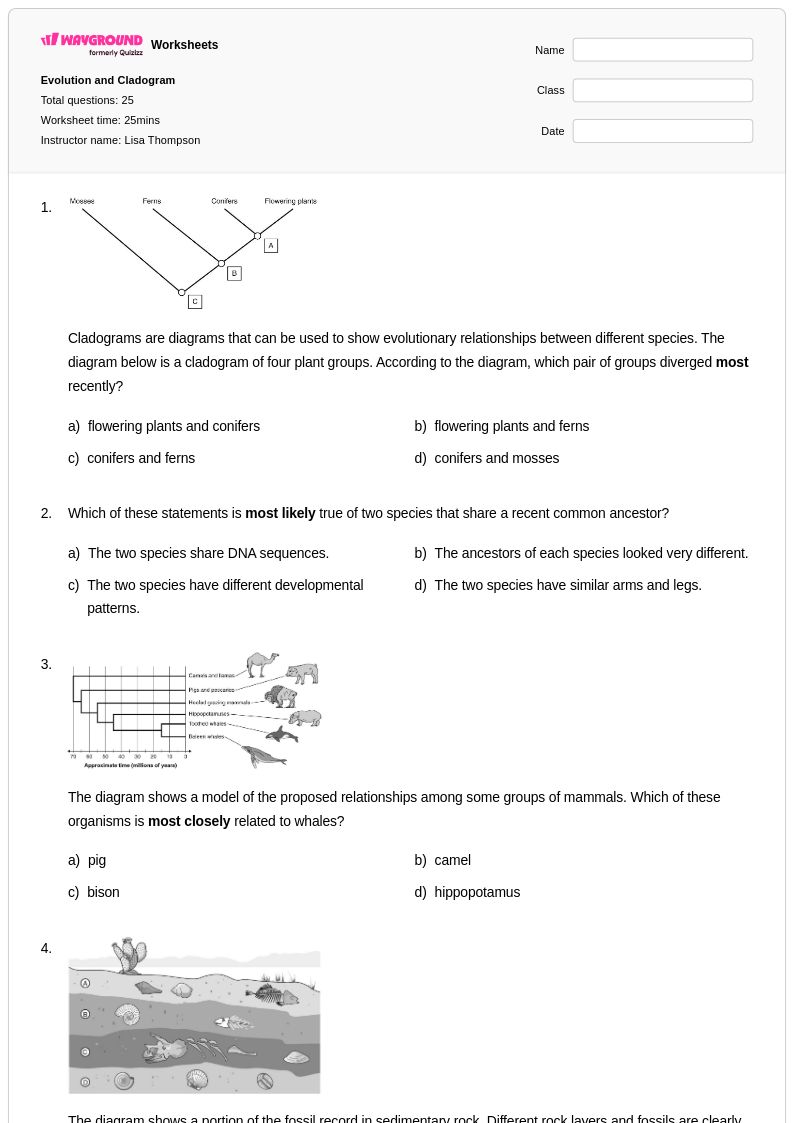
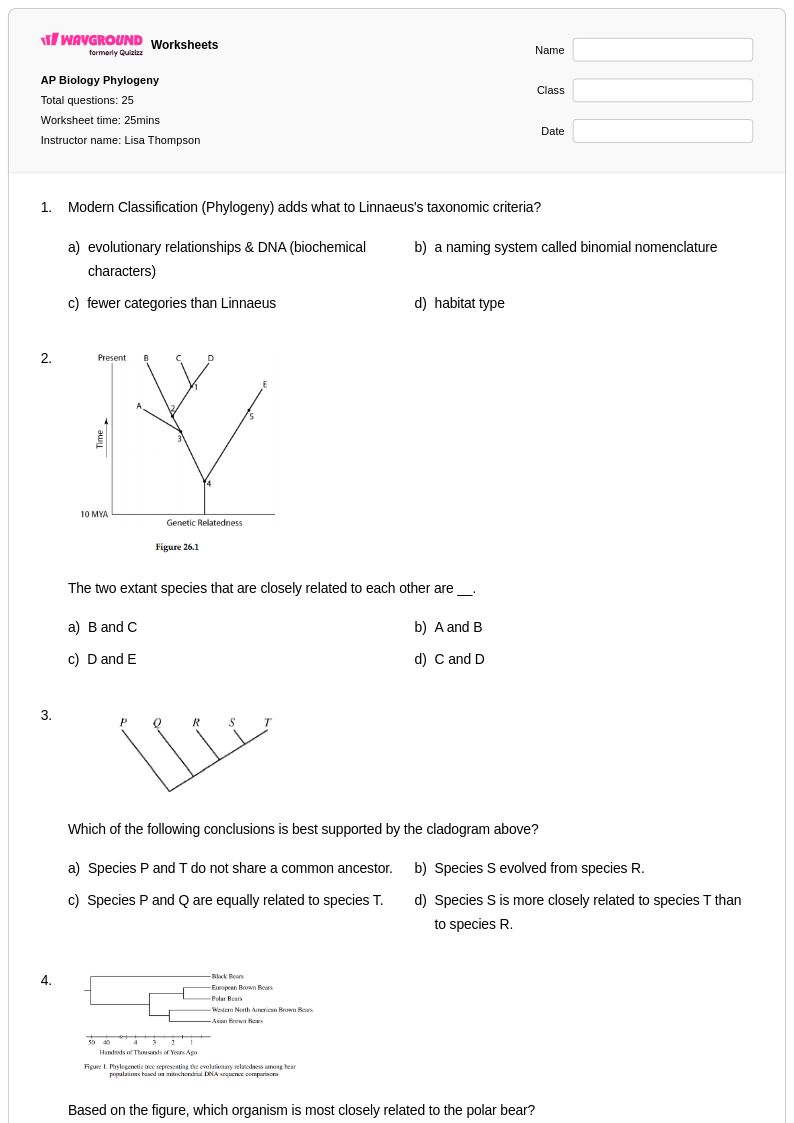
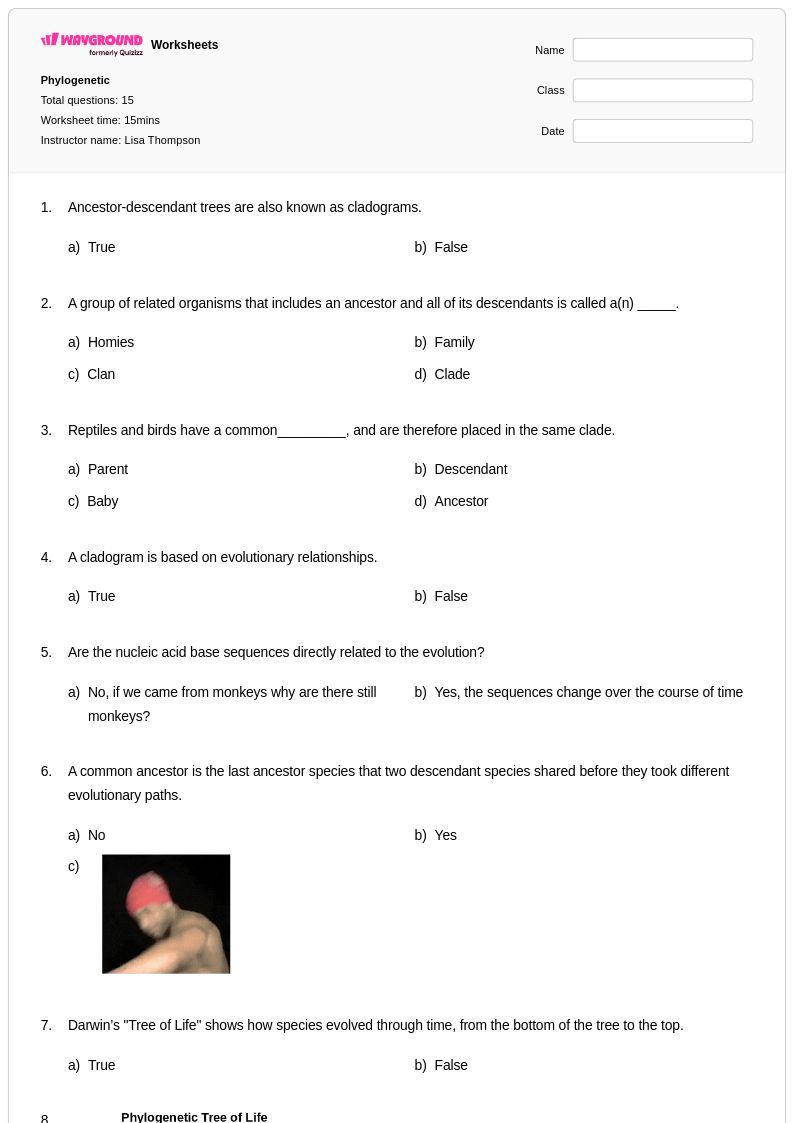
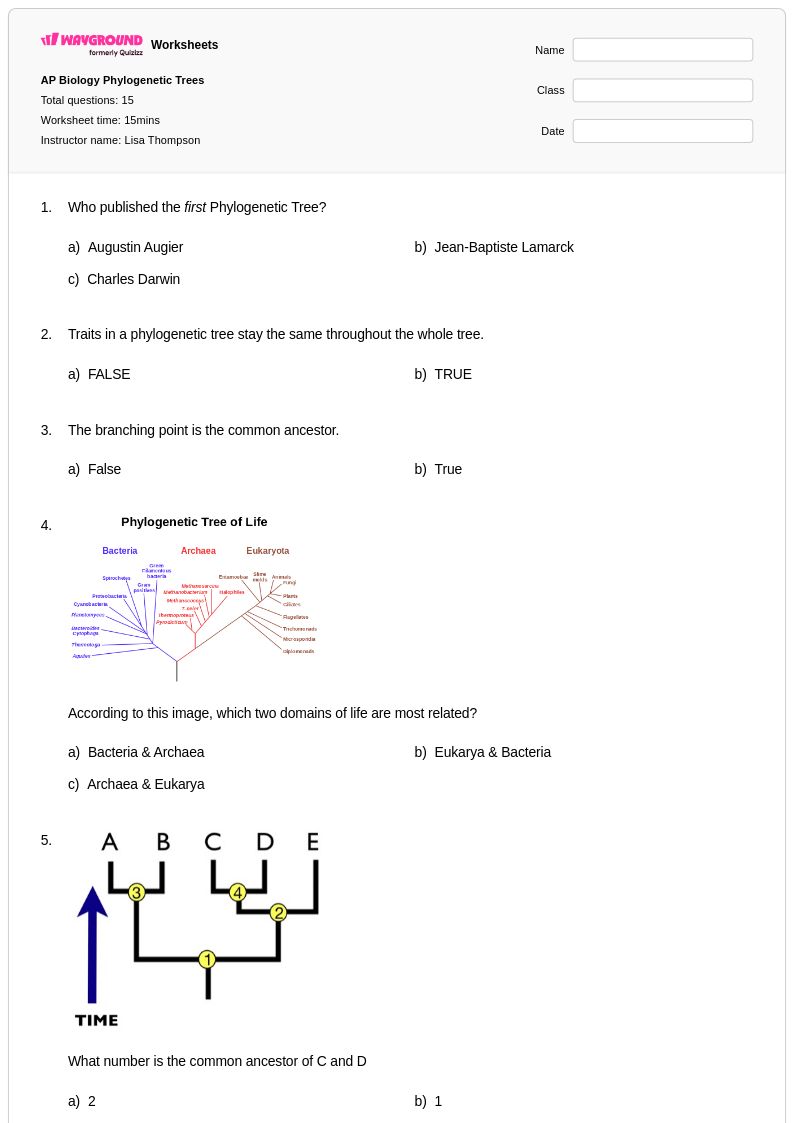
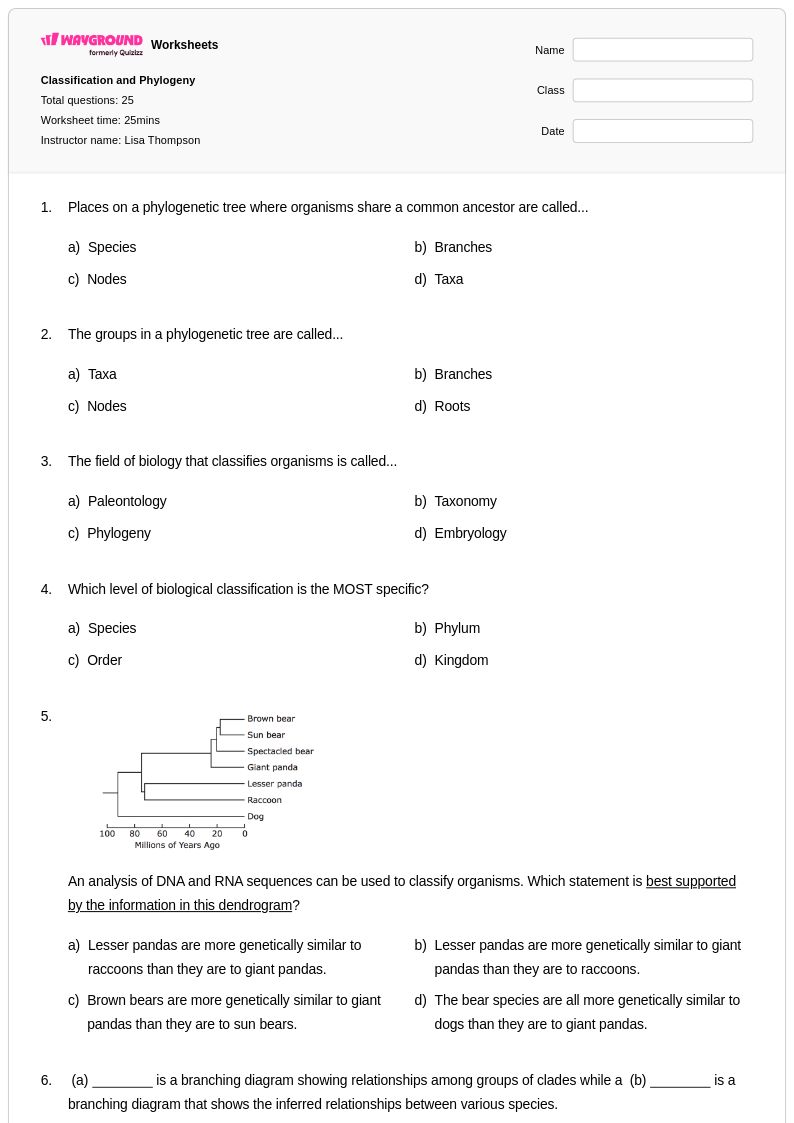
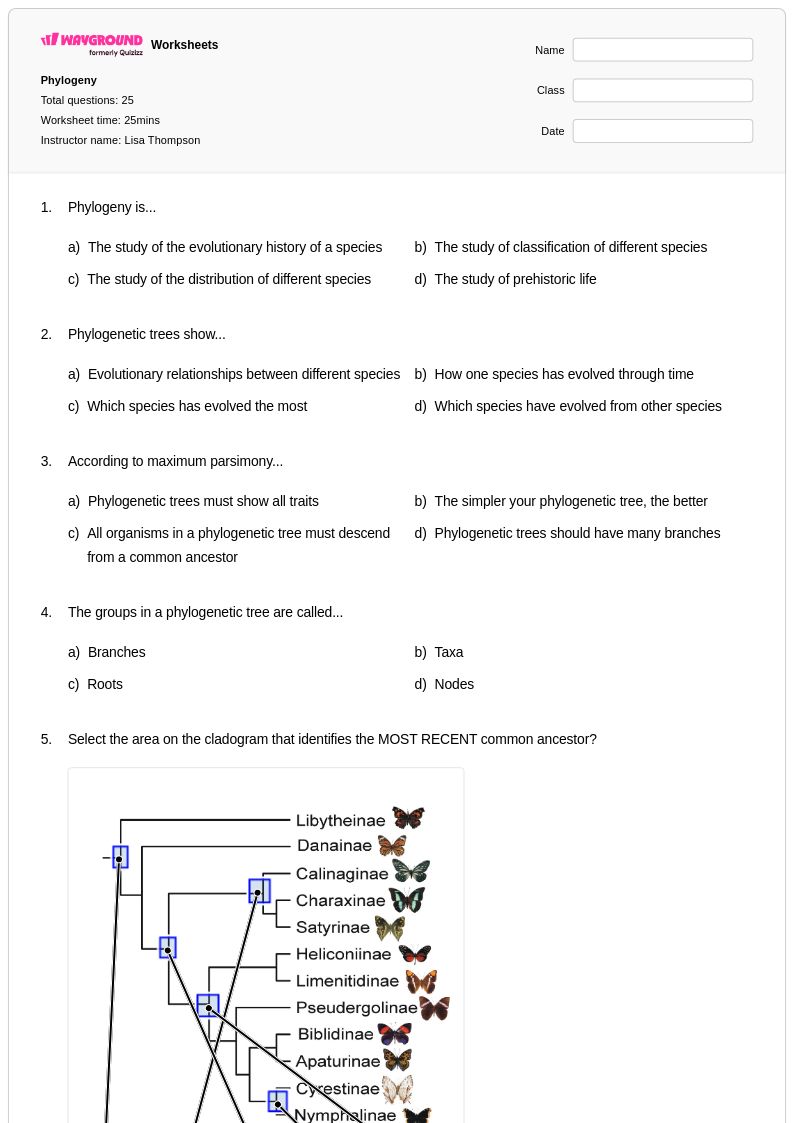
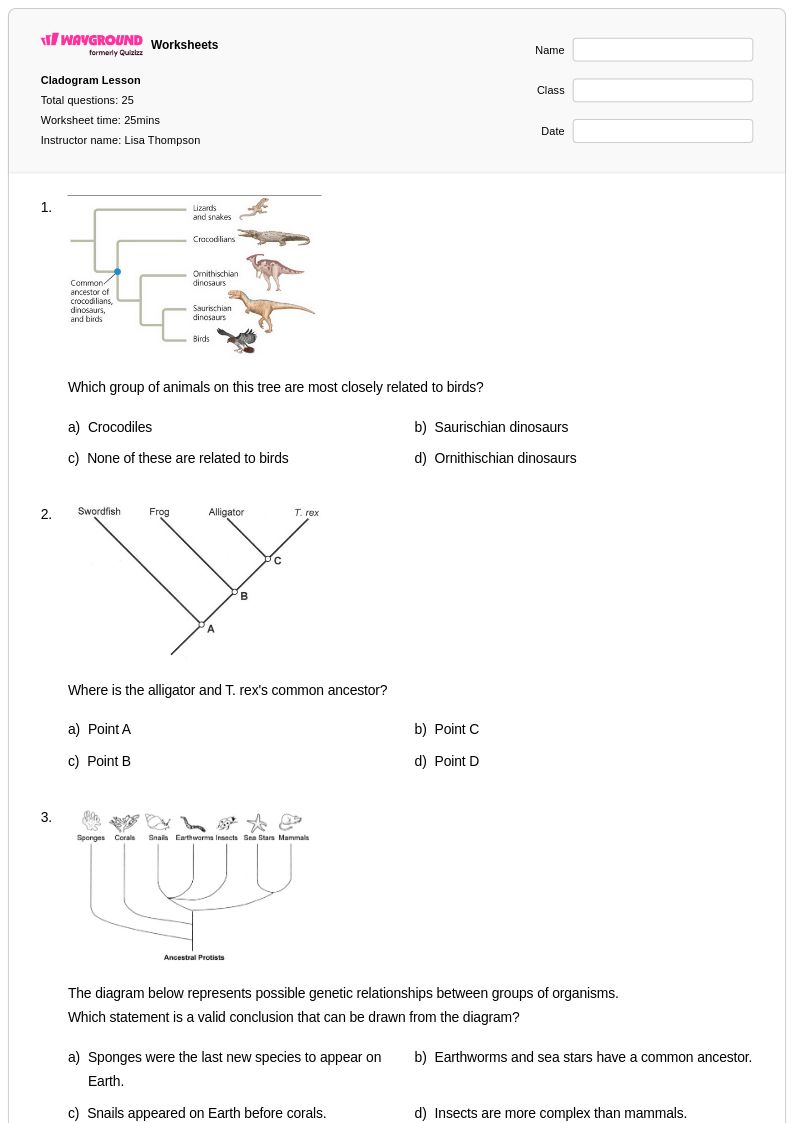
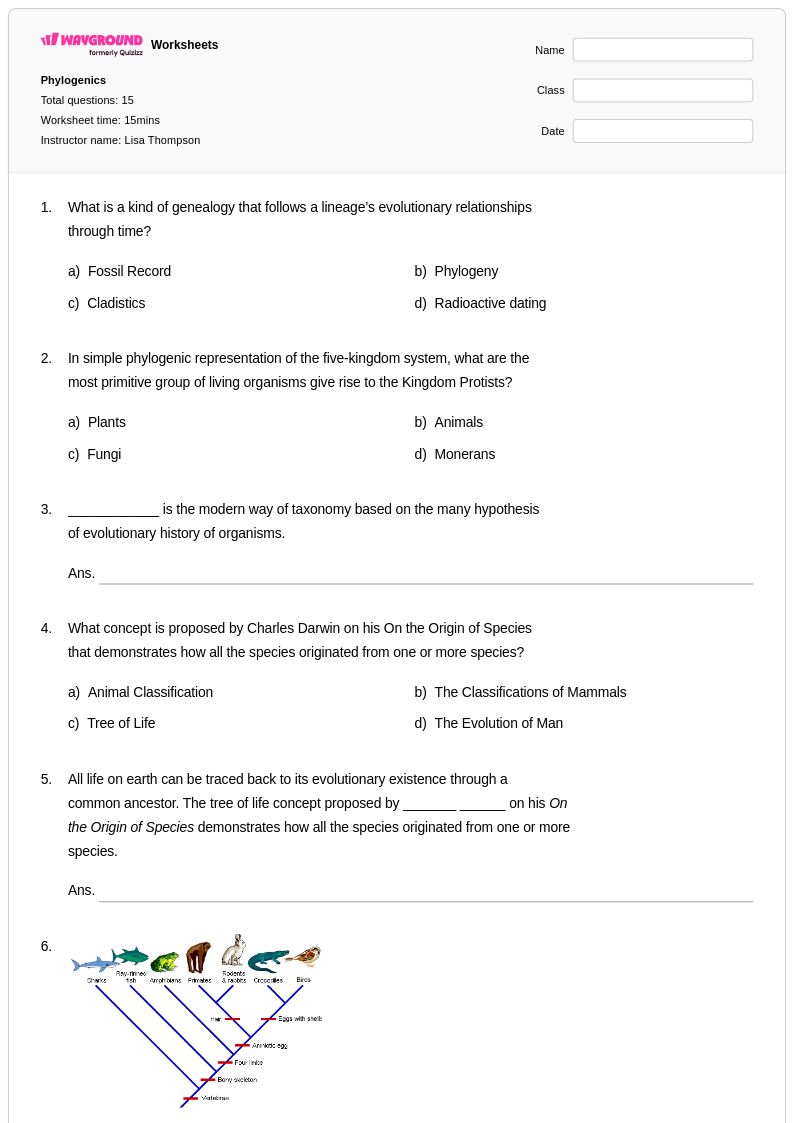
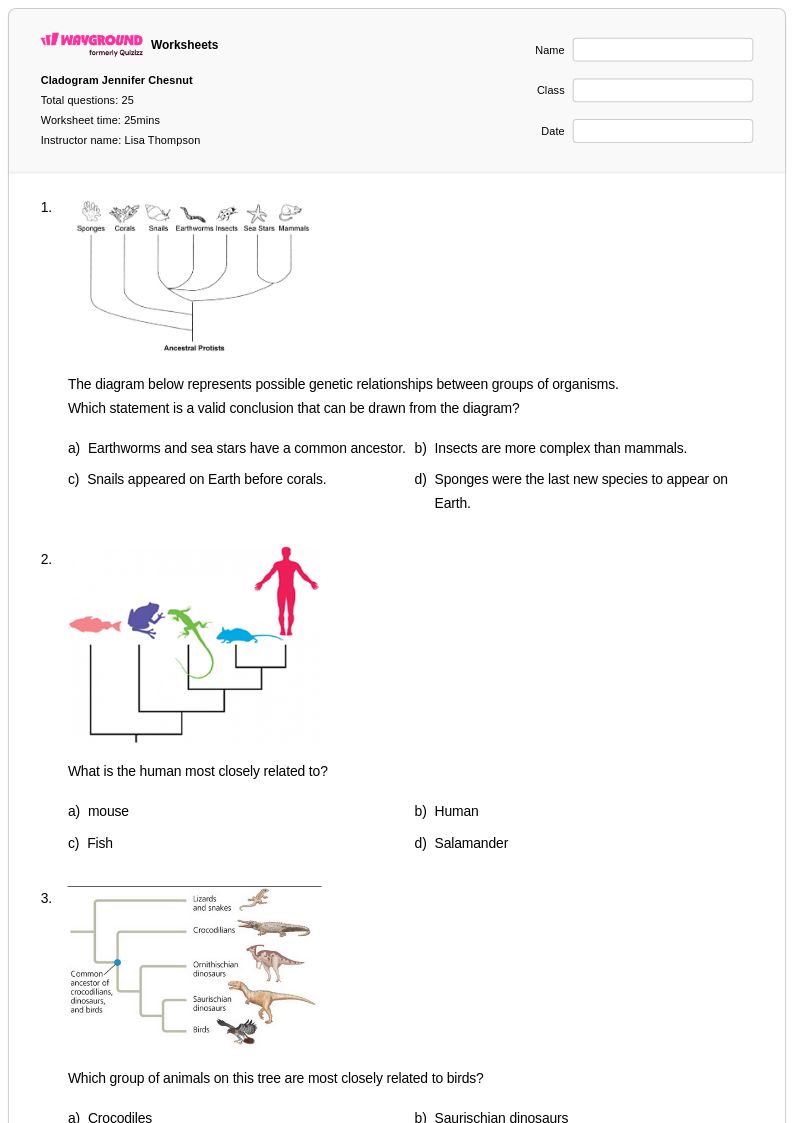
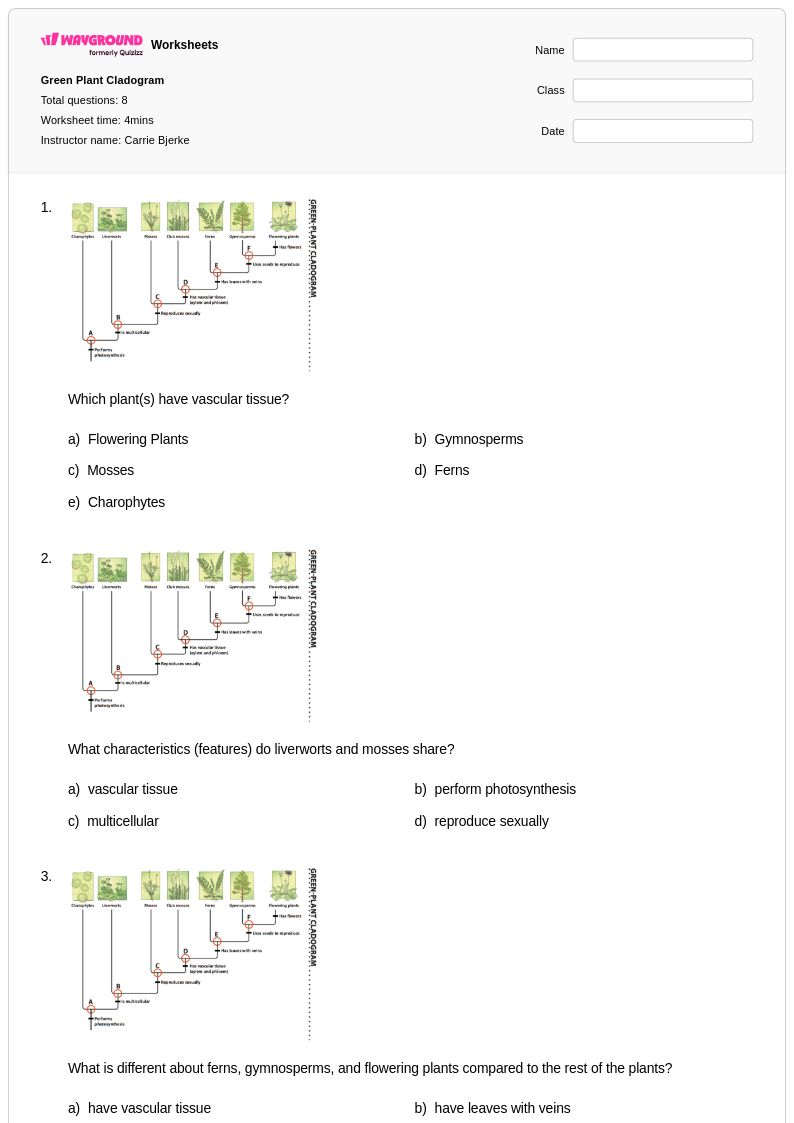
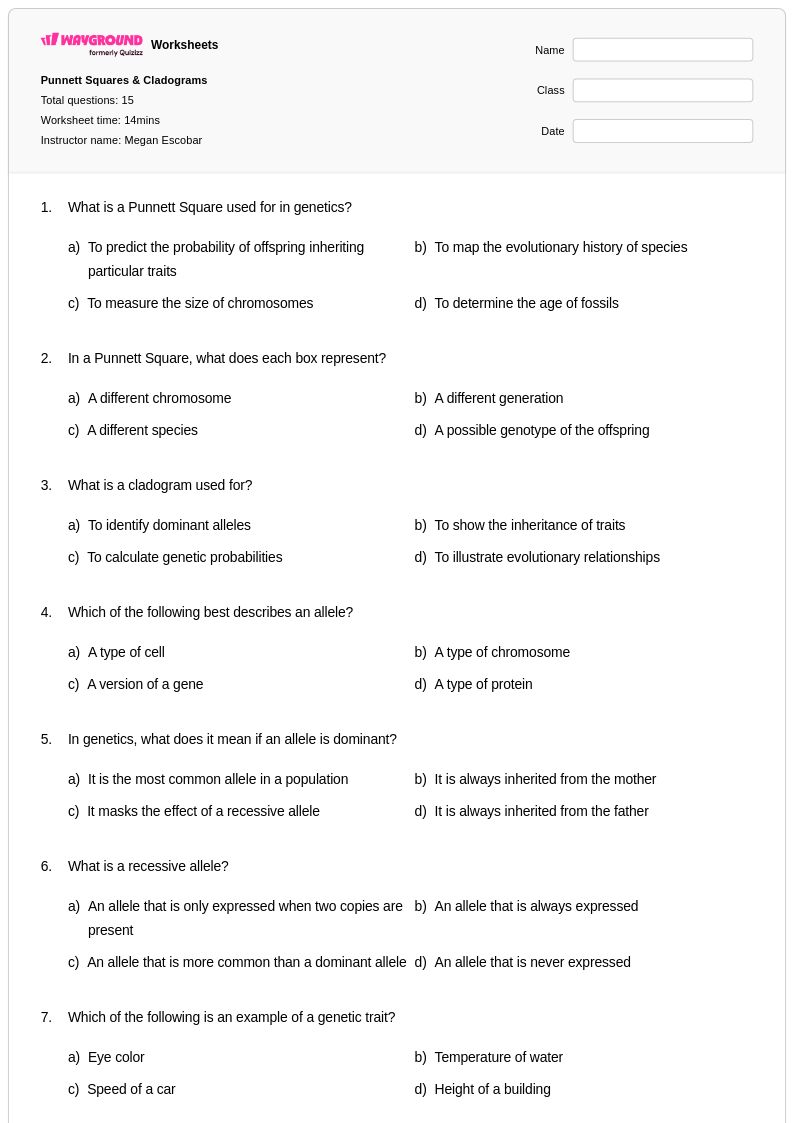
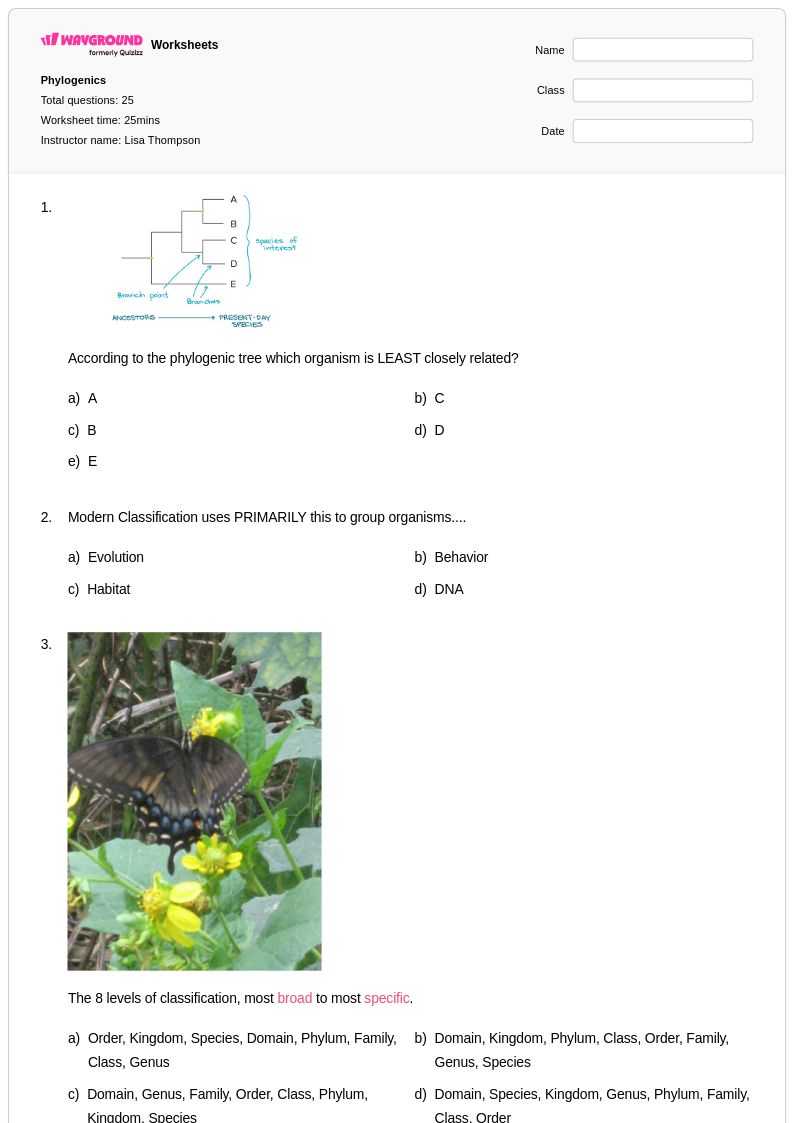
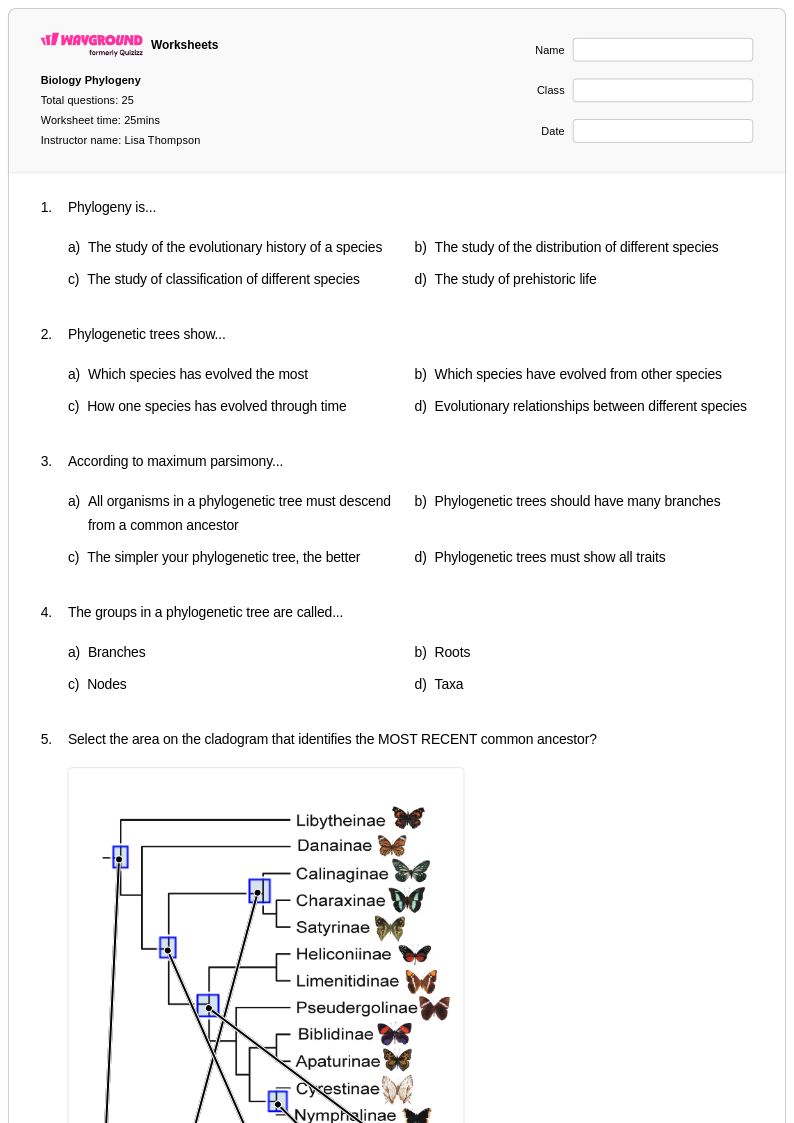
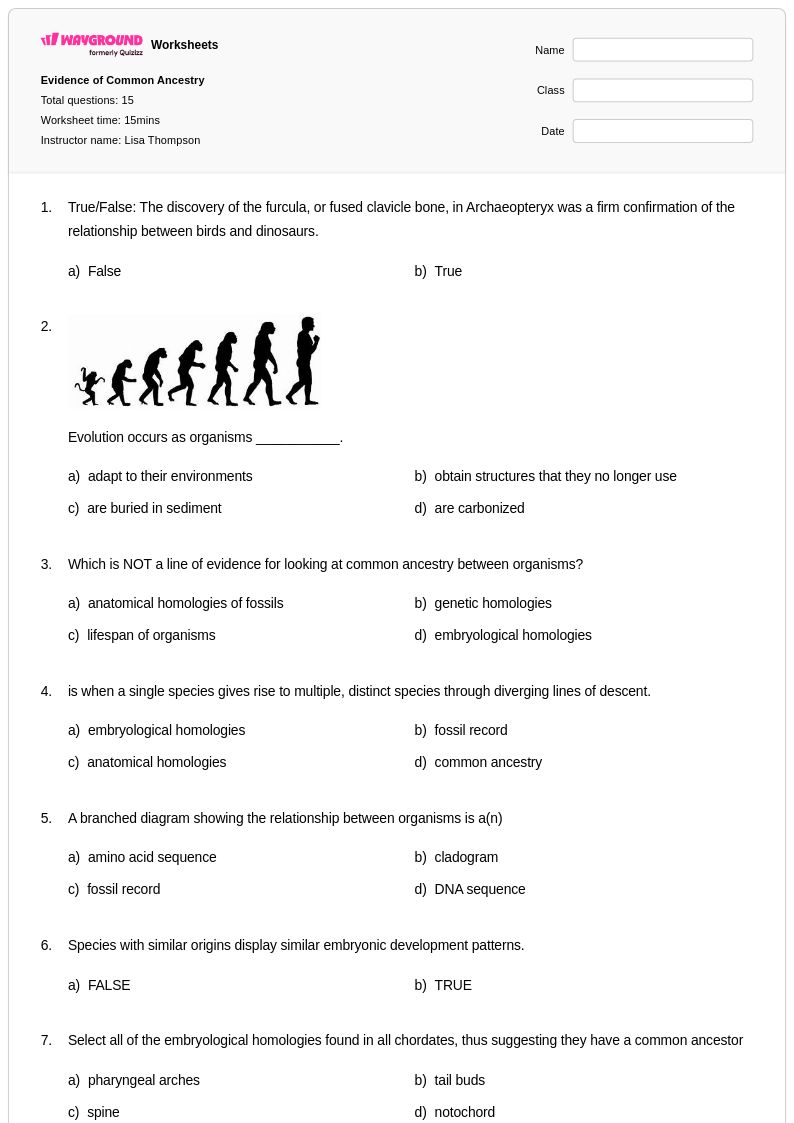
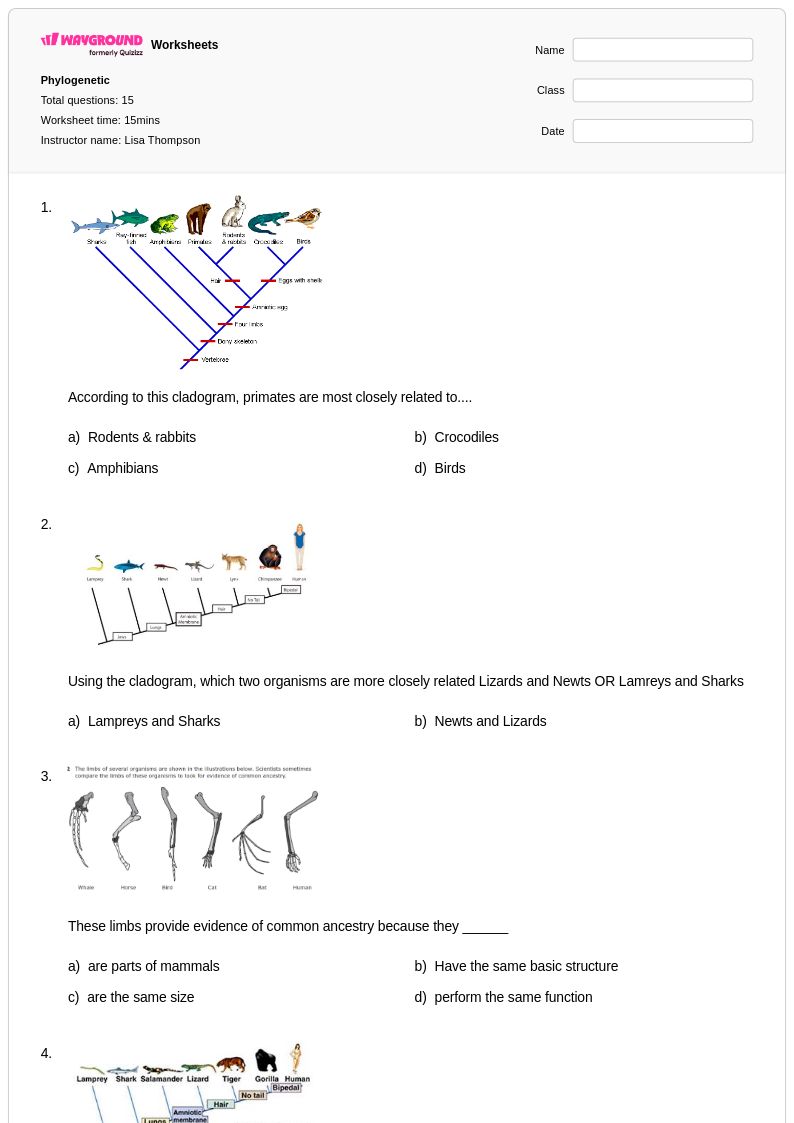
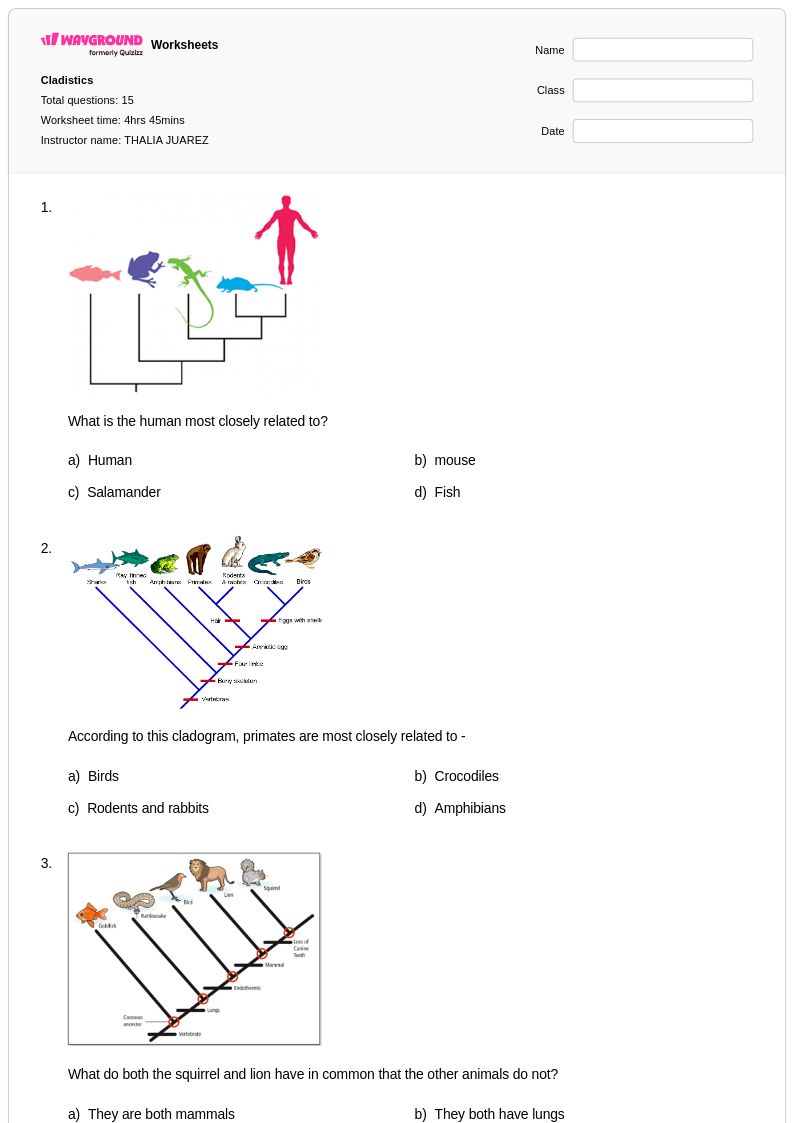
Access free Cladogram Analysis worksheets and printables from Wayground to help students master evolutionary relationships, phylogenetic trees, and species classification through engaging practice problems with comprehensive answer keys.
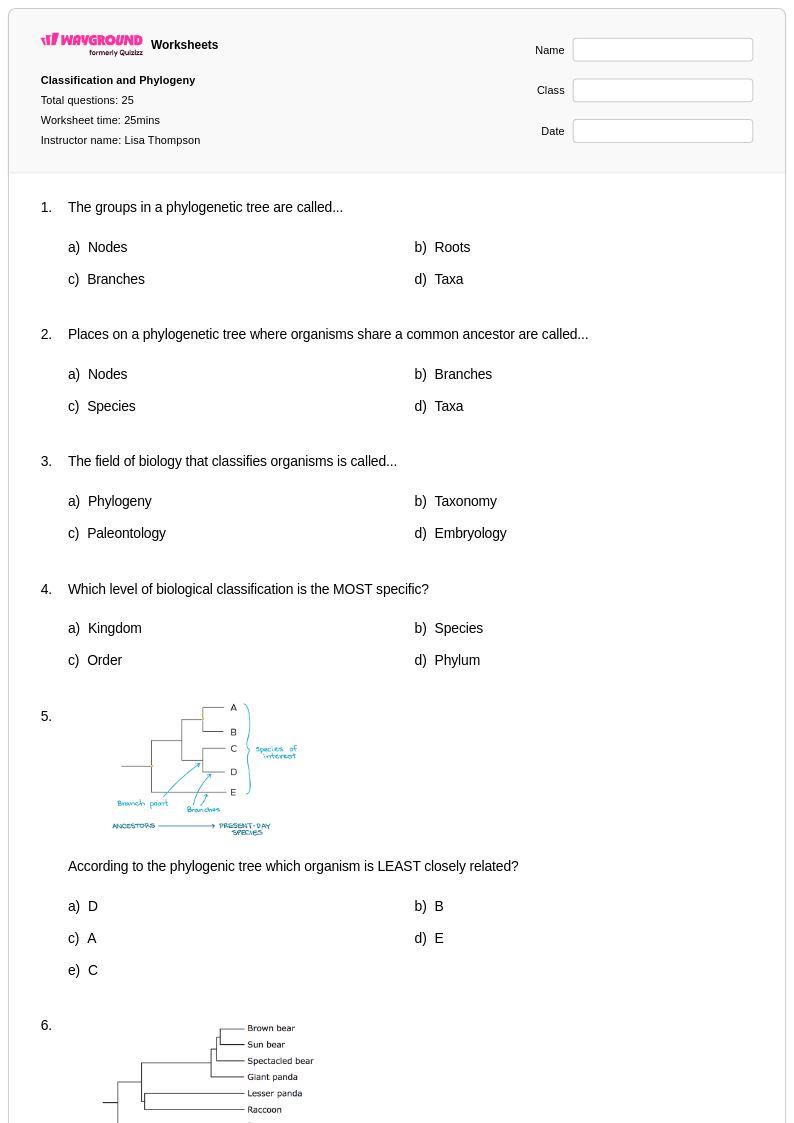
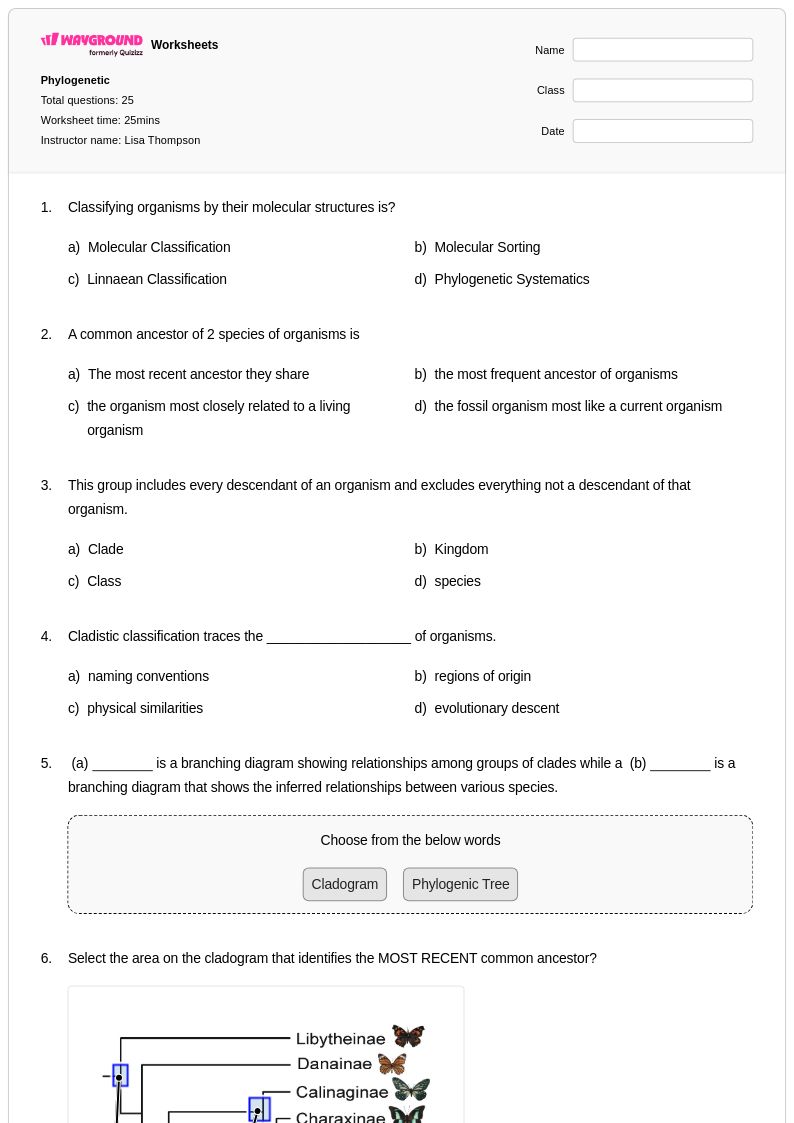
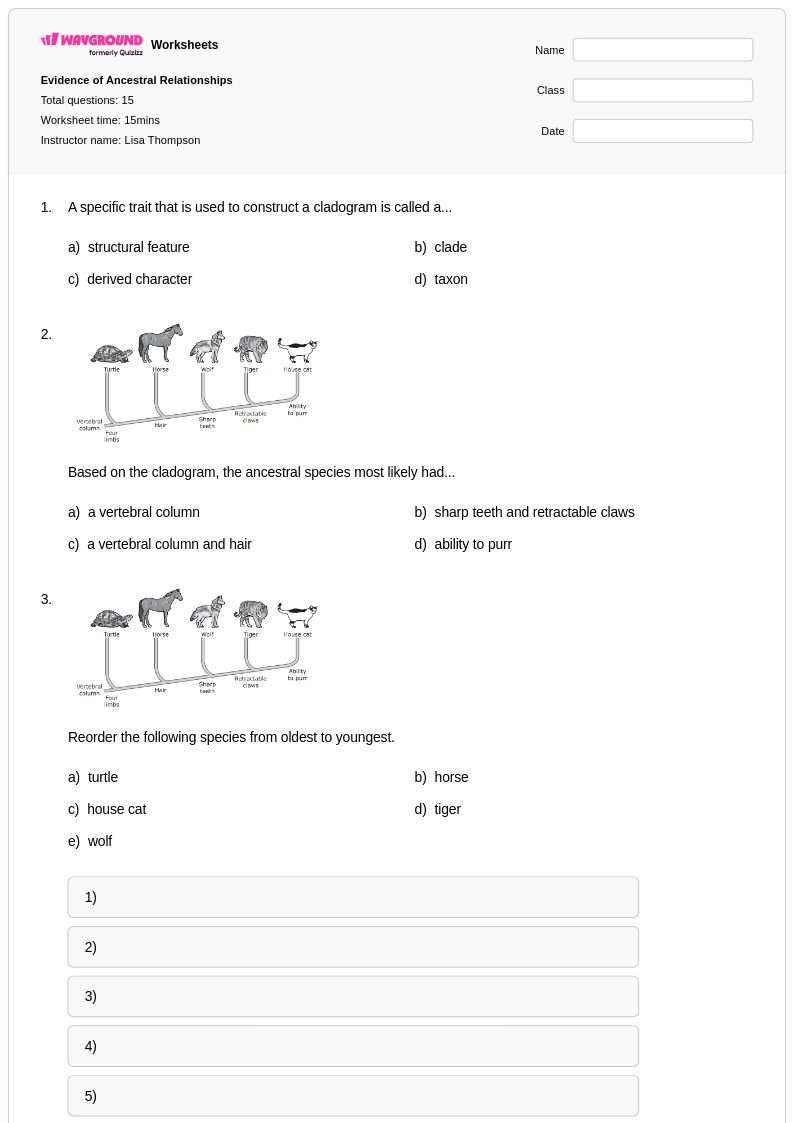
Cladogram analysis worksheets available through Wayground (formerly Quizizz) provide students with essential practice in interpreting evolutionary relationships and phylogenetic trees. These comprehensive resources strengthen critical scientific skills including reading branching diagrams, identifying common ancestors, determining evolutionary sequences, and analyzing morphological and molecular data used in constructing phylogenetic hypotheses. Students work through practice problems that challenge them to trace lineages, compare derived characteristics among species, and evaluate the relative timing of evolutionary events. Each worksheet comes with a detailed answer key to support independent learning and self-assessment, while the free printables offer educators flexibility in delivering both formative and summative assessments in convenient pdf format.
Wayground (formerly Quizizz) empowers teachers with millions of educator-created cladogram analysis resources that streamline lesson planning and enhance student understanding of evolutionary biology concepts. The platform's robust search and filtering capabilities allow instructors to quickly locate worksheets aligned with specific curriculum standards and learning objectives, while built-in differentiation tools enable seamless modification of content complexity to meet diverse student needs. Teachers can customize these materials for targeted skill practice, remediation activities, or enrichment opportunities, with resources available in both printable and digital formats including downloadable pdf versions. This comprehensive collection supports evidence-based instruction by providing varied practice opportunities that help students master the analytical thinking required for interpreting phylogenetic relationships and understanding evolutionary patterns across different taxonomic groups.
FAQs
How do I teach students to read and interpret a cladogram?
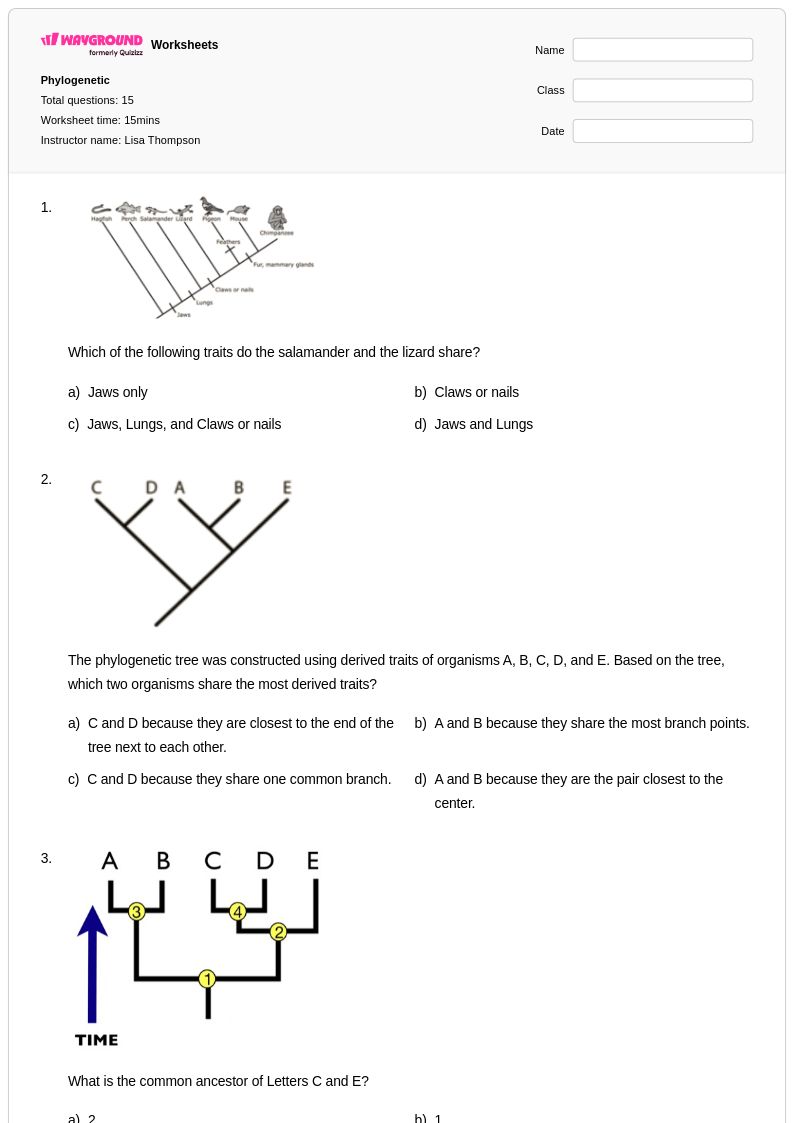
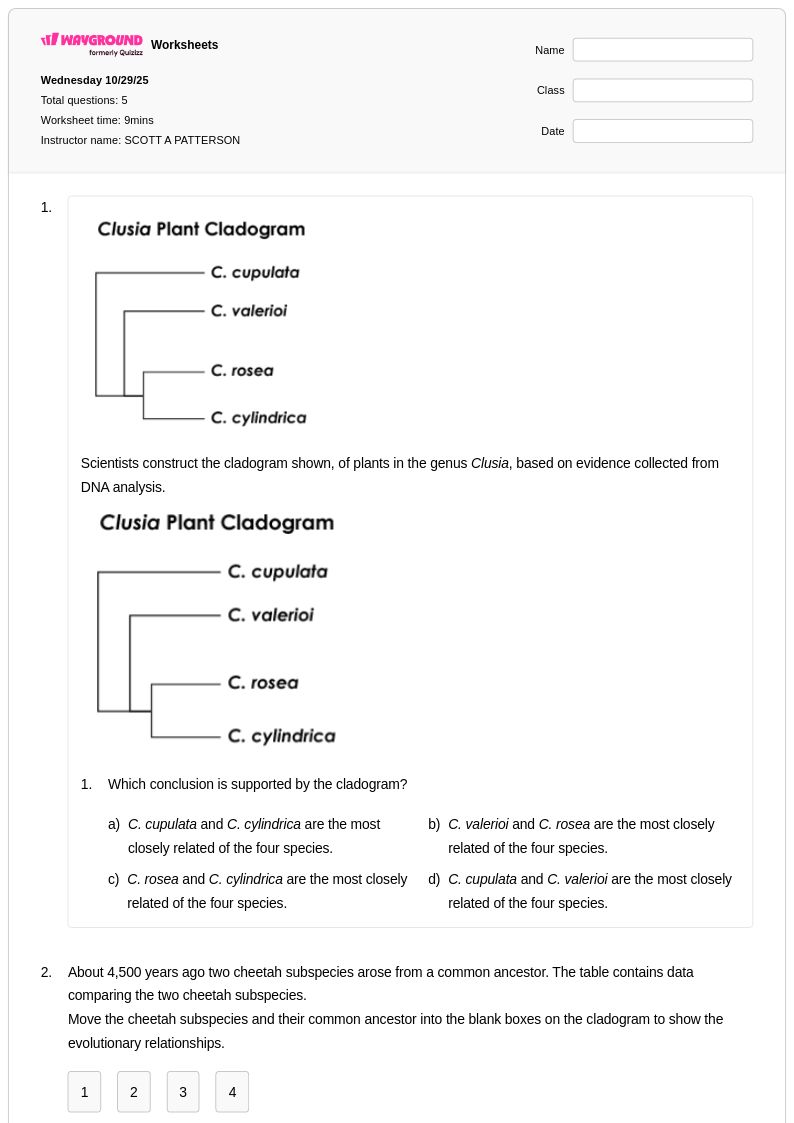
Start by teaching students the core vocabulary: nodes represent common ancestors, branches represent lineages, and taxa at the tips are the organisms being compared. Walk students through a simple, three-taxon cladogram before introducing more complex diagrams with multiple branching points. Emphasize that the position of a node, not the left-right order of taxa, determines relatedness. Once students can identify common ancestors and trace lineages, introduce derived characteristics (synapomorphies) to help them understand what drives the branching pattern.
What exercises help students practice cladogram analysis?
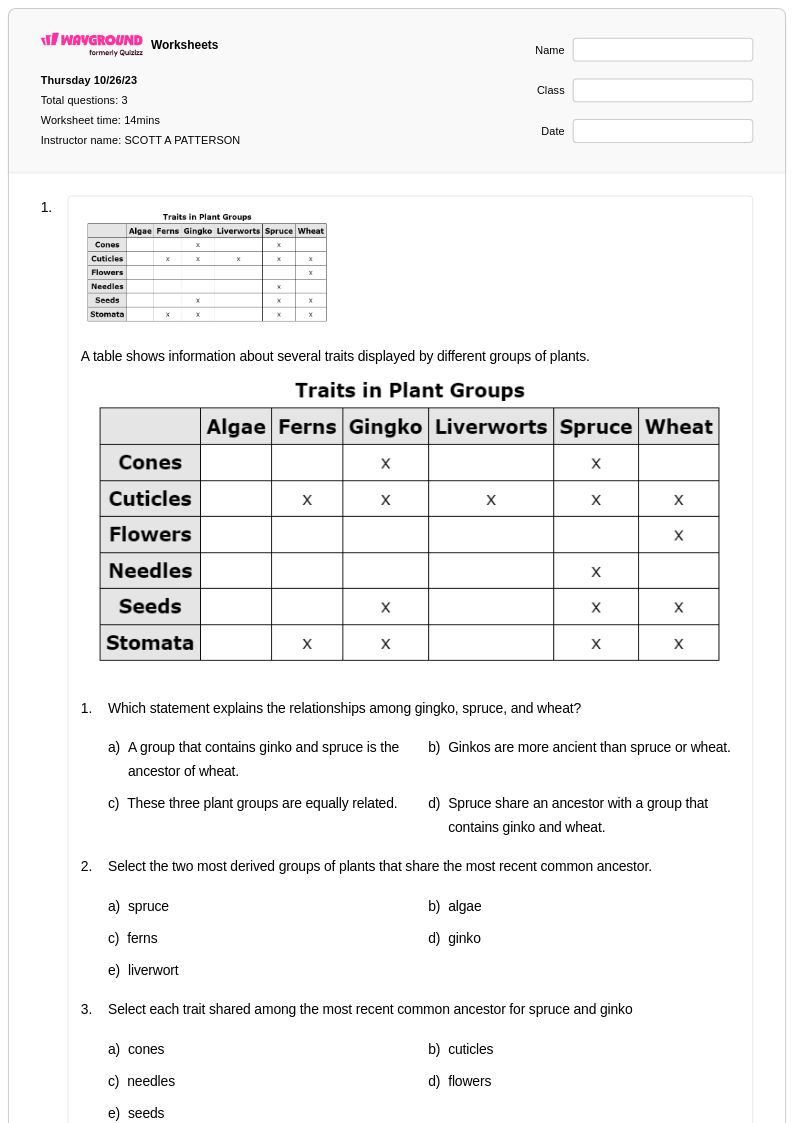
Effective practice exercises include reading pre-built cladograms to identify common ancestors, ranking the relative timing of evolutionary events, and using a character matrix to construct a cladogram from scratch. Students also benefit from comparing morphological traits across species and determining which taxa share the most recent common ancestor. Worksheets that present both molecular and morphological data give students exposure to the two main data types used in real phylogenetic analysis.
What mistakes do students commonly make when analyzing cladograms?
The most common error is assuming that taxa placed next to each other on a cladogram are the most closely related, when relatedness is actually determined by the most recent shared node. Students also frequently confuse ancestral traits with derived traits, which leads to incorrect groupings. Another persistent misconception is reading a cladogram as a linear progression from 'primitive' to 'advanced' rather than as a branching pattern of shared ancestry. Targeted practice problems that specifically address these error patterns help students self-correct before high-stakes assessments.
How do I use Wayground's cladogram analysis worksheets in my classroom?
Wayground's cladogram analysis worksheets are available as printable PDFs for traditional classroom use and in digital formats for technology-integrated learning environments, including the option to host them as a quiz directly on Wayground. The printable versions work well for guided practice, lab activities, or take-home review, while the digital format supports self-paced learning and immediate feedback. Each worksheet includes a complete answer key, making them suitable for independent practice, formative assessment, or structured remediation.
How can I differentiate cladogram analysis instruction for students at different skill levels?
For struggling students, begin with two- or three-taxon cladograms and provide a completed character matrix so they can focus on reading the diagram rather than building it. More advanced students can work from raw morphological or molecular data to construct their own phylogenetic hypotheses. On Wayground, teachers can apply built-in differentiation tools such as reduced answer choices or read-aloud support for individual students, allowing the same worksheet to serve multiple learner levels without requiring separate materials.
How does cladogram analysis connect to broader biology curriculum standards?
Cladogram analysis directly supports standards related to evolution, natural selection, and biological classification, making it a core skill in most high school biology and AP Biology curricula. Understanding phylogenetic trees also reinforces students' ability to evaluate evidence for evolutionary relationships, which is central to Next Generation Science Standards (NGSS) practices around analyzing and interpreting data. Because cladograms appear across units on genetics, ecology, and taxonomy, mastery of this skill has cross-unit value throughout a biology course.