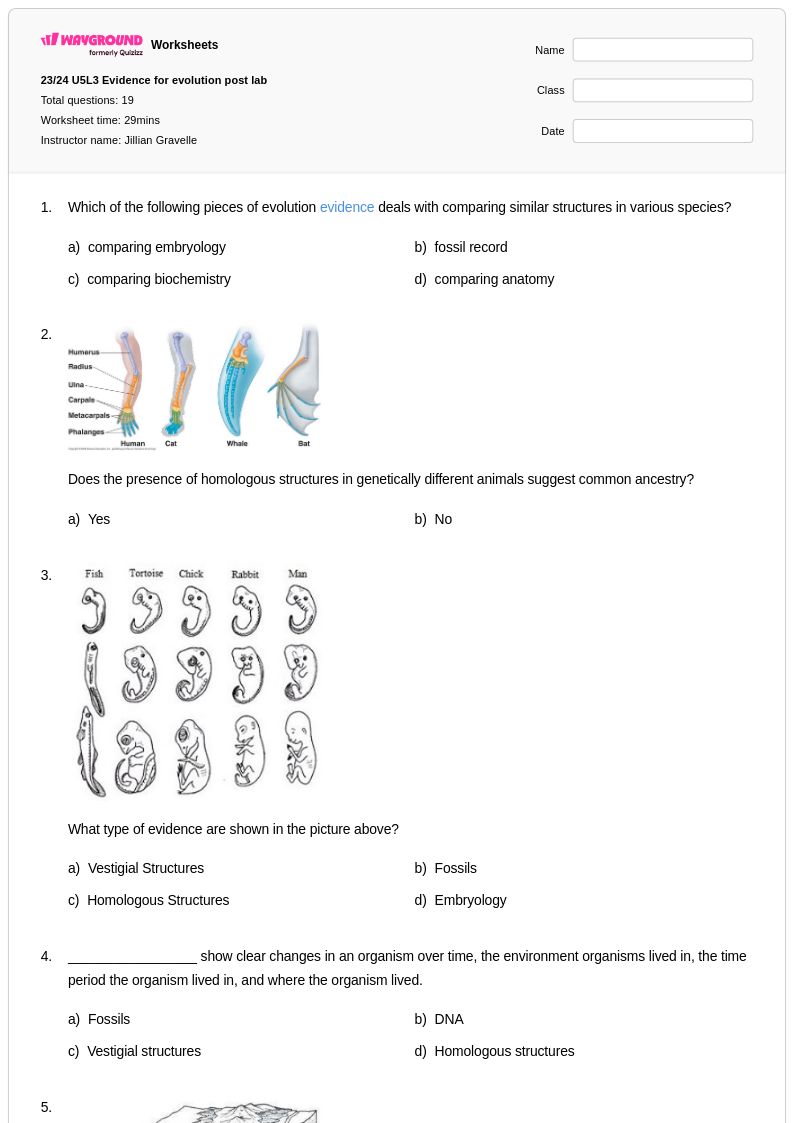
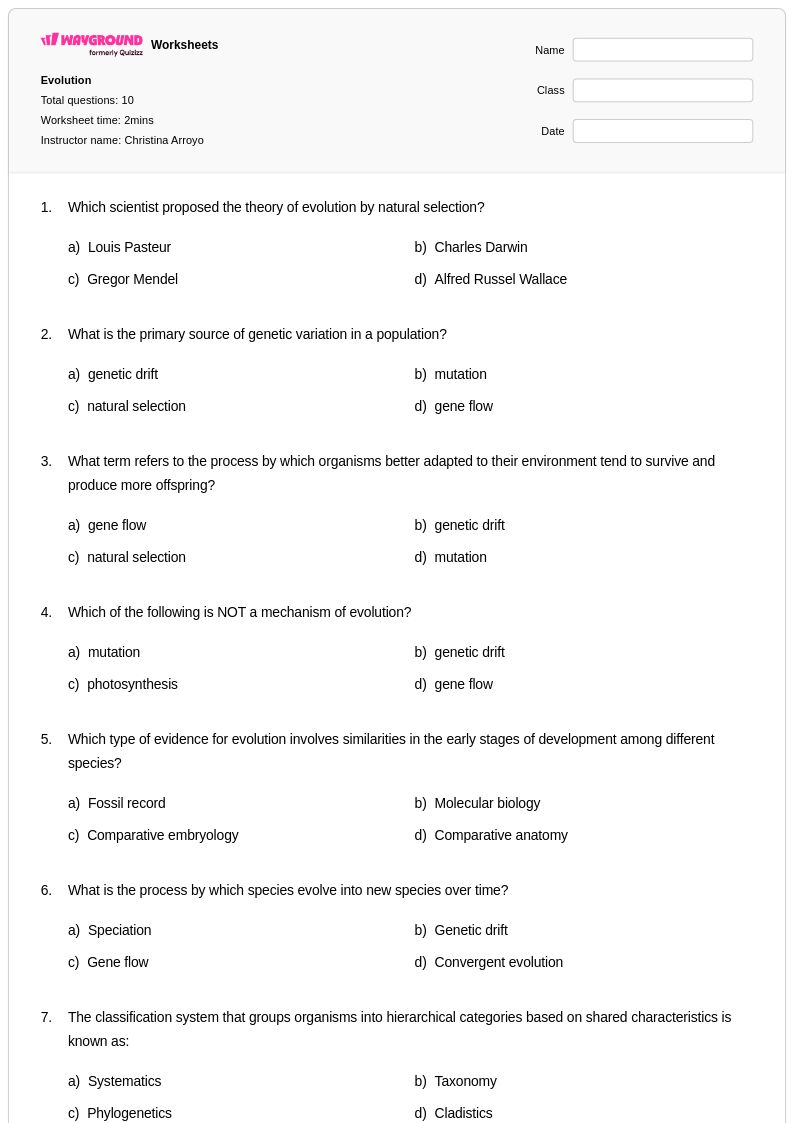
Free comparative embryology worksheets and printables help students explore embryonic development patterns across species, featuring practice problems and answer keys to master evolutionary relationships through detailed PDF activities.
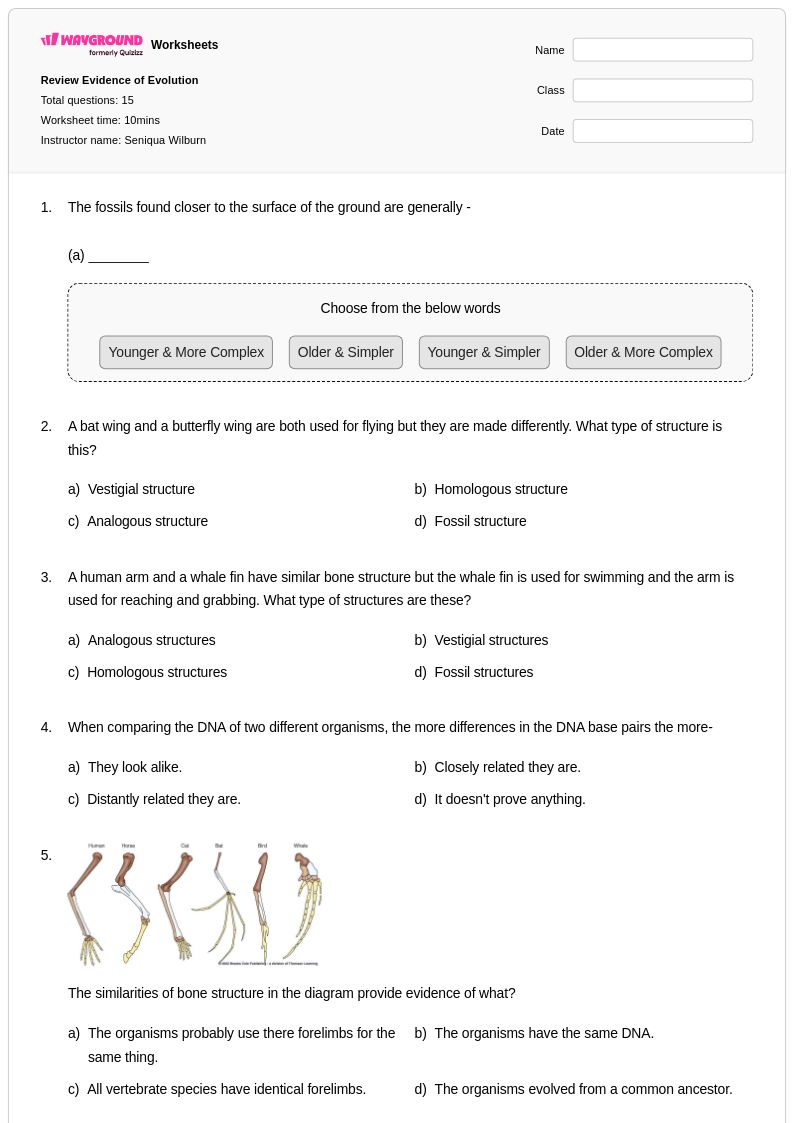
Comparative embryology worksheets available through Wayground (formerly Quizizz) provide students with essential practice in analyzing embryonic development patterns across different species to understand evolutionary relationships. These comprehensive resources strengthen critical scientific skills including observation of embryonic stages, identification of homologous structures, and interpretation of developmental similarities that reveal common ancestry. Students work through practice problems that challenge them to compare vertebrate embryos, analyze gill slits and tail formations, and draw conclusions about phylogenetic relationships based on embryological evidence. The collection includes detailed answer keys that help students verify their understanding of complex developmental processes, while free printables ensure accessibility for diverse learning environments where students can practice identifying vestigial structures and developmental patterns at their own pace.
Wayground (formerly Quizizz) supports biology educators with millions of teacher-created comparative embryology resources that feature robust search and filtering capabilities to locate materials perfectly aligned with curriculum standards and learning objectives. Teachers can easily differentiate instruction by selecting from worksheets that range from basic embryonic stage identification to advanced phylogenetic analysis, with flexible customization tools allowing educators to modify content for remediation or enrichment purposes. The platform's availability in both printable and digital pdf formats enables seamless integration into diverse classroom environments, whether teachers need hands-on activities for laboratory sessions or digital resources for remote learning. These comprehensive tools streamline lesson planning while providing targeted skill practice that helps students master the intricate connections between embryological development and evolutionary biology.
FAQs
How do I teach comparative embryology in a biology class?
Start by establishing why embryonic similarity across species serves as evidence for common ancestry, then guide students through visual comparisons of vertebrate embryos at different developmental stages. Focus on observable structures like gill slits, tail formations, and limb buds that appear across fish, amphibians, reptiles, birds, and mammals. Connecting these observations to phylogenetic trees helps students move from pattern recognition to evolutionary reasoning. Using side-by-side diagrams and structured analysis tasks keeps the comparison concrete and manageable.
What exercises help students practice comparative embryology?
Effective practice exercises include labeling embryonic stages across species, identifying homologous structures such as gill slits and notochords, and completing comparison charts that prompt students to draw conclusions about common ancestry. Tasks that ask students to rank embryos by developmental similarity and match embryos to their adult organisms reinforce both observation and analytical skills. Worksheets that integrate phylogenetic tree interpretation alongside embryological evidence give students practice connecting two major lines of evolutionary support.
What mistakes do students commonly make when analyzing embryological evidence for evolution?
A frequent misconception is that embryonic similarity means the organisms are identical or closely related in all traits, rather than sharing a common ancestor at some point in evolutionary history. Students also confuse homologous structures with analogous ones, misattributing similar embryonic features to convergent evolution rather than shared ancestry. Another common error is conflating Haeckel's biogenetic law with modern comparative embryology; teachers should clarify that while embryonic similarities are real evidence, the claim that 'ontogeny recapitulates phylogeny' is an oversimplification. Emphasizing that embryological evidence must be interpreted alongside molecular and fossil data helps students build a more accurate picture.
How do I use comparative embryology worksheets in my classroom?
Comparative embryology worksheets on Wayground are available as printable PDFs for traditional lab and classroom use, as well as in digital formats for technology-integrated or remote learning environments. Teachers can assign them as guided in-class activities, independent practice, or formative assessments, and can host them as a quiz directly on Wayground to track student responses. The included answer keys allow students to self-check their work or enable teachers to use them for quick scoring. Both formats accommodate different instructional setups without requiring additional preparation.
How can I differentiate comparative embryology instruction for students at different skill levels?
For students newer to the topic, begin with worksheets focused on basic embryonic stage identification and visual matching before introducing phylogenetic analysis. Advanced students benefit from tasks that require them to interpret embryological evidence in combination with molecular or fossil data and construct supported arguments about evolutionary relationships. On Wayground, teachers can apply student-level accommodations such as read aloud support, reduced answer choices, or extended time to individual students without affecting the experience of the rest of the class, making it straightforward to support diverse learners within the same assignment.
How does comparative embryology relate to other lines of evolutionary evidence?
Comparative embryology is one of several converging lines of evidence for evolution, alongside fossil records, comparative anatomy, biogeography, and molecular biology. Embryological similarities, such as the presence of pharyngeal pouches and post-anal tails across vertebrate embryos, provide direct developmental support for common ancestry that complements genetic and structural evidence. Teaching students to triangulate across multiple evidence types builds stronger scientific reasoning than relying on any single line of evidence alone.