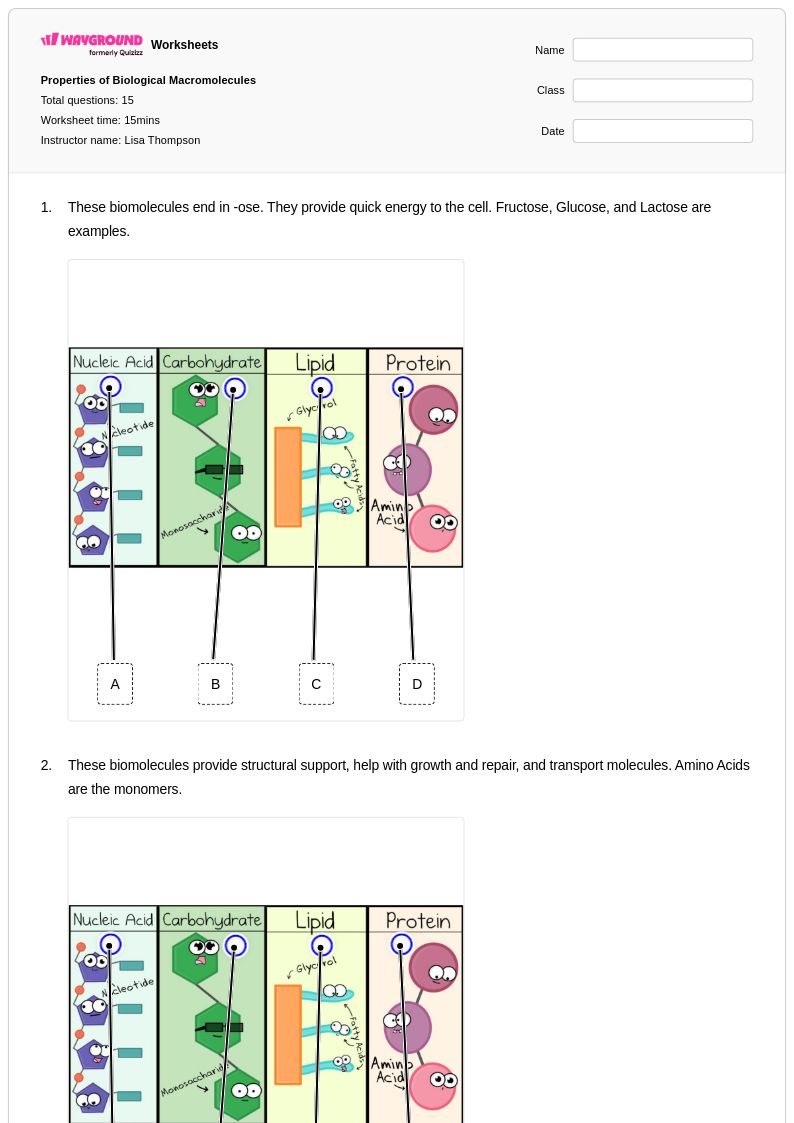
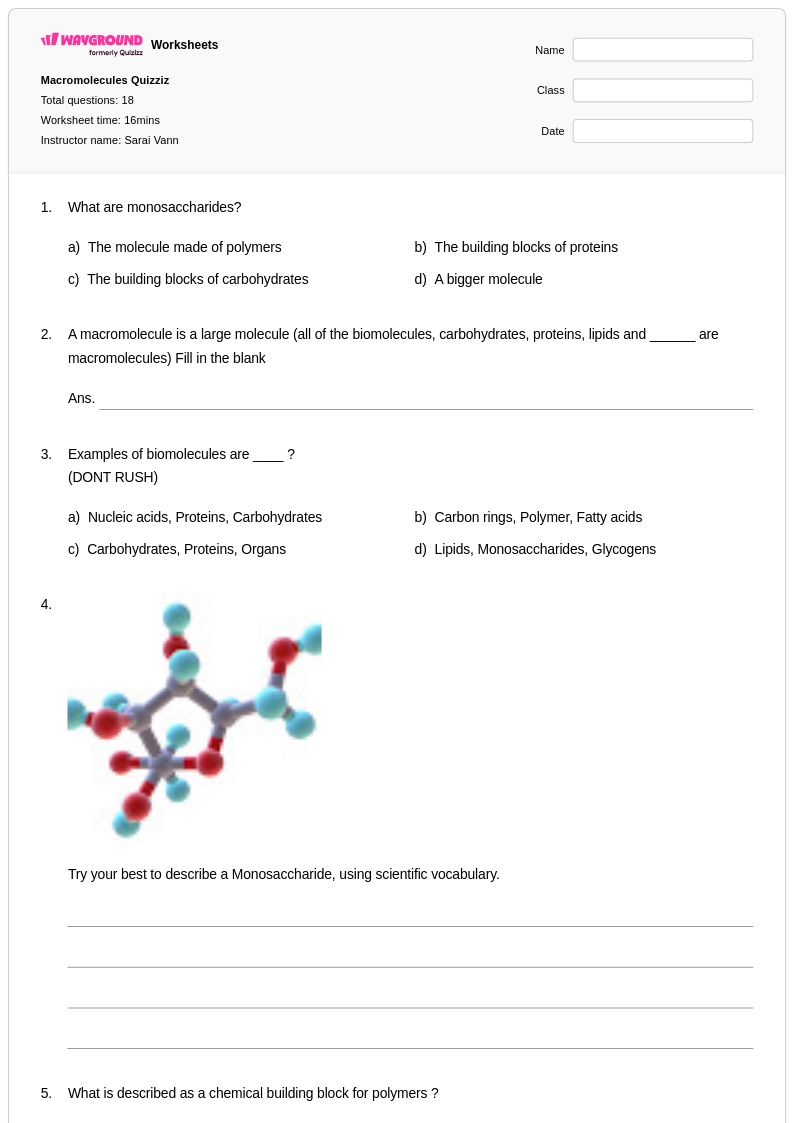
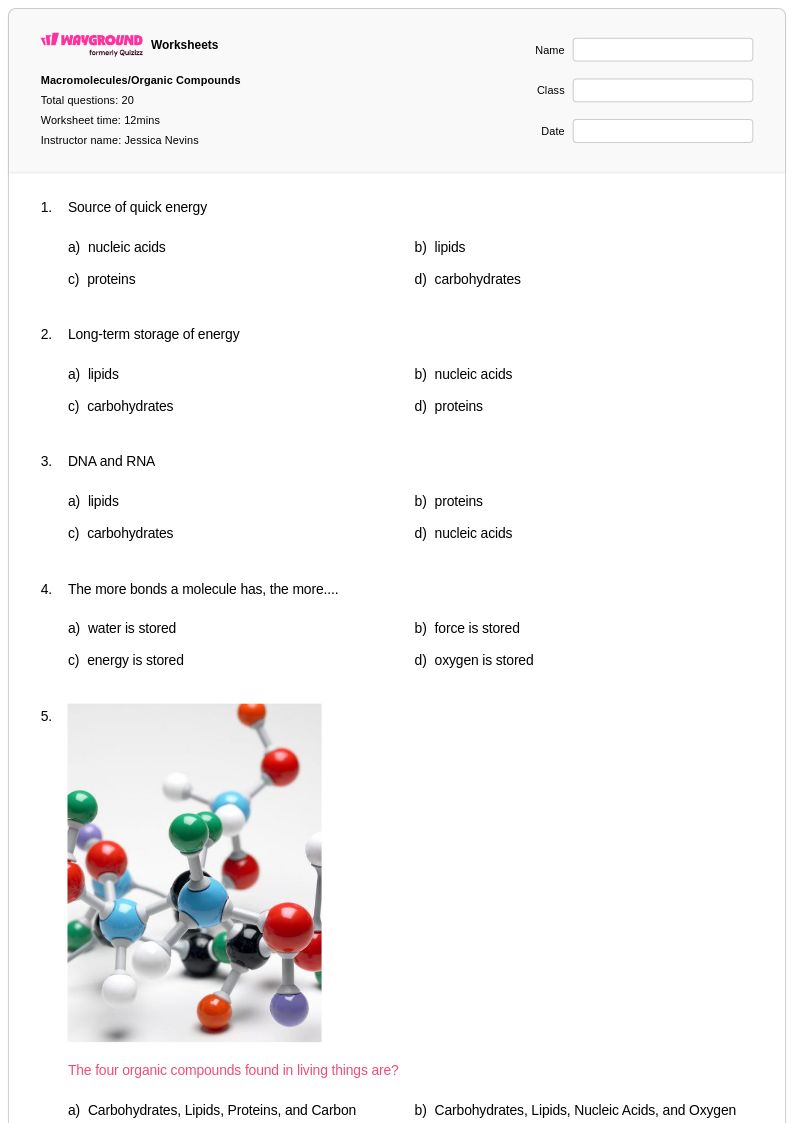
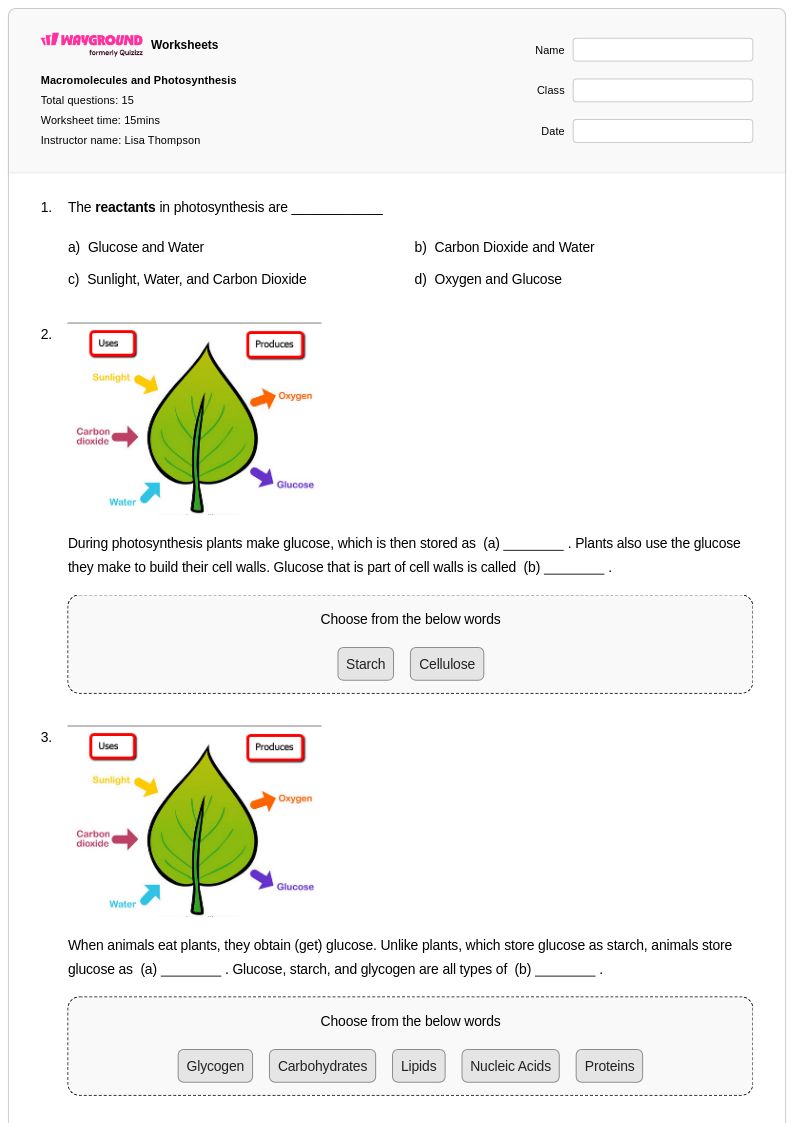
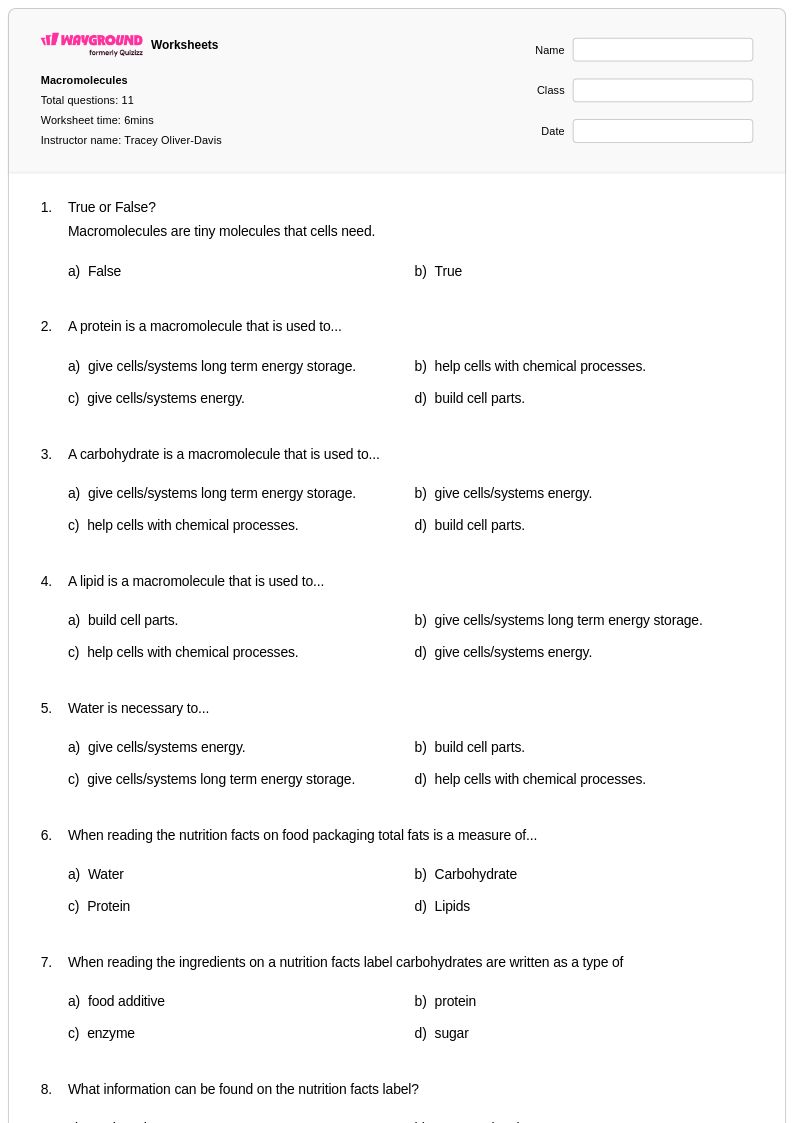
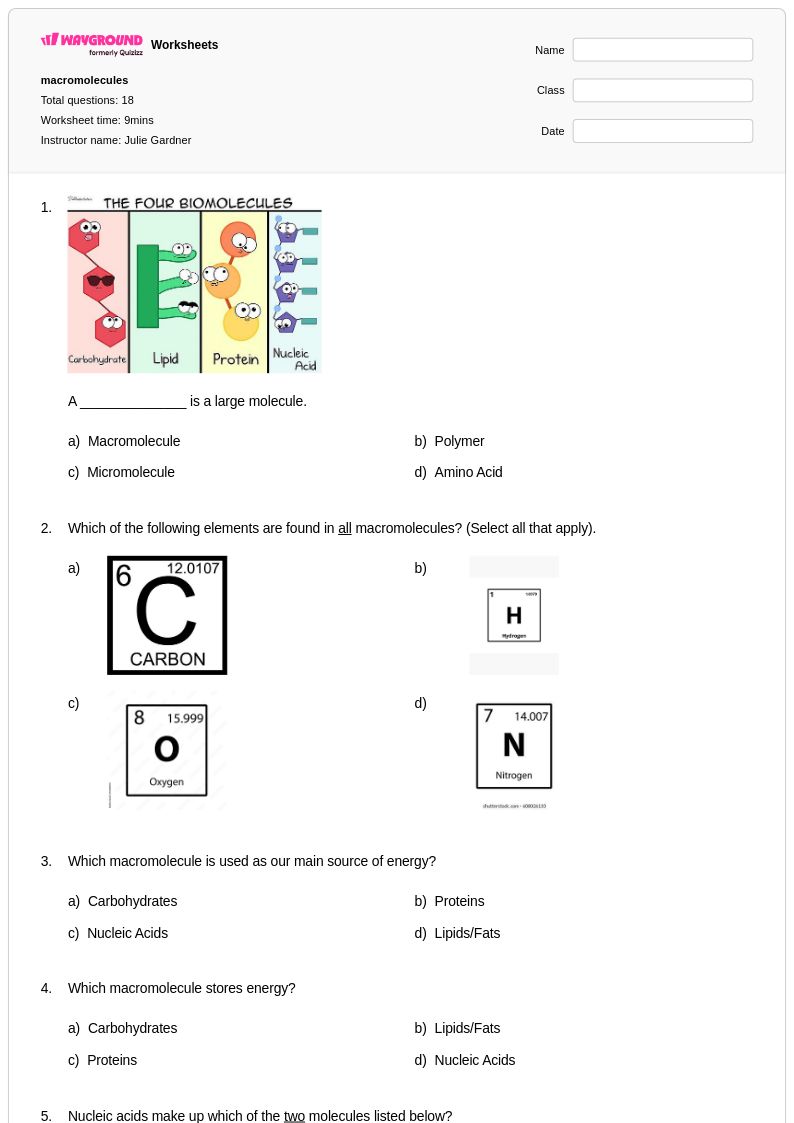
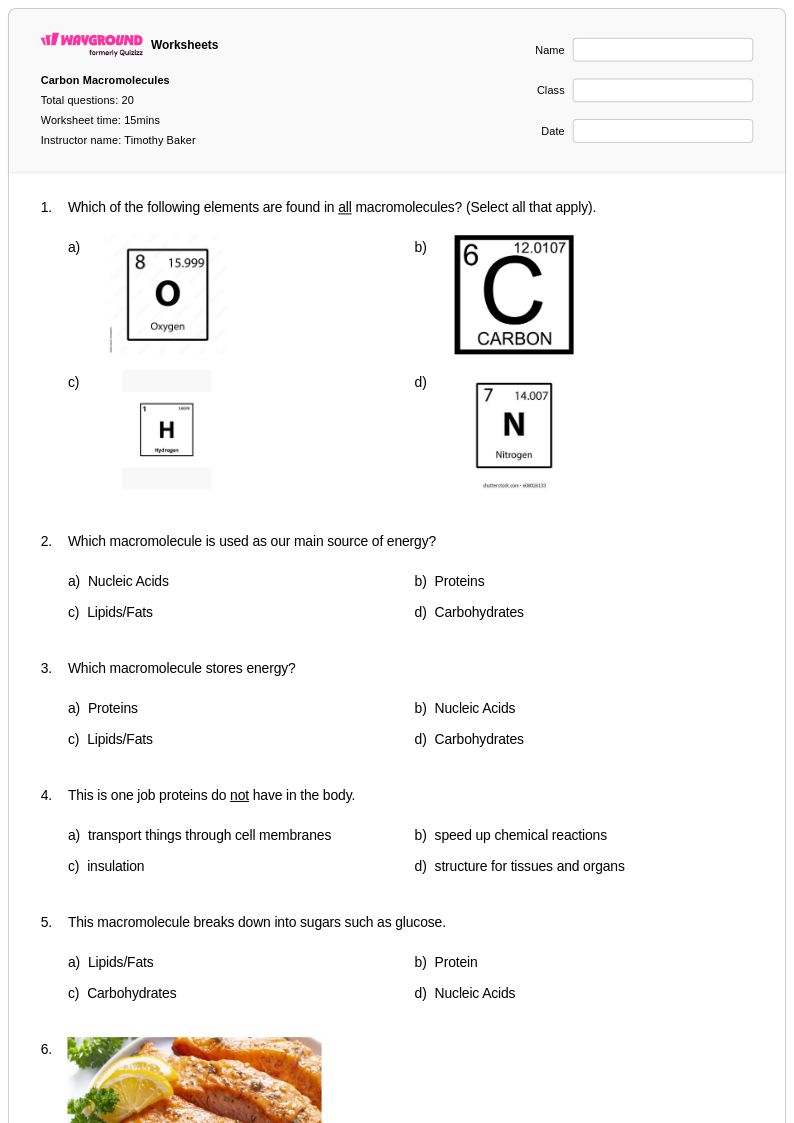
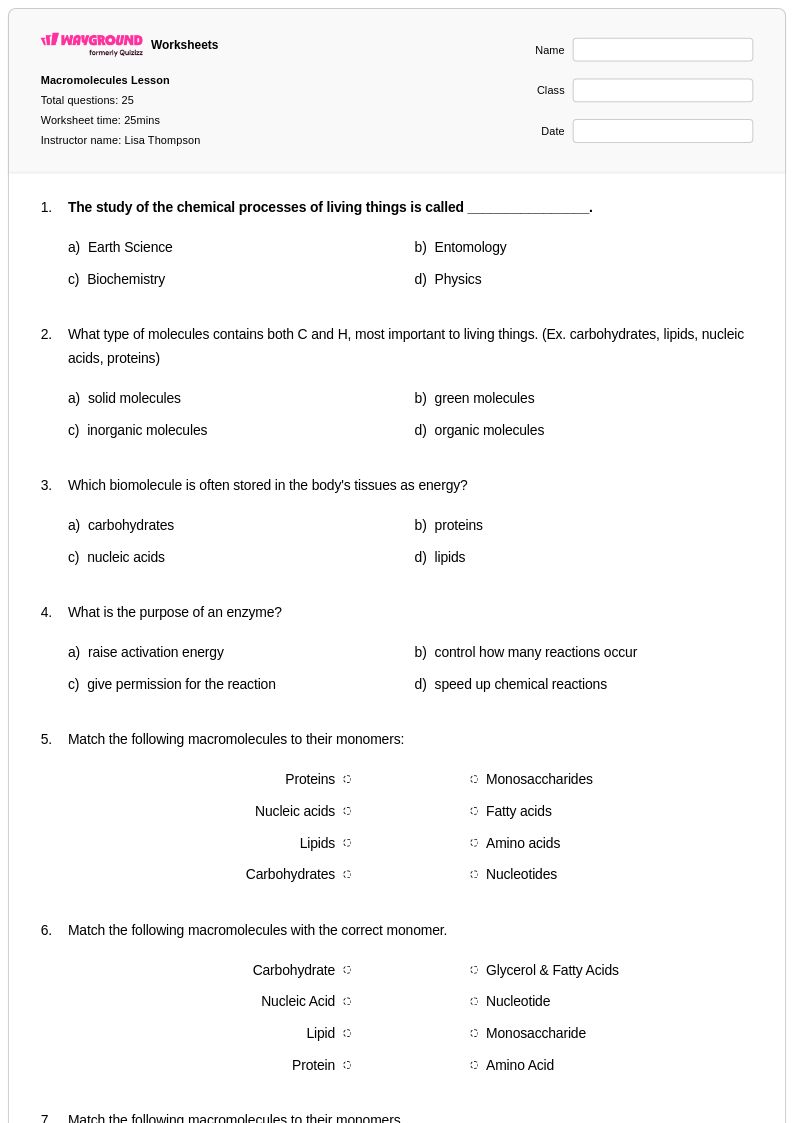
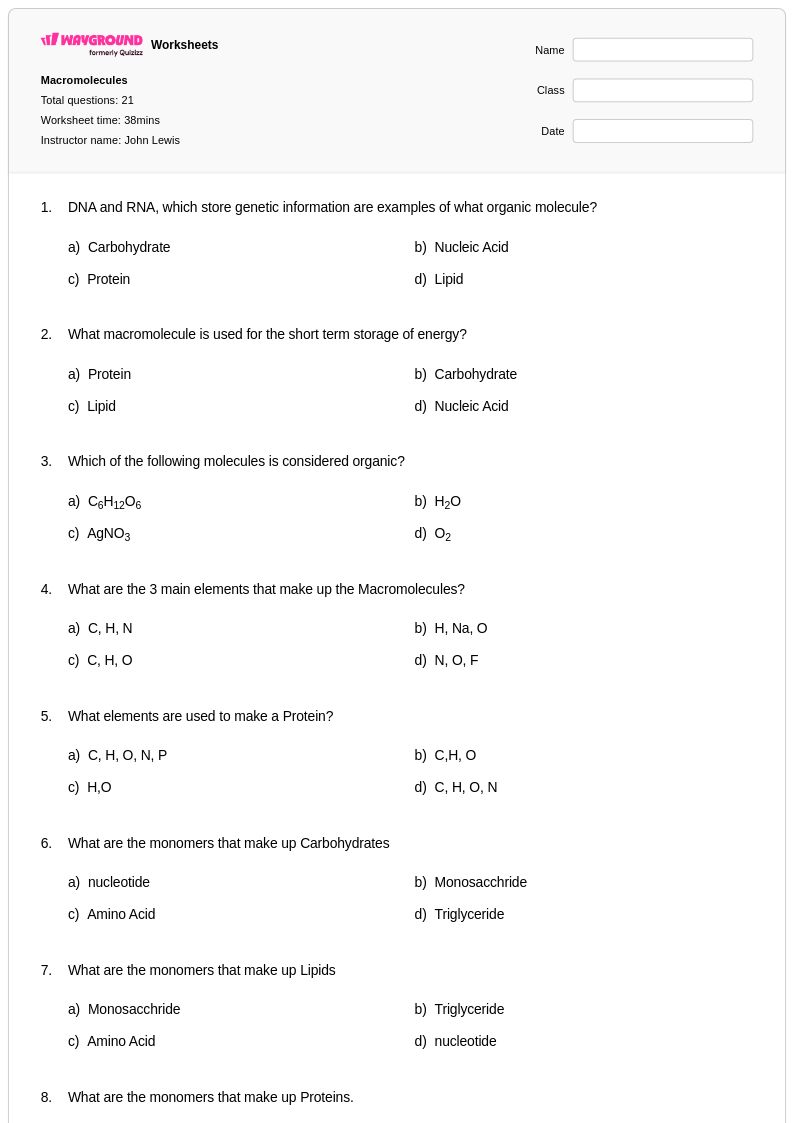
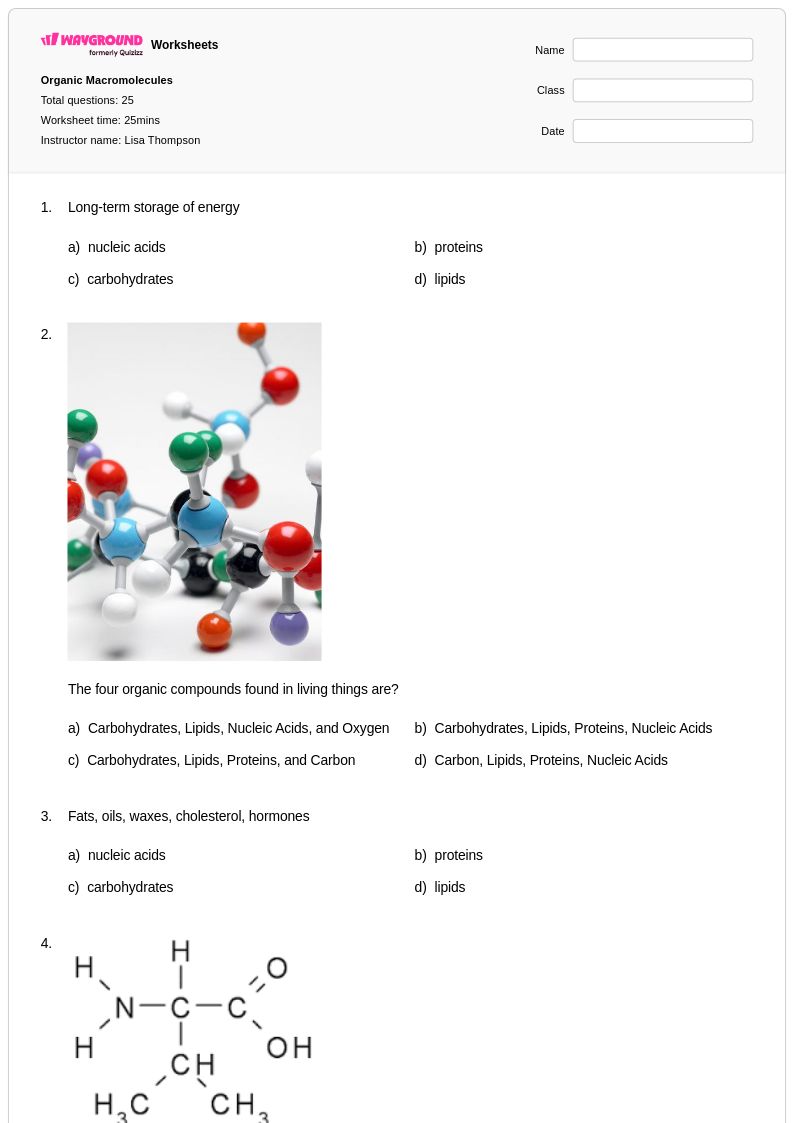
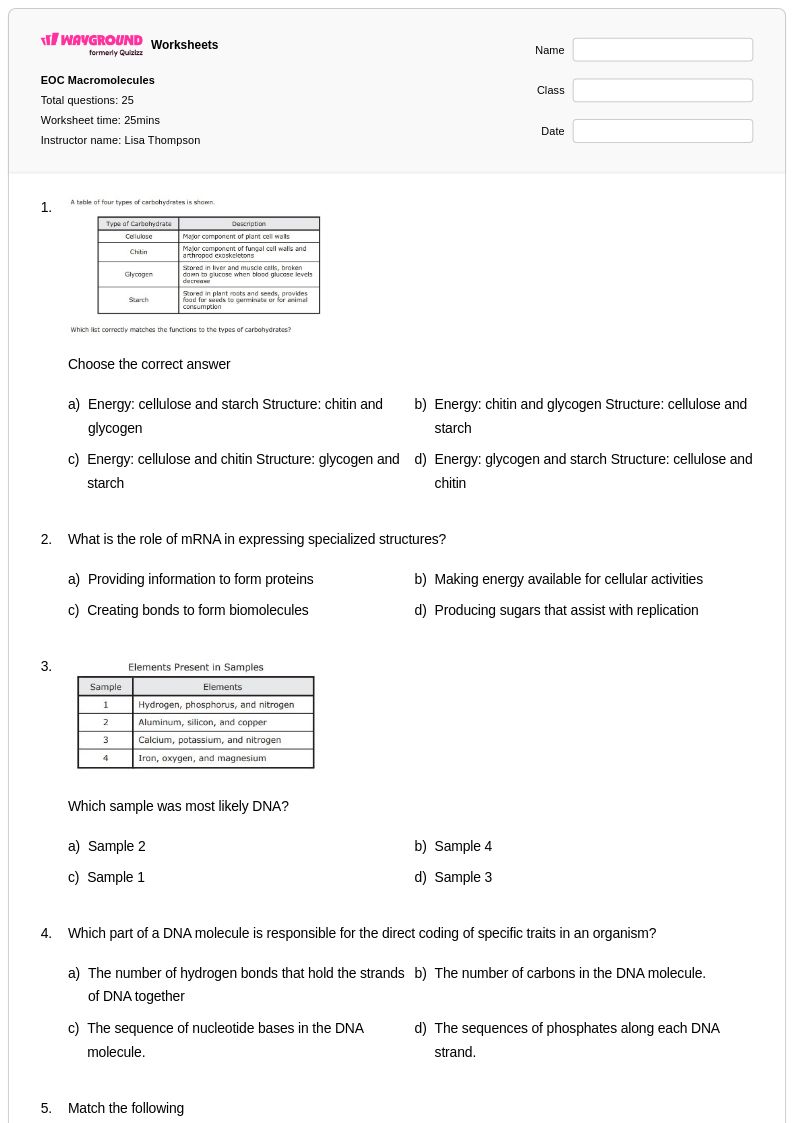
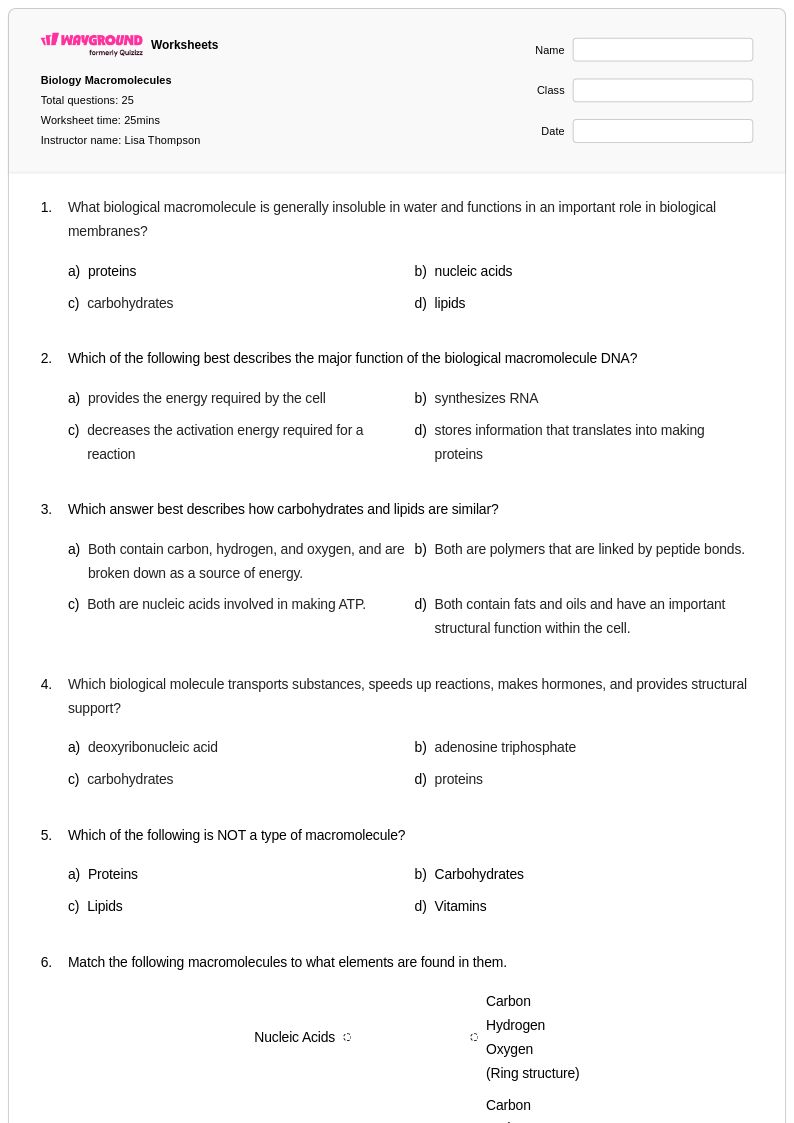
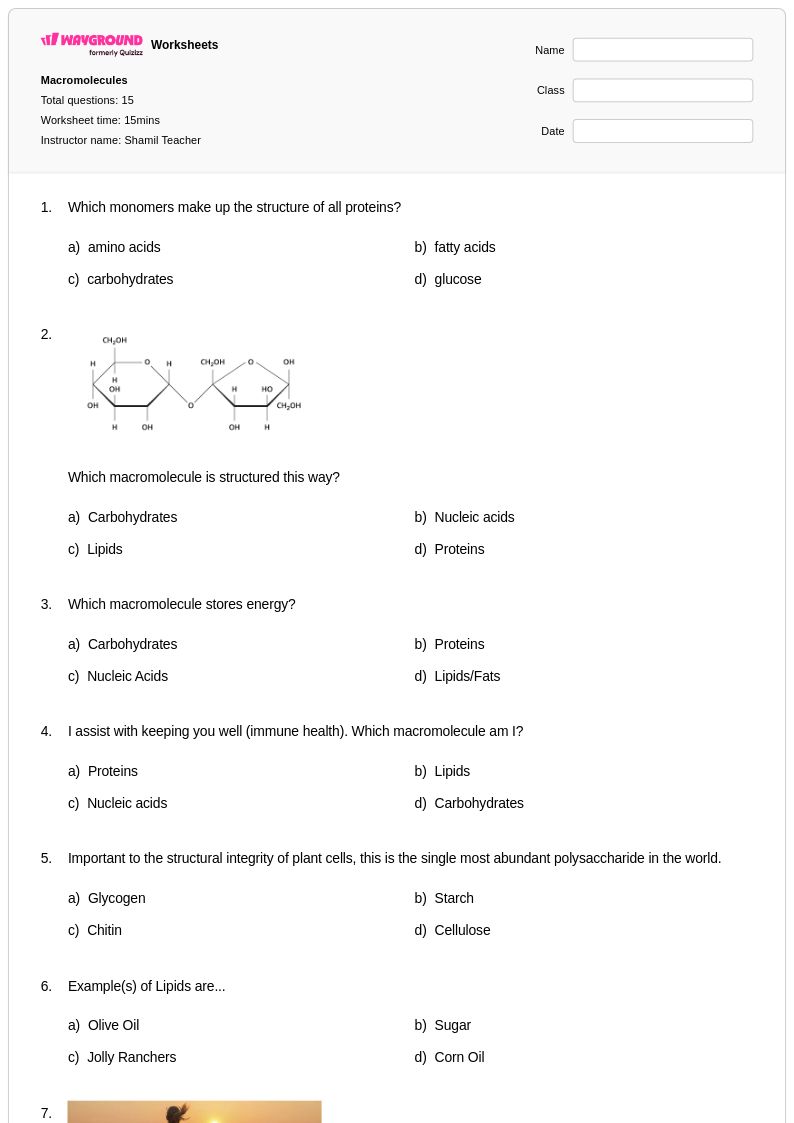
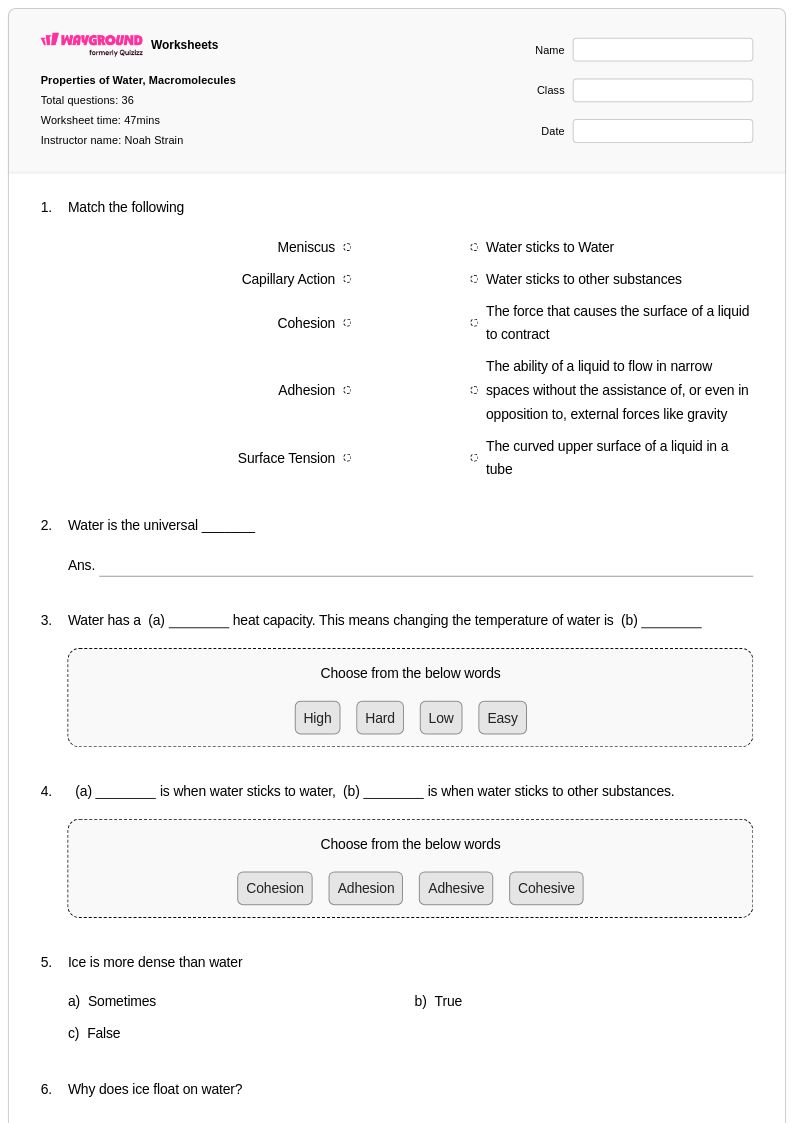
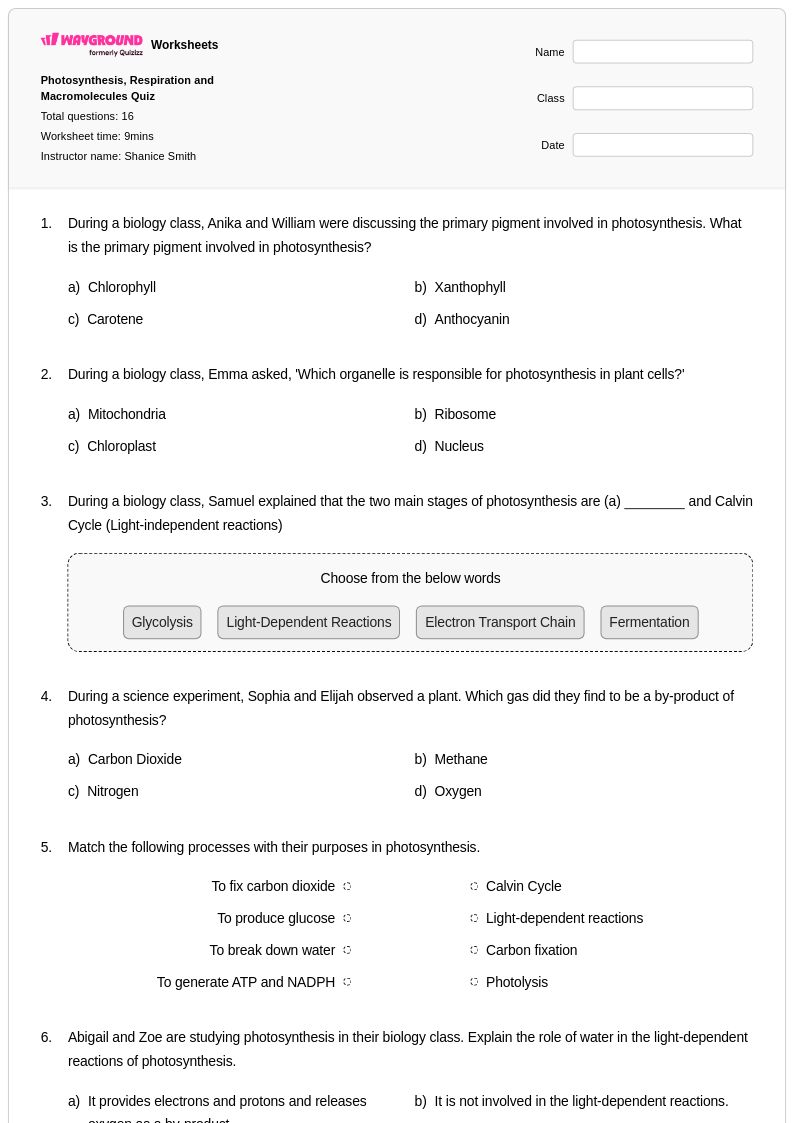
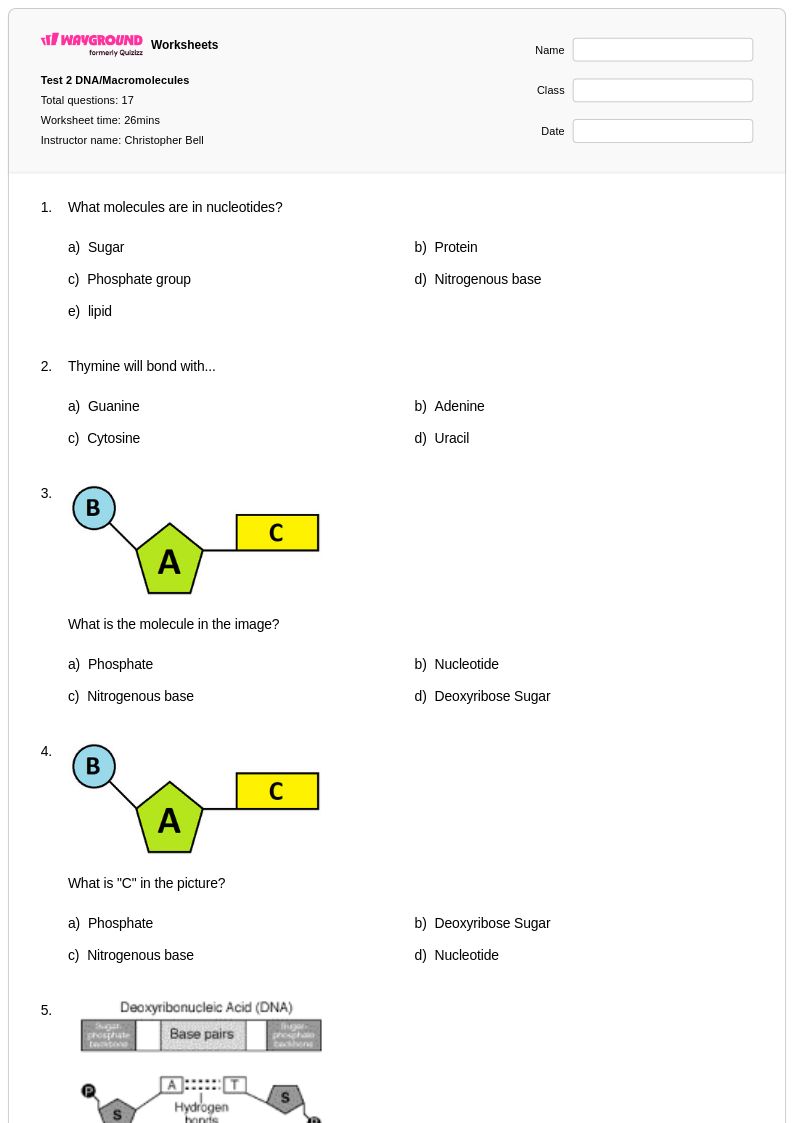
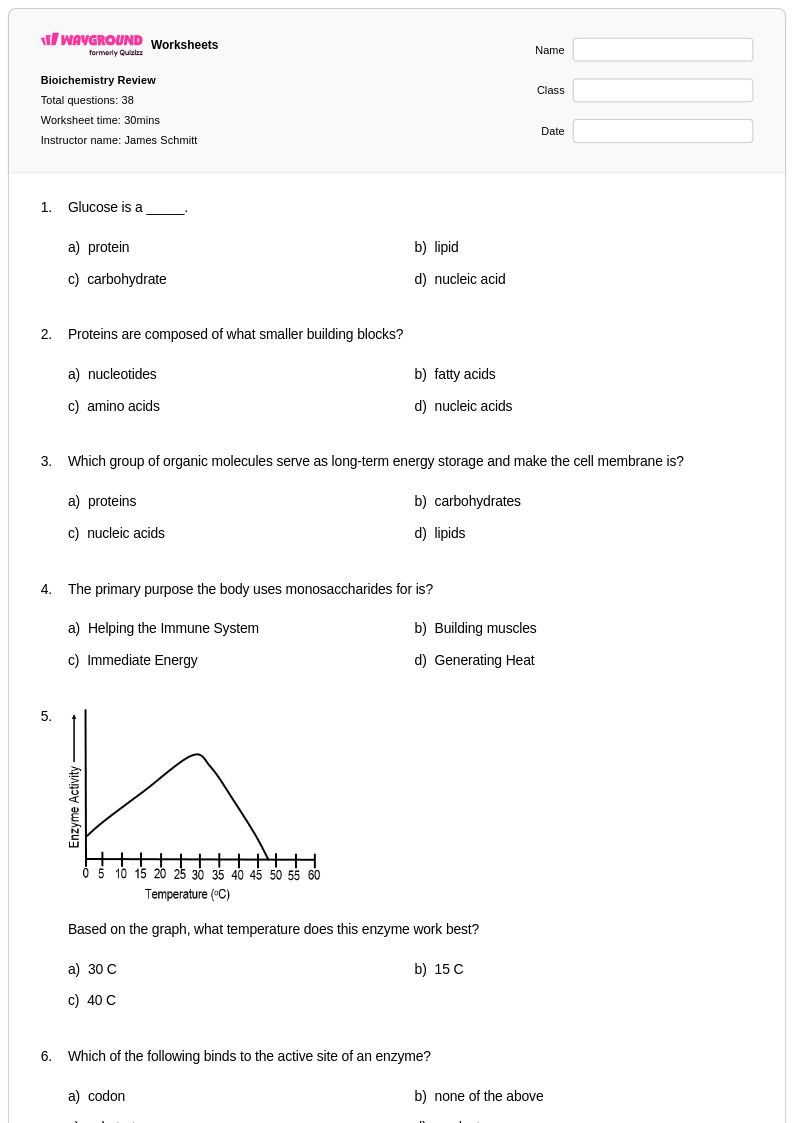
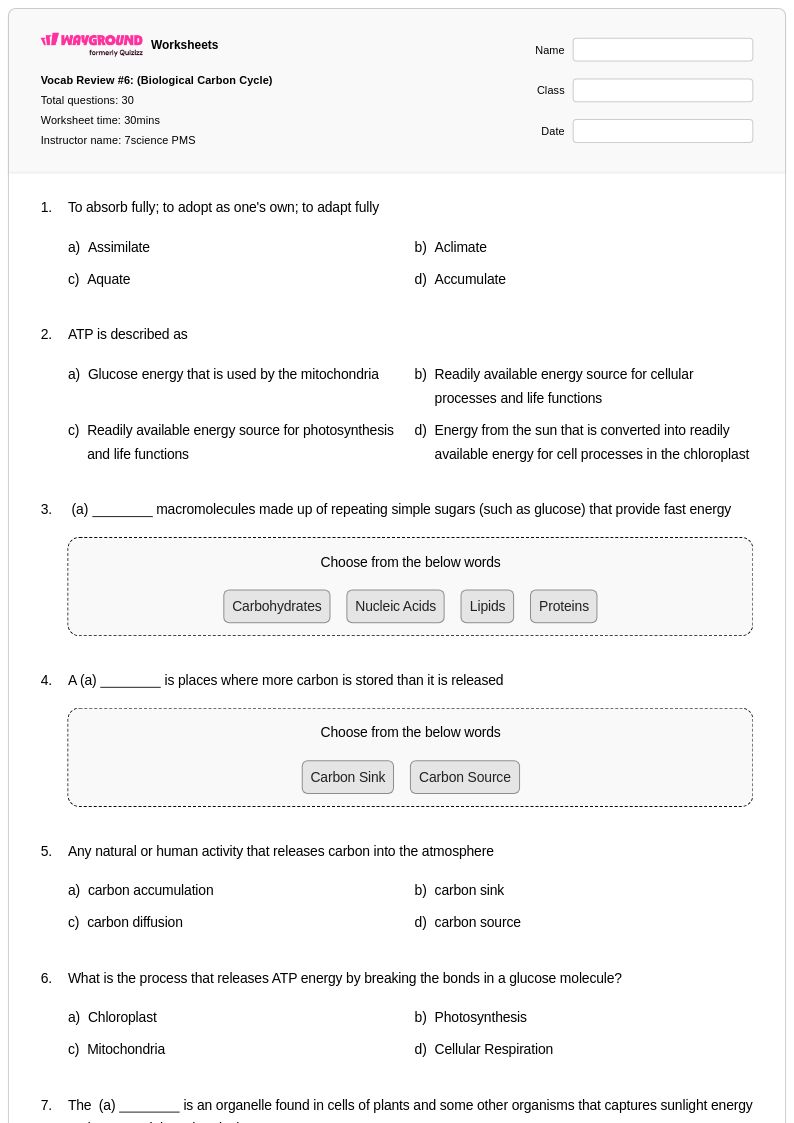
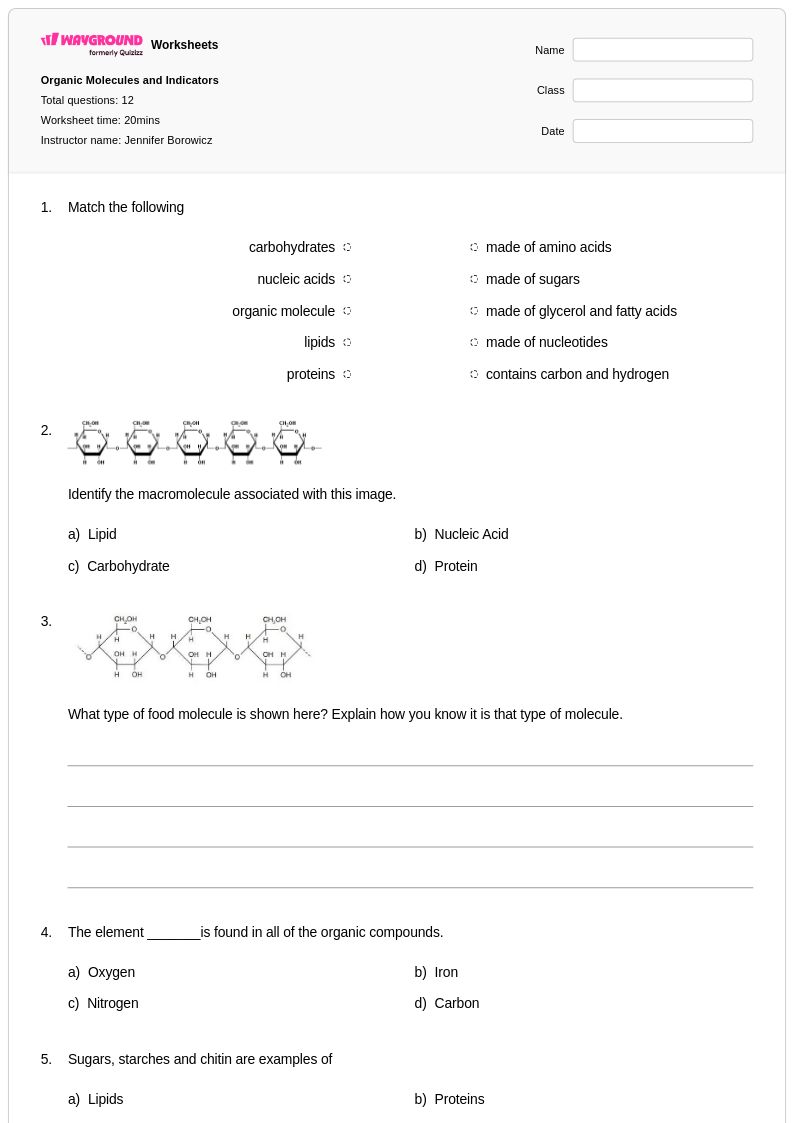
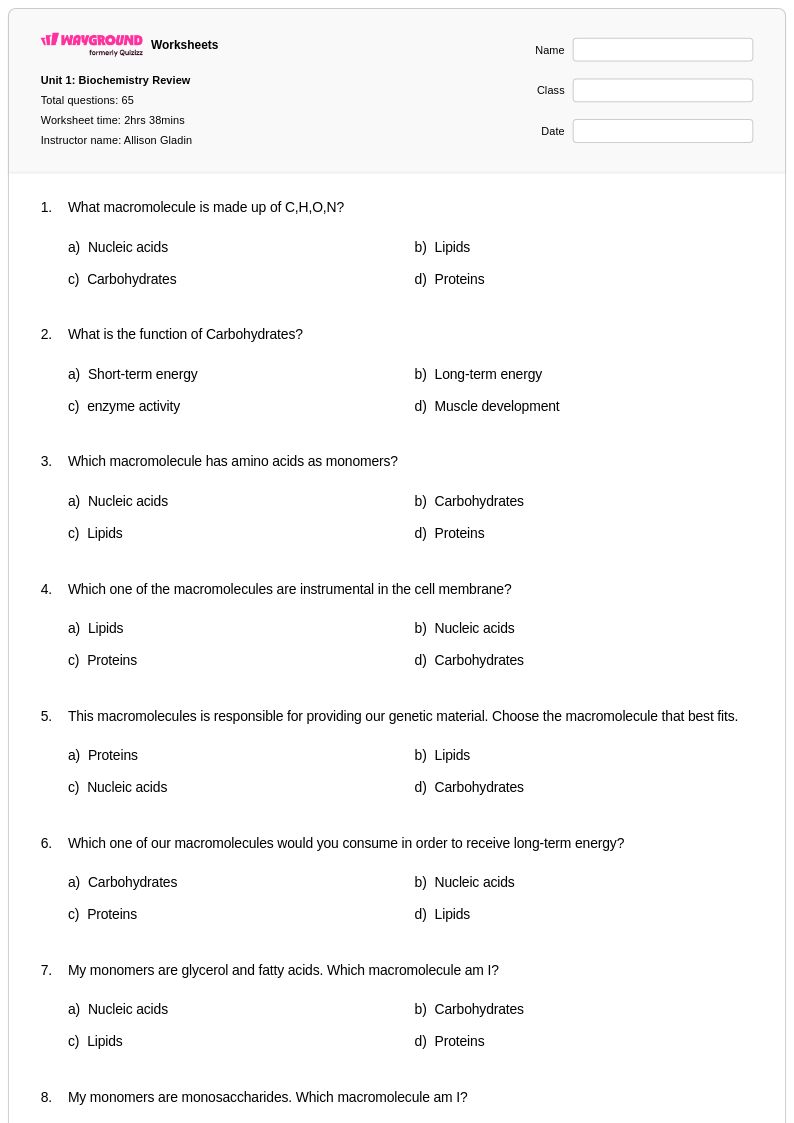
Explore Wayground's comprehensive collection of free macromolecules worksheets and printables that help students master the structure and function of proteins, carbohydrates, lipids, and nucleic acids through engaging practice problems and detailed answer keys.
Macromolecules worksheets available through Wayground (formerly Quizizz) provide comprehensive coverage of the four major biological macromolecules: carbohydrates, lipids, proteins, and nucleic acids. These educational resources strengthen students' understanding of molecular structure, function, and the critical roles these large molecules play in living organisms. The worksheets feature practice problems that challenge learners to identify functional groups, analyze chemical bonds, and connect molecular structure to biological function. Each worksheet collection includes detailed answer keys that support both independent study and classroom instruction, while the free printables offer flexibility for educators working with diverse learning environments and varying technological resources.
Wayground (formerly Quizizz) empowers educators with access to millions of teacher-created macromolecules worksheets that can be easily searched and filtered by specific molecular types, complexity levels, and instructional objectives. The platform's robust standards alignment ensures that worksheet content connects directly to curriculum requirements, while built-in differentiation tools allow teachers to modify complexity and scaffold learning for students at different mastery levels. These flexible customization options, combined with availability in both printable pdf formats and interactive digital versions, streamline lesson planning and provide targeted resources for remediation, enrichment, and skill practice. Teachers can efficiently identify gaps in student understanding of molecular concepts and deploy appropriate worksheet interventions to reinforce key biological principles.
FAQs
How do I teach macromolecules to high school biology students?
Start by building a conceptual framework around the four major macromolecules: carbohydrates, lipids, proteins, and nucleic acids. Teach each one by anchoring its function to its structure — for example, how the peptide bonds and R-groups in proteins determine their shape and biological role. Using visual diagrams alongside practice problems that ask students to identify functional groups and chemical bonds helps bridge abstract chemistry to biological context.
What kinds of practice problems help students learn macromolecules?
Effective macromolecules practice focuses on three skills: identifying structural components (such as monomers and functional groups), analyzing chemical bonds (peptide, glycosidic, ester, and phosphodiester bonds), and connecting molecular structure to biological function. Problems that ask students to compare and contrast the four macromolecules side by side are particularly useful for building integrated understanding rather than isolated memorization.
What mistakes do students commonly make when learning about macromolecules?
Students frequently confuse the monomers of each macromolecule — for instance, mixing up nucleotides with amino acids — and often struggle to connect molecular structure to function without explicit scaffolding. Another common error is treating lipids as polymers when they are not built from repeating monomer units in the same way carbohydrates, proteins, and nucleic acids are. Targeted practice that repeatedly asks students to identify the correct monomer and bond type for each macromolecule helps correct these patterns.
How can I assess whether students understand macromolecule structure and function?
Strong assessment tasks ask students to do more than define terms — they should require students to analyze an unfamiliar molecule, predict its function based on its structure, or explain why a structural change would alter biological activity. Questions that involve functional group identification or bond analysis are effective at revealing whether students have surface-level recall versus genuine conceptual understanding. Exit tickets comparing two macromolecules on a specific criterion (e.g., energy storage vs. energy release) are a quick formative tool.
How do I use Wayground's macromolecules worksheets in my classroom?
Wayground's macromolecules worksheets are available as printable PDFs for traditional classroom use and in digital formats for technology-integrated environments, including the option to host them as a quiz directly on Wayground. Each worksheet includes a detailed answer key, making them suitable for independent student practice, guided group work, or teacher-led review. The digital format also allows teachers to apply individual accommodations — such as read aloud, extended time, or reduced answer choices — for students who need additional support.
How do I differentiate macromolecules instruction for students at different levels?
For students who are still building foundational knowledge, scaffold with worksheets that focus on one macromolecule at a time before introducing comparative analysis. For more advanced students, assign problems that require them to connect macromolecule structure to cellular processes like DNA replication or enzyme catalysis. On Wayground, teachers can apply built-in differentiation tools to modify complexity and scaffold learning for students at different mastery levels, and individual accommodations such as reduced answer choices or read aloud can be assigned to specific students without affecting the rest of the class.