Free Printable Distance on the Coordinate Plane Worksheets for Class 8
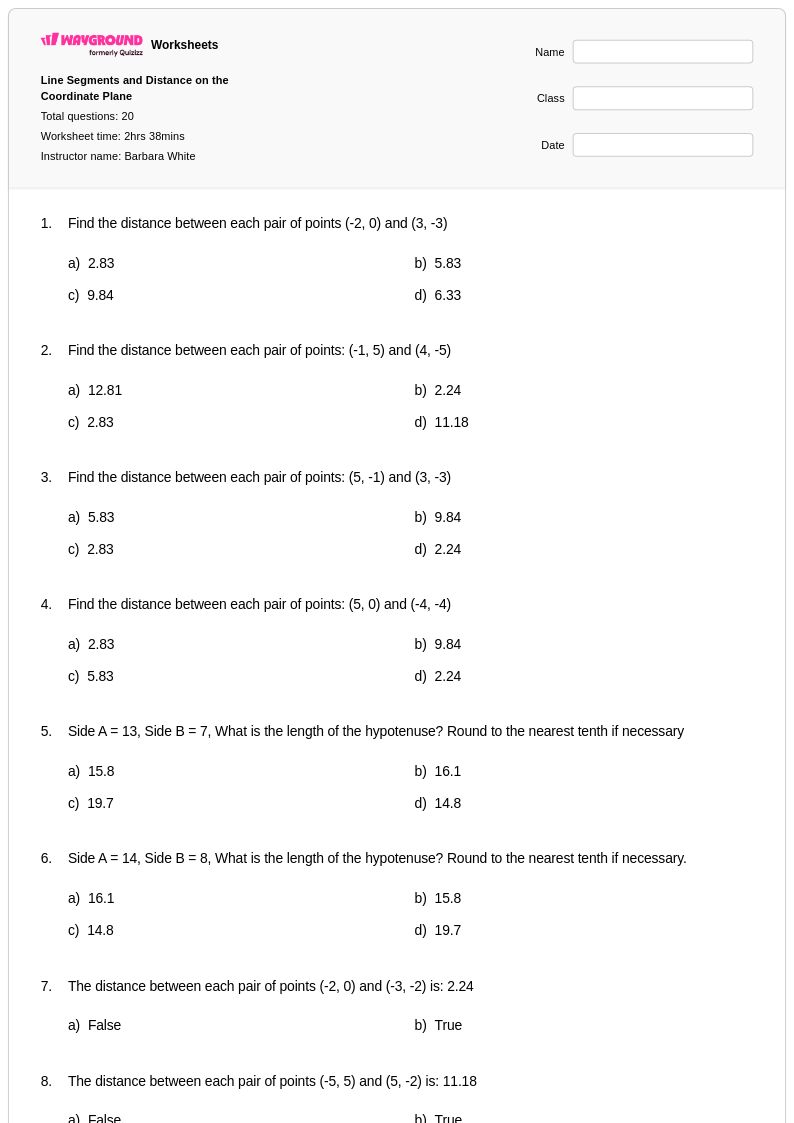
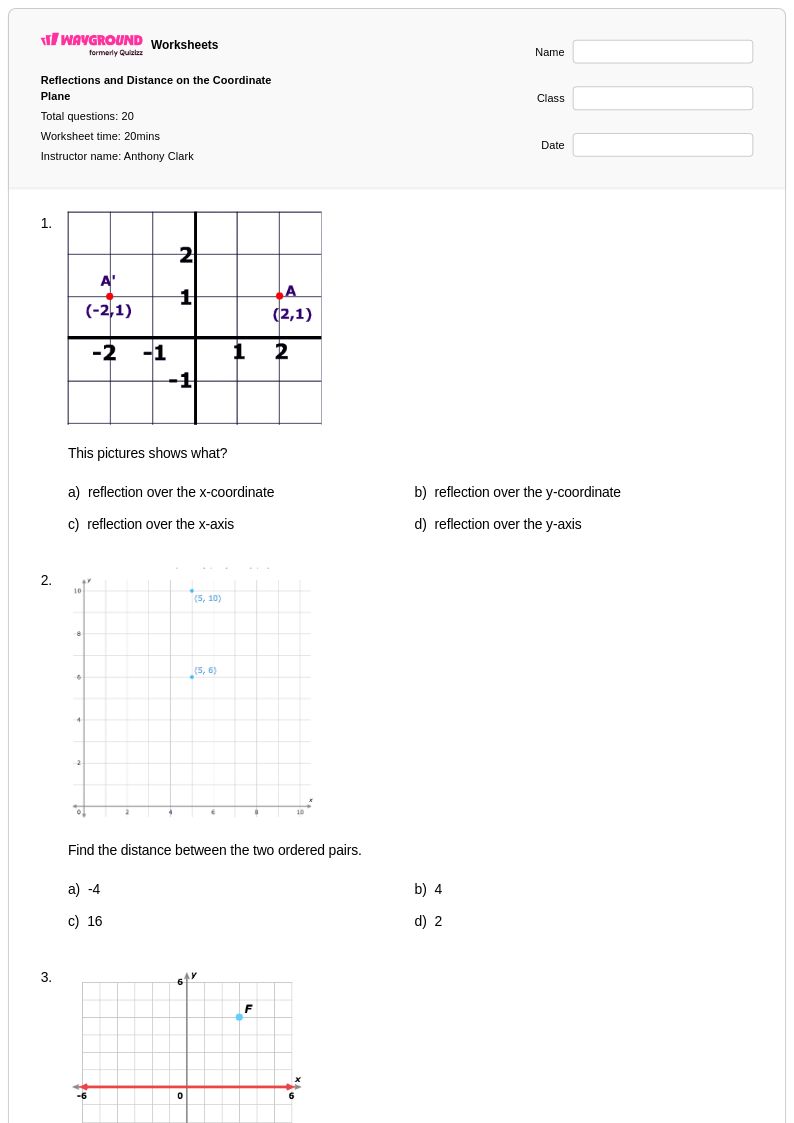
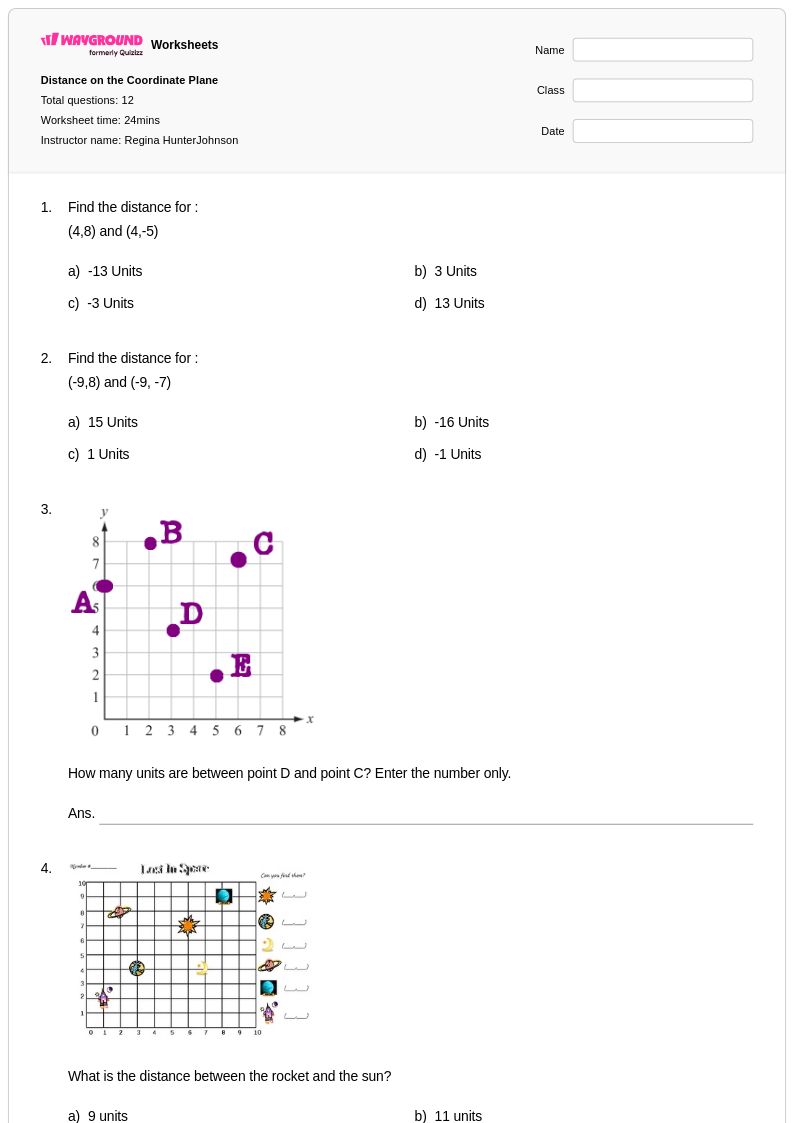
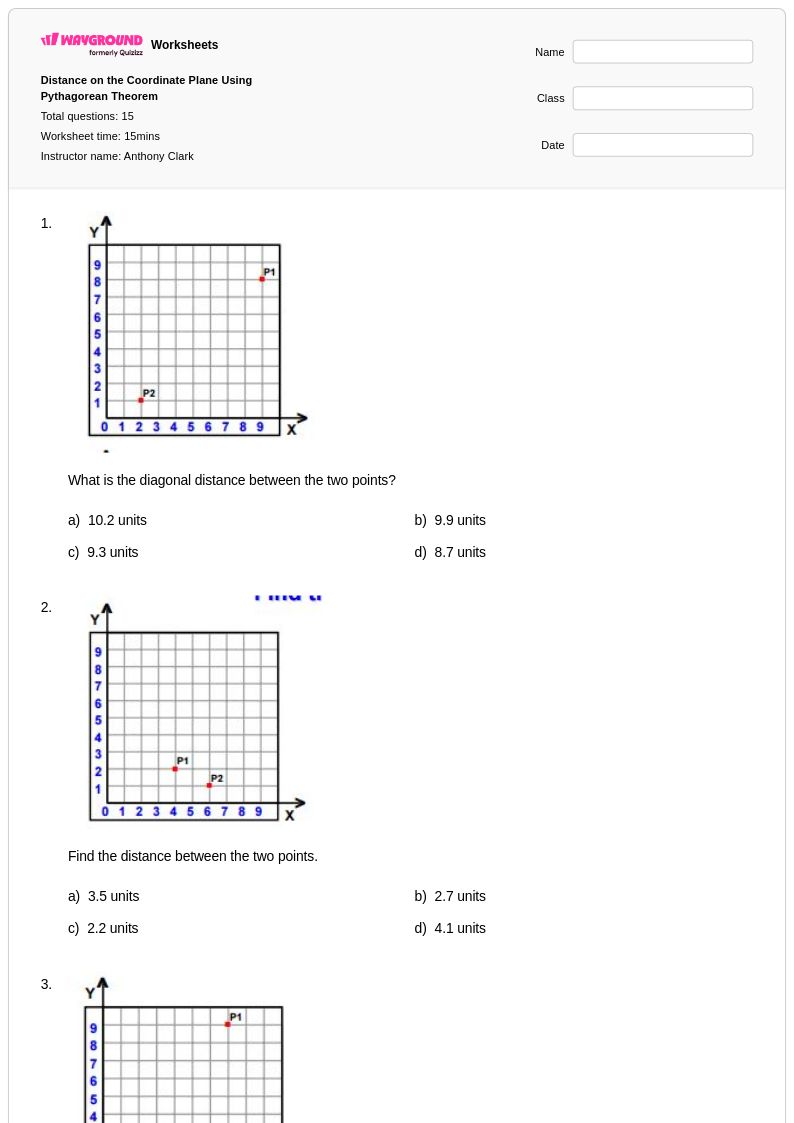
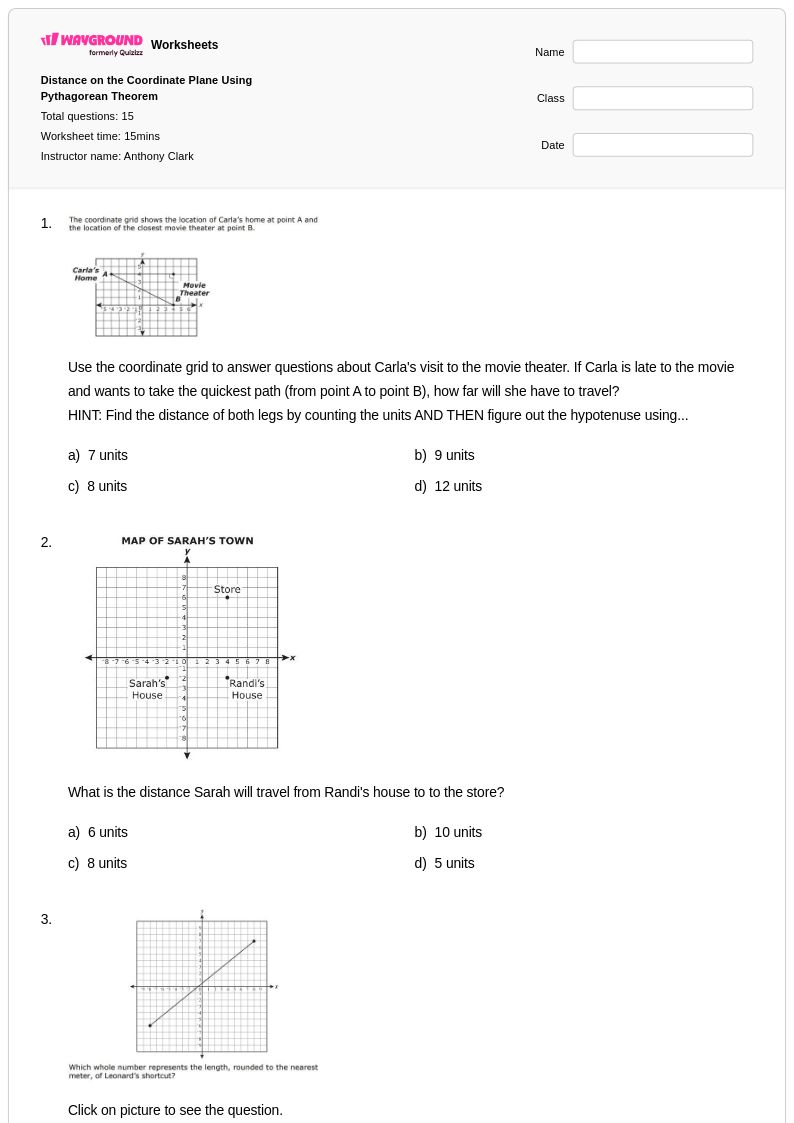
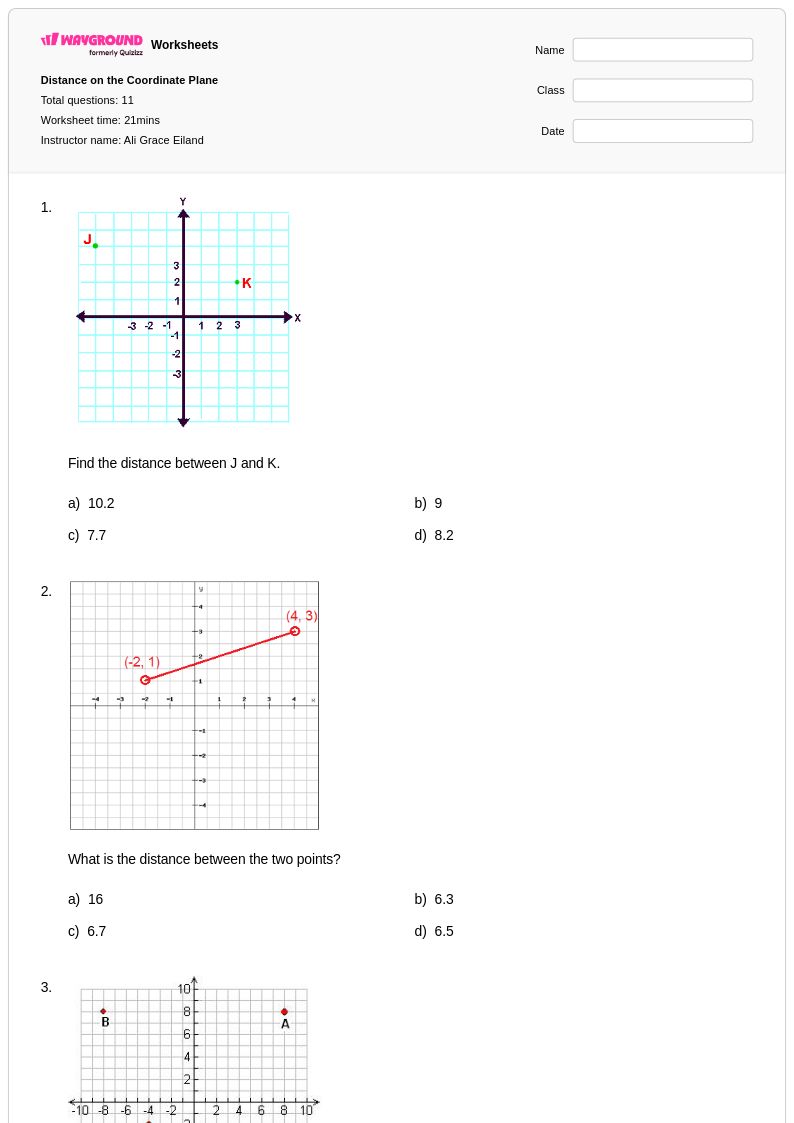
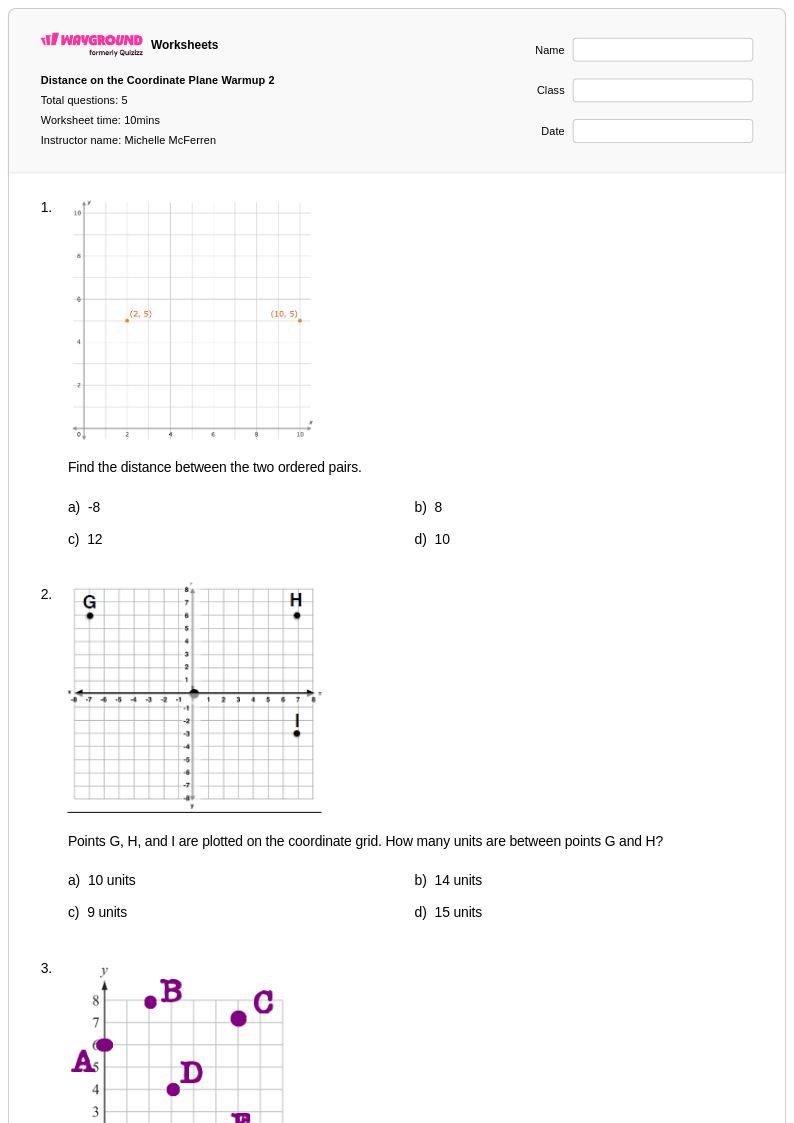
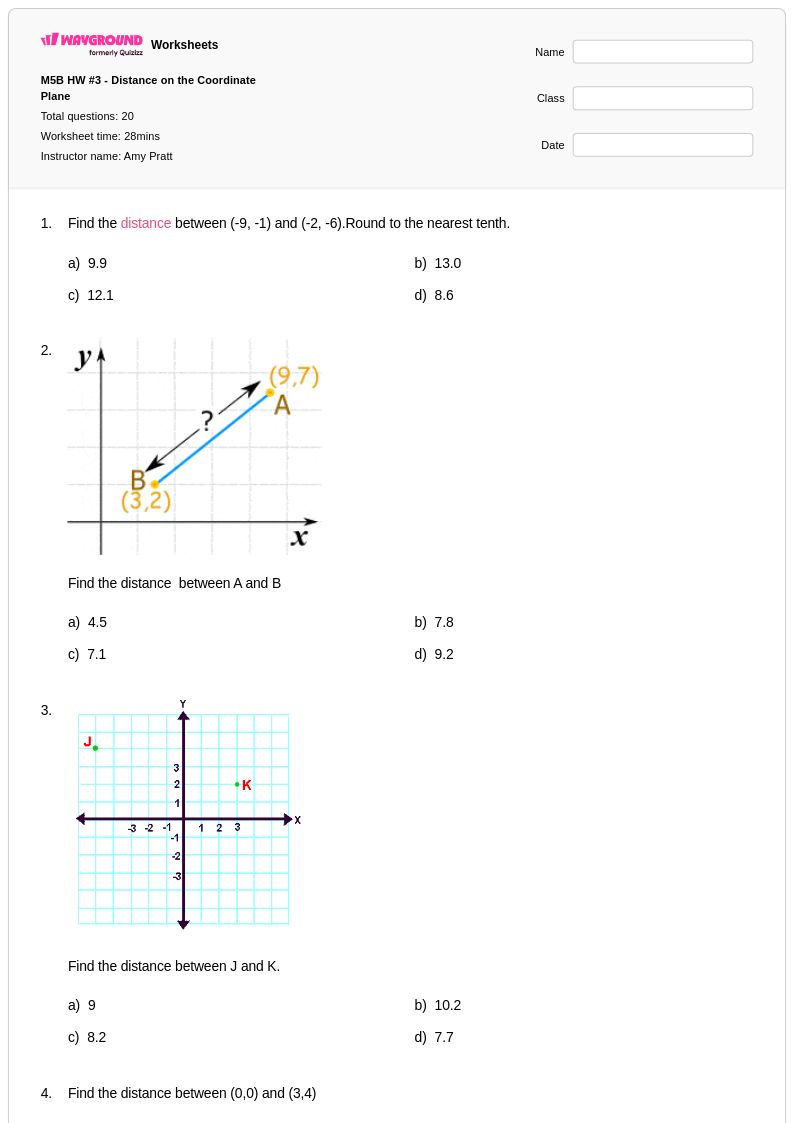
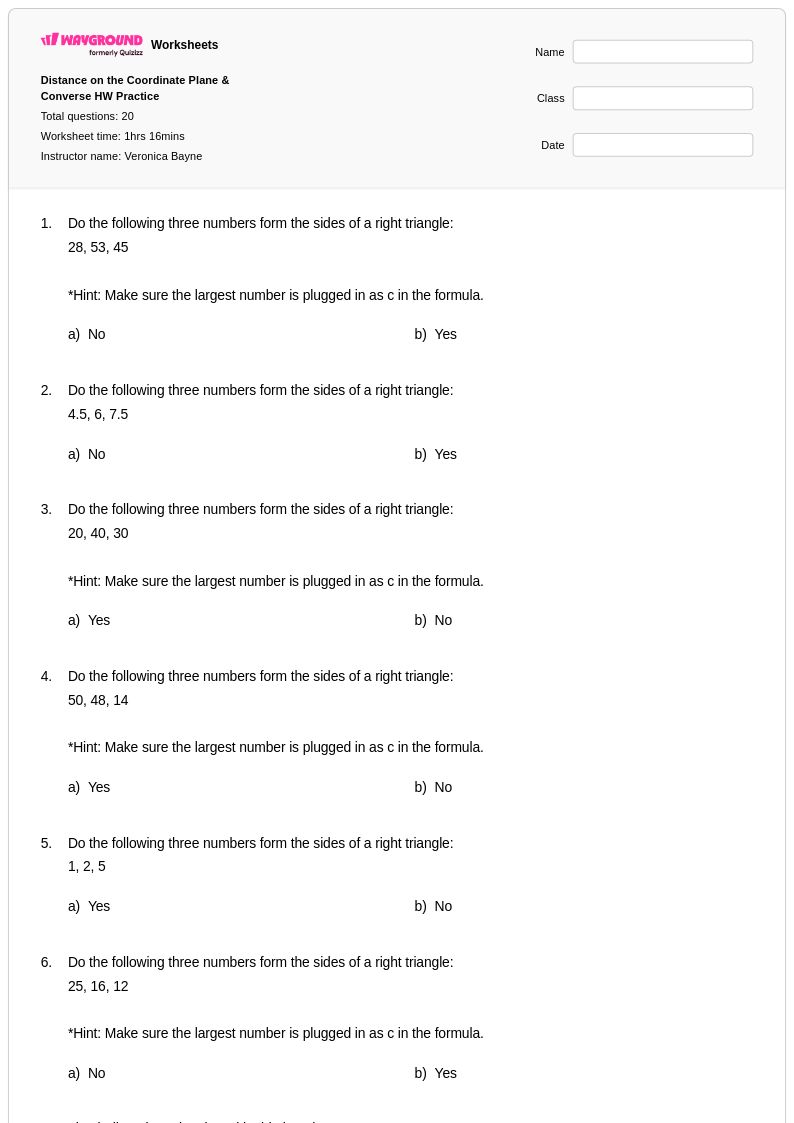
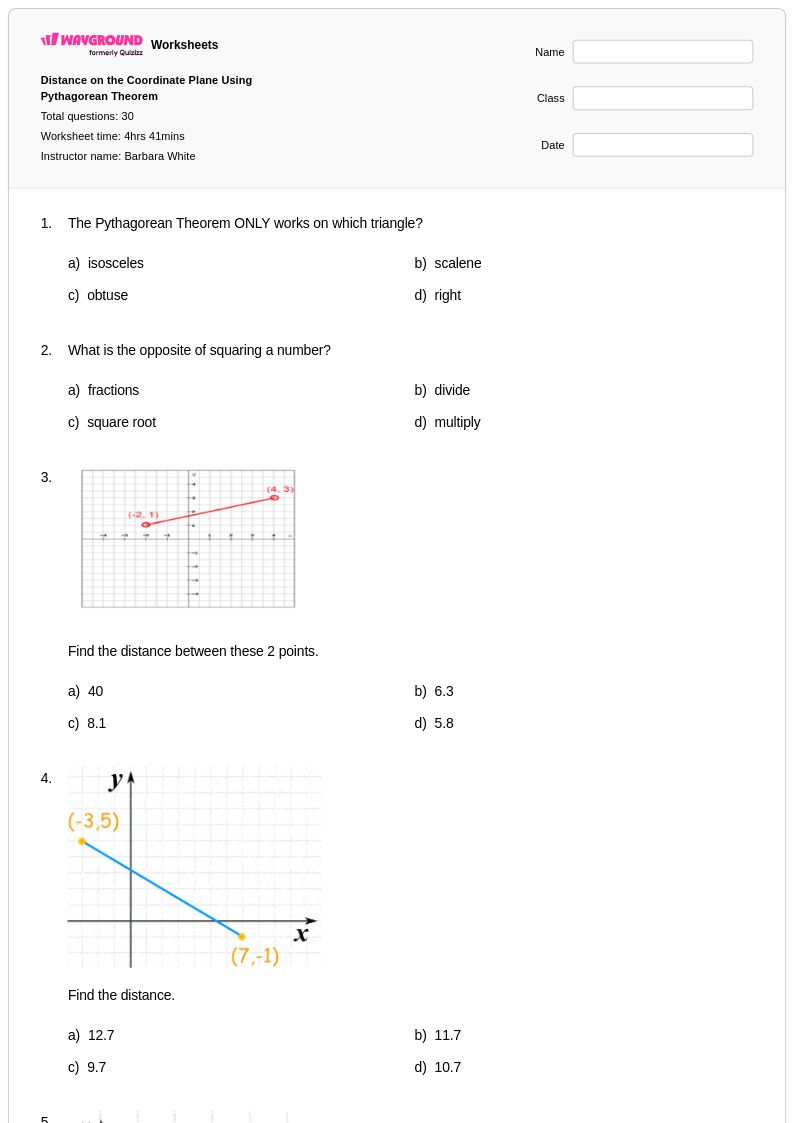
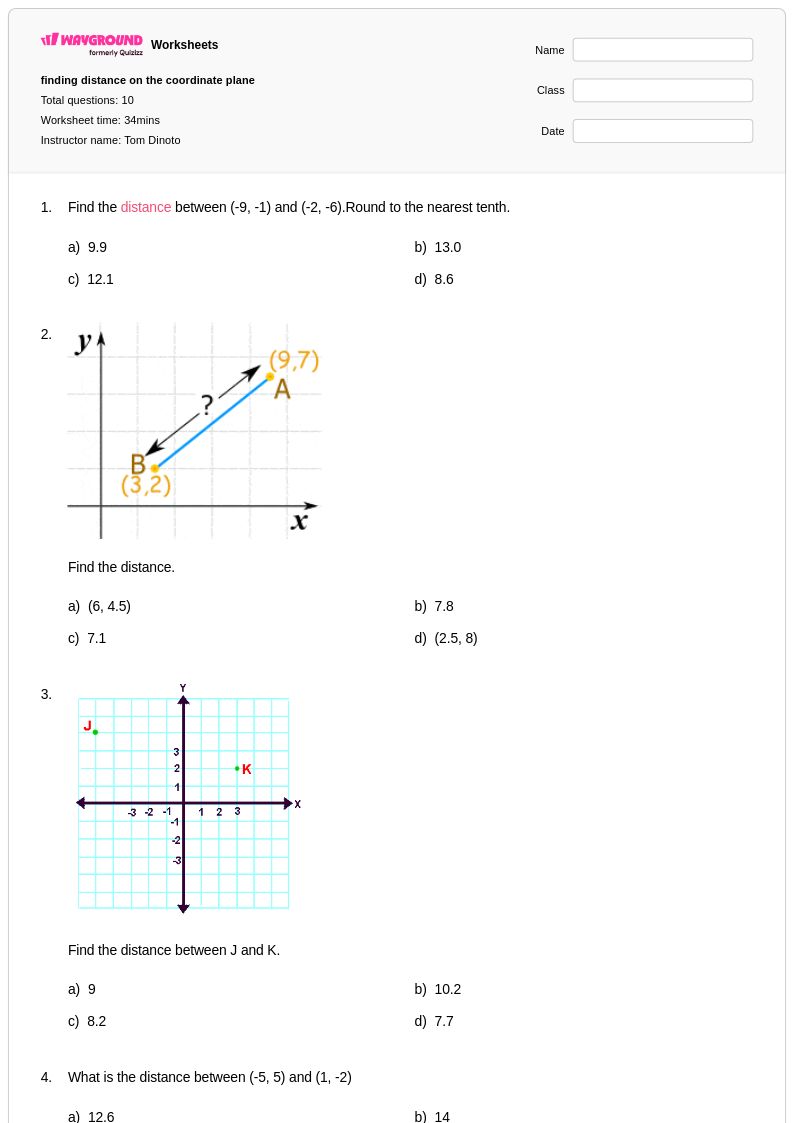
Class 8 distance on the coordinate plane worksheets provide free printables and practice problems with answer keys to help students master calculating distances between points using the distance formula and Pythagorean theorem.
Explore printable Distance on the Coordinate Plane worksheets for Class 8
Distance on the coordinate plane worksheets for Class 8 provide essential practice for students developing spatial reasoning and analytical geometry skills. These comprehensive worksheet collections available through Wayground help eighth-grade students master the calculation of distances between points using the distance formula, which builds directly on their understanding of the Pythagorean theorem. Students work through carefully structured practice problems that progress from finding distances between points with simple coordinates to more complex scenarios involving decimal and negative coordinates. Each worksheet includes a complete answer key, making them valuable resources for independent study, homework assignments, and classroom assessment. These free printable materials strengthen critical mathematical thinking skills while reinforcing coordinate geometry concepts that serve as foundational knowledge for advanced mathematics courses.
Wayground's extensive collection of teacher-created distance on the coordinate plane worksheets offers educators millions of high-quality resources with robust search and filtering capabilities to match specific classroom needs. Teachers can easily locate materials aligned with state and national mathematics standards, ensuring that worksheet content supports curriculum objectives for Class 8 geometry instruction. The platform's differentiation tools enable educators to customize worksheets for diverse learning levels, while flexible formatting options provide both printable pdf versions for traditional paper-and-pencil work and digital formats for technology-integrated classrooms. These features streamline lesson planning and support targeted skill practice, whether teachers need materials for initial concept introduction, remediation for struggling students, or enrichment activities for advanced learners ready to explore more challenging coordinate plane applications.
FAQs
How do I teach the distance formula to 8th graders?
Don't introduce the formula cold. Start by having students draw the right triangle between two points on a grid, label the legs as the horizontal and vertical differences, and solve using the Pythagorean theorem. Then show that the formula d = √[(x₂−x₁)² + (y₂−y₁)²] is just that process written algebraically. Students who understand the derivation can reconstruct the formula if they forget it — students who only memorize it can't.
What exercises help 8th graders practice distance on the coordinate plane?
Effective practice moves through three levels: integer coordinates in a single quadrant, then negative coordinates across all four quadrants, then decimal and fractional coordinates. Beyond straight calculation, include problems that ask students to verify whether a triangle is isosceles by comparing side lengths, or to find a missing endpoint given a distance and one point. Those application problems reveal whether students actually understand the formula or are just pattern-matching.
What mistakes do 8th graders commonly make with the distance formula?
Two errors dominate. First, students subtract in the wrong order for one coordinate but not the other — this doesn't affect the answer since the differences are squared, but it signals shaky understanding of what the formula is doing. Second, and more consequential: students add the squared differences and then forget to take the square root, or they take the square root of each term separately before adding. Both produce wrong answers and usually mean the student is executing steps from memory rather than understanding the structure.
How do I use these Grade 8 worksheets in my class?
Each worksheet includes a complete answer key, so they're ready to assign as homework or in-class practice immediately. Print the PDF for paper-based work — the Wayground for Teachers app lets you scan student submissions for grading without manual entry. Alternatively, host the worksheet as a digital quiz on Wayground for instant results and automatic scoring.
Is the distance formula a Grade 8 Common Core standard?
Yes. Common Core places the distance formula in Grade 8, where it's treated as a direct application of the Pythagorean theorem in a coordinate geometry context. Students are expected to apply the theorem to find distances between two points in the coordinate plane — not just in abstract right-triangle problems. This is the culmination of a progression that starts with plotting points in Grade 5, moves through absolute-value distances in Grade 6, and builds through Pythagorean theorem work in Grades 7–8. From here, students carry the formula into high school geometry and algebra.
How can I support diverse learners with distance formula practice?
For students who struggle to track multiple coordinate values across a problem, Wayground's Read Aloud feature reads the question aloud, reducing the chance of misreading a coordinate. The dyslexia-friendly font and wider font spacing options make subscript-heavy notation like x₁, y₁, x₂, y₂ easier to distinguish. For students who need more scaffolding, start them on problems where one coordinate is shared between the two points — so the formula reduces to a single subtraction — before moving to full diagonal distances.
What grade level is the distance formula taught?
The distance formula is formally introduced in Grade 8 in most US curricula, where it's connected to the Pythagorean theorem. Some students encounter it earlier in an informal way — counting grid units or finding horizontal/vertical distances — starting in Grades 5 and 6. It then reappears in high school geometry and algebra courses with more complex applications.