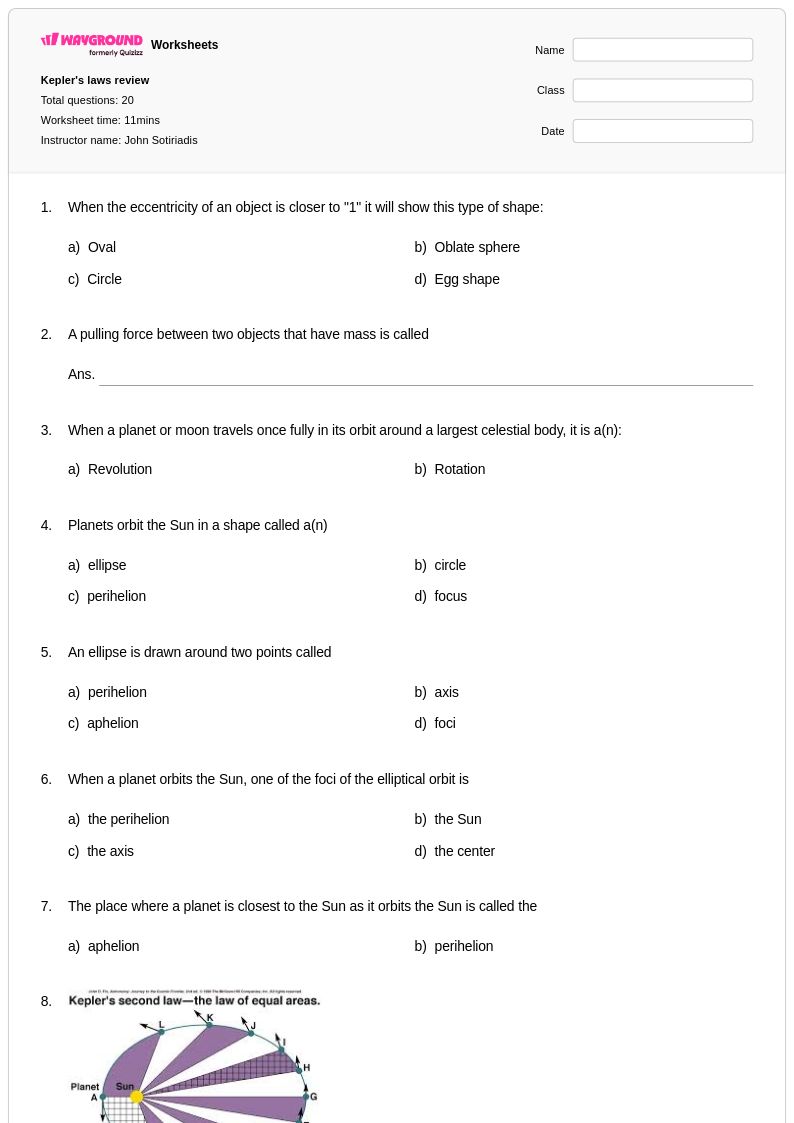
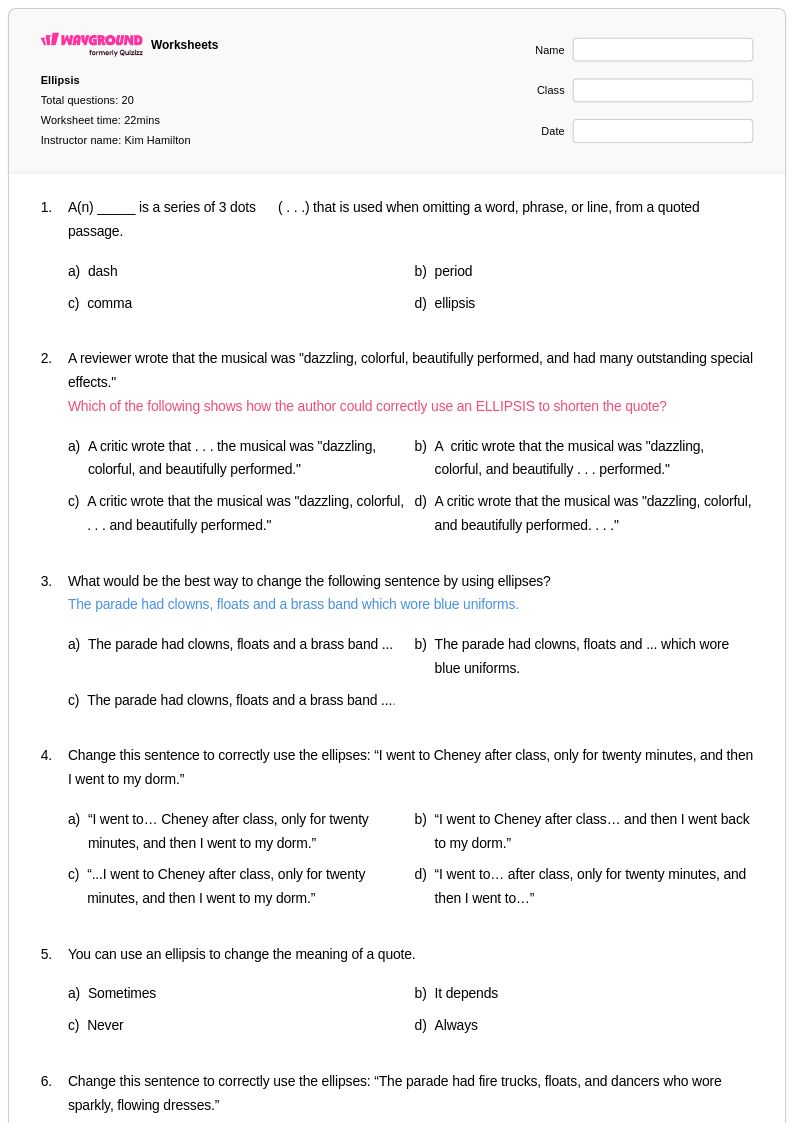
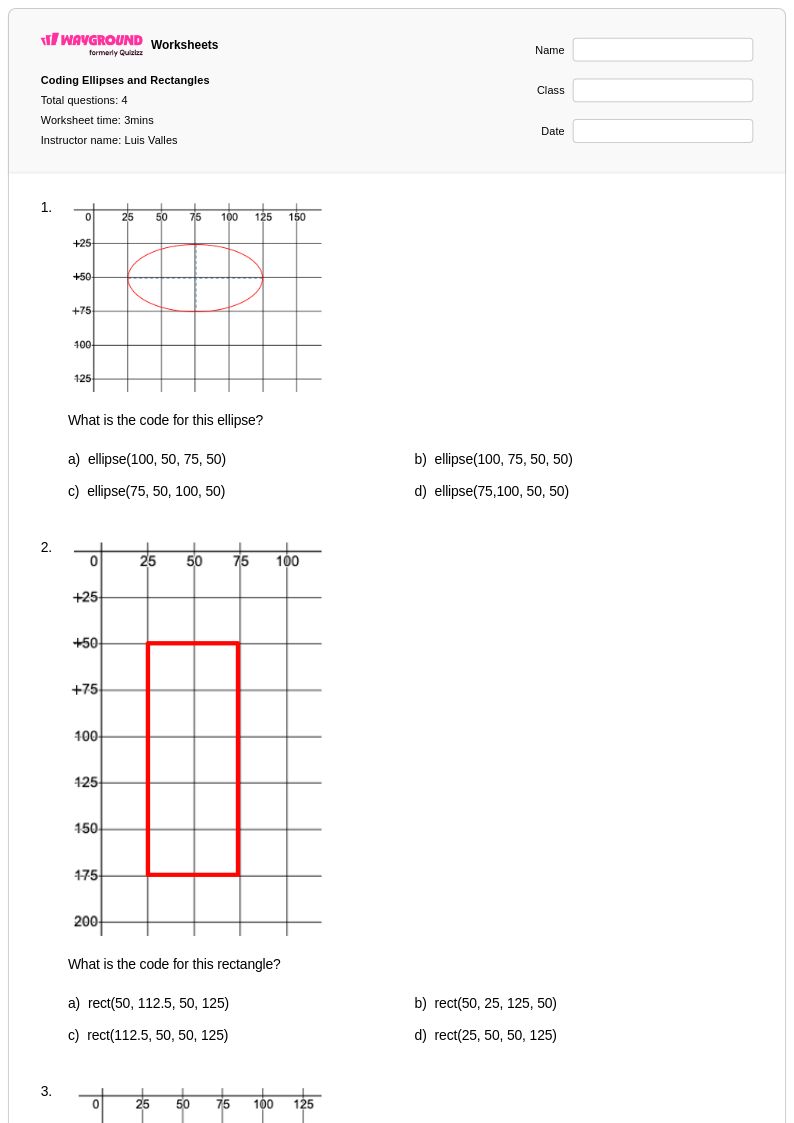
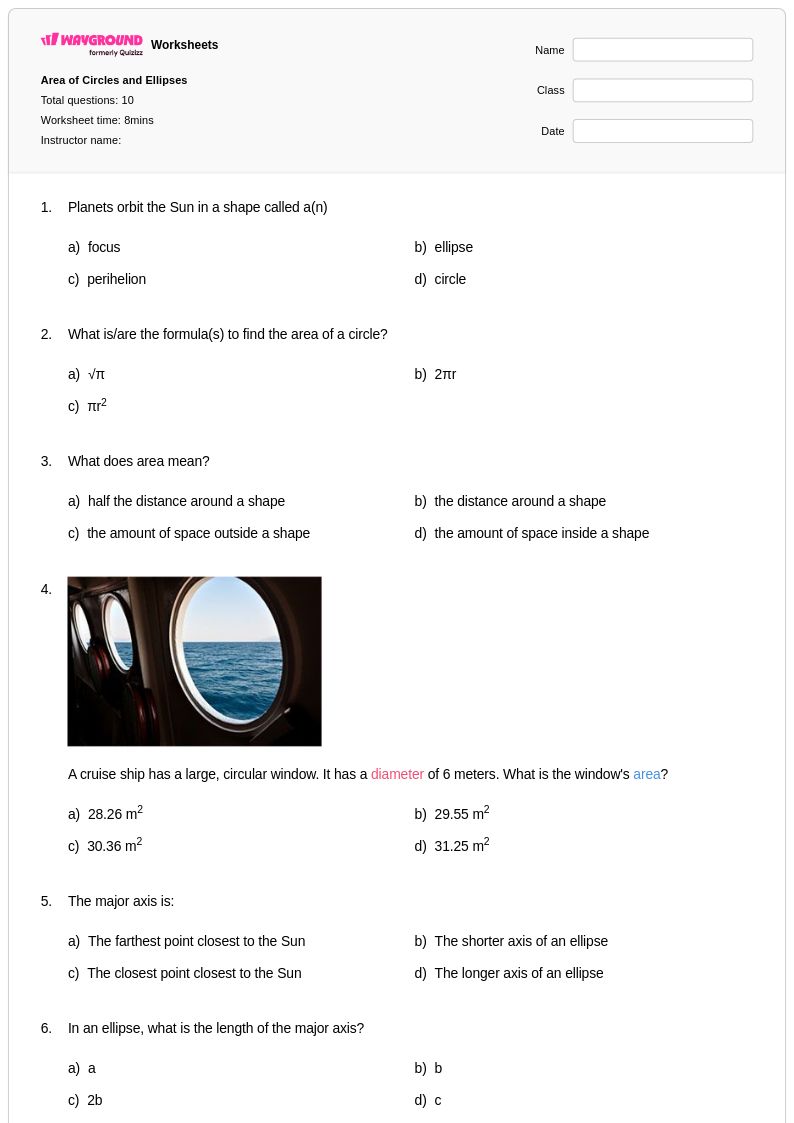
Class 8 ellipses worksheets from Wayground provide comprehensive printables with practice problems and answer keys to help students master ellipse properties, equations, and graphing through engaging PDF exercises.
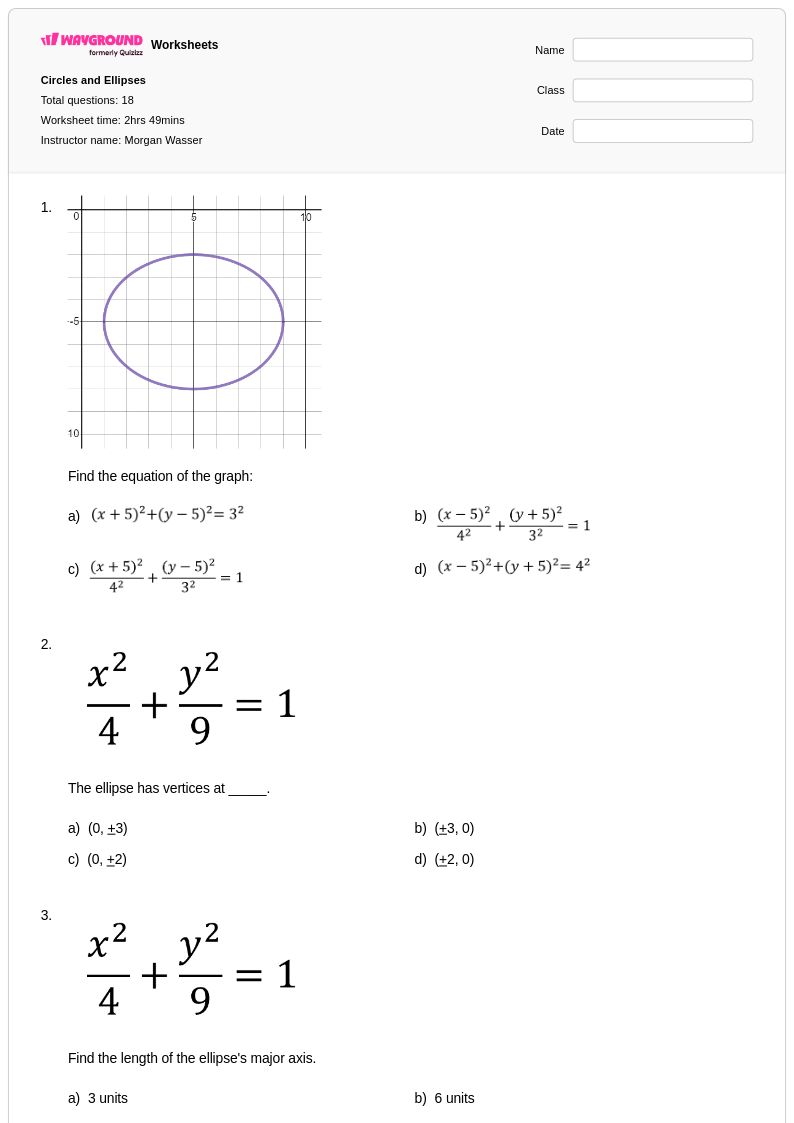
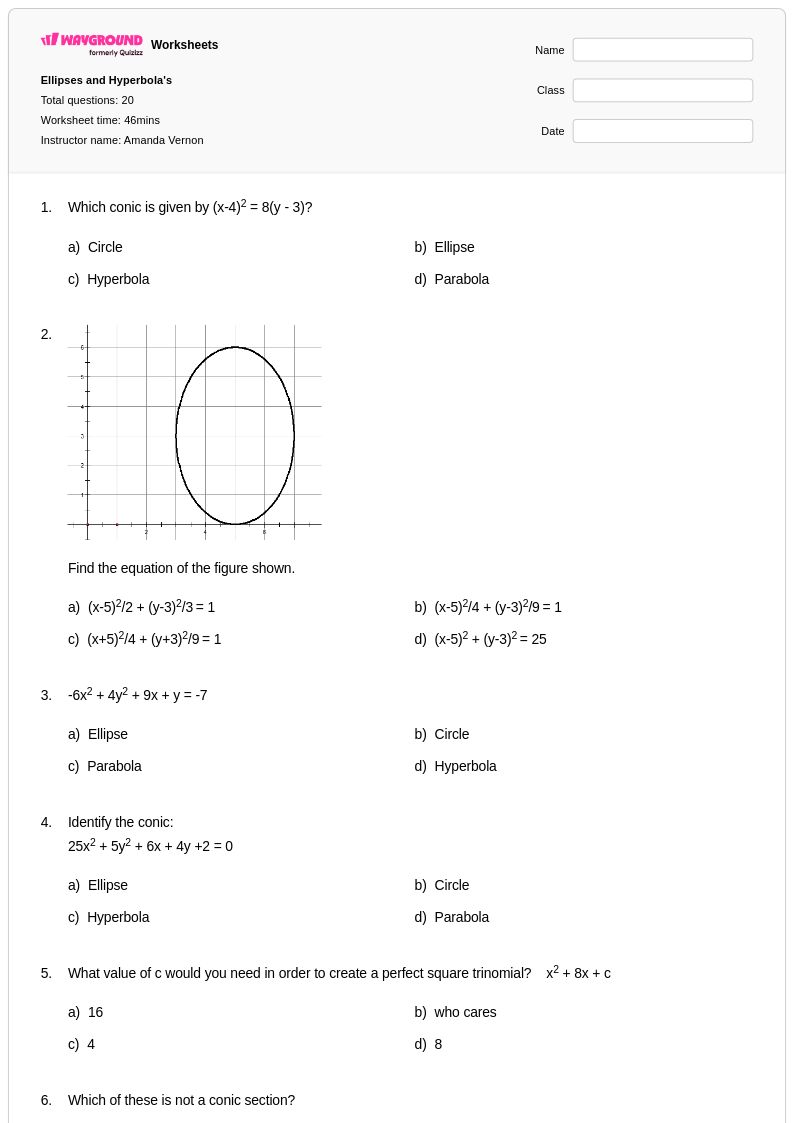
Ellipses worksheets for Class 8 mathematics provide comprehensive practice opportunities for students to master this fundamental geometric concept through Wayground's extensive collection of teacher-created resources. These carefully designed worksheets focus on developing essential skills including identifying ellipse properties, understanding the relationship between major and minor axes, calculating foci and vertices, and applying the standard form equation of an ellipse. Students work through progressive practice problems that build conceptual understanding while reinforcing algebraic manipulation skills necessary for ellipse equations. Each worksheet collection includes detailed answer keys to support independent learning and self-assessment, with free printable pdf formats ensuring easy classroom distribution and home practice accessibility.
Wayground's platform empowers educators with millions of high-quality ellipse worksheets that streamline lesson planning and enhance mathematical instruction for Class 8 students. Teachers benefit from robust search and filtering capabilities that allow quick identification of resources aligned to specific learning standards and curricular objectives. The platform's differentiation tools enable instructors to customize worksheet difficulty levels, supporting both remediation for struggling learners and enrichment opportunities for advanced students. Available in both printable and digital pdf formats, these resources offer maximum flexibility for diverse classroom environments while maintaining consistent quality across all materials. This comprehensive approach to ellipse instruction ensures teachers can effectively address varied learning needs through targeted skill practice and systematic concept reinforcement.
FAQs
What ellipse skills should 8th graders be mastering?
By Grade 8, students should be working with the standard form equation of an ellipse, not just its visual properties. That means identifying the center, vertices, and foci from an equation; understanding how the values of a and b determine the shape's dimensions; and applying the relationship c² = a² − b² to find the foci. Students should also be able to move between the equation and a graph in both directions — given one, produce the other.
How do I teach the standard form equation of an ellipse to 8th graders?
Start by connecting the equation to what students already know geometrically. The denominators a² and b² directly control the length of each axis — show this visually by graphing the same ellipse with different values and asking students to predict what changes. Then introduce the foci calculation as a consequence of the equation's structure rather than a separate formula to memorize. Students who see c² = a² − b² as something that falls out of the geometry, not an arbitrary rule, retain it much better.
What mistakes do 8th graders commonly make with ellipse equations?
The most frequent errors: mixing up a and b (forgetting that a is always the larger value), misidentifying which axis is major based on whether the larger denominator is under x or y, and sign errors when rearranging general form into standard form. A reliable check is to have students verify their answer by plugging the vertices back into the equation — if it doesn't equal 1, something went wrong.
How do I use Wayground's Grade 8 ellipses worksheets in my class?
These worksheets work well as structured practice after direct instruction on the standard form equation. Assign them digitally on Wayground to get immediate performance data, or print the PDF for a focused, pen-and-paper session — particularly useful before a test when you want students practicing without a calculator or screen. Every worksheet includes a complete answer key, and if you collect paper submissions, the Wayground for Teachers app lets you scan and grade them without sorting through a pile manually.
How does ellipse instruction in 8th grade connect to high school math?
Grade 8 is typically where students first encounter the algebraic form of an ellipse, and that work feeds directly into high school precalculus and algebra II. Common Core's high school geometry strand asks students to derive the equations of conic sections and understand them as cross-sections of a cone — ellipses being one of four. Students who arrive in those courses already fluent with standard form, vertices, and foci can focus on the harder ideas (eccentricity, translations, connections to hyperbolas) rather than re-learning the basics.
How can I support struggling learners with ellipse equations in 8th grade?
Algebraic manipulation is often the sticking point, not the geometry itself. For students who get lost in the equation work, Wayground's reduced answer choices accommodation lets them focus on selecting the correct structural feature (e.g., which axis is major) without being derailed by arithmetic errors in the options. For students who need more time to work through multi-step problems, per-student extended time can be configured without affecting the rest of the class. On the worksheet itself, a larger font size or wider spacing can reduce visual clutter on equation-heavy pages.