Free Printable Mass Relationships in Chemical Reactions worksheets
Explore Wayground's free printable worksheets and practice problems covering mass relationships in chemical reactions, complete with answer keys to help students master stoichiometry, molar ratios, and quantitative analysis in chemistry.
Explore printable Mass Relationships in Chemical Reactions worksheets
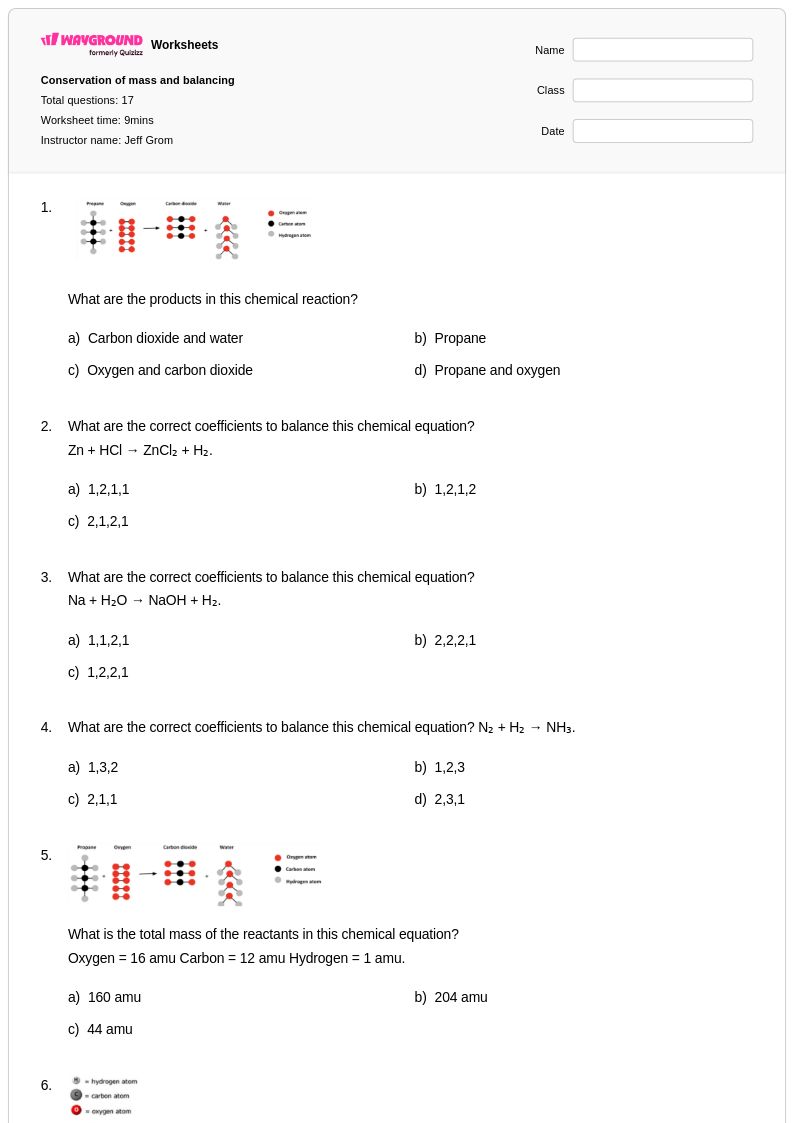
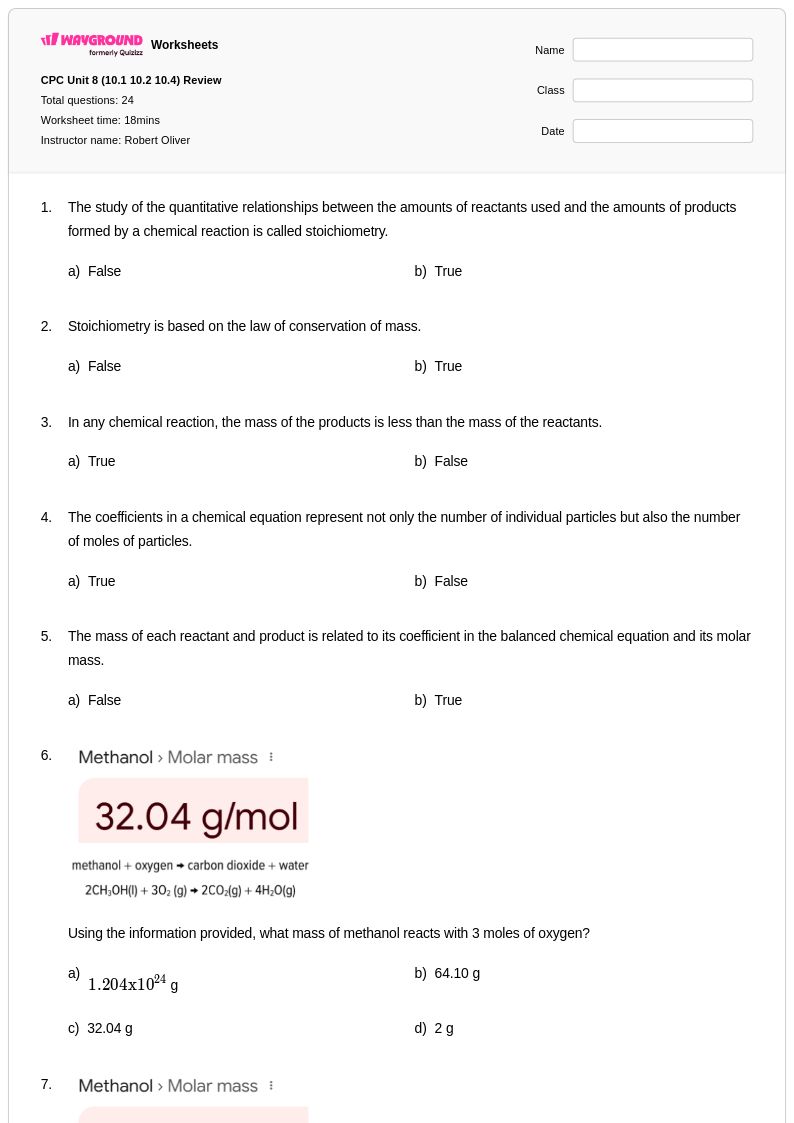
Mass relationships in chemical reactions represent a fundamental concept in chemistry that bridges theoretical understanding with practical laboratory applications. Wayground's comprehensive collection of worksheets in this area provides students with essential practice in stoichiometry, mole conversions, and quantitative analysis of chemical equations. These educational resources strengthen critical problem-solving skills including balancing chemical equations, calculating theoretical yields, determining limiting reactants, and analyzing percent composition of compounds. Each worksheet comes complete with detailed answer keys and step-by-step solution guides, making them invaluable for both classroom instruction and independent study. Available as free printable pdf downloads, these practice problems range from basic mole-to-mole calculations to complex multi-step stoichiometry challenges that prepare students for advanced chemistry coursework.
Wayground, formerly Quizizz, empowers educators with millions of teacher-created resources specifically designed to support instruction in chemical reaction stoichiometry and mass relationships. The platform's sophisticated search and filtering capabilities allow teachers to quickly locate worksheets aligned with specific chemistry standards and learning objectives, while built-in differentiation tools enable customization for students at varying skill levels. Whether delivered in traditional printable format or through interactive digital assignments, these resources seamlessly integrate into lesson planning for initial concept introduction, targeted remediation sessions, or enrichment activities for advanced learners. The extensive database ensures teachers have access to diverse problem sets covering everything from simple formula mass calculations to complex industrial chemistry applications, supporting comprehensive skill development in quantitative chemical analysis.
FAQs
How do I teach mass relationships in chemical reactions to chemistry students?
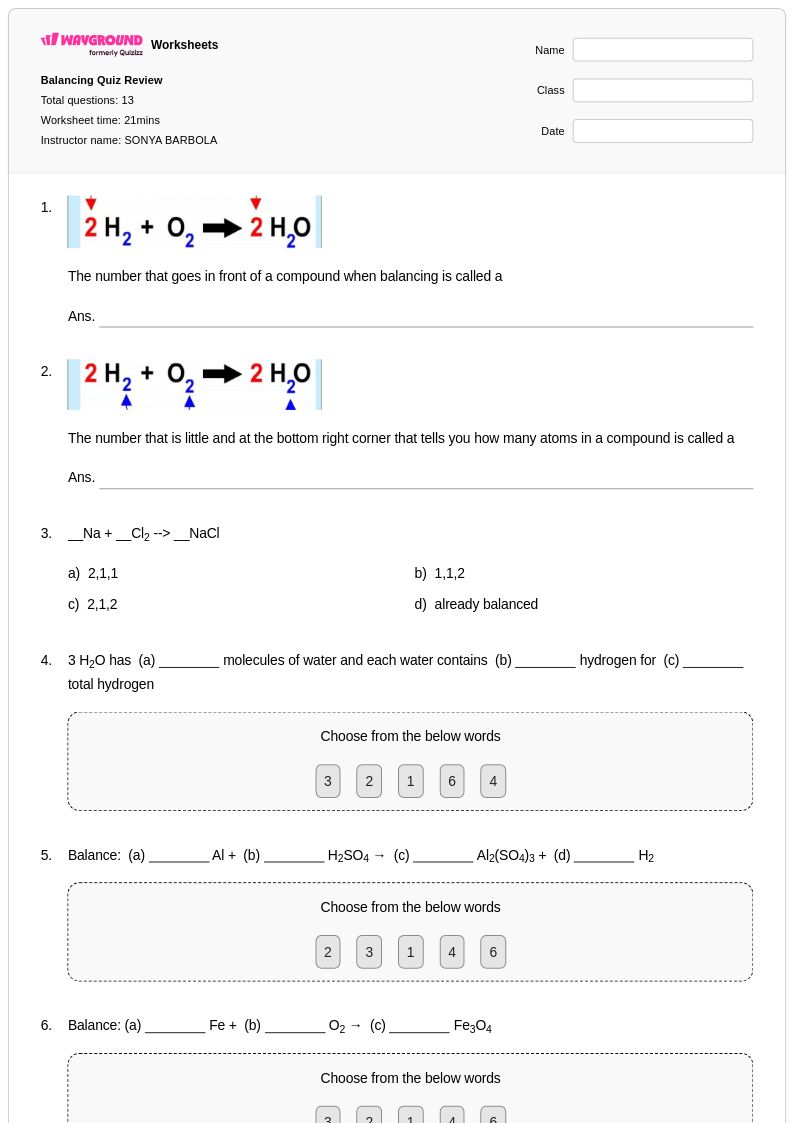
Start by ensuring students can reliably balance chemical equations before introducing stoichiometric ratios, since unbalanced equations will produce incorrect mass calculations every time. From there, build the mole concept explicitly — students need to understand why molar mass acts as a conversion factor between grams and moles before they can work multi-step problems. A sequenced approach that moves from mole-to-mole ratios, to mass-to-mole, to mass-to-mass calculations helps students develop procedural fluency without skipping foundational reasoning.
What exercises help students practice stoichiometry and molar ratios?
The most effective practice problems require students to identify the given quantity, convert to moles, apply the molar ratio from the balanced equation, and convert back to the target unit — forcing each step to be explicit rather than memorized. Problems that vary the starting substance (reactant vs. product) and the target unit (grams, moles, liters of gas) build flexibility. Including limiting reactant problems and percent yield calculations extends practice to real-world lab contexts where students must reconcile theoretical and actual results.
What mistakes do students commonly make with stoichiometry and mass calculations?
The most persistent error is setting up molar ratios upside down — students frequently invert the coefficients from the balanced equation, which produces answers that are mathematically plausible but chemically wrong. A second common mistake is using atomic mass instead of molar mass, or failing to account for polyatomic formulas when calculating formula mass. Students also struggle with limiting reactant problems because they attempt to compare raw gram quantities rather than converting both reactants to moles first.
How do I differentiate stoichiometry instruction for students at different skill levels?
For struggling students, scaffold problem-solving by providing partially completed dimensional analysis setups so they focus on identifying the correct conversion factors rather than managing the full procedure simultaneously. For advanced learners, multi-step problems involving percent composition, empirical formula determination, and industrial yield calculations deepen quantitative reasoning. On Wayground, teachers can apply accommodations such as reduced answer choices or read-aloud support to individual students, allowing the same assignment to serve mixed-ability classes without requiring separate versions.
How can I use these mass relationships in chemical reactions worksheets in my classroom?
These worksheets are available as free printable PDFs for traditional classroom use and in digital formats for technology-integrated learning environments, including the option to host them as a quiz on Wayground. Printable versions work well for guided practice, homework, or lab pre-work, while the digital format allows teachers to assign problems with immediate feedback and track student progress. Both formats include complete answer keys, making them practical for independent study, sub plans, or test review.
How do I assess whether students truly understand mass relationships in chemical reactions versus just following steps?
Conceptual understanding shows when students can identify why a limiting reactant controls the yield, not just calculate which reactant runs out first. Assess depth by asking students to predict how doubling one reactant affects product mass, or to explain what percent yield less than 100% physically means in a lab context. Error analysis tasks — where students diagnose and correct a worked problem containing a deliberate mistake — are particularly effective at distinguishing procedural fluency from genuine chemical reasoning.