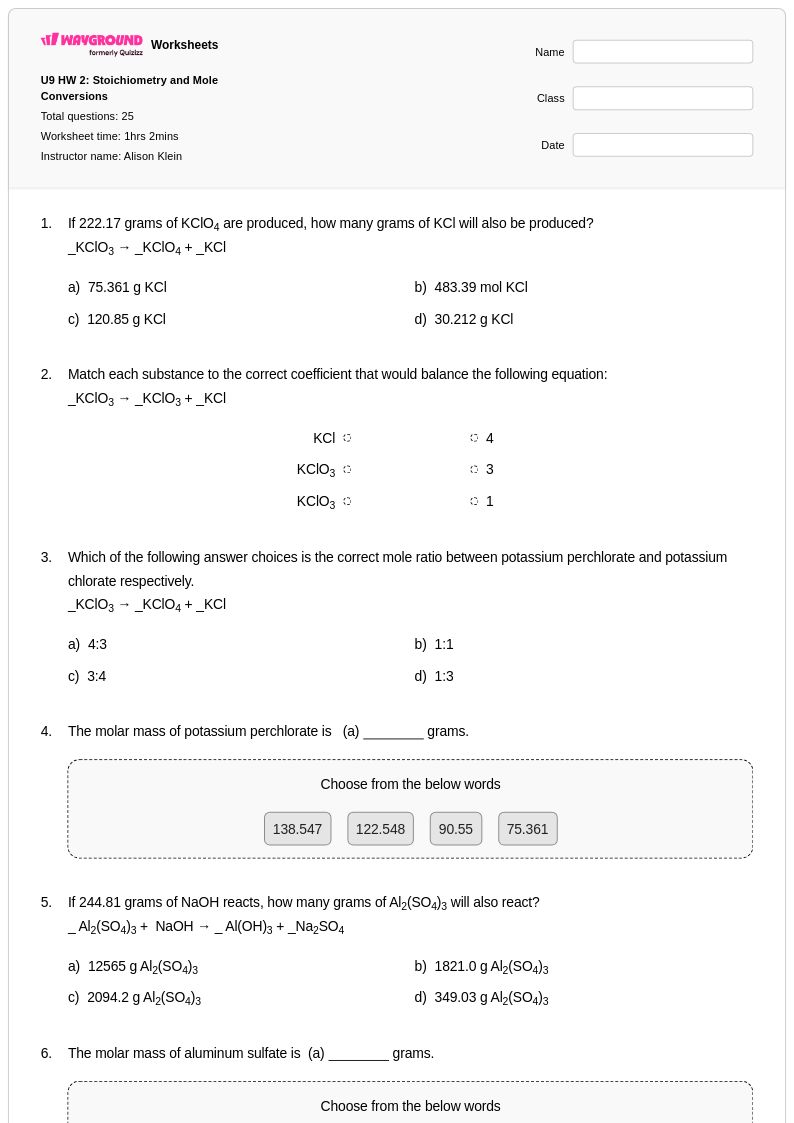
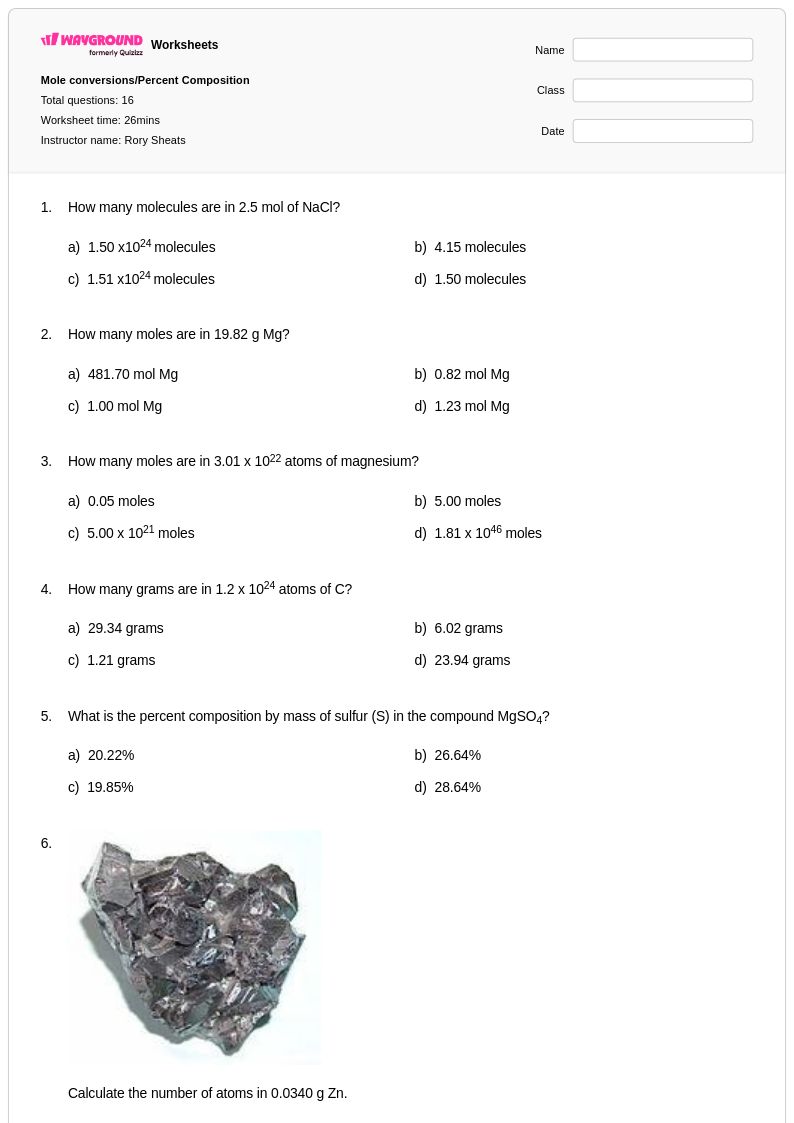
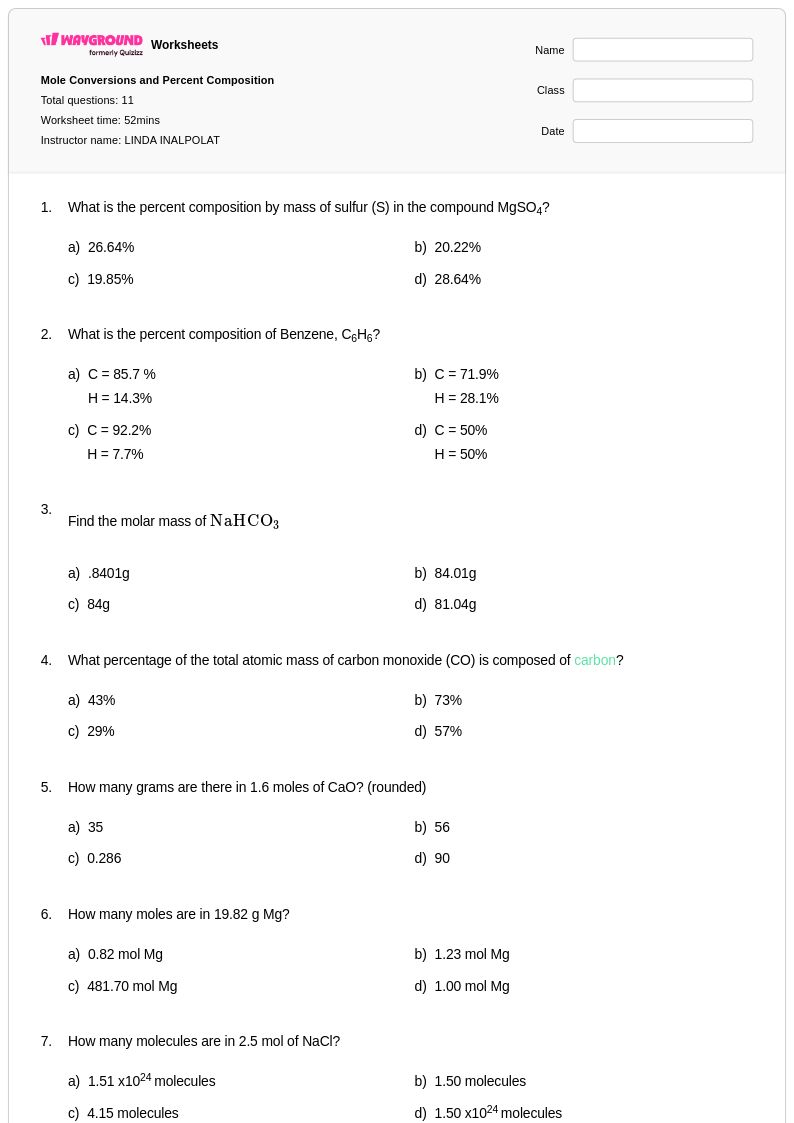
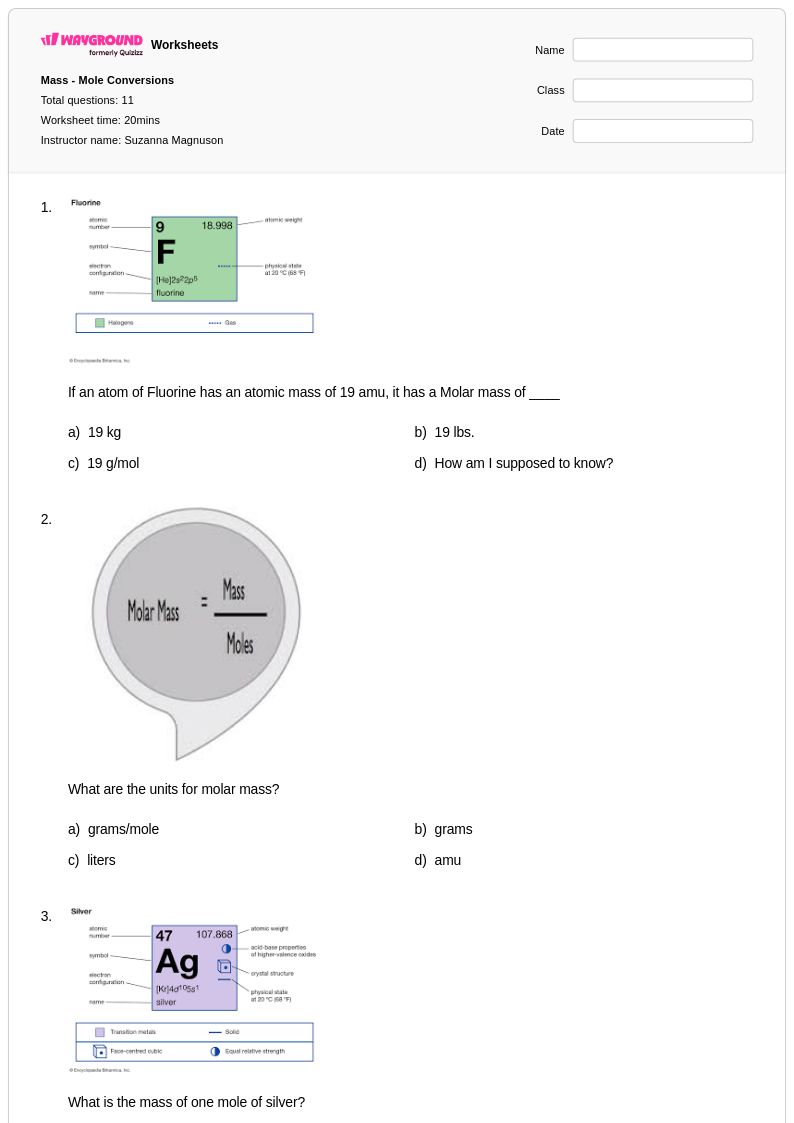
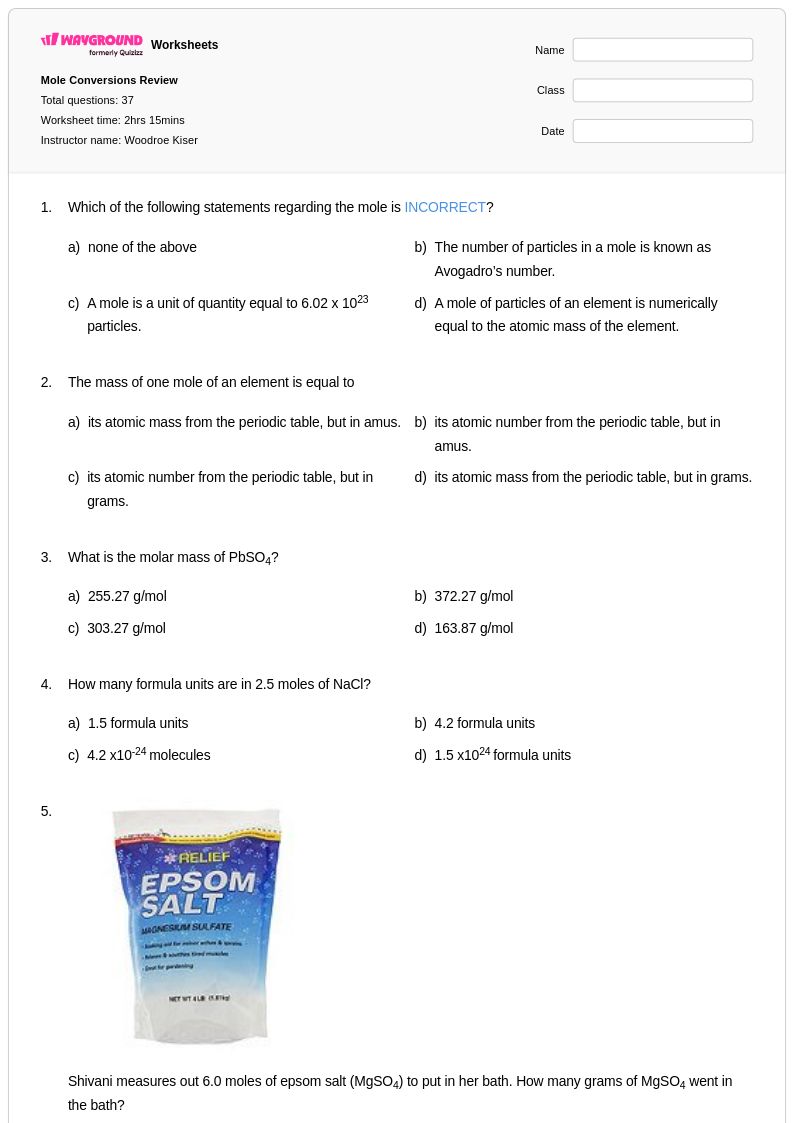
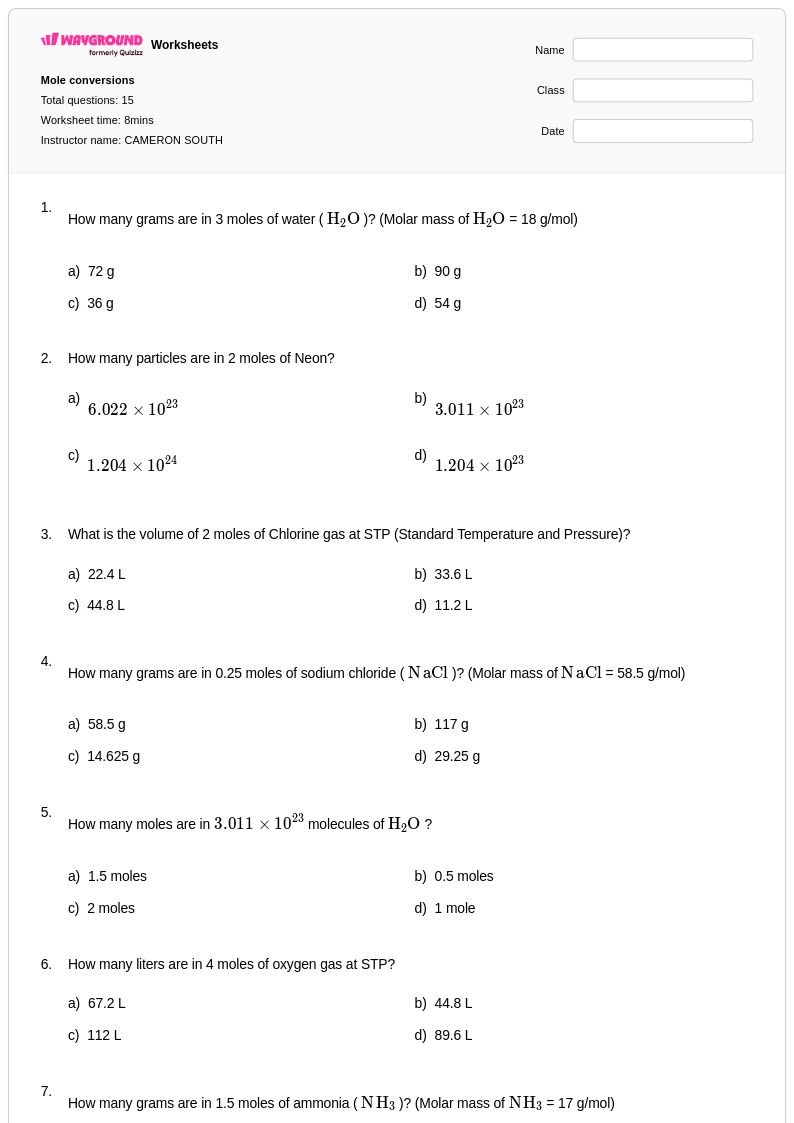
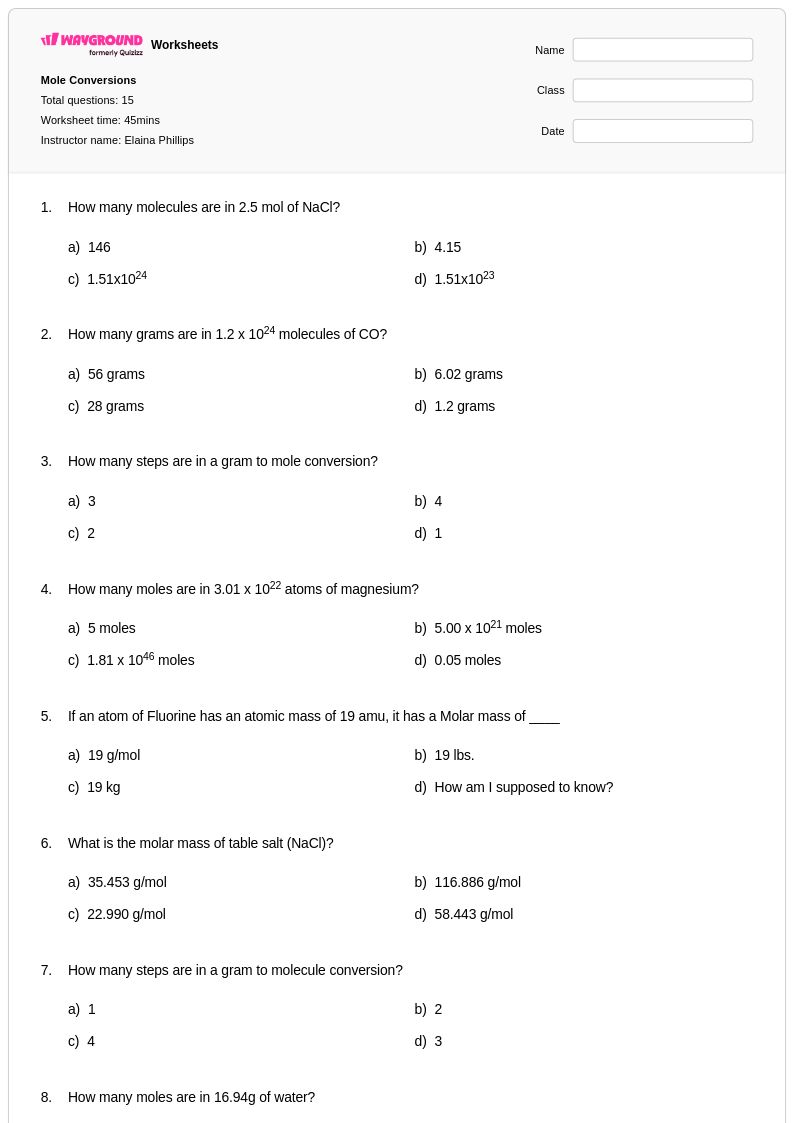
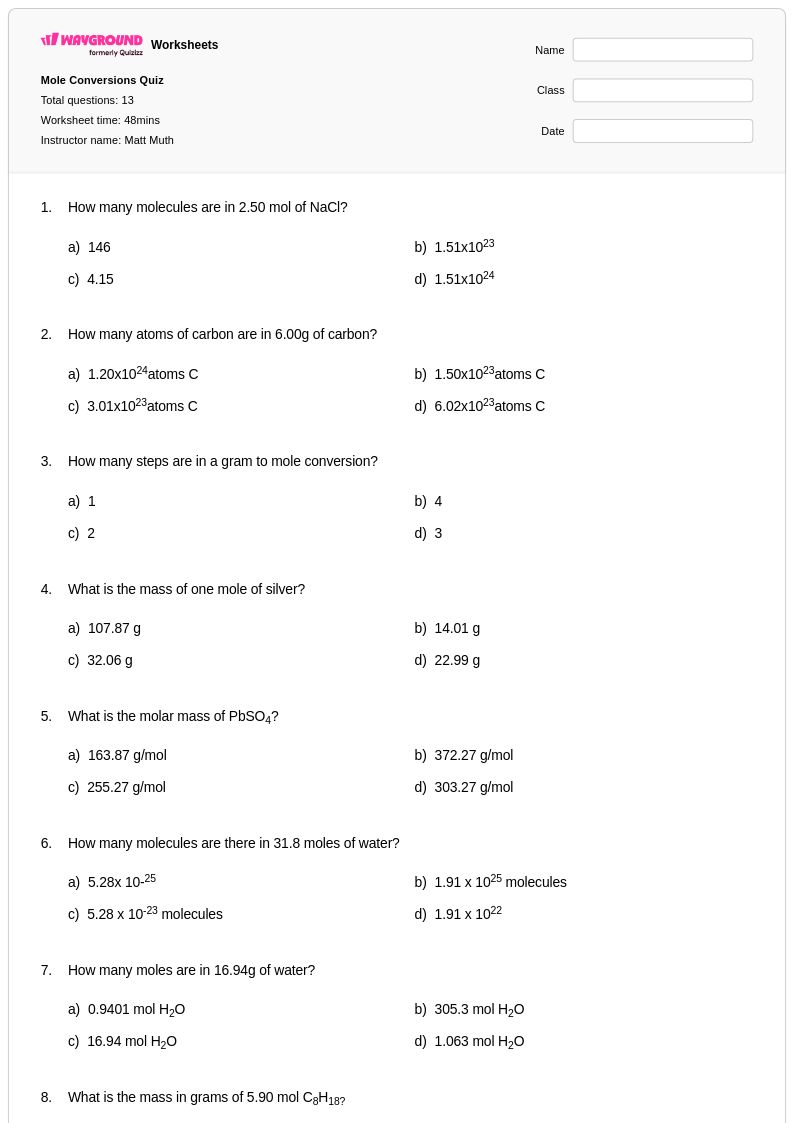
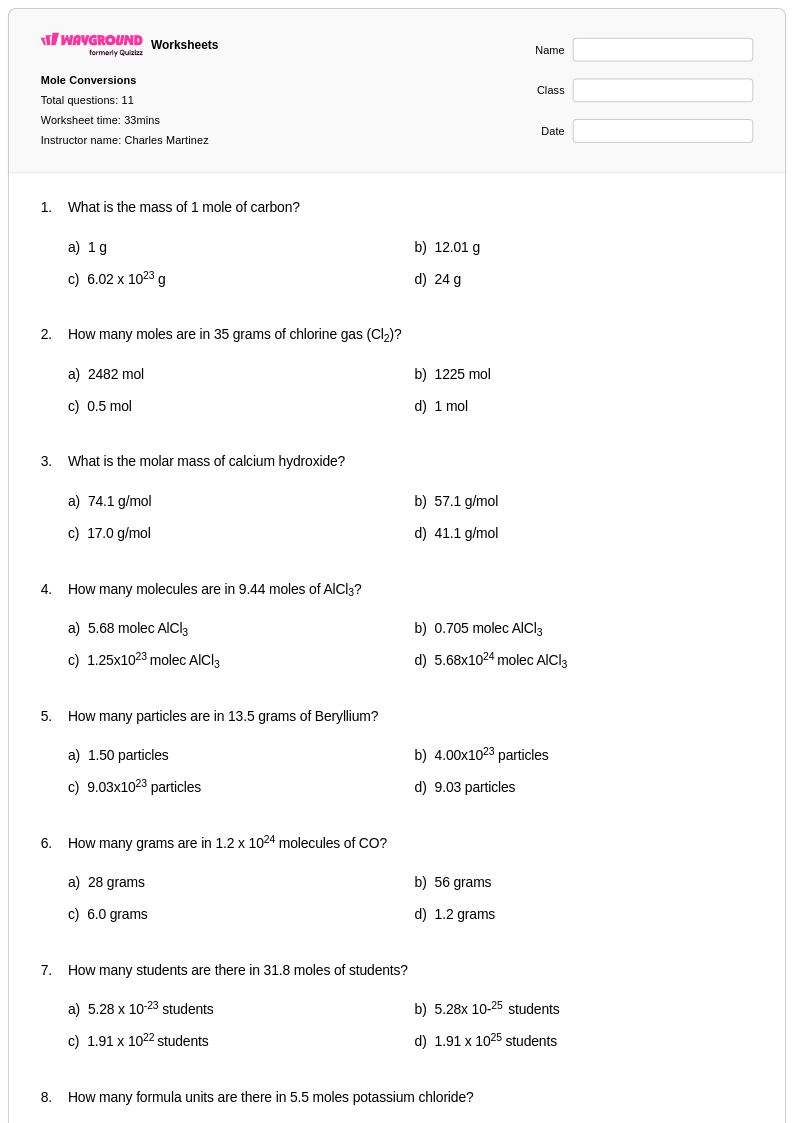
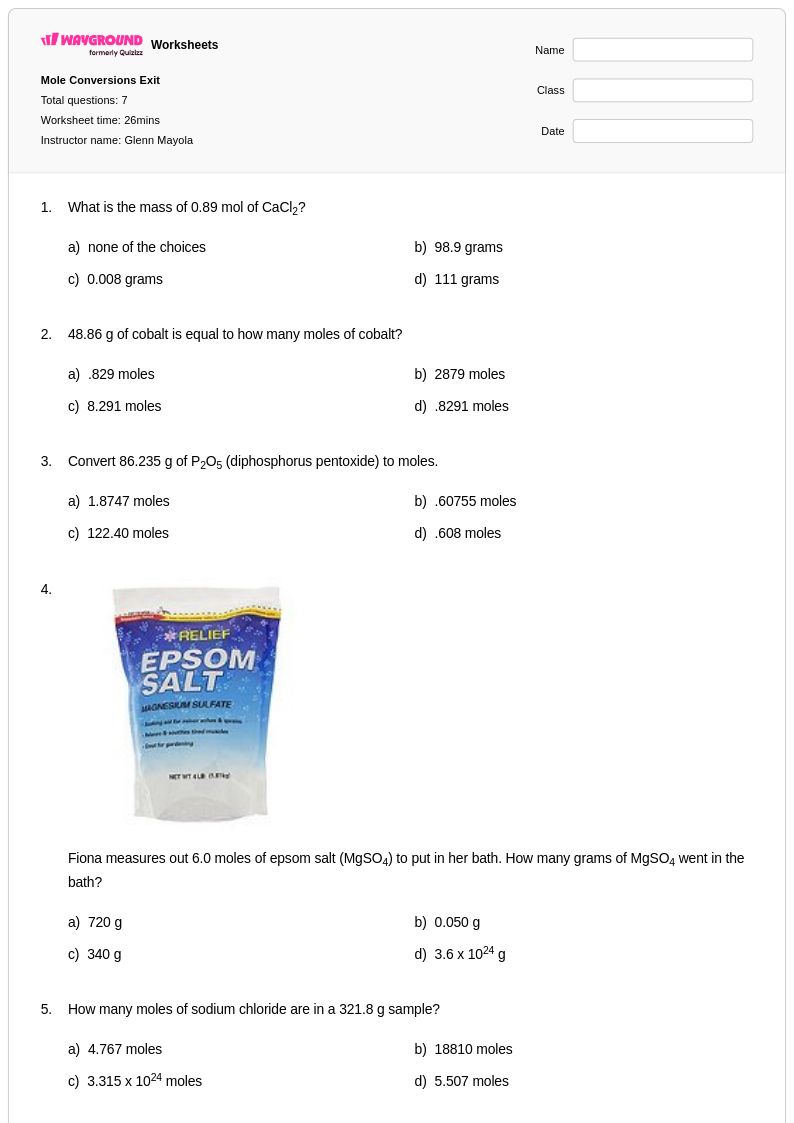
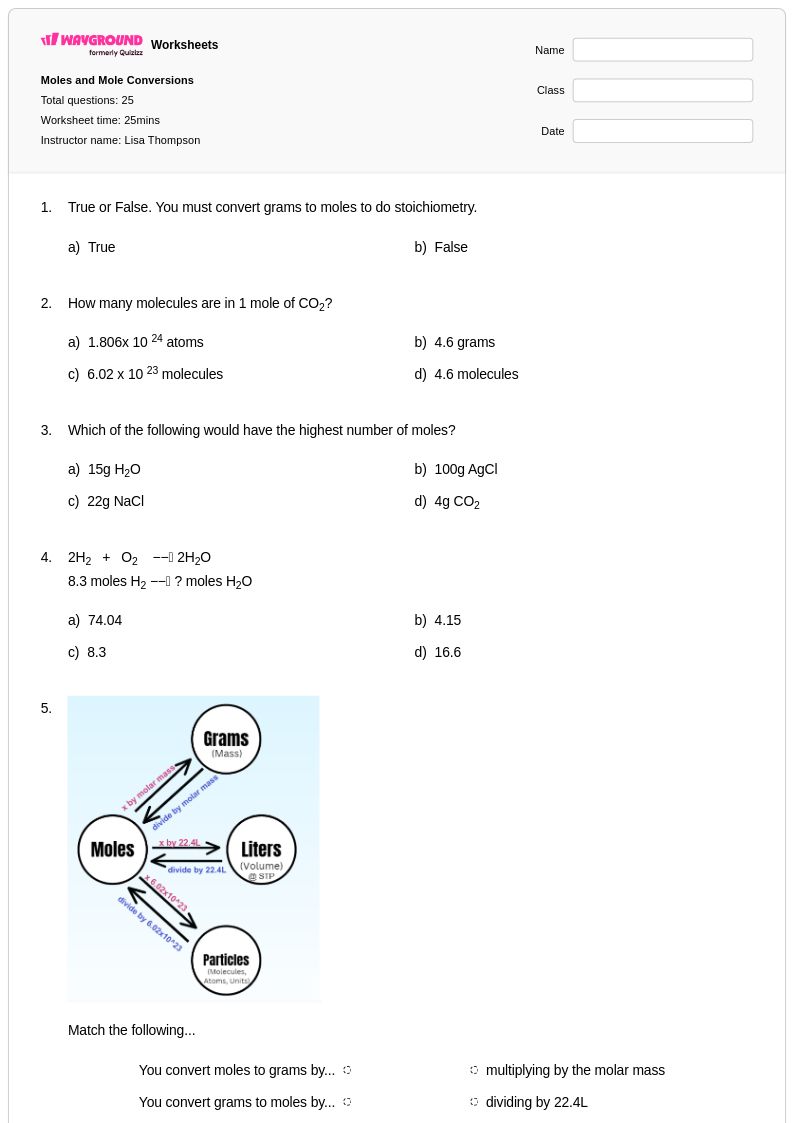
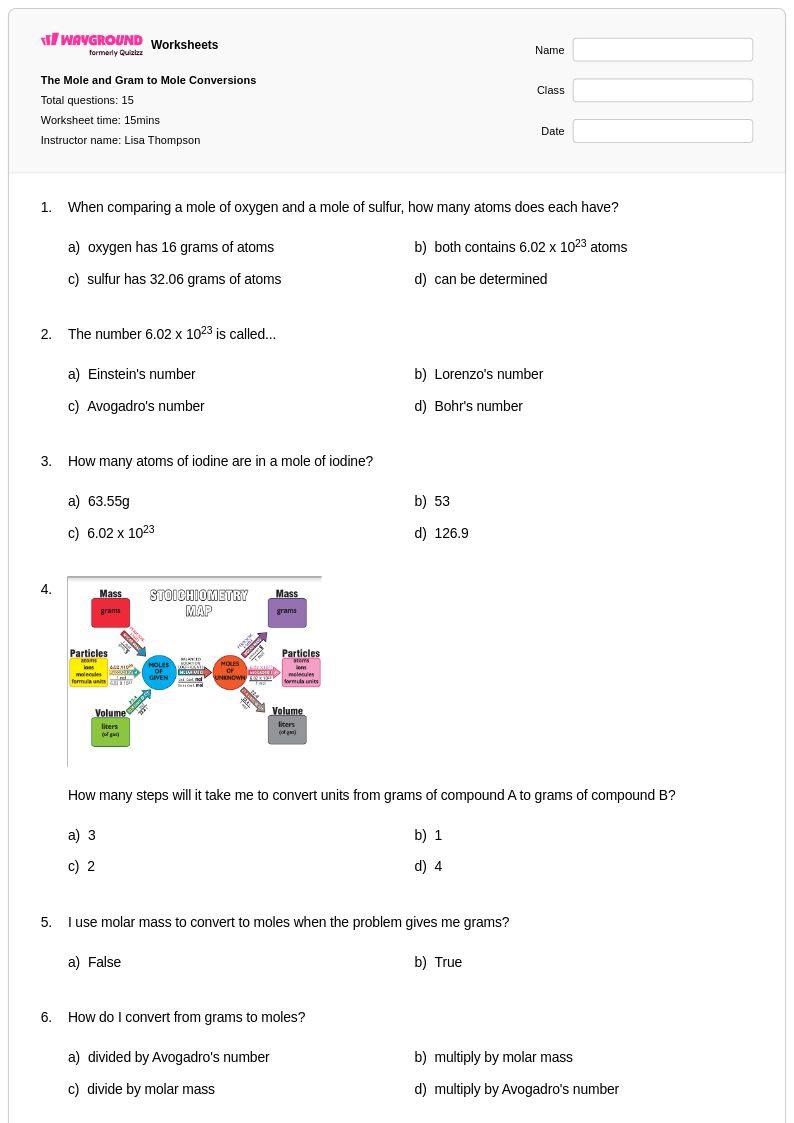
Discover free mole conversions worksheets and printables that help chemistry students master stoichiometric calculations through comprehensive practice problems with detailed answer keys and downloadable PDF resources.
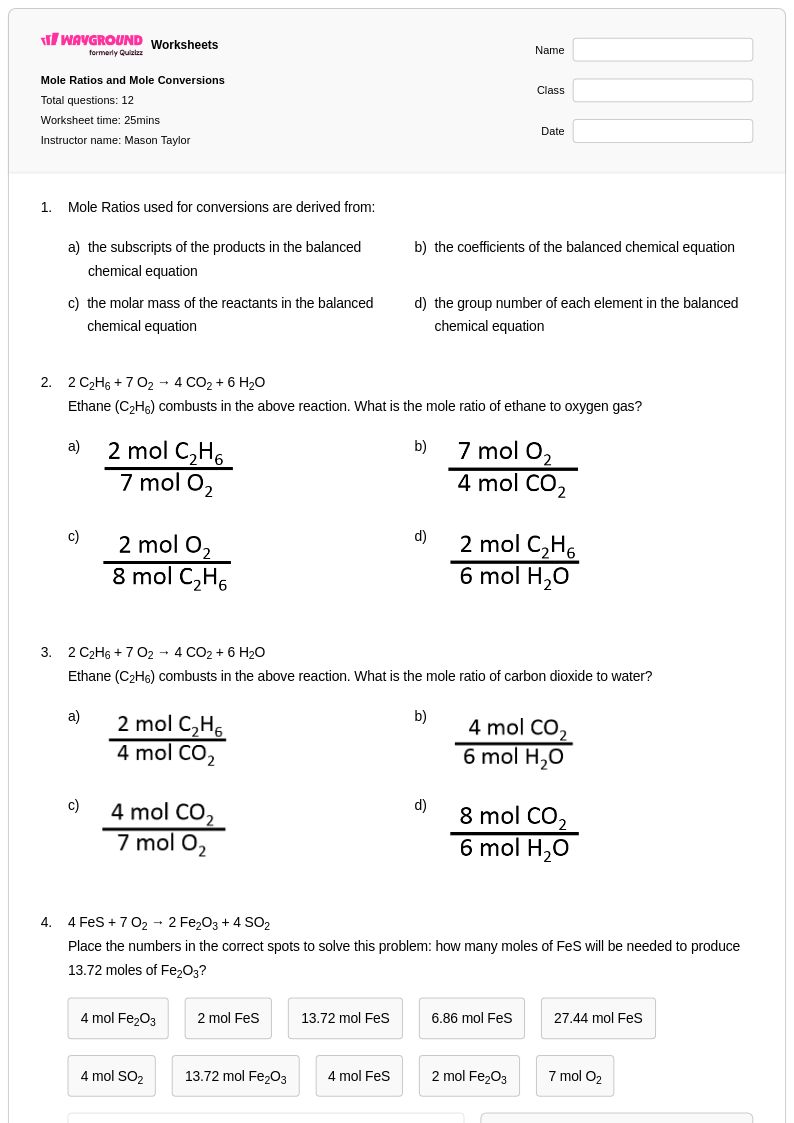
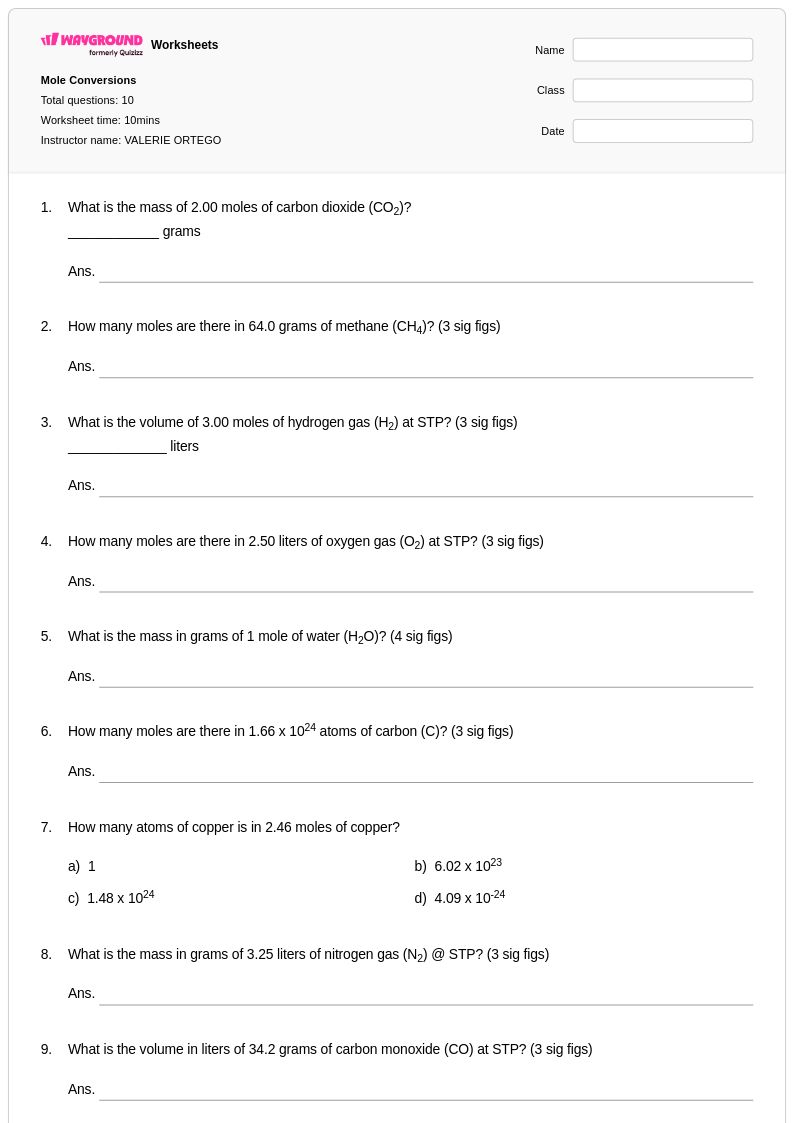
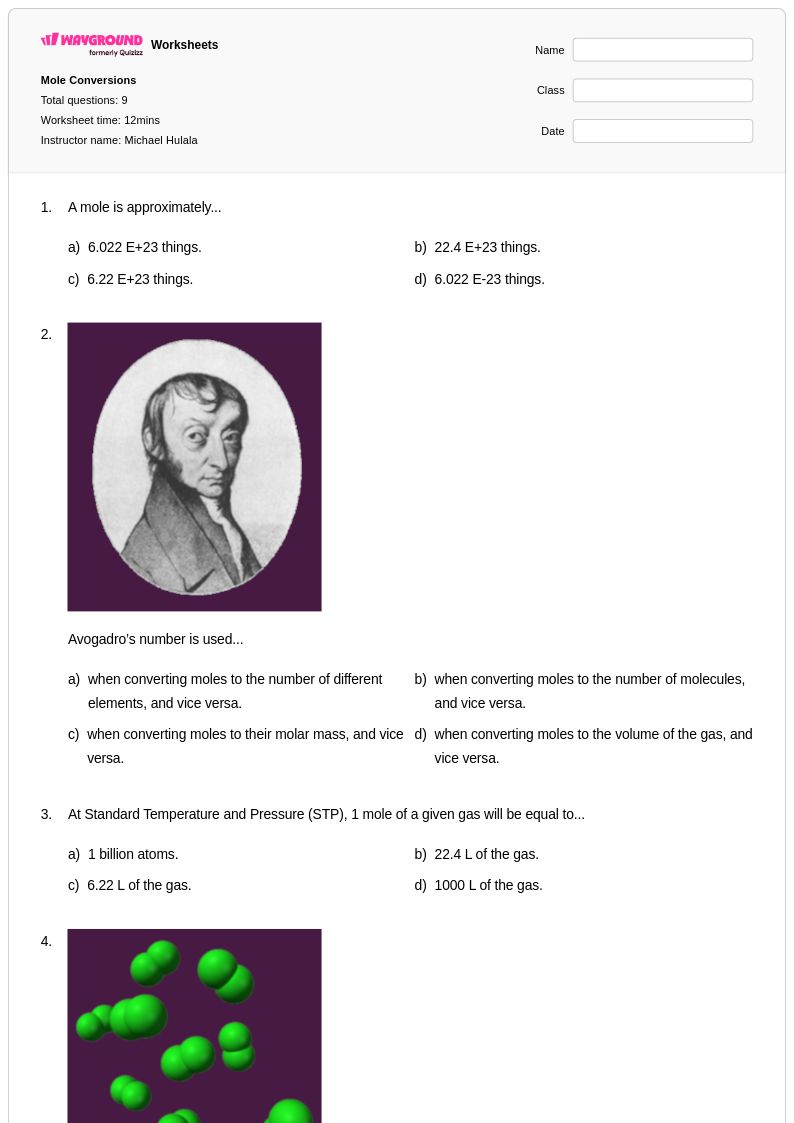
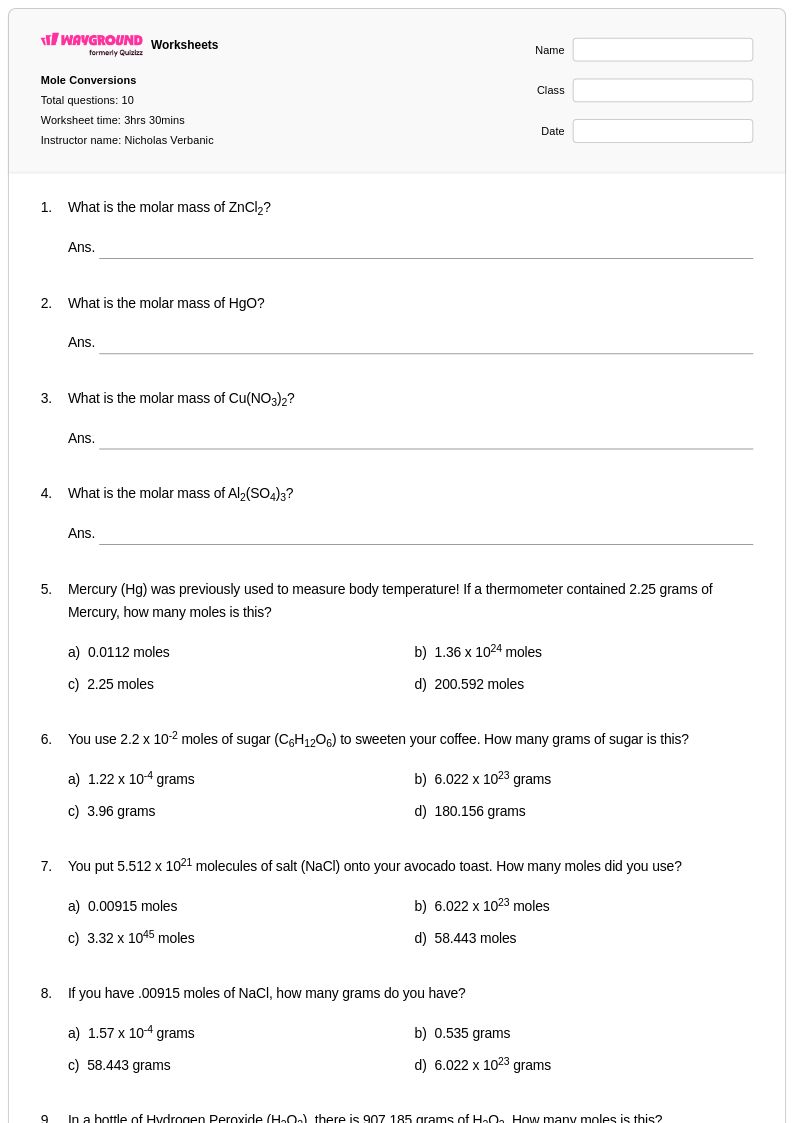
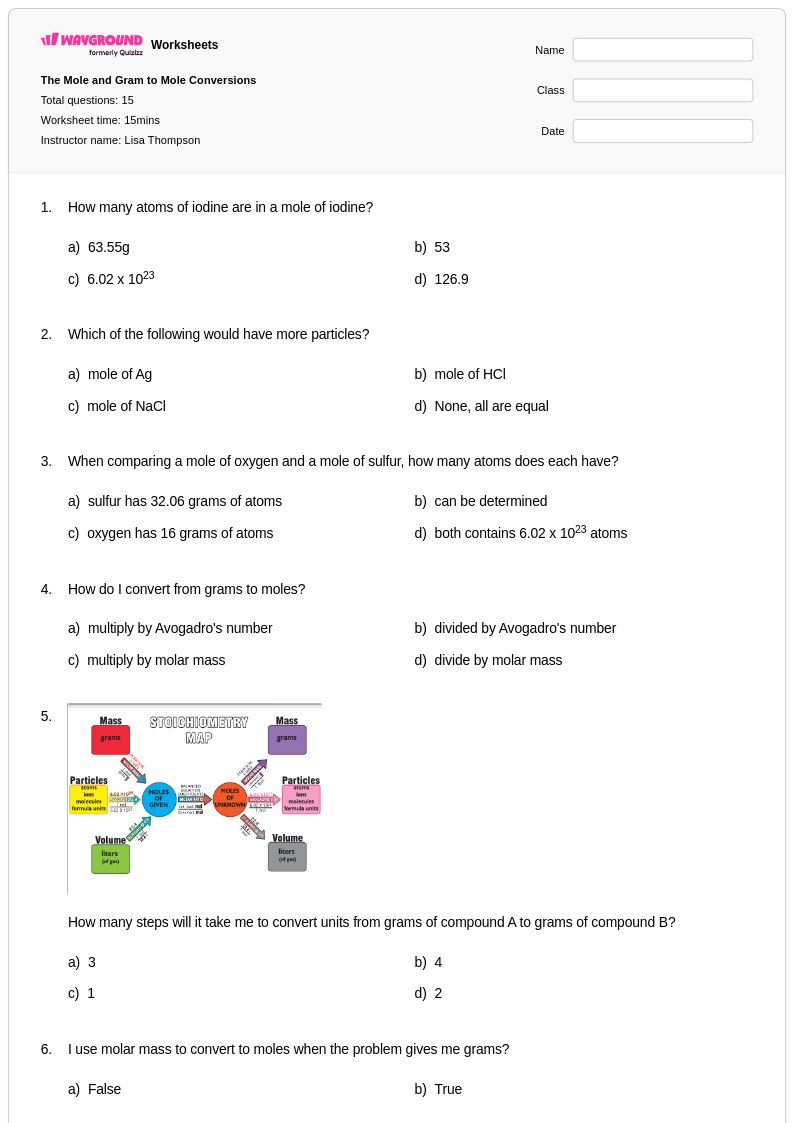
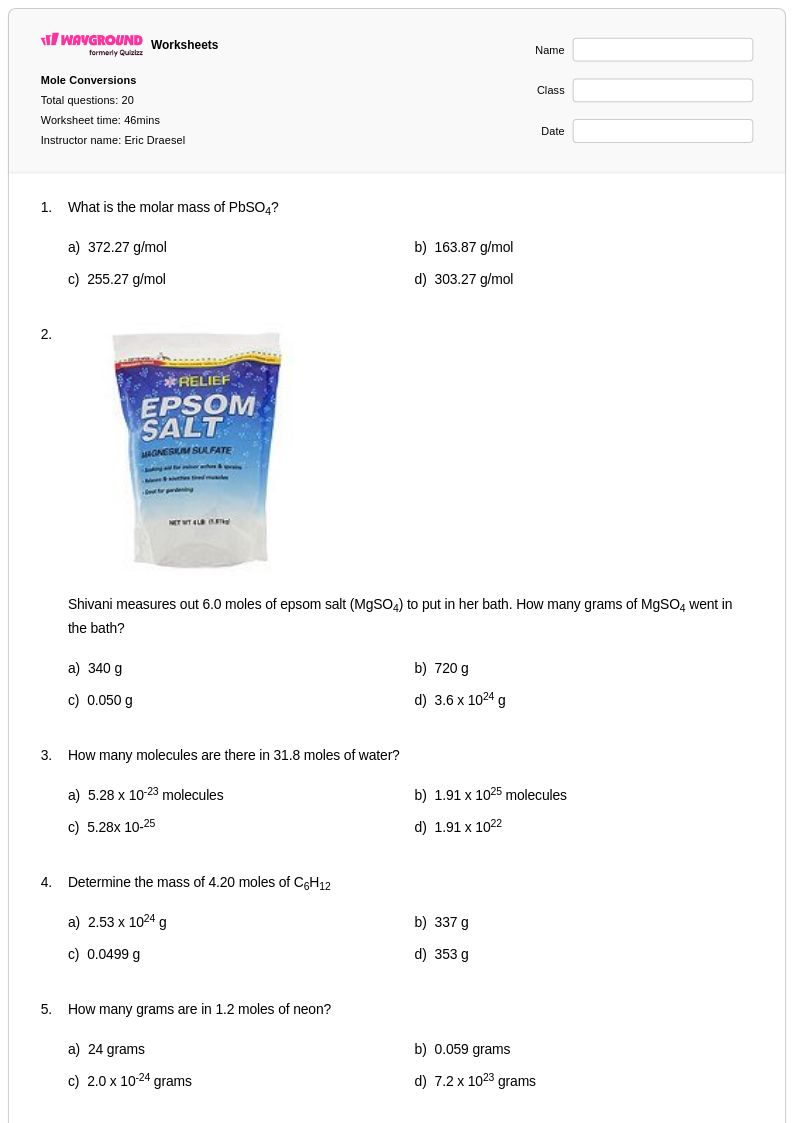
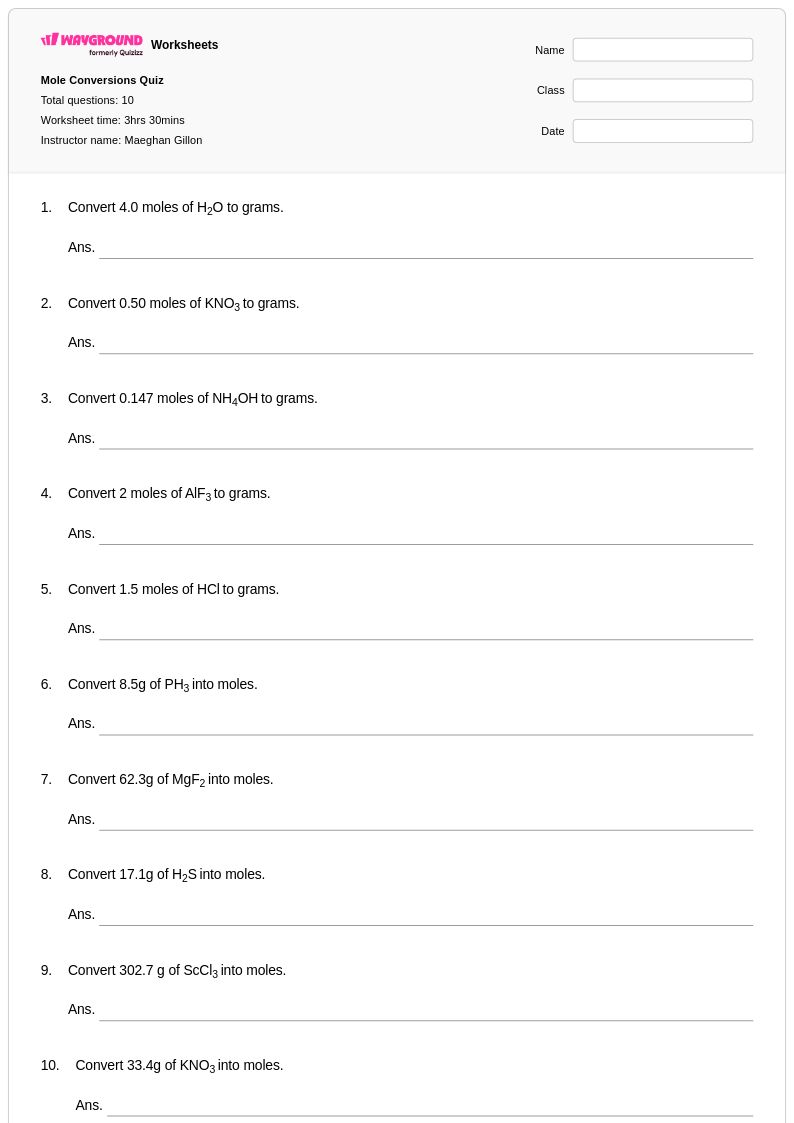
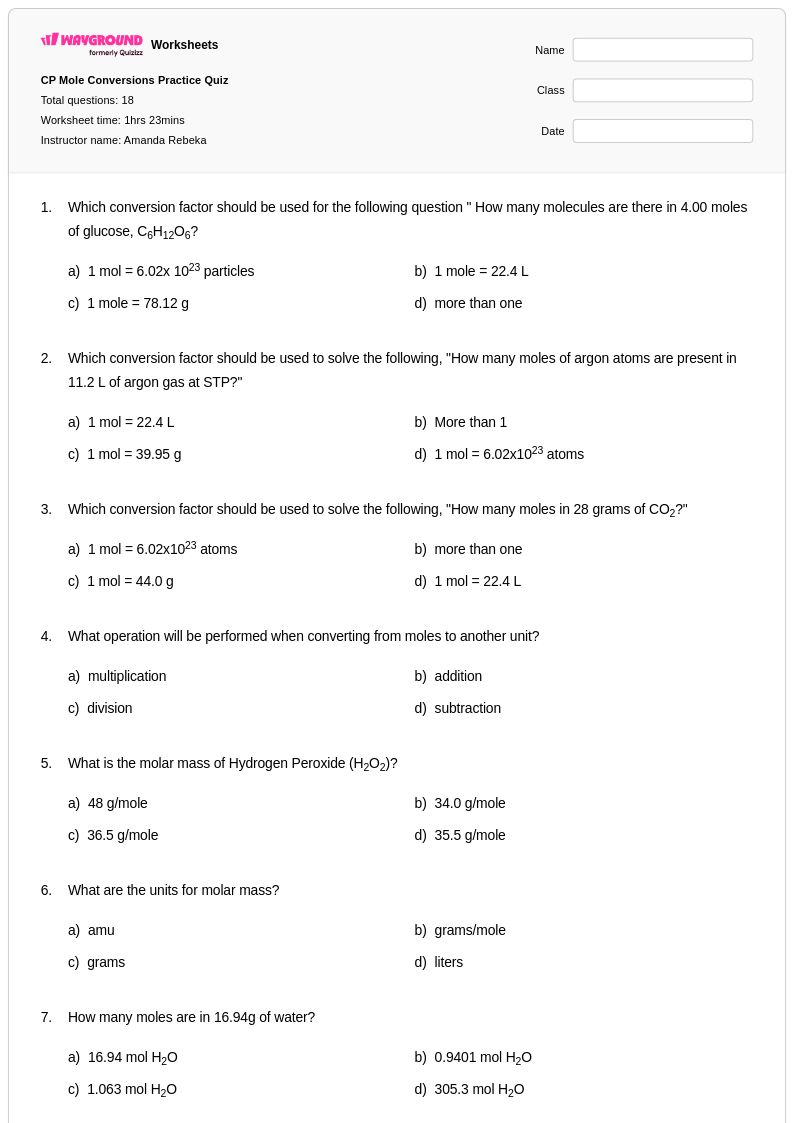
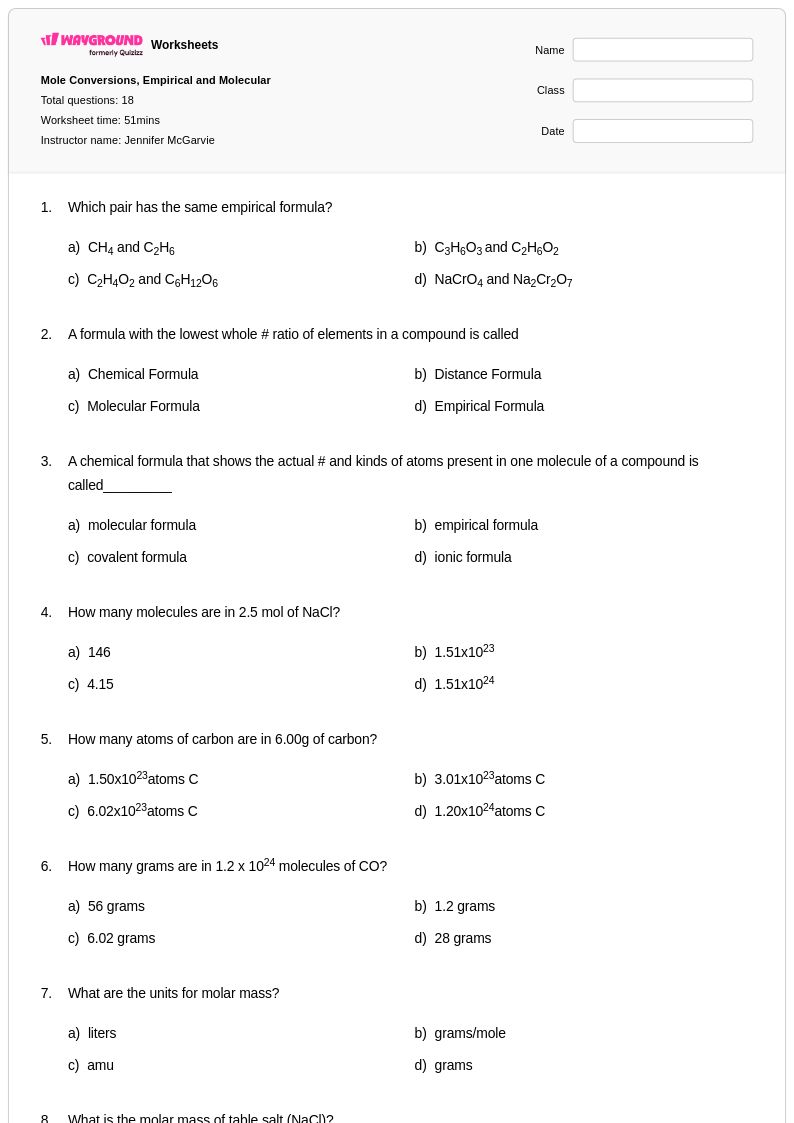
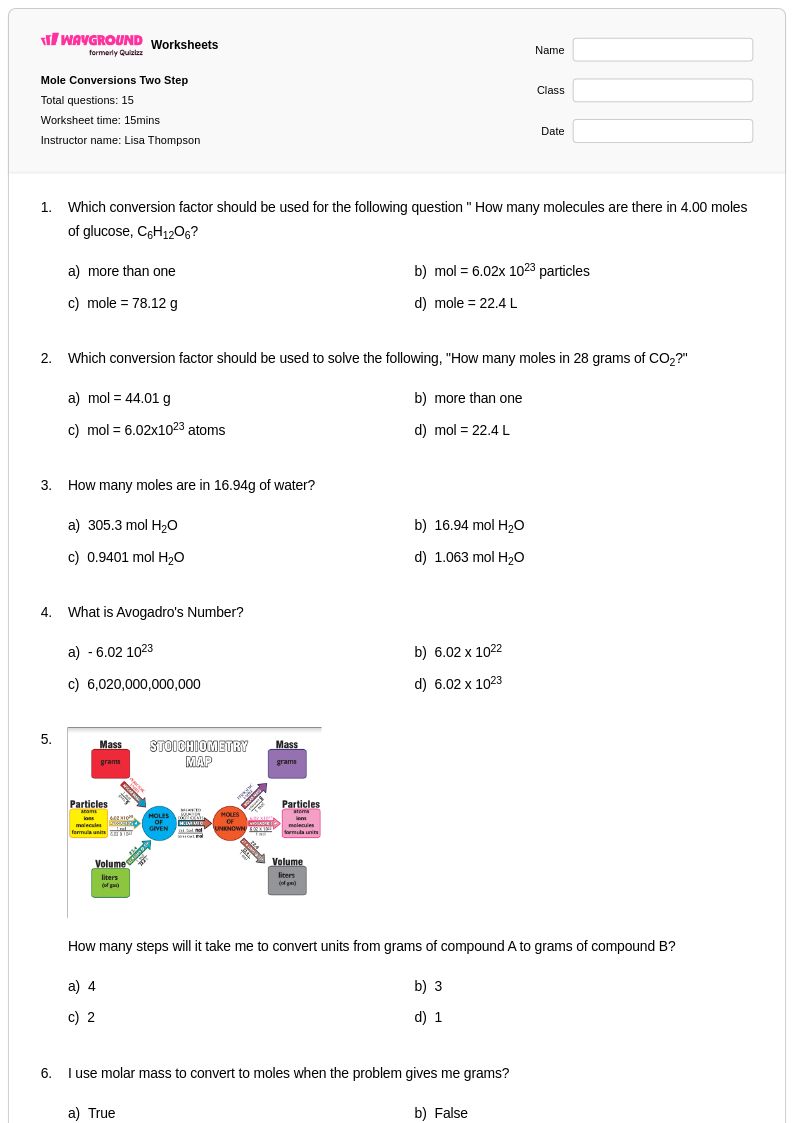
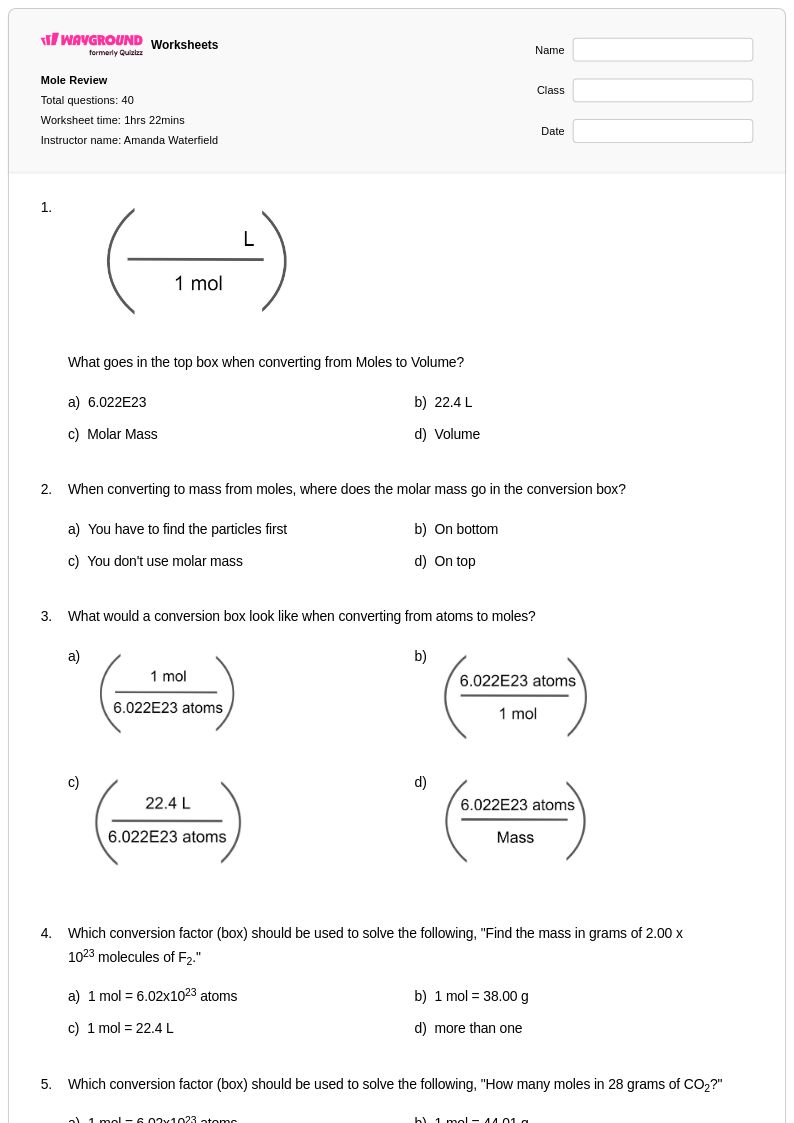
Mole conversions represent one of the most fundamental yet challenging concepts in chemistry, requiring students to master the relationships between moles, mass, particles, and volume through systematic problem-solving approaches. The mole conversion worksheets available through Wayground (formerly Quizizz) provide comprehensive practice with these essential stoichiometric calculations, helping students develop fluency in converting between different units using Avogadro's number, molar mass, and molar volume at STP. These carefully structured practice problems guide learners through step-by-step conversion processes, from basic mole-to-gram calculations to more complex multi-step problems involving molecular formulas and empirical relationships. Each worksheet includes detailed answer keys that demonstrate proper dimensional analysis techniques, while the free printable pdf format ensures accessibility for both classroom instruction and independent study sessions.
Wayground (formerly Quizizz) empowers chemistry educators with an extensive collection of teacher-created mole conversion resources, drawing from millions of professionally developed materials that can be easily located through advanced search and filtering capabilities. The platform's alignment with national chemistry standards ensures that worksheets target specific learning objectives related to quantitative analysis and stoichiometric reasoning, while built-in differentiation tools allow teachers to modify problem complexity based on individual student needs. These flexible customization options enable educators to create targeted practice sets for remediation of struggling learners or enrichment challenges for advanced students, with materials available in both digital interactive formats and traditional printable pdf versions. The comprehensive worksheet collections streamline lesson planning by providing ready-to-use assessments and practice opportunities that reinforce mole concept mastery across diverse learning environments.
FAQs
How do I teach mole conversions to chemistry students?
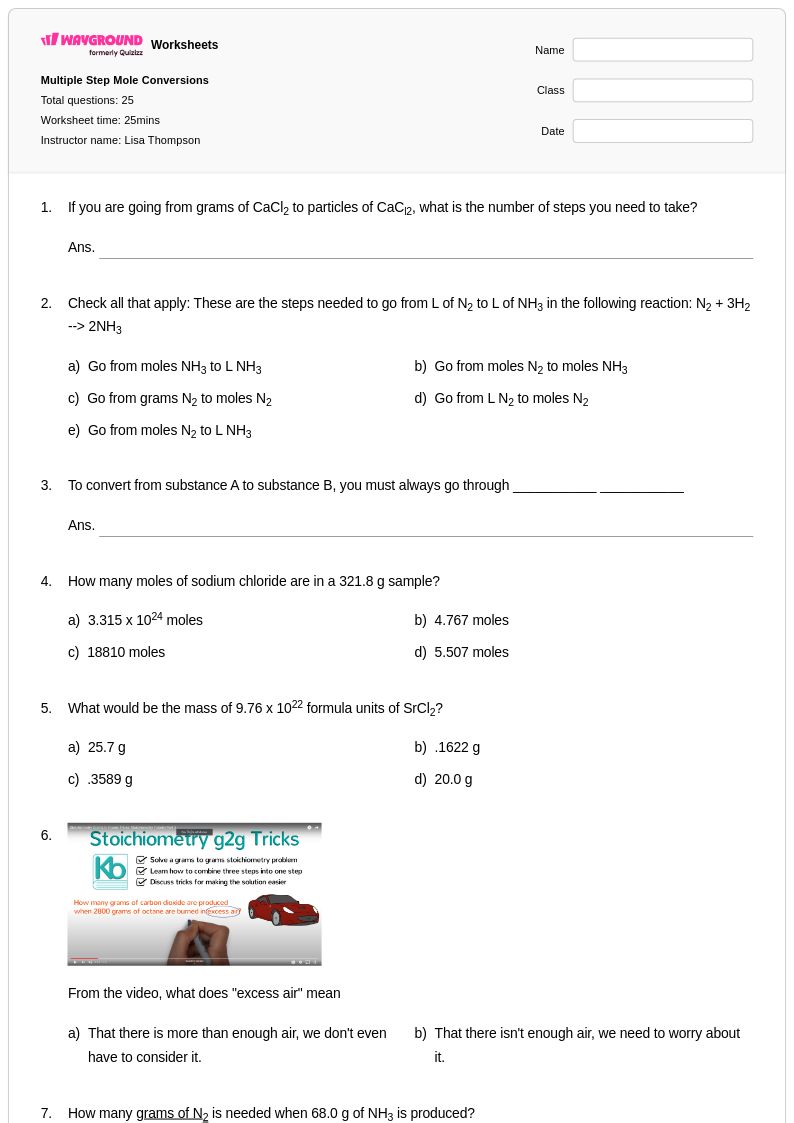
Start by building fluency with a single conversion type before introducing multi-step problems. Teach dimensional analysis as the core technique, showing students how to set up conversion factors using Avogadro's number (6.022 × 10²³), molar mass from the periodic table, and molar volume at STP (22.4 L/mol). Once students can move confidently between moles, grams, and particles in isolation, introduce chained conversions that require two or more steps. Anchoring every conversion in the mole as the central unit helps students see the logic rather than memorize disconnected formulas.
What exercises help students practice mole conversions?
Structured problem sets that isolate one conversion type at a time are the most effective starting point — for example, a worksheet focused exclusively on mole-to-gram calculations before combining it with particle-count problems. Step-by-step dimensional analysis problems that require students to show their work and cancel units explicitly are especially valuable because they expose procedural errors early. Progressing from single-step to multi-step conversions involving molecular formulas and empirical relationships builds the fluency needed for broader stoichiometry work.
What mistakes do students commonly make with mole conversions?
The most frequent error is inverting the conversion factor — for instance, multiplying by molar mass when they should be dividing, or vice versa. Students also commonly confuse Avogadro's number with molar volume, applying the wrong constant for particle or volume conversions. Skipping dimensional analysis and working from memory rather than unit-tracking leads to errors that are hard to self-diagnose. Requiring students to write out units at every step and explicitly cancel them reduces these mistakes significantly.
How do I use Wayground's mole conversion worksheets in my class?
Wayground's mole conversion worksheets are available as printable PDFs, making them easy to use for in-class practice, homework, or lab pre-work in traditional classroom settings. They are also available in digital formats, so students can complete them on devices in tech-integrated or hybrid environments. Teachers can host any worksheet as a quiz directly on Wayground, enabling real-time tracking of student responses. Each worksheet includes a detailed answer key demonstrating proper dimensional analysis technique, which supports both teacher grading and student self-correction.
How can I differentiate mole conversion practice for students at different levels?
For struggling students, begin with single-step conversions using simple compounds and provide a reference sheet listing Avogadro's number, molar volume at STP, and how to read molar mass from the periodic table. For advanced students, introduce multi-step problems that combine mole-to-gram and mole-to-particle conversions within a single problem, or incorporate molecular formula and empirical formula relationships. On Wayground, teachers can also apply individual accommodations such as reduced answer choices or read-aloud support to specific students, allowing the rest of the class to work under default settings without disruption.
At what point in a chemistry course should I introduce mole conversion worksheets?
Mole conversions should be introduced after students have a working understanding of atomic mass, the periodic table, and the concept of the mole as a counting unit. In most high school chemistry sequences, this falls early in a stoichiometry unit, typically in grades 10 or 11. Establishing mole conversion fluency at this stage is essential because it underpins nearly every quantitative calculation that follows, including limiting reagents, solution concentration, and gas law applications.