
Free Printable Neuromuscular Junction Worksheets for Class 10
Class 10 Biology students can master neuromuscular junction concepts with our comprehensive collection of free worksheets, printables, and practice problems featuring detailed answer keys to reinforce nerve-muscle communication understanding.
Download any worksheet with a free account
Free PDF downloads, saved to your library.
Keep exploring
Explore printable Neuromuscular Junction worksheets for Class 10
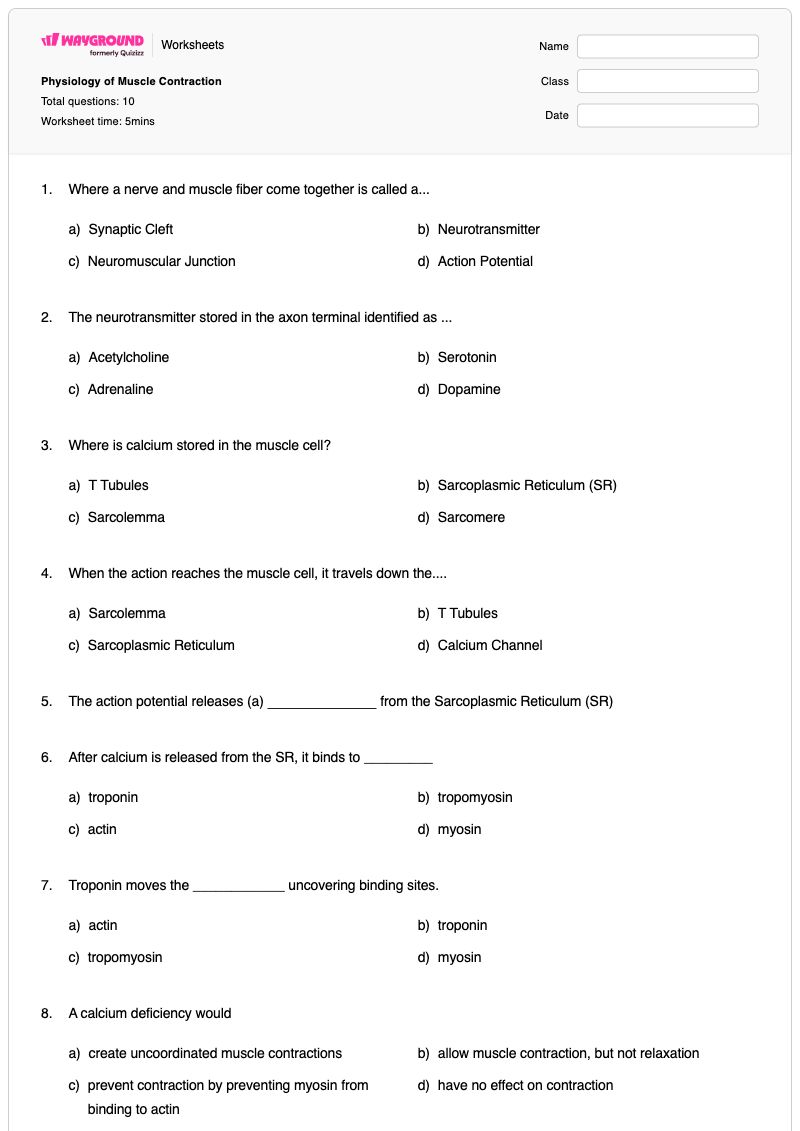
Neuromuscular junction worksheets for Class 10 students available through Wayground (formerly Quizizz) provide comprehensive coverage of this critical biological concept where motor neurons communicate with muscle fibers. These expertly designed educational materials focus on the intricate mechanisms of synaptic transmission, including the release of acetylcholine, the role of calcium ions, and the process of muscle contraction initiation. Students engage with practice problems that strengthen their understanding of neurotransmitter function, synaptic cleft dynamics, and the molecular events that enable voluntary movement. The worksheets feature detailed diagrams, analytical questions, and step-by-step explorations of signal transduction pathways, with accompanying answer keys that support independent learning and self-assessment. These free printables in pdf format help students master the complex interactions between the nervous and muscular systems while building essential skills in biological analysis and scientific reasoning.
Wayground (formerly Quizizz) empowers educators with access to millions of teacher-created neuromuscular junction resources that support diverse instructional needs and learning objectives. The platform's robust search and filtering capabilities enable teachers to quickly locate materials aligned with specific curriculum standards and differentiated for varying skill levels within their Class 10 biology classrooms. These versatile worksheet collections are available in both printable and digital formats, including downloadable pdf versions that facilitate seamless integration into lesson plans, homework assignments, and assessment strategies. Teachers can customize existing materials or combine multiple resources to create targeted practice sessions for remediation, enrichment, or skill reinforcement, ensuring that all students develop a thorough understanding of synaptic transmission mechanisms. The comprehensive nature of these resources supports effective instructional planning while providing flexible tools for addressing individual student needs in mastering this fundamental aspect of human physiology.
Frequently asked questions
Start by grounding students in the structural relationship between motor neurons and muscle fibers before introducing the chemical signaling sequence. Walk through synaptic transmission step by step: action potential arrival, acetylcholine release from synaptic vesicles, binding to receptors on the motor end plate, and the resulting muscle fiber depolarization. Diagram-based activities work especially well here because students can trace each stage spatially rather than memorizing an abstract sequence. Connecting the process to real-world examples like neuromuscular blocking agents or myasthenia gravis gives students a clinical anchor that strengthens retention.