Free Printable RNA and Protein Synthesis Worksheets for Class 10
Class 10 RNA and Protein Synthesis worksheets from Wayground offer comprehensive printables and practice problems to help students master transcription, translation, and genetic code concepts with detailed answer keys.
Explore printable RNA and Protein Synthesis worksheets for Class 10
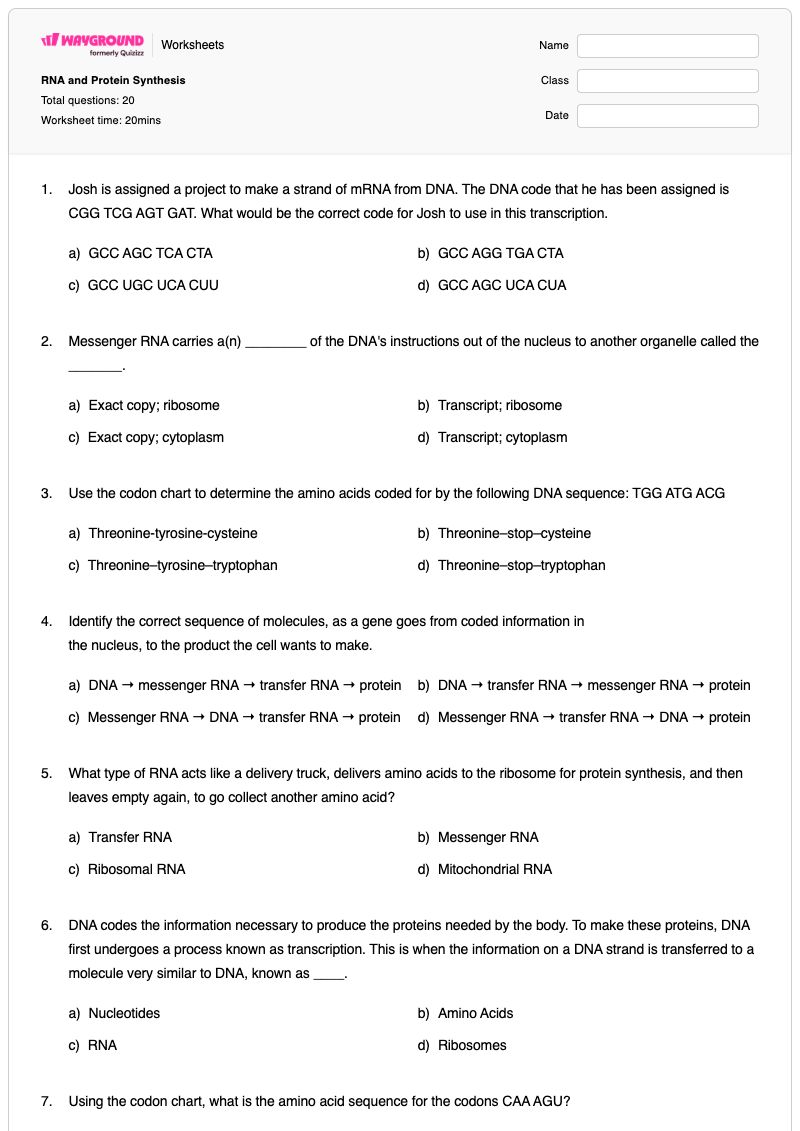
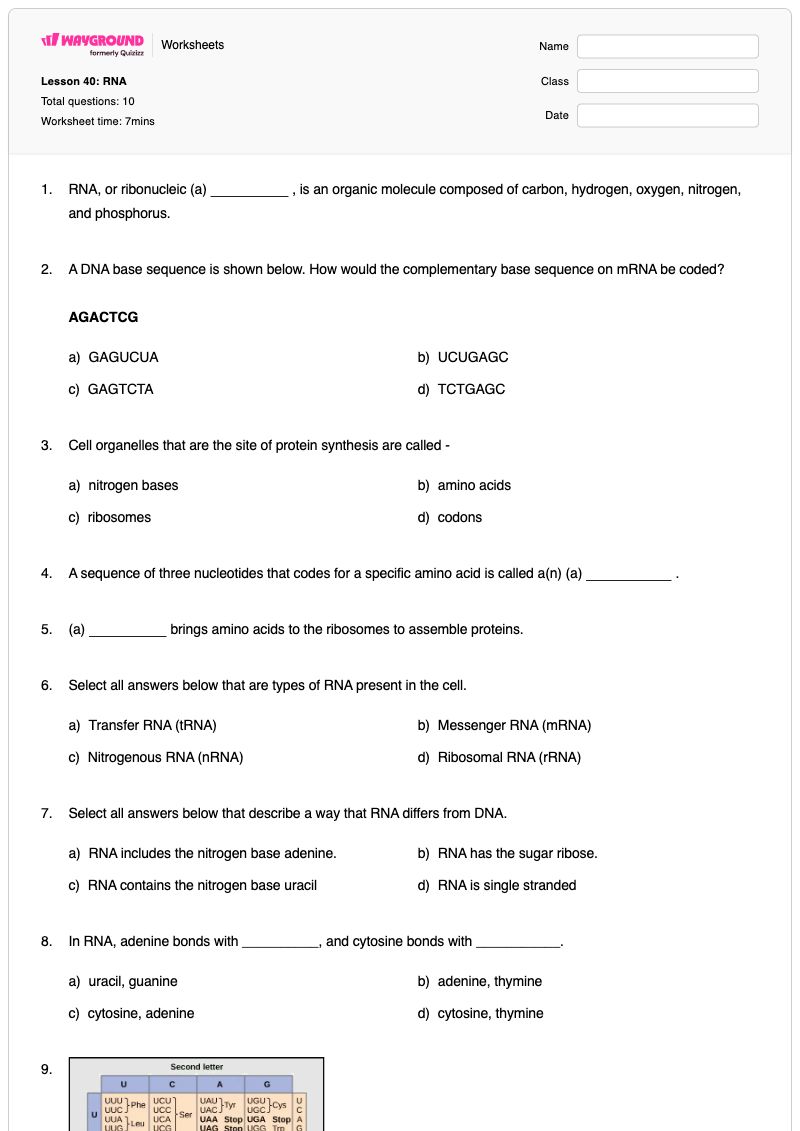
RNA and protein synthesis worksheets for Class 10 students available through Wayground (formerly Quizizz) provide comprehensive coverage of the fundamental molecular processes that drive cellular function and heredity. These expertly designed resources strengthen students' understanding of transcription, translation, and the central dogma of molecular biology through targeted practice problems that explore DNA-to-RNA transcription, mRNA processing, ribosomal translation, and protein folding mechanisms. The worksheets systematically build proficiency in interpreting genetic codes, analyzing amino acid sequences, and understanding the roles of various RNA types including messenger RNA, transfer RNA, and ribosomal RNA. Each resource includes detailed answer keys and is available as free printables in PDF format, enabling students to master complex concepts such as codon recognition, anticodon pairing, and the relationship between genotype and phenotype through structured practice.
Wayground (formerly Quizizz) empowers educators with an extensive collection of millions of teacher-created RNA and protein synthesis worksheets, featuring robust search and filtering capabilities that align with state and national biology standards. The platform's differentiation tools allow teachers to customize content complexity and focus areas, accommodating diverse learning needs within Class 10 classrooms while maintaining academic rigor. These resources are available in both printable PDF formats and interactive digital versions, providing flexibility for in-class instruction, homework assignments, laboratory supplements, and assessment preparation. Teachers can efficiently plan comprehensive units on molecular biology, implement targeted remediation for students struggling with transcription and translation concepts, and provide enrichment opportunities for advanced learners through progressively challenging problem sets that reinforce critical thinking skills in cellular and molecular biology.
Frequently asked questions
Teaching RNA and protein synthesis effectively starts with anchoring students in the central dogma: DNA is transcribed into mRNA, which is then translated into a protein. Break instruction into two distinct phases — transcription and translation — before connecting them as a unified process. Using codon charts as a hands-on decoding activity helps students visualize how nucleotide sequences map to amino acids. Reinforcing each stage with targeted practice problems that require students to trace genetic information from DNA through to a functional protein deepens conceptual retention.
The most effective practice exercises for transcription and translation require students to actively apply rules rather than recall definitions. Codon chart interpretation problems, mRNA strand construction from a DNA template, and amino acid sequence prediction tasks all build procedural fluency. Practice problems that introduce point mutations and ask students to predict the effect on the resulting protein are especially valuable for deepening understanding of how molecular errors propagate through gene expression.
One of the most common errors is confusing the roles of mRNA, tRNA, and rRNA — students often conflate tRNA's anticodon function with mRNA's codon sequence. Another frequent mistake is misapplying complementary base pairing rules during transcription, particularly forgetting that uracil replaces thymine in RNA. Students also regularly misread codon charts by starting from the wrong axis, which leads to incorrect amino acid assignments and cascading errors in translation practice problems.
Protein synthesis worksheets are well-suited for formative assessment because they expose procedural gaps that multiple-choice tests often miss. Asking students to construct a complete pathway from a given DNA sequence to a final amino acid chain reveals exactly where breakdowns occur — whether in transcription, codon reading, or tRNA matching. Error analysis tasks, where students identify mistakes in a pre-worked example, are particularly diagnostic and push students toward higher-order evaluation skills.
Wayground's RNA and protein synthesis worksheets are available as printable PDFs for traditional classroom use and in digital formats for technology-integrated environments, giving teachers flexibility across in-person, hybrid, and remote settings. Teachers can also host worksheets directly as a quiz on Wayground, enabling real-time student response tracking. Each worksheet includes a complete answer key, which reduces grading time and supports independent student self-review. The platform's search and filtering tools allow teachers to quickly locate materials aligned to specific standards or curriculum focus areas.
Students who struggle with protein synthesis often need the process scaffolded into smaller, clearly labeled steps before they attempt full pathway problems. Providing a reference sheet with base pairing rules and a codon chart during initial practice reduces cognitive overload and lets students focus on procedural logic. On Wayground, teachers can enable accommodations such as Read Aloud for students who benefit from audio support, and Reduced Answer Choices to lower cognitive load during digital practice, with these settings applied per student so the rest of the class is unaffected.
Transcription is the process by which a DNA sequence is copied into a complementary mRNA strand inside the nucleus, using RNA polymerase. Translation occurs in the cytoplasm, where ribosomes read the mRNA codon sequence and tRNA molecules deliver the corresponding amino acids to build a polypeptide chain. These two processes are distinct in location, molecular machinery, and output, but together they constitute the central mechanism by which genetic information is expressed as functional protein in the cell.