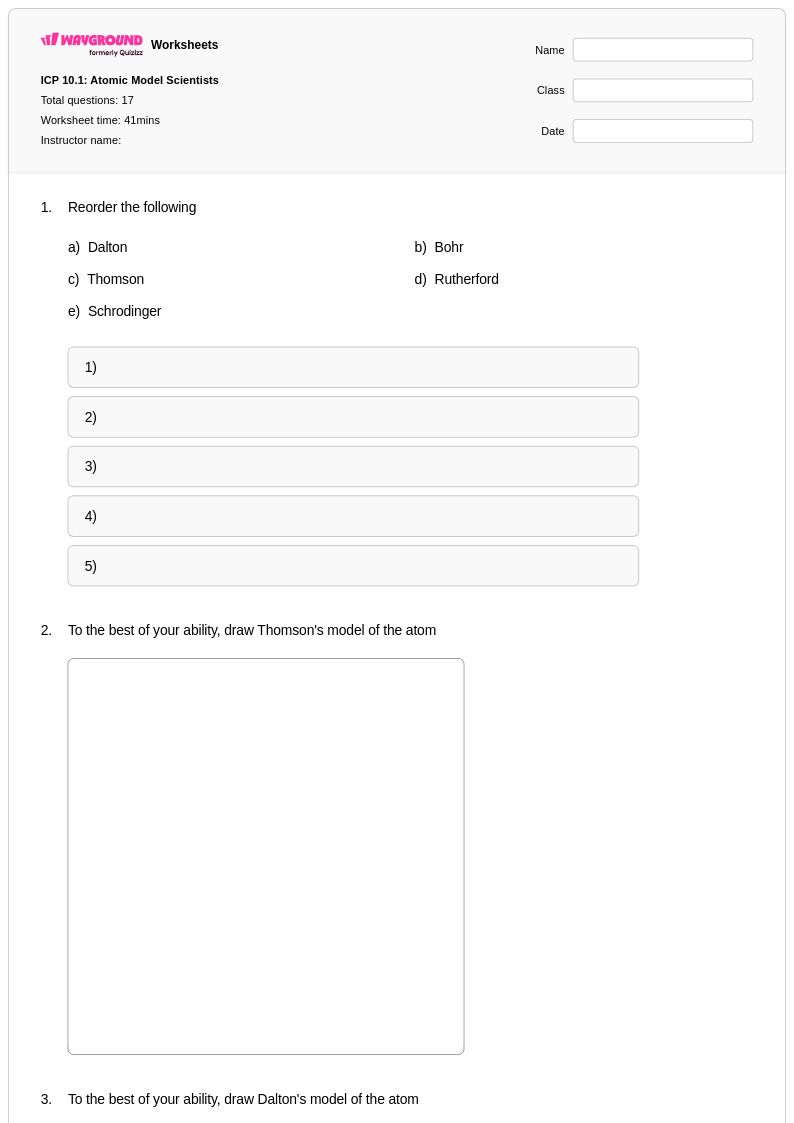
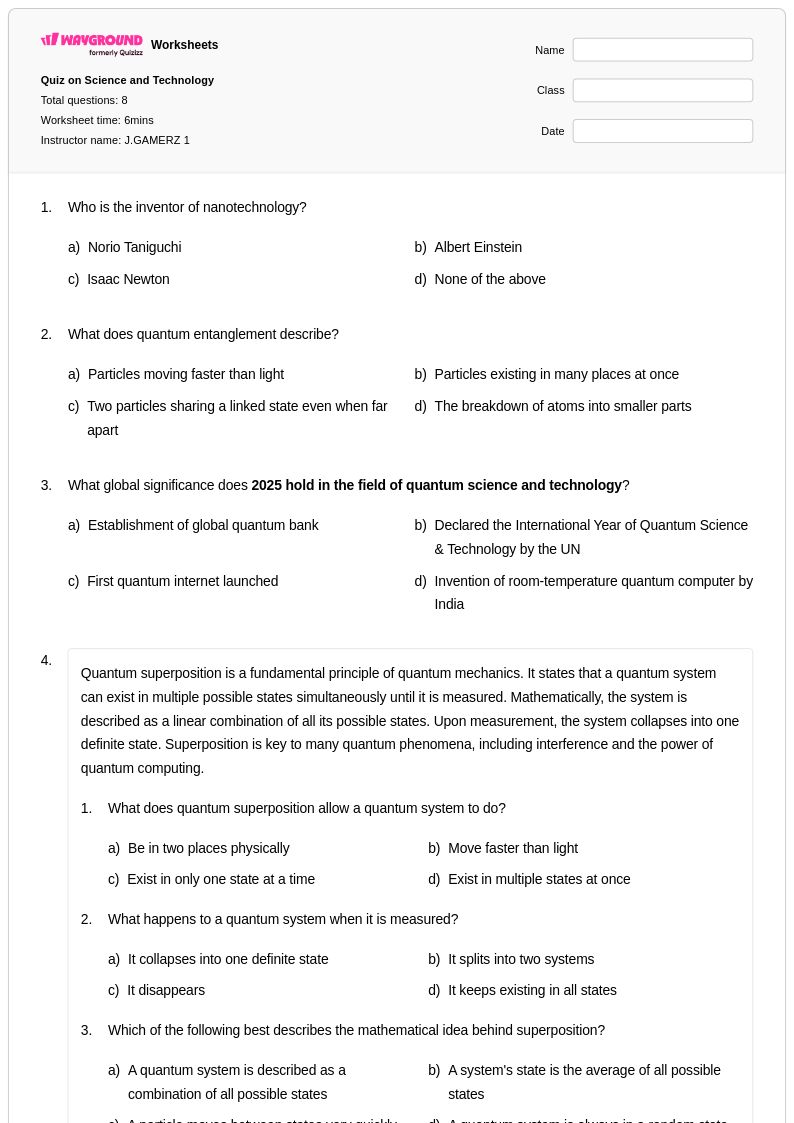
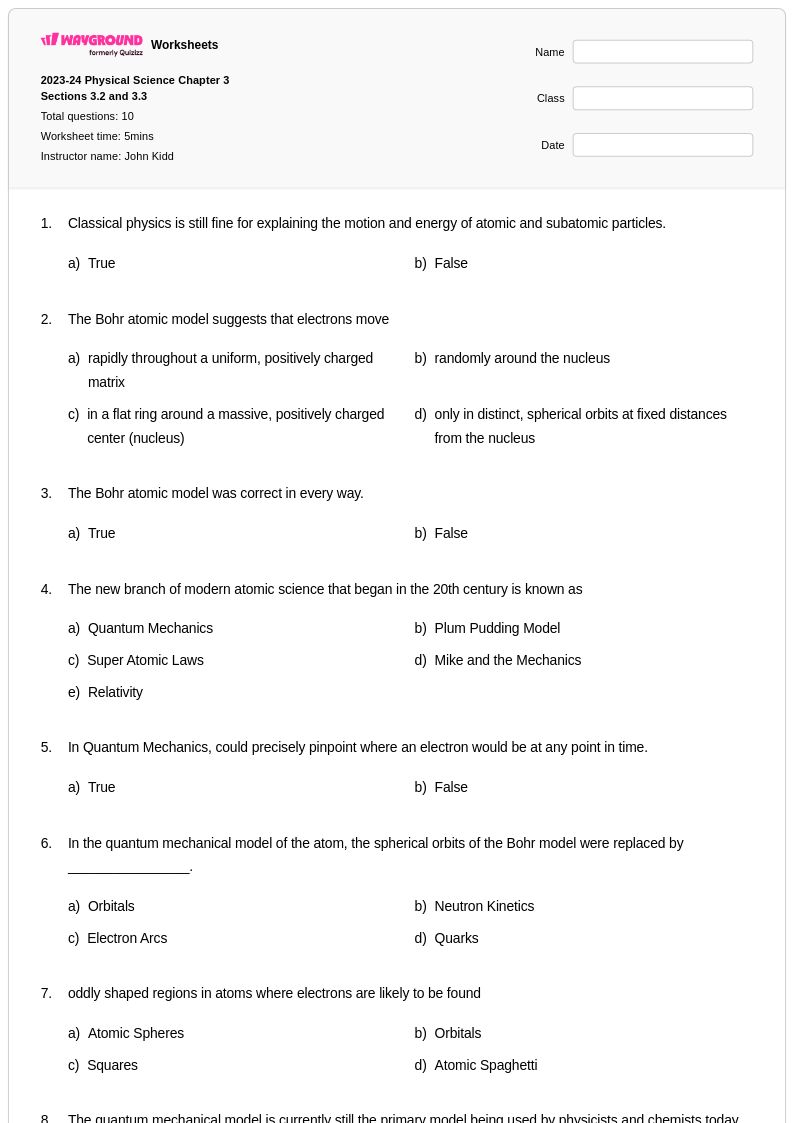
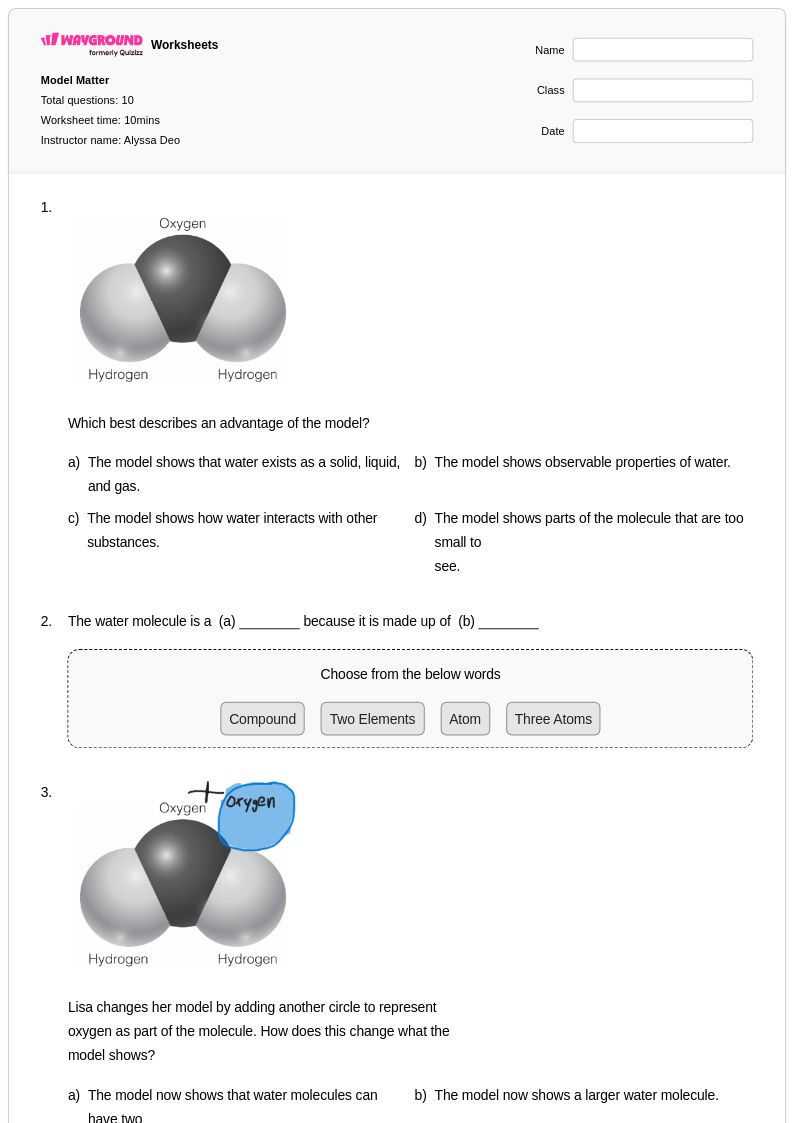
Explore Wayground's comprehensive quantum mechanics worksheets featuring free printables and practice problems with answer keys to help students master wave-particle duality, uncertainty principles, and quantum theory fundamentals.
Quantum mechanics worksheets available through Wayground (formerly Quizizz) provide comprehensive coverage of this foundational physics concept, enabling students to master the mathematical principles and theoretical frameworks that govern atomic and subatomic behavior. These expertly designed practice problems strengthen critical analytical skills including wave-particle duality calculations, uncertainty principle applications, quantum state determinations, and probability distribution analysis. Each worksheet collection includes detailed answer keys and step-by-step solutions that guide students through complex quantum phenomena such as electron configurations, orbital mechanics, and energy level transitions. Available as free printables and downloadable pdf resources, these materials offer structured practice opportunities that build conceptual understanding while reinforcing mathematical problem-solving techniques essential for advanced physics study.
Wayground (formerly Quizizz) empowers educators with millions of teacher-created quantum mechanics resources that streamline lesson planning and support differentiated instruction across diverse learning environments. The platform's robust search and filtering capabilities allow teachers to quickly locate materials aligned with specific curriculum standards, whether focusing on introductory quantum concepts or advanced theoretical applications. Customization tools enable instructors to modify existing worksheets or create tailored assessments that address individual student needs, supporting both remediation efforts for struggling learners and enrichment opportunities for advanced students. These quantum mechanics materials are available in both printable and digital formats, including convenient pdf downloads, ensuring seamless integration into classroom instruction while providing flexible options for homework assignments, laboratory preparation, and targeted skill practice sessions.
FAQs
How do I teach quantum mechanics to high school or introductory college students?
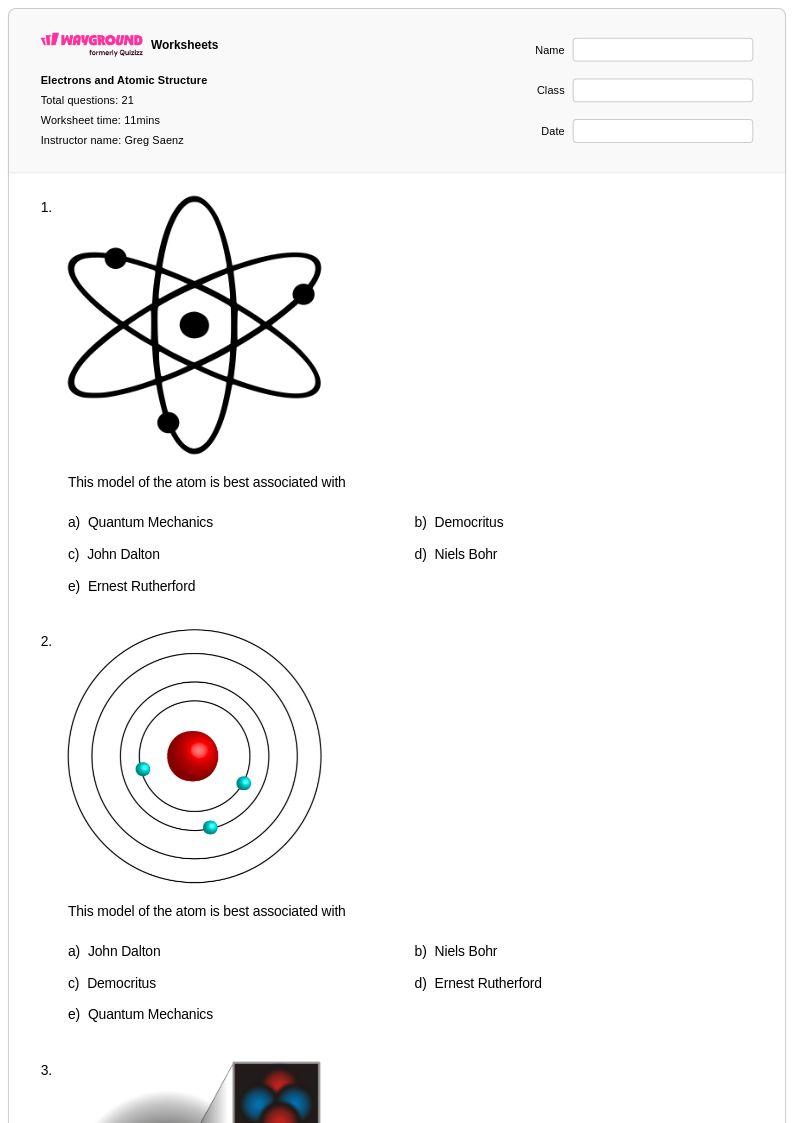
Start with classical physics analogies before introducing quantum concepts — connect wave behavior from sound and light to the wave-particle duality of electrons. Sequence instruction from atomic models (Bohr, then quantum mechanical) through energy quantization, orbital shapes, and the uncertainty principle. Grounding each abstract idea in experimental evidence, such as the photoelectric effect or double-slit experiment, helps students build conceptual scaffolding before engaging with the mathematics.
What exercises help students practice quantum mechanics problem-solving?
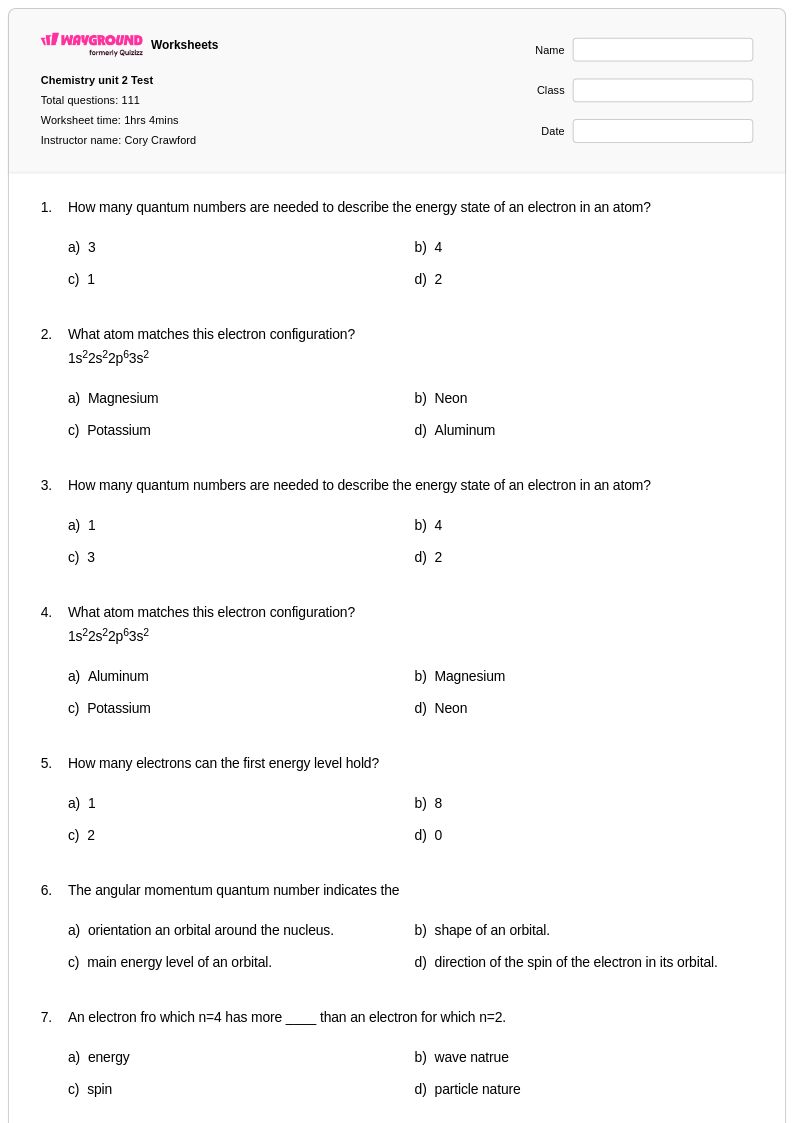
Effective practice problems for quantum mechanics include wave-particle duality calculations (using de Broglie wavelength), Heisenberg uncertainty principle applications, energy level transition problems using the Rydberg formula, and electron configuration exercises using quantum numbers. Problems that require students to determine quantum states or interpret probability distributions are especially useful for reinforcing both conceptual understanding and mathematical fluency.
What mistakes do students commonly make when learning quantum mechanics?
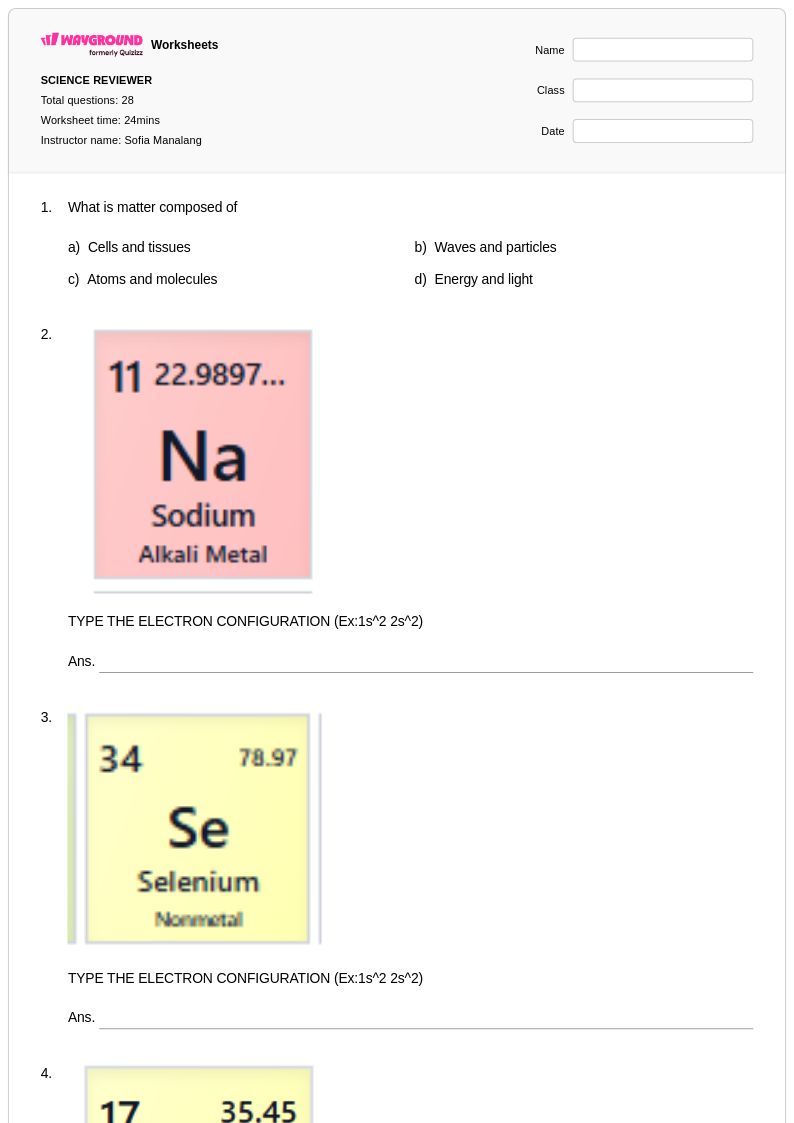
Students frequently conflate classical particle behavior with quantum behavior, assuming electrons follow defined orbital paths rather than existing as probability distributions. A common error in uncertainty principle problems is treating the inequality as an equation and solving for exact values. Students also mix up the four quantum numbers — particularly confusing the magnetic quantum number range with the azimuthal quantum number — leading to incorrect electron configuration assignments.
How do I differentiate quantum mechanics instruction for students at different levels?
For struggling students, focus on conceptual understanding before introducing mathematical formalism — use visual representations of orbital shapes and energy diagrams before assigning calculation problems. For advanced students, extend practice to multi-electron systems, spin-orbit coupling, or introductory quantum mechanics applications in spectroscopy. On Wayground, teachers can apply accommodations such as read aloud support, reduced answer choices, and extended time on a per-student basis, so each learner engages with the material at an appropriate level of challenge.
How can I use Wayground's quantum mechanics worksheets in my classroom?
Wayground's quantum mechanics worksheets are available as printable PDFs for traditional classroom and lab use, as well as in digital formats for technology-integrated learning environments. Teachers can assign them as homework, use them for targeted skill practice, or host them as interactive quizzes directly on the Wayground platform. Each worksheet includes detailed answer keys and step-by-step solutions, making them practical for independent student work, formative assessment, or teacher-led review sessions.
How do I assess student understanding of quantum mechanics concepts?
Effective assessment in quantum mechanics should probe both conceptual understanding and mathematical application. Look for whether students can correctly interpret a probability distribution or identify which quantum numbers are valid for a given electron, not just whether they can reproduce a formula. Common misconceptions — such as treating orbitals as fixed paths or misapplying the uncertainty principle — are reliable indicators of gaps that need targeted re-teaching before students progress to more advanced quantum theory.