Free Printable Rutherford Gold Foil Experiment Worksheets for Class 10
Explore Class 10 Rutherford Gold Foil Experiment worksheets and printables from Wayground that help students master atomic structure concepts through engaging practice problems, free PDFs, and comprehensive answer keys.
Explore printable Rutherford Gold Foil Experiment worksheets for Class 10
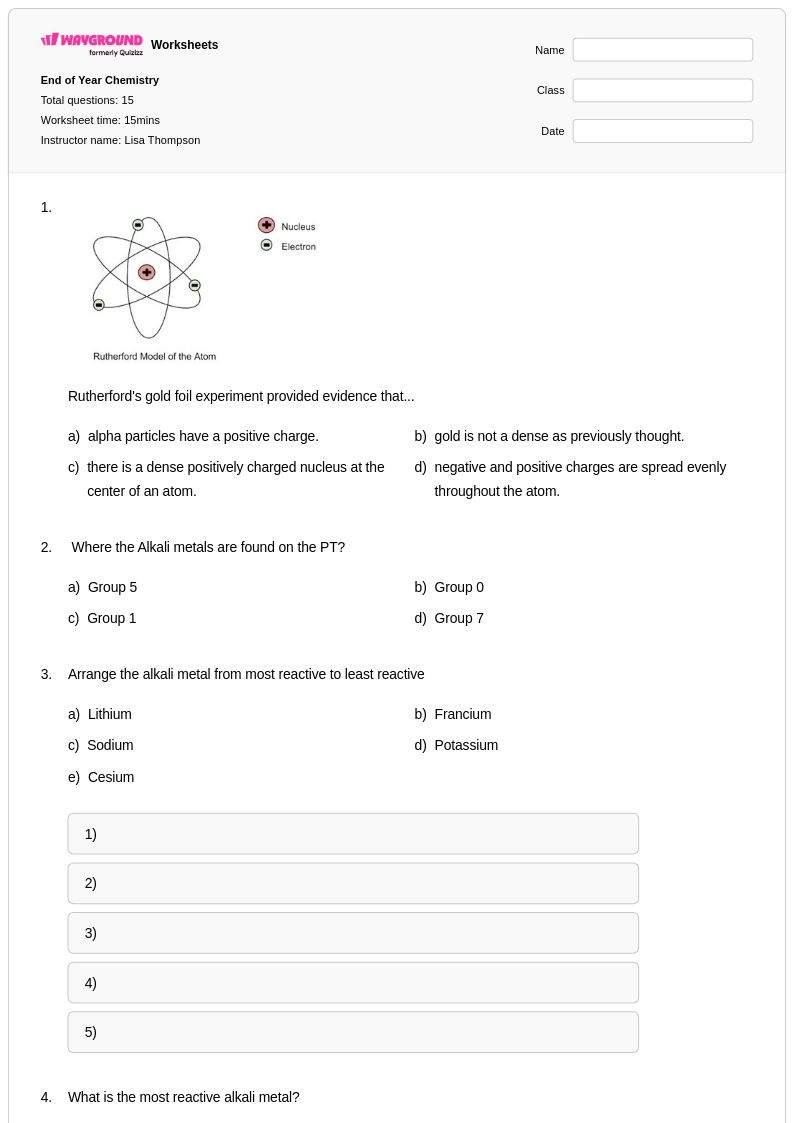
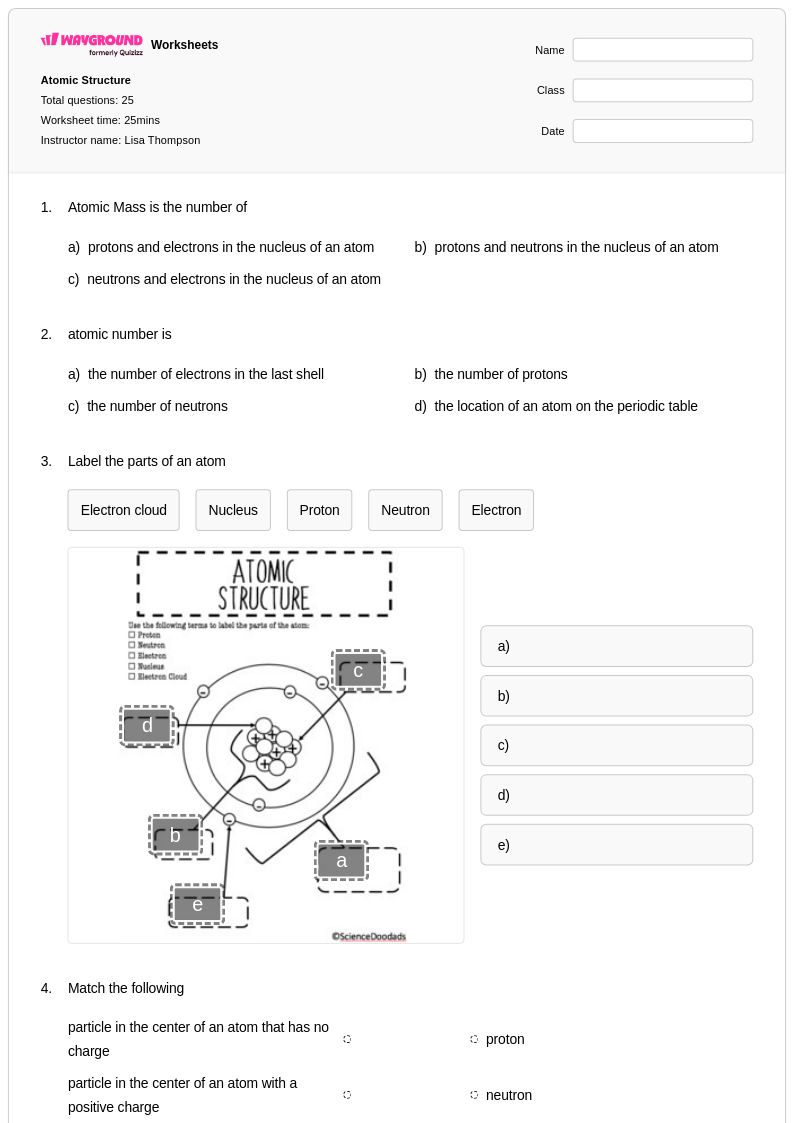
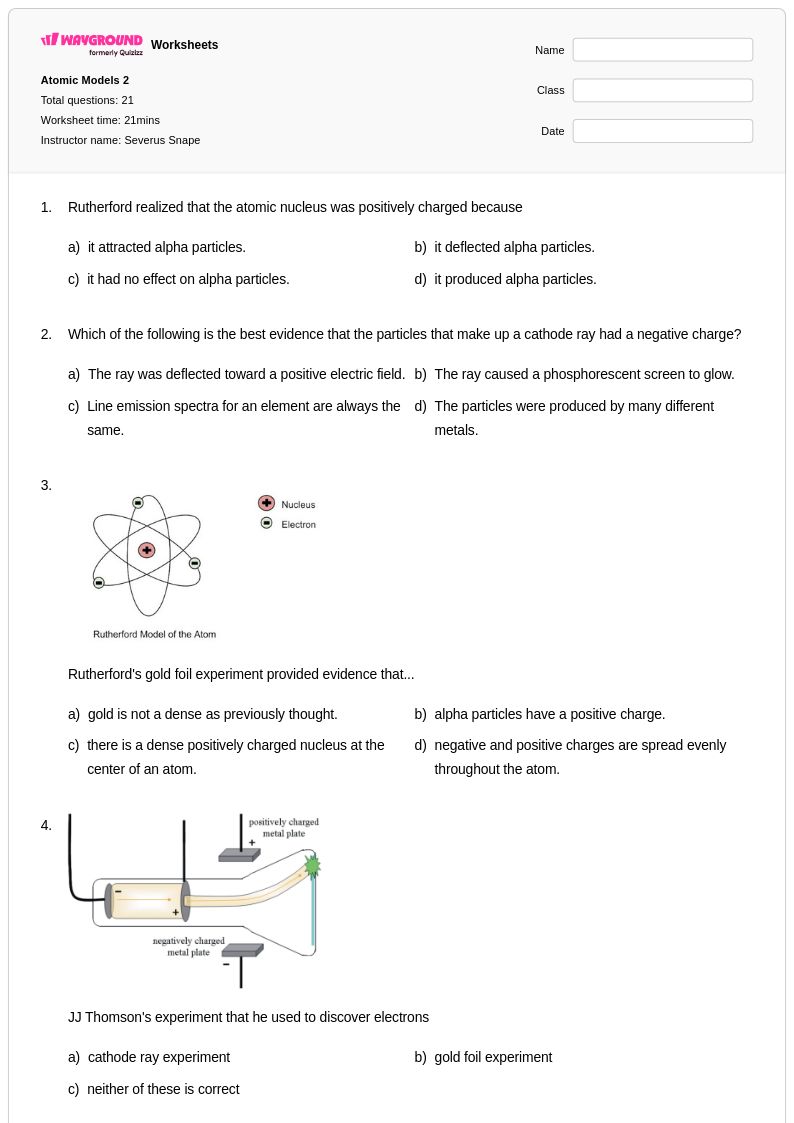
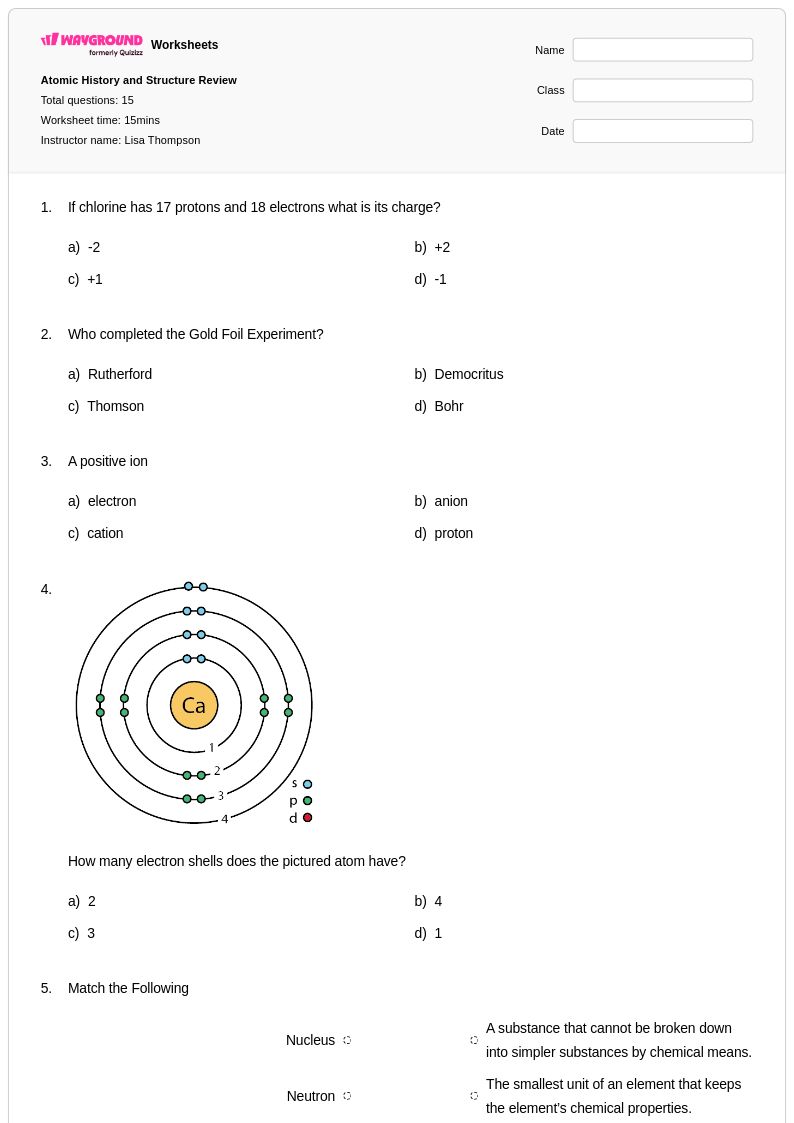
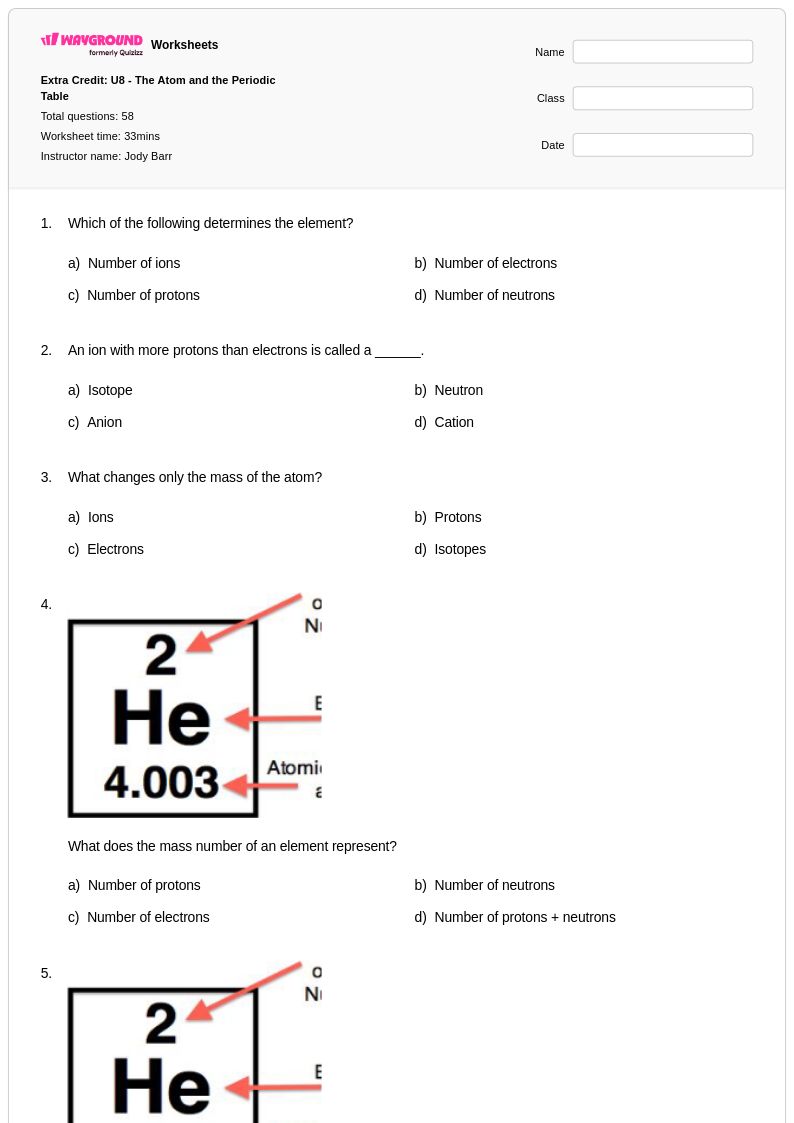
Rutherford Gold Foil Experiment worksheets for Class 10 students available through Wayground (formerly Quizizz) provide comprehensive coverage of this pivotal discovery that revolutionized atomic theory. These expertly designed worksheets guide students through the experimental setup, methodology, and groundbreaking conclusions that led Ernest Rutherford to propose the nuclear model of the atom. Students develop critical thinking skills by analyzing how alpha particle deflection patterns challenged the prevailing plum pudding model, while strengthening their understanding of atomic structure, nuclear density, and the scientific method. The collection includes detailed practice problems that reinforce key concepts, accompanied by comprehensive answer keys that support both independent study and classroom instruction. Available as free printables in convenient pdf format, these worksheets emphasize quantitative analysis of experimental data and help students master the mathematical relationships governing particle interactions.
Wayground (formerly Quizizz) empowers educators with millions of teacher-created resources specifically designed for Rutherford Gold Foil Experiment instruction at the Class 10 level. The platform's robust search and filtering capabilities allow teachers to quickly locate worksheets aligned with specific curriculum standards, while differentiation tools enable seamless customization for diverse learning needs and skill levels. These resources are available in both printable pdf format for traditional classroom use and digital formats for interactive learning experiences, providing maximum flexibility for lesson planning and implementation. Teachers can effectively utilize these worksheets for targeted remediation of atomic theory concepts, enrichment activities for advanced students, and systematic skill practice that bridges historical scientific discoveries with modern understanding of atomic structure, ultimately supporting comprehensive chemistry education across varied instructional contexts.
FAQs
How do I teach the Rutherford Gold Foil Experiment to my students?
Start by establishing what scientists believed about atomic structure before 1909, specifically Thomson's plum pudding model, so students understand what Rutherford's experiment was designed to test. Walk students through the experimental setup: alpha particles fired at a thin gold foil sheet, with a detector screen surrounding it. The key teaching moment is the unexpected result — most particles passed straight through, but a small fraction deflected at large angles, and some even bounced back. This evidence led Rutherford to conclude that atoms contain a small, dense, positively charged nucleus rather than a diffuse distribution of positive charge.
What are common student misconceptions about the Rutherford Gold Foil Experiment?
A frequent misconception is that most alpha particles were deflected, when in reality the vast majority passed straight through the foil with little or no deflection. Students also commonly confuse Rutherford's nuclear model with Bohr's later model, conflating two distinct advances in atomic theory. Another error is misunderstanding why gold was used — gold can be hammered into an extremely thin sheet just a few atoms thick, which was critical for the experiment's design. Addressing these misconceptions directly before assessments significantly reduces persistent errors in student explanations.
What types of practice problems help students understand the Rutherford Gold Foil Experiment?
Effective practice problems ask students to interpret scattering diagrams and predict the path of alpha particles given different nuclear configurations. Problems that require students to explain why specific observations disprove the plum pudding model build analytical reasoning alongside content knowledge. Data analysis tasks — such as calculating the ratio of deflected to undeflected particles and connecting that ratio to the relative size of the nucleus — push students beyond memorization into genuine experimental reasoning. Comparison problems that contrast Thomson's model with Rutherford's model are especially useful for reinforcing why the experimental evidence demanded a new atomic model.
How do I use Rutherford Gold Foil Experiment worksheets in my classroom?
Rutherford Gold Foil Experiment worksheets on Wayground are available as printable PDFs for traditional classroom use and in digital formats for technology-integrated learning environments, including the option to host them as a quiz on Wayground. Printable versions work well for guided note-taking during direct instruction or as structured homework assignments, while digital formats allow for self-paced review or formative assessment. Teachers can also use these worksheets as pre-lab preparation before a simulation activity or as post-lab consolidation to reinforce experimental conclusions.
How does the Rutherford Gold Foil Experiment connect to the broader chemistry curriculum?
The Rutherford Gold Foil Experiment is a foundational event in atomic theory and serves as the conceptual bridge between Thomson's plum pudding model and the modern nuclear model of the atom. It directly supports curriculum standards around atomic structure, the development of scientific models, and the nature of experimental evidence. Understanding this experiment is prerequisite knowledge for later topics including electron configuration, periodic trends, and nuclear chemistry, making it a high-leverage teaching point early in a chemistry course.
How can I differentiate instruction for students who are struggling with atomic structure concepts related to Rutherford's experiment?
For students who are struggling, focus first on the observable evidence before introducing the atomic model conclusions — asking 'What did scientists actually see?' before 'What does it mean?' reduces cognitive overload. Visual representations of particle paths and scattering diagrams are particularly effective for students who have difficulty with abstract spatial reasoning. On Wayground, teachers can apply individual accommodations such as read aloud support and reduced answer choices for students who need them, and these settings are saved and reusable across future sessions without disrupting the experience of other students in the class.