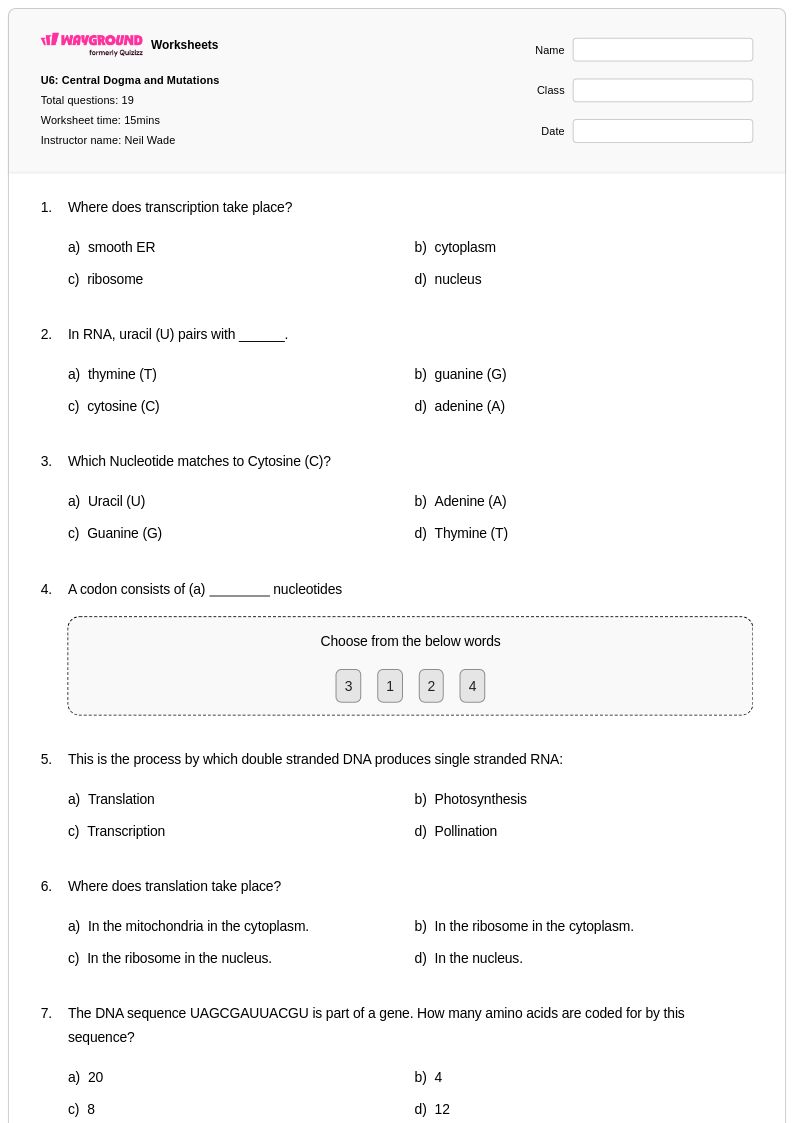
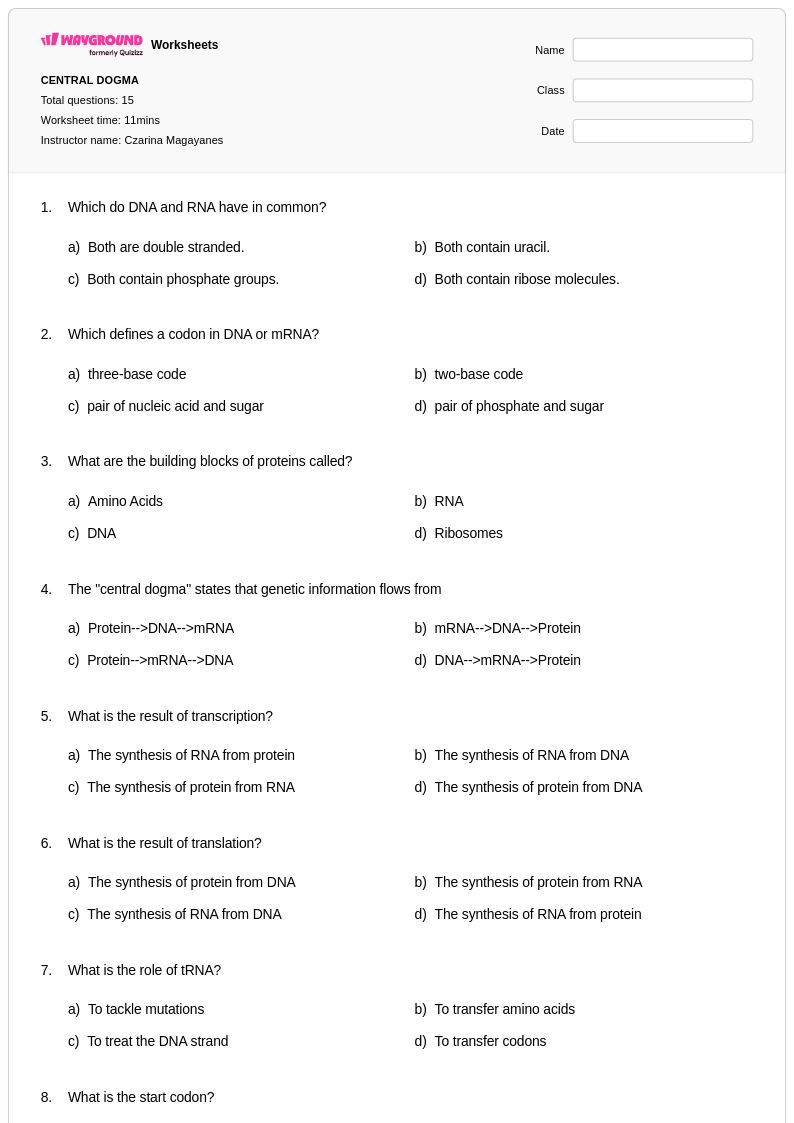
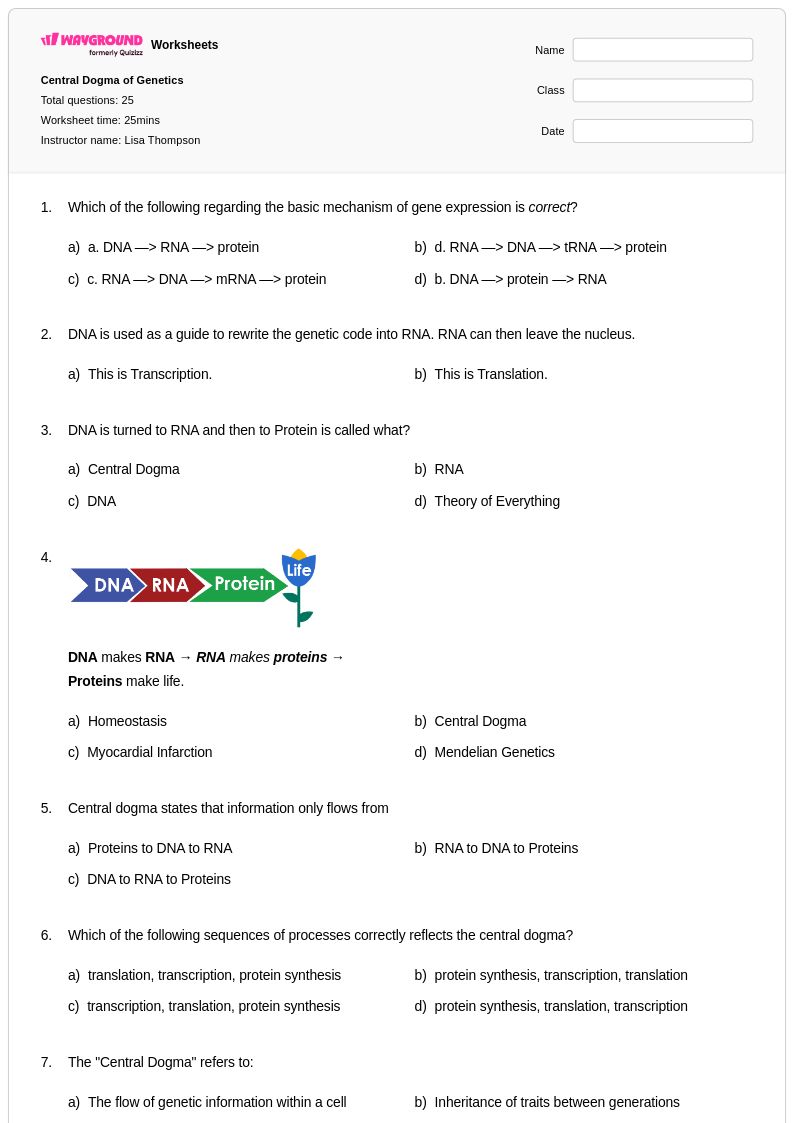
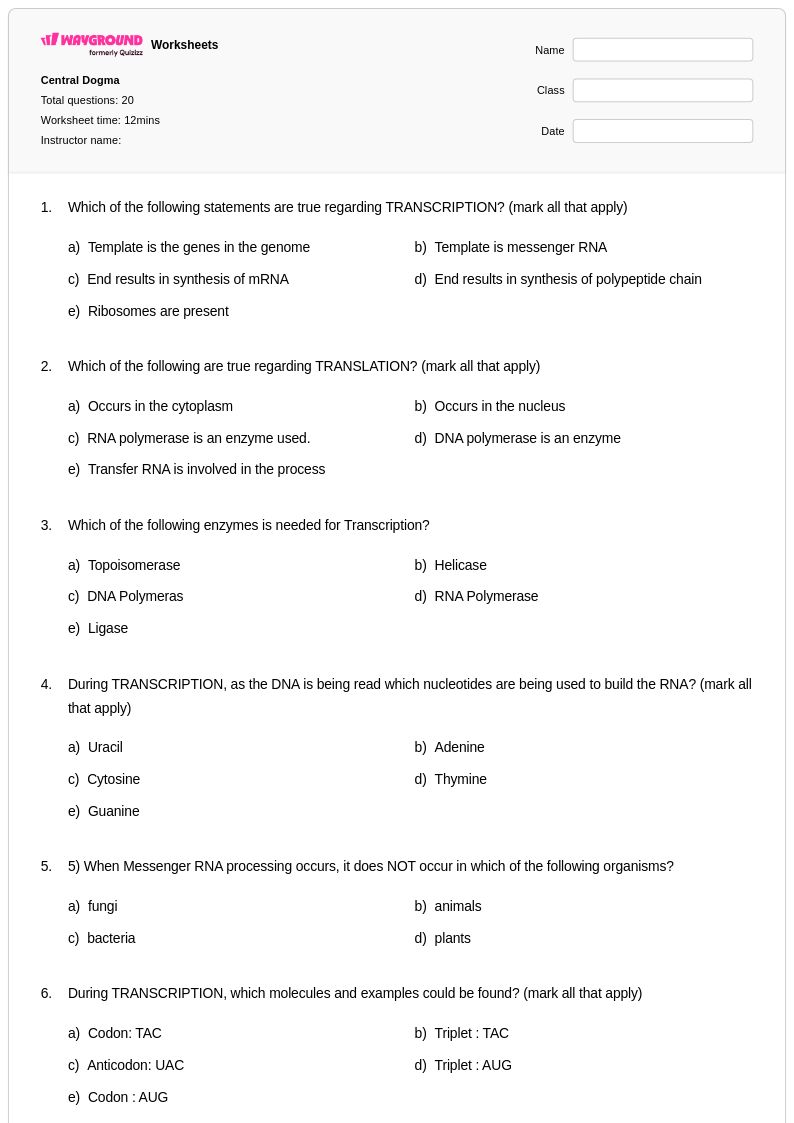
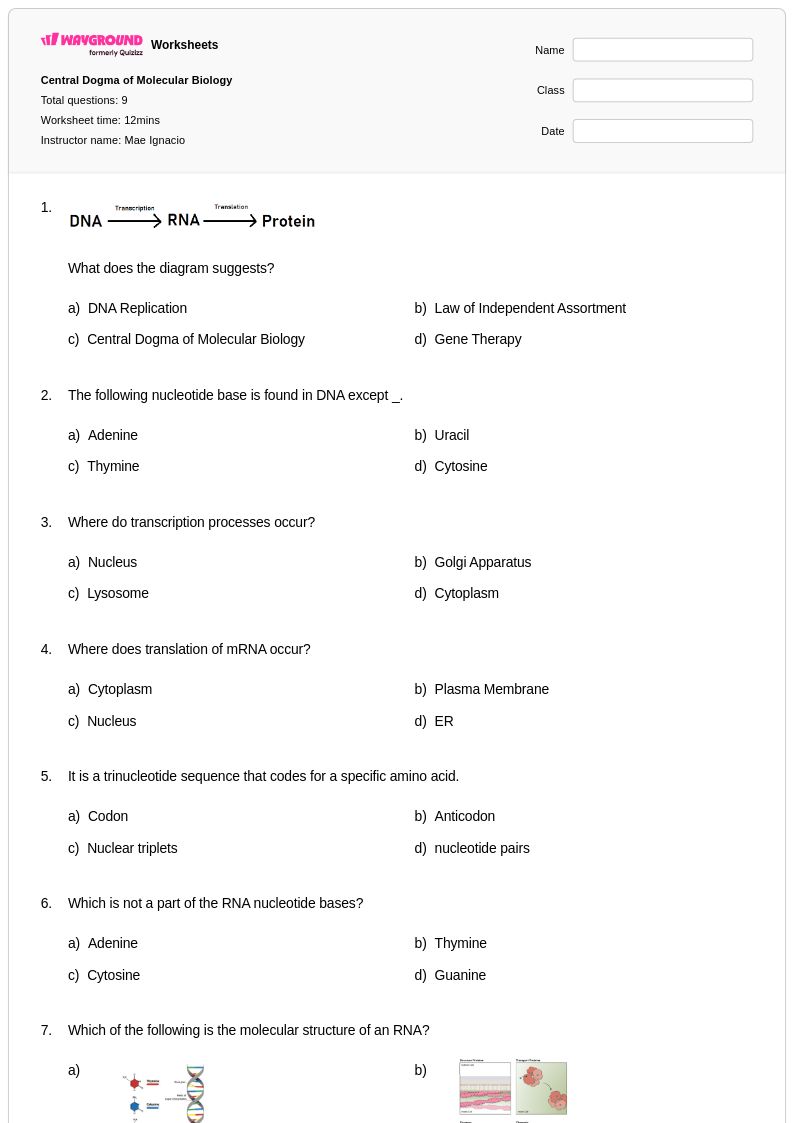
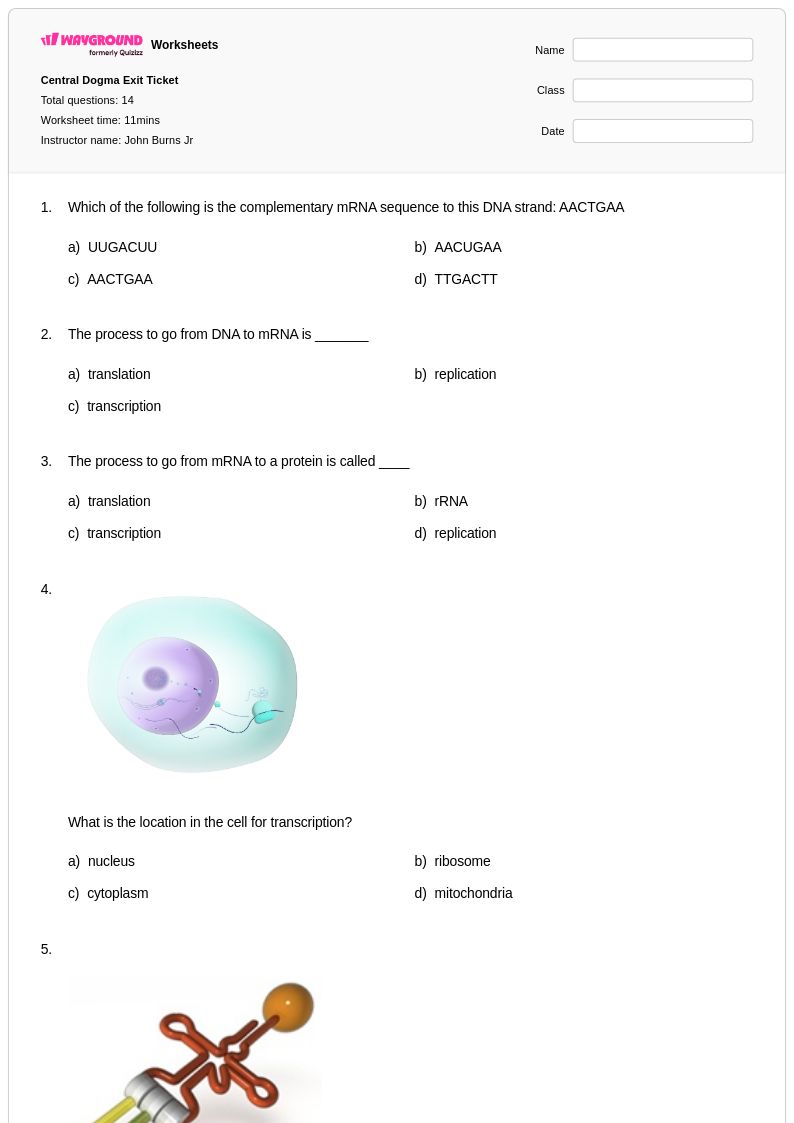
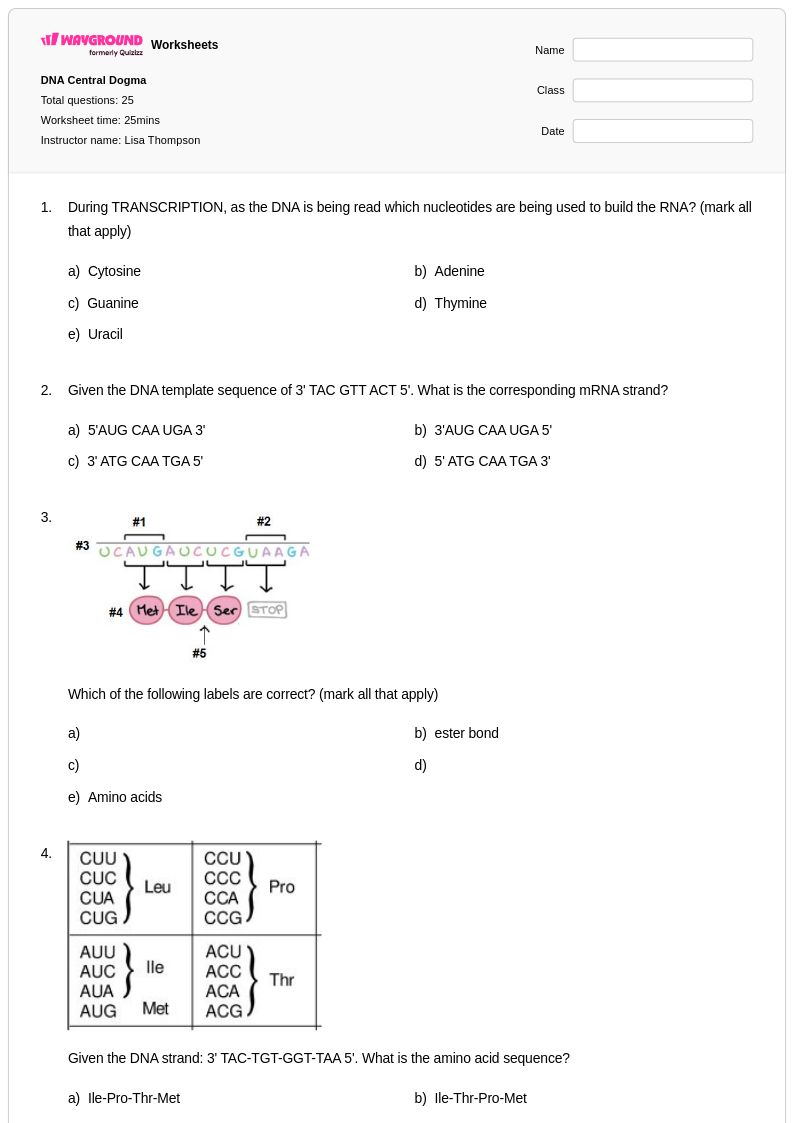
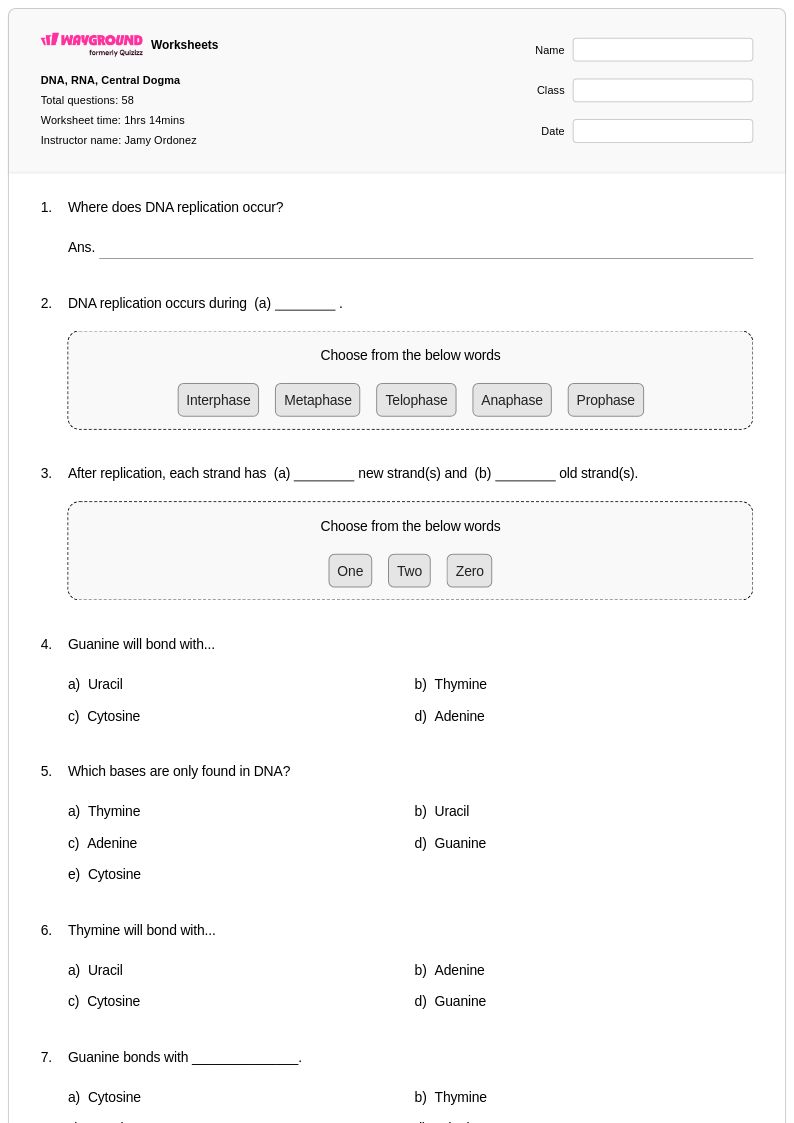
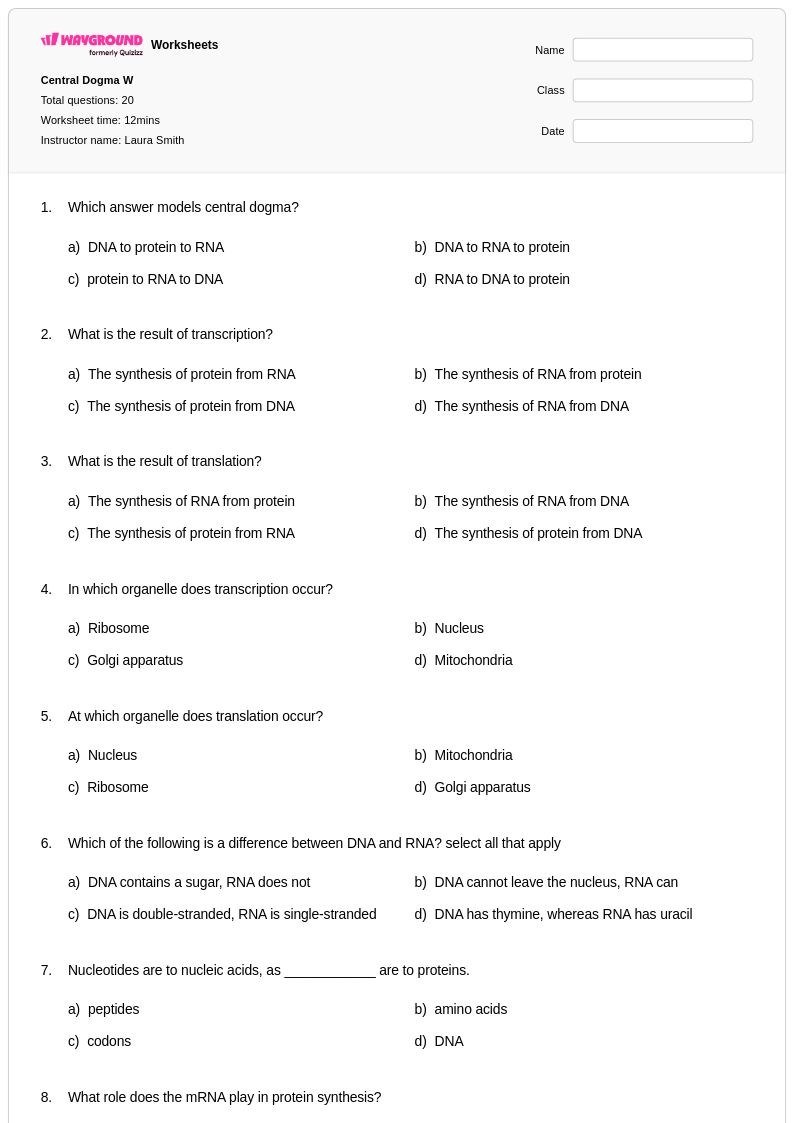
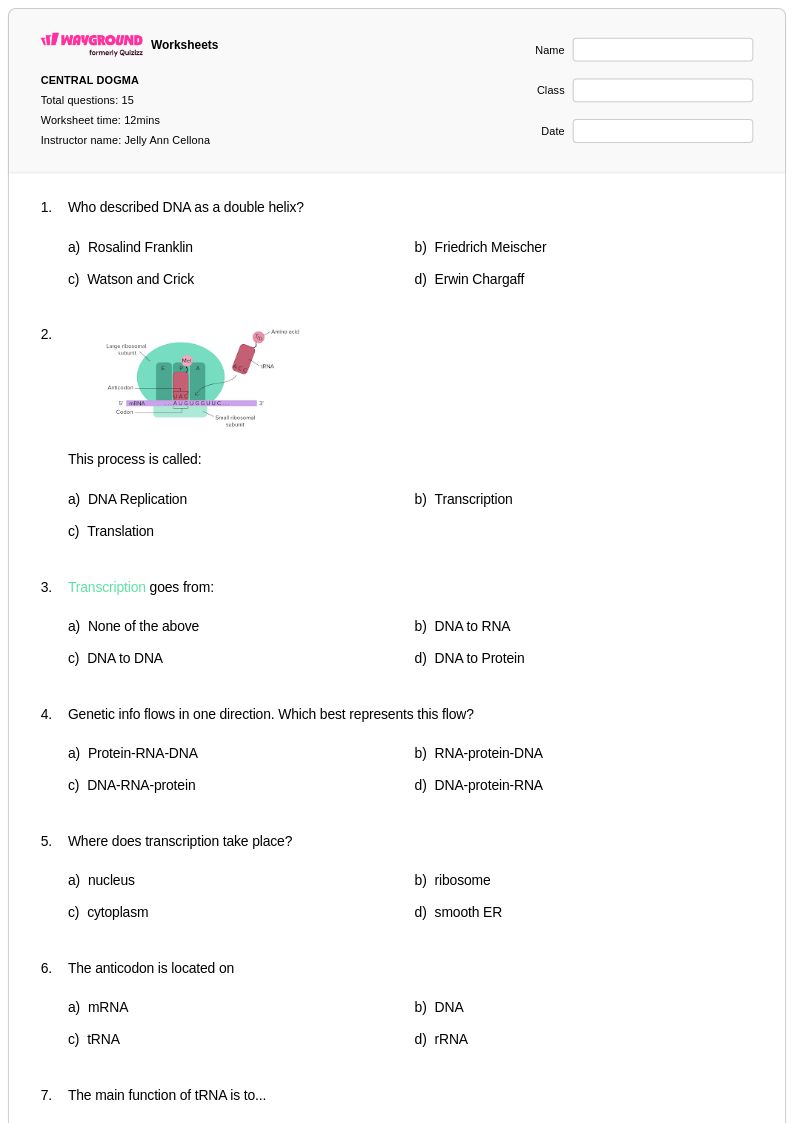
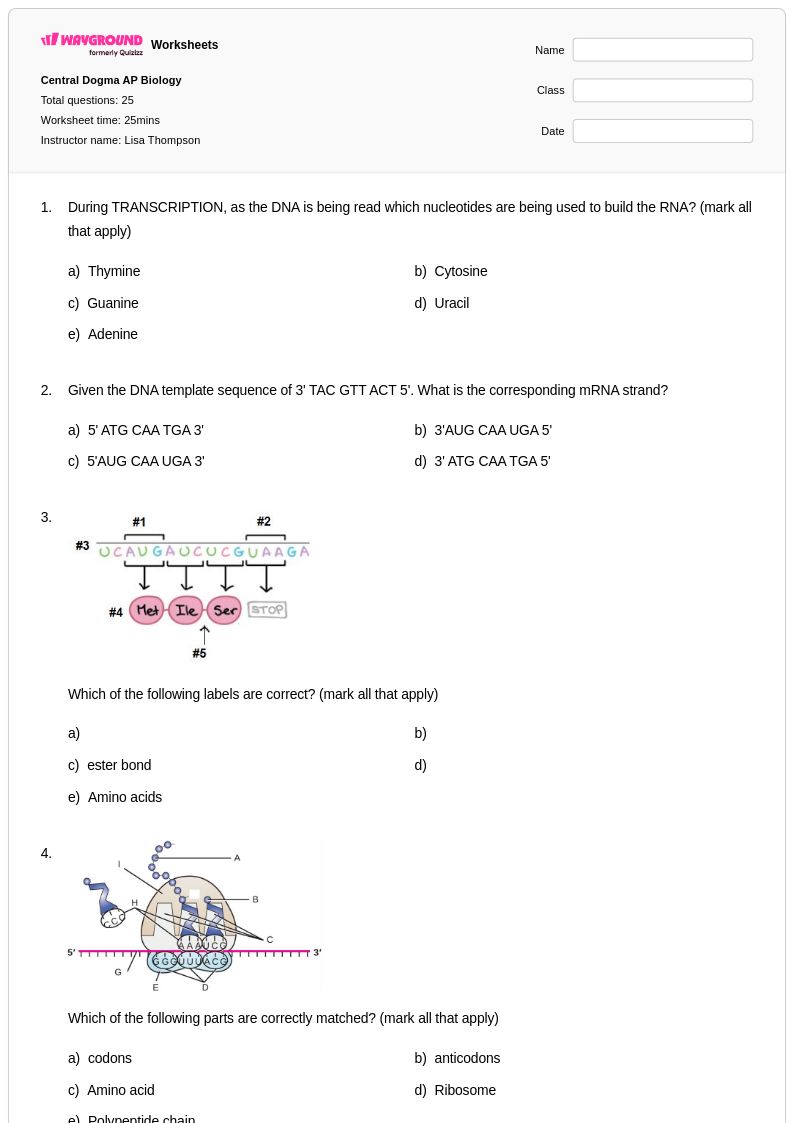
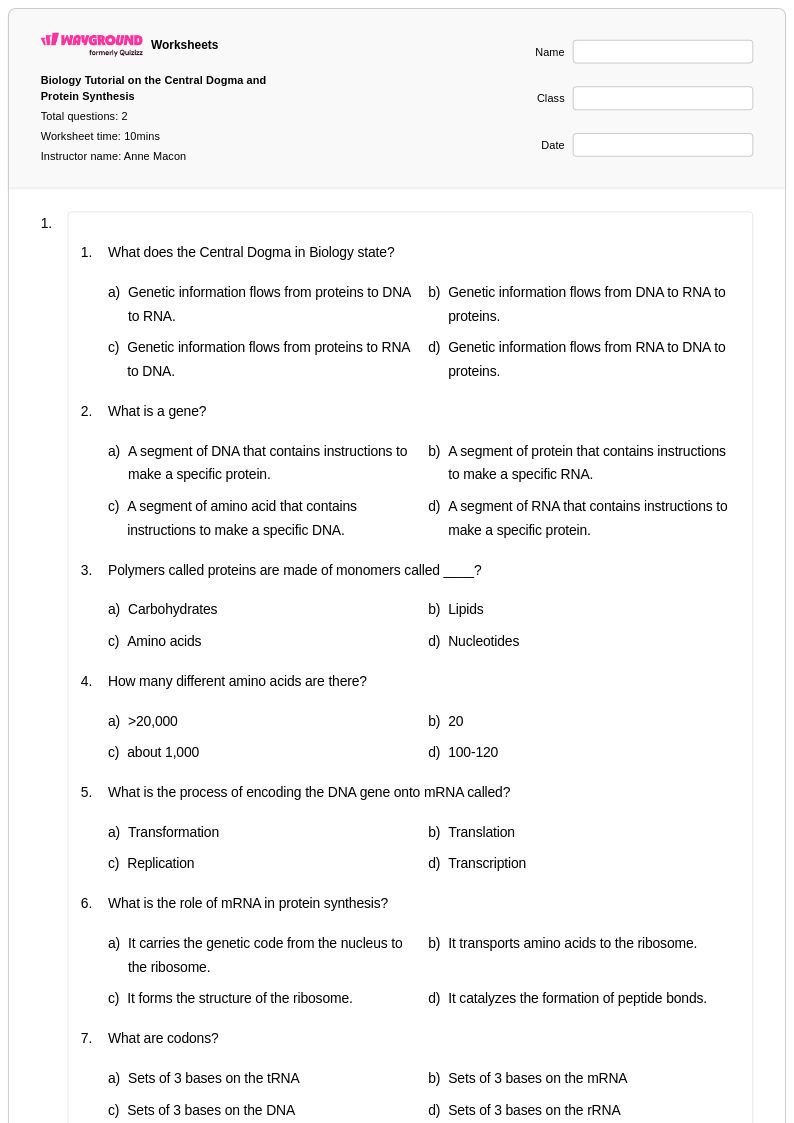
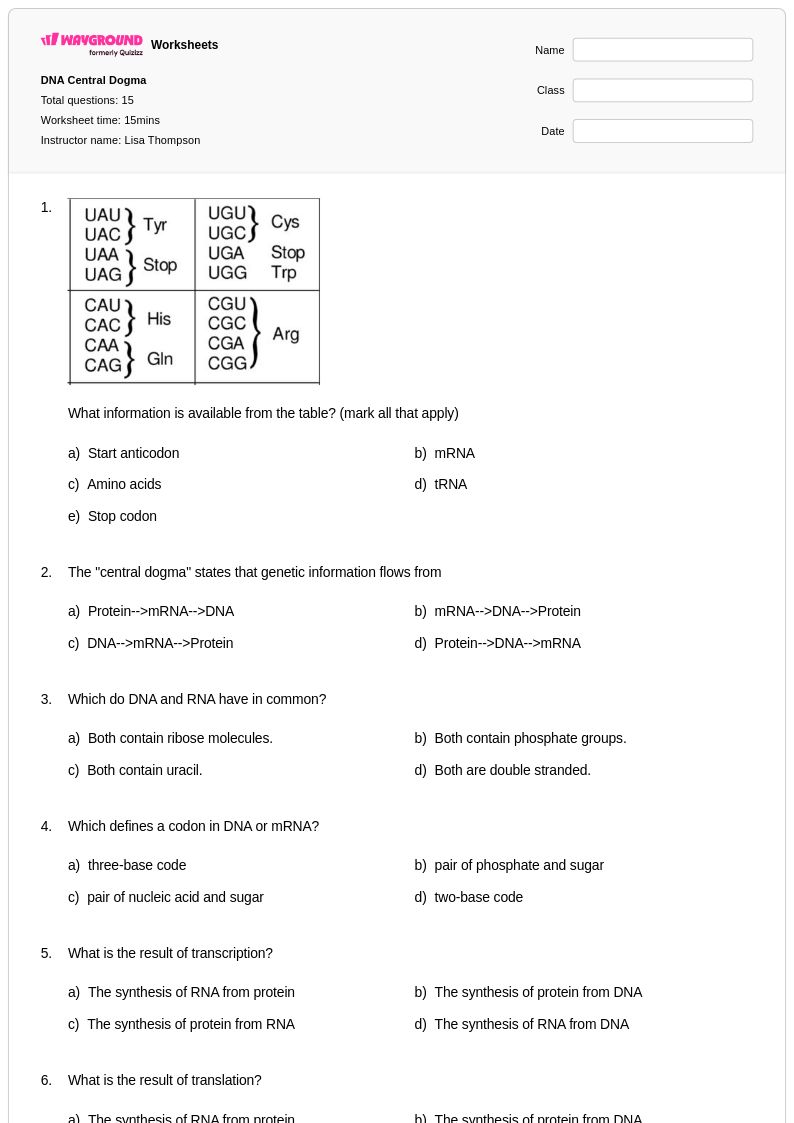
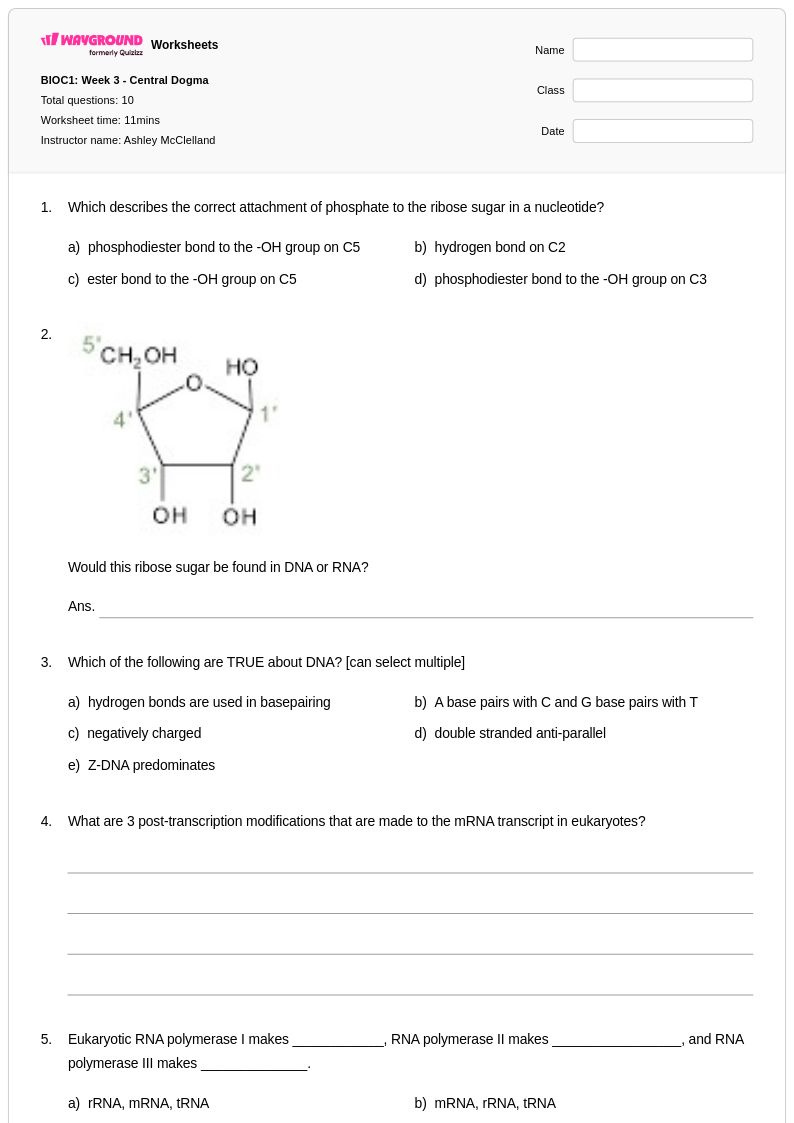
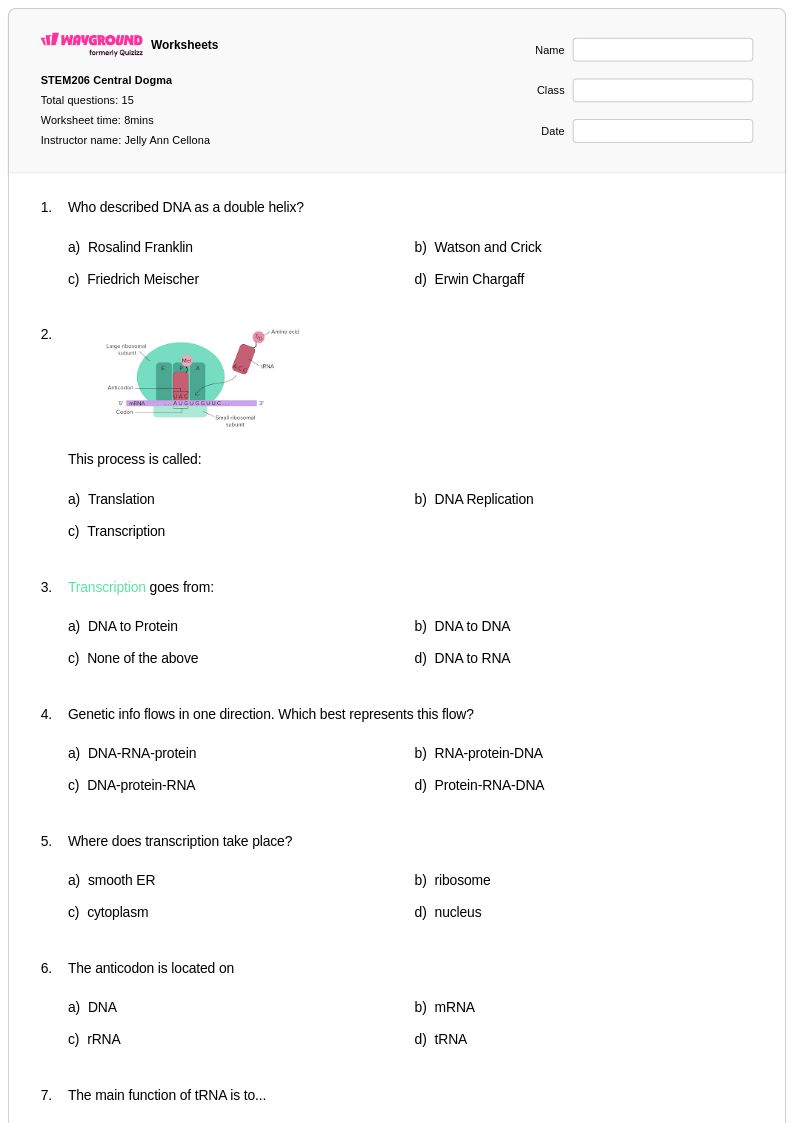
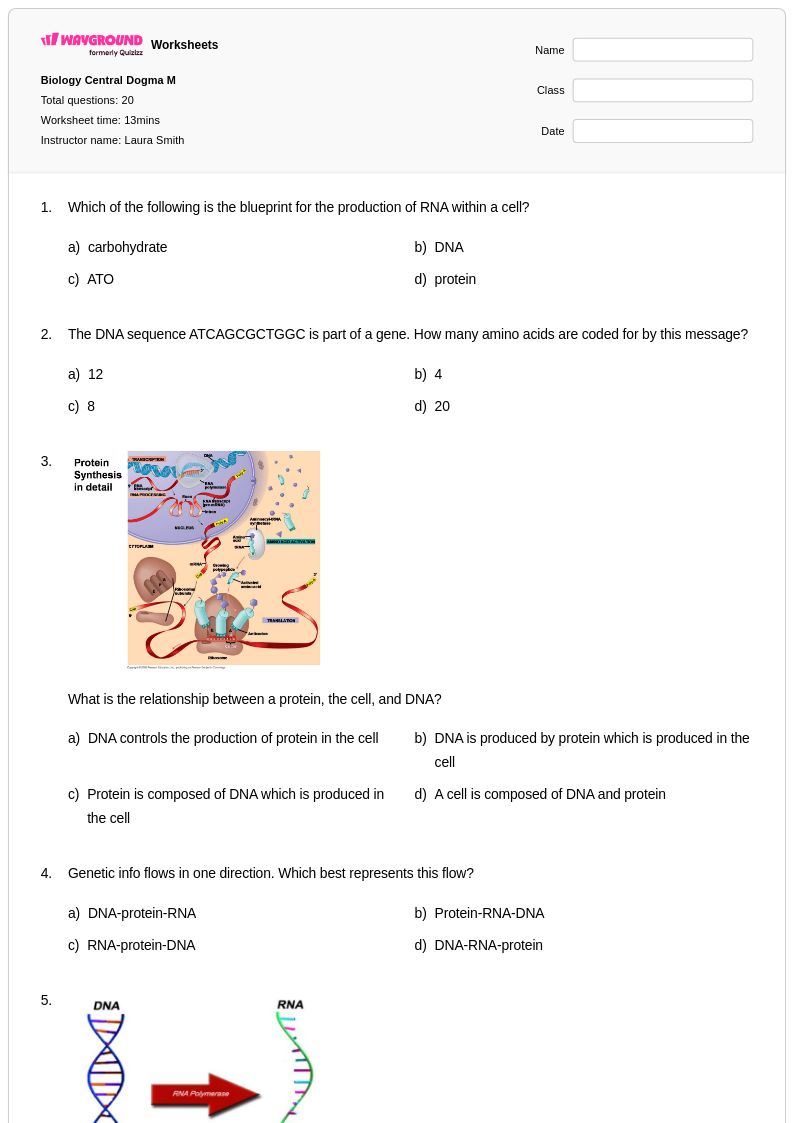
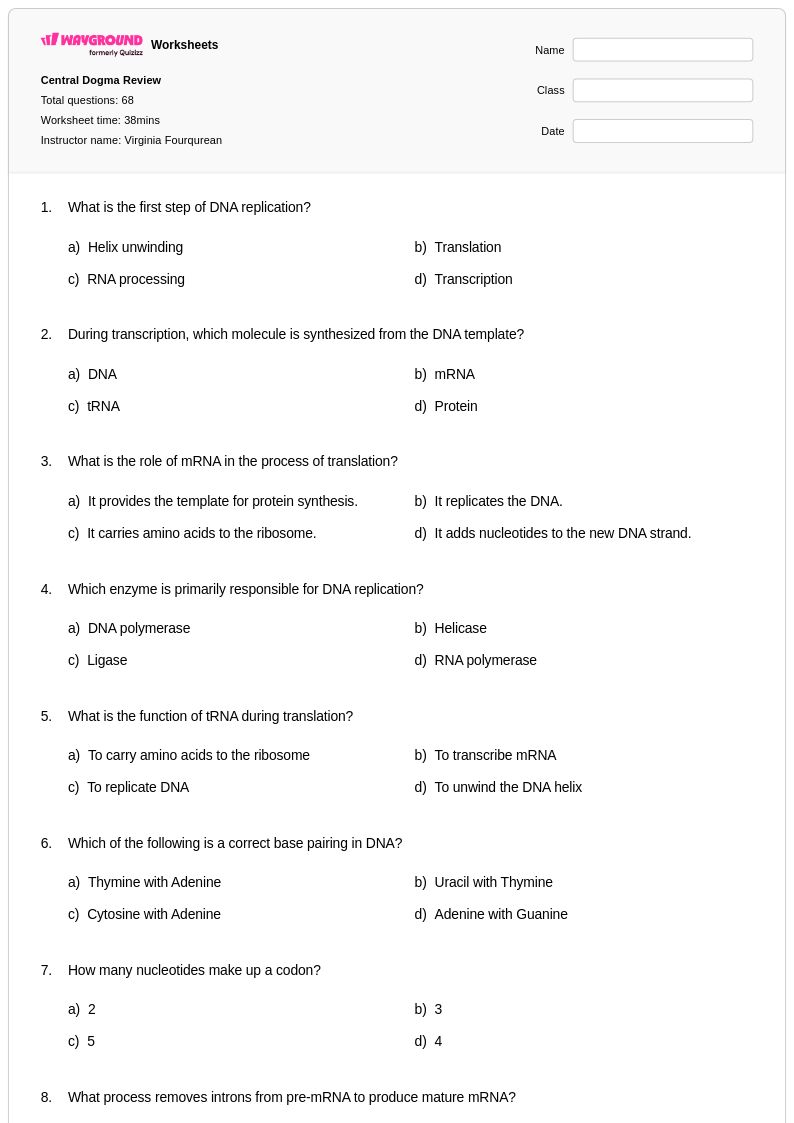
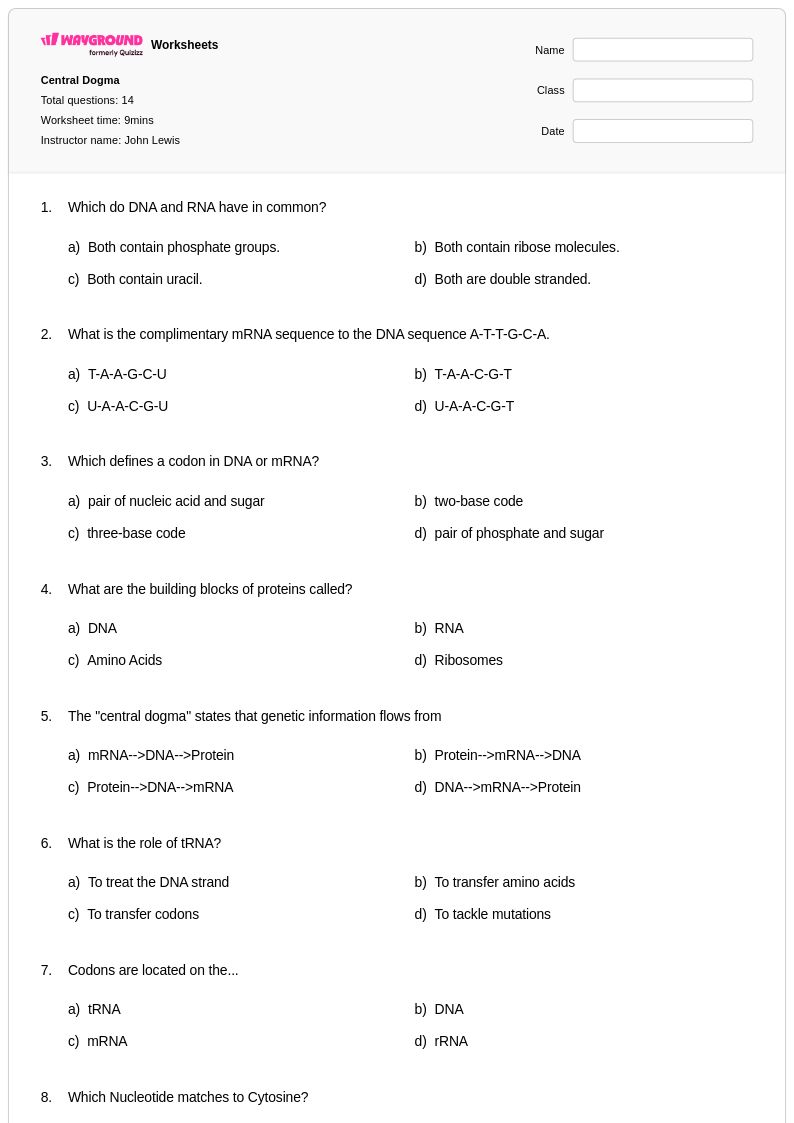
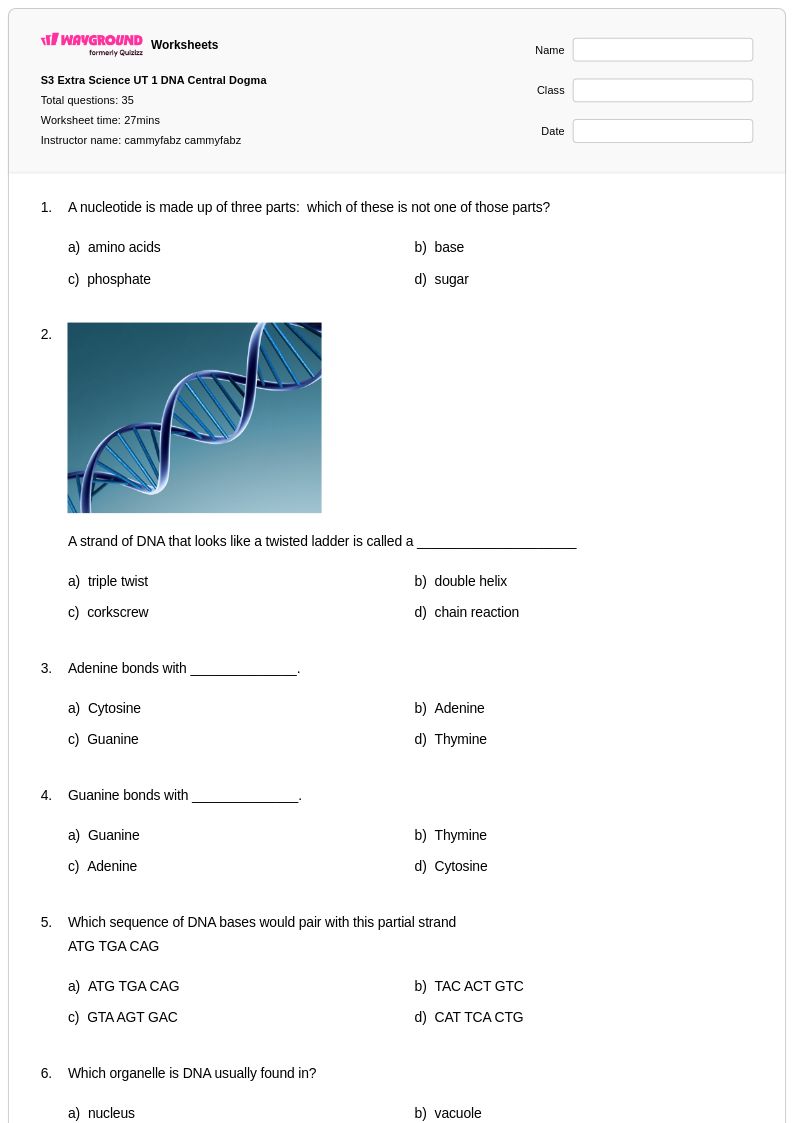
Explore Wayground's free Central Dogma worksheets and printables that help students master DNA transcription, RNA translation, and protein synthesis through engaging practice problems with complete answer keys.
Central dogma worksheets available through Wayground (formerly Quizizz) provide comprehensive coverage of the fundamental principle governing gene expression in molecular biology. These educational resources focus on the flow of genetic information from DNA to RNA to proteins, helping students master the sequential processes of transcription and translation that form the foundation of cellular function. The worksheets strengthen critical analytical skills by guiding learners through complex molecular mechanisms, from understanding DNA replication and mRNA synthesis to exploring ribosomal protein production and genetic code interpretation. Each resource includes detailed answer keys and practice problems designed to reinforce conceptual understanding, with many available as free printables in convenient PDF format for classroom distribution and independent study.
Wayground (formerly Quizizz) empowers educators with millions of teacher-created central dogma resources that streamline lesson planning and enhance molecular biology instruction. The platform's robust search and filtering capabilities allow teachers to quickly locate materials aligned with specific curriculum standards, while differentiation tools enable customization for diverse learning needs and ability levels. These comprehensive worksheet collections are available in both printable and digital formats, including downloadable PDFs that facilitate flexible classroom implementation and remote learning scenarios. Teachers can effectively utilize these resources for targeted skill practice, remediation of challenging concepts like codon recognition and amino acid sequences, and enrichment activities that deepen student understanding of genetic information transfer, ultimately supporting varied instructional approaches and learning objectives in molecular biology education.
FAQs
How do I teach the central dogma of molecular biology?
Start by establishing the directional flow of genetic information: DNA is transcribed into mRNA, which is then translated into a protein. Use a step-by-step approach that separates transcription and translation into distinct lessons before connecting them as a unified process. Visual diagrams showing the nucleus (transcription) versus the ribosome (translation) help students anchor each stage spatially before tackling the molecular details.
What practice problems help students understand DNA transcription and translation?
Effective practice problems include writing complementary mRNA strands from a given DNA template, using a codon chart to identify amino acid sequences, and tracing a complete gene expression pathway from DNA to final protein. Problems that require students to identify errors in a sequence or predict the effect of a point mutation add analytical depth and reinforce conceptual understanding beyond memorization.
What mistakes do students commonly make when learning the central dogma?
The most frequent errors include confusing the template and coding strands of DNA during transcription, forgetting that RNA uses uracil instead of thymine, and misreading codons in the wrong reading frame during translation. Students also commonly conflate transcription and replication, using 'copying DNA' as a catch-all explanation for both. Targeted practice problems that require students to distinguish between these processes by name and mechanism help correct these misconceptions early.
How do I use central dogma worksheets to support different skill levels in my class?
Scaffold worksheets by starting lower-level learners on single-step tasks such as transcription only, then progress to full pathway problems for more advanced students. Wayground supports per-student accommodations including reduced answer choices to lower cognitive load for struggling learners, read-aloud functionality for students who need audio support, and extended time settings for assessments, all of which can be configured individually without alerting other students.
How can I use Wayground's central dogma worksheets in my classroom?
Wayground's central dogma worksheets are available as printable PDFs for traditional classroom distribution and in digital formats for technology-integrated instruction. Teachers can assign them as independent practice, guided group work, or homework, and can host the worksheet as a live quiz on Wayground to collect real-time student responses and review results. Answer keys are included with each resource, reducing preparation time.
How do I assess whether students understand the genetic code and codon recognition?
Codon recognition is best assessed through tasks that require students to use a codon chart independently rather than from memory, translating a given mRNA sequence into an amino acid chain and identifying start and stop codons. Common errors to watch for include reading codons in overlapping frames, skipping the start codon, and not stopping translation at a stop codon. Brief exit tickets with a three-to-four codon sequence give quick insight into individual student accuracy.