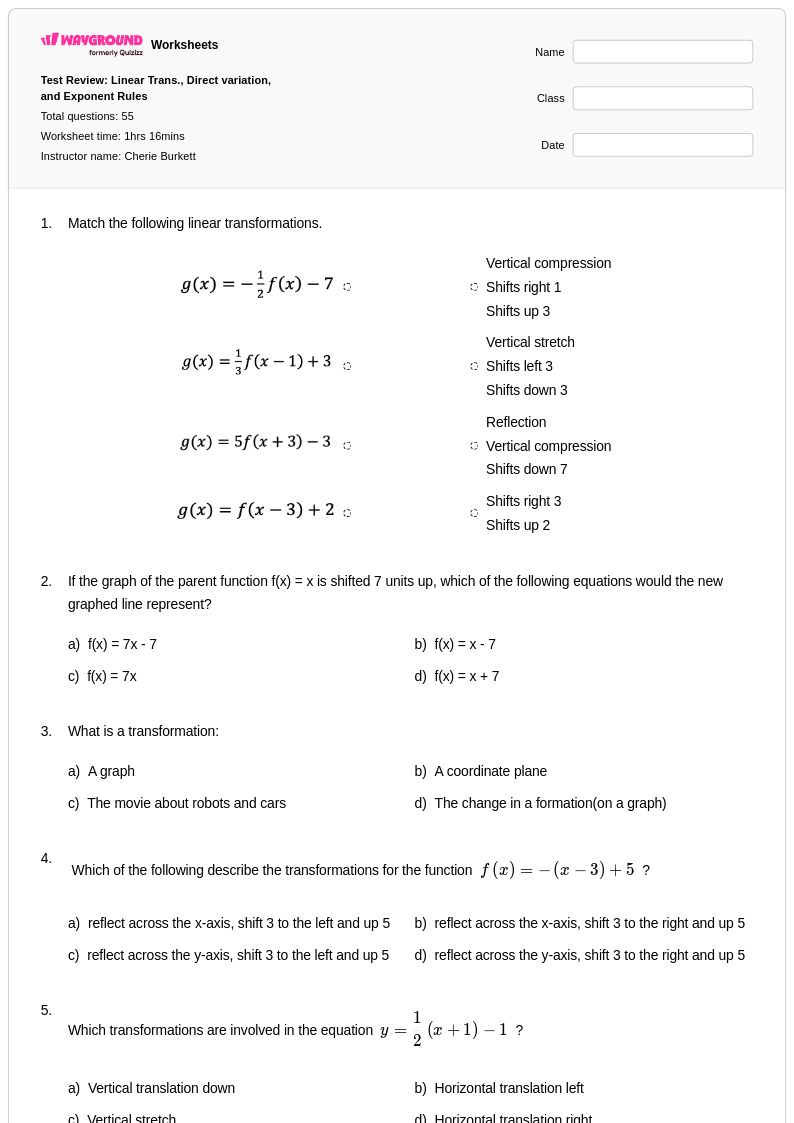
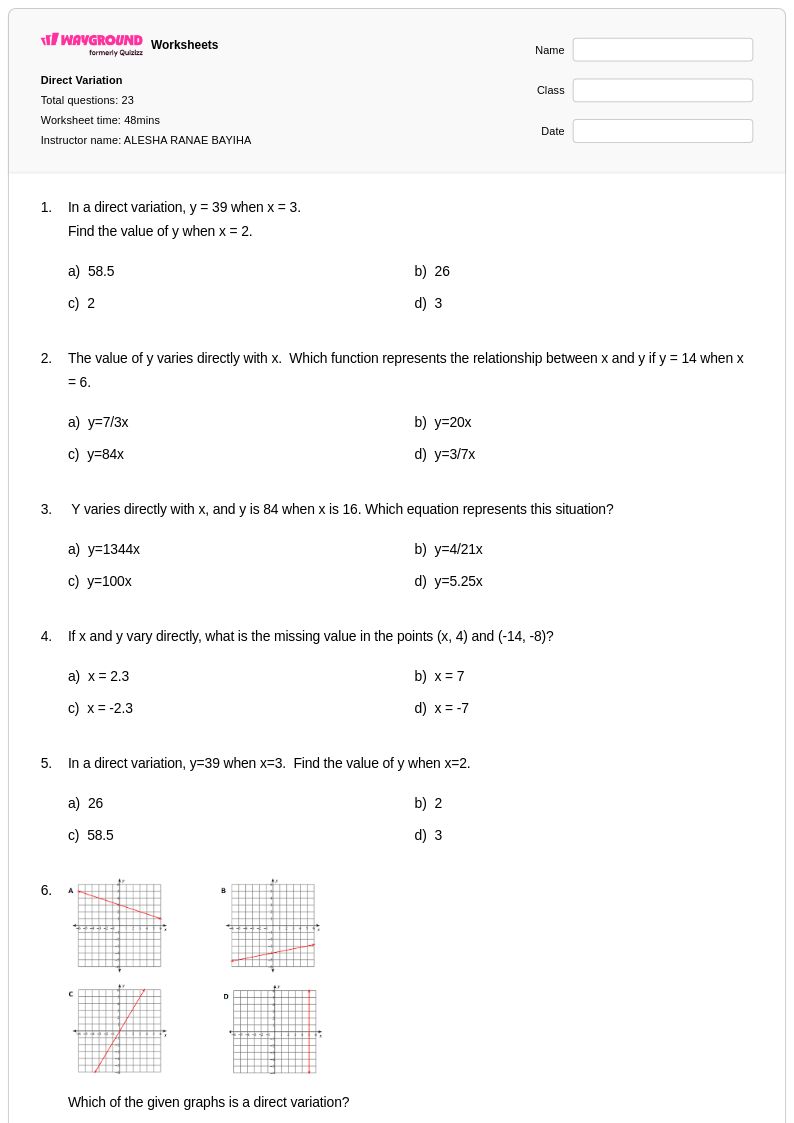
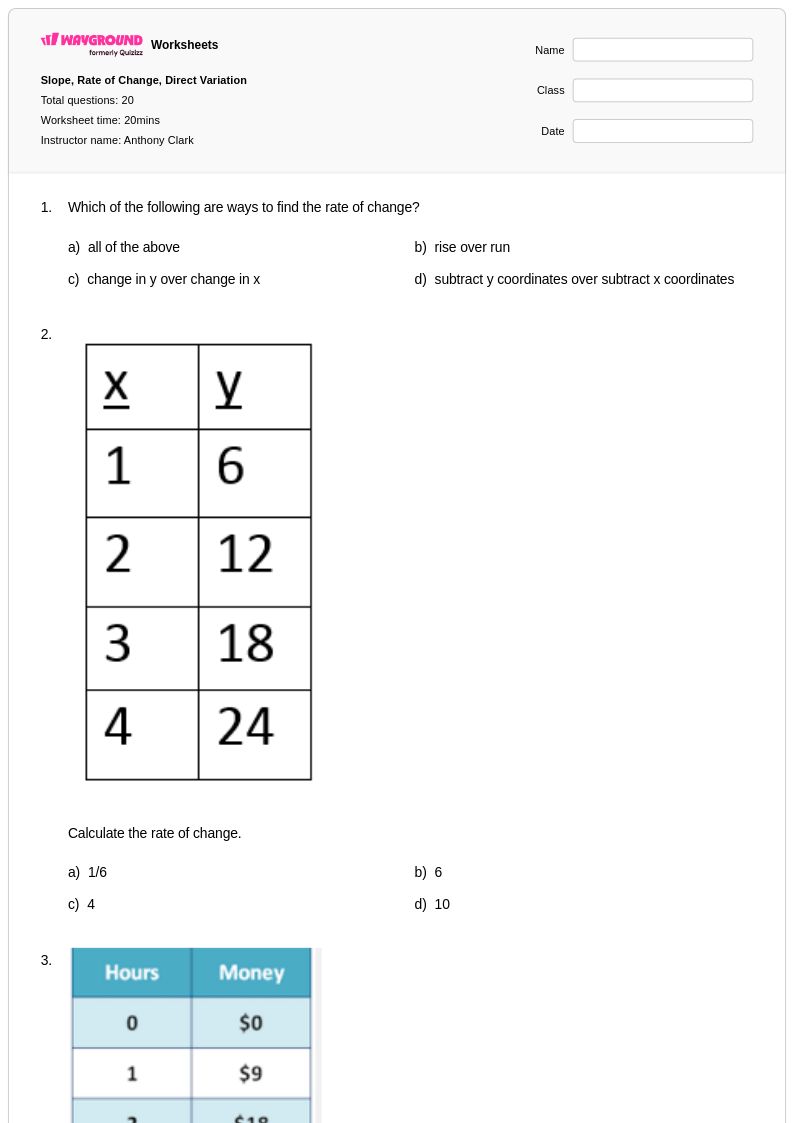
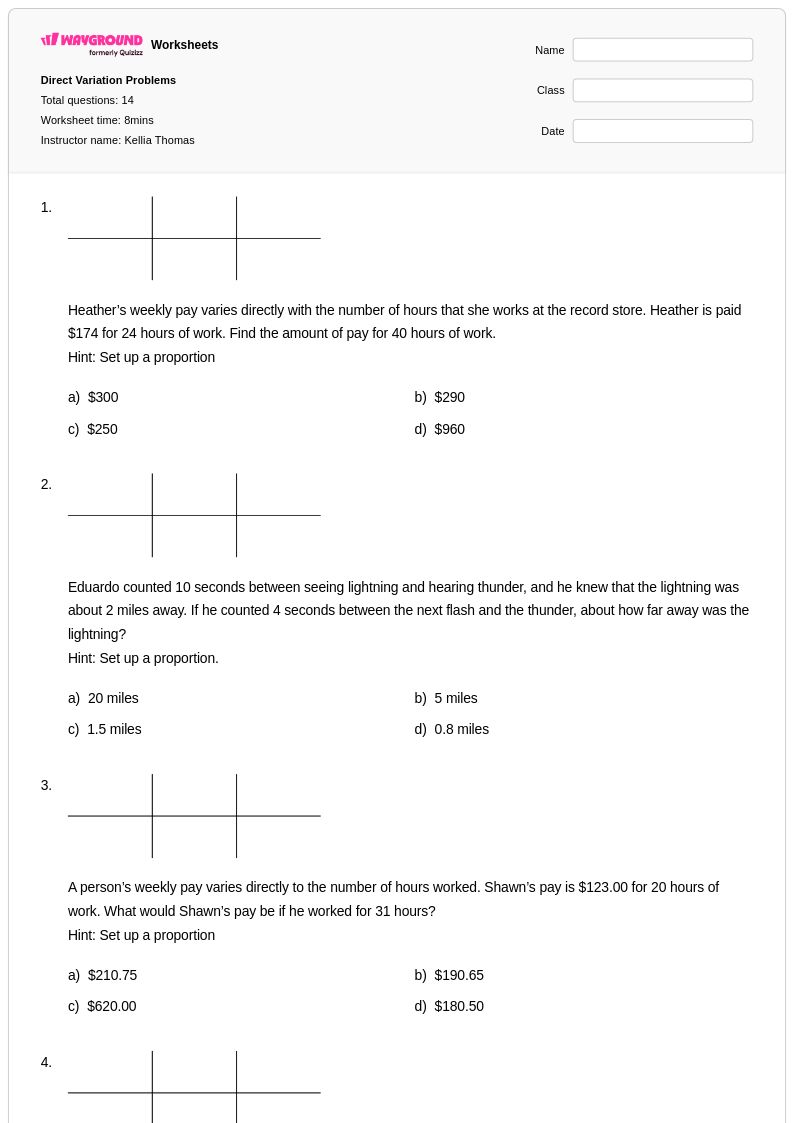
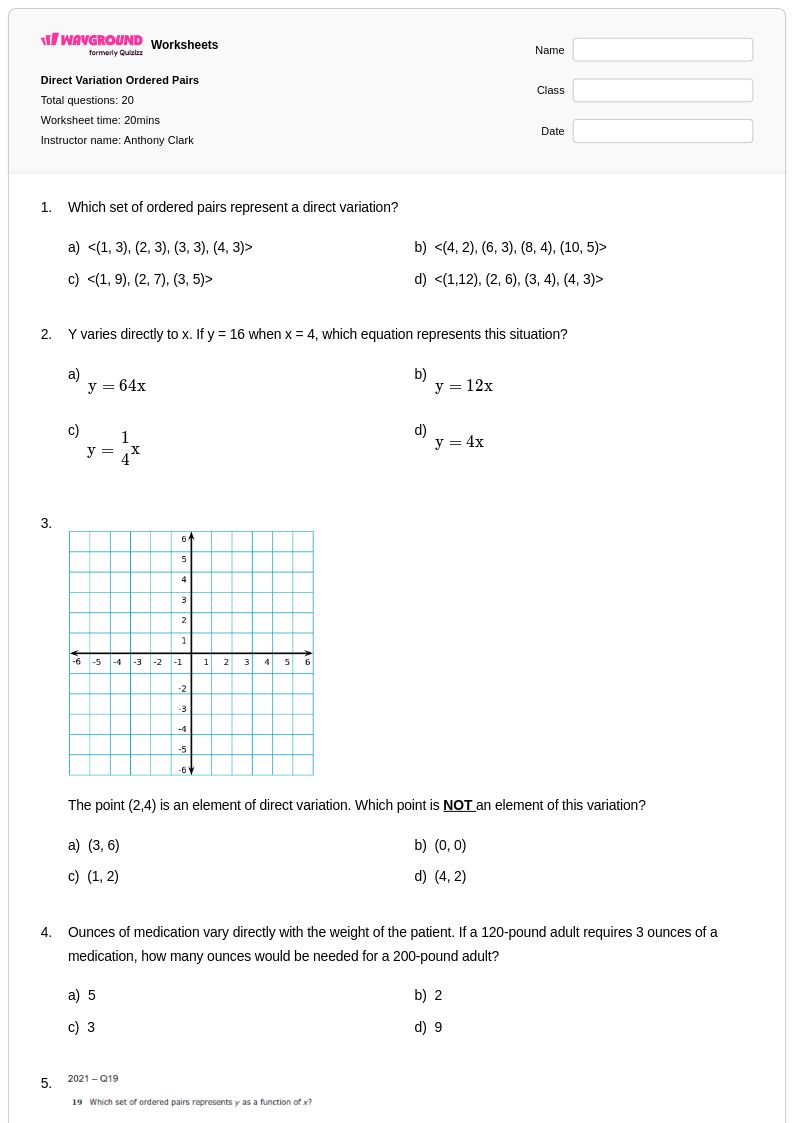
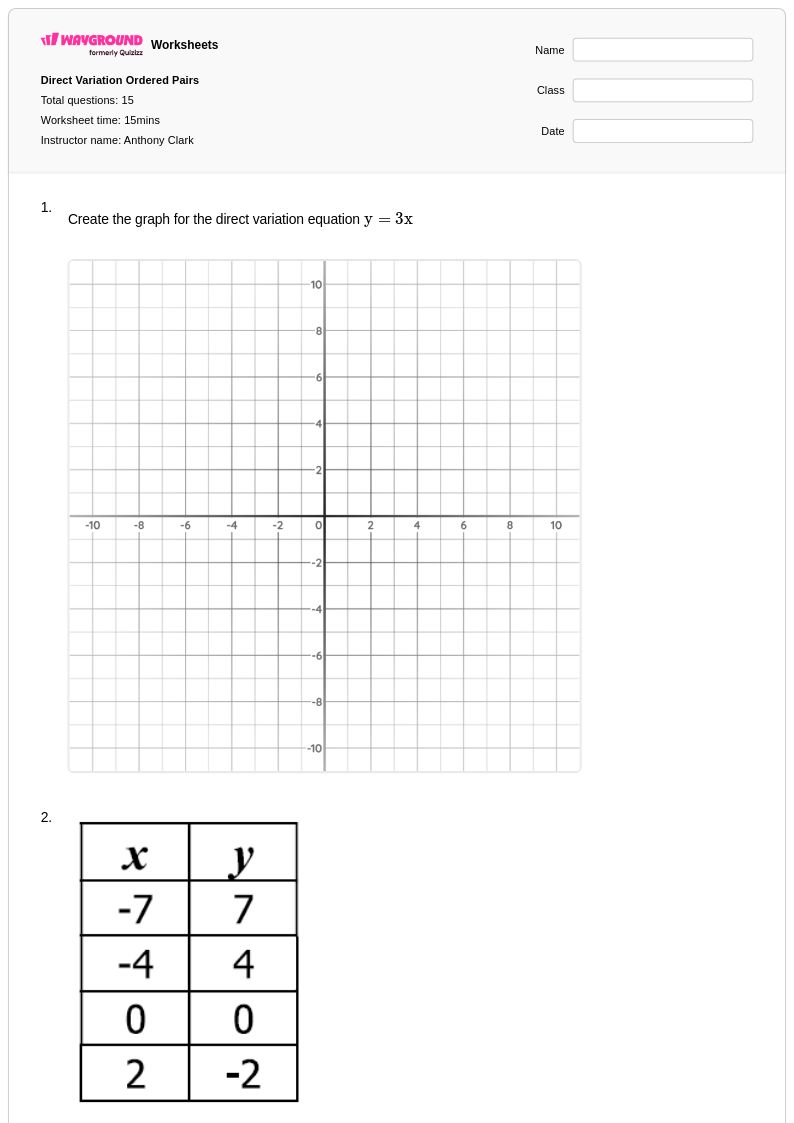
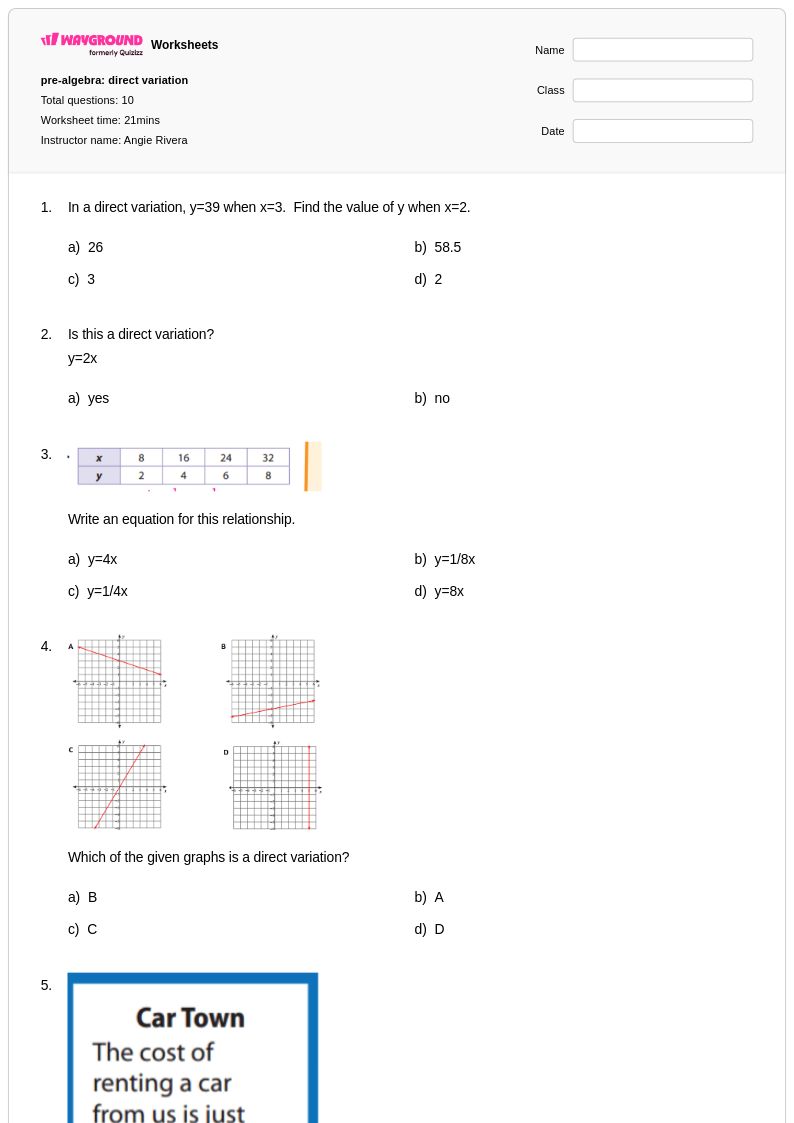
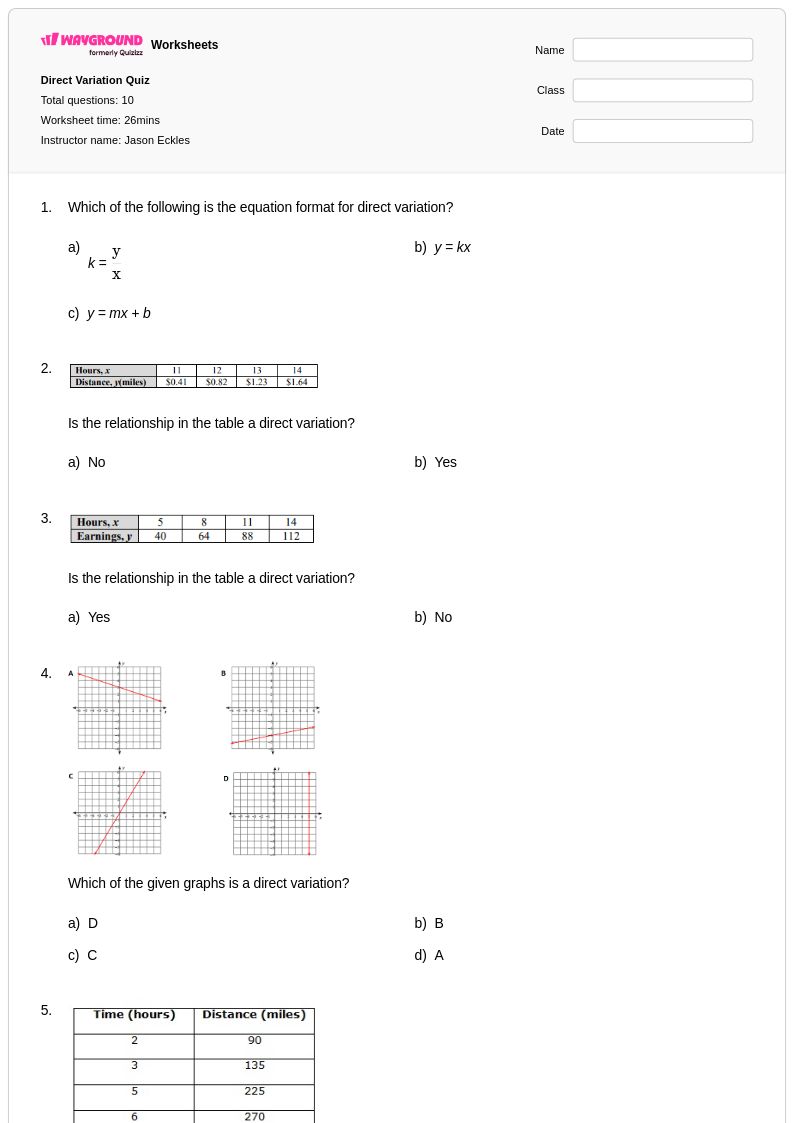
Explore Wayground's free direct variation worksheets and printables featuring practice problems with answer keys to help students master proportional relationships and algebraic reasoning skills.
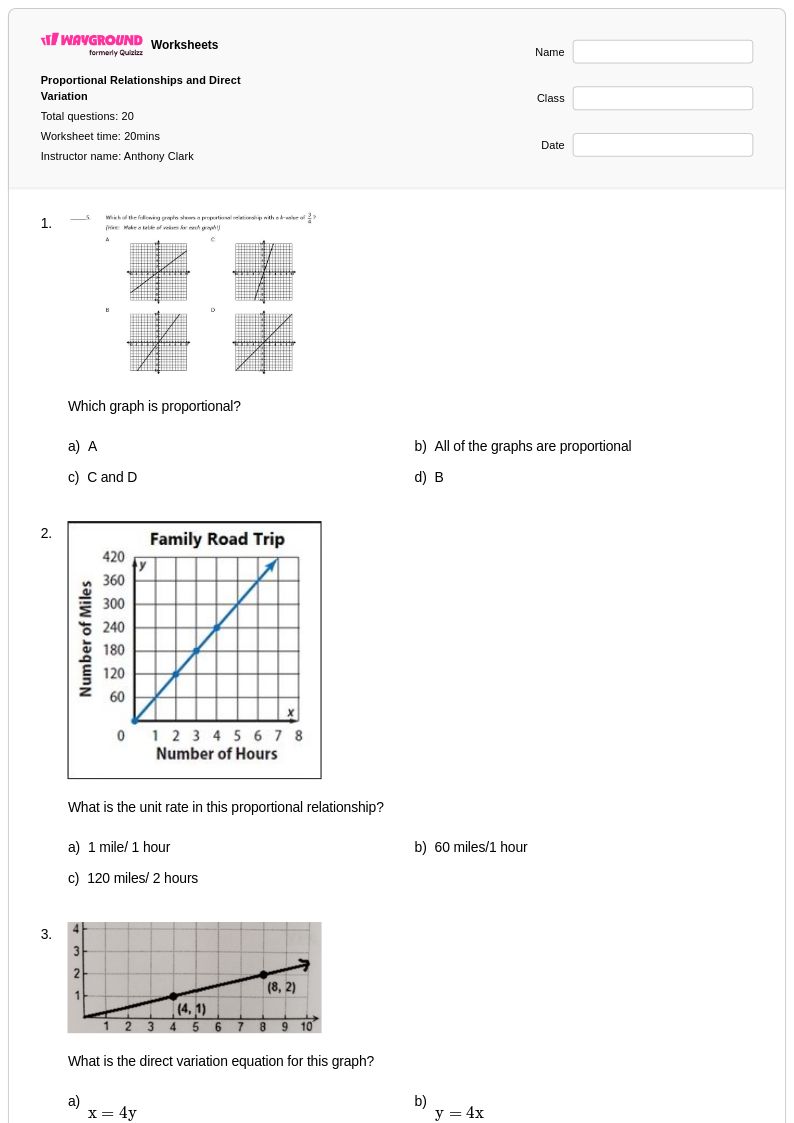
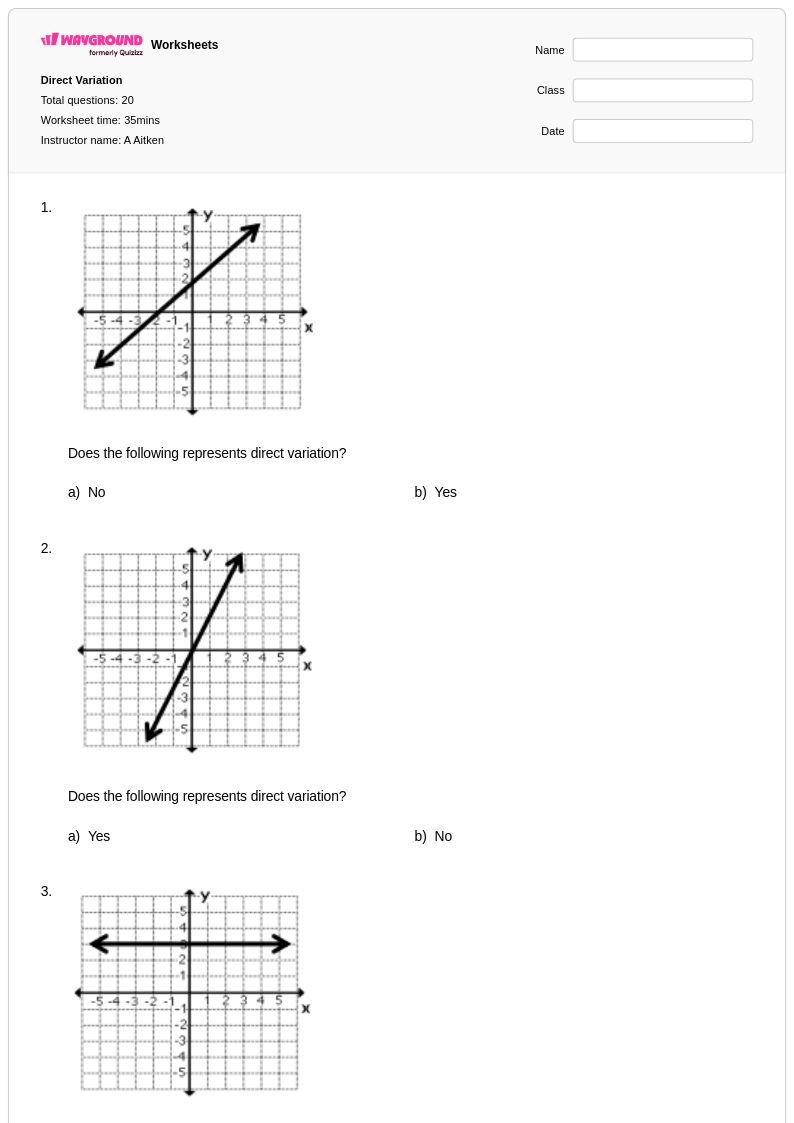
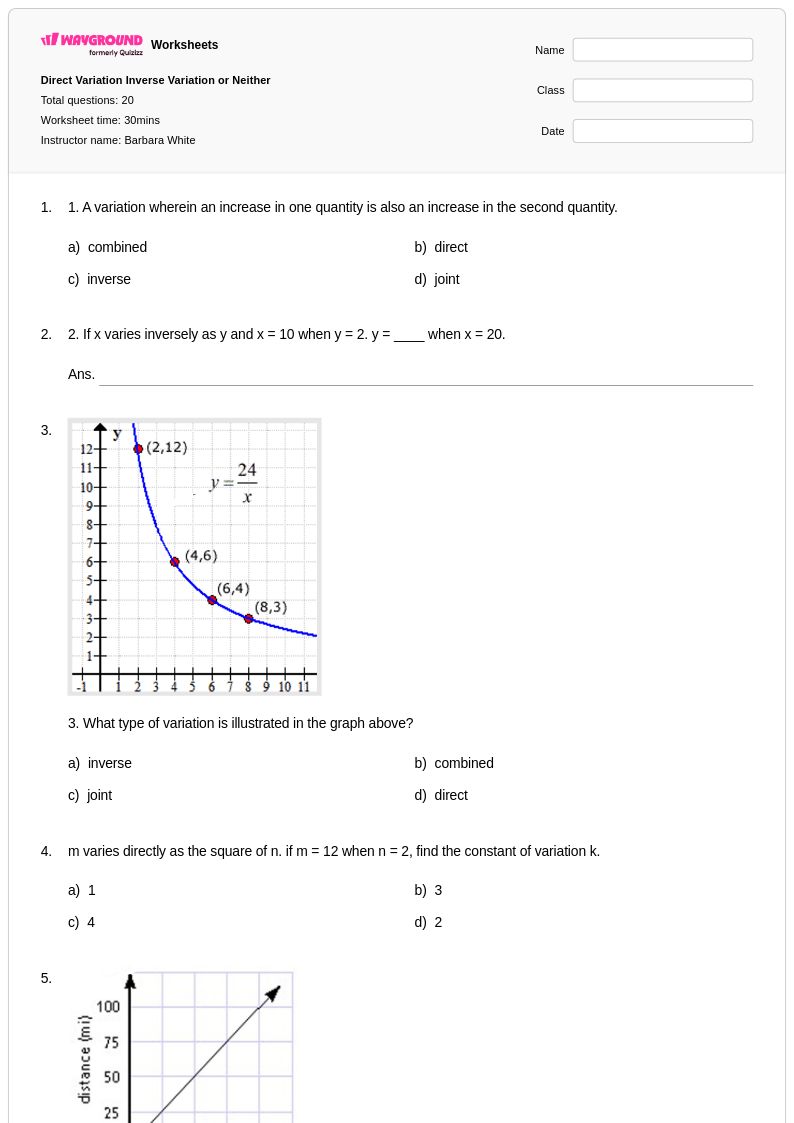
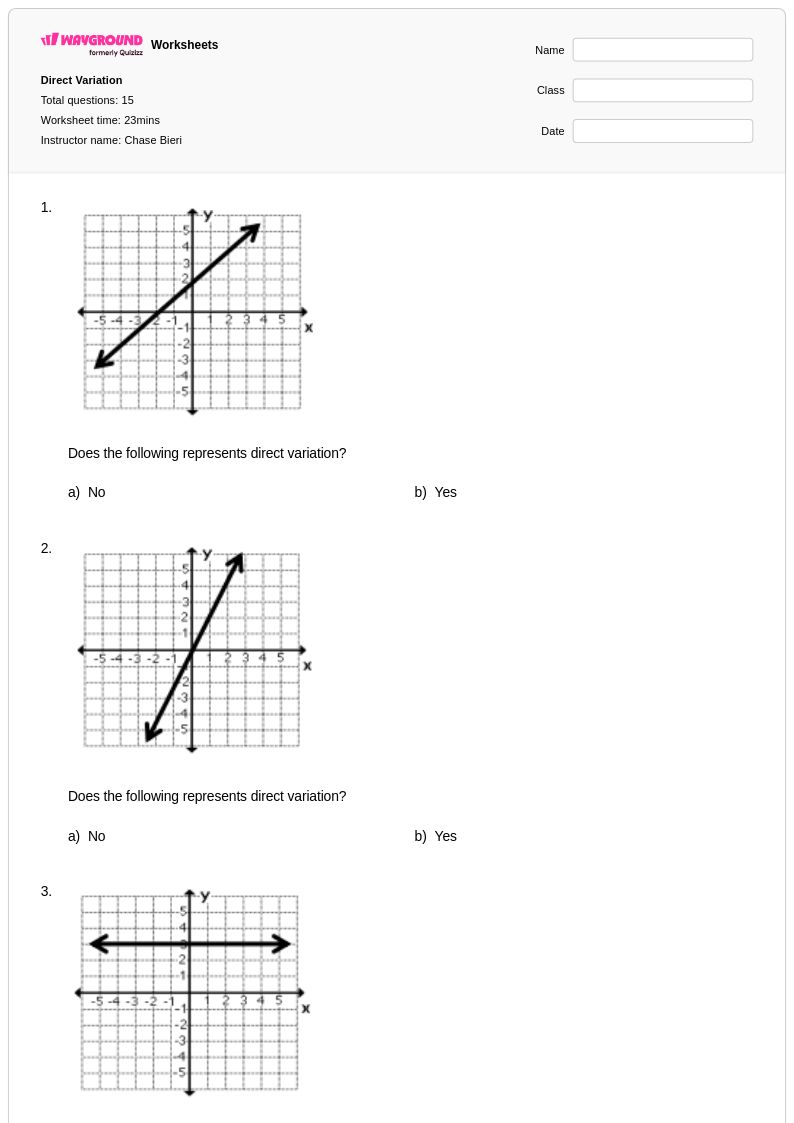
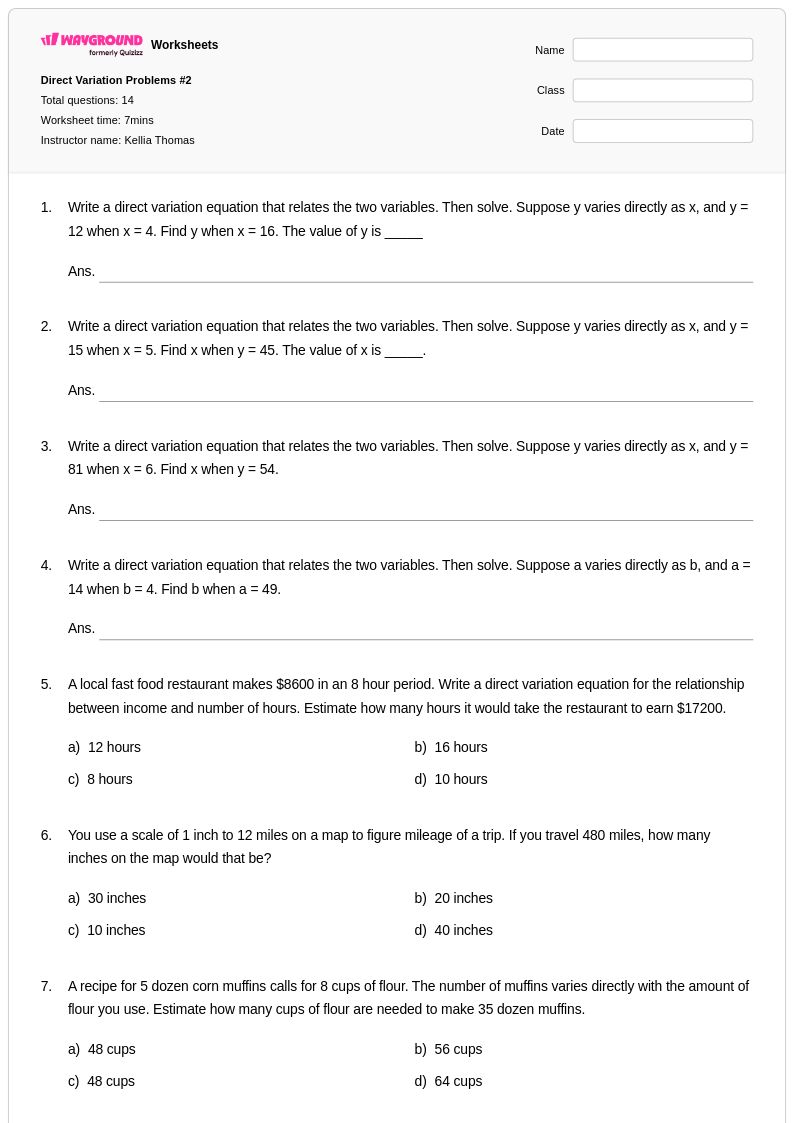
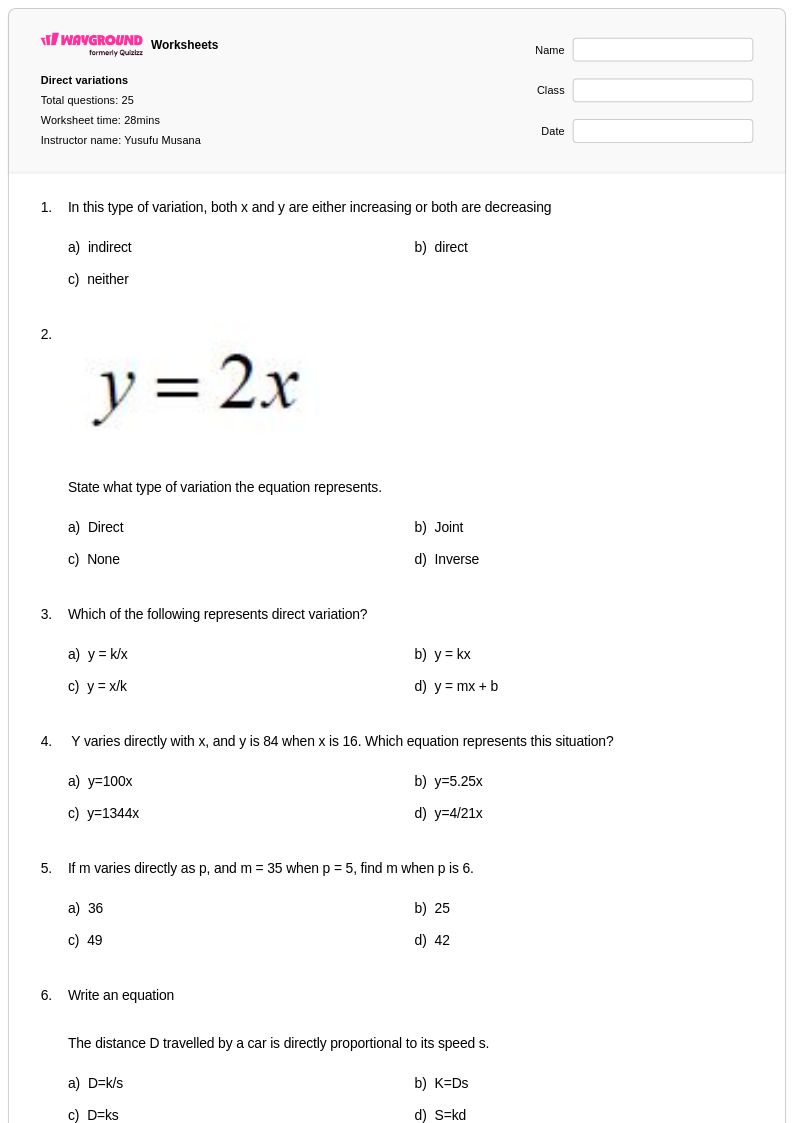
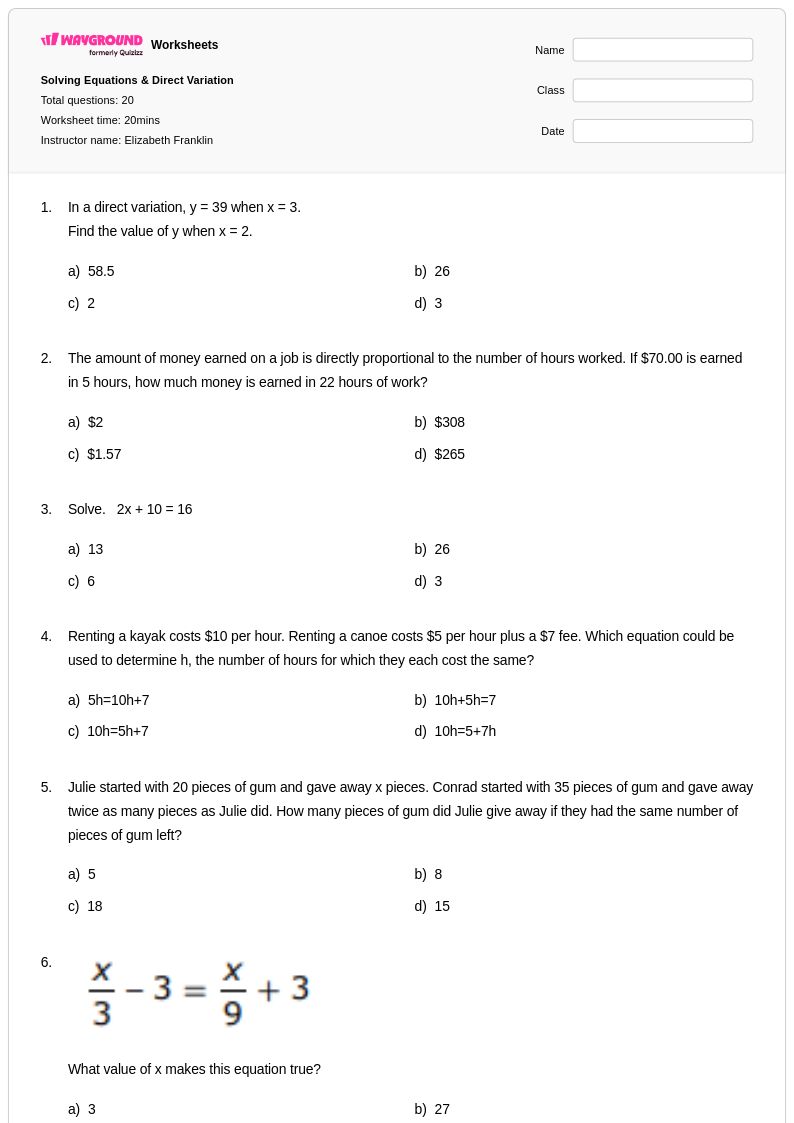
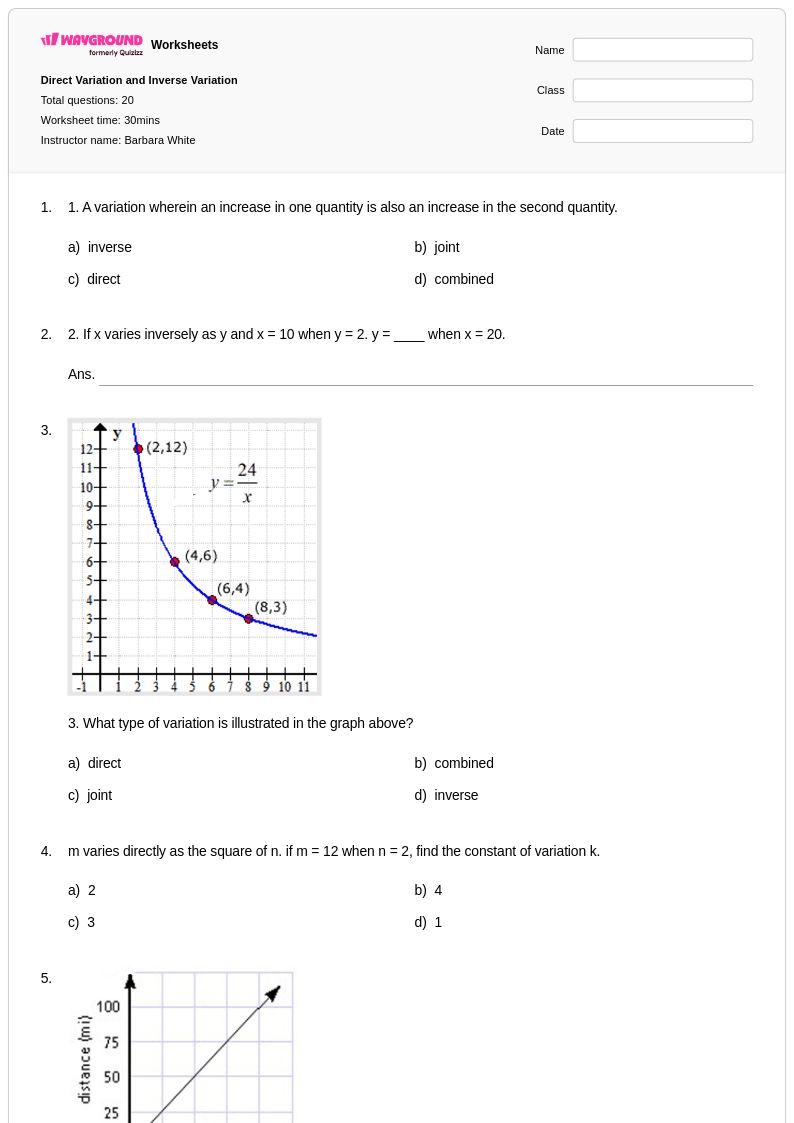
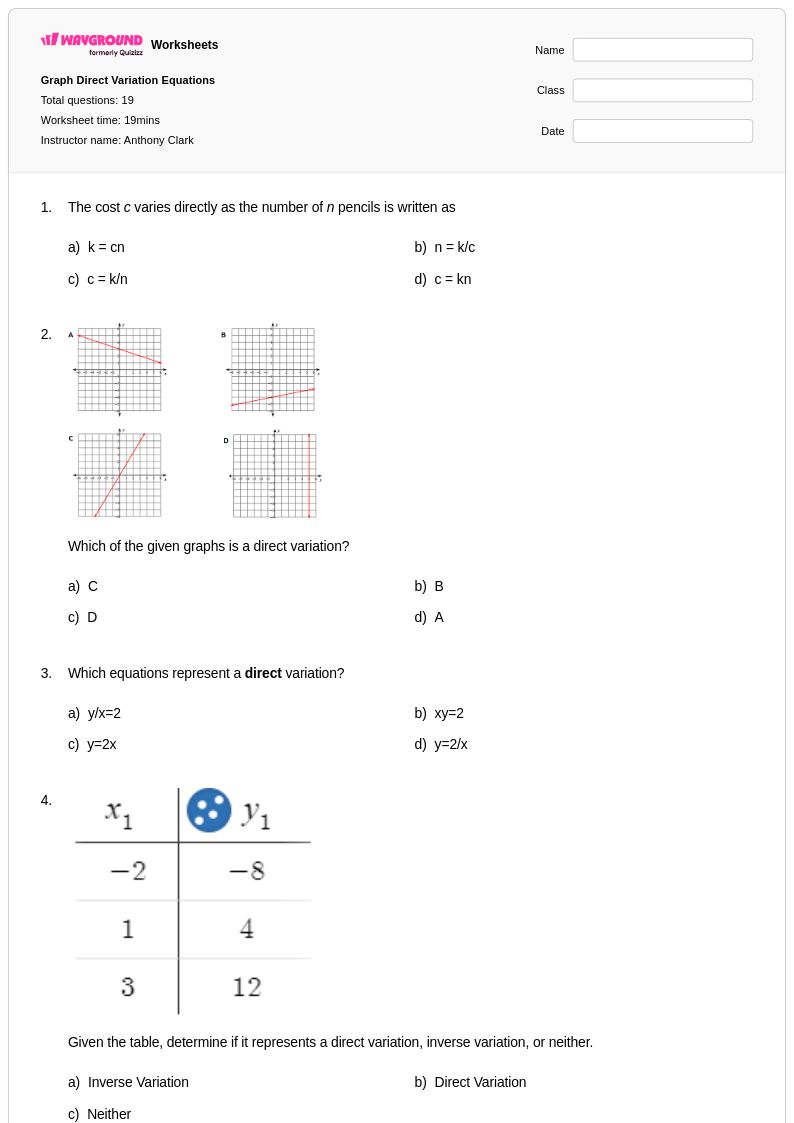
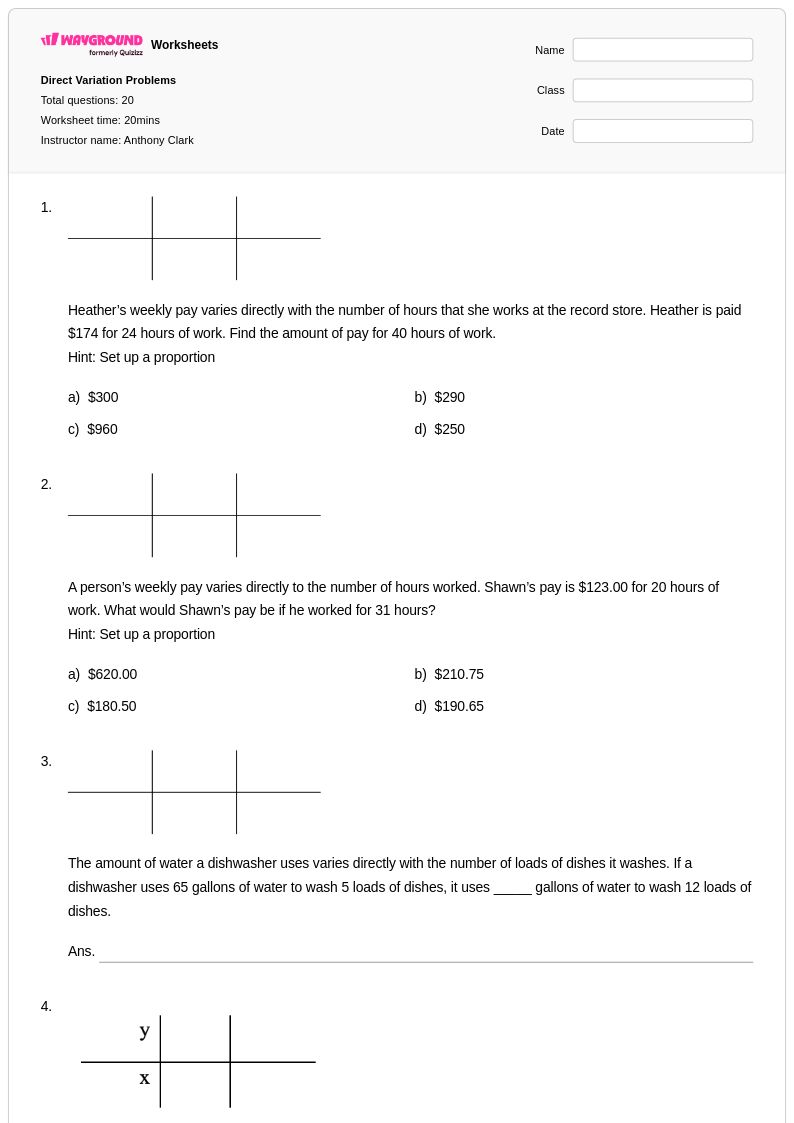
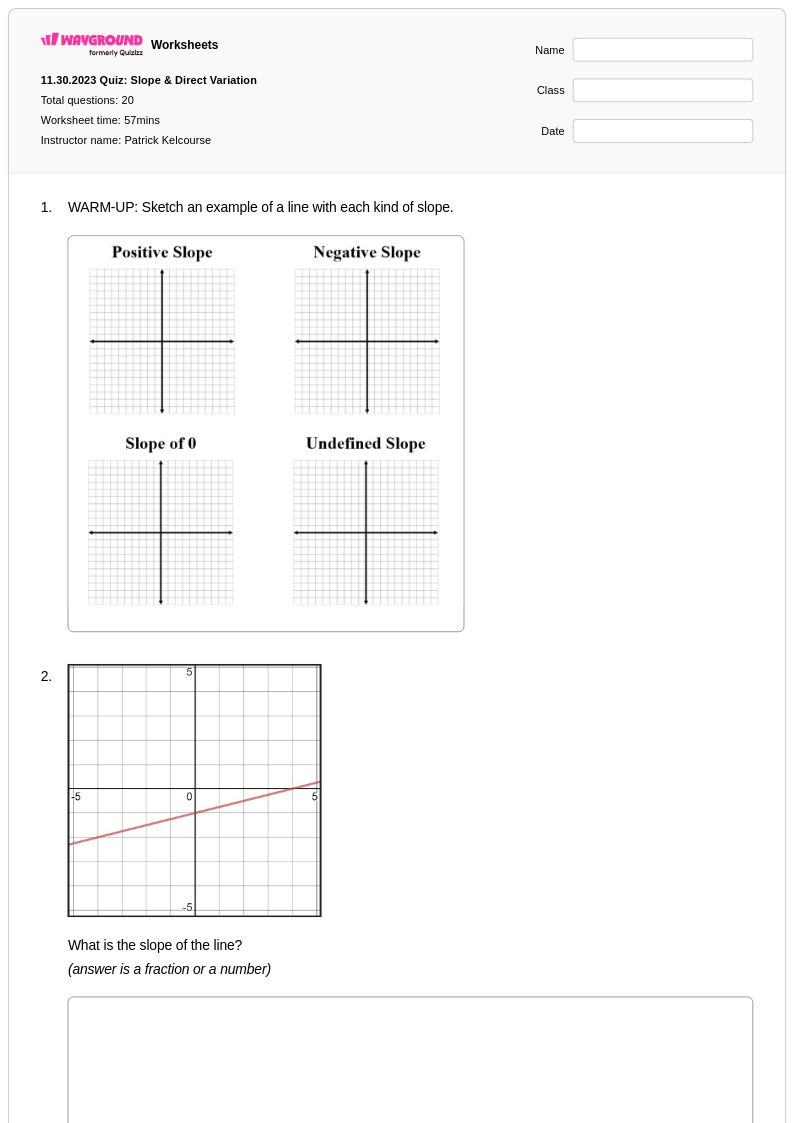
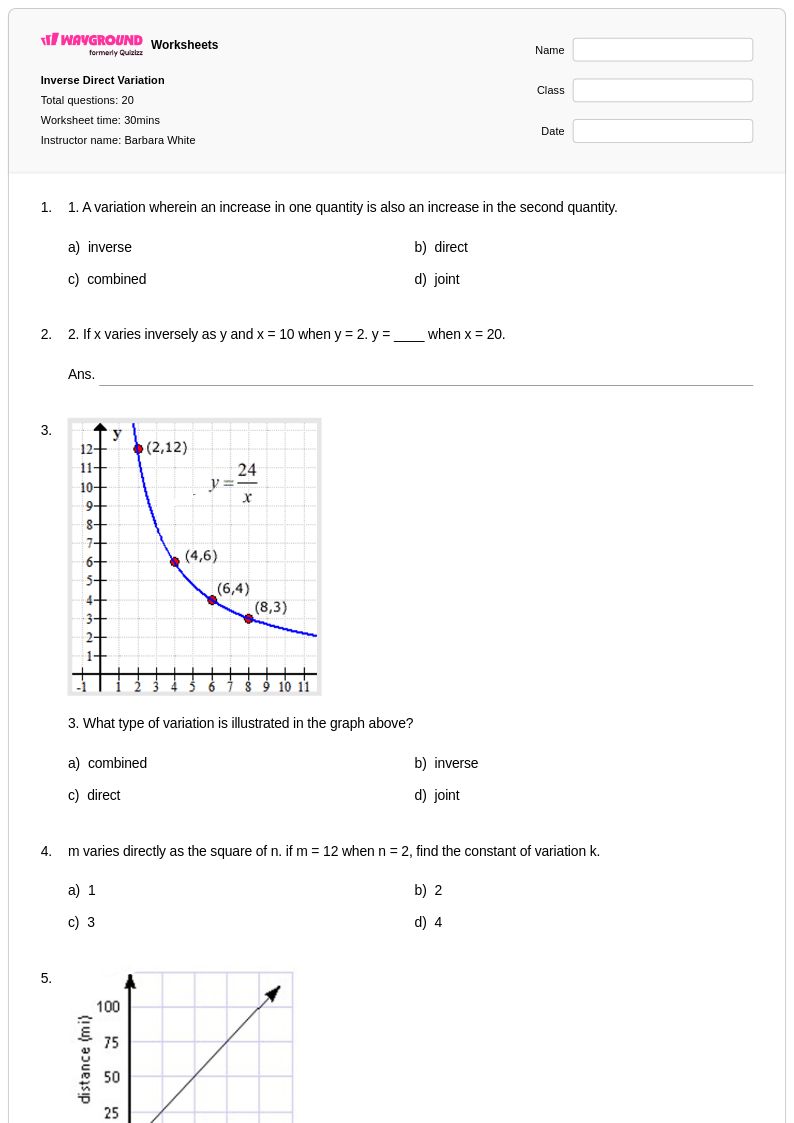
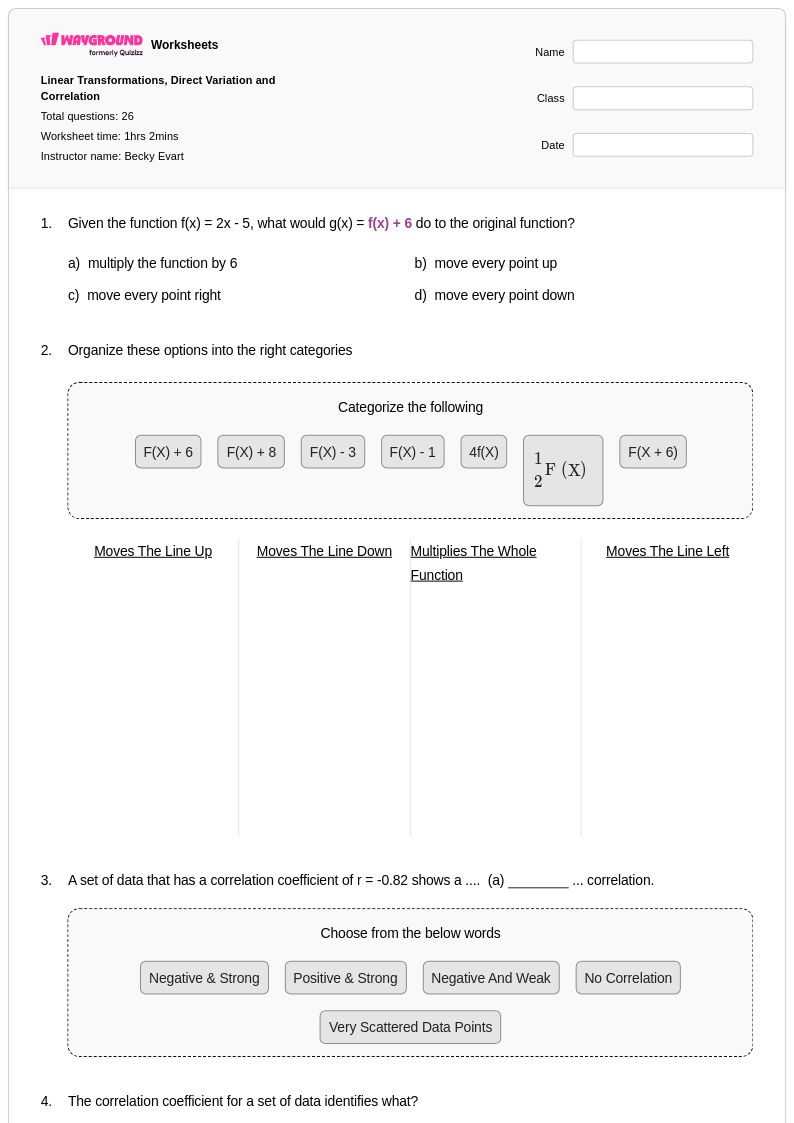
Direct variation worksheets available through Wayground (formerly Quizizz) provide comprehensive practice with this fundamental algebraic concept where one variable changes proportionally with another. These carefully designed mathematics resources help students master the essential skills of identifying direct variation relationships, writing equations in the form y = kx, calculating the constant of variation, and solving real-world problems involving proportional relationships. The worksheet collection includes diverse practice problems that progress from basic recognition exercises to complex application scenarios, complete with detailed answer keys that support both independent study and classroom instruction. These free printable resources strengthen students' understanding of linear relationships, graphing techniques, and algebraic reasoning through systematic skill-building exercises presented in convenient pdf format.
Wayground (formerly Quizizz) empowers mathematics educators with an extensive collection of millions of teacher-created direct variation worksheets that streamline lesson planning and enhance algebraic instruction. The platform's robust search and filtering capabilities allow teachers to quickly locate resources aligned with specific curriculum standards and learning objectives, while built-in differentiation tools enable seamless customization for diverse student needs and ability levels. These versatile worksheet collections are available in both printable and digital formats, providing flexibility for traditional classroom environments, remote learning situations, and hybrid instructional models. Teachers can efficiently implement targeted skill practice, remediation support for struggling learners, and enrichment opportunities for advanced students, ensuring that every mathematics learner develops a solid foundation in direct variation concepts and proportional reasoning.
FAQs
How do I teach direct variation?
Start with a concrete proportional situation students already understand — like paying $12 per hour at a job — and ask them to build a table of values, then graph it. Once they see the line passing through the origin, introduce y = kx as the algebraic way to describe what they already noticed. From there, move to identifying k from a table or equation before tackling real-world problems where k isn't handed to them directly.
What exercises help students practice direct variation?
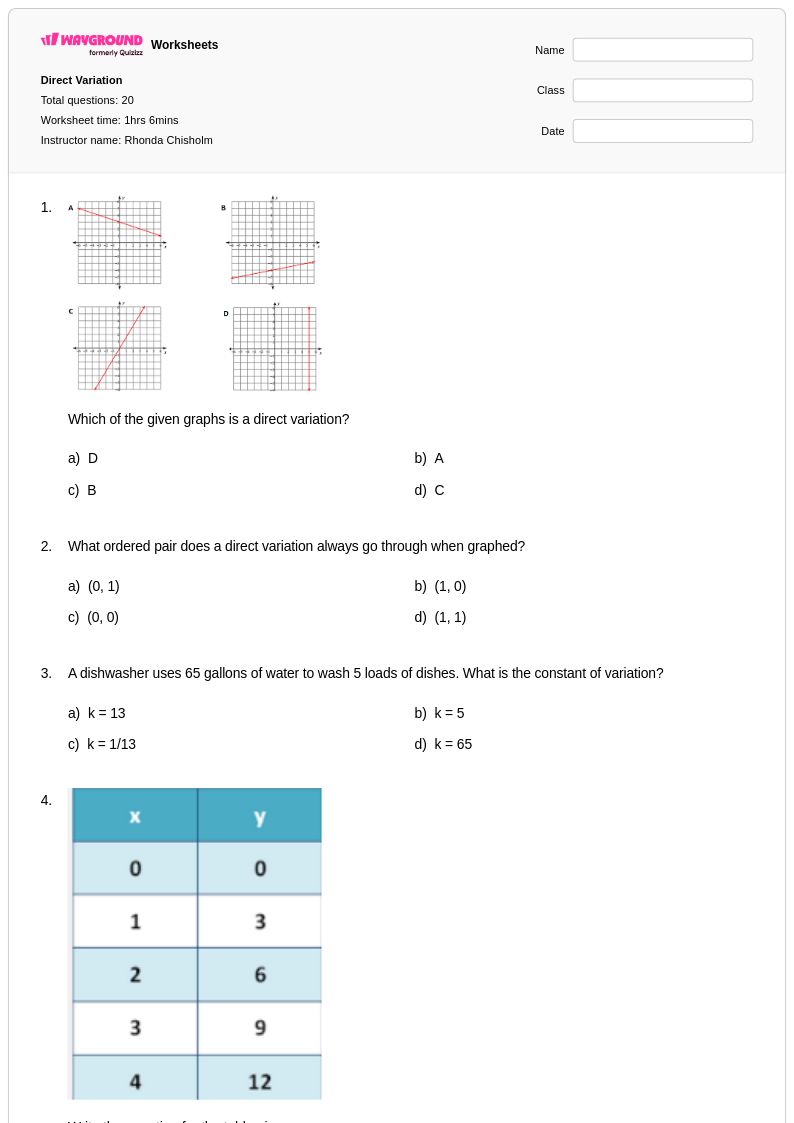
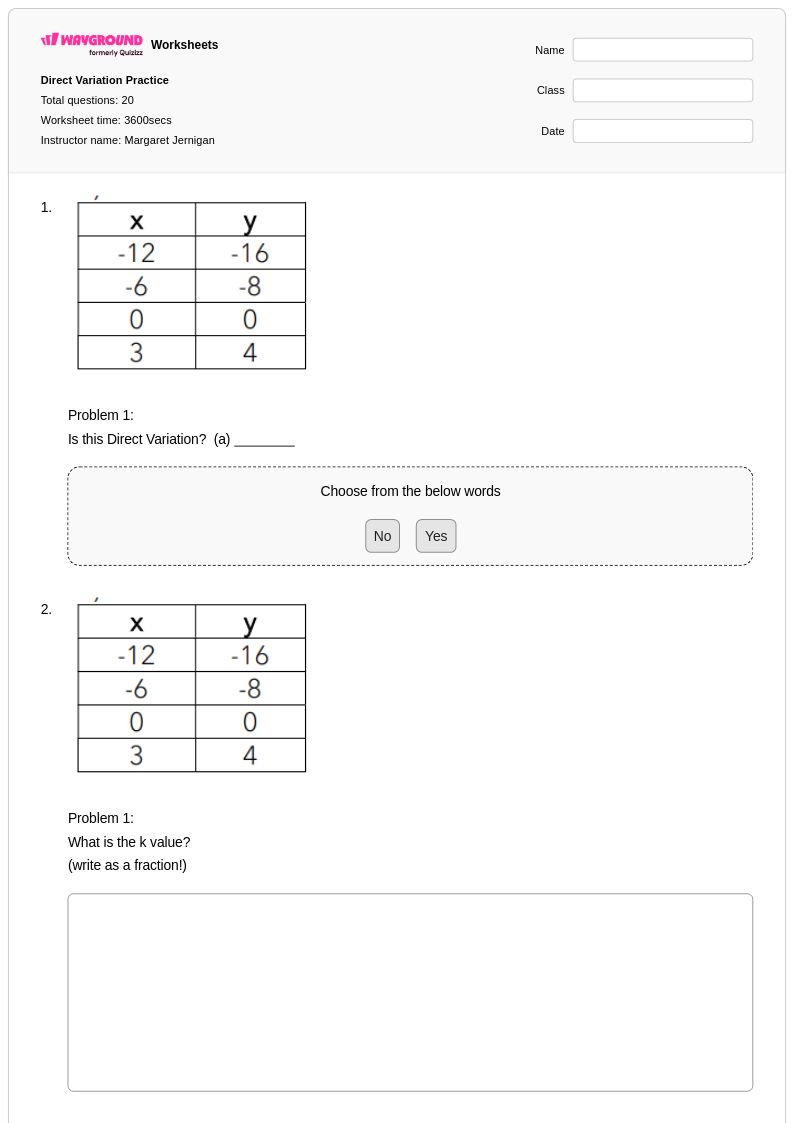
The most productive practice moves through three stages: recognizing whether a relationship is direct variation (given a table, graph, or equation), calculating the constant of variation k, and then applying y = kx to solve for an unknown. Wayground's direct variation worksheets cover all three, progressing from basic identification problems to multi-step real-world scenarios, so students build fluency before hitting the harder applications.
What mistakes do students commonly make with direct variation?
Two errors come up constantly. First, students confuse any linear equation with direct variation — they'll accept y = 3x + 2 as a direct variation because it looks proportional, missing that the y-intercept must be zero. Second, when solving for k, they'll invert the ratio and write k = y/x correctly once, then flip it to x/y on the next problem without noticing. Targeted practice on non-examples (lines that don't pass through the origin) and consistent ratio-setup drills address both.
How do I use Wayground's direct variation worksheets in my class?
You can run these as a digital quiz hosted on Wayground — students work through problems on their devices and you see results in real time — or download the PDF and print it for paper practice. Every worksheet includes a complete answer key, so students can self-check during independent work. If you go the print route, the Wayground for Teachers app lets you scan or photograph completed worksheets to grade them without manual data entry.
How does Common Core sequence direct variation in the math curriculum?
Common Core builds toward direct variation through its emphasis on ratios and proportional relationships in grades 6–7, where students analyze unit rates and constant ratios in tables and graphs. By grade 8, that proportional reasoning connects directly to linear functions: students are expected to recognize that a proportional relationship is a special case of a linear function whose graph passes through the origin — which is exactly what y = kx describes. Direct variation practice at this stage bridges ratio work from middle school to the formal function notation students will use in high school algebra.
How can I differentiate direct variation practice for mixed-ability classes?
For students who struggle with the algebraic notation, Wayground lets you generate an alternate version of the worksheet with larger font sizes or a dyslexia-friendly font, reducing visual friction so the math itself stays in focus. For students who need more support during a digital session, the reduced answer choices accommodation limits the options displayed, which helps when a student understands the concept but gets overwhelmed by similar-looking values of k. Advanced students can be pointed toward the application problems in the collection — science and economics contexts where k isn't labeled — while others consolidate the core equation.