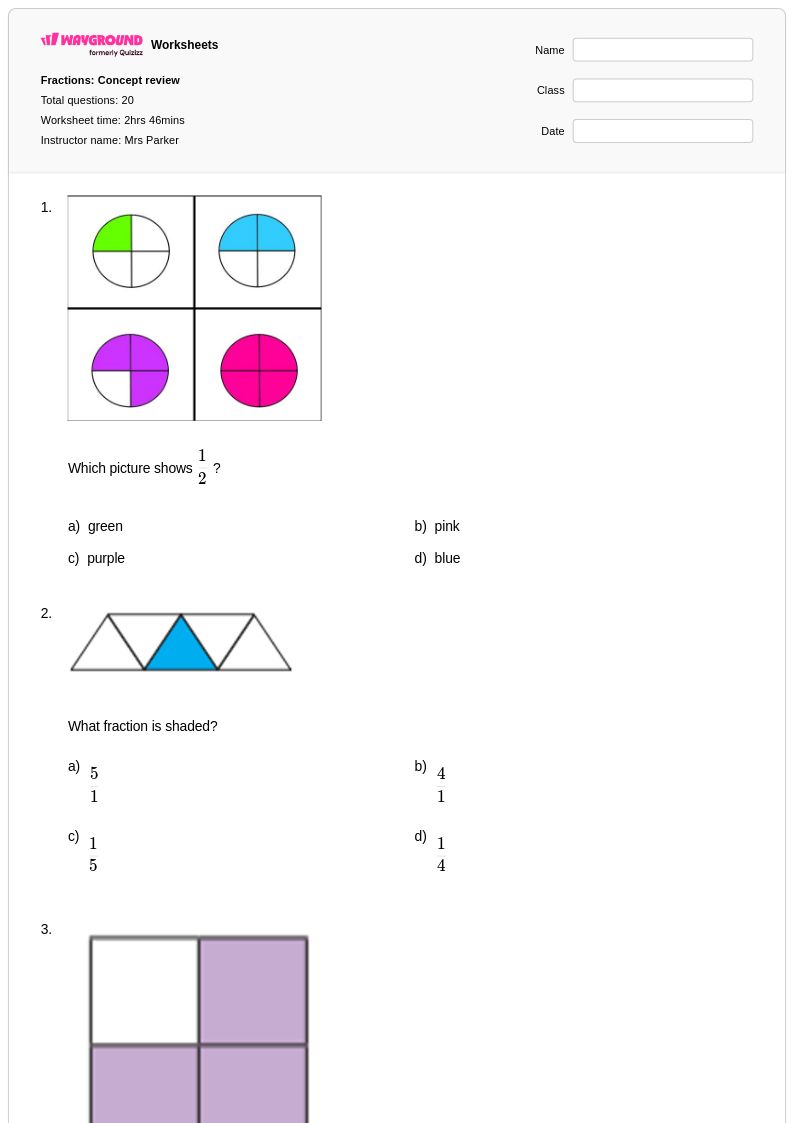
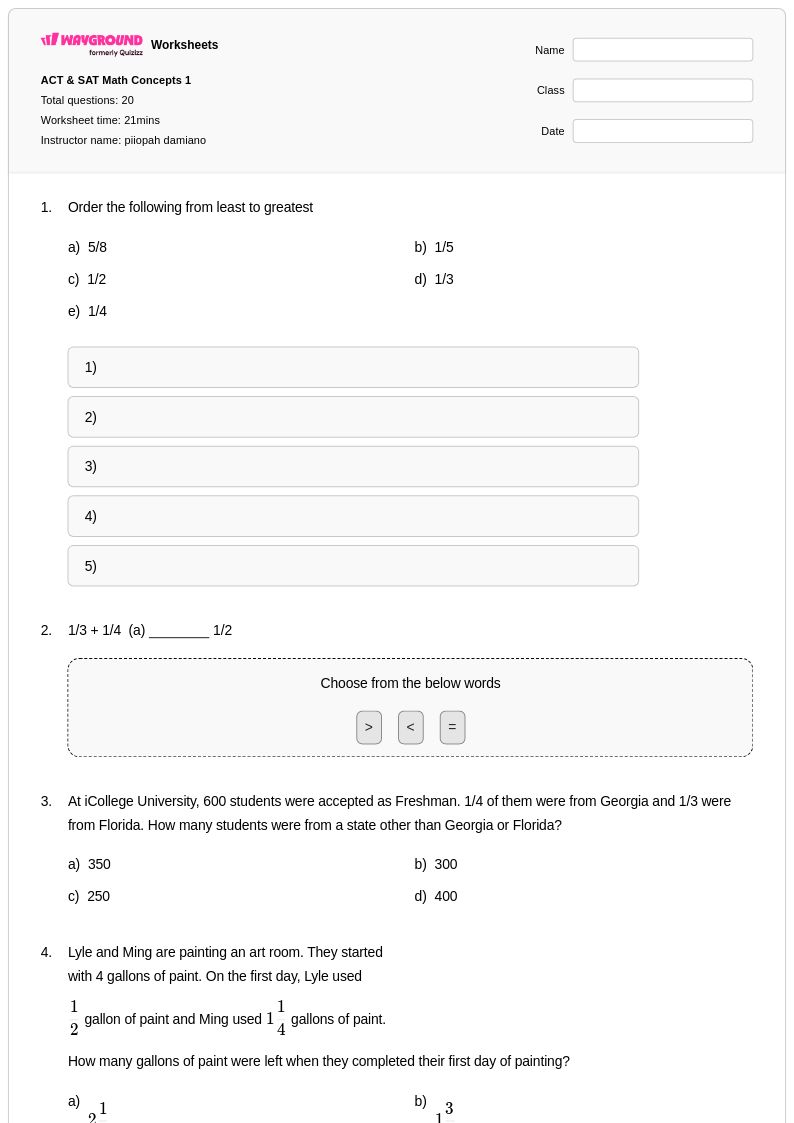
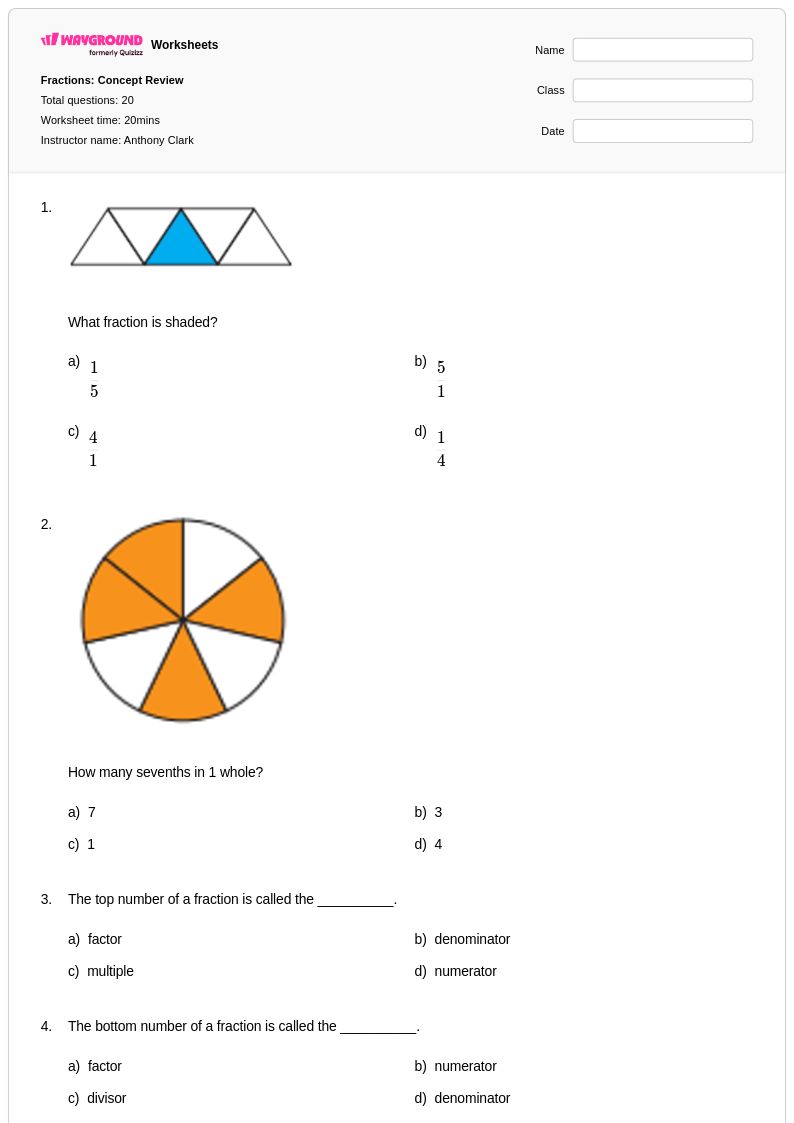
Master directional concepts with Wayground's comprehensive collection of free geometry worksheets featuring engaging practice problems, printable PDFs, and complete answer keys to help students develop spatial reasoning skills.
Directional concepts worksheets available through Wayground (formerly Quizizz) provide essential foundational practice for students developing spatial reasoning and navigational skills in mathematics. These comprehensive resources focus on helping learners master fundamental directional vocabulary including left, right, up, down, forward, backward, and diagonal movements, while building critical spatial awareness that serves as a cornerstone for advanced geometric thinking. The worksheets systematically guide students through increasingly complex directional challenges, from basic position identification to multi-step navigation problems, ensuring thorough skill development through varied practice problems. Each worksheet collection includes detailed answer keys and is available as free printables in convenient PDF format, making them accessible for both classroom instruction and independent study sessions.
Wayground's extensive collection draws from millions of teacher-created resources specifically designed to support educators in delivering effective directional concepts instruction across diverse learning environments. The platform's robust search and filtering capabilities allow teachers to quickly locate worksheets that align with specific curriculum standards and match individual student needs, while built-in differentiation tools enable seamless customization for learners at varying skill levels. These versatile resources are available in both printable PDF format and interactive digital versions, providing maximum flexibility for lesson planning, targeted remediation, enrichment activities, and ongoing skill practice. Teachers can efficiently adapt these materials to support whole-class instruction, small group work, or individualized learning paths, ensuring that every student develops strong spatial reasoning abilities that will support their continued success in geometry and broader mathematical concepts.
FAQs
How do I teach directional concepts to elementary students?
Start with the body as a reference point — students grasp left/right and up/down most reliably when they anchor those terms to themselves before applying them to objects or maps. From there, move to positional vocabulary (above, below, beside, in front of, behind) using physical objects in the classroom, then transfer to 2D representations on paper. The key is keeping language consistent: if you say 'above' in one activity, don't switch to 'on top of' in the next until students are secure with both.
What exercises help students practice directional concepts?
The most effective practice combines following directions with producing them. Give students a simple grid or picture and ask them to describe where an object is, then reverse it — you describe, they identify. Multi-step navigation problems (move two spaces right, then one space down) push students beyond single-term recall into applying directional language sequentially, which is where real understanding shows.
What mistakes do students commonly make with directional concepts?
Left/right confusion is the most persistent error, especially when students are facing a different direction than a character or figure in a diagram. Students often apply their own orientation to a picture rather than the figure's. A second common issue is conflating relative terms — 'near' and 'next to' get used interchangeably, and 'in front of' shifts meaning depending on whether the reference object has a clear front face. Calling these distinctions out explicitly, rather than assuming students will infer them, saves a lot of reteaching.
How do I use Wayground's directional concepts worksheets in my classroom?
Each worksheet comes with a complete answer key, so you can assign it independently without prep overhead. For digital use, you can host the worksheet as a quiz on Wayground and students complete it on their devices. If you prefer paper, download the PDF, print it, and assign it as classwork or homework — then use the Wayground for Teachers app to scan and grade student submissions without manual marking. Both routes use the same content, so the choice comes down to your classroom setup that day.
How can I differentiate directional concepts practice for students at different levels?
For students who struggle with left/right or positional vocabulary, Wayground's Read Aloud accommodation reads questions aloud so decoding doesn't block spatial reasoning, and reduced answer choices lower the cognitive load while students build confidence. For accessibility, you can generate an alternate version of the same worksheet with a larger font or dyslexia-friendly typeface without creating a separate assignment. Students who need more challenge can move to multi-step navigation problems while the rest of the class works on single-position identification — all from the same worksheet collection.
At what grade level are directional concepts taught?
Directional vocabulary like up, down, left, and right is introduced in kindergarten and Grade 1. By Grade 2, students extend this to relative positional terms (between, next to, beside) and begin applying them in 2D contexts. Grade 3 typically marks the transition from positional vocabulary practice to using directional language within geometry and grid-based problems. Wayground's collection covers this full range, so you can find materials matched to wherever your students are in that progression.