Explore Wayground's comprehensive collection of ellipses worksheets featuring free printables, practice problems, and answer keys to help students master this essential geometry concept through engaging mathematical exercises.
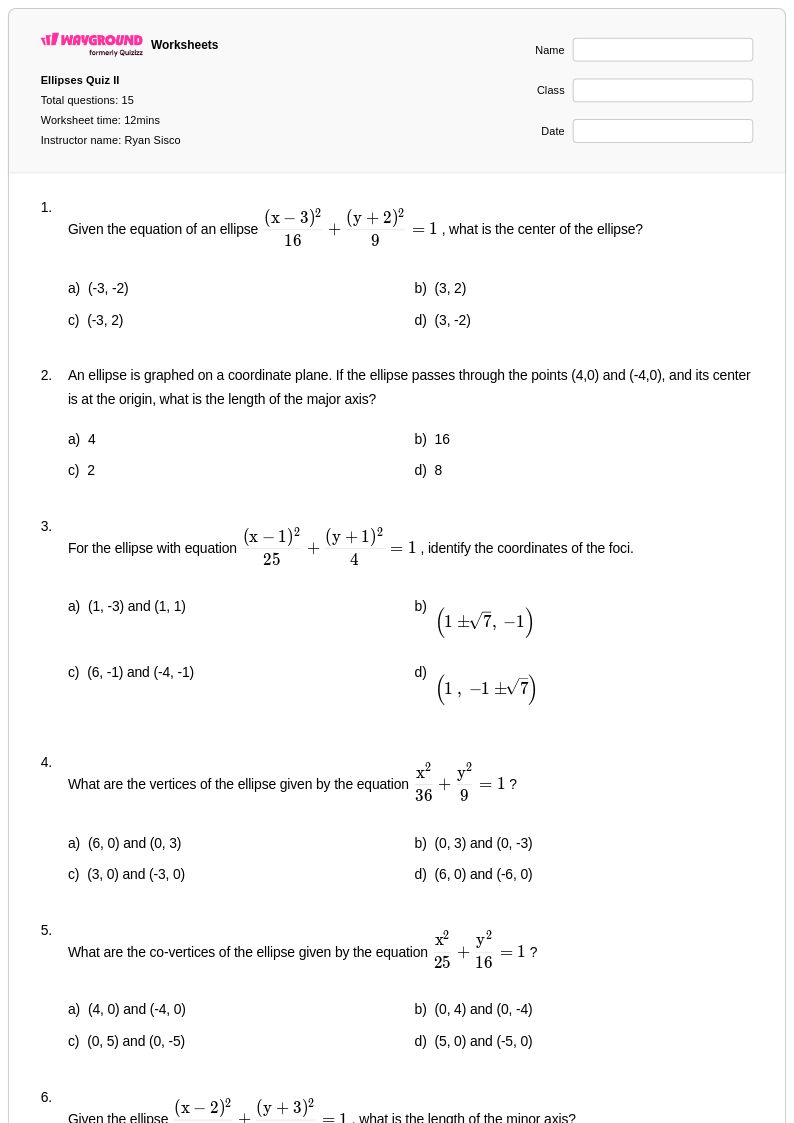
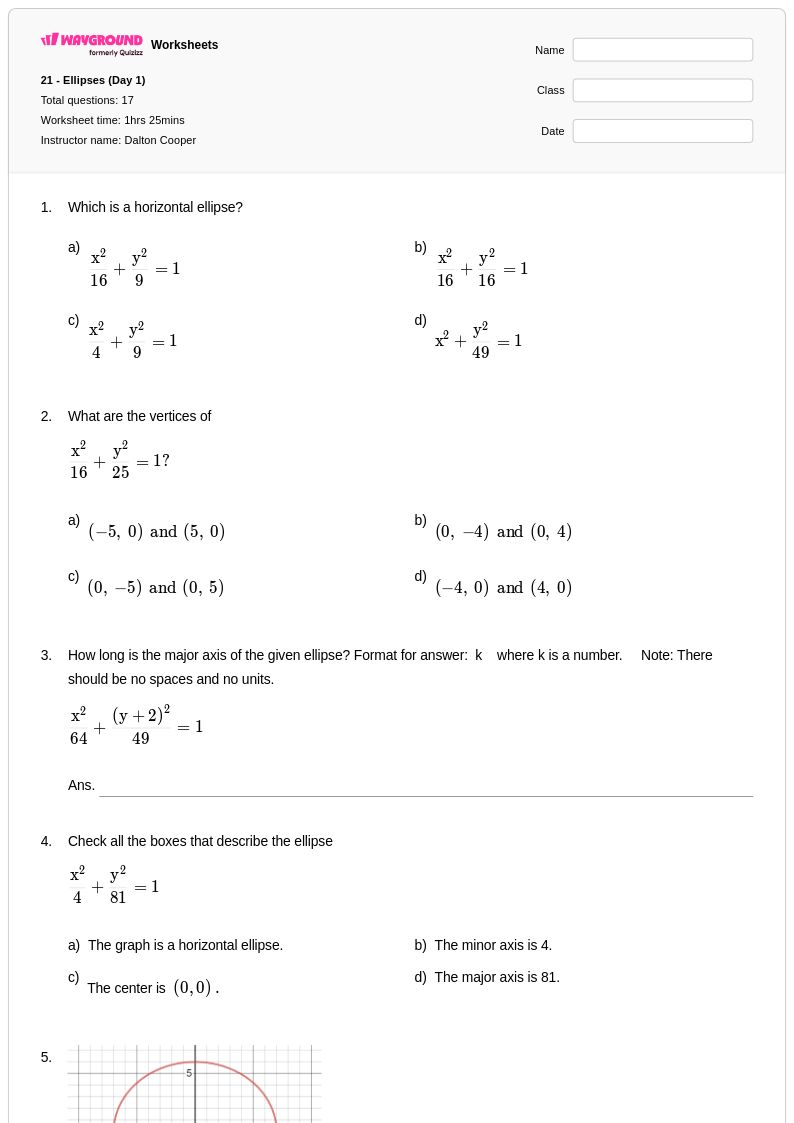
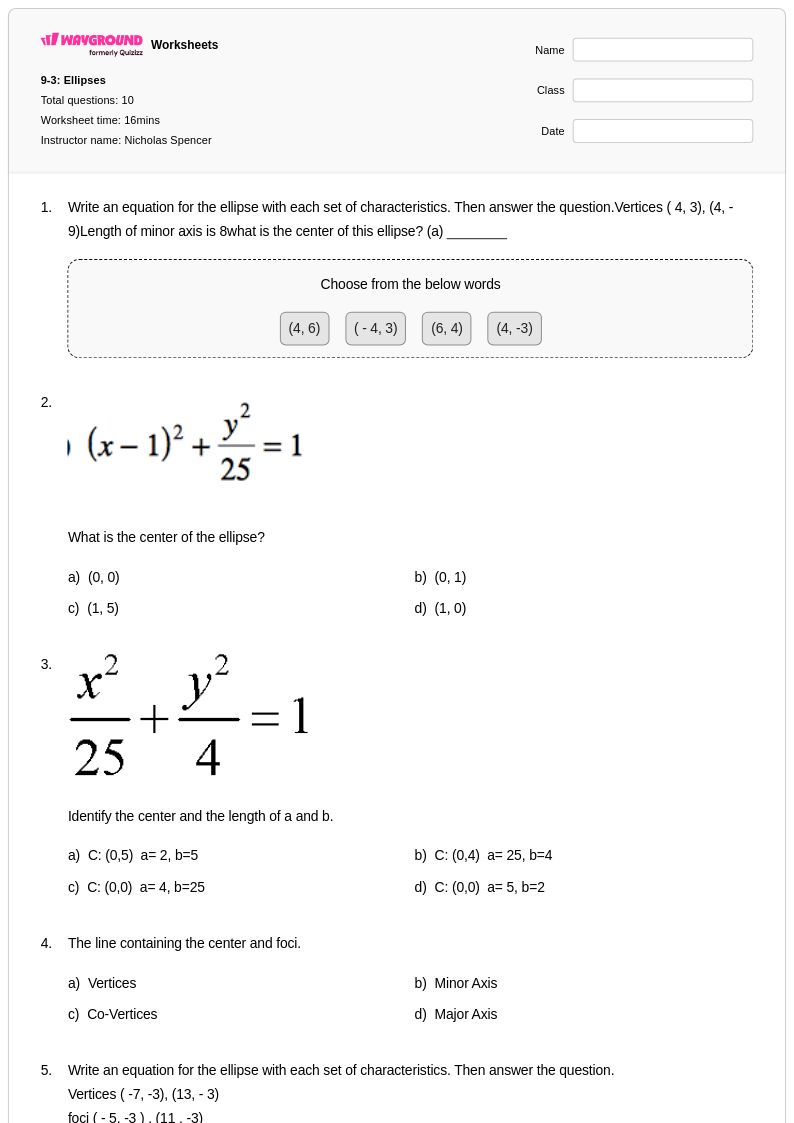
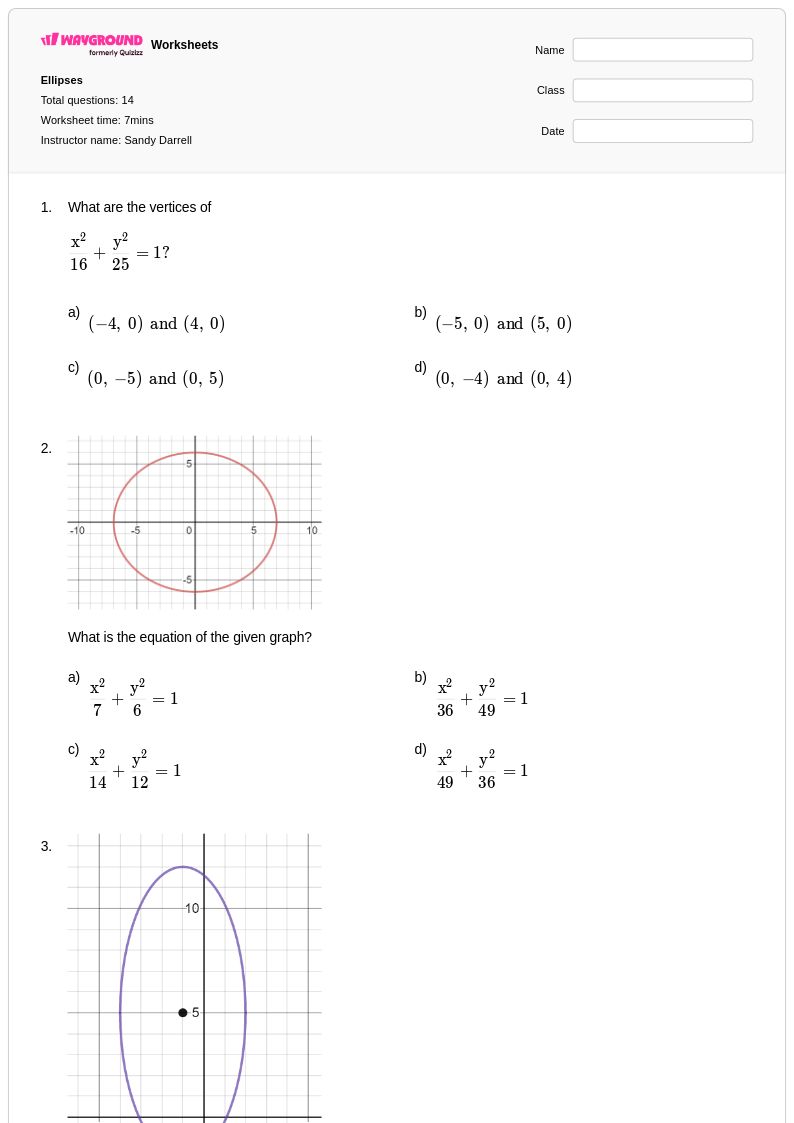
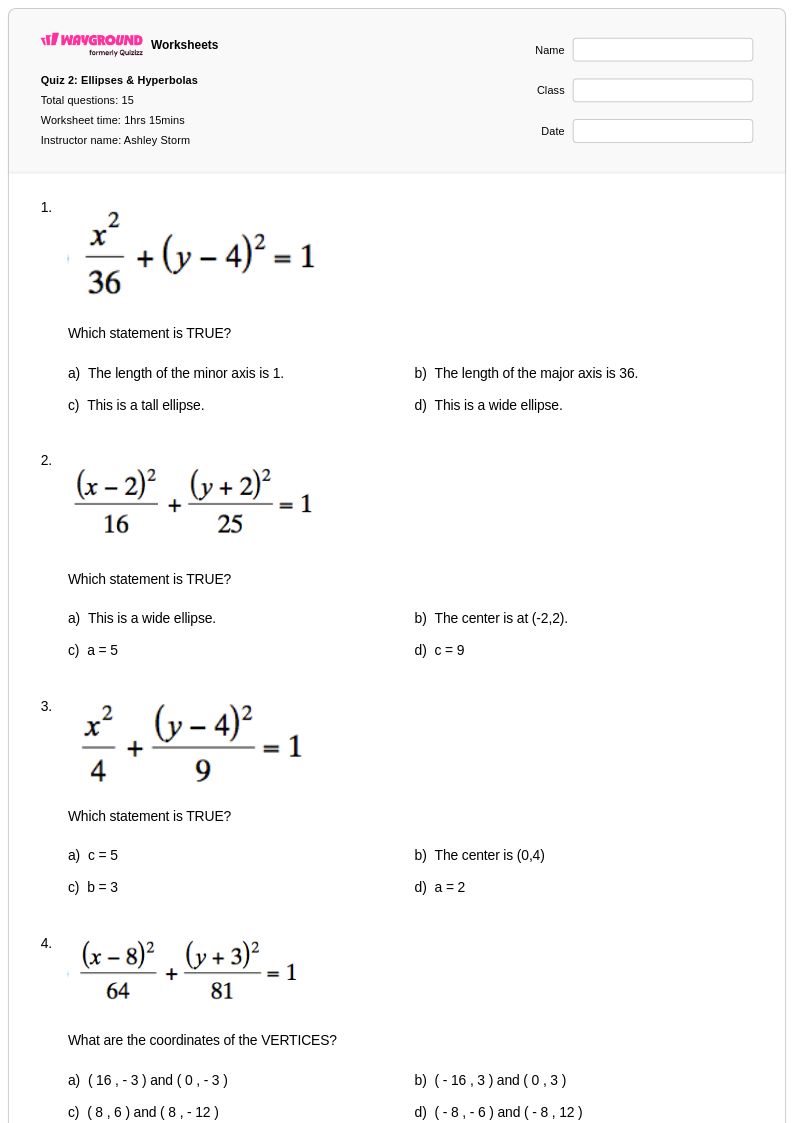
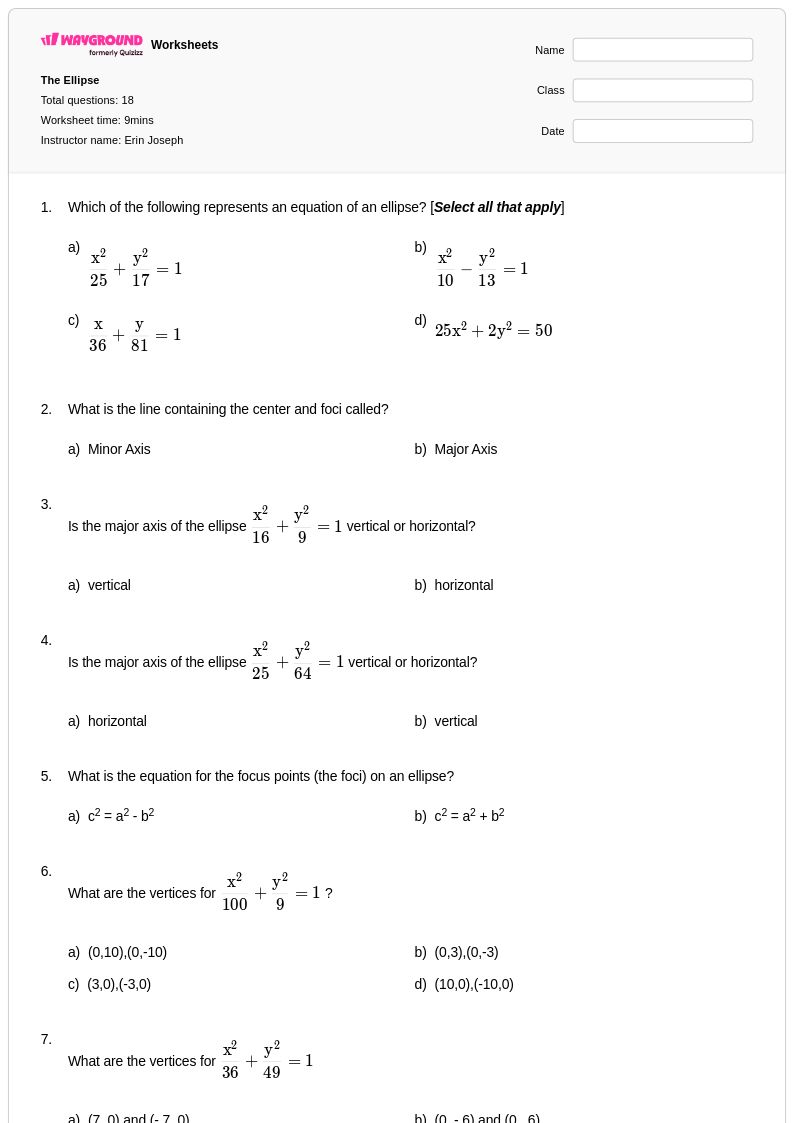
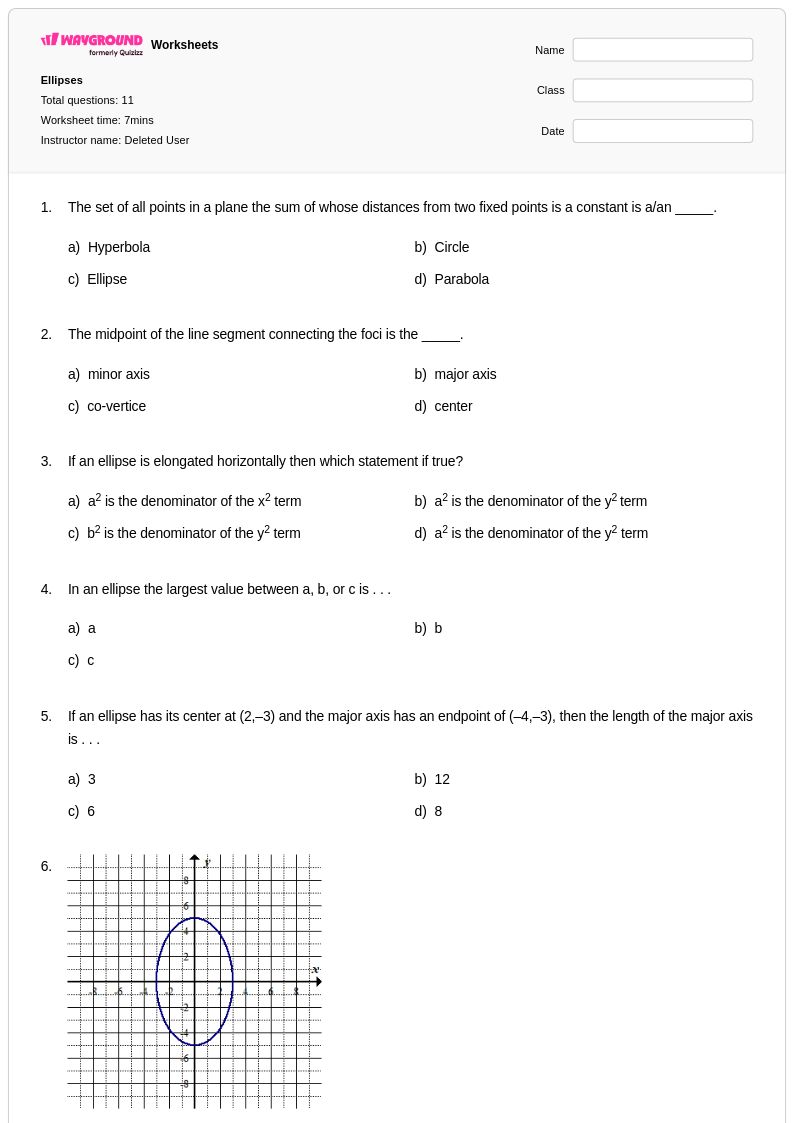
Ellipses worksheets available through Wayground (formerly Quizizz) provide comprehensive practice with one of geometry's most elegant conic sections, helping students master the fundamental properties and applications of these oval-shaped curves. These carefully designed resources strengthen essential skills including identifying the center, vertices, and foci of ellipses, calculating major and minor axes lengths, writing equations in both standard and general forms, and solving real-world problems involving elliptical shapes. Each worksheet collection includes detailed answer keys that support independent learning and self-assessment, while the free printable format ensures accessibility for all classrooms. Students work through progressively challenging practice problems that build confidence with ellipse transformations, graphing techniques, and the relationship between algebraic representations and geometric properties.
Wayground (formerly Quizizz) empowers mathematics educators with millions of teacher-created ellipse resources that streamline lesson planning and differentiated instruction across all skill levels. The platform's robust search and filtering capabilities allow teachers to quickly locate worksheets aligned with specific curriculum standards, whether focusing on basic ellipse identification or advanced applications in physics and engineering contexts. These versatile materials are available in both printable pdf format for traditional classroom use and digital formats for interactive learning environments, supporting flexible customization to meet diverse student needs. Teachers can effectively use these resources for targeted skill practice, remediation support for struggling learners, and enrichment activities for advanced students, ensuring that every learner develops a solid foundation in understanding ellipses and their mathematical significance within the broader study of conic sections.
FAQs
How do I teach ellipses to students?
Start with the geometric definition: an ellipse is the set of all points where the sum of distances to two fixed points (the foci) is constant. That relationship is the key to everything else. From there, connect it to the standard form equation by showing how changing the values of a and b stretches or compresses the shape along each axis. Students who understand why the equation looks the way it does — not just how to use it — are far better prepared to handle graphing, transformations, and real-world applications like planetary orbits or elliptical arches.
What exercises help students practice ellipses?
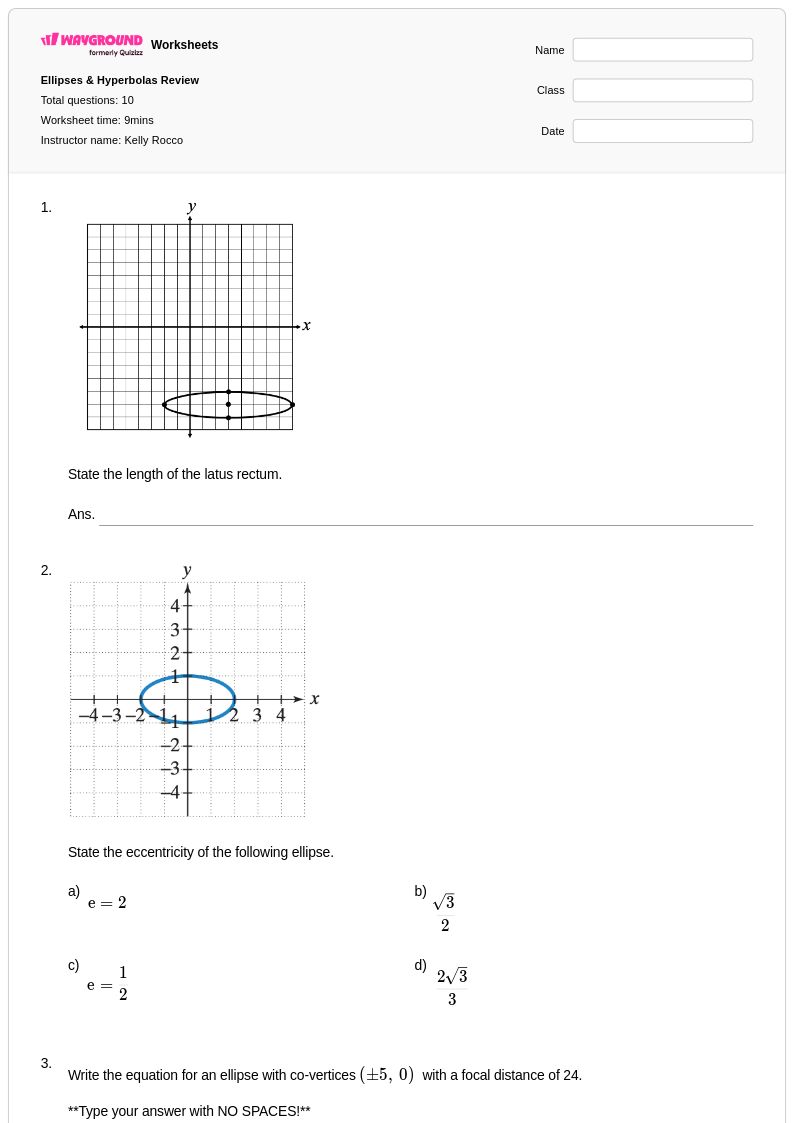
The most effective practice moves between representations: give students an equation and ask them to graph it, then give them a graph and ask them to write the equation. Add problems that require identifying the center, vertices, and foci from both forms. For a stronger challenge, include problems where the ellipse is not centered at the origin, since translating the center is where many students first hit a wall.
What mistakes do students commonly make with ellipses?
Three errors come up constantly. First, students confuse which value is a and which is b — they forget that a is always the larger denominator, regardless of whether it's under x or y. Second, they misidentify the orientation of the major axis, placing it horizontally when it should be vertical (or vice versa). Third, when calculating foci, students mix up the relationship c² = a² − b² and sometimes add instead of subtract. Drilling the a > b rule and requiring students to state the orientation before they graph catches most of these early.
How do I use Wayground's ellipses worksheets in my class?
Each worksheet comes with a complete answer key, so it works well for independent practice or homework without extra prep on your end. You can host it as a digital quiz on Wayground — useful for getting instant results — or download the printable PDF and hand it out on paper, which works well for classes reducing screen time or for test-prep sessions where you want students working by hand. If you go the paper route, the Wayground for Teachers app lets you scan or capture student submissions for grading, so you're not stuck sorting through a stack of papers manually.
Are ellipses worksheets aligned to Common Core standards?
Ellipses as a conic section sit within the high school geometry and algebra strand of Common Core, which asks students to derive and use the equations of conic sections and connect algebraic representations to geometric properties. The progression typically runs from understanding circles (center and radius from an equation) to ellipses, where students extend that thinking to two foci and two axes of different lengths. Mastery of ellipses then sets up work with hyperbolas and parabolas, completing the conic sections picture.
How can I differentiate ellipses practice for mixed-ability classes?
For students who struggle with the algebraic manipulation, Wayground's reduced answer choices accommodation lowers the cognitive load on multiple-choice problems so they can focus on the geometric reasoning rather than getting lost in the arithmetic. The read-aloud feature helps students who have difficulty parsing dense equation-heavy text independently. For worksheet-level scaffolding, you can generate a version with a larger font size or a dyslexia-friendly font for students who need it — same problems, more accessible format — without creating a separate assignment from scratch.
What real-world applications of ellipses can I use in lessons?
Planetary orbits are the most compelling: Kepler's first law states that planets travel in elliptical paths with the sun at one focus, which gives the foci concept immediate physical meaning. Closer to everyday experience, whispering galleries (like the one in the U.S. Capitol) work because sound from one focus reflects to the other — a direct application of the reflective property of ellipses. Either example gives students a reason to care about the math before they work through the problems.