Free Printable Models of Atoms Worksheets for Class 10
Enhance Class 10 chemistry learning with Wayground's comprehensive collection of free printable worksheets covering atomic models, featuring engaging practice problems and complete answer keys to master atomic structure concepts.
Explore printable Models of Atoms worksheets for Class 10
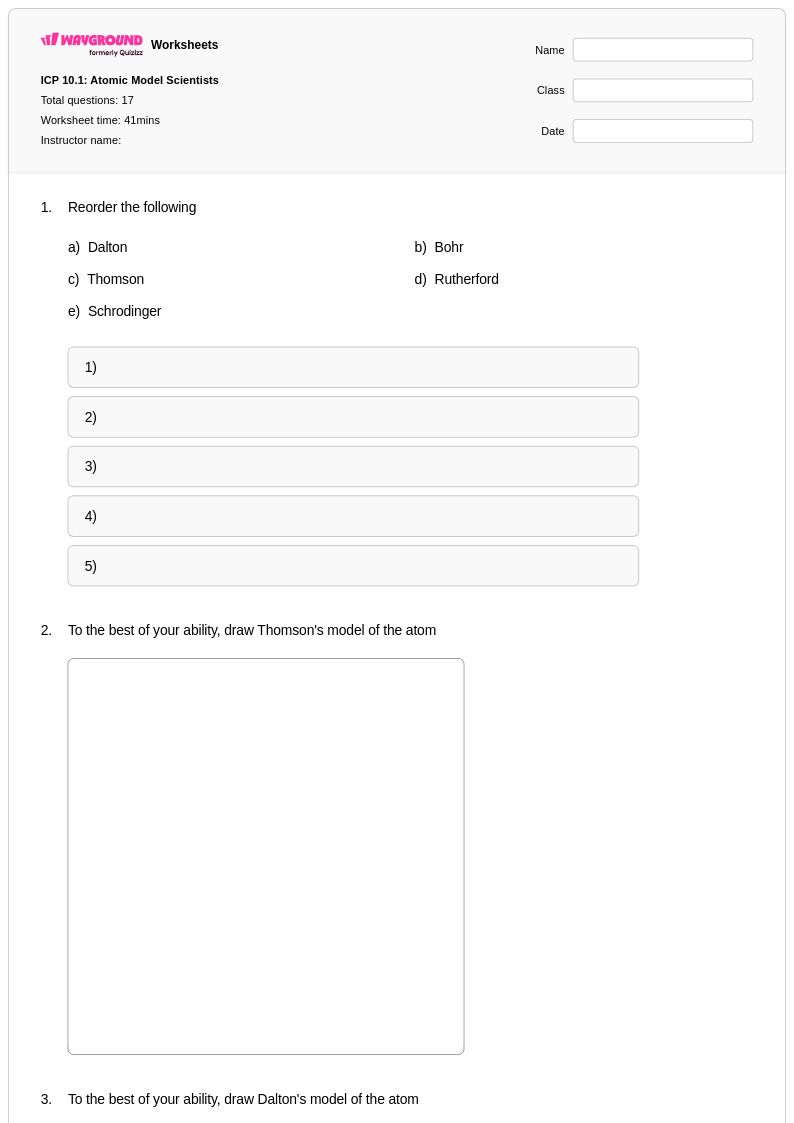
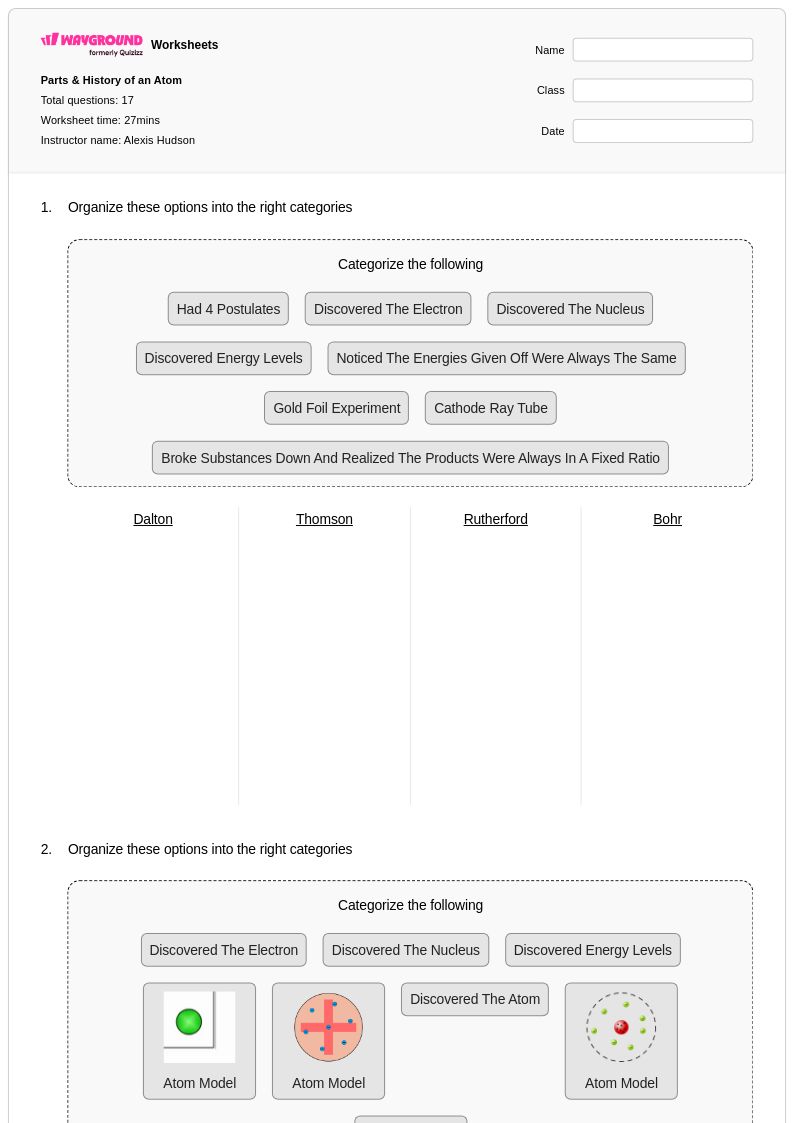
Models of atoms worksheets for Class 10 students available through Wayground (formerly Quizizz) provide comprehensive coverage of atomic theory development and structural representations that form the foundation of modern chemistry understanding. These expertly designed practice problems guide students through the evolution of atomic models, from Dalton's solid sphere concept through Thomson's plum pudding model, Rutherford's nuclear model, and Bohr's planetary model to the contemporary quantum mechanical model. The worksheets strengthen critical analytical skills by having students compare and contrast different atomic theories, interpret experimental evidence that led to model revisions, and apply electron configuration principles using various representational methods. Each printable resource includes detailed answer keys that support independent learning and self-assessment, while the free pdf format ensures accessibility for diverse classroom environments and homework assignments.
Wayground (formerly Quizizz) empowers chemistry educators with millions of teacher-created atomic model worksheets that feature robust search and filtering capabilities aligned with national and state chemistry standards for Class 10 coursework. The platform's differentiation tools allow instructors to customize atomic theory content based on individual student needs, whether providing remediation for struggling learners or enrichment activities for advanced students ready to explore quantum mechanical concepts in greater depth. Teachers can seamlessly adapt these resources between printable and digital formats, facilitating flexible lesson planning that accommodates both traditional classroom instruction and modern technology-enhanced learning environments. The extensive collection supports systematic skill practice through scaffolded problem sets, enabling educators to track student progress in understanding atomic structure concepts while providing targeted intervention strategies for complex topics like electron orbital arrangements and atomic model limitations.
FAQs
How do I teach the historical development of atomic models in sequence?
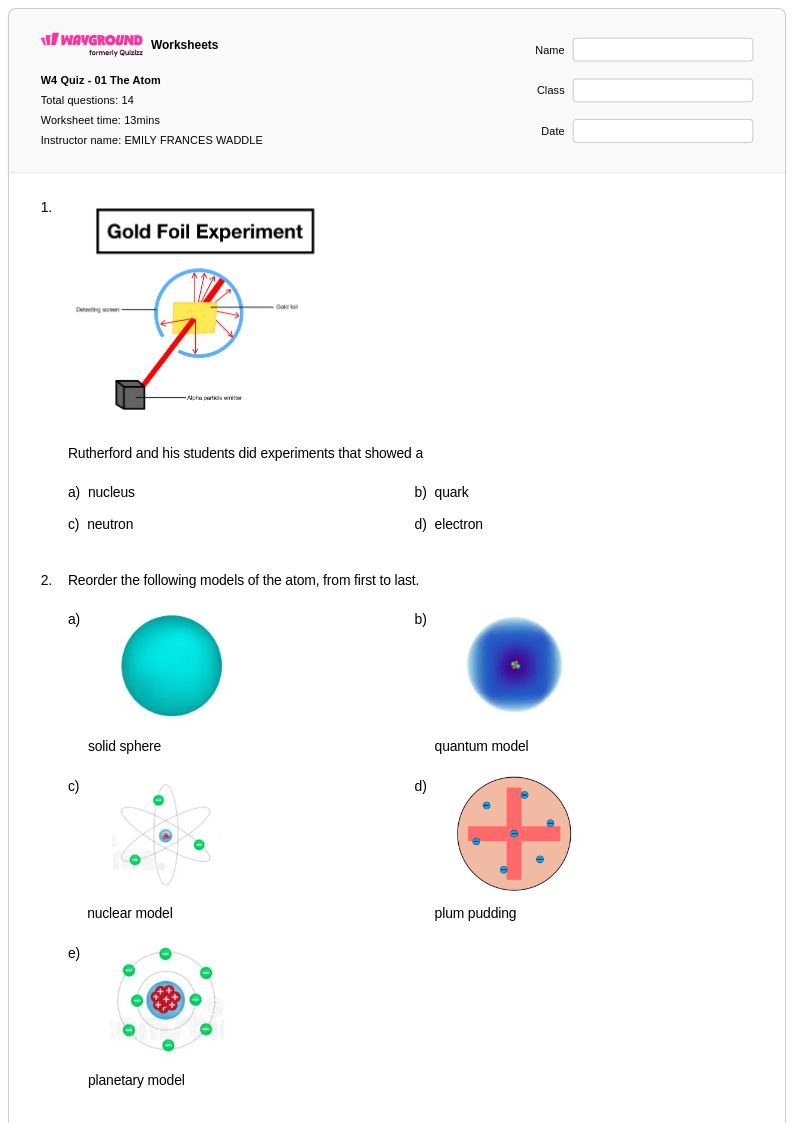
Teach atomic models chronologically by progressing through Dalton's solid sphere model, Thomson's plum pudding model, Rutherford's nuclear model, Bohr's planetary model, and finally the modern quantum mechanical model. For each model, anchor instruction around the experimental evidence that prompted the revision — this helps students understand that science evolves through observation rather than arbitrary change. Connecting each transition to a key experiment, such as Rutherford's gold foil experiment, gives students concrete cause-and-effect anchors for the progression.
What are the most common mistakes students make when comparing atomic models?
Students frequently treat earlier atomic models as simply 'wrong' rather than understanding them as useful approximations that were revised as new evidence emerged. A related misconception is conflating the Bohr model with the modern quantum mechanical model — students often assume electrons travel in fixed circular orbits rather than existing in probabilistic regions called orbitals. Explicitly addressing why each model was accepted in its time, and what experimental anomaly it could not explain, helps students move past these errors.
What practice exercises help students understand the strengths and limitations of different atomic models?
Effective practice includes side-by-side comparison tasks where students identify what each model accurately predicts and where it breaks down — for example, why the Bohr model works for hydrogen but fails for multi-electron atoms. Evidence-matching exercises, where students connect specific experimental results to the model revision they caused, build analytical reasoning alongside content knowledge. These structured activities develop the critical thinking skills students need to evaluate scientific models rather than simply memorize them.
How can I use atomic models worksheets to assess student understanding?
Use atomic models worksheets formatively by assigning tasks that require students to explain the reasoning behind each model revision, not just identify the models by name. Questions that ask students to predict what a given model would or would not be able to explain reveal deeper conceptual understanding than recall-based items. Including diagram labeling, evidence analysis, and short justification prompts within the same worksheet gives teachers a more complete picture of where each student's understanding stands.
How do I use Wayground's Models of Atoms worksheets in my classroom?
Wayground's Models of Atoms worksheets are available as printable PDFs for traditional classroom use and in digital formats for technology-integrated environments, including the option to host them as a quiz directly on Wayground. Each worksheet includes a complete answer key, supporting both independent student work and teacher-led instruction. The platform's search and filtering tools allow teachers to locate materials that match their specific curriculum scope, whether covering introductory atomic theory or more advanced quantum mechanical concepts. For students who need additional support, Wayground's accommodation settings allow teachers to enable features such as read aloud, extended time, or reduced answer choices on an individual basis.
How do I differentiate atomic models instruction for students at different levels?
For students who are still building foundational understanding, focus instruction on the visual and conceptual differences between models before introducing the experimental evidence. Advanced learners benefit from tasks that require them to evaluate the quantum mechanical model's limitations and discuss what modern particle physics has added beyond it. On Wayground, teachers can apply individual accommodations such as read aloud support or reduced answer choices for students who need them, while the rest of the class works with standard settings, allowing differentiation without disrupting the flow of the lesson.