Free Printable Single and Double Replacement Reactions Worksheets for Class 10
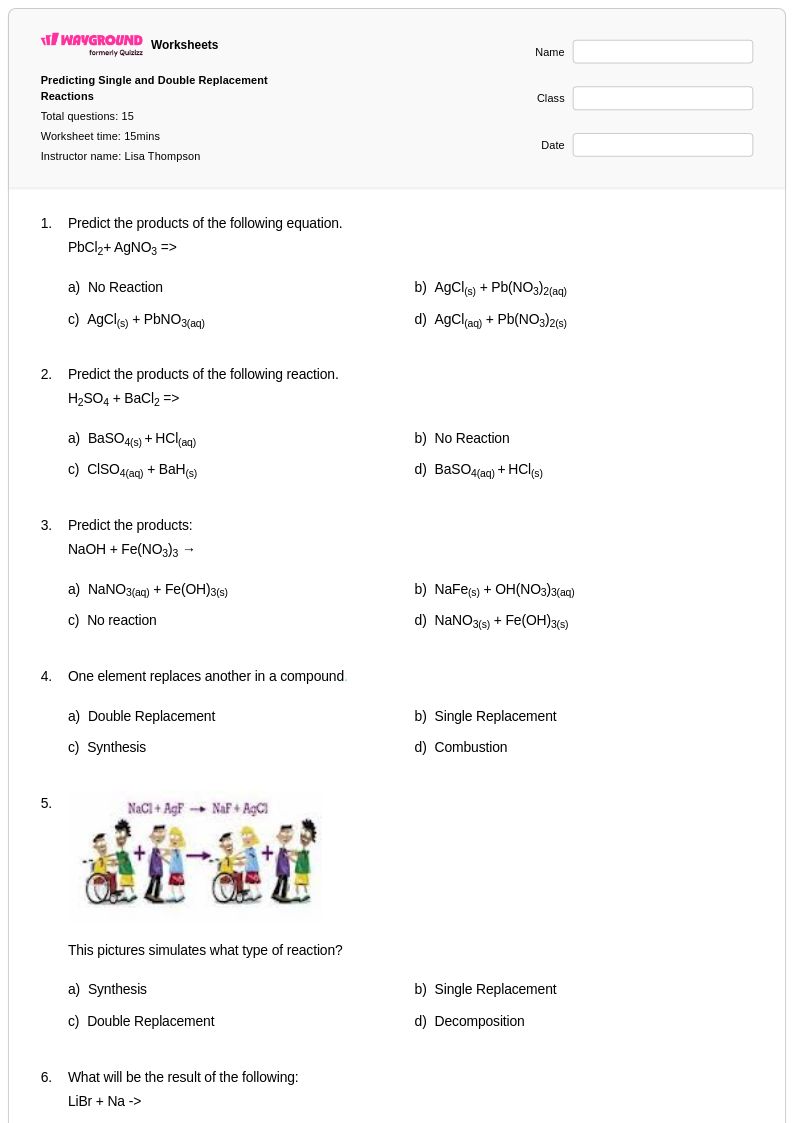
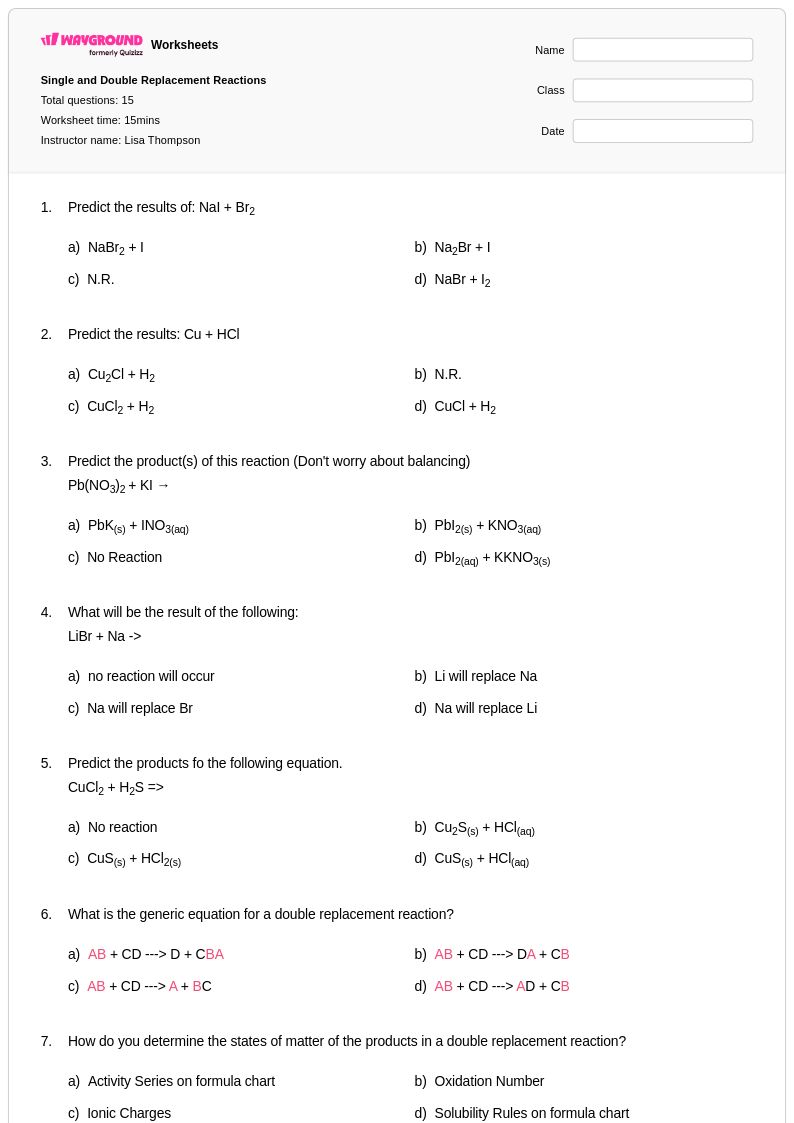
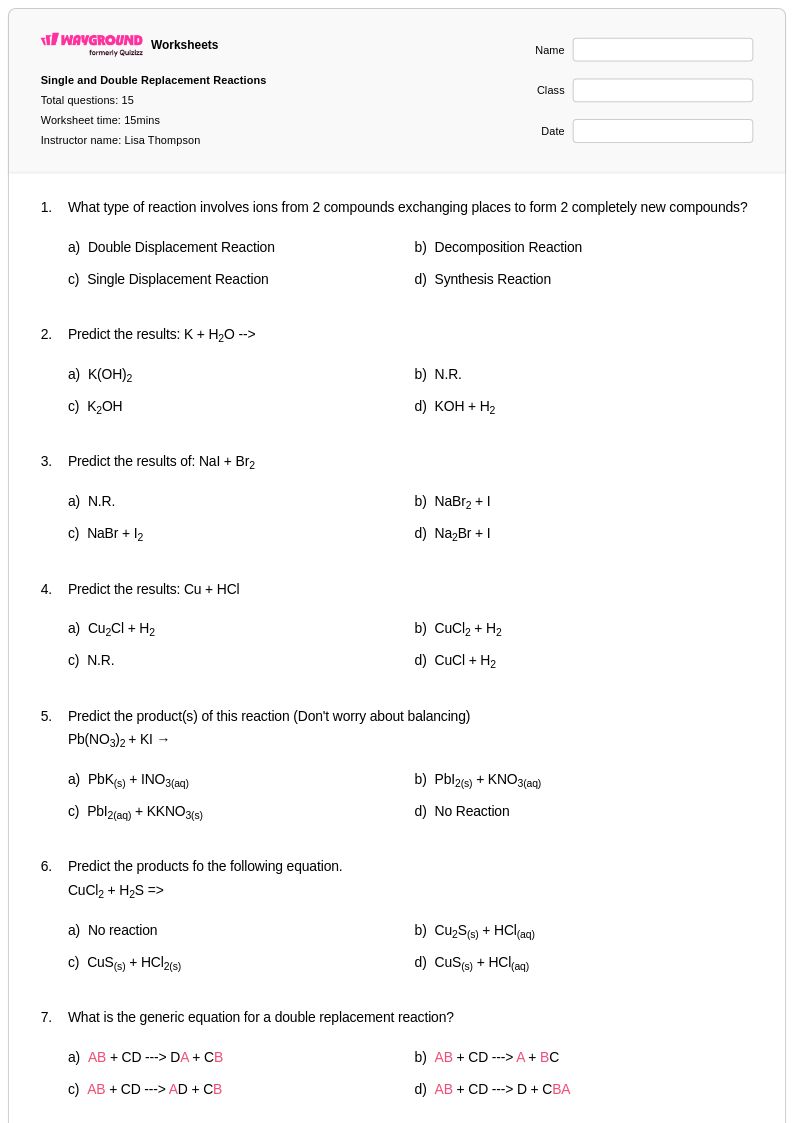
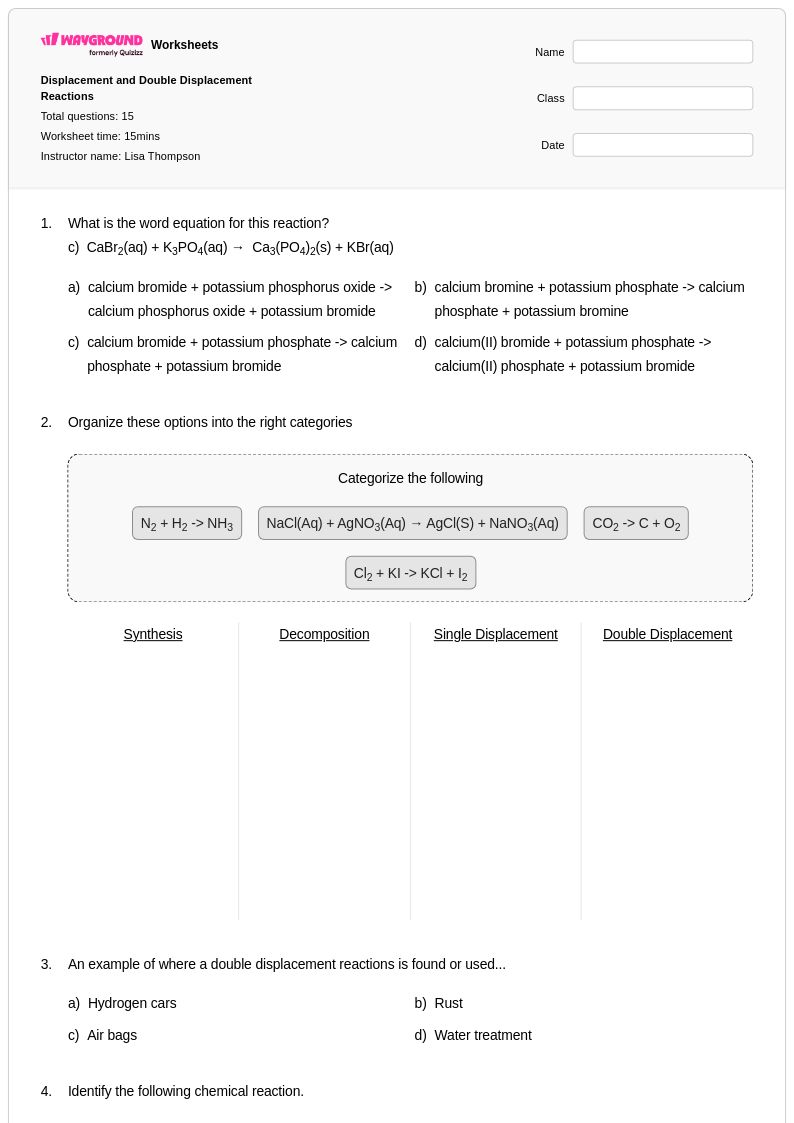
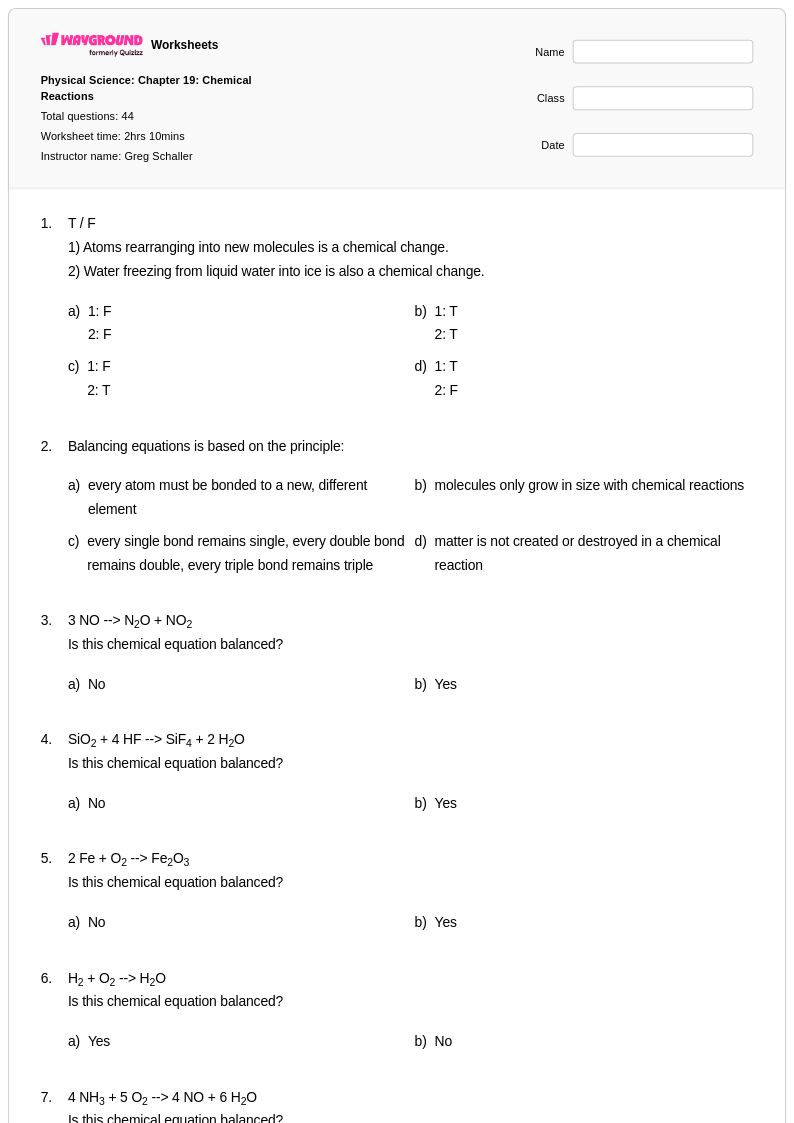
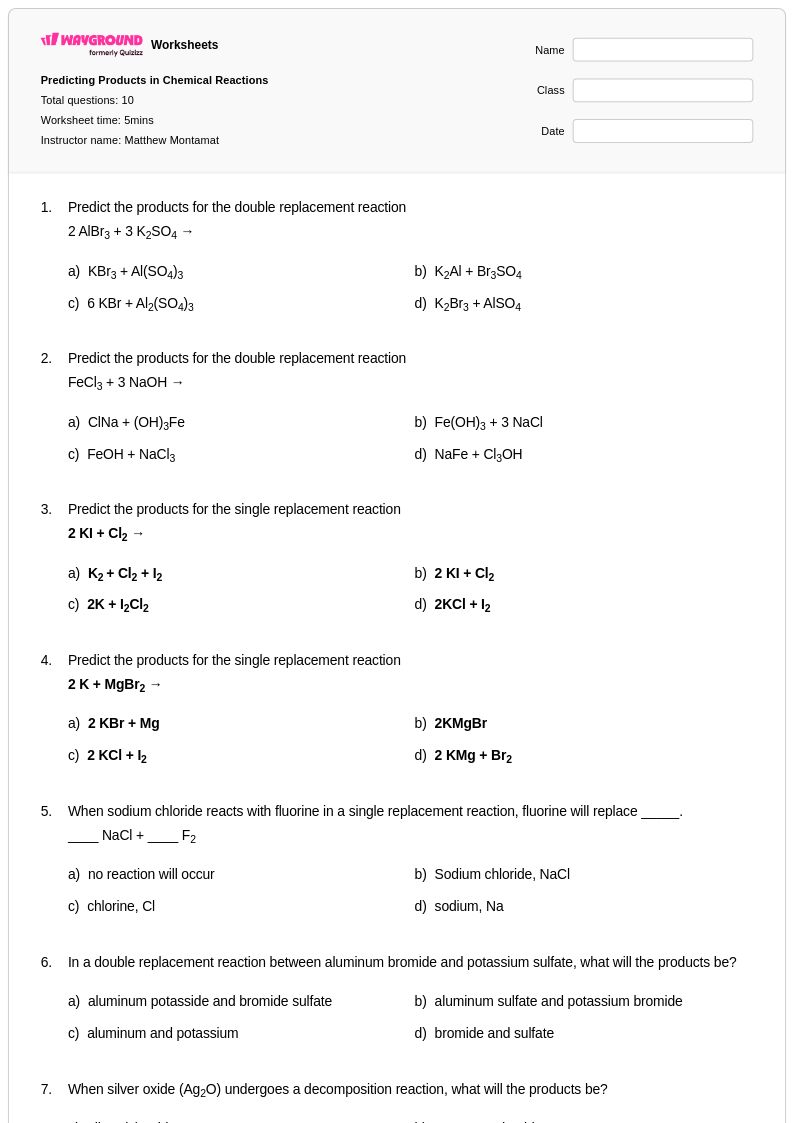
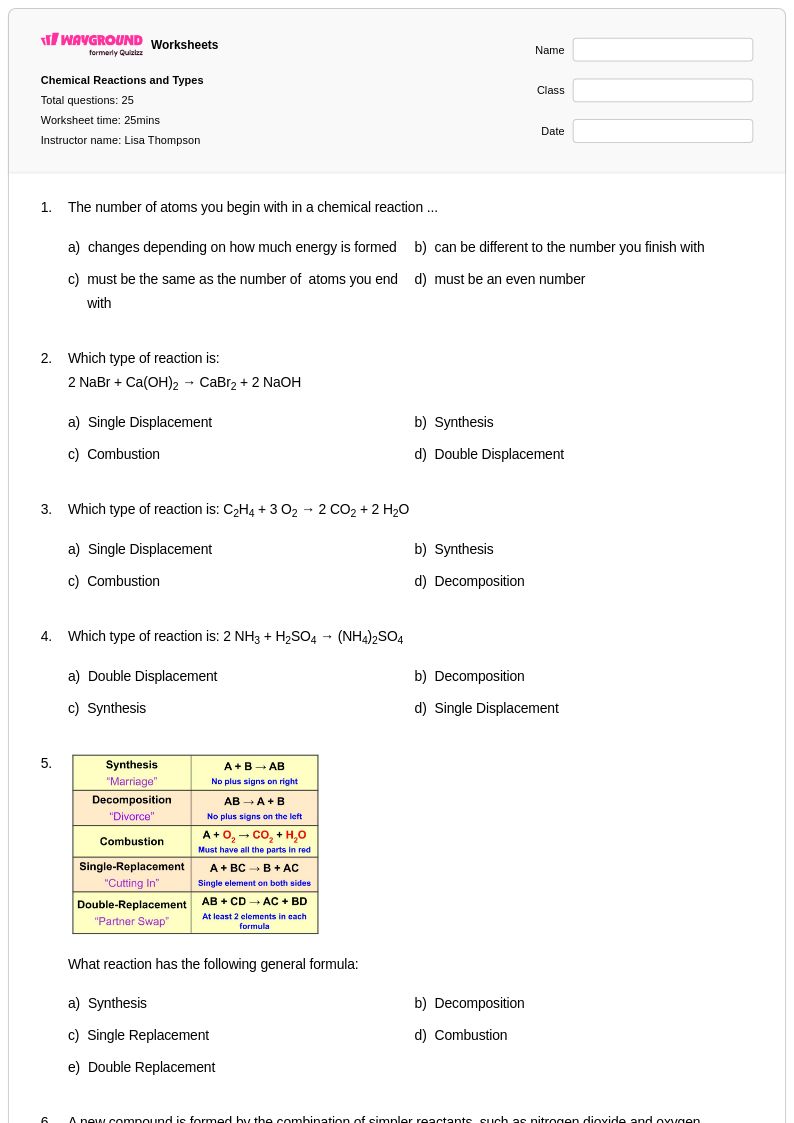
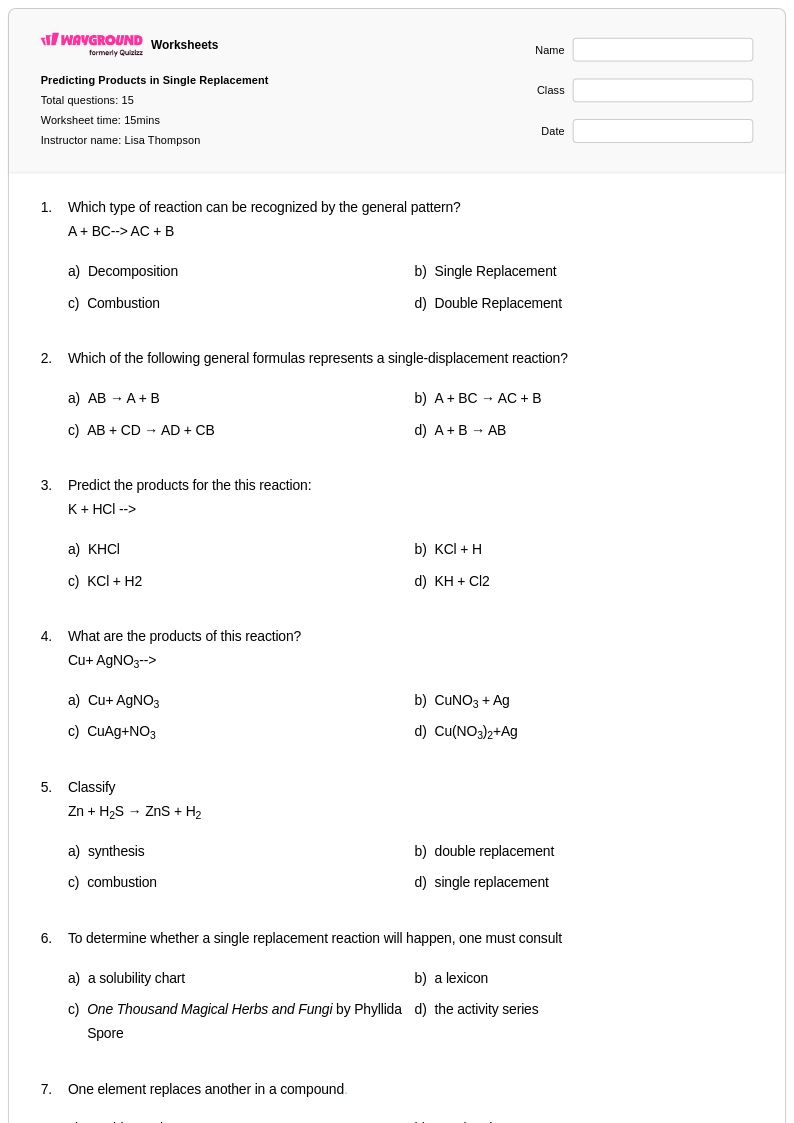
Class 10 single and double replacement reactions worksheets from Wayground offer comprehensive printables and practice problems with answer keys to help students master chemical equation balancing and reaction prediction skills.
Explore printable Single and Double Replacement Reactions worksheets for Class 10
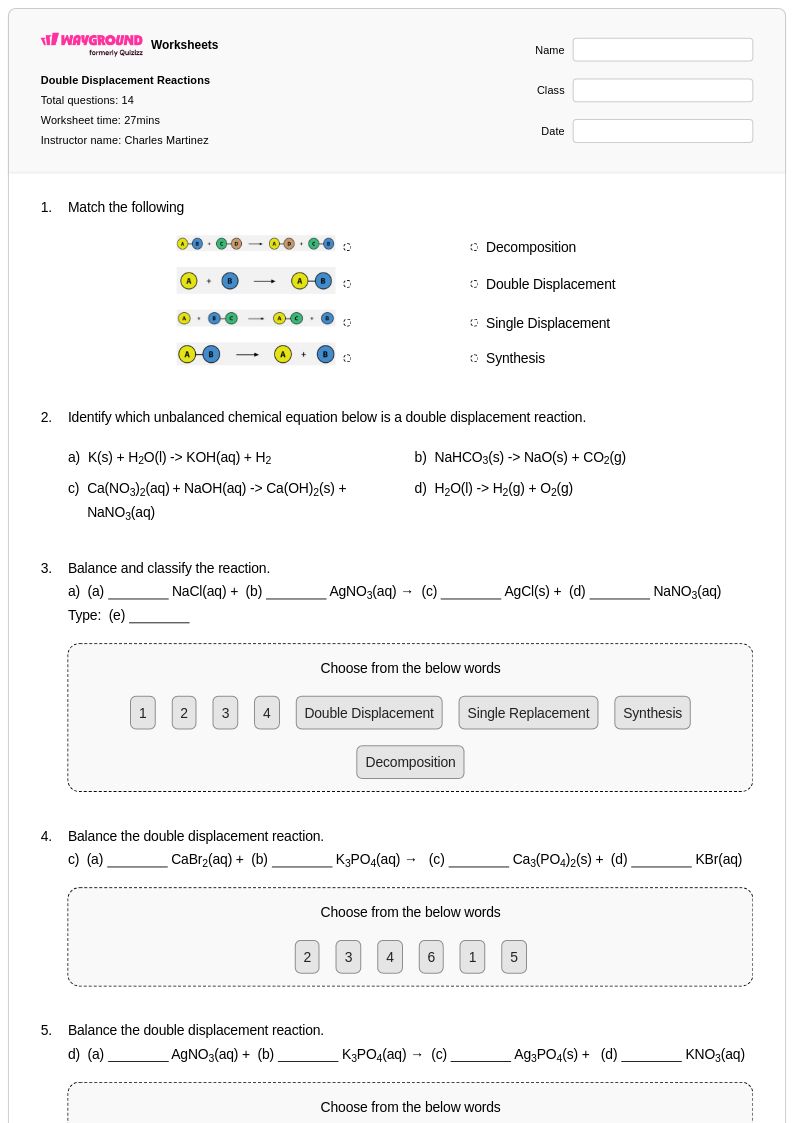
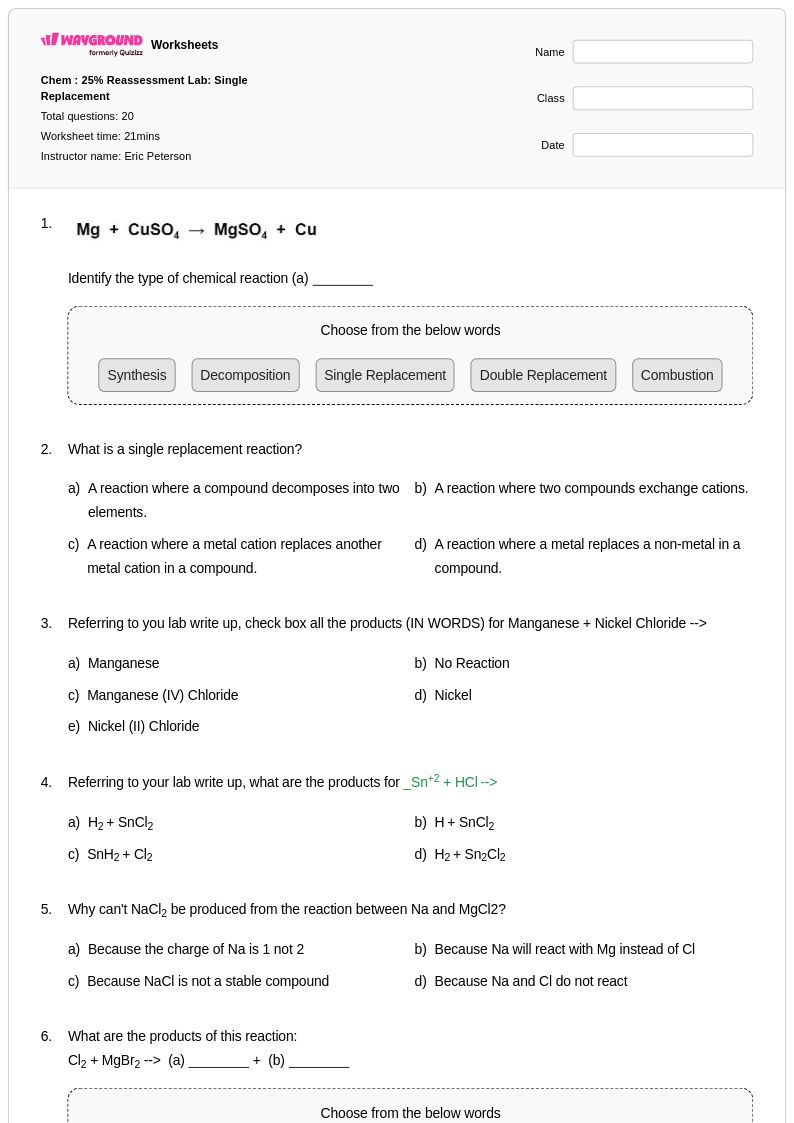
Single and double replacement reactions represent fundamental concepts in Class 10 chemistry that require systematic practice to master the prediction of products and balancing of chemical equations. Wayground's comprehensive worksheet collection focuses specifically on these reaction types, providing students with extensive practice problems that strengthen their ability to identify reactants, predict products using activity series, and apply solubility rules. These worksheets feature carefully scaffolded exercises ranging from basic pattern recognition to complex multi-step problems, complete with answer keys that enable independent learning and self-assessment. The free printable resources include detailed explanations of reaction mechanisms, helping students understand when metals displace other metals in compounds and when ions exchange partners in aqueous solutions, making these essential chemistry concepts accessible through structured practice.
Wayground's platform empowers teachers with millions of teacher-created resources specifically designed for single and double replacement reactions, offering robust search and filtering capabilities that align with chemistry curriculum standards. Educators can easily locate worksheets that match their students' proficiency levels and customize content to address individual learning needs, whether for remediation of struggling learners or enrichment activities for advanced students. The platform's differentiation tools allow teachers to modify problem complexity and provide additional scaffolding, while the availability of both printable pdf formats and digital versions ensures flexible implementation across diverse classroom environments. These comprehensive worksheet collections streamline lesson planning by providing ready-to-use materials that support skill practice, formative assessment, and reinforcement of critical chemical reaction concepts throughout the Class 10 chemistry curriculum.
FAQs
How do I teach single and double replacement reactions in chemistry?
Start by grounding students in the activity series and solubility rules before introducing reaction prediction. For single replacement, teach students to compare the reactivity of the free element against the element it displaces using the activity series. For double replacement, focus on identifying when a precipitate, gas, or water forms as the driving force for the reaction. Scaffolding these concepts in sequence — reactivity first, then product prediction, then balancing — helps students build procedural fluency alongside conceptual understanding.
What exercises help students practice predicting products in replacement reactions?
The most effective practice involves presenting students with unbalanced, incomplete equations and asking them to predict whether a reaction occurs and, if so, what the products are. Exercises that require students to reference the activity series for single replacement reactions and apply solubility rules for double replacement reactions build the decision-making habits they need for assessments. Varied problem sets that mix both reaction types also help students practice distinguishing between them before writing and balancing the full equation.
What mistakes do students commonly make with single and double replacement reactions?
The most frequent error in single replacement reactions is failing to check the activity series before predicting a reaction — students often write products even when no reaction should occur. In double replacement reactions, students commonly swap only one pair of ions rather than both, or forget to apply solubility rules to determine whether a precipitate actually forms. Another persistent mistake is writing unbalanced equations and treating them as complete. Explicitly requiring students to show their activity series and solubility rule reasoning step-by-step reduces these errors significantly.
How do I differentiate replacement reaction worksheets for students at different skill levels?
For struggling students, begin with single replacement problems that use only the most common metals from the activity series, and provide the activity series and solubility tables as references. Advanced students can work with problems that omit these references, include less familiar elements, or require them to explain why a reaction does or does not occur. On Wayground, teachers can apply accommodations such as reduced answer choices or read-aloud support to individual students, while other students receive the standard version, keeping differentiation seamless within a single assignment.
How can I use Wayground's single and double replacement reaction worksheets in my classroom?
Wayground's worksheets are available as printable PDFs for traditional classroom use and in digital formats for technology-integrated environments, making them flexible for homework, lab preparation, or in-class review. Teachers can also host the material as a quiz directly on Wayground, allowing for real-time student responses and immediate feedback. Each worksheet includes a complete answer key, which supports both self-paced independent study and teacher-led instruction.
How do solubility rules connect to double replacement reactions?
Solubility rules are essential for double replacement reactions because they determine whether the reaction actually proceeds. When the two reactants exchange ion partners, a reaction occurs only if one of the new compounds is insoluble (forming a precipitate), a gas, or water. Without applying solubility rules, students cannot accurately determine the products or confirm that a reaction takes place. Teaching solubility rules as a prerequisite — not a parallel topic — sets students up to approach double replacement reactions with the right analytical framework.