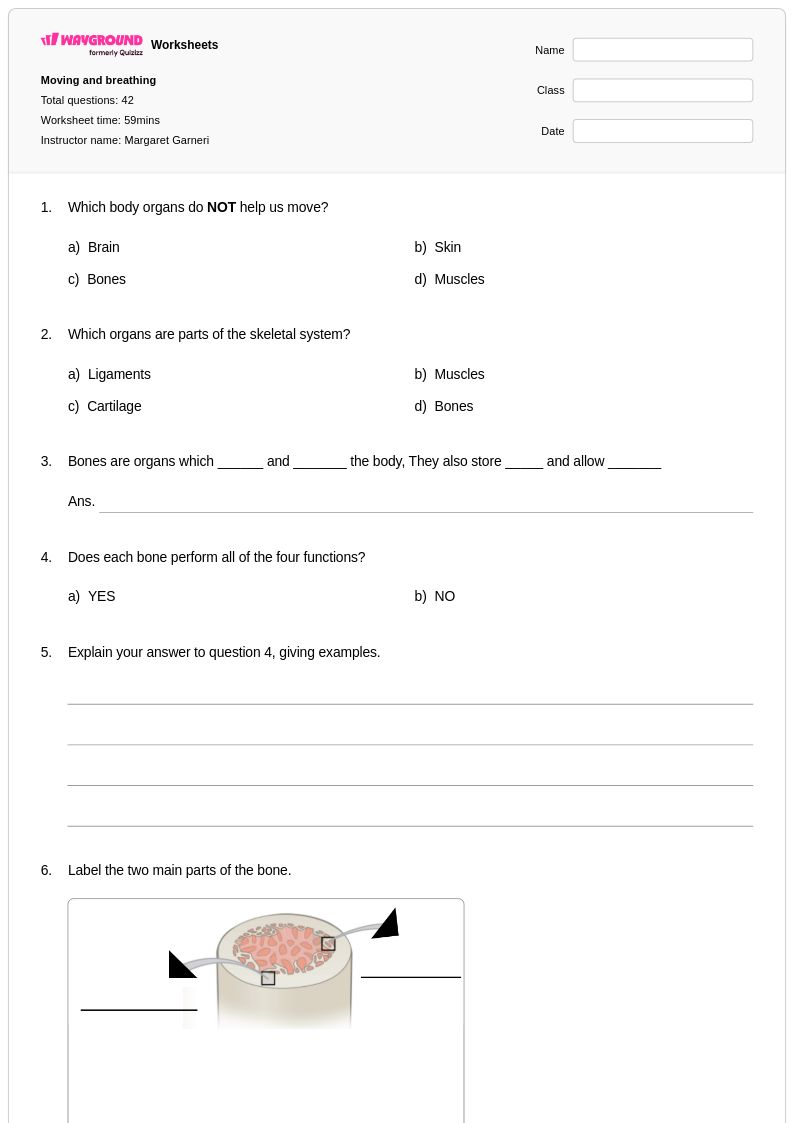
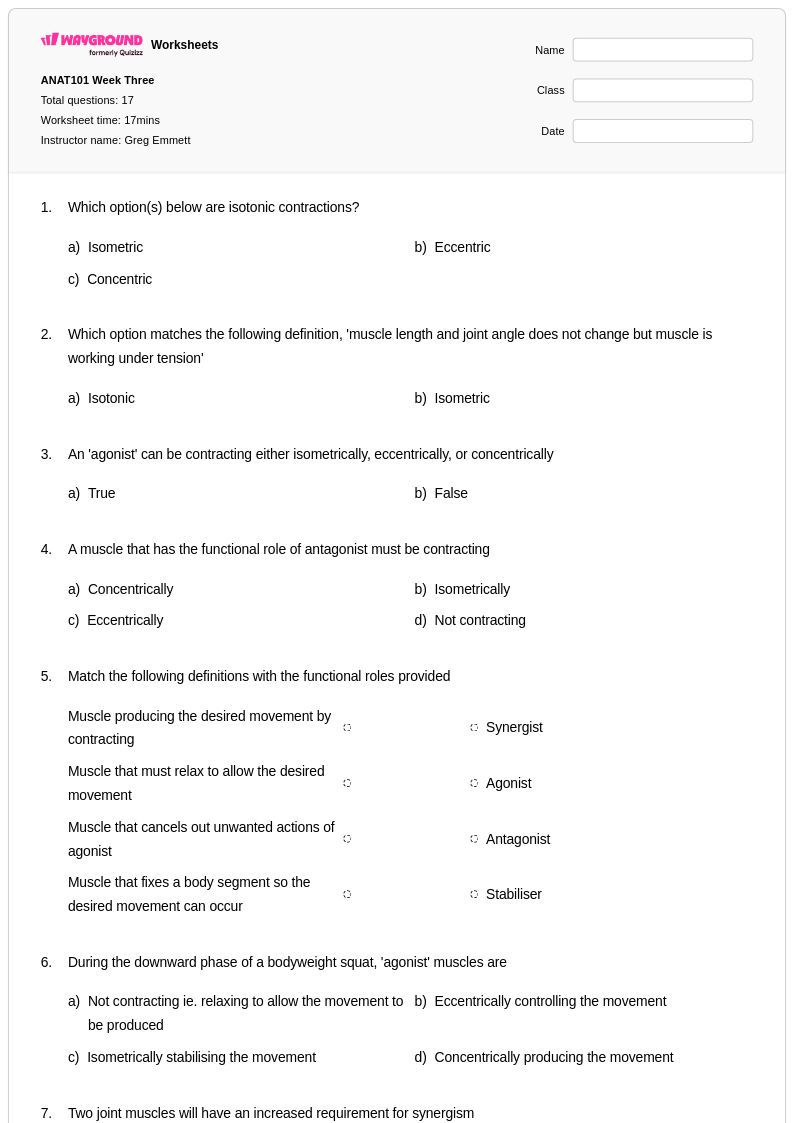
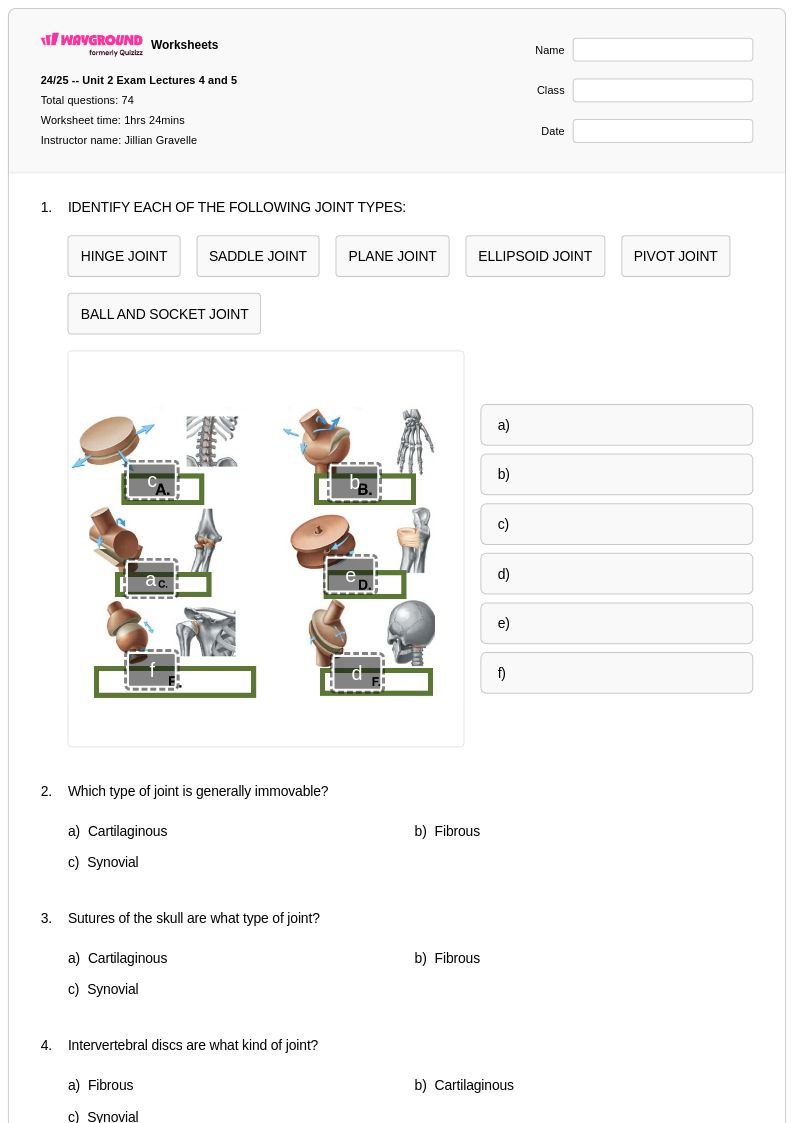
Explore free printable biology worksheets focused on movement at joints, featuring comprehensive practice problems and answer keys to help students master how different joint types enable body movement and flexibility.
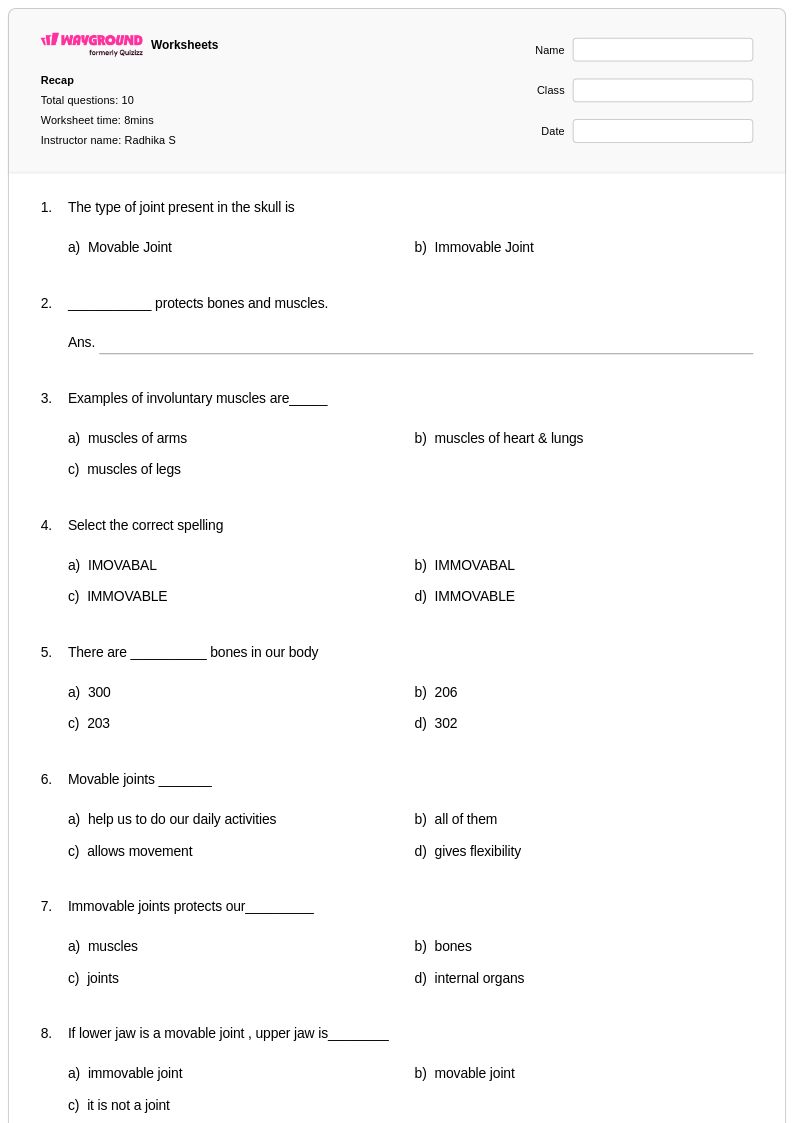
Movement at joints worksheets available through Wayground (formerly Quizizz) provide comprehensive resources for students to explore the biomechanics and physiology of human articulation. These expertly designed worksheets focus on the various types of joint movements including flexion, extension, abduction, adduction, rotation, and circumduction, helping students understand how synovial, cartilaginous, and fibrous joints facilitate different ranges of motion throughout the skeletal system. Each worksheet strengthens critical analytical skills by challenging students to identify specific joint types, classify movement patterns, and connect anatomical structures to their functional roles in human locomotion. The collection includes detailed practice problems with accompanying answer keys, ensuring students can self-assess their understanding of complex concepts like antagonistic muscle pairs and the relationship between joint structure and mobility. These free printable resources serve as essential tools for reinforcing classroom instruction and building foundational knowledge in human anatomy and kinesiology.
Wayground (formerly Quizizz) supports educators with an extensive library of millions of teacher-created movement at joints worksheets, offering robust search and filtering capabilities that allow instructors to quickly locate resources aligned with specific learning objectives and educational standards. The platform's differentiation tools enable teachers to customize worksheet difficulty levels and content focus areas, making it simple to address diverse learning needs within a single classroom through targeted remediation and enrichment activities. Teachers can access these resources in both digital and printable PDF formats, providing flexibility for various instructional settings and student preferences while maintaining consistent quality and academic rigor. The comprehensive filtering system allows educators to efficiently plan lessons, identify gaps in student understanding, and implement targeted skill practice sessions that reinforce key concepts about joint mechanics, movement terminology, and the integration of skeletal and muscular systems in human movement.
FAQs
How do I teach movement at joints in a biology or anatomy class?
Start by establishing the three structural joint categories — synovial, cartilaginous, and fibrous — before introducing movement terminology like flexion, extension, abduction, adduction, rotation, and circumduction. Using physical demonstrations or having students move their own limbs while naming the action helps anchor abstract vocabulary to lived experience. From there, connecting joint structure to function (why a ball-and-socket joint allows circumduction while a hinge joint does not) builds the analytical thinking students need for assessments.
What exercises help students practice identifying types of movement at joints?
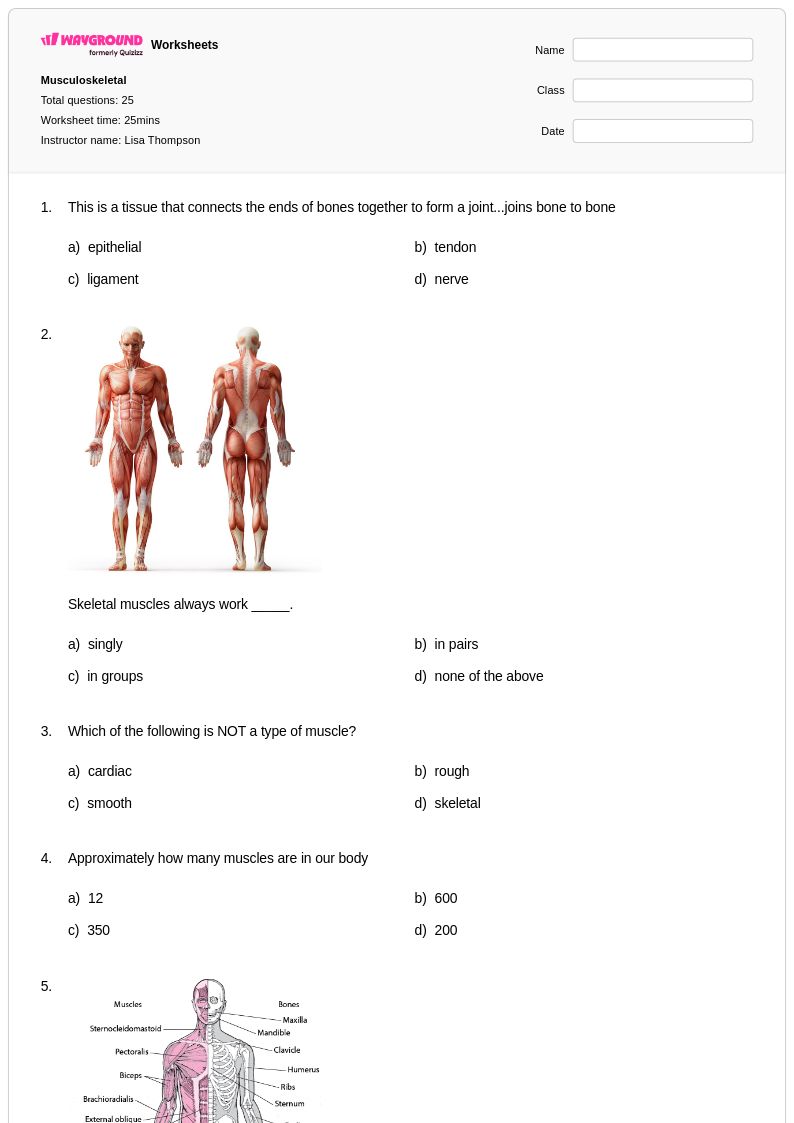
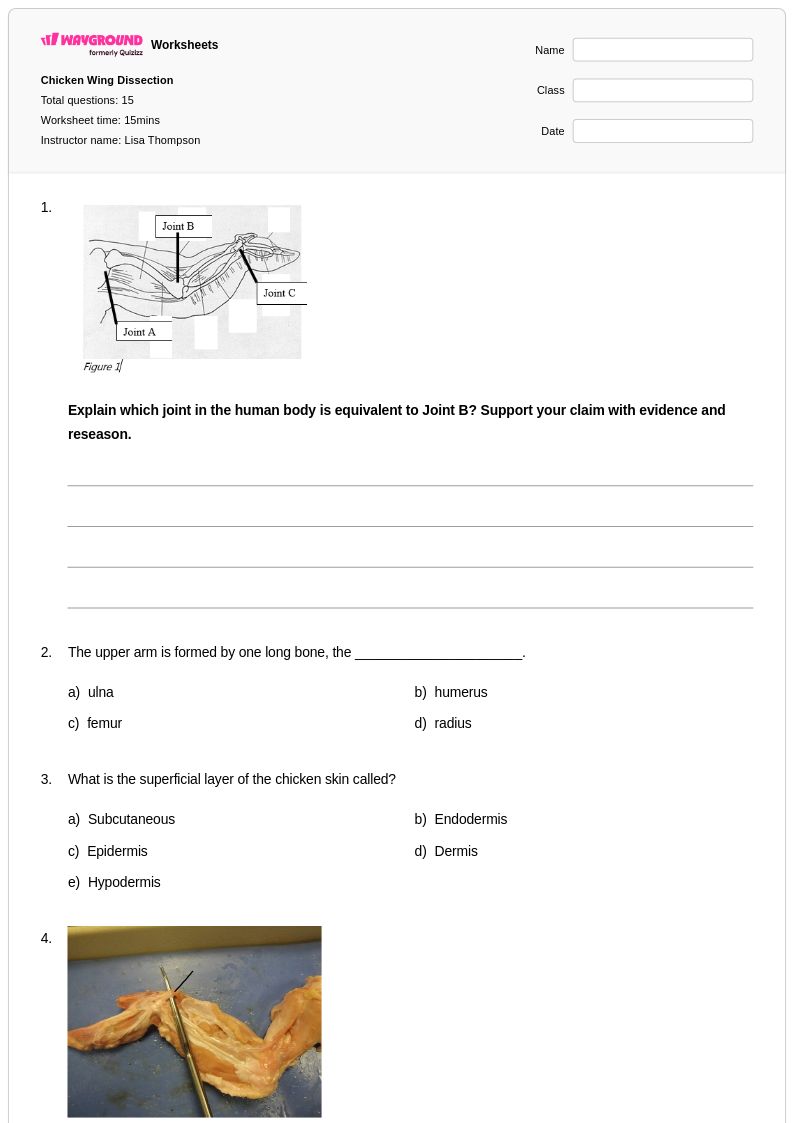
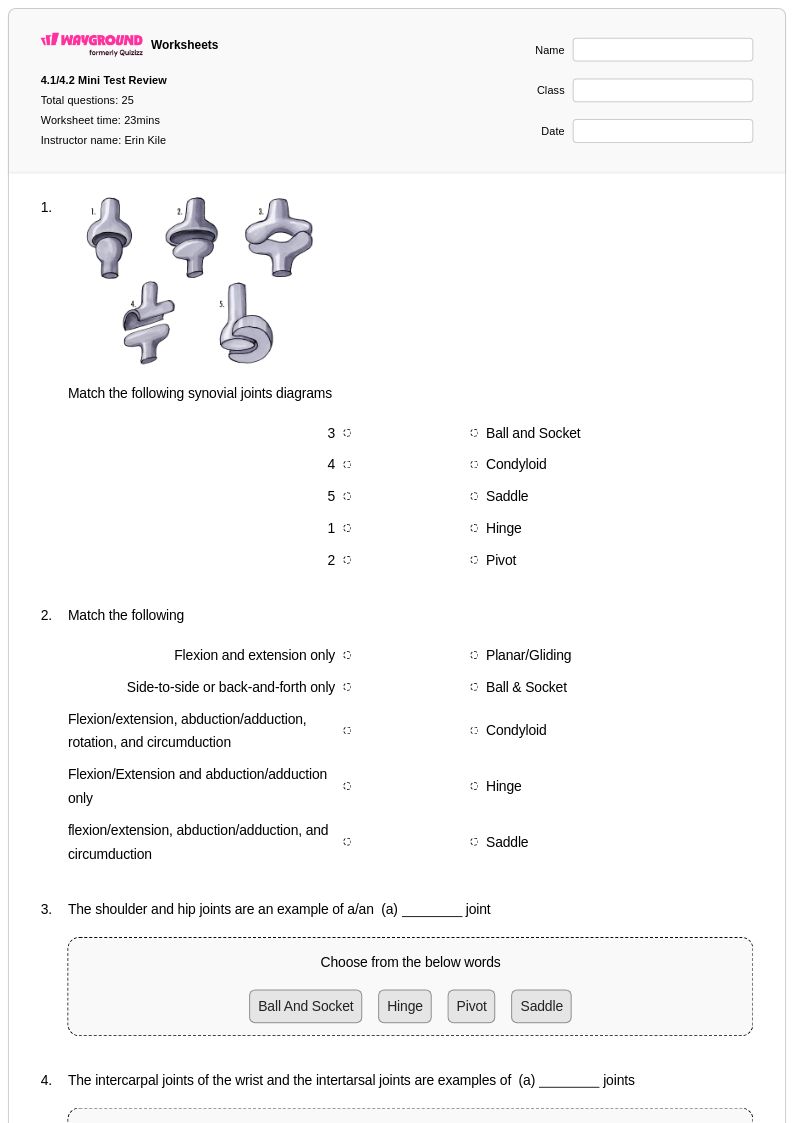
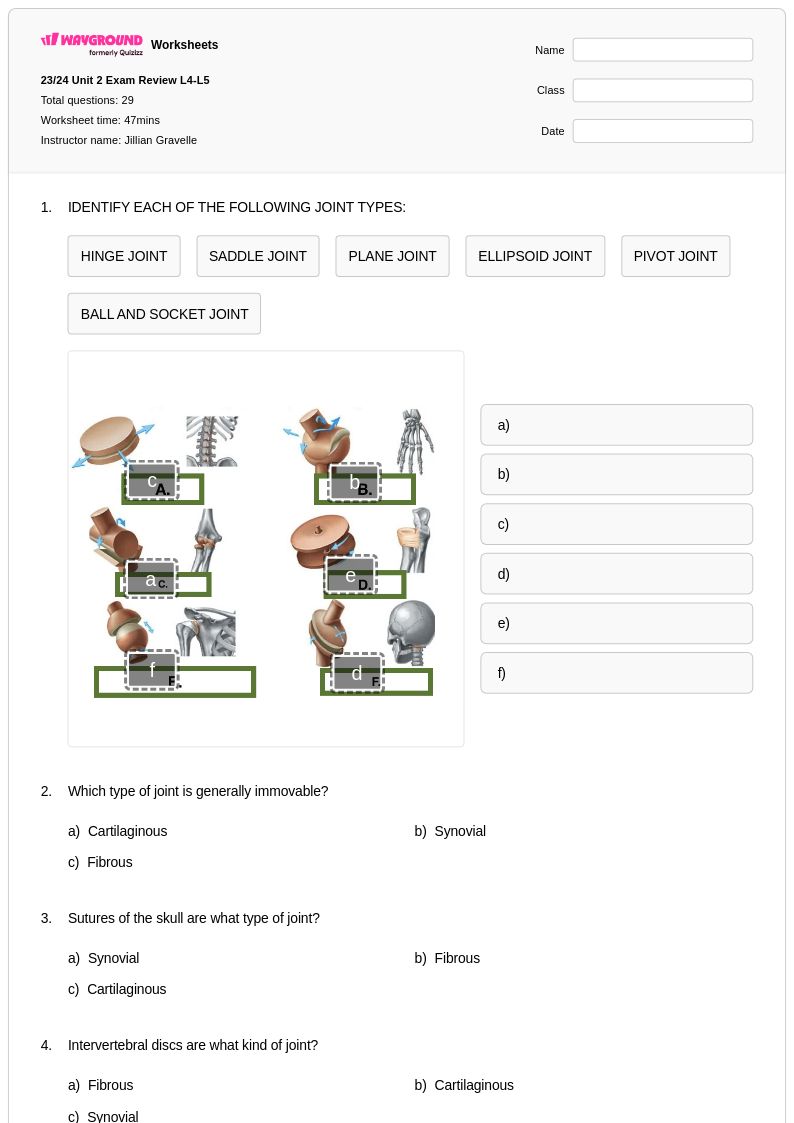
Effective practice activities include classification tasks where students match movement terms to labeled diagrams of the skeleton, as well as scenario-based problems asking students to identify which joint type and movement pattern are involved in a specific action like throwing a ball or bending the knee. Worksheets that ask students to connect antagonistic muscle pairs to their corresponding joint movements are especially valuable for reinforcing the muscular and skeletal system relationship. Repeated practice with answer keys allows students to self-correct and consolidate the terminology before formal assessment.
What mistakes do students commonly make when learning about joint movement?
One of the most frequent errors is confusing abduction and adduction — students often reverse the two, especially under test conditions. Students also commonly misclassify joint types by focusing on location rather than structure, for example assuming all limb joints are synovial without considering cartilaginous joints like the intervertebral discs. Another persistent misconception is treating flexion and extension as universal descriptors without recognizing that context matters, particularly at the ankle where the terminology shifts to plantarflexion and dorsiflexion.
How can I differentiate movement at joints worksheets for students with different learning needs?
For students who need additional support, reduce the number of answer choices on classification tasks to lower cognitive load and allow more time on timed activities. Wayground supports individual student accommodations including extended time per question, read-aloud functionality for students who benefit from hearing content, reduced answer choices, and adjustable font sizes and reading themes — all configurable per student without notifying the rest of the class. Higher-level learners can be challenged with open-ended prompts that require them to explain the relationship between joint structure and range of motion rather than simply labeling diagrams.
How do I use movement at joints worksheets effectively in my classroom?
These worksheets work well as guided practice following direct instruction on joint types and movement terminology, or as review tools before a unit assessment. Wayground's movement at joints worksheets are available as printable PDFs for traditional classroom use and in digital formats for technology-integrated environments, and teachers can also host them as a quiz directly on the Wayground platform. The included answer keys allow students to self-assess independently, freeing up class time for discussion of higher-order concepts like how injury or aging affects joint mobility.
How do I connect movement at joints to the broader musculoskeletal system?
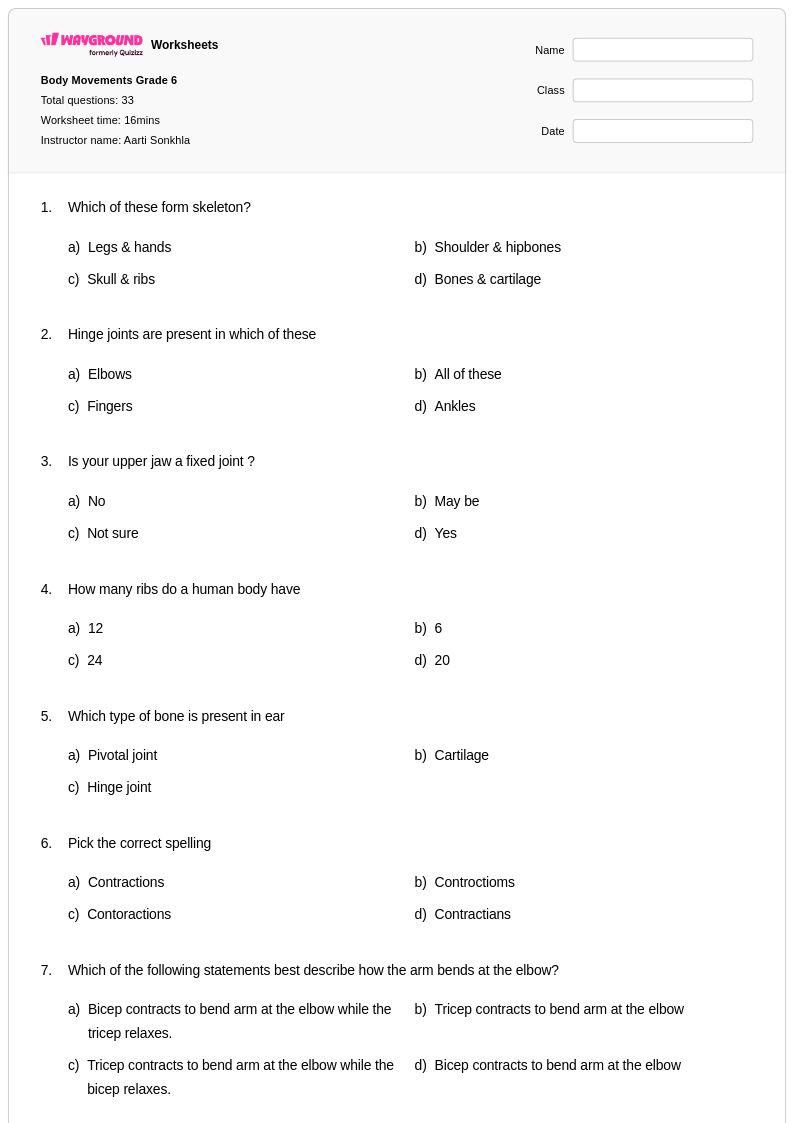
Joint movement cannot be fully understood without teaching antagonistic muscle pairs — the concept that one muscle contracts while its opposing muscle relaxes to produce controlled movement at a joint. Linking specific joint types to the muscles that act on them (for example, the biceps and triceps acting on the hinge joint at the elbow) gives students a functional framework rather than isolated vocabulary. This integrated approach also prepares students for topics like injury biomechanics, rehabilitation, and sports science.