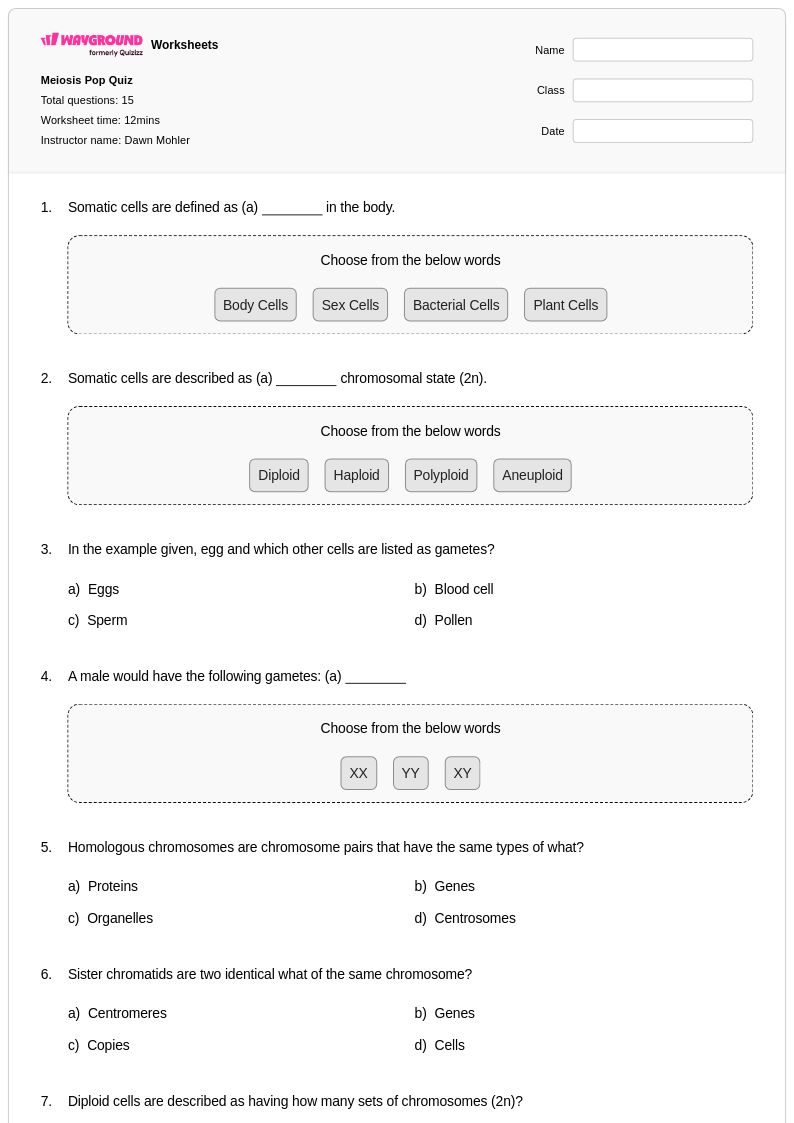
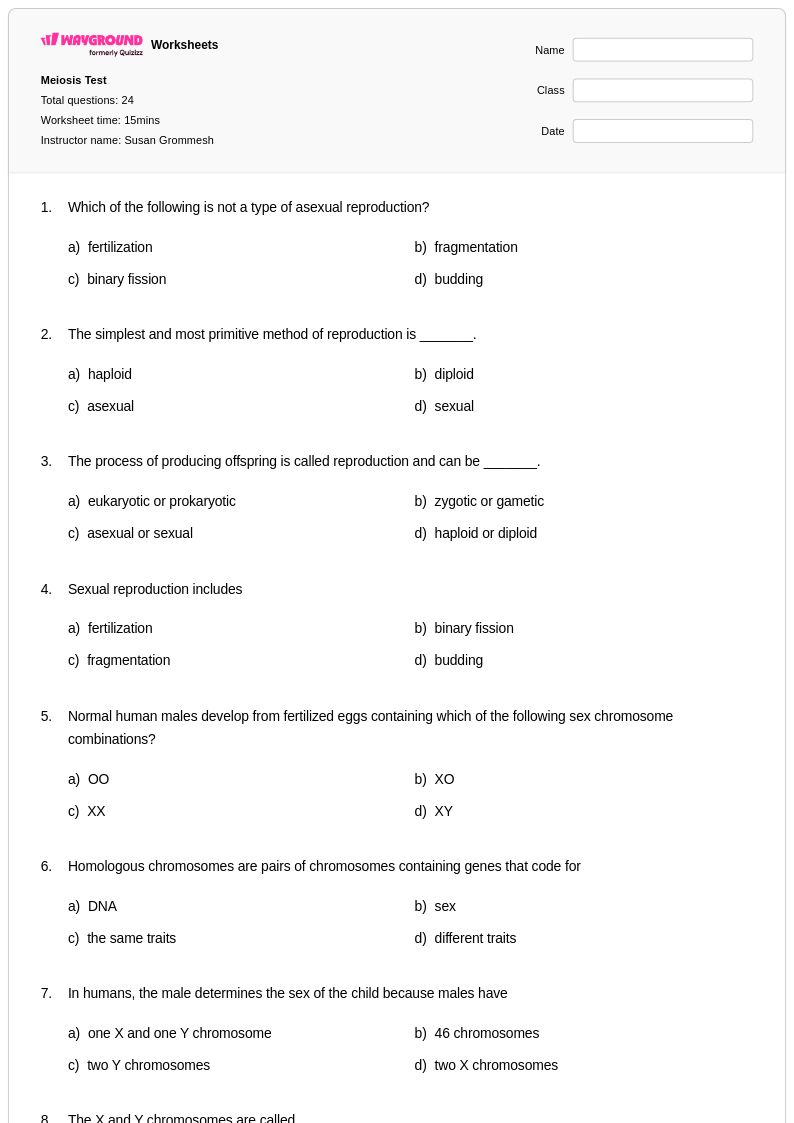
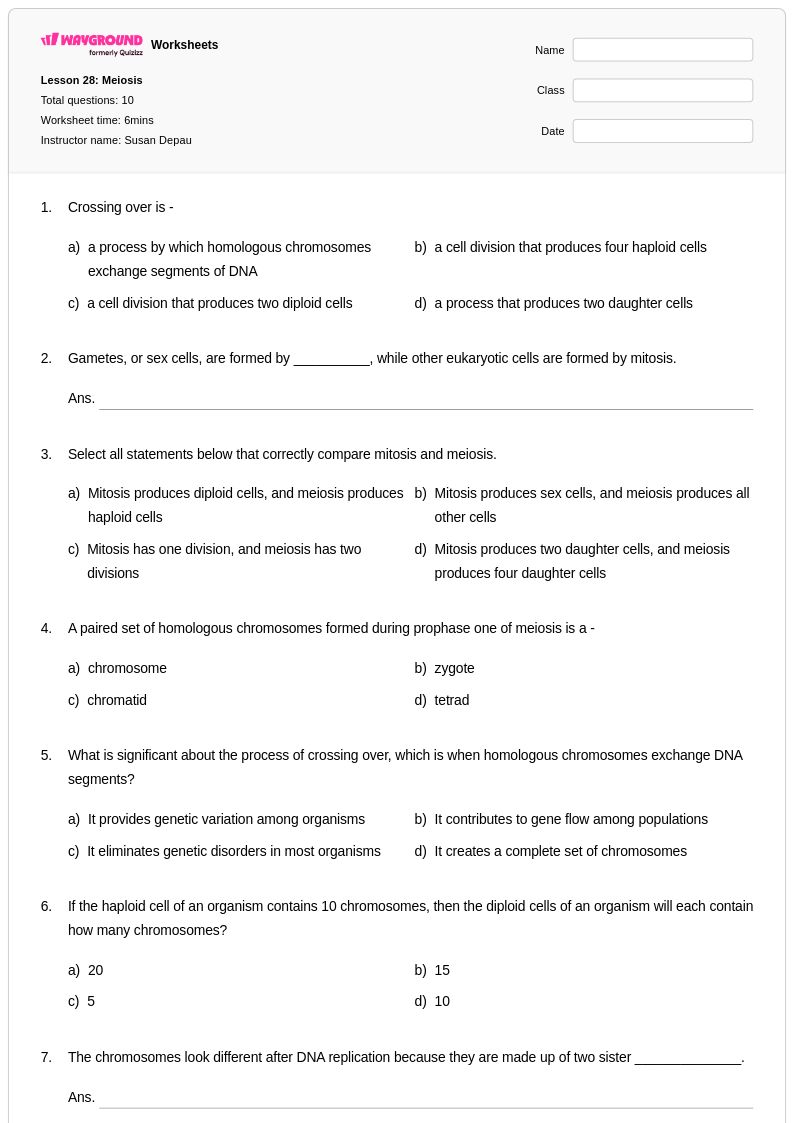
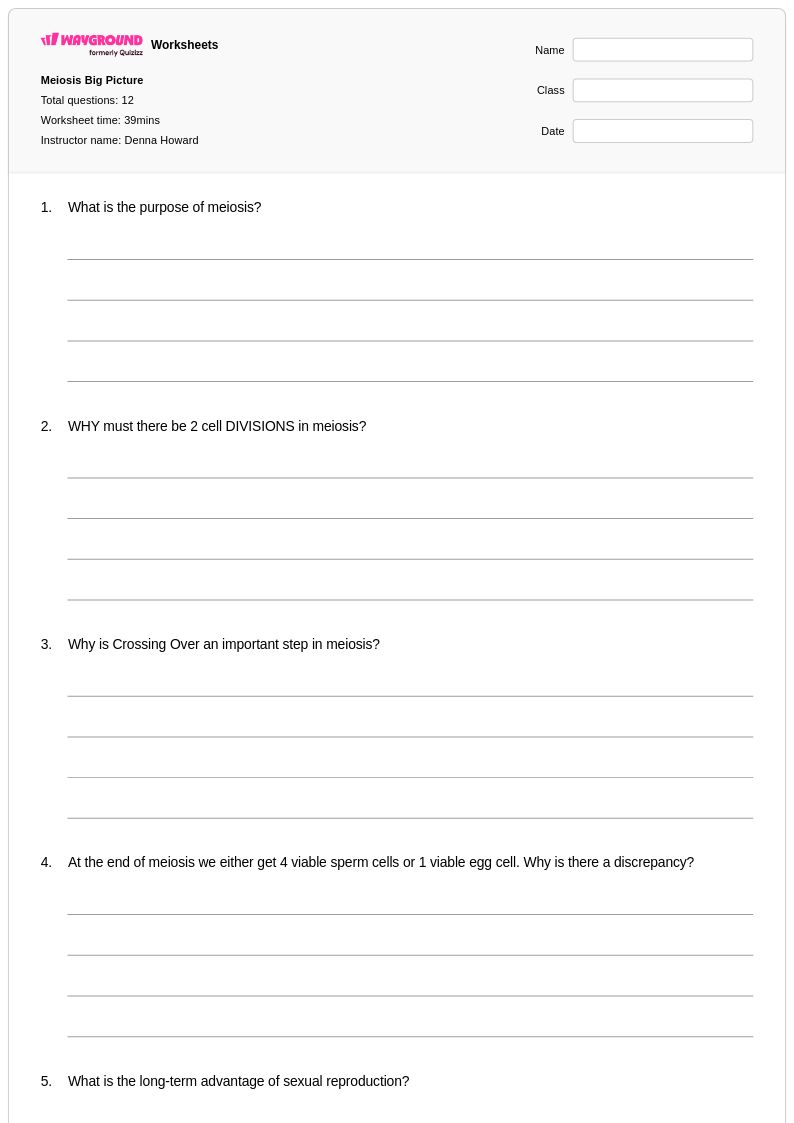
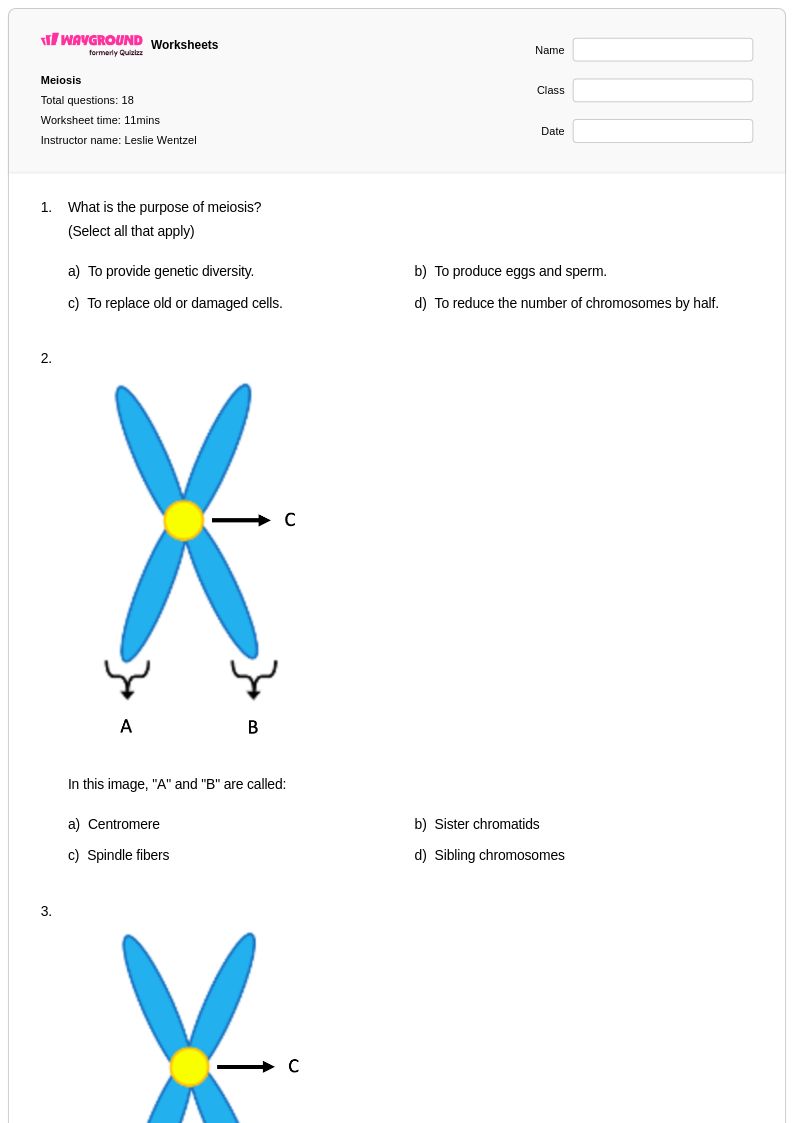
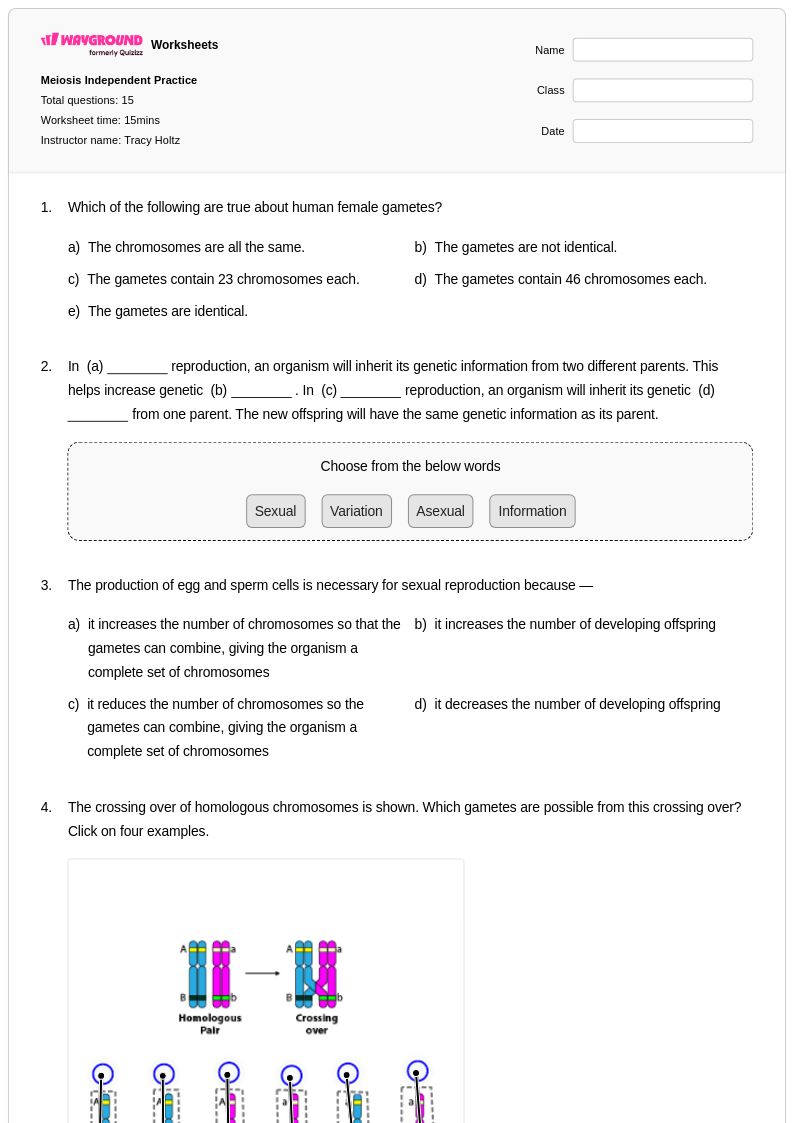
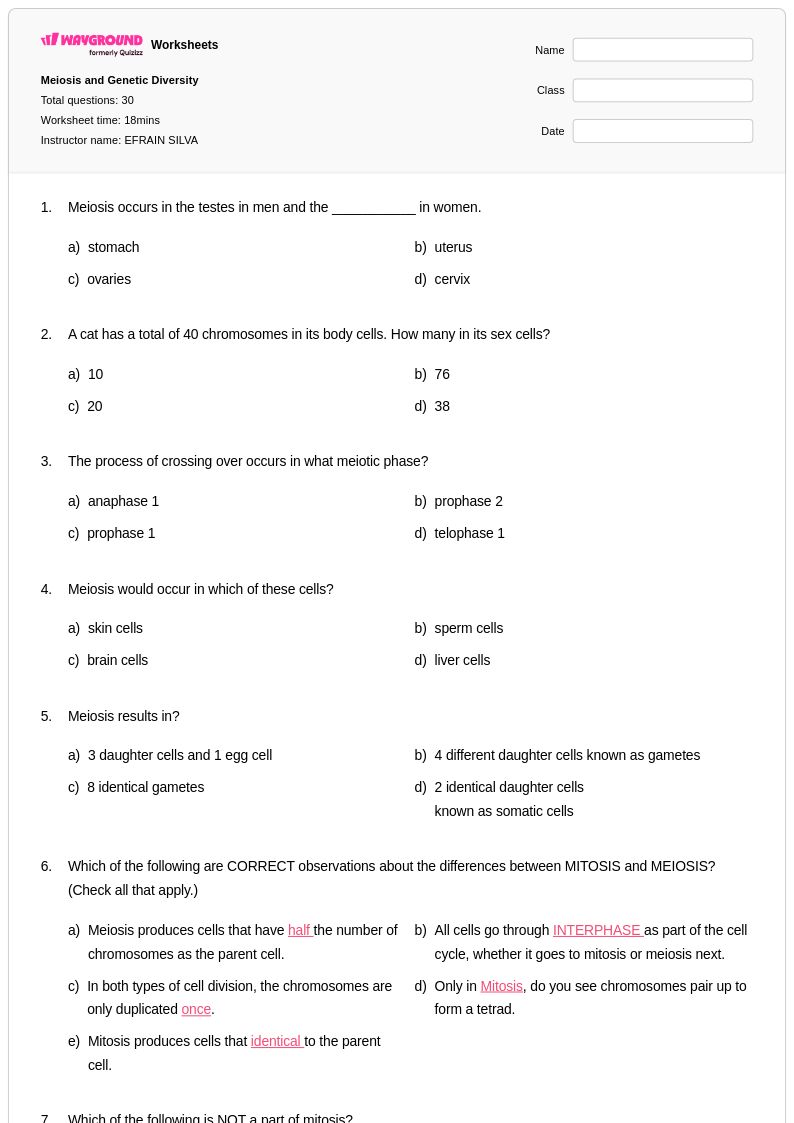
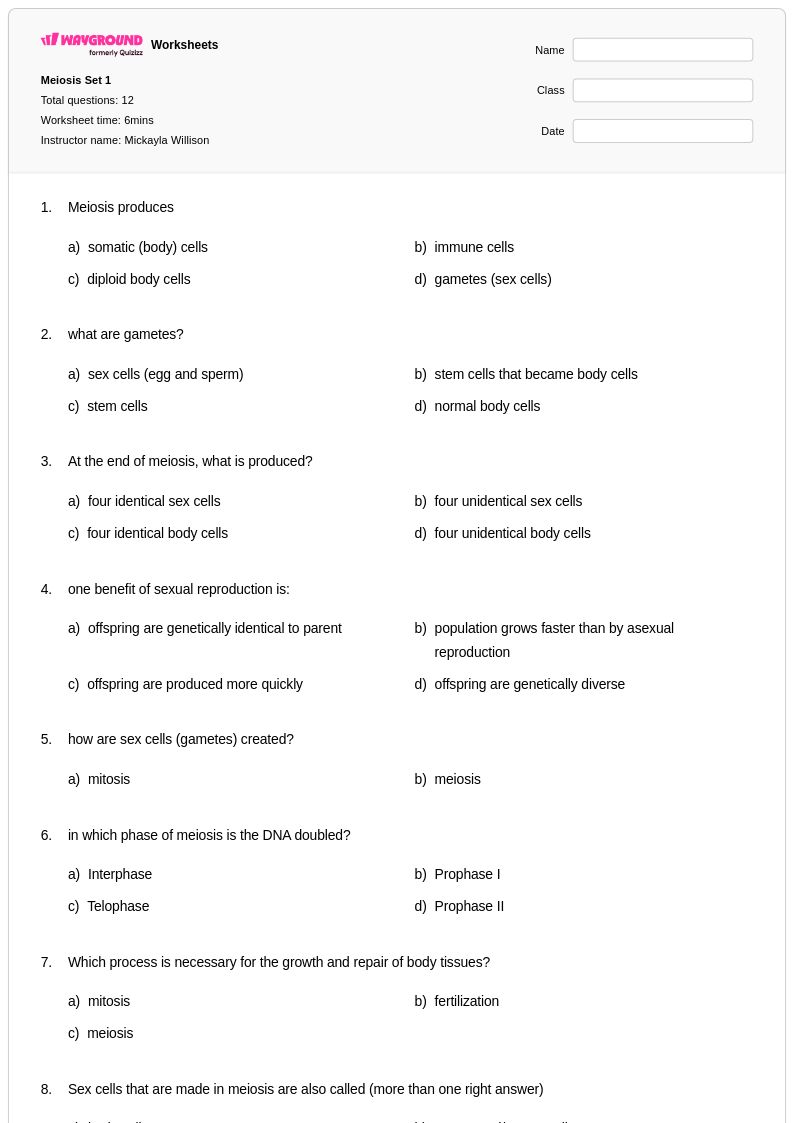
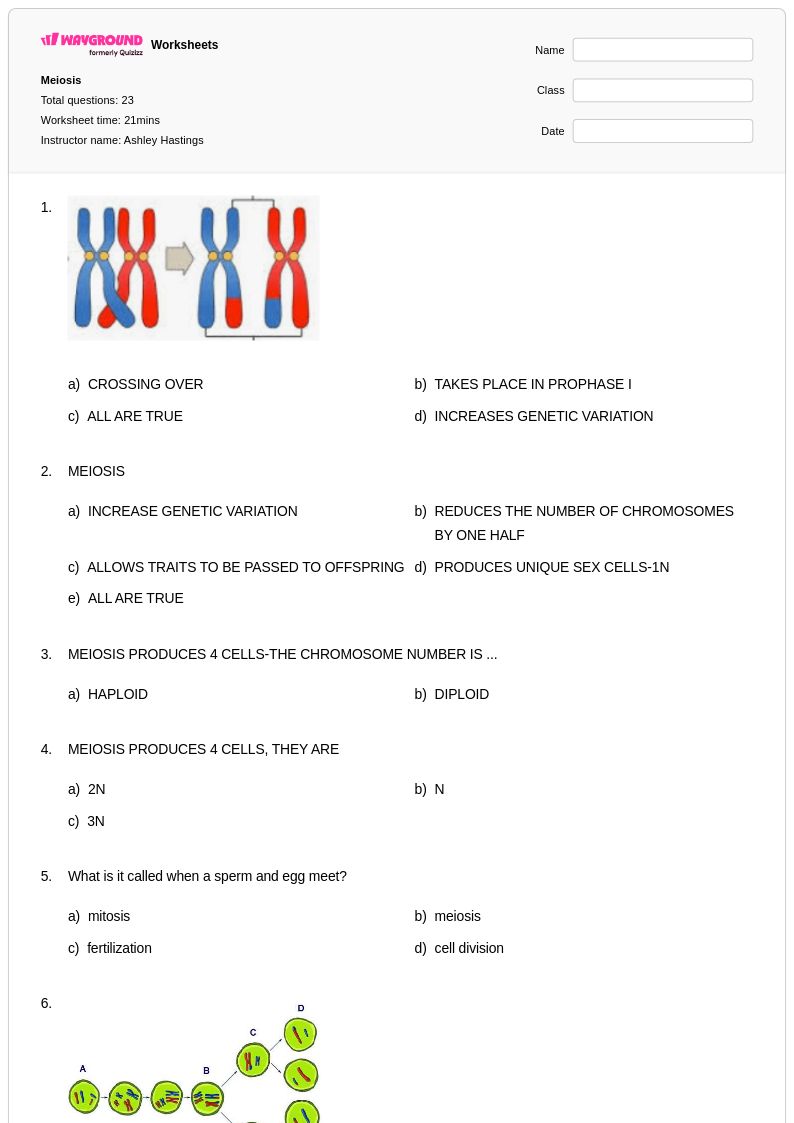
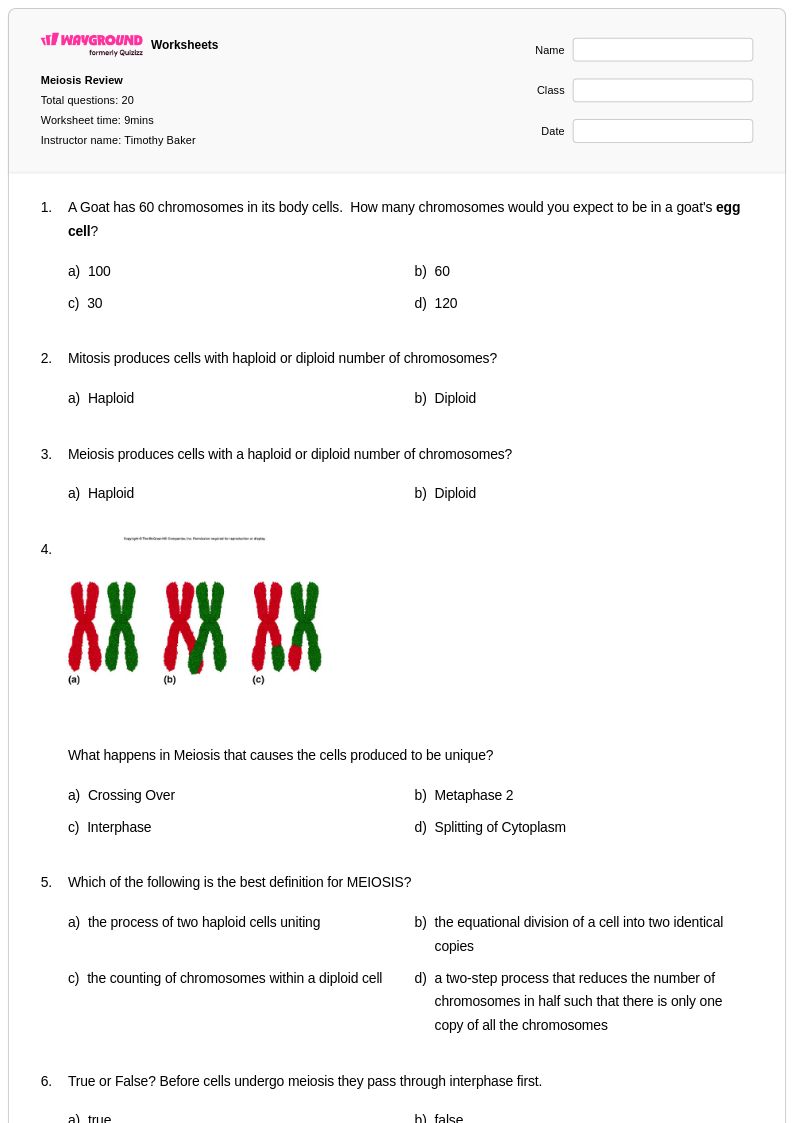
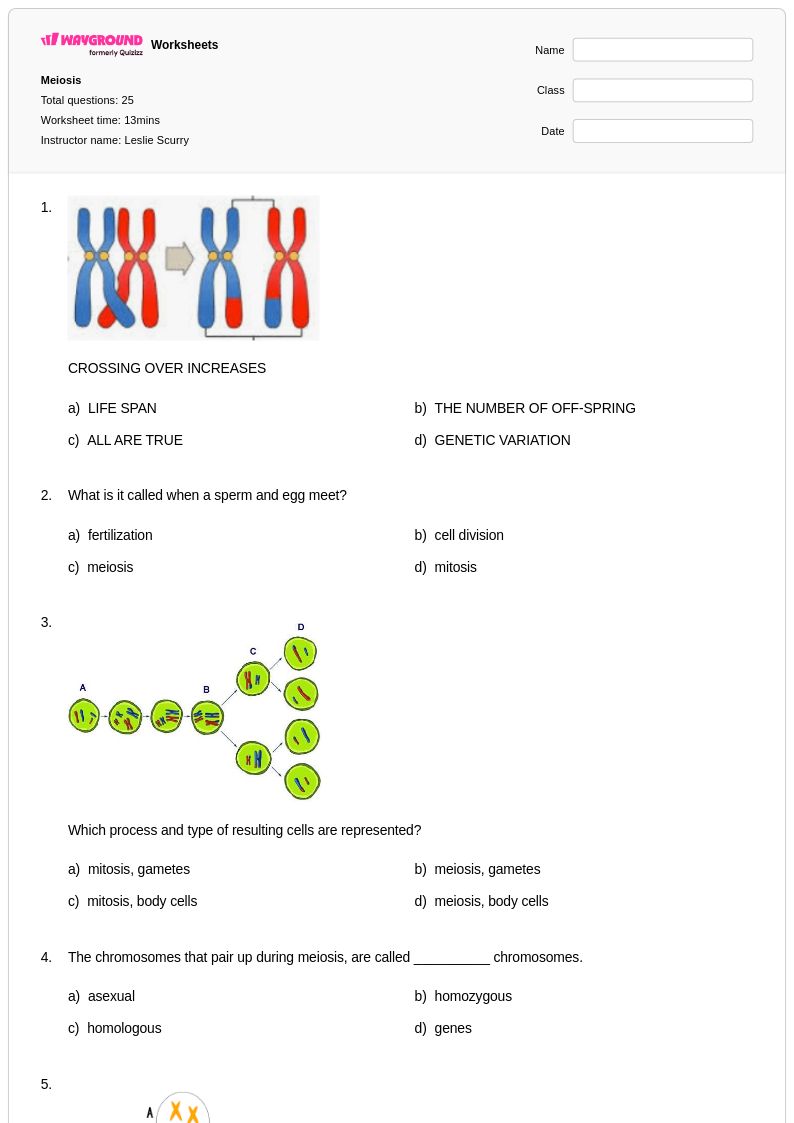
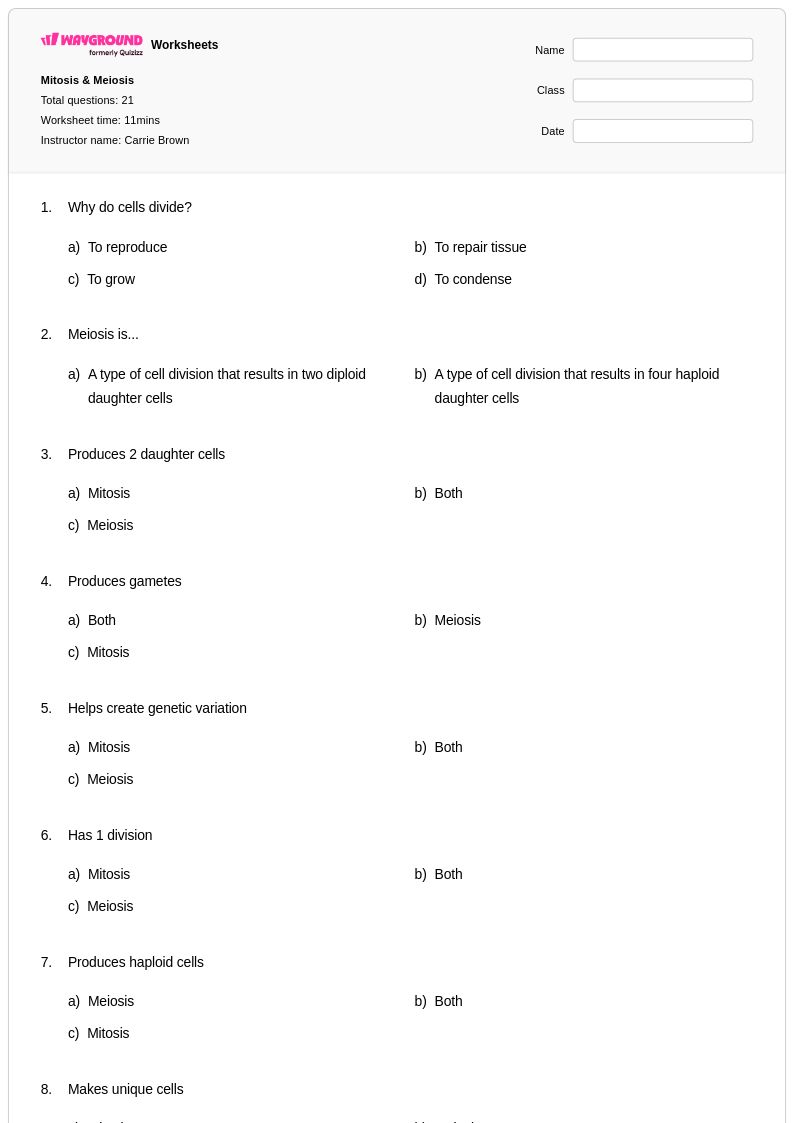
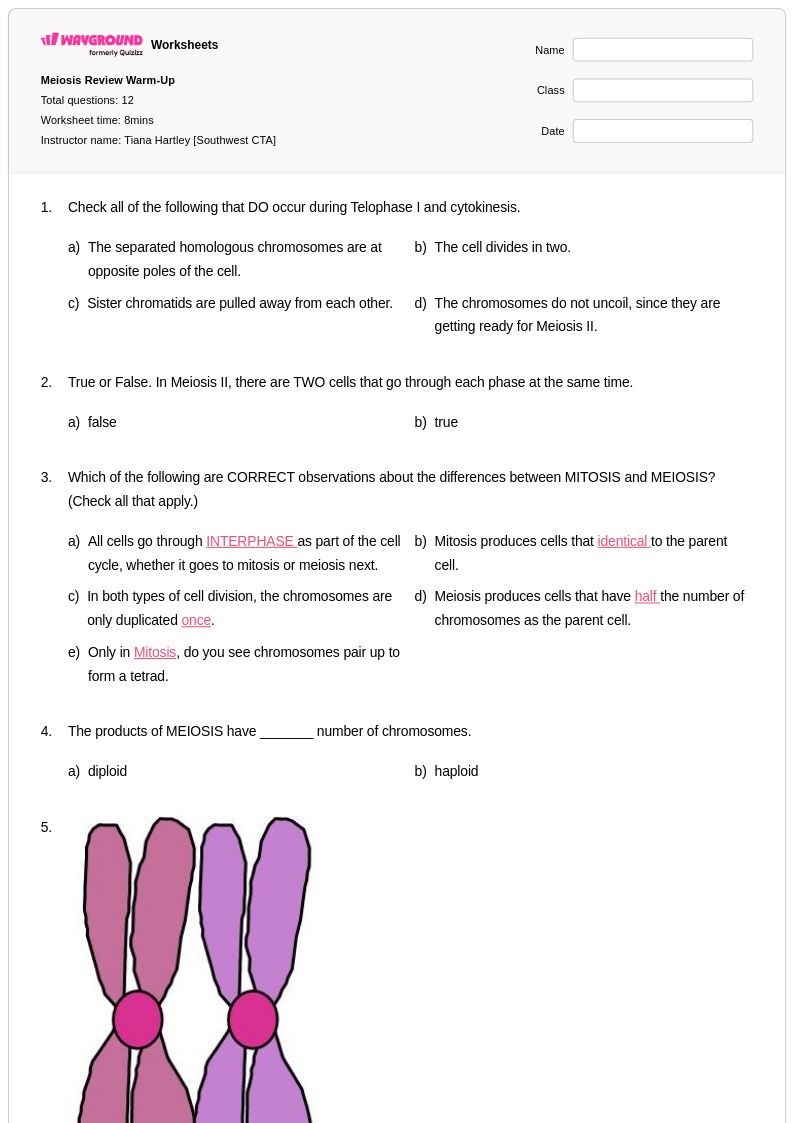
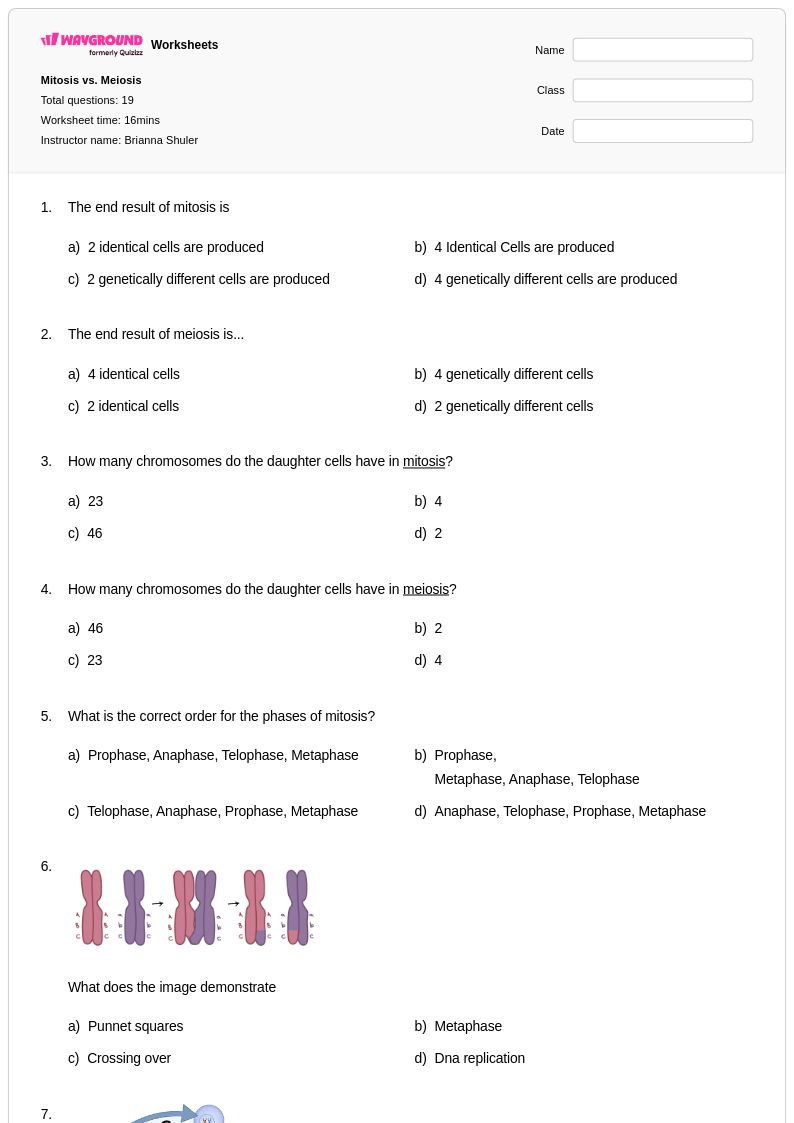
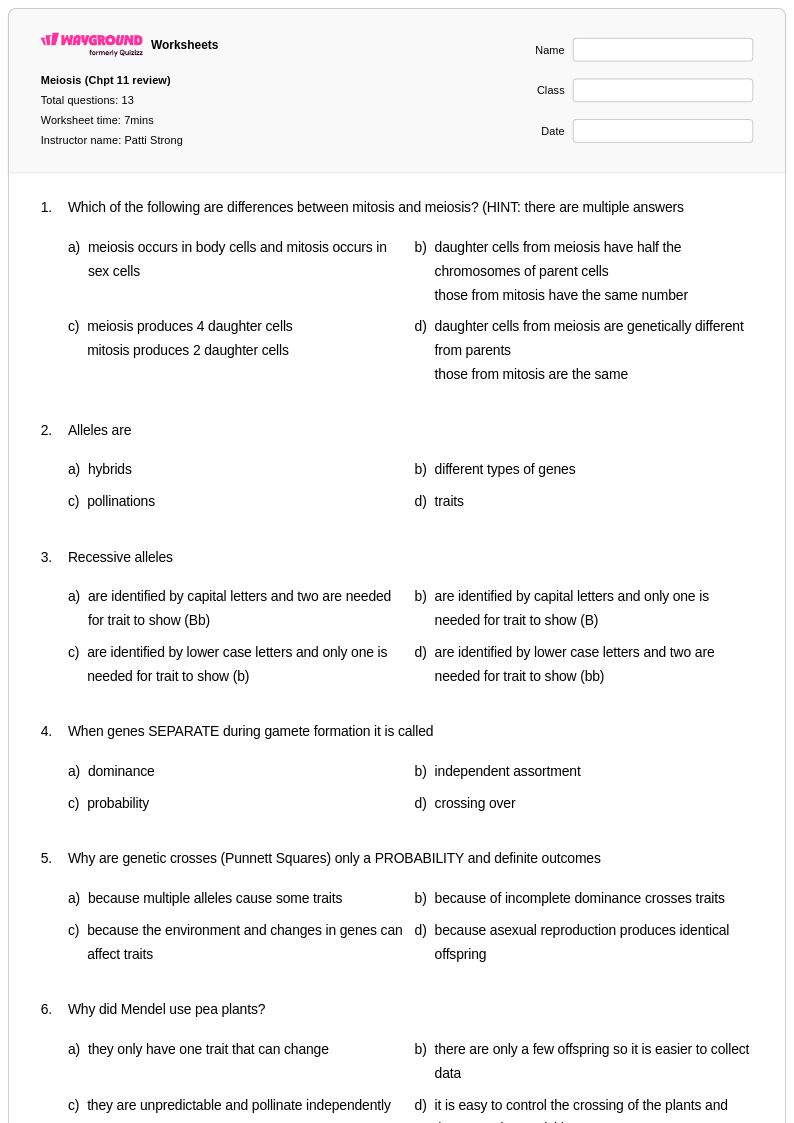
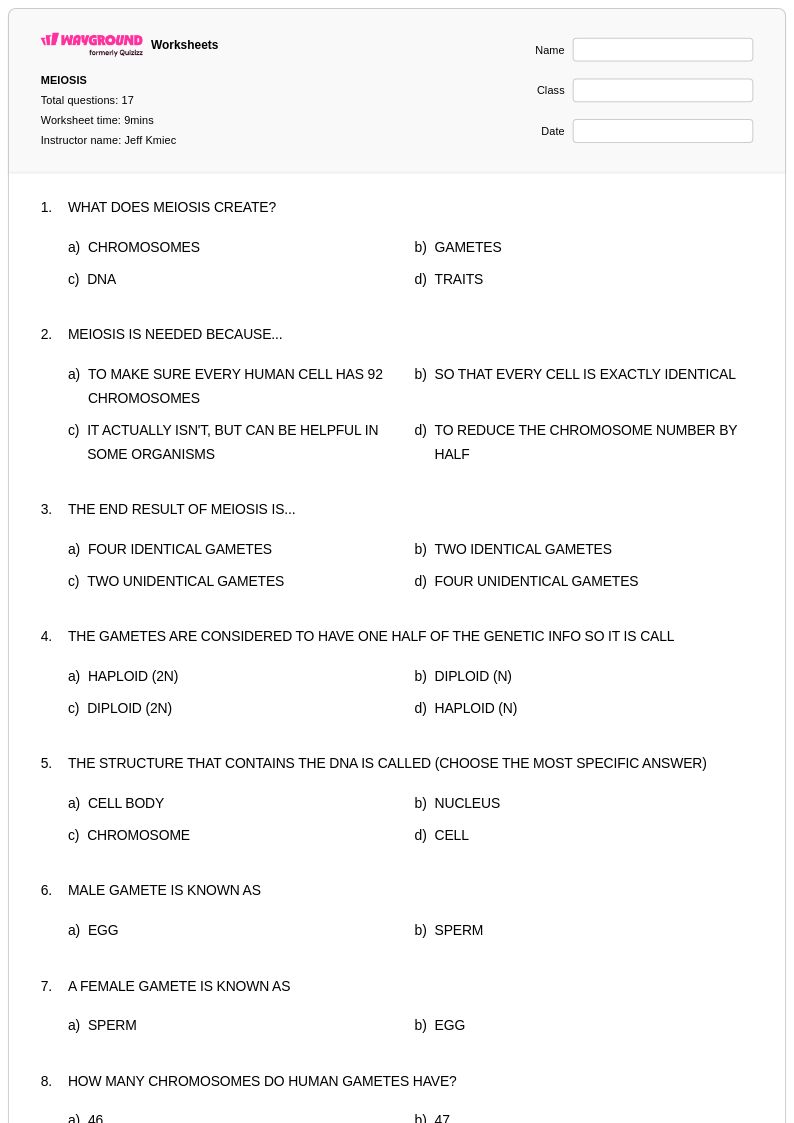
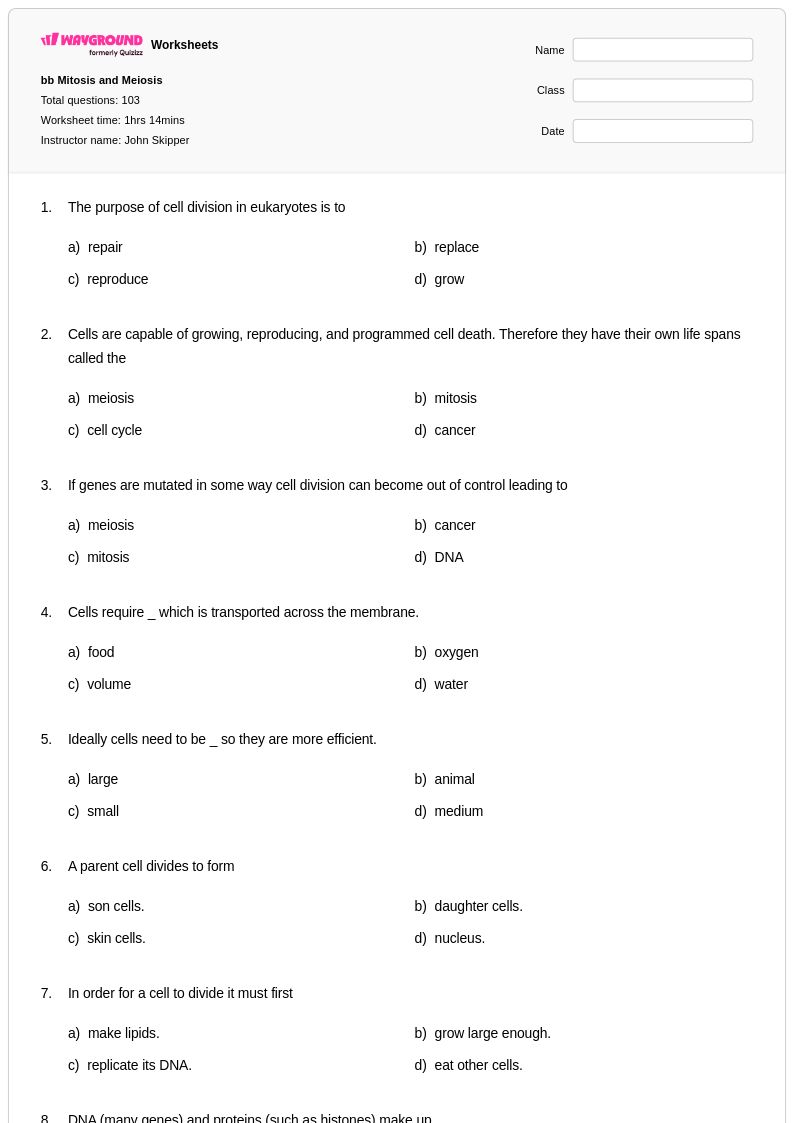
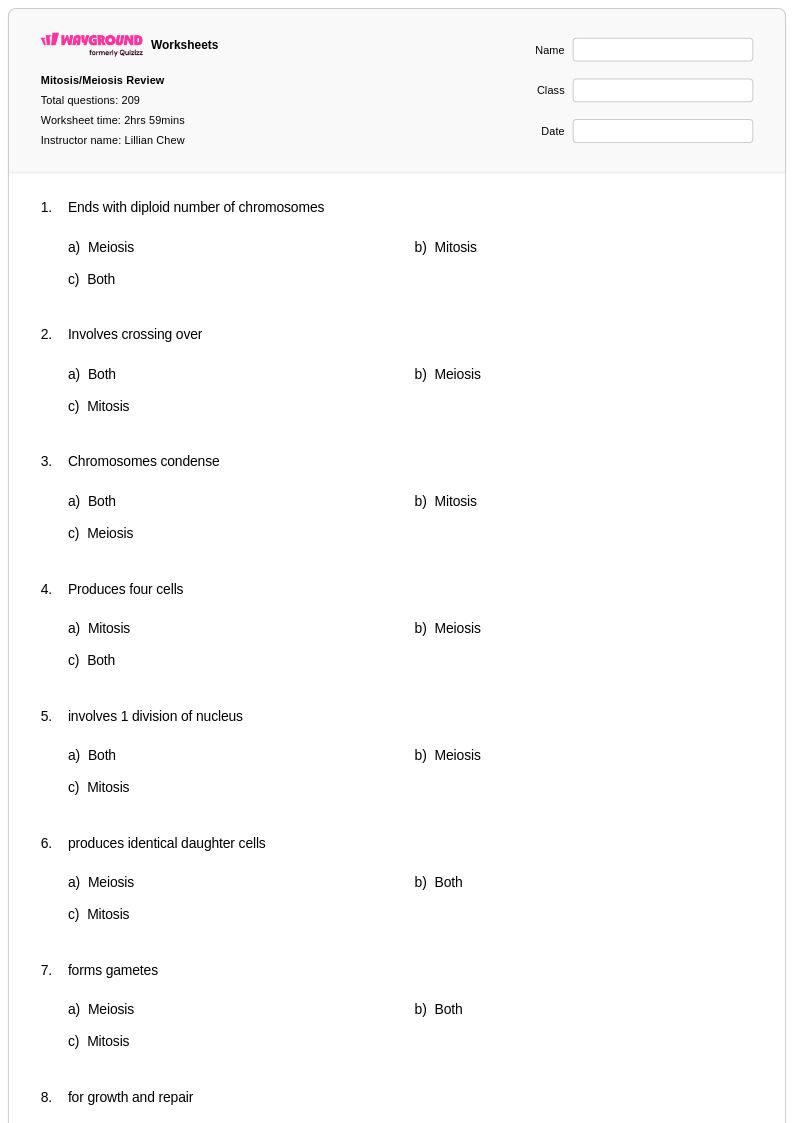
Grade 11 Biology meiosis worksheets and printables help students master cell division concepts through comprehensive practice problems, free PDF resources, and detailed answer keys for effective learning.
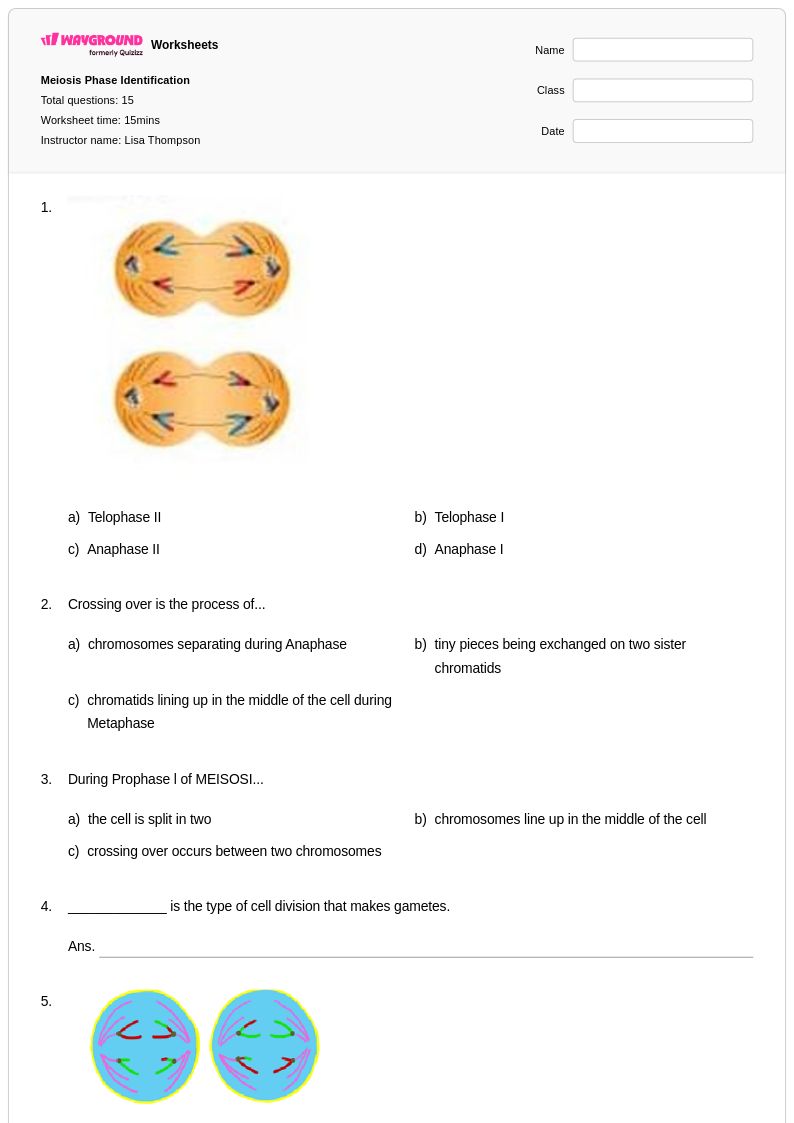
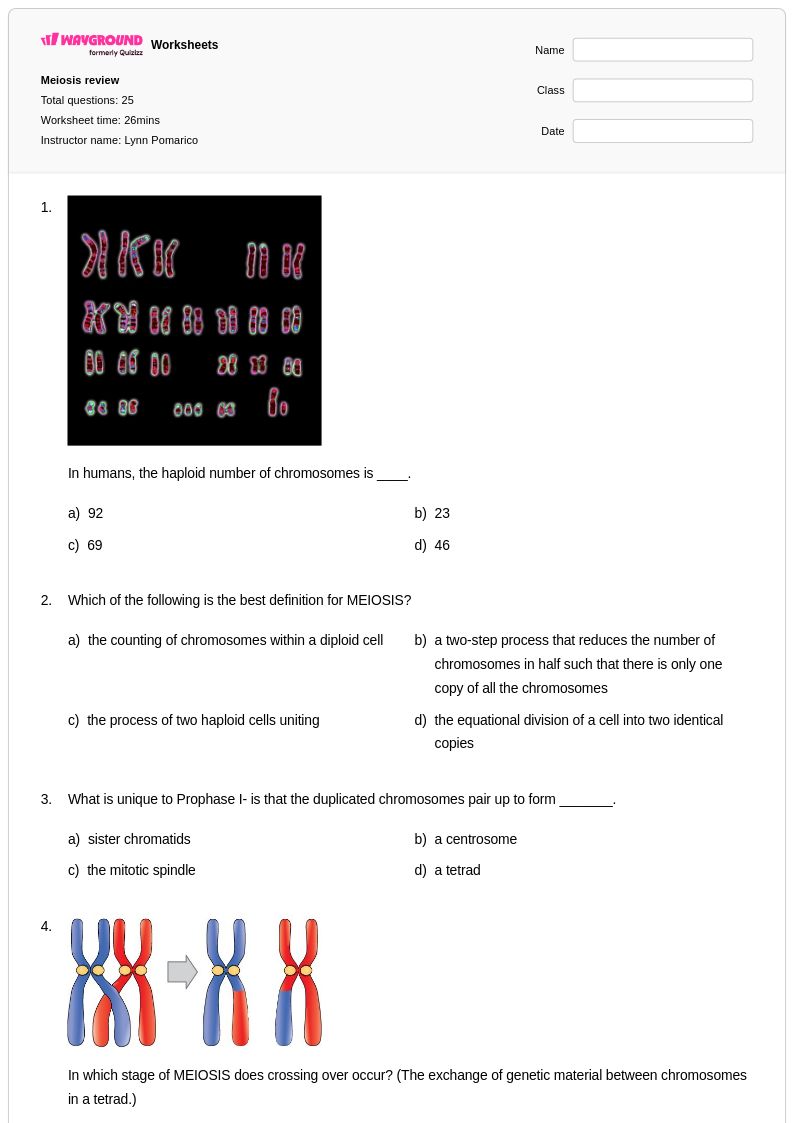
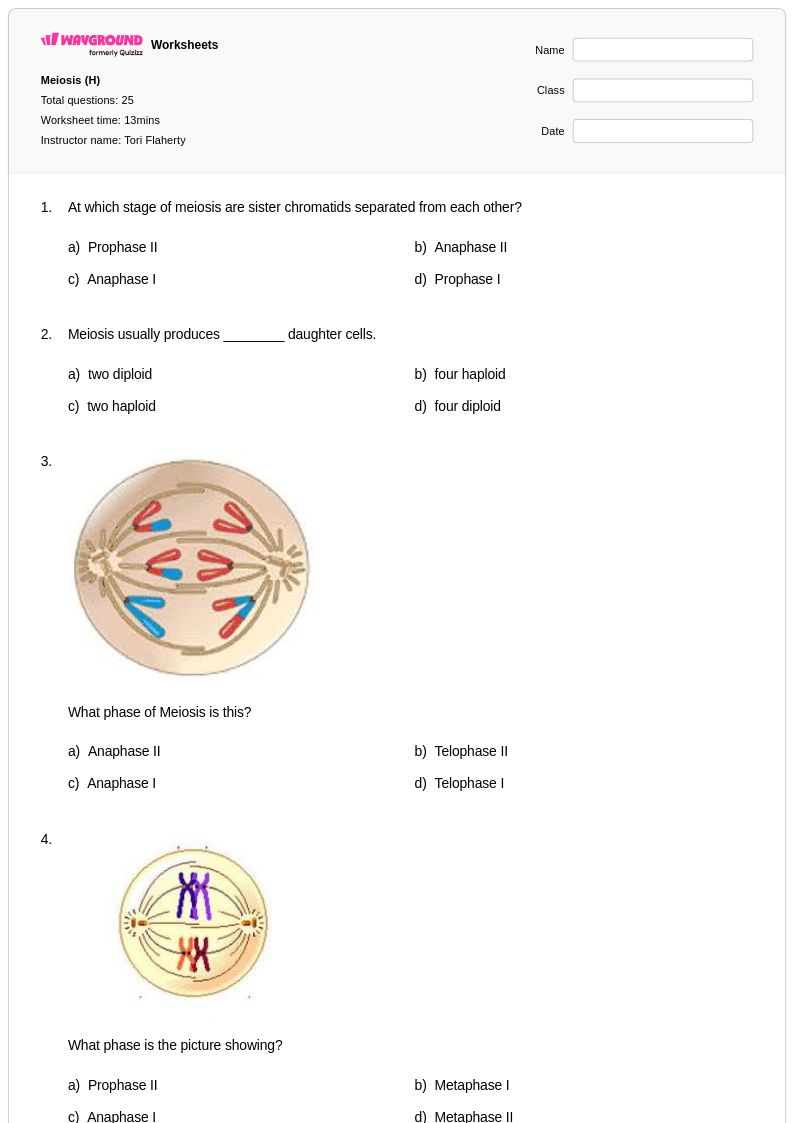
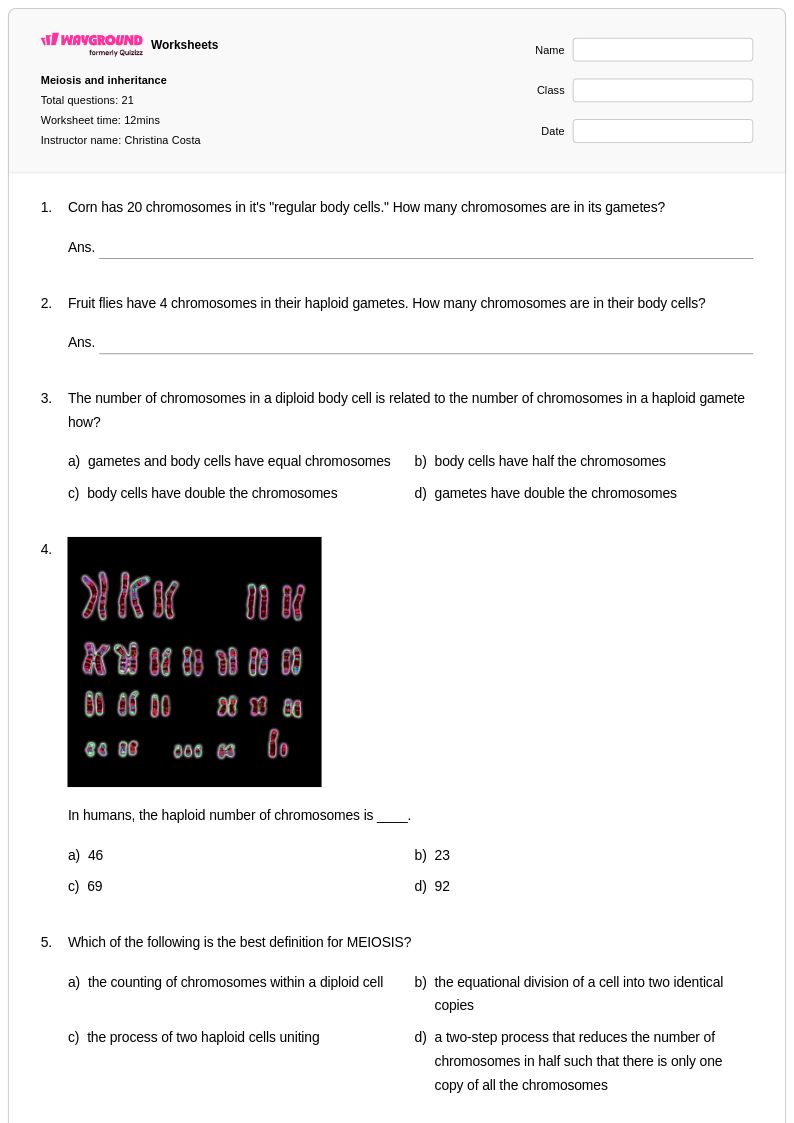
Meiosis worksheets for Grade 11 students through Wayground (formerly Quizizz) provide comprehensive coverage of this fundamental cellular division process that creates gametes for sexual reproduction. These expertly designed resources strengthen students' understanding of the complex stages of meiosis I and II, including prophase, metaphase, anaphase, and telophase, while emphasizing critical concepts such as crossing over, independent assortment, and genetic recombination. The practice problems within these worksheets challenge students to analyze chromosome behavior, calculate genetic diversity outcomes, and compare meiosis with mitosis to deepen their comprehension of cellular reproduction. Each worksheet includes detailed answer keys and is available as free printables in convenient PDF format, enabling students to work through challenging scenarios involving homologous chromosome pairing, synapsis formation, and the reduction from diploid to haploid chromosome numbers.
Wayground (formerly Quizizz) empowers educators with an extensive collection of millions of teacher-created meiosis worksheets specifically aligned with Grade 11 biology standards and curriculum requirements. The platform's robust search and filtering capabilities allow teachers to quickly locate resources that match their specific instructional needs, whether focusing on genetic variation, gamete formation, or meiotic errors like nondisjunction. Advanced differentiation tools enable educators to customize worksheet difficulty levels and content focus areas, supporting both remediation for struggling learners and enrichment opportunities for advanced students. These versatile resources are available in both printable and digital formats, including downloadable PDFs, making them ideal for classroom instruction, homework assignments, laboratory preparation, and targeted skill practice sessions that reinforce understanding of this essential biological process.
FAQs
How do I teach meiosis to high school biology students?
Start by ensuring students have a solid grasp of mitosis before introducing meiosis, since the two processes are frequently confused. Use side-by-side comparison charts to highlight where meiosis diverges, particularly during meiosis I when homologous chromosomes separate rather than sister chromatids. Introducing crossing over and independent assortment in the context of genetic variation gives students a biological reason for why meiosis matters, which improves retention and engagement.
What exercises help students practice identifying the stages of meiosis?
Diagram-labeling exercises are highly effective for helping students distinguish between prophase I, metaphase I, anaphase I, and their meiosis II counterparts. Practice problems that ask students to track a specific chromosome pair through each phase reinforce the logic of chromosome reduction from diploid to haploid. Worksheets that include nondisjunction scenarios add an applied layer, connecting stage identification to real consequences like chromosomal abnormalities.
What mistakes do students commonly make when learning meiosis?
The most common error is conflating meiosis with mitosis, particularly when students forget that meiosis I separates homologous chromosomes while meiosis II separates sister chromatids. Students also frequently misplace crossing over, incorrectly assigning it to meiosis II rather than prophase I. Another persistent misconception is assuming that the cells produced after meiosis I are already the final gametes, overlooking that a second division is still required.
How do meiosis worksheets help students understand genetic variation?
Meiosis worksheets that include problems on independent assortment and crossing over help students move beyond memorizing phases and into reasoning about why offspring are genetically unique. Calculation problems asking students to determine the number of possible chromosome combinations reinforce the mathematical basis of genetic diversity. When worksheets pair these problems with diagrams showing recombination events, students can connect the visual and conceptual levels simultaneously.
How can I use meiosis worksheets in my classroom?
Meiosis worksheets on Wayground are available as printable PDFs for traditional classroom use and in digital formats for technology-integrated environments, giving teachers flexibility regardless of their setup. Teachers can also host worksheets as a quiz directly on Wayground, enabling real-time student responses and immediate feedback. The included answer keys make them equally effective for guided instruction, independent practice, or assigned homework.
How do I differentiate meiosis instruction for students at different skill levels?
For struggling students, simplify by focusing first on the outcome of meiosis (four haploid cells) before introducing the mechanics of each phase. Wayground supports individual accommodations such as read aloud for students who need audio support, reduced answer choices to lower cognitive load, and extended time settings that can be configured per student without notifying peers. Advanced learners can be extended into chromosomal abnormalities, linkage mapping, or comparing meiosis across different organisms.