Free Printable Water Potential Worksheets for Grade 11
Grade 11 water potential worksheets from Wayground help students master osmosis and solute concentration concepts through comprehensive practice problems, free printable PDFs, and detailed answer keys for biology success.
Explore printable Water Potential worksheets for Grade 11
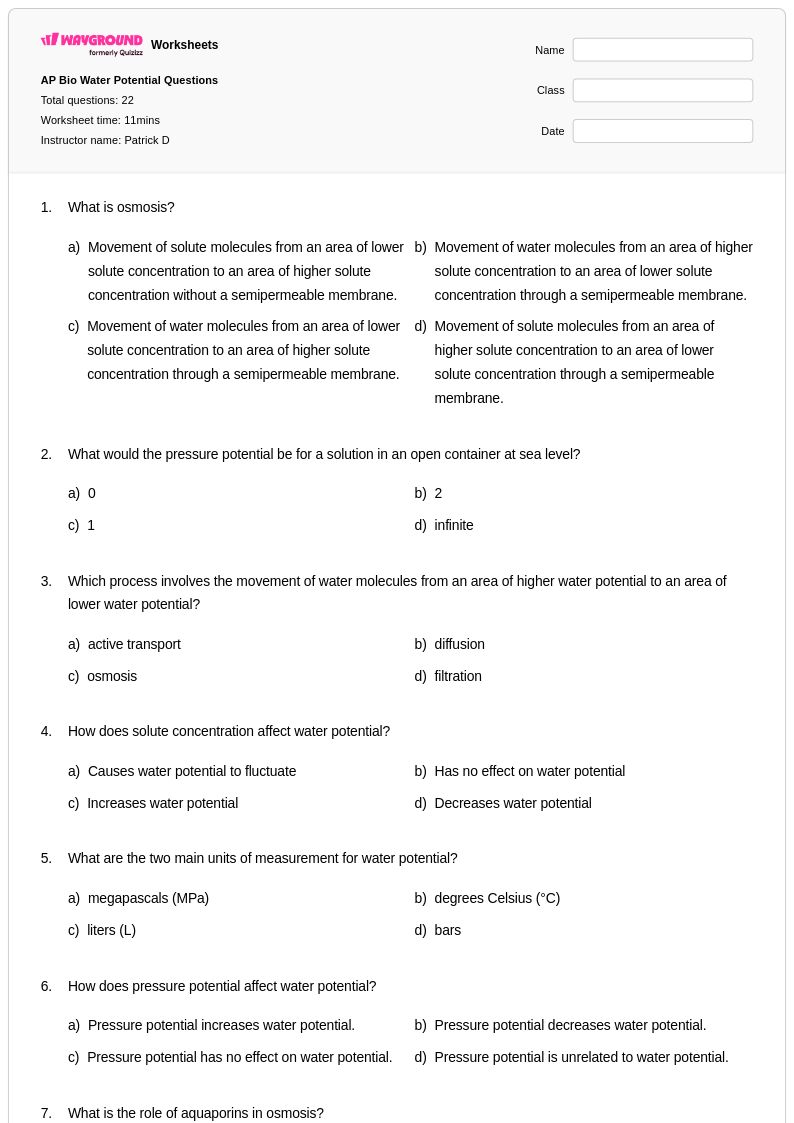
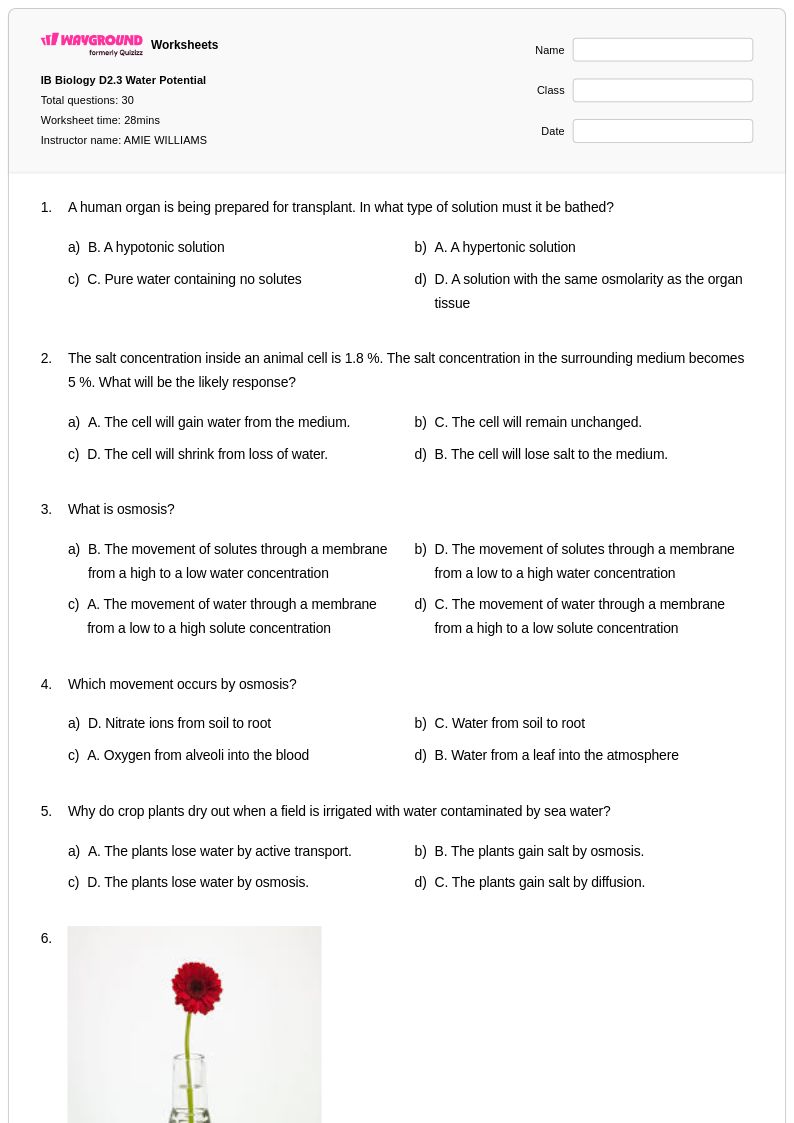
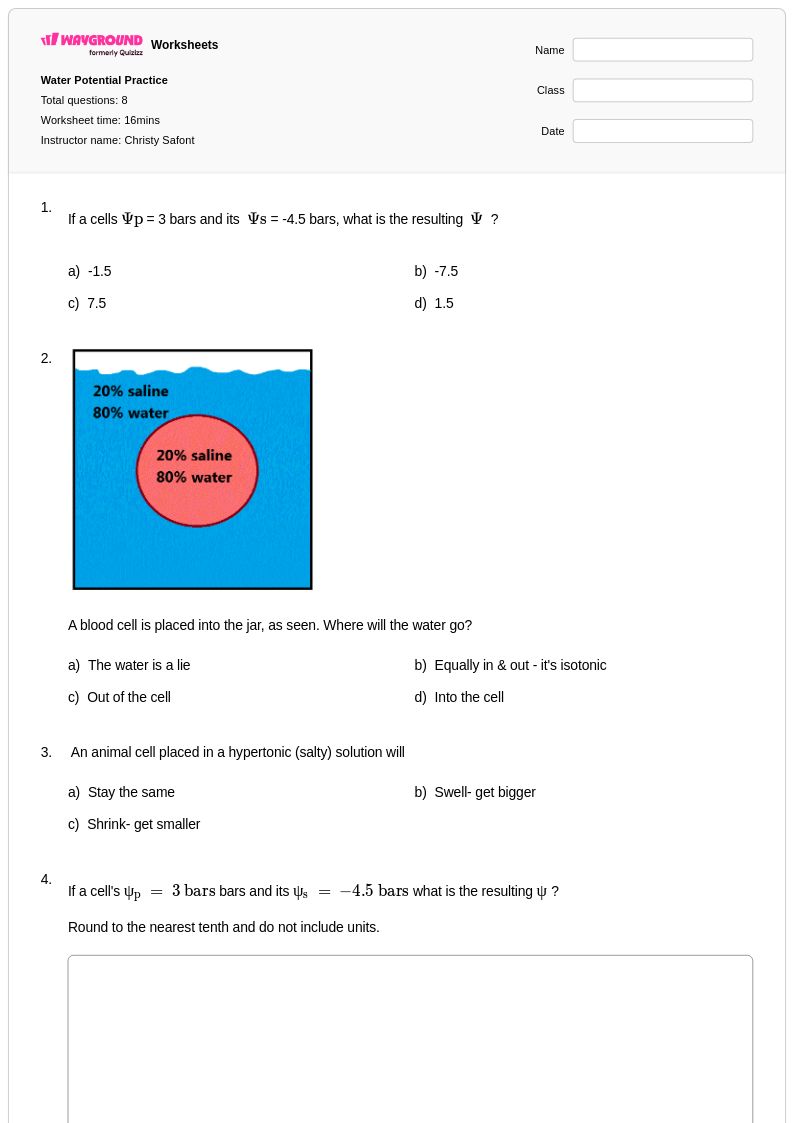
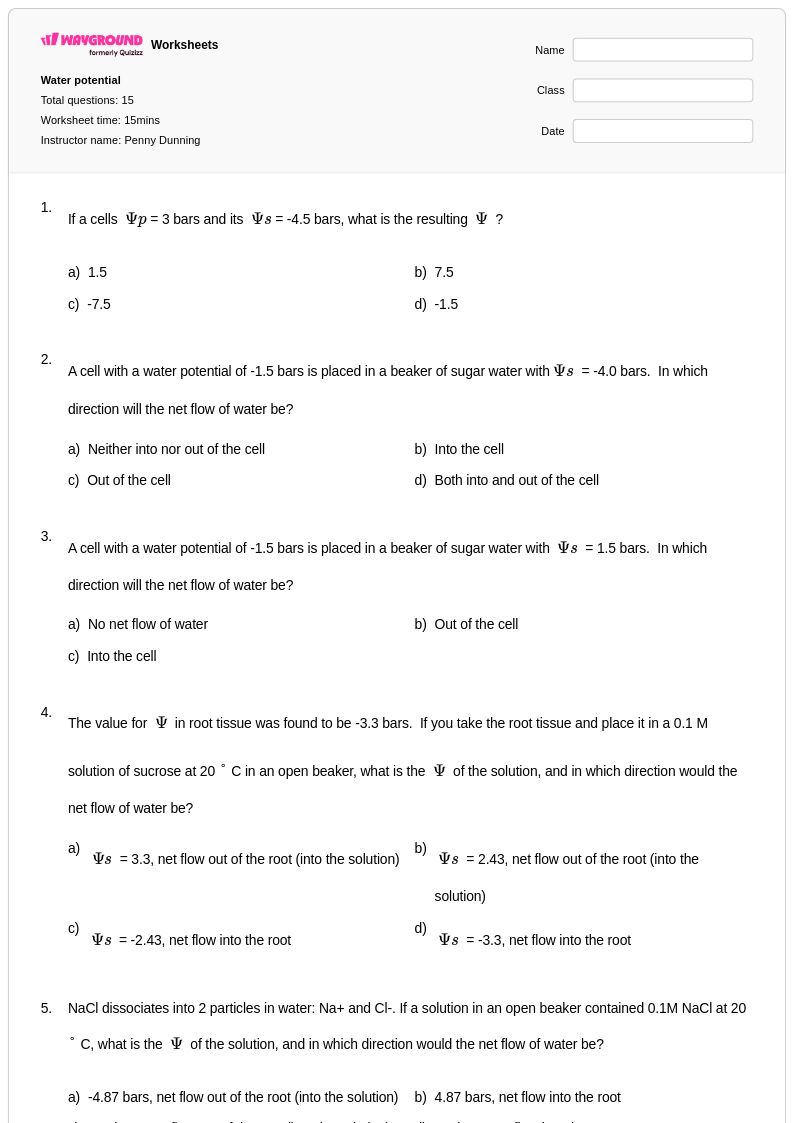
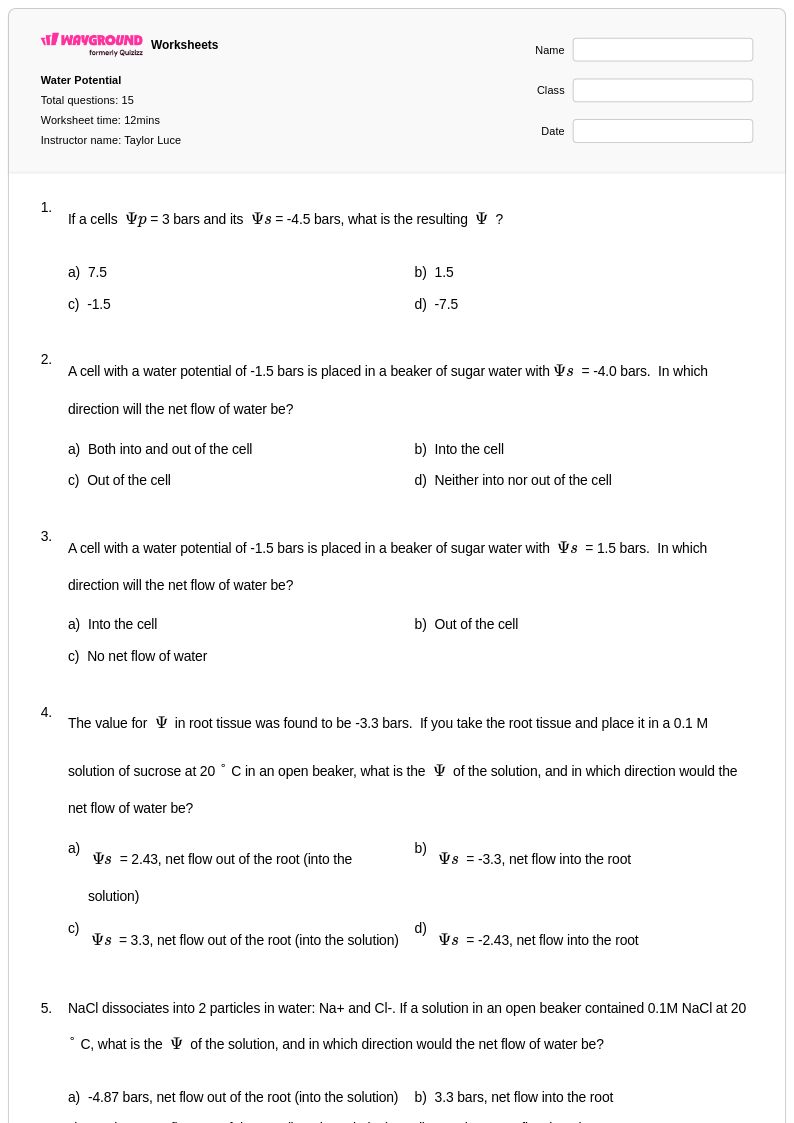
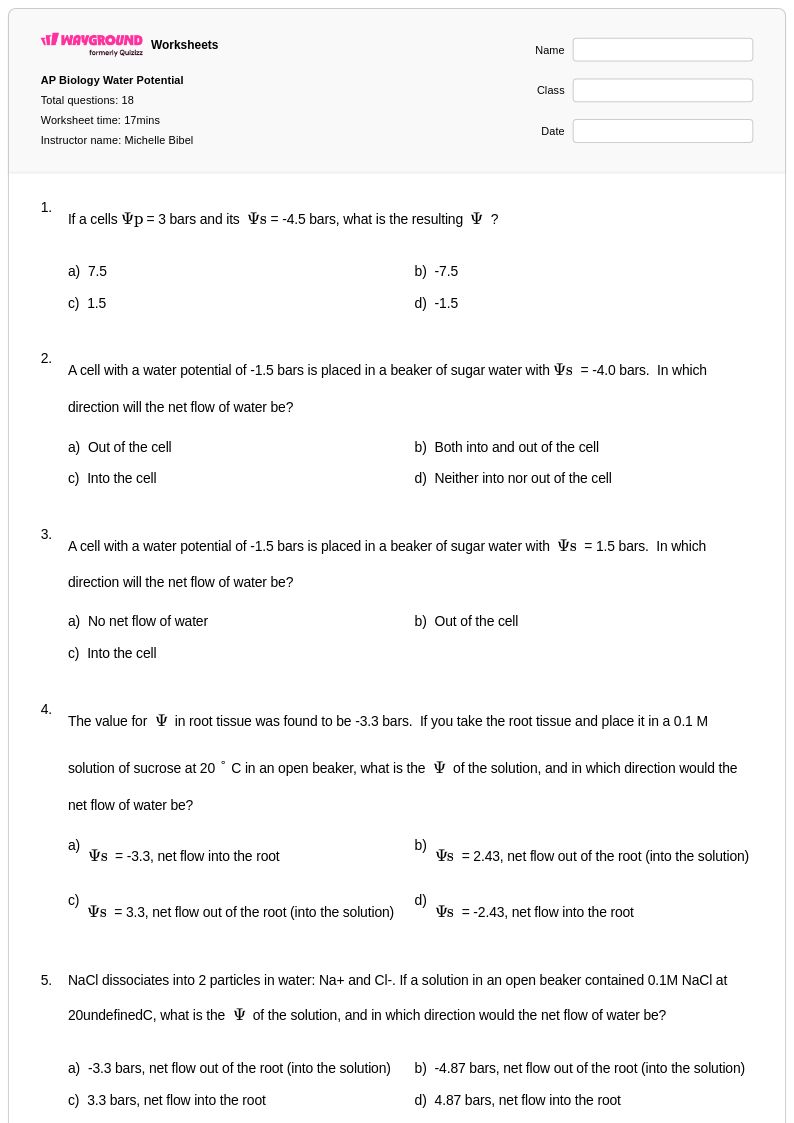
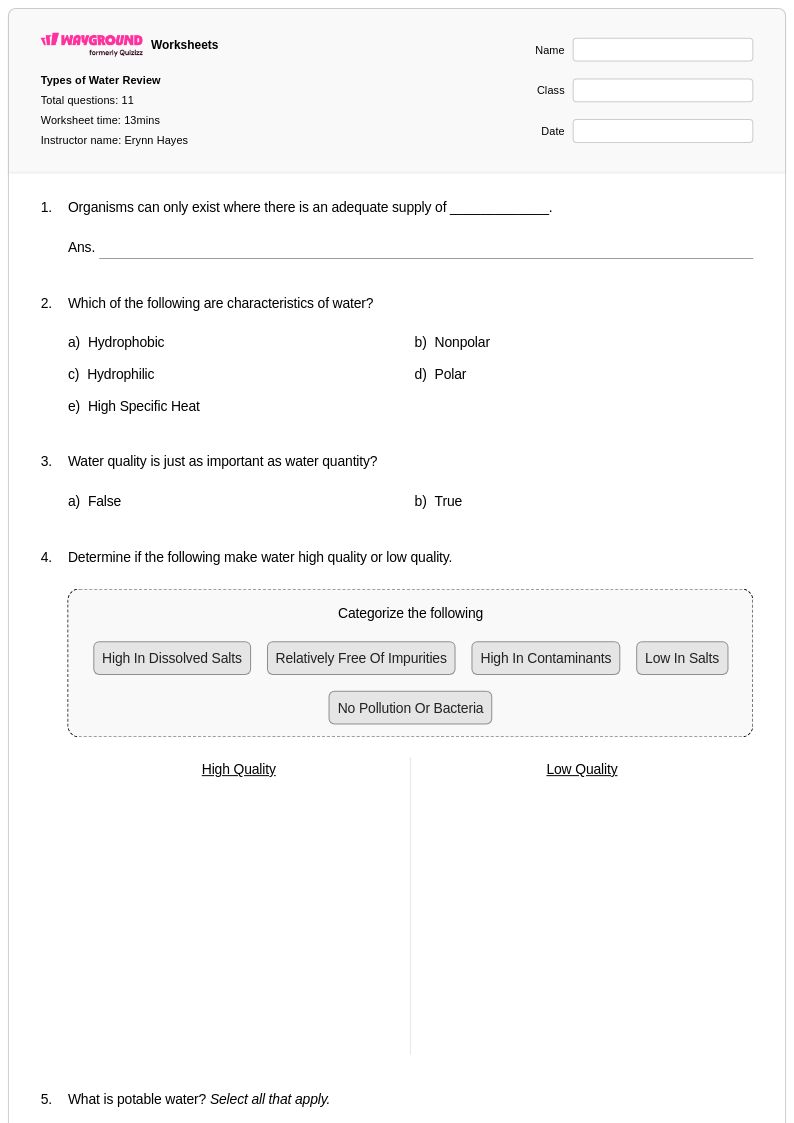
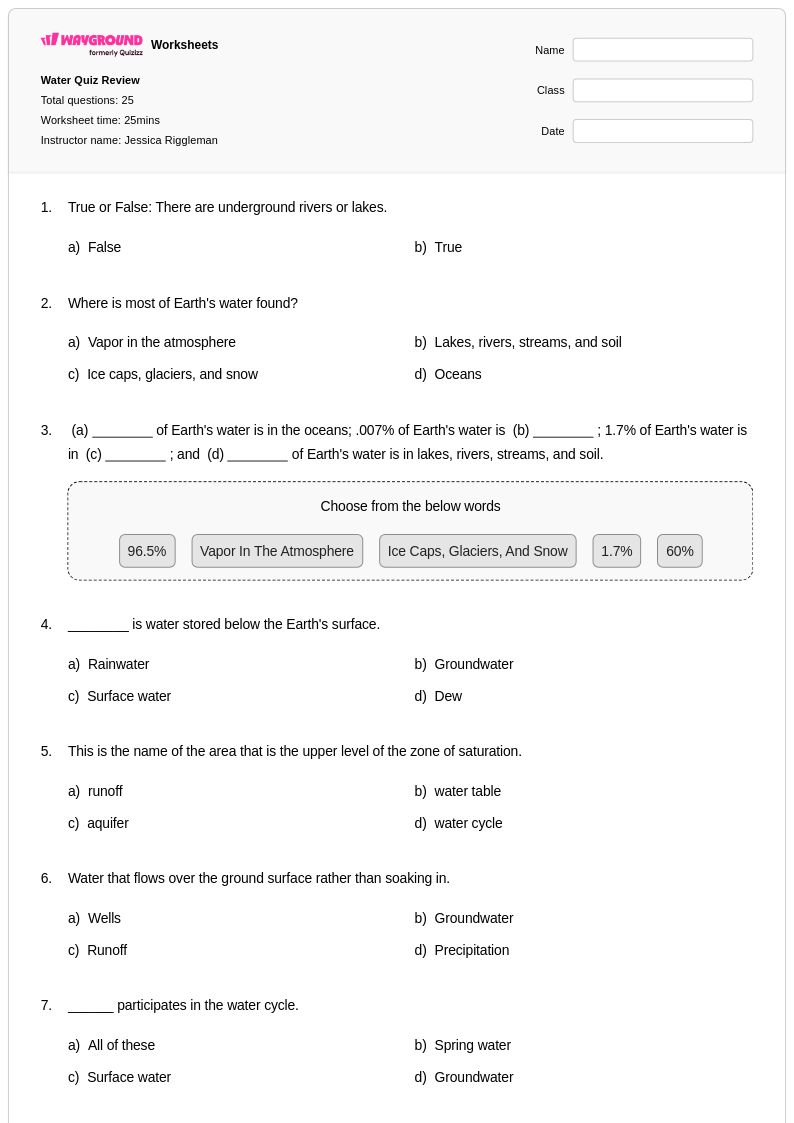
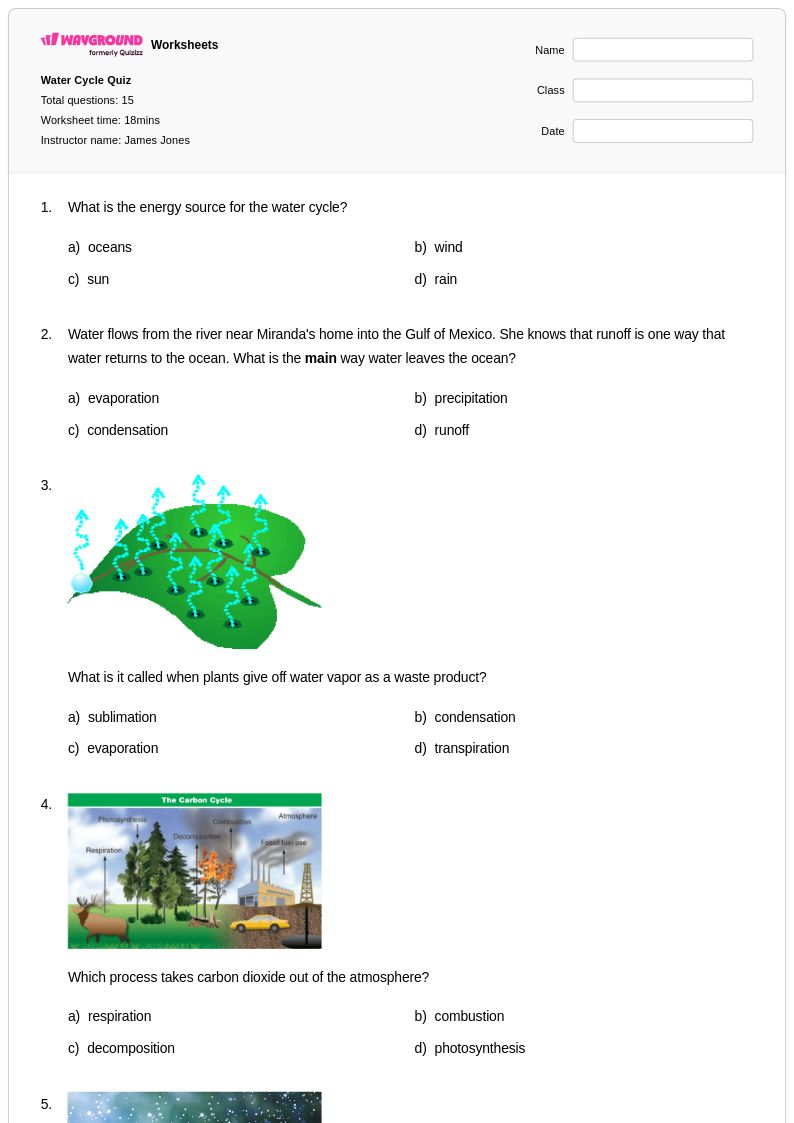
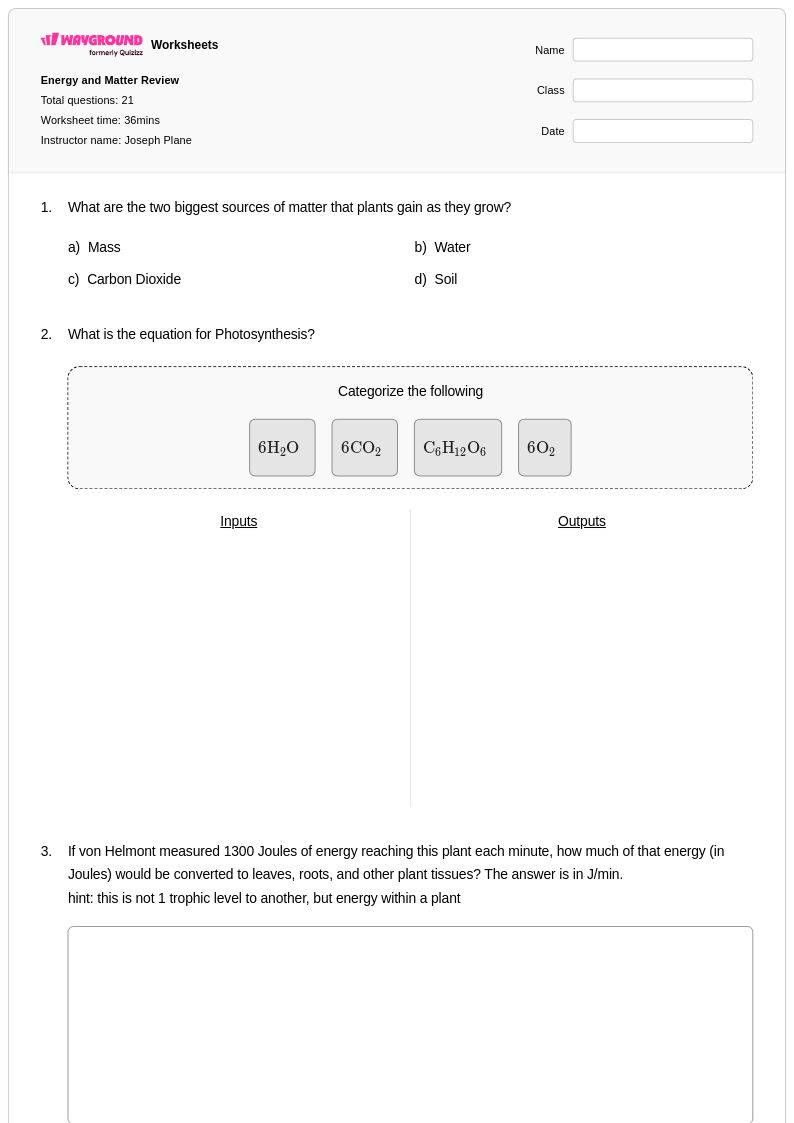
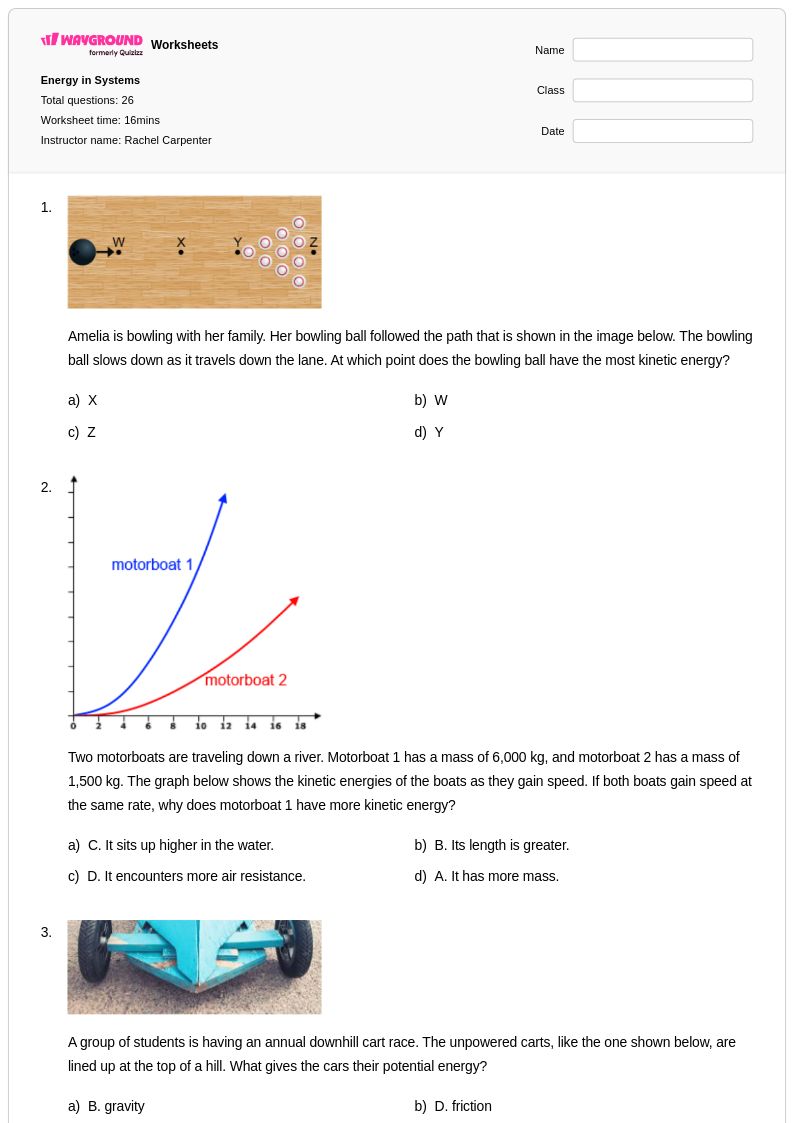
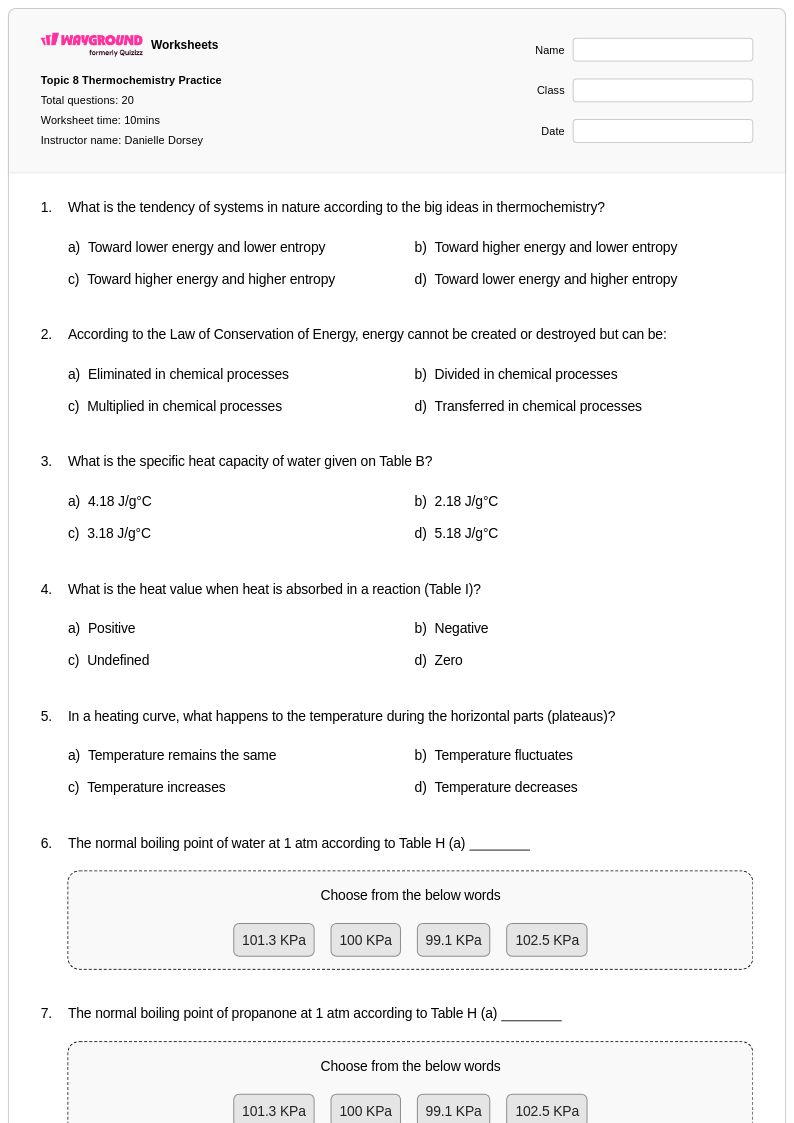
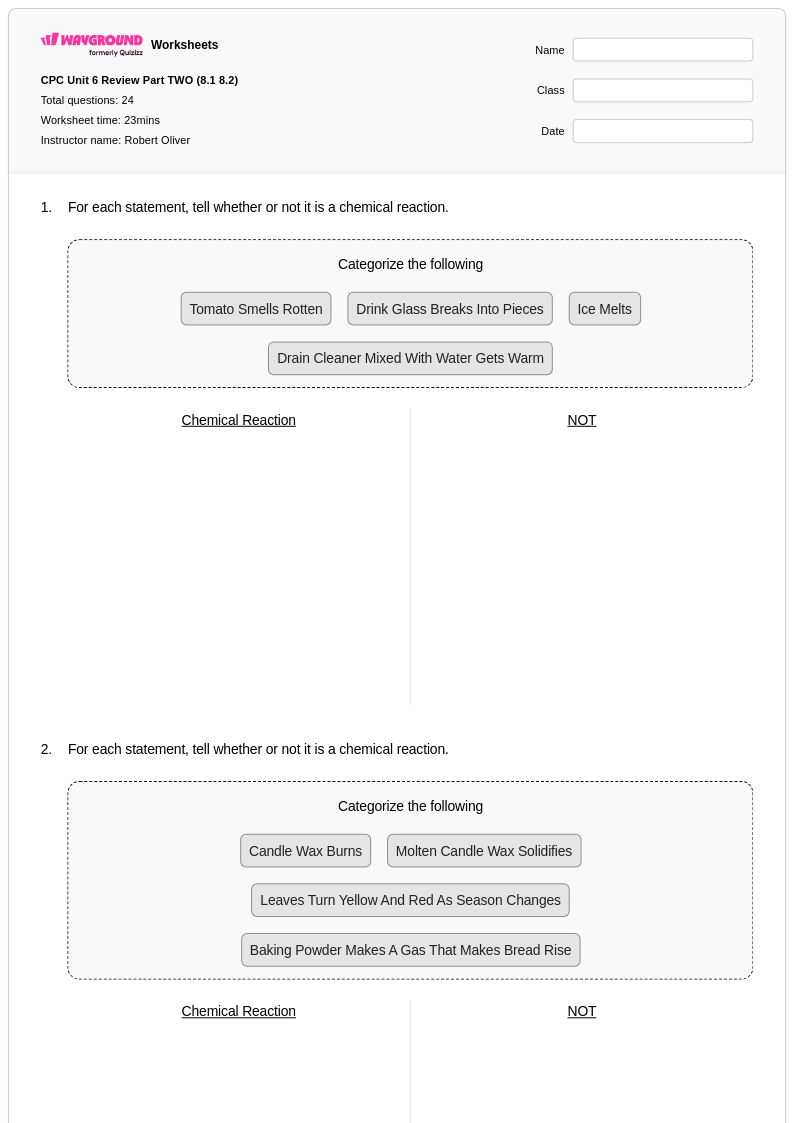
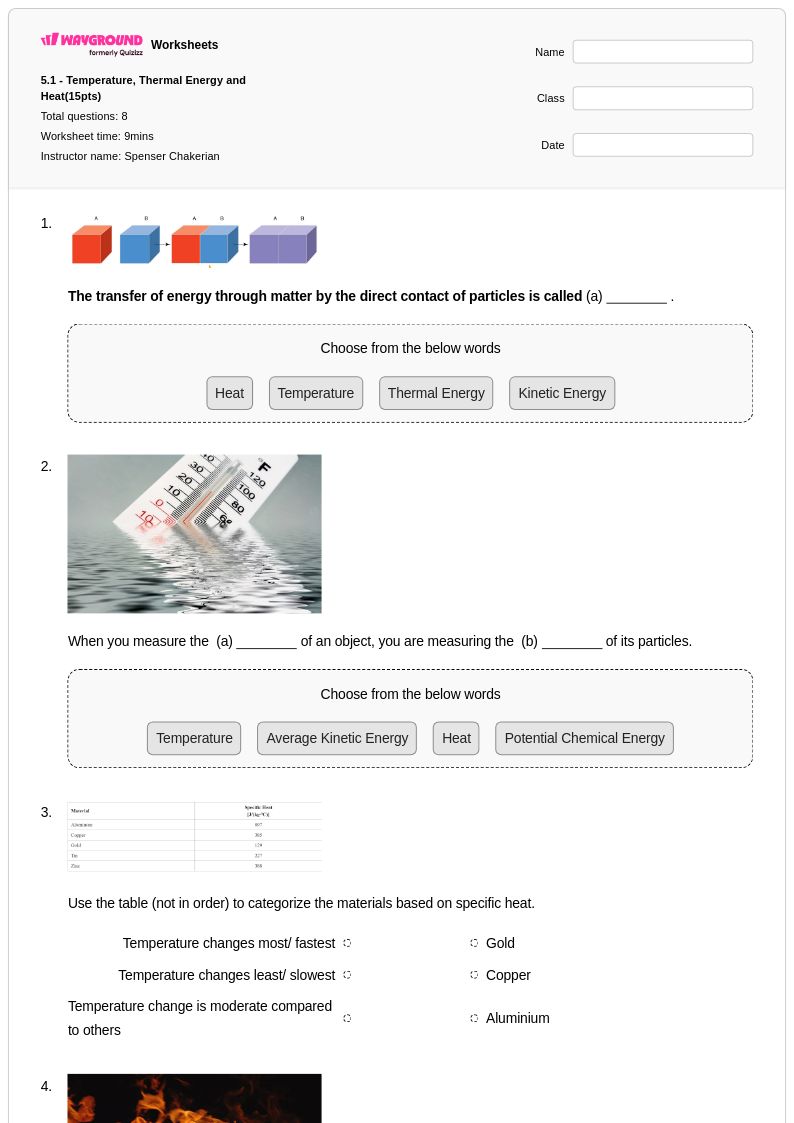
Water potential worksheets for Grade 11 biology students available through Wayground provide comprehensive practice with this fundamental concept that governs water movement in biological systems. These carefully designed resources help students master the mathematical calculations involved in determining water potential using the formula Ψ = Ψₛ + Ψₚ, while strengthening their understanding of how solute potential and pressure potential interact to drive water transport in plants and cells. The worksheets include detailed practice problems that guide students through real-world scenarios involving osmosis, turgor pressure, and plant water relations, with complete answer keys that explain the step-by-step solutions. Students work through increasingly complex problems involving hypertonic, hypotonic, and isotonic solutions, developing the analytical skills needed to predict water movement across cell membranes and understand how plants maintain water balance under varying environmental conditions. These free printable resources serve as essential tools for reinforcing classroom instruction and preparing students for advanced biology assessments.
Wayground's extensive collection of teacher-created water potential worksheets draws from millions of educational resources, offering biology educators powerful search and filtering capabilities to locate materials perfectly aligned with Grade 11 curriculum standards and learning objectives. The platform's differentiation tools enable teachers to customize worksheet difficulty levels and problem complexity, ensuring that both struggling learners and advanced students receive appropriate challenges when exploring concepts like plasmolysis, cell wall pressure, and water potential gradients. These resources are available in both printable pdf formats for traditional classroom use and digital formats for online learning environments, providing the flexibility educators need for lesson planning, targeted remediation sessions, and enrichment activities. Teachers can efficiently identify worksheets that focus on specific aspects of water potential, from basic conceptual understanding to advanced problem-solving applications, while the standards alignment features ensure that practice activities directly support required learning outcomes and prepare students for standardized biology assessments.
FAQs
How do I teach water potential to biology students?
Start by grounding students in the concept that water moves from areas of higher water potential to areas of lower water potential, driven by solute concentration and pressure. Use diagrams of plant cells in hypotonic, hypertonic, and isotonic solutions to make the direction of movement concrete before introducing the mathematical formula (Ψ = Ψs + Ψp). Once students understand the conceptual logic, layer in calculations so the math reinforces the concept rather than replacing it. Connecting water potential to observable phenomena like plant wilting and turgor pressure helps students see why the concept matters beyond the formula.
What practice problems help students get better at calculating water potential?
Students benefit most from problems that require them to calculate solute potential, pressure potential, and total water potential separately before combining them, rather than jumping straight to a final answer. Scenario-based problems, such as predicting whether a cell will gain or lose water when placed in a given solution, bridge calculation skills and conceptual reasoning. Including multi-step problems that model real-world situations like osmotic regulation in plant cells or root water uptake gives students meaningful context for the math and builds transferable analytical skills.
What mistakes do students commonly make when solving water potential problems?
The most common error is confusing the direction of water movement, with many students incorrectly assuming water moves toward higher solute concentration rather than toward lower water potential. Students also frequently forget that solute potential (Ψs) is always a negative value, which leads to calculation errors when adding pressure potential. A third persistent misconception is treating water potential as a property of the solute alone, rather than recognizing that pressure potential, especially turgor pressure in plant cells, plays an equally important role in determining the final value.
How can I use water potential worksheets to assess student understanding formatively?
Water potential worksheets work well as exit tickets when focused on a single scenario, such as identifying which direction water will move between two cells with given water potential values. Multi-step calculation problems are useful mid-unit checks to determine whether students can correctly apply the Ψ = Ψs + Ψp formula before assessments. Because misconceptions in this topic tend to be systematic rather than random, reviewing patterns in student errors across a worksheet set can help teachers identify whether the whole class needs reteaching on a specific component, such as the sign convention for solute potential.
How do I use Wayground's water potential worksheets in my classroom?
Wayground's water potential worksheets are available as printable PDFs for traditional classroom use and in digital formats for technology-integrated learning environments, giving teachers flexibility to assign them as in-class practice, homework, or review. Teachers can also host these worksheets as a quiz directly on Wayground, which allows students to work through problems digitally while teachers monitor progress in real time. Each worksheet includes a detailed answer key so students can check their work independently, making them equally effective for guided instruction and self-paced study.
How can I differentiate water potential instruction for students who are struggling?
For students who struggle with the mathematical side of water potential, start by isolating the conceptual direction-of-movement question before asking them to calculate values, so they build confidence in the underlying logic first. On Wayground, teachers can enable reduced answer choices for individual students to lower cognitive load on multiple-choice problems, and the Read Aloud feature can support students who have difficulty processing dense scientific text. Extended time accommodations can also be assigned per student for timed digital sessions, ensuring that processing differences do not obscure what a student actually understands about the concept.