Explore Wayground's free activation energy worksheets and printables with comprehensive practice problems and answer keys to help students master this fundamental chemistry concept through hands-on learning exercises.
Activation energy worksheets available through Wayground (formerly Quizizz) provide comprehensive practice materials that help students master this fundamental concept in chemical kinetics. These educational resources focus on developing students' understanding of the minimum energy required for chemical reactions to occur, including how catalysts lower activation energy barriers and how temperature affects reaction rates. The worksheets strengthen critical analytical skills through practice problems that require students to interpret energy diagrams, calculate activation energies from experimental data, and predict how various factors influence reaction pathways. Each worksheet collection includes detailed answer keys and is available as free printables in convenient pdf format, allowing students to work through complex scenarios involving enzyme kinetics, collision theory, and the relationship between activation energy and reaction spontaneity.
Wayground (formerly Quizizz) supports chemistry educators with an extensive library of millions of teacher-created activation energy resources that can be easily customized to meet diverse classroom needs. The platform's robust search and filtering capabilities enable teachers to quickly locate materials aligned with specific chemistry standards and learning objectives, while differentiation tools allow for seamless adaptation of content difficulty levels. These activation energy worksheet collections are available in both printable pdf formats and interactive digital versions, providing flexible options for in-class instruction, homework assignments, and assessment preparation. Teachers can efficiently plan comprehensive lesson sequences, provide targeted remediation for students struggling with energy barrier concepts, offer enrichment activities for advanced learners, and create focused skill practice sessions that reinforce understanding of catalysis, reaction mechanisms, and thermodynamic principles.
FAQs
How do I teach activation energy to chemistry students?
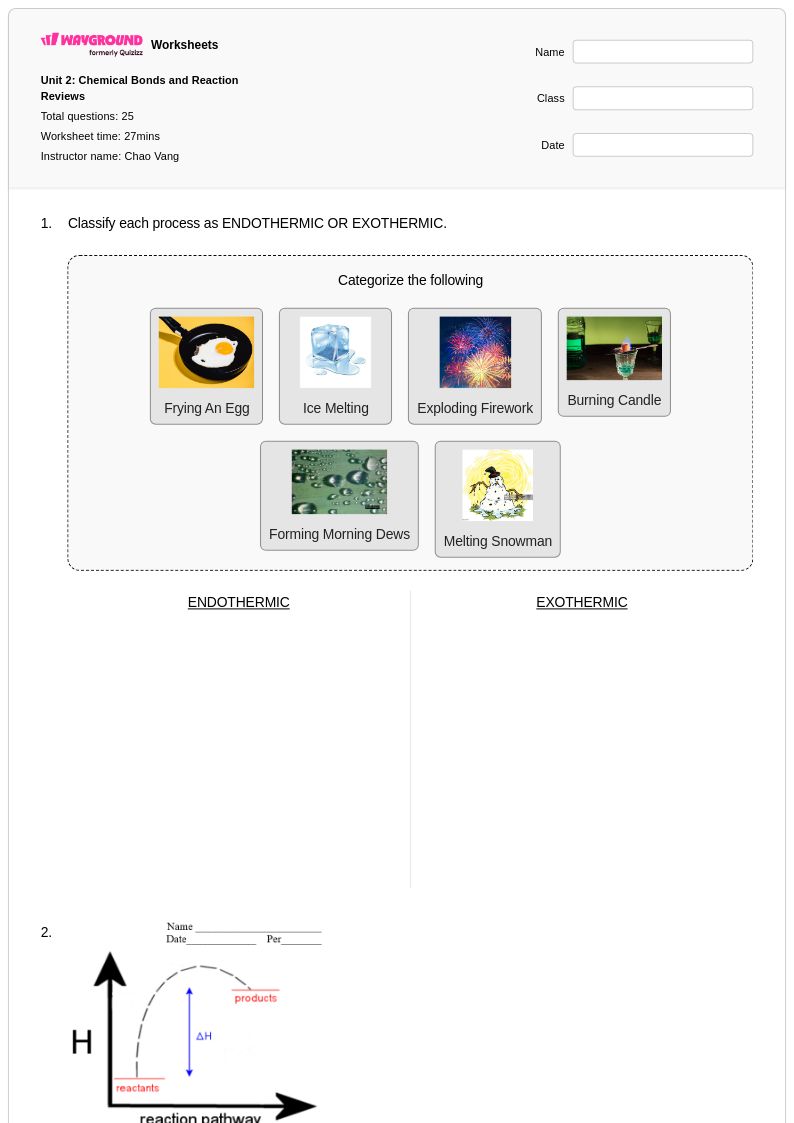
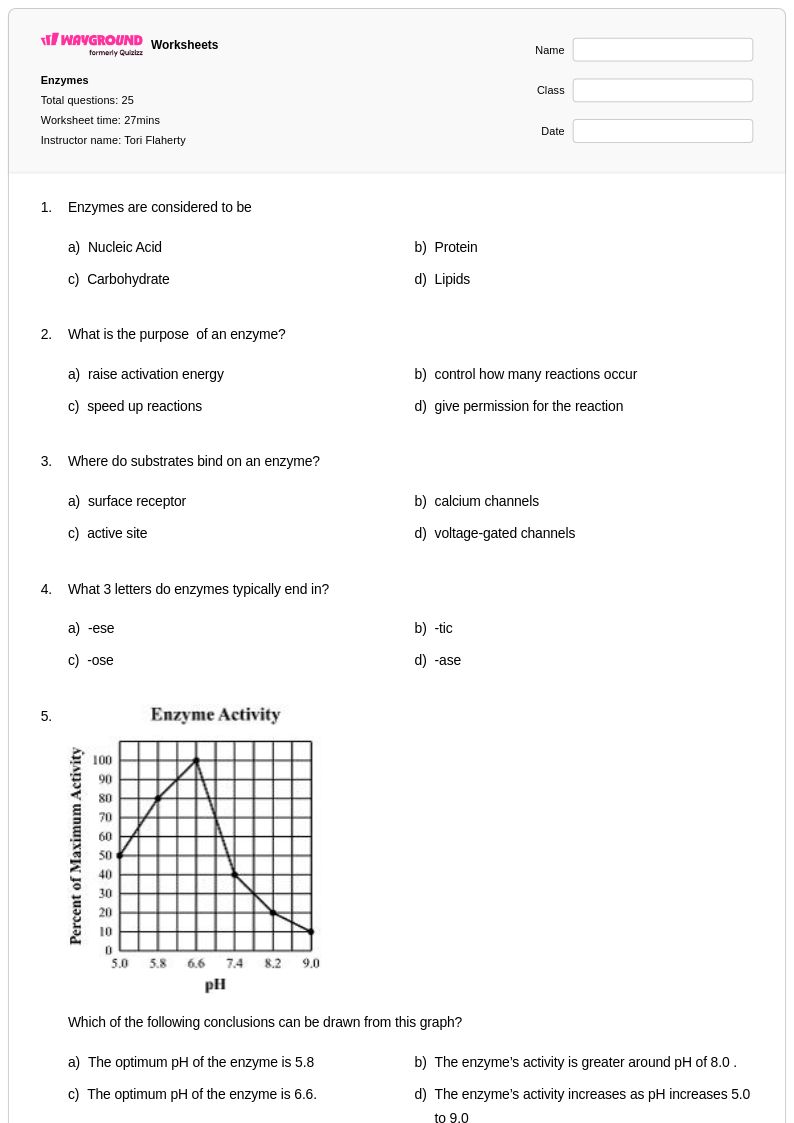
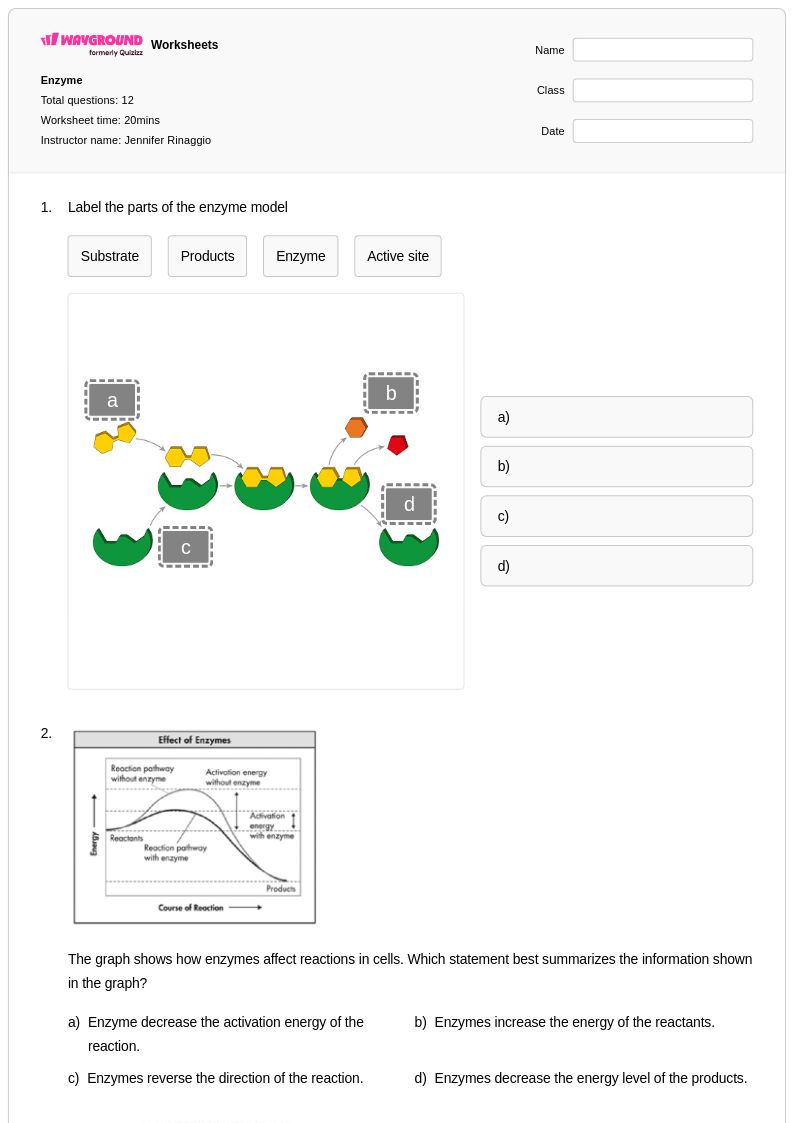
Start by grounding students in the idea that all chemical reactions require a minimum energy input to break existing bonds before new ones can form. Use energy diagrams (reaction coordinate diagrams) to visualize the energy barrier between reactants and products, and explicitly connect activation energy to collision theory so students understand why not every molecular collision results in a reaction. Introducing catalysts as a contrast — showing how they lower the activation energy barrier without being consumed — helps students see the concept in a real-world context such as enzyme function in biology or industrial catalysis in chemistry.
What exercises help students practice activation energy?
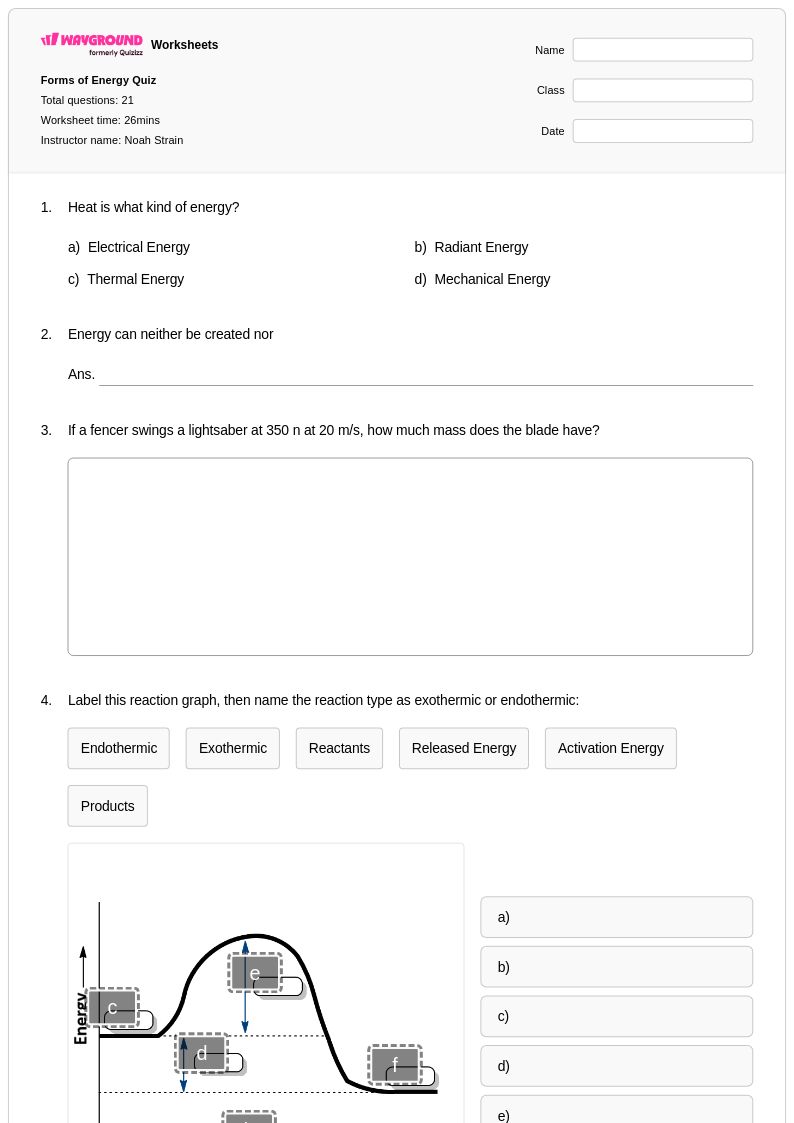
The most effective practice exercises require students to interpret energy diagrams, identifying activation energy for both forward and reverse reactions, and distinguishing between exothermic and endothermic pathways. Calculation problems using the Arrhenius equation help students quantify how temperature and activation energy relate to reaction rate, while scenario-based problems involving catalysts and enzyme kinetics push students to apply the concept rather than just recall it. Worksheets that combine diagram interpretation with short-answer explanation questions are especially useful for building both analytical and conceptual understanding.
What mistakes do students commonly make when learning about activation energy?
One of the most common misconceptions is confusing activation energy with the overall energy change of a reaction — students often assume exothermic reactions have low activation energies, which is not necessarily true. Another frequent error is misreading energy diagrams, particularly failing to measure activation energy from the reactants' energy level to the transition state peak rather than to the products. Students also tend to think catalysts add energy to a reaction rather than providing an alternative pathway with a lower energy barrier, so targeted practice problems that address this distinction directly are especially valuable.
How do I use Wayground's activation energy worksheets in my classroom?
Wayground's activation energy worksheets are available as printable PDFs for traditional classroom use and in digital formats for technology-integrated environments, including the option to host them as a quiz directly on Wayground. Printable versions work well for in-class guided practice or homework assignments, while digital versions support self-paced review and immediate feedback. All worksheets include complete answer keys, making them efficient for both instruction and self-assessment.
How does temperature affect activation energy, and how do I explain this to students?
Activation energy itself does not change with temperature — it is a fixed property of the reaction. What changes is the proportion of molecules that have enough kinetic energy to meet or exceed that activation energy threshold. Higher temperatures increase the average kinetic energy of molecules, meaning more collisions have sufficient energy to overcome the barrier, which is why reaction rates increase with temperature. A clear way to illustrate this for students is to overlay a Maxwell-Boltzmann distribution curve at two temperatures and show how the area beyond the activation energy threshold grows as temperature rises.
How can I differentiate activation energy instruction for students at different skill levels?
For students who are struggling, reduce complexity by focusing first on reading energy diagrams correctly before introducing calculations, and use visual scaffolds that label each part of the diagram explicitly. For advanced learners, extend practice to include Arrhenius equation calculations, multi-step reaction mechanisms, and comparisons between catalyzed and uncatalyzed pathways. On Wayground, teachers can apply accommodations such as read aloud support for students who need text-to-speech assistance and reduced answer choices for students who benefit from a lower cognitive load, making it possible to differentiate within the same assignment.