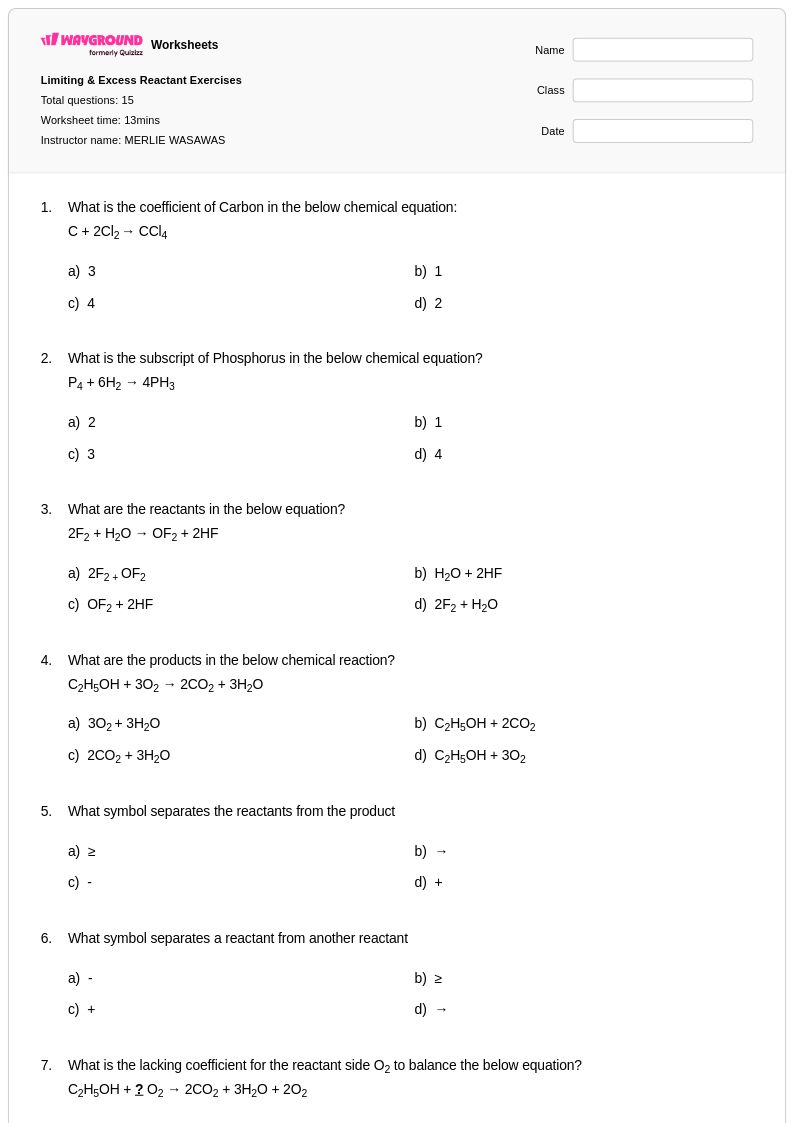
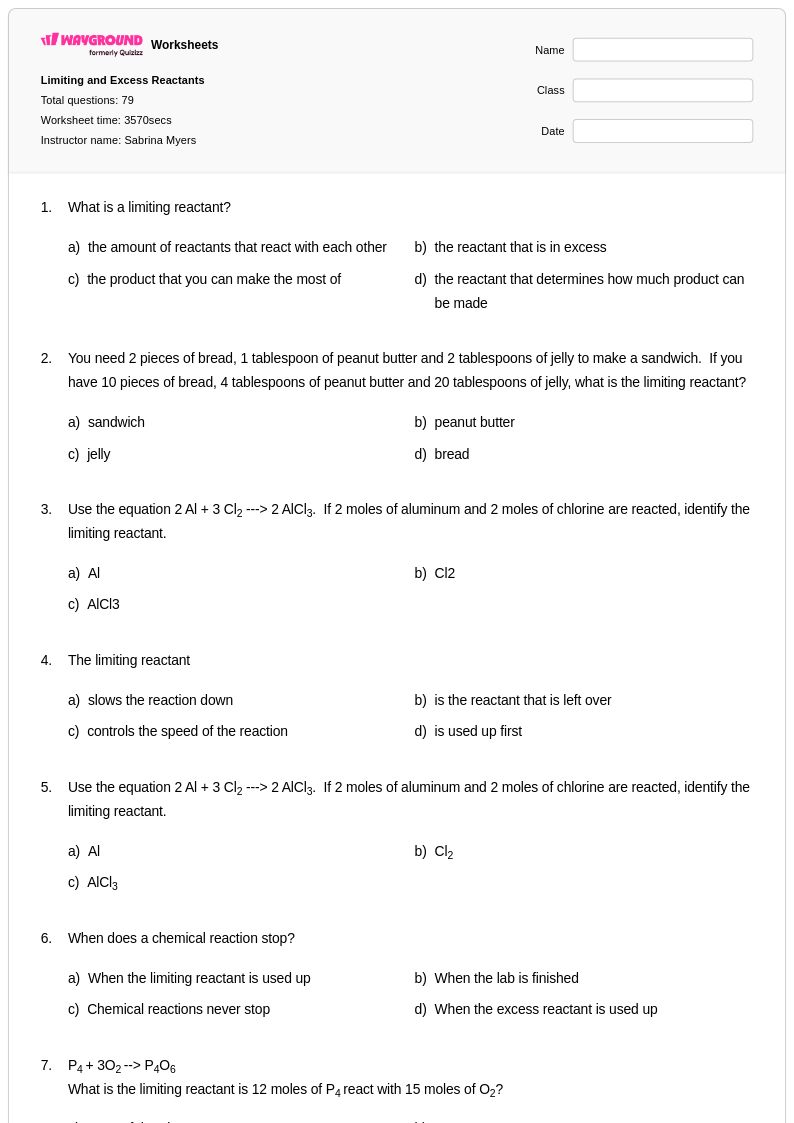
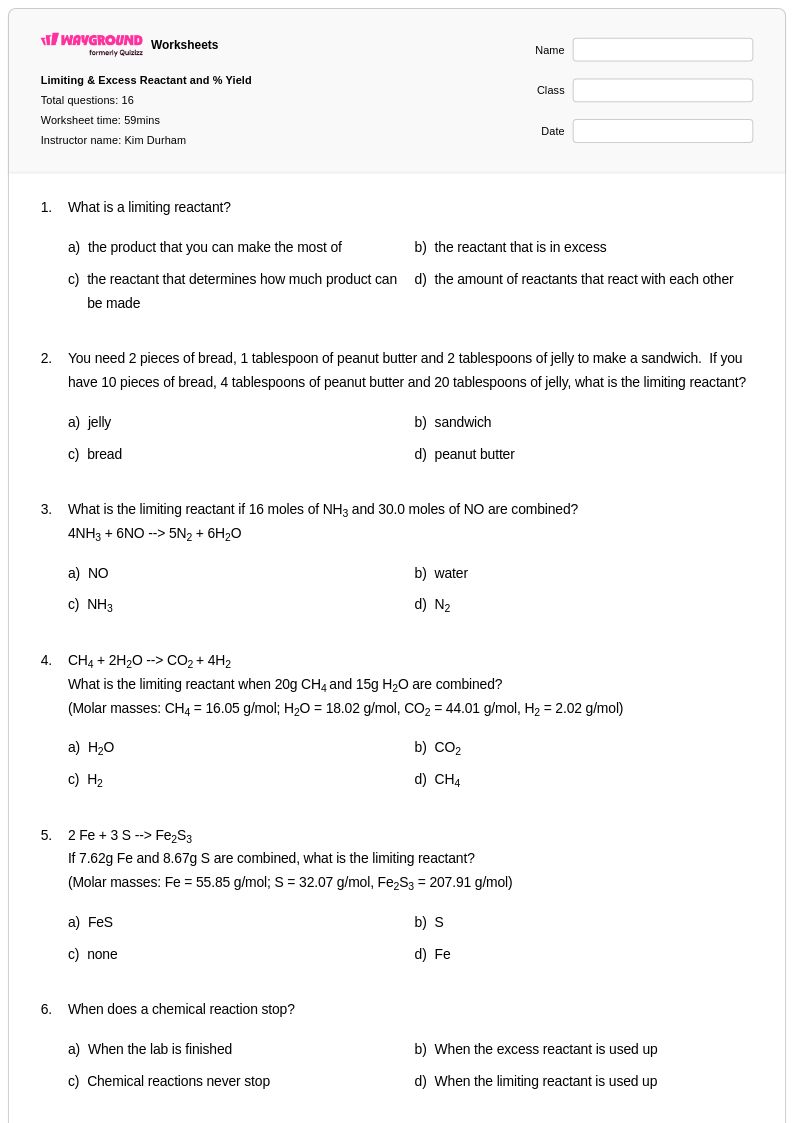
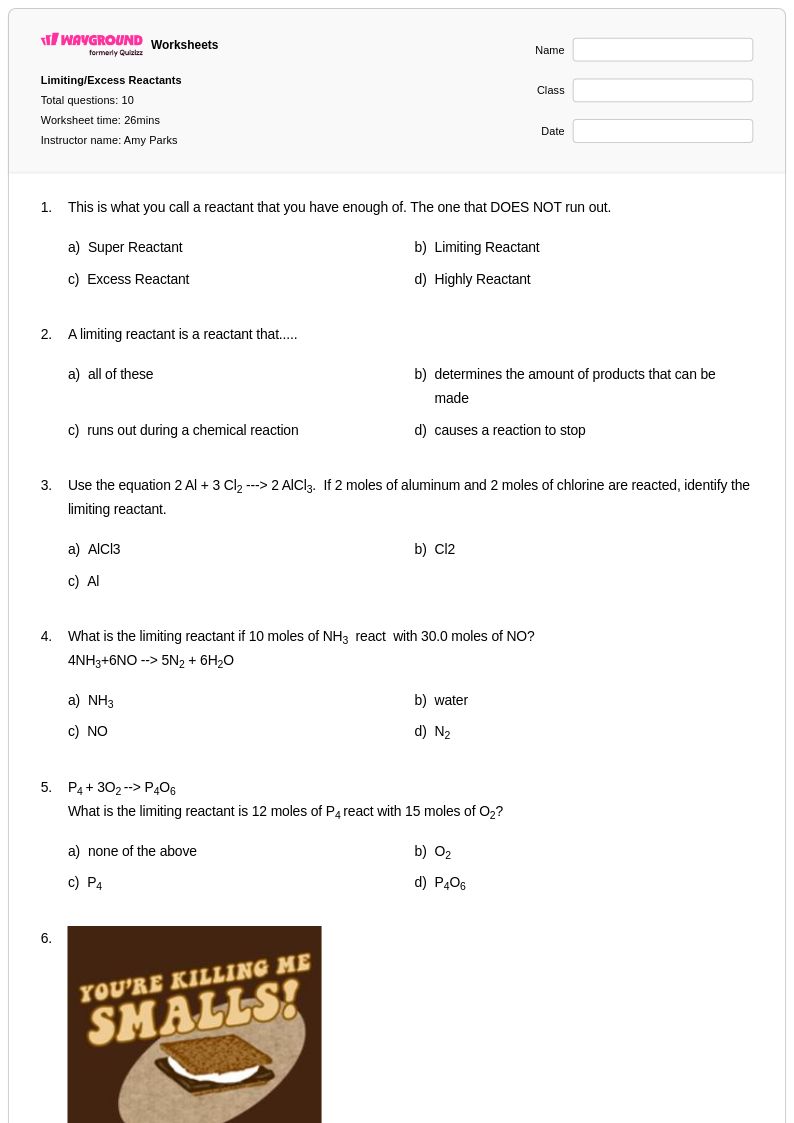
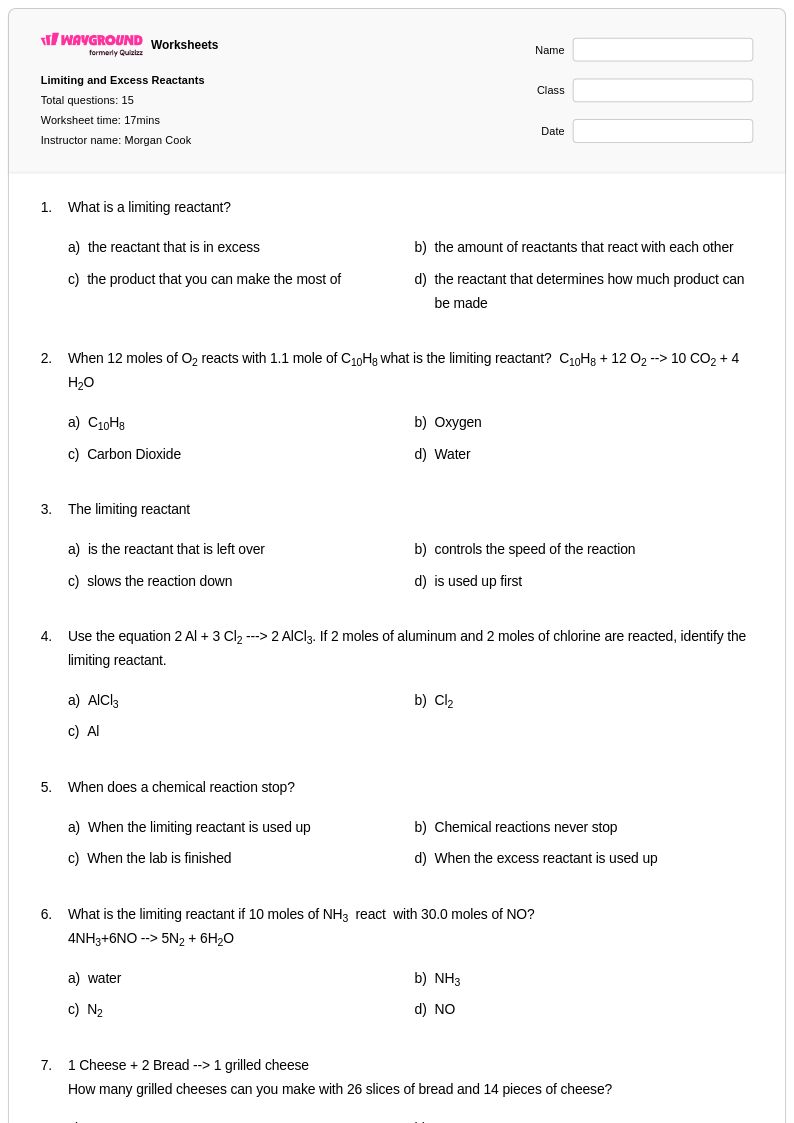
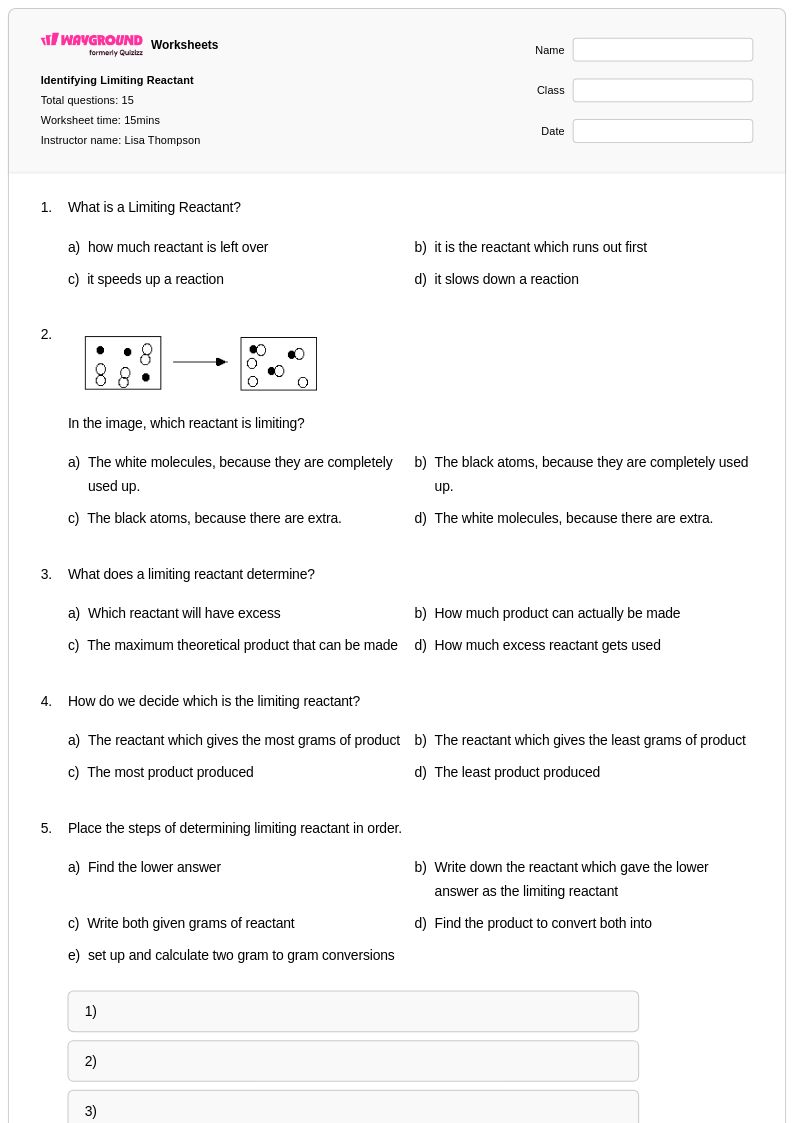
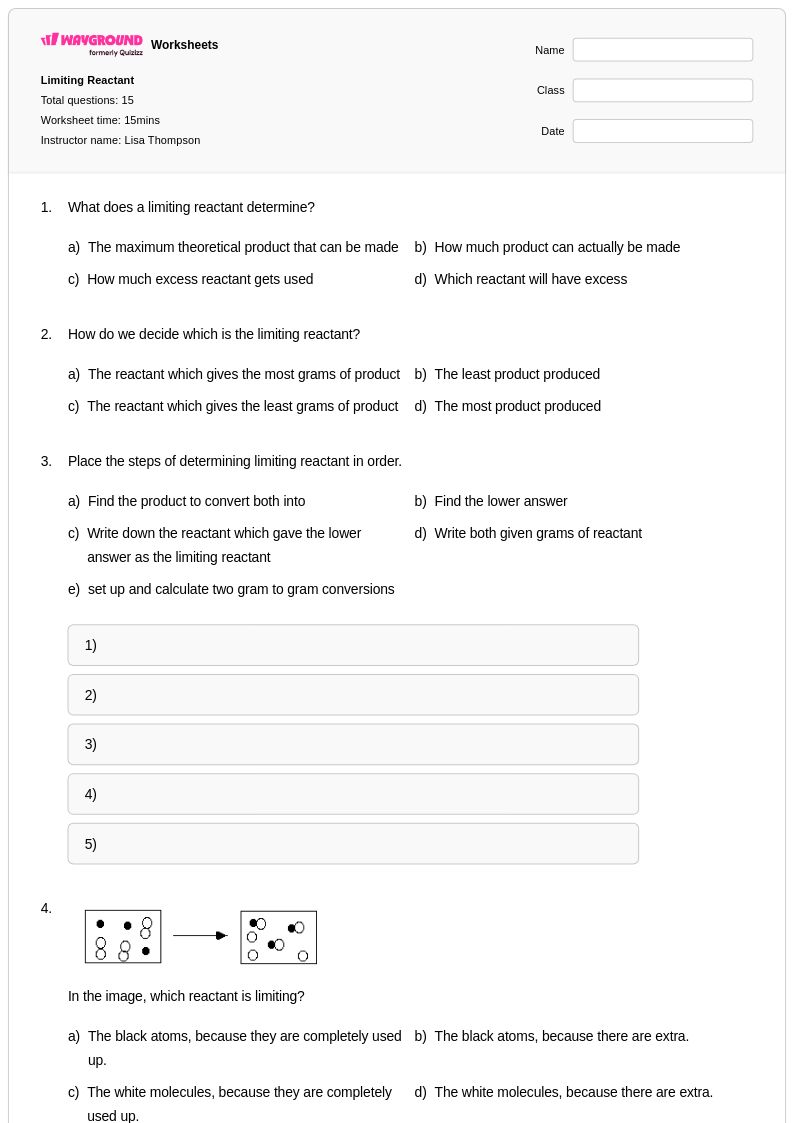
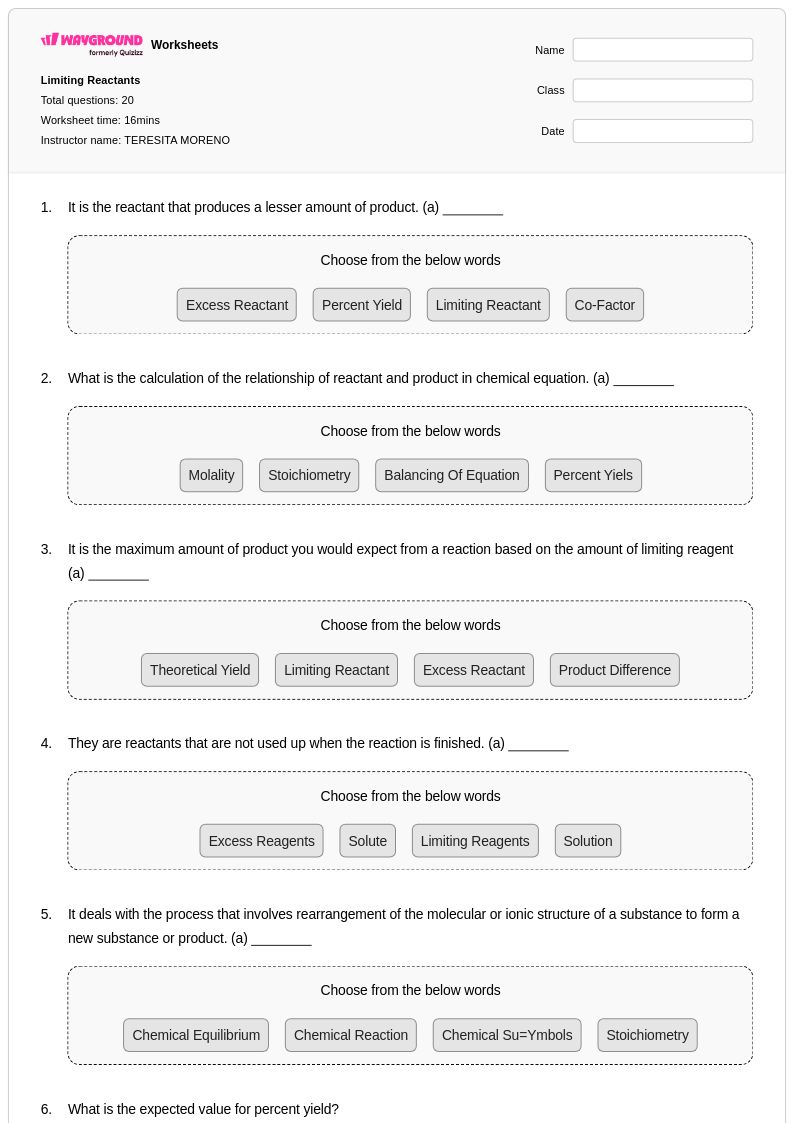
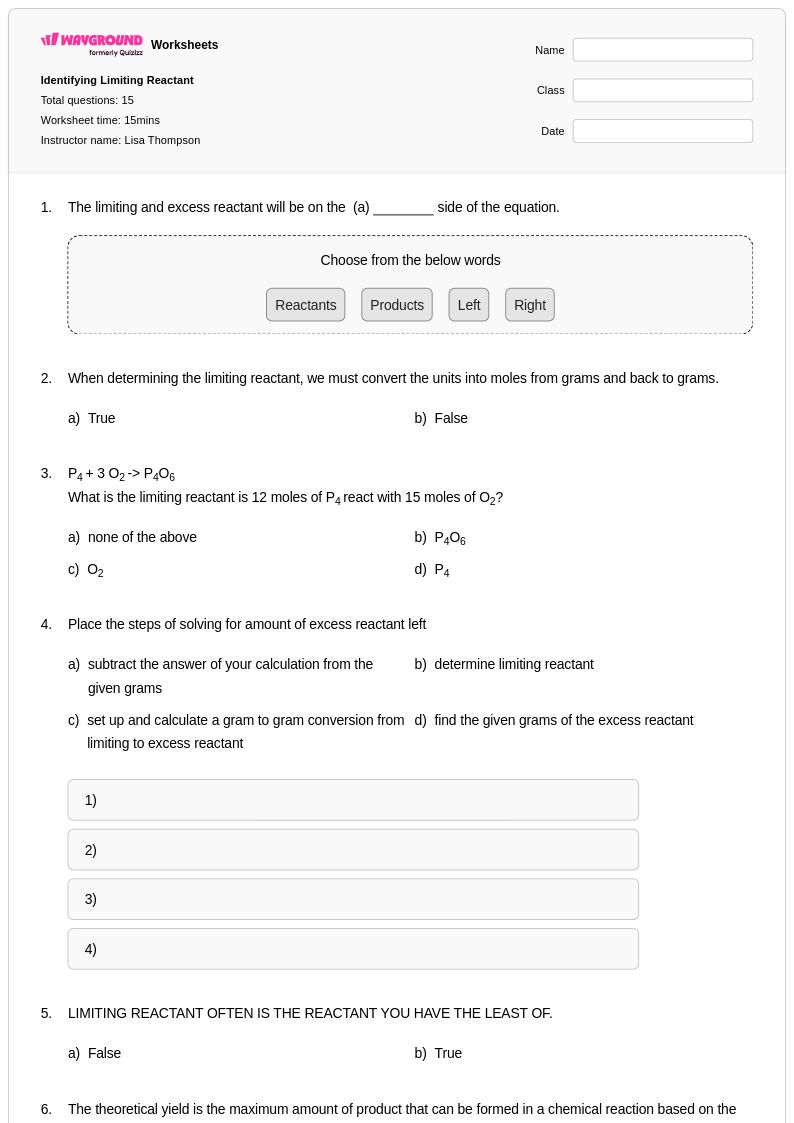
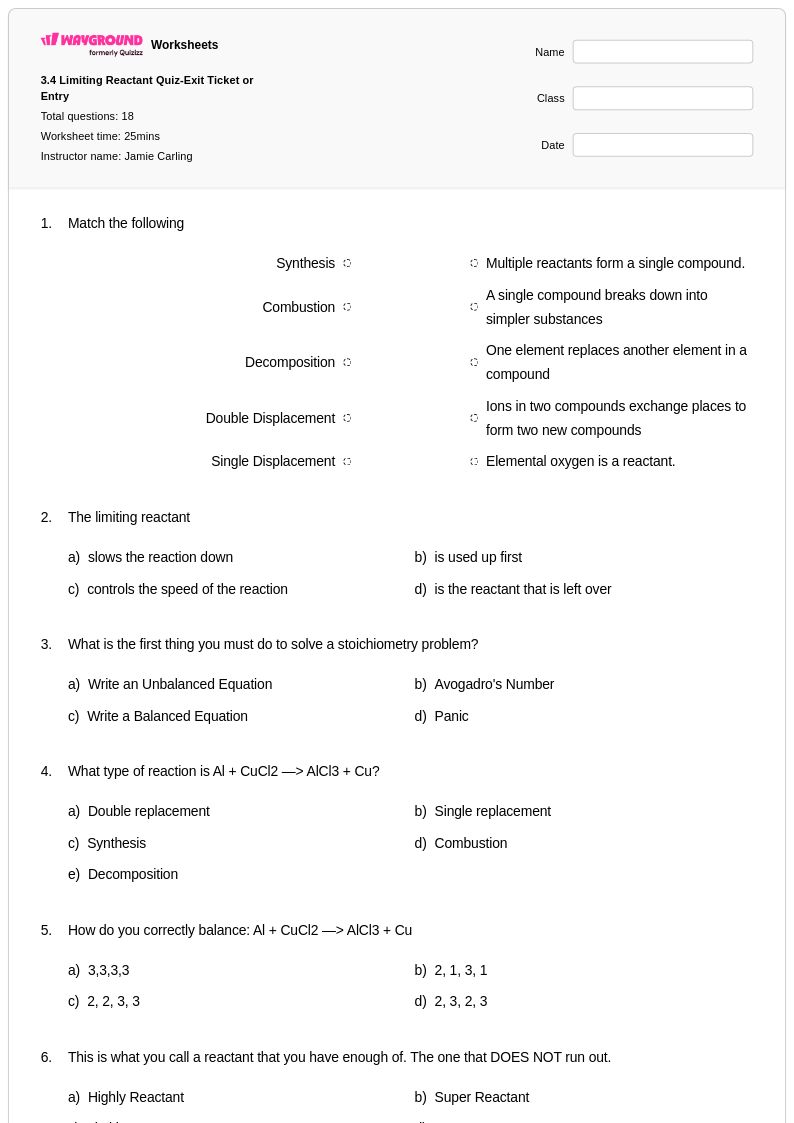
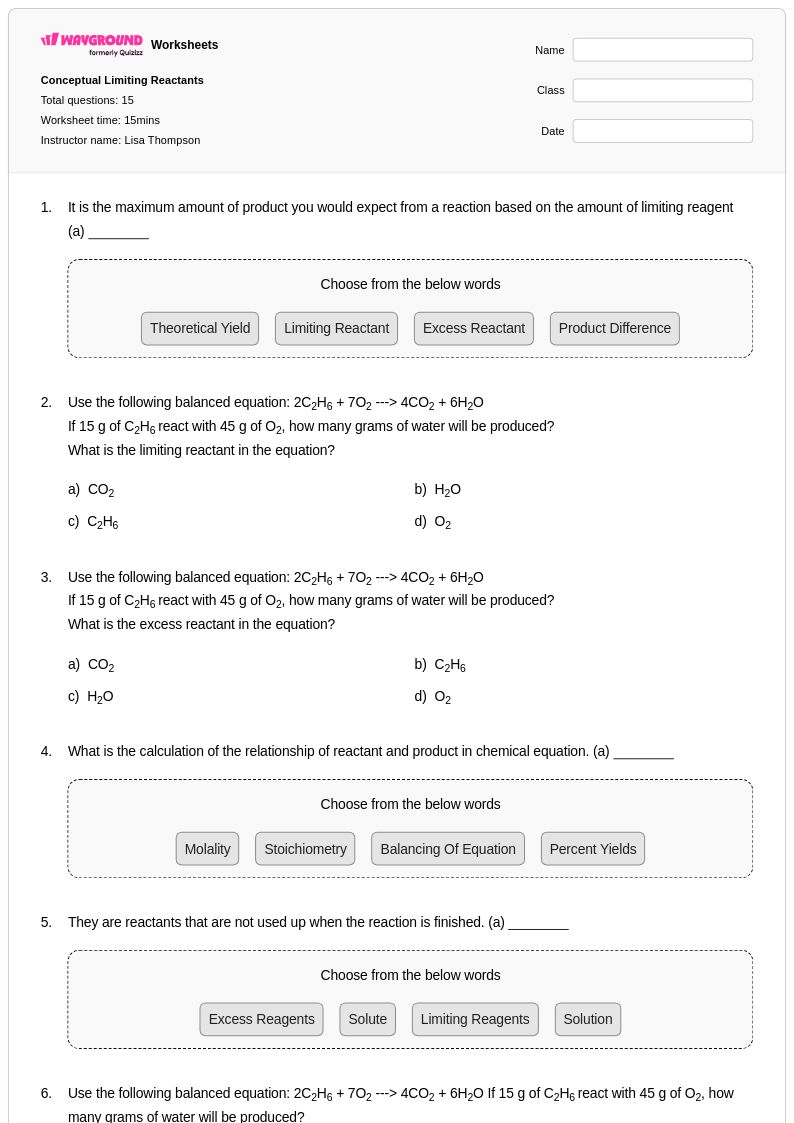
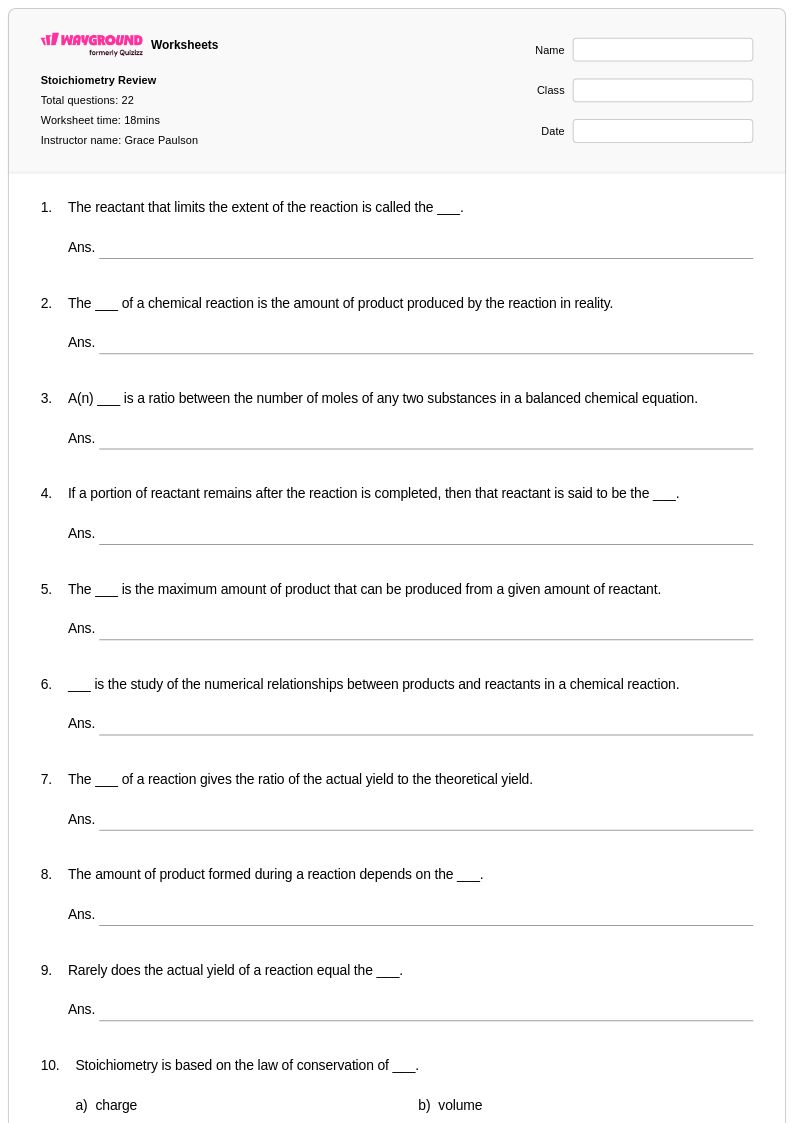
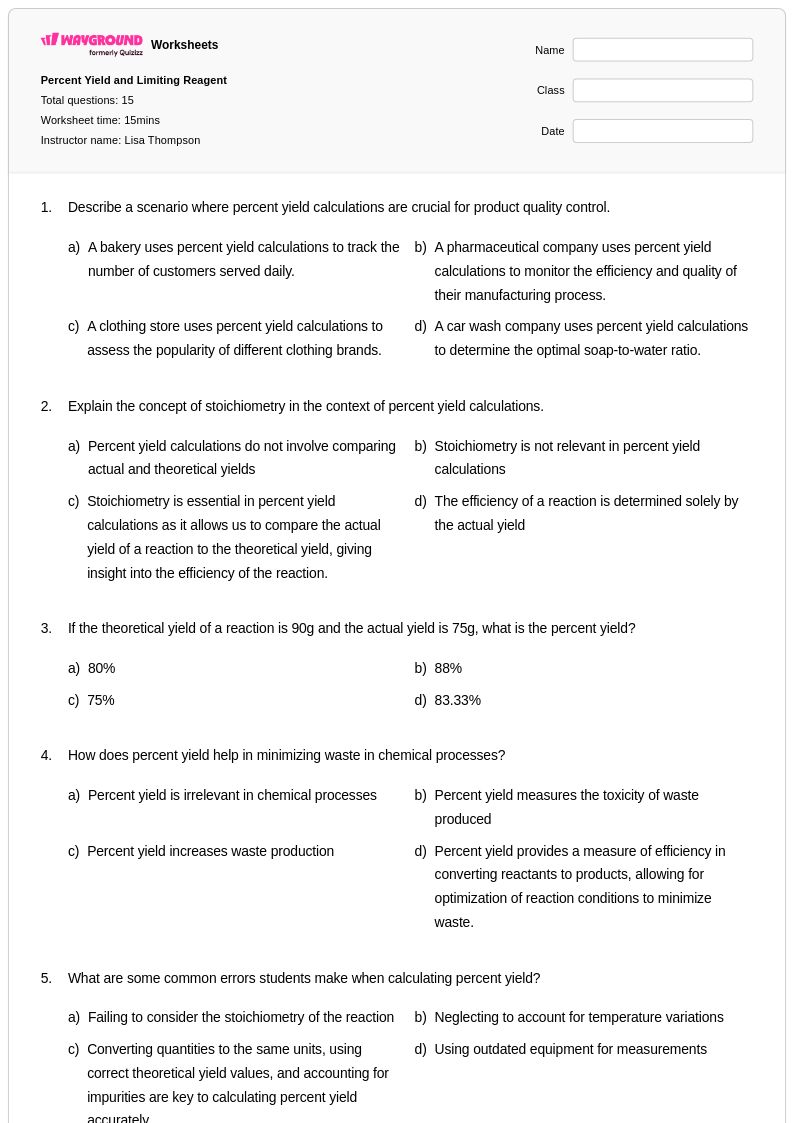
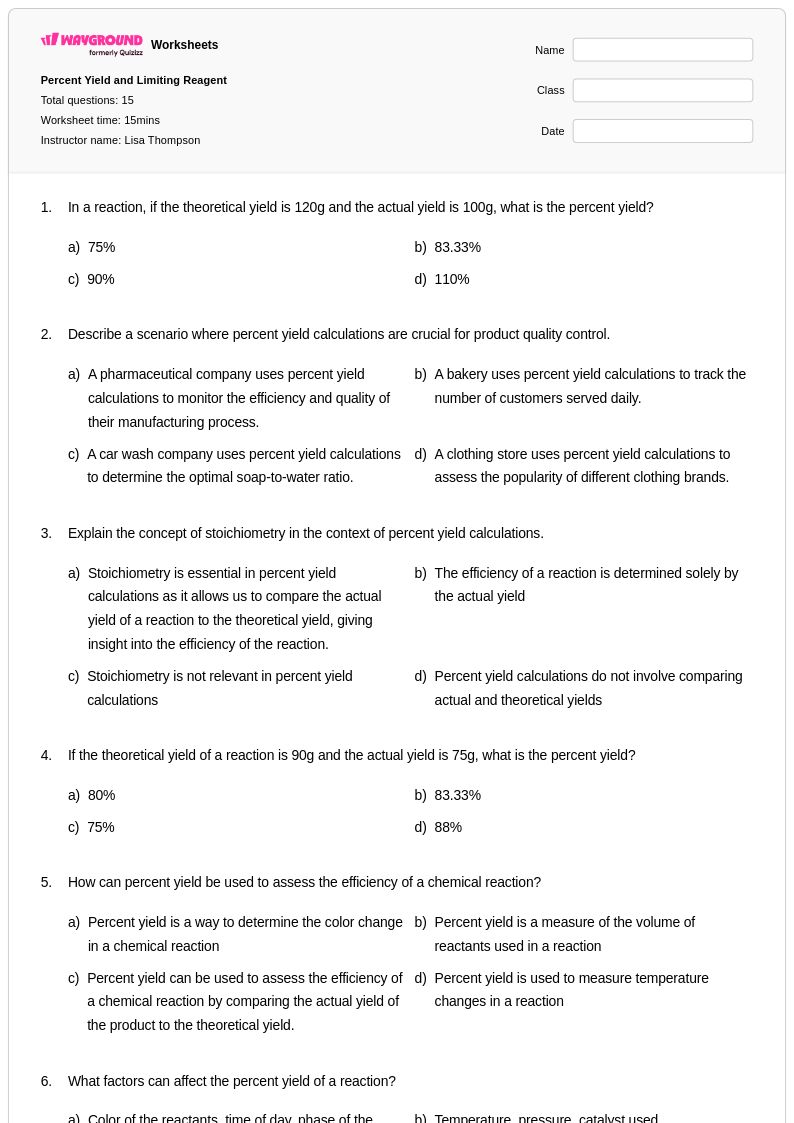
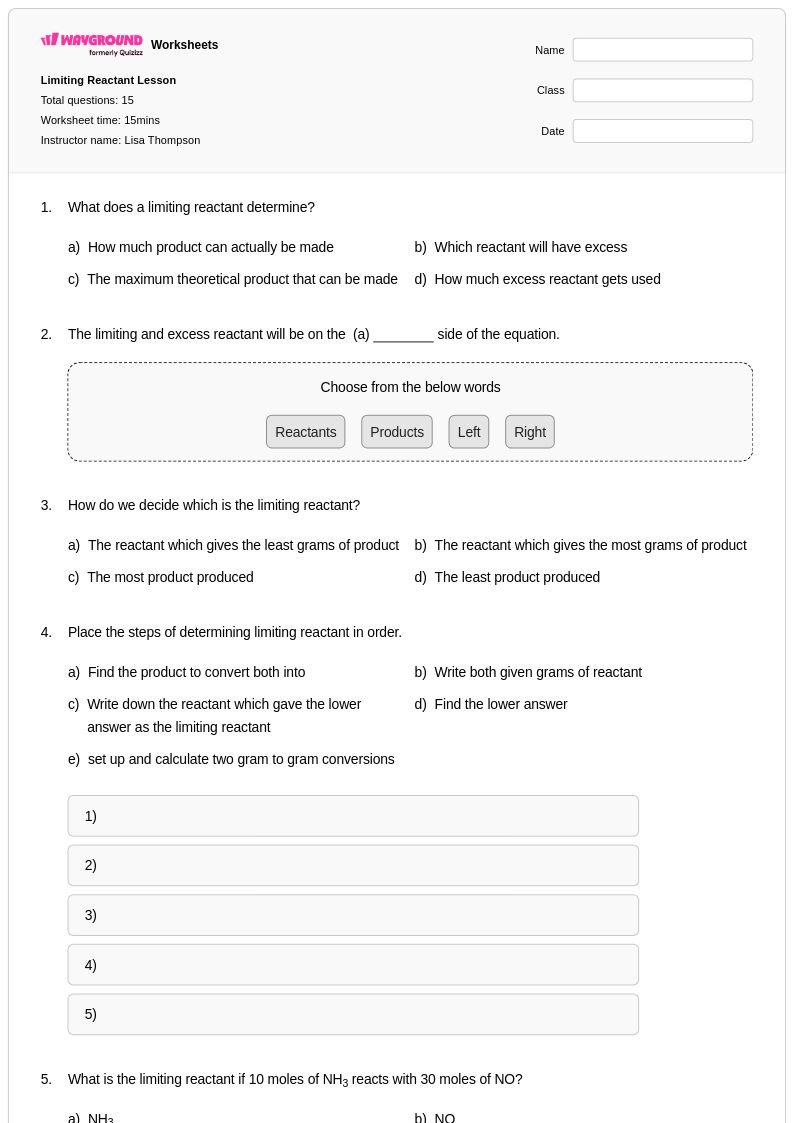
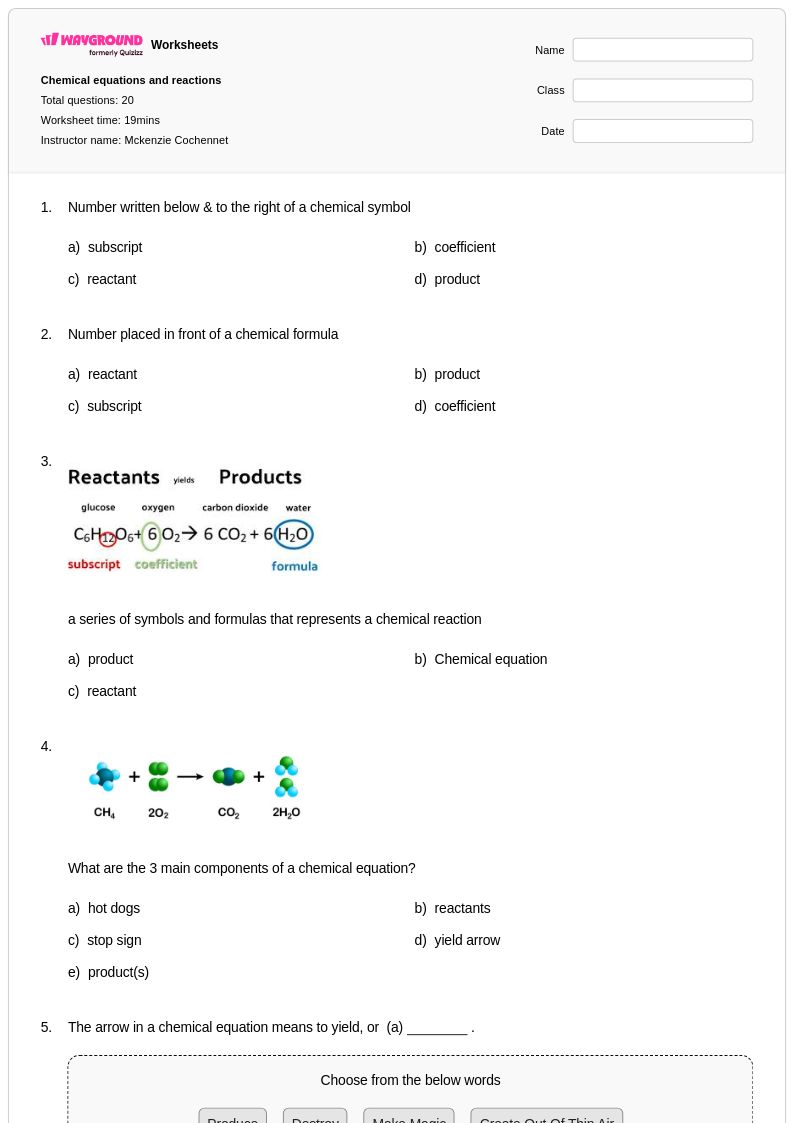
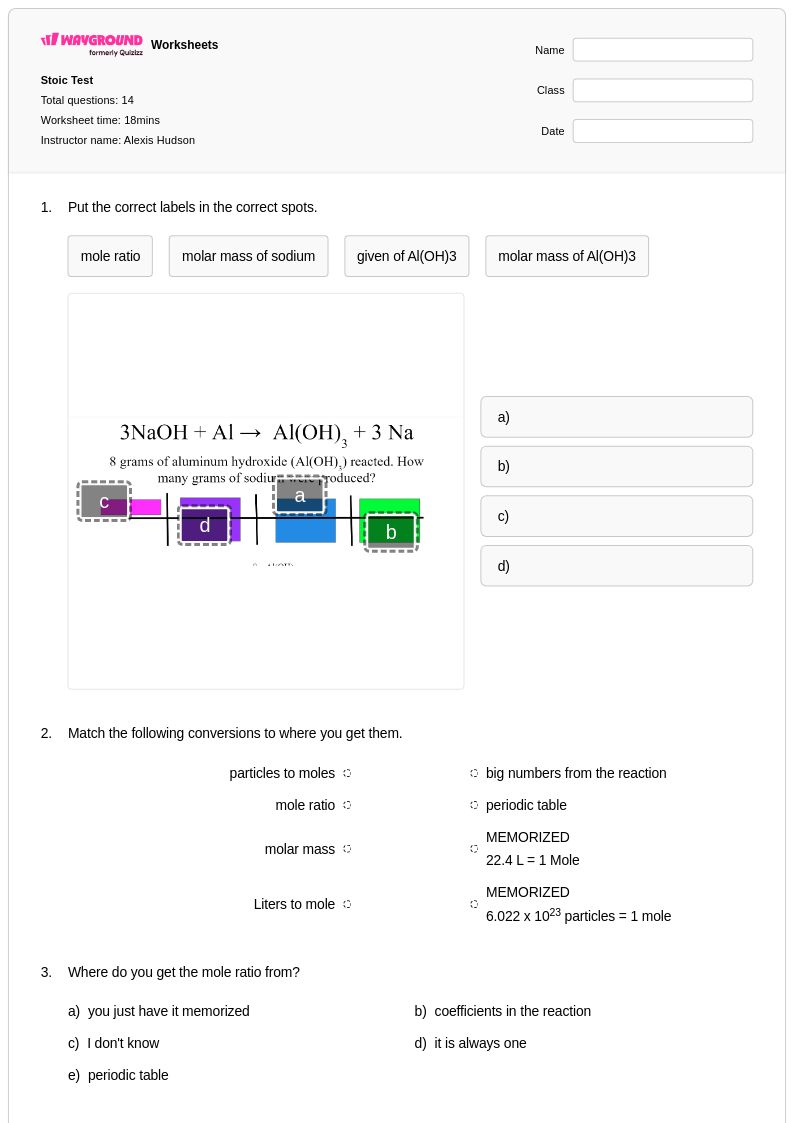
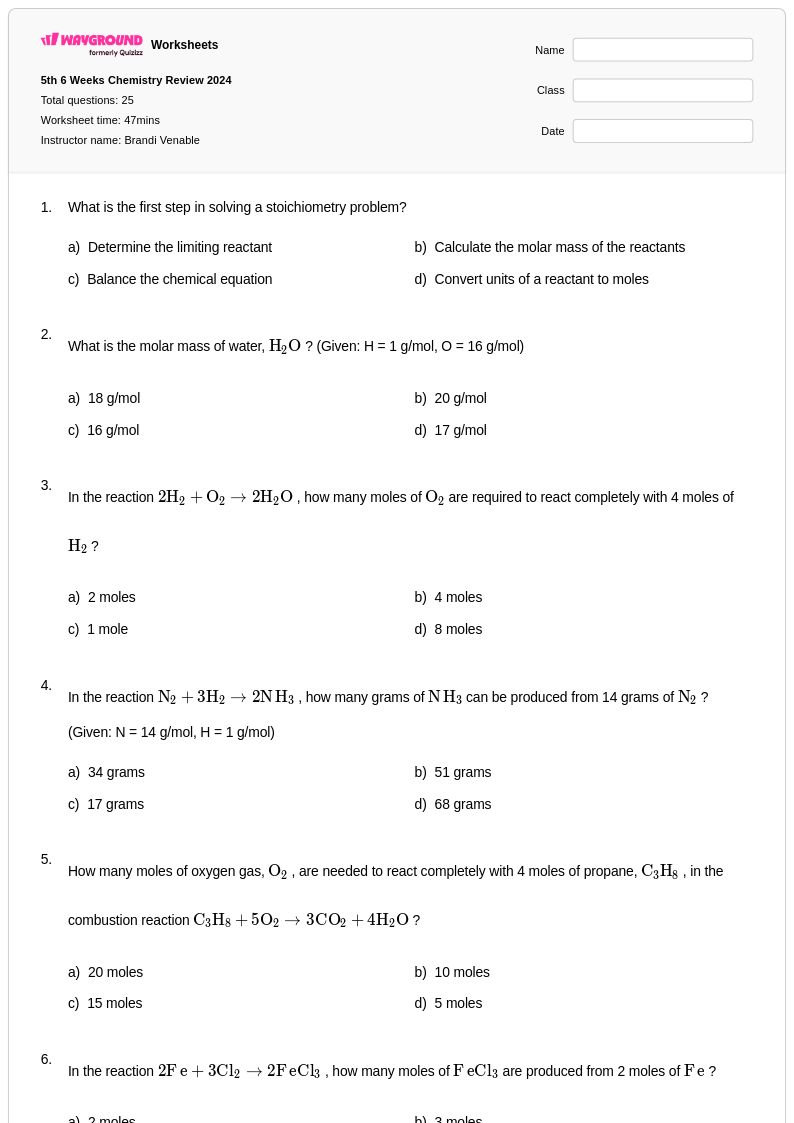
Master excess reactant calculations with Wayground's comprehensive collection of free stoichiometry worksheets, featuring printable PDFs, guided practice problems, and detailed answer keys to strengthen chemical equation problem-solving skills.
Excess reactant worksheets available through Wayground (formerly Quizizz) provide comprehensive practice opportunities for students learning to identify and calculate limiting and excess reagents in chemical reactions. These carefully designed worksheets strengthen critical stoichiometric problem-solving skills by challenging students to determine which reactant will be completely consumed and which will remain in excess when given specific quantities of reactants. The practice problems progressively build complexity, starting with simple mole-to-mole comparisons and advancing to multi-step calculations involving mass conversions and theoretical yield determinations. Each worksheet includes detailed answer keys that guide students through the systematic approach required for excess reactant analysis, while the free printable format ensures accessibility for both classroom instruction and independent study. These pdf resources emphasize the conceptual understanding necessary to predict reaction outcomes and perform accurate quantitative analysis in chemistry.
Wayground (formerly Quizizz) supports chemistry educators with an extensive collection of teacher-created excess reactant worksheets, drawing from millions of educational resources that have been developed and refined by classroom professionals. The platform's robust search and filtering capabilities allow teachers to quickly locate materials that align with specific chemistry standards and match their students' skill levels, whether for introductory stoichiometry concepts or advanced reaction analysis. Differentiation tools enable educators to customize worksheet difficulty and problem types to address diverse learning needs, supporting both remediation for struggling students and enrichment challenges for advanced learners. The flexible format options, including printable pdf versions and digital assignments, facilitate seamless integration into various instructional approaches, from traditional worksheet-based practice to technology-enhanced learning environments. These comprehensive resources streamline lesson planning while providing teachers with reliable materials for skill practice, formative assessment, and targeted intervention in excess reactant problem-solving.
FAQs
How do I teach excess reactant and limiting reagent to chemistry students?
Start by building students' understanding of the concept through a concrete analogy, such as making sandwiches where one ingredient runs out first. Then introduce the mole ratio comparison method: have students convert all reactant quantities to moles, divide by the stoichiometric coefficients, and identify the smallest value as the limiting reagent. Once students can identify the limiting reactant, move them toward calculating the amount of excess reactant that remains after the reaction is complete. Scaffolded practice problems that increase in complexity, from simple mole comparisons to multi-step mass and yield calculations, help solidify this progression.
What practice problems help students get better at excess reactant calculations?
Effective practice begins with mole-to-mole comparisons using balanced equations, then advances to problems requiring mass-to-mole conversions before the comparison step. Students should also practice calculating how much excess reactant remains after the limiting reagent is fully consumed, as this is a common extension question on assessments. Including problems that integrate theoretical yield determinations alongside excess reactant analysis prepares students for multi-concept stoichiometry tasks. Progressive worksheets that layer these skills in sequence are particularly effective for building fluency.
What mistakes do students commonly make when solving excess reactant problems?
The most frequent error is comparing raw masses or volumes of reactants directly without first converting to moles and applying stoichiometric ratios. Students also often identify the limiting reagent correctly but then fail to calculate the remaining amount of the excess reactant, stopping the problem too early. Another common misconception is assuming the reactant present in larger quantity is always the excess reactant, which ignores the role of mole ratios from the balanced equation. Targeted practice that explicitly requires students to show each conversion step helps surface and correct these errors.
How can I differentiate excess reactant worksheets for students at different skill levels?
For struggling students, begin with problems that provide balanced equations and pre-converted mole values so they can focus on the comparison and identification step without being overwhelmed by multi-step conversions. Advanced learners benefit from problems that incorporate percent yield, impure reactants, or require them to balance the equation themselves before solving. On Wayground, teachers can apply accommodations such as reduced answer choices or read-aloud support for individual students who need additional scaffolding, while other students receive the standard version without any disruption to the class workflow.
How do I use Wayground's excess reactant worksheets in my classroom?
Wayground's excess reactant worksheets are available as printable PDFs for traditional classroom use and in digital formats for technology-integrated learning environments, making them flexible for both in-person and remote instruction. Teachers can also host worksheets as a quiz directly on Wayground, allowing for real-time student responses and streamlined grading. The included answer keys support independent student review as well as teacher-led correction sessions, making these resources suitable for guided practice, homework, or formative assessment.
How do excess reactant calculations connect to theoretical yield in stoichiometry?
Excess reactant and theoretical yield problems are closely linked because the theoretical yield of a product is always calculated based on the limiting reagent, not the excess reactant. Once students identify which reactant is fully consumed, they use that quantity to determine the maximum amount of product that can form. Teaching these two concepts together reinforces why identifying the limiting reagent is the critical first step in any complete stoichiometric analysis. Problems that require both calculations in sequence are effective for helping students see the logical connection between them.