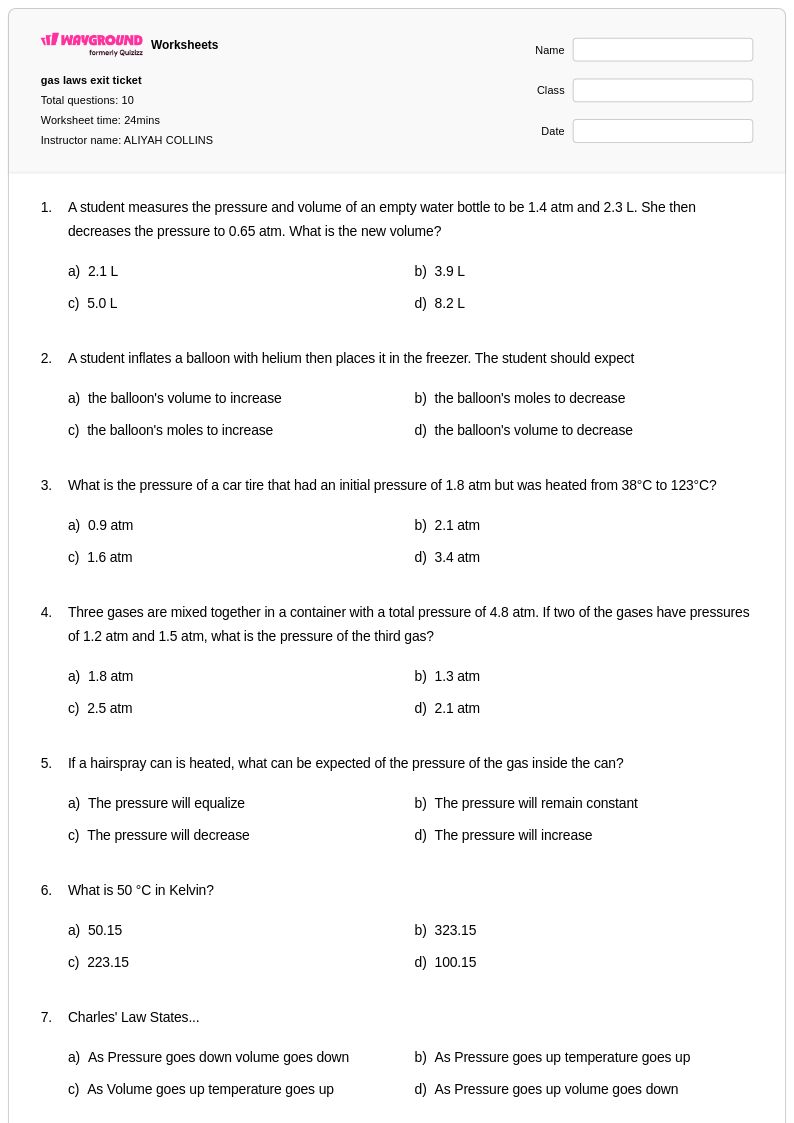
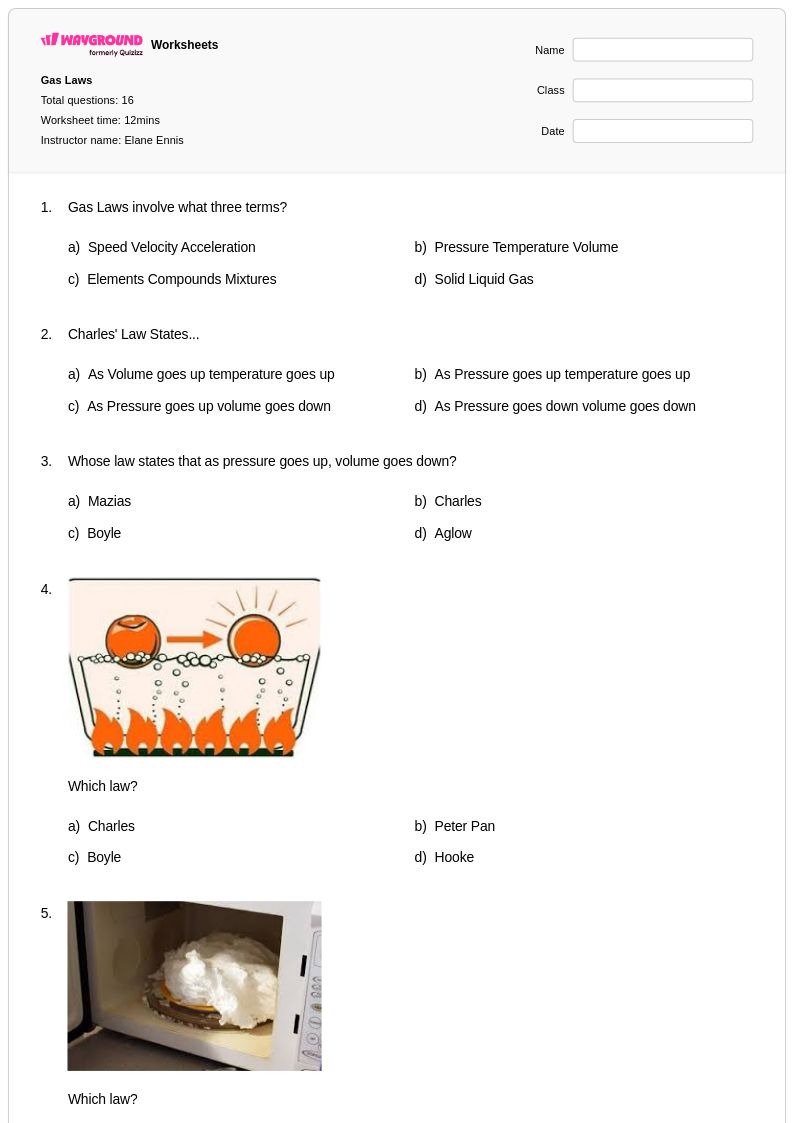
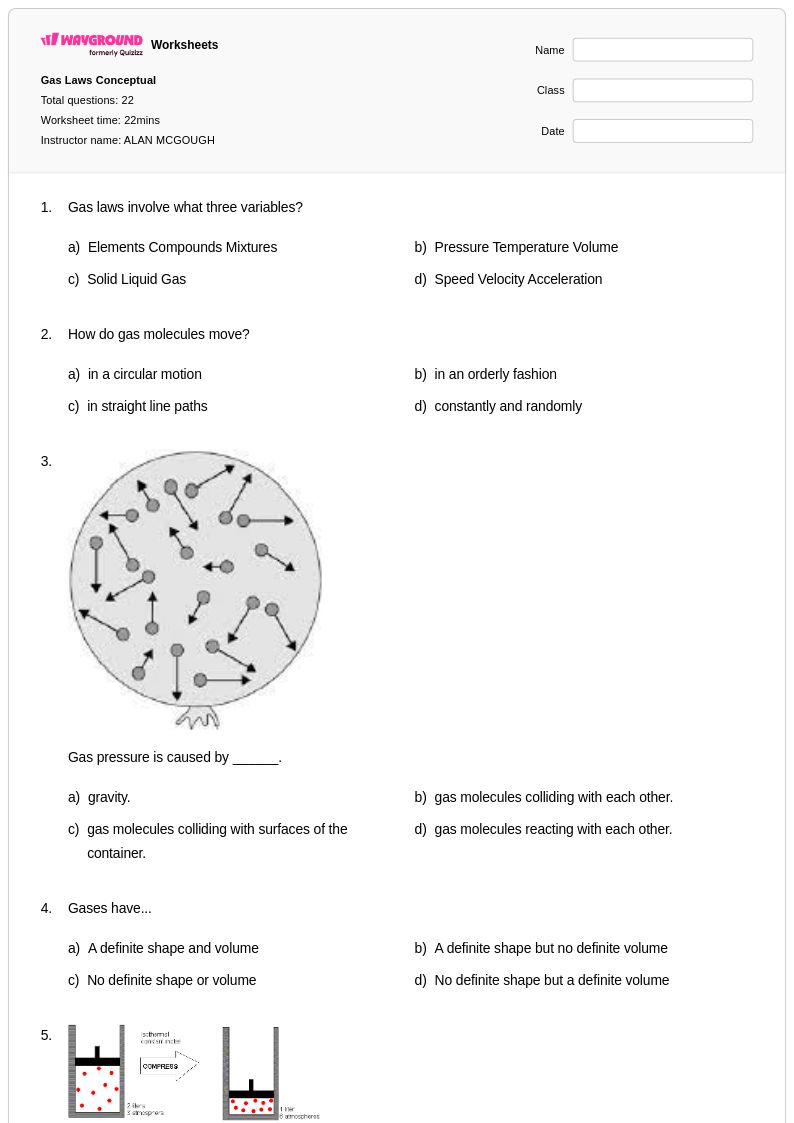
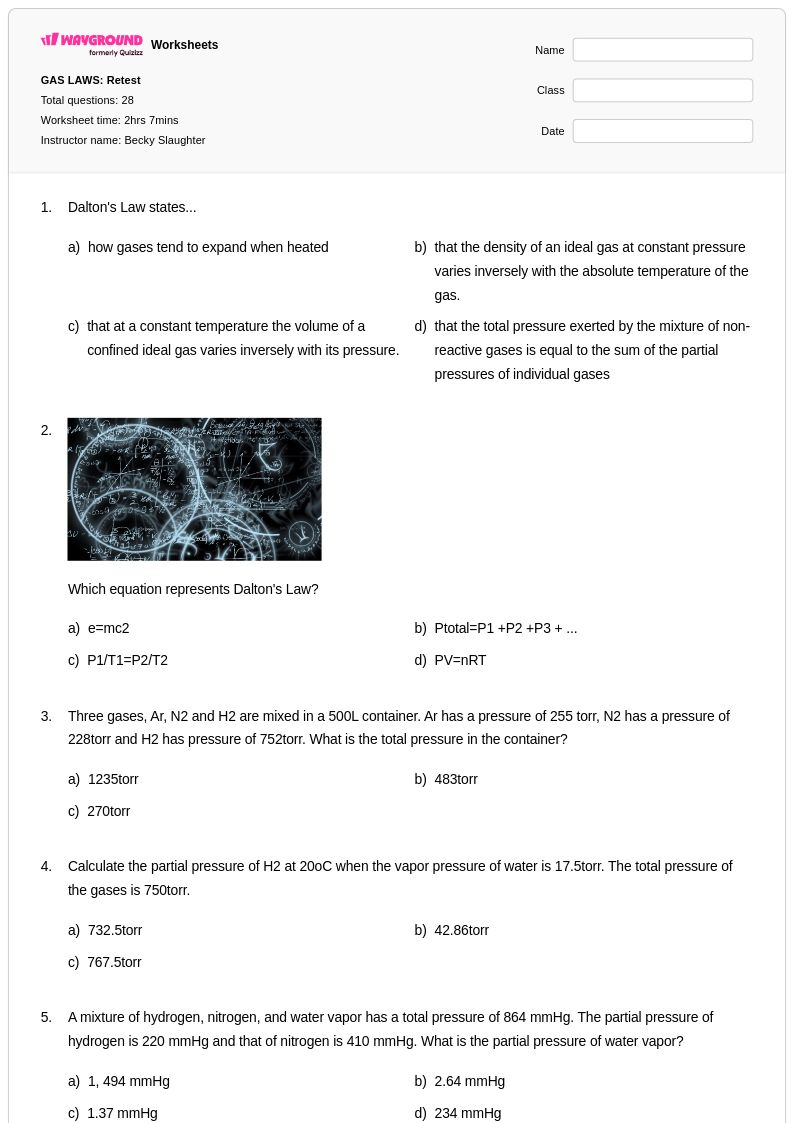
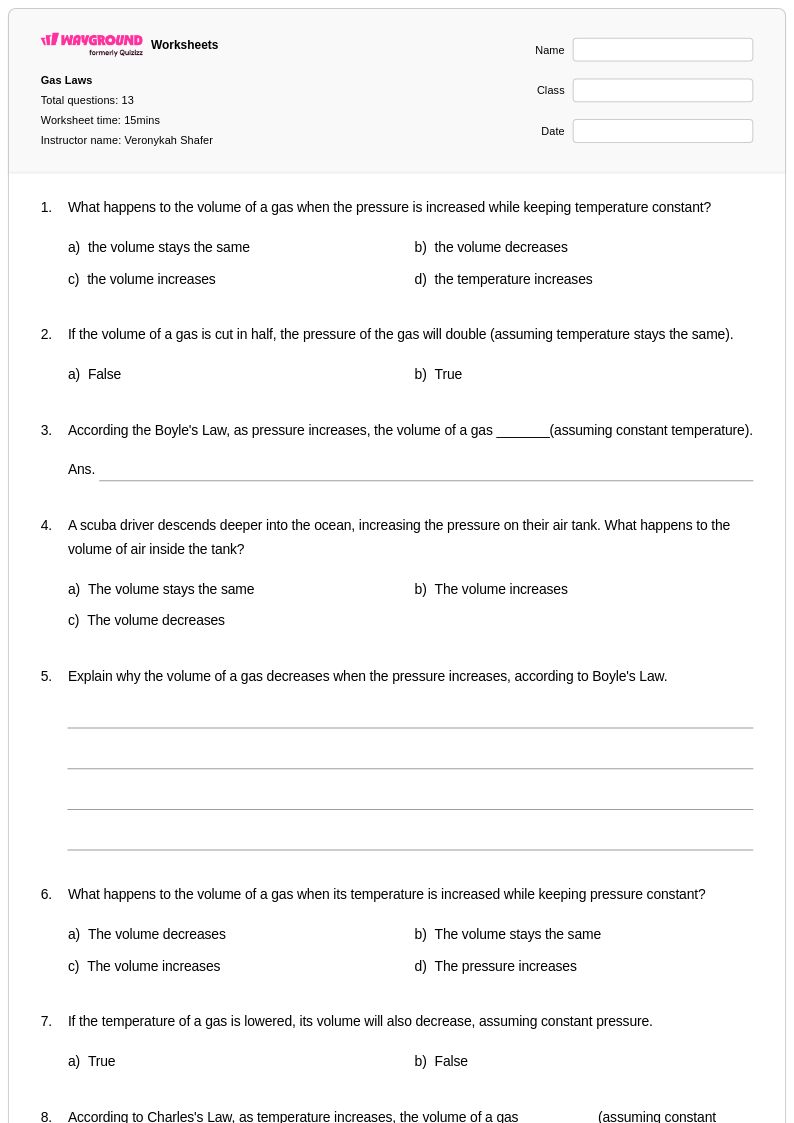
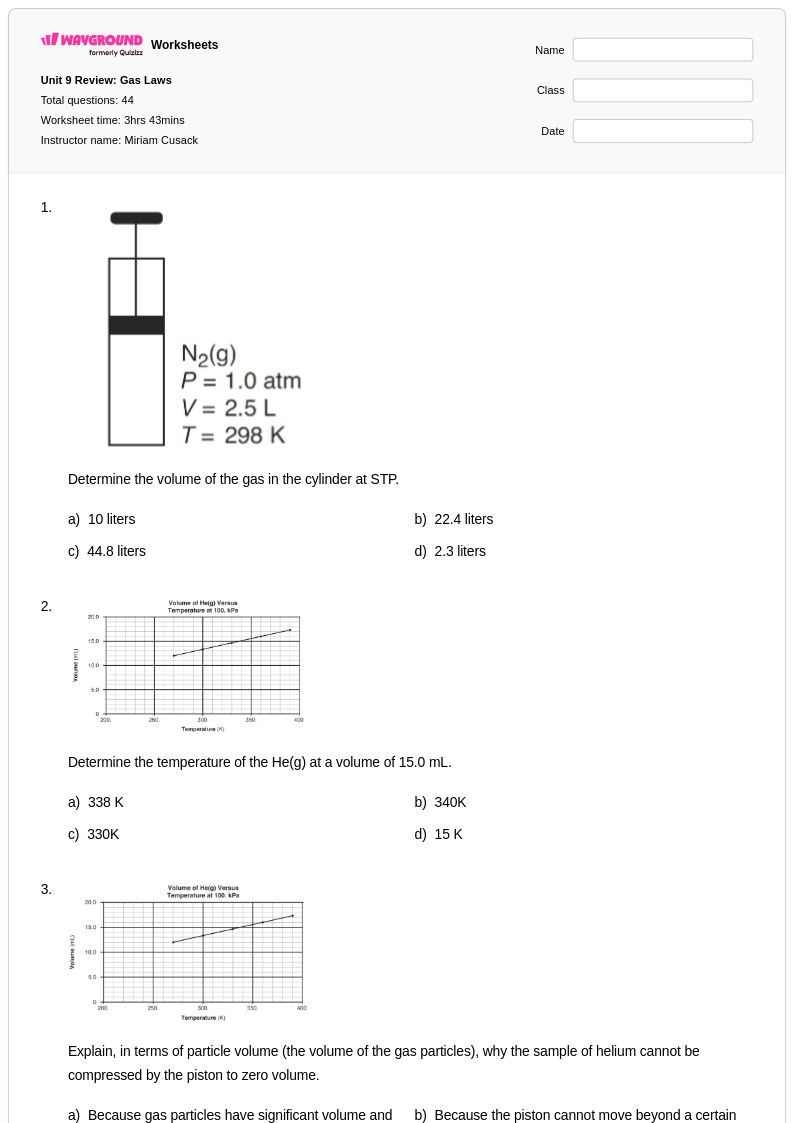
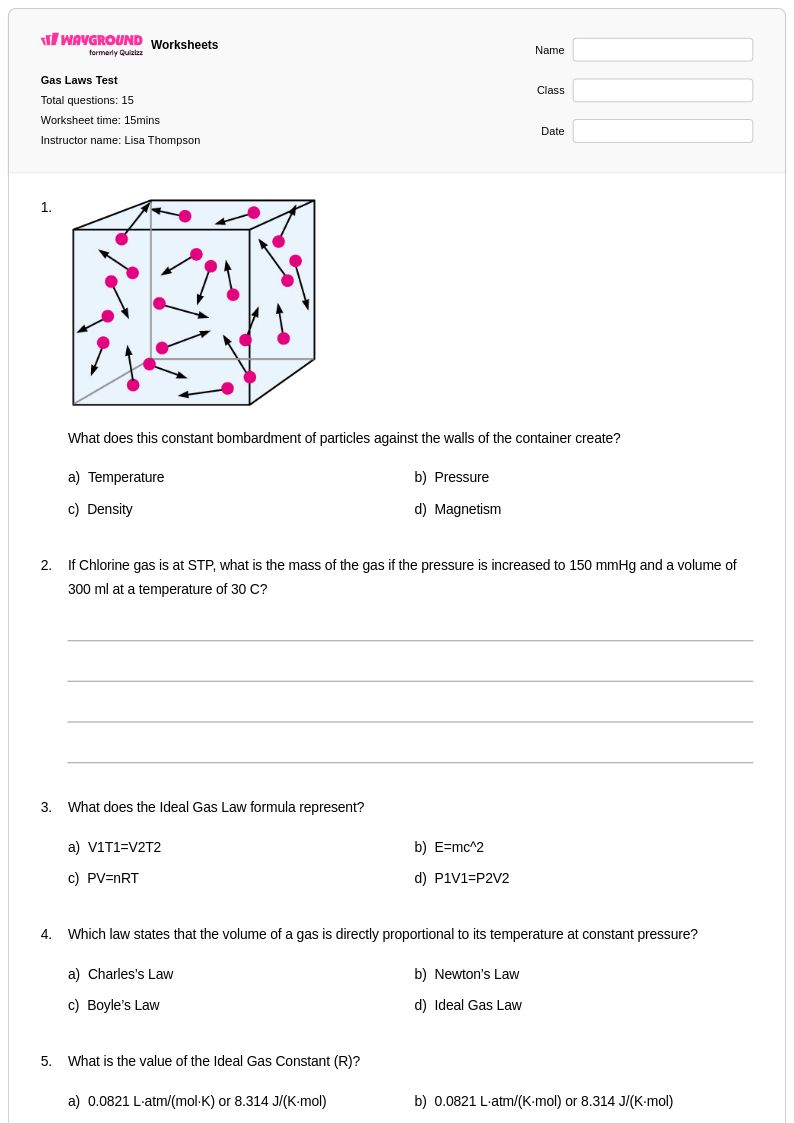
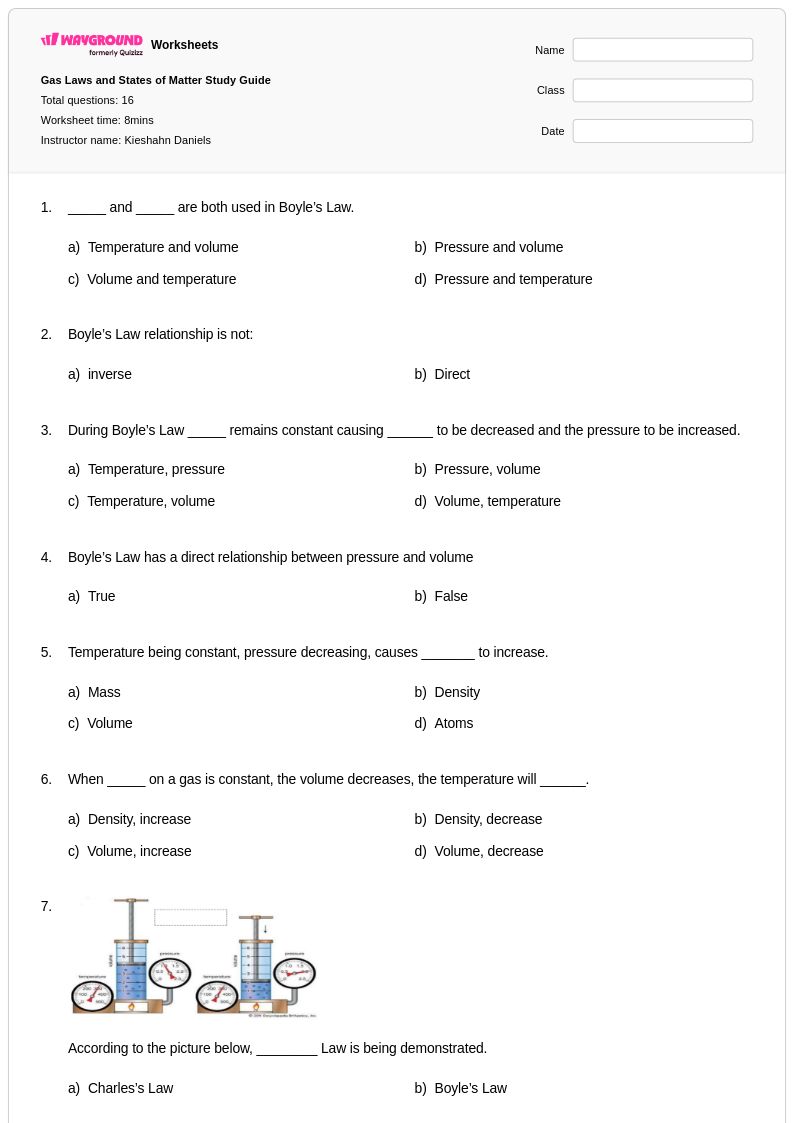
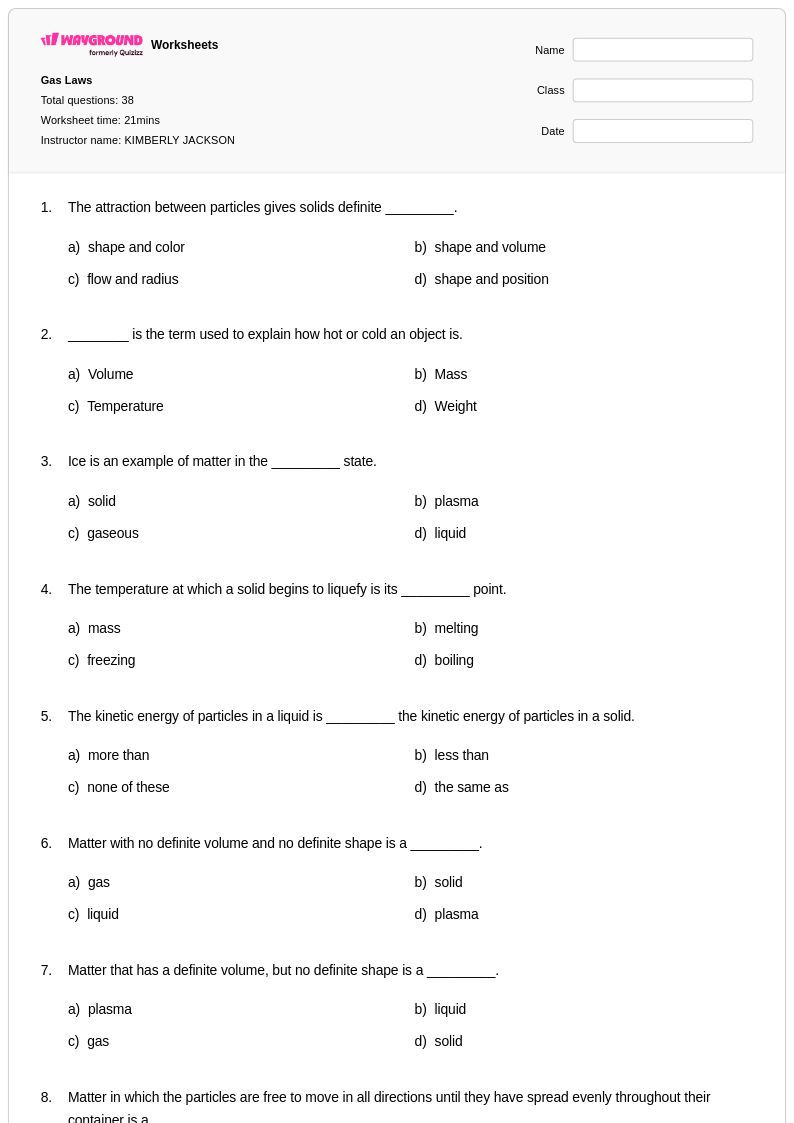
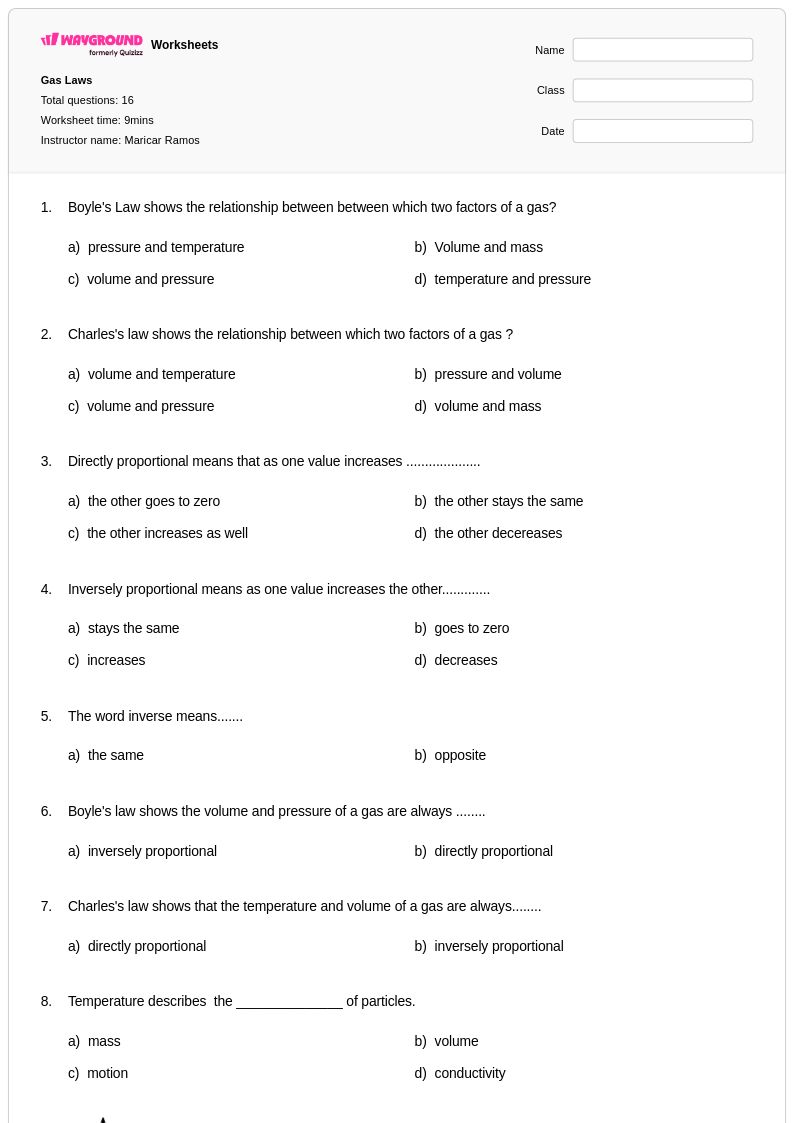
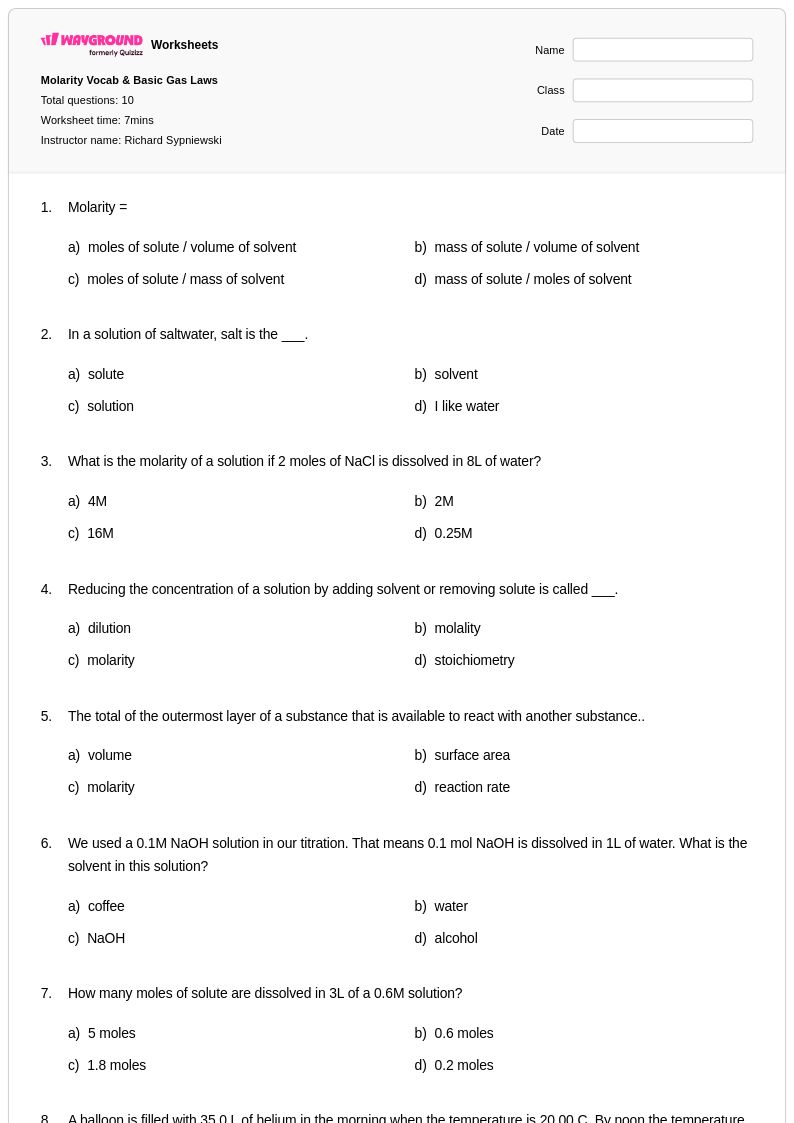
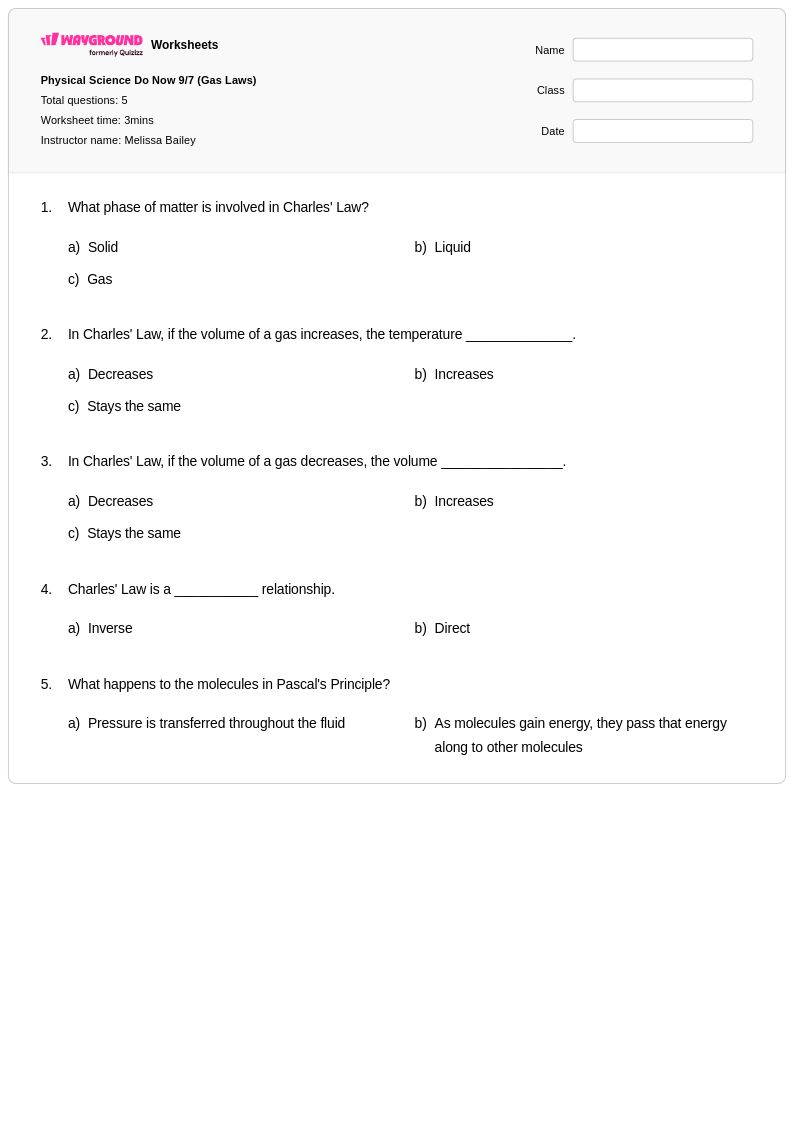
Explore Wayground's comprehensive collection of gas laws worksheets featuring free printables and practice problems with answer keys to help students master Boyle's Law, Charles's Law, and ideal gas relationships through hands-on PDF exercises.
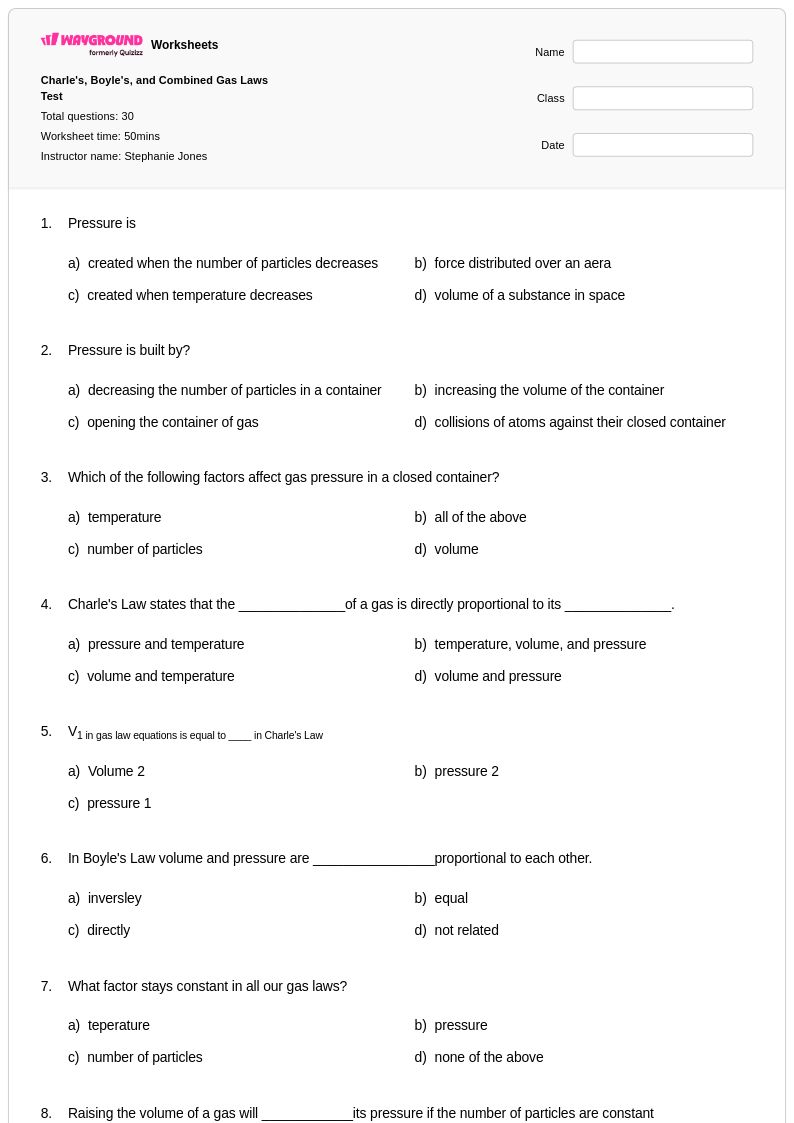
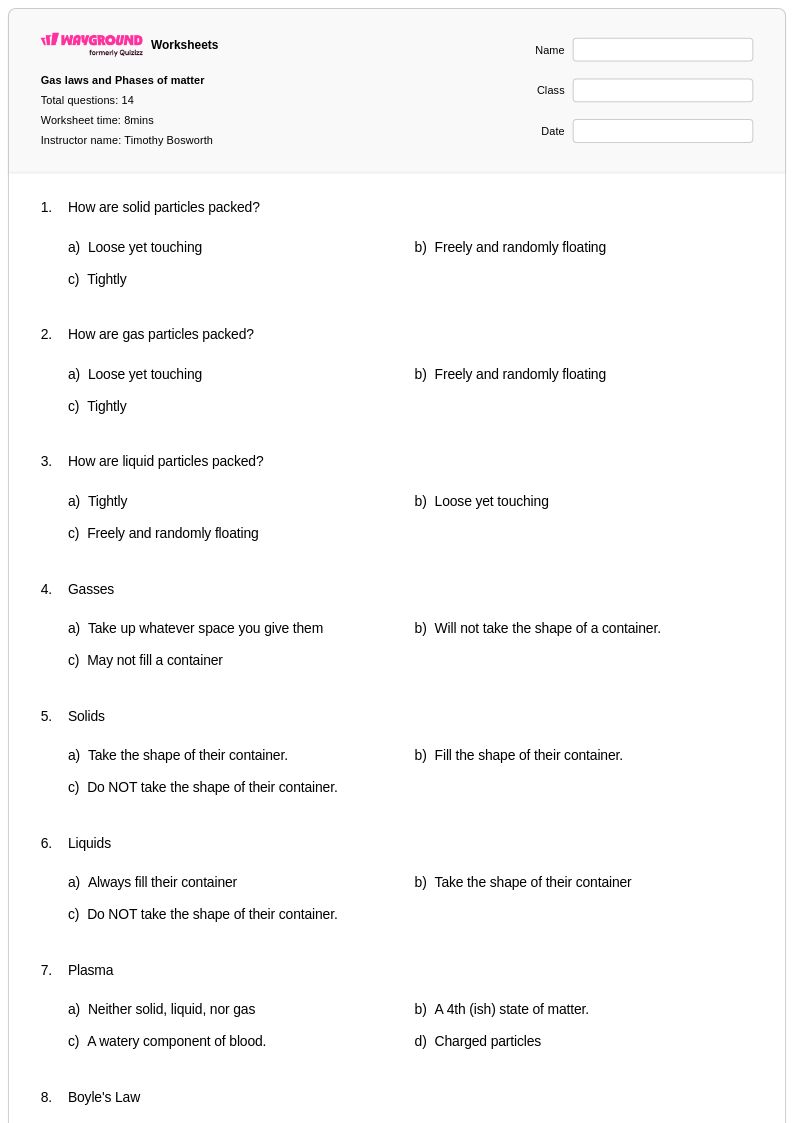
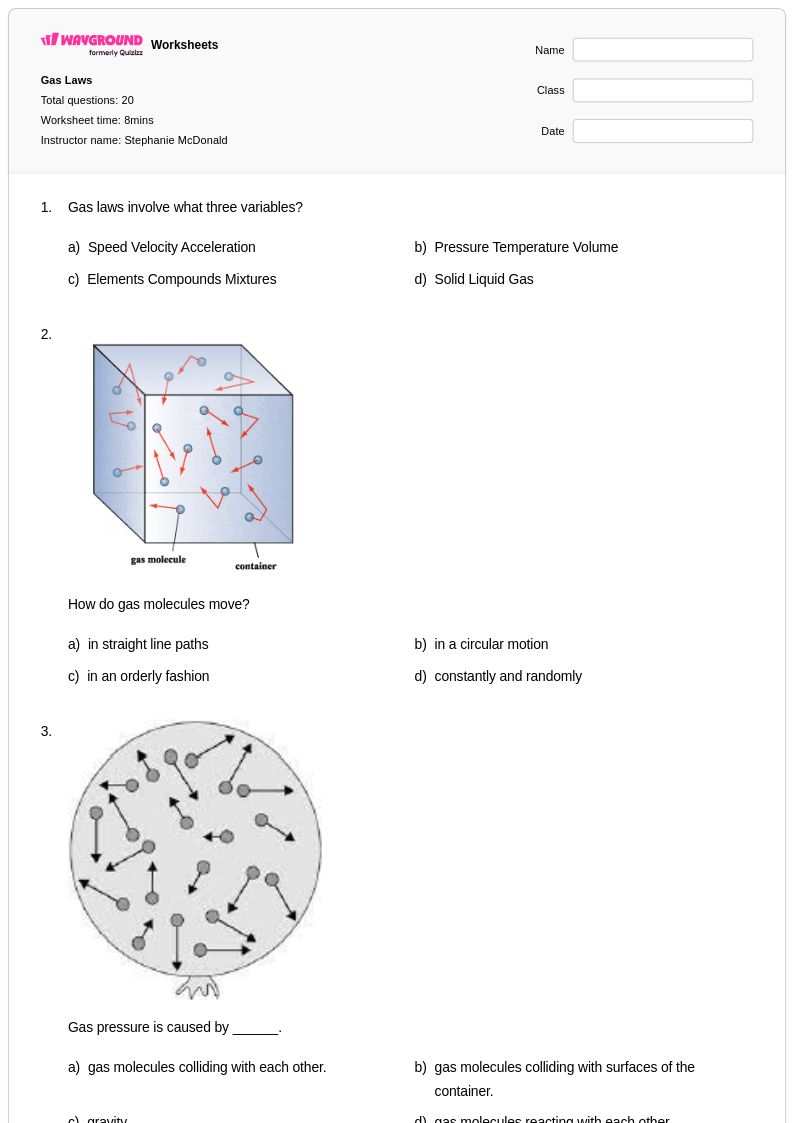
Gas laws worksheets available through Wayground (formerly Quizizz) provide comprehensive practice materials that help students master fundamental principles governing the behavior of gases under varying conditions of pressure, volume, and temperature. These expertly designed resources strengthen critical analytical skills by guiding students through problem-solving exercises involving Boyle's Law, Charles's Law, Gay-Lussac's Law, and the combined gas law, while building proficiency in mathematical calculations and conceptual understanding of molecular behavior. Each worksheet collection includes detailed answer keys that support independent learning and self-assessment, with free printable resources offering practice problems ranging from basic proportional relationships to complex real-world applications involving gas behavior in different scenarios.
Wayground (formerly Quizizz) empowers educators with millions of teacher-created gas laws resources that streamline lesson planning through robust search and filtering capabilities, allowing instructors to locate materials aligned with specific learning standards and curriculum requirements. The platform's differentiation tools enable teachers to customize worksheets for diverse learning needs, providing both remediation support for struggling students and enrichment opportunities for advanced learners ready to tackle more challenging gas law calculations. Available in both printable pdf format and interactive digital versions, these flexible resources facilitate seamless integration into classroom instruction, homework assignments, and assessment preparation, ensuring students develop mastery of gas law principles through targeted skill practice and repeated exposure to varied problem types.
FAQs
How do I teach gas laws to high school chemistry students?
Start by building conceptual understanding before introducing equations. Use demonstrations like a sealed syringe to show Boyle's Law (pressure and volume relationship) or a balloon in hot and cold water to illustrate Charles's Law (volume and temperature relationship). Once students grasp the inverse and direct proportionality patterns, introduce the mathematical forms and progress to combined gas law and ideal gas law problems. Anchoring abstract concepts in physical demonstrations significantly improves retention and equation fluency.
What types of practice problems help students get better at gas law calculations?
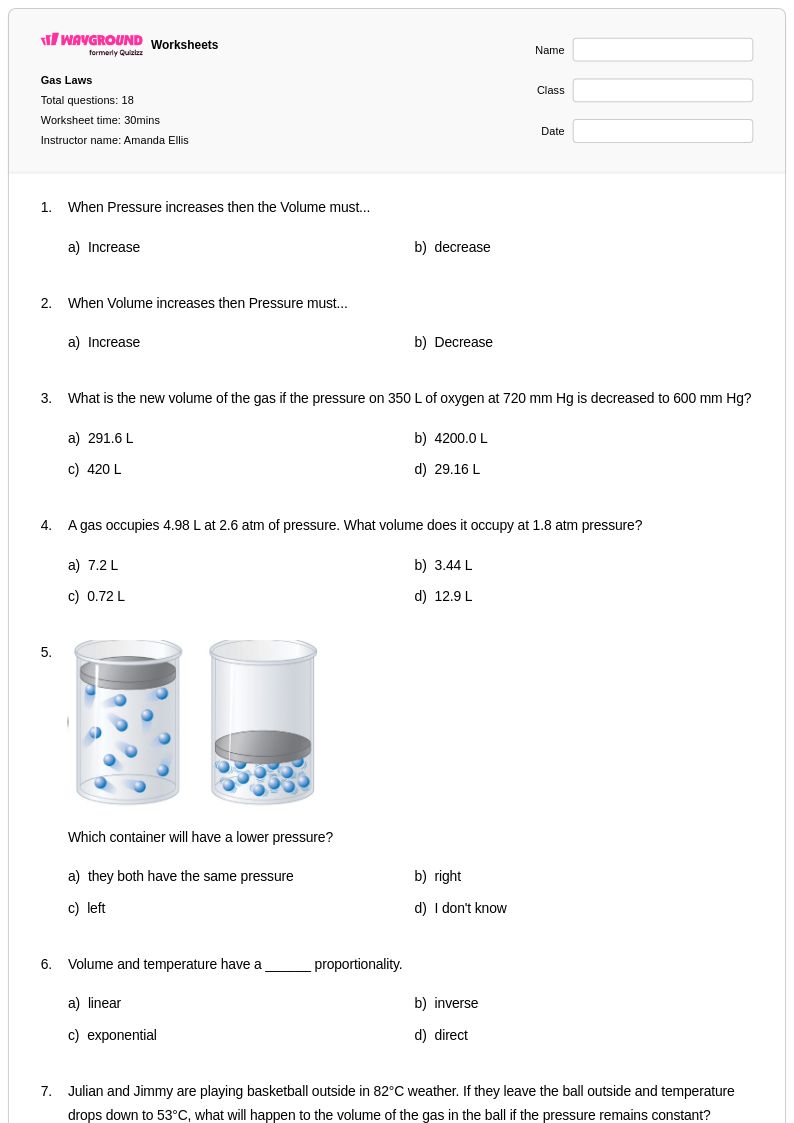
Students benefit most from a sequenced mix of problem types: start with single-variable problems isolating one gas law at a time (e.g., Boyle's Law only), then move to combined gas law problems requiring students to identify which variables are held constant. Include unit conversion practice, since errors with Kelvin versus Celsius and kPa versus atm are among the most common calculation mistakes. Real-world application problems, such as calculating gas behavior in a pressurized container or at altitude, reinforce transfer of skills beyond rote formula use.
What mistakes do students most commonly make when solving gas law problems?
The most frequent error is using Celsius instead of Kelvin in temperature-dependent gas law equations, which produces incorrect results because gas law formulas require absolute temperature. Students also struggle to identify which law applies when multiple variables change simultaneously, often defaulting to the combined gas law even when a simpler relationship is sufficient. A third common mistake is failing to keep units consistent, particularly when pressure is given in different units across problems. Building a habit of listing known and unknown variables before solving reduces these errors significantly.
How do I differentiate gas law instruction for students at different skill levels?
For struggling students, focus first on the conceptual relationship between variables using graphs and diagrams before introducing equations, and provide formula reference sheets during early practice. For advanced learners, extend to ideal gas law problems, molar mass calculations, and multi-step real-world scenarios. On Wayground, teachers can apply accommodations such as reduced answer choices or read aloud support to individual students while the rest of the class receives standard settings, allowing differentiation without disrupting the flow of instruction.
How do I use Wayground's gas laws worksheets in my classroom?
Wayground's gas laws worksheets are available as printable PDFs for traditional classroom use and in digital formats for technology-integrated environments, making them suitable for in-class practice, homework assignments, or review sessions. Teachers can also host the worksheets as interactive quizzes directly on Wayground, enabling real-time tracking of student responses. Each worksheet includes a complete answer key, supporting independent student practice and reducing grading time for teachers.
How do I help students understand the difference between Boyle's Law, Charles's Law, and Gay-Lussac's Law?
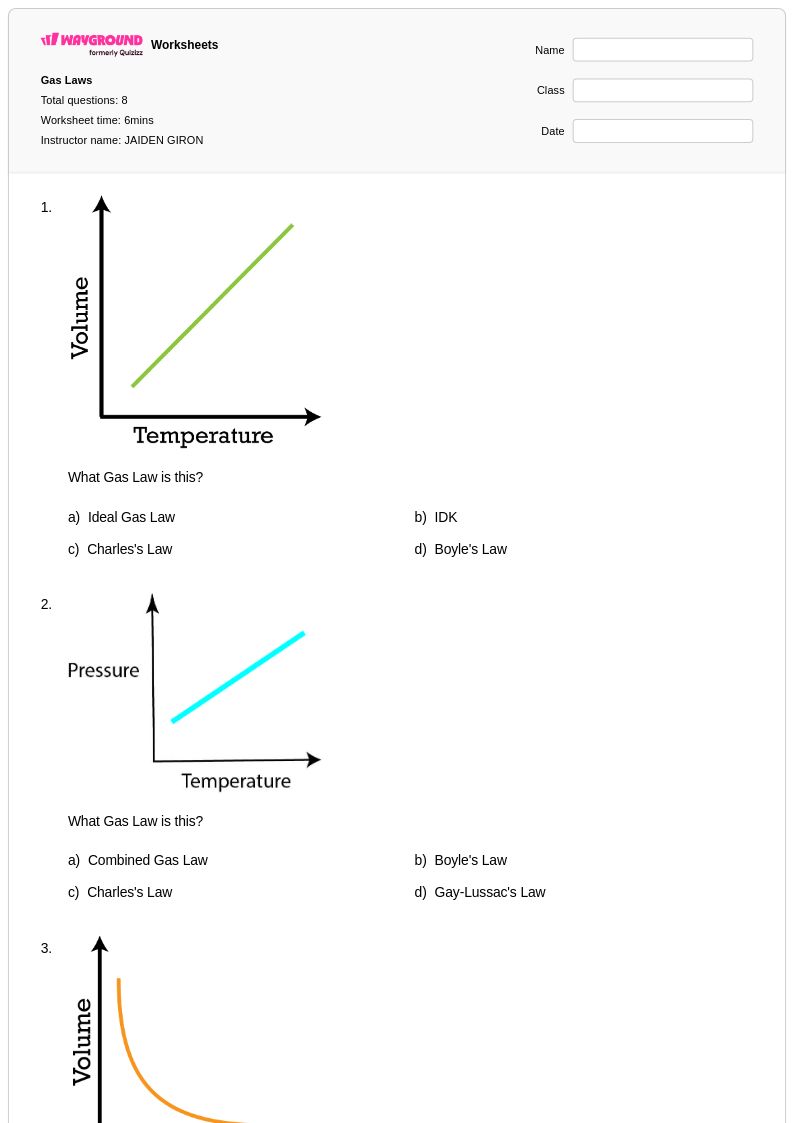
Each of the three foundational gas laws describes the relationship between exactly two variables while holding the third constant: Boyle's Law relates pressure and volume at constant temperature, Charles's Law relates volume and temperature at constant pressure, and Gay-Lussac's Law relates pressure and temperature at constant volume. A comparison chart or triangle diagram showing all three relationships helps students see the pattern before they encounter combined gas law problems where all three variables change. Repeated practice identifying the constant variable in a problem is the most effective way to prevent students from misapplying the wrong law.